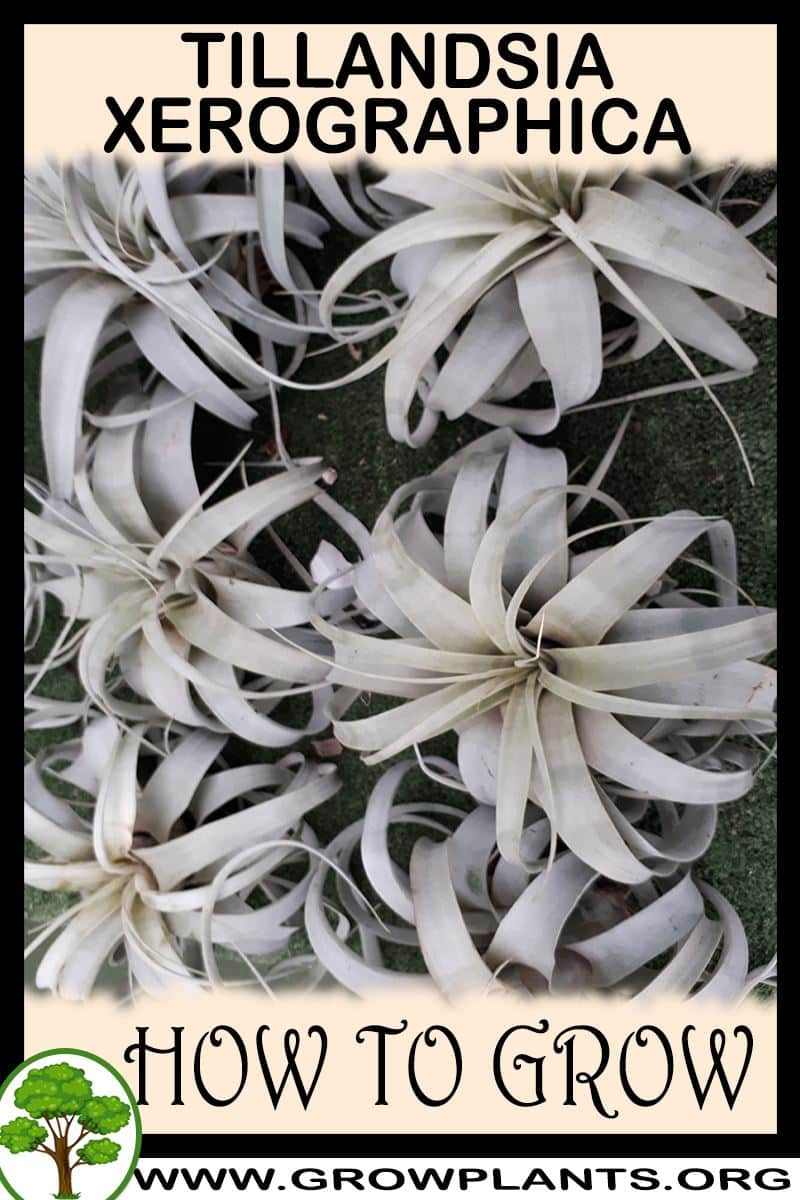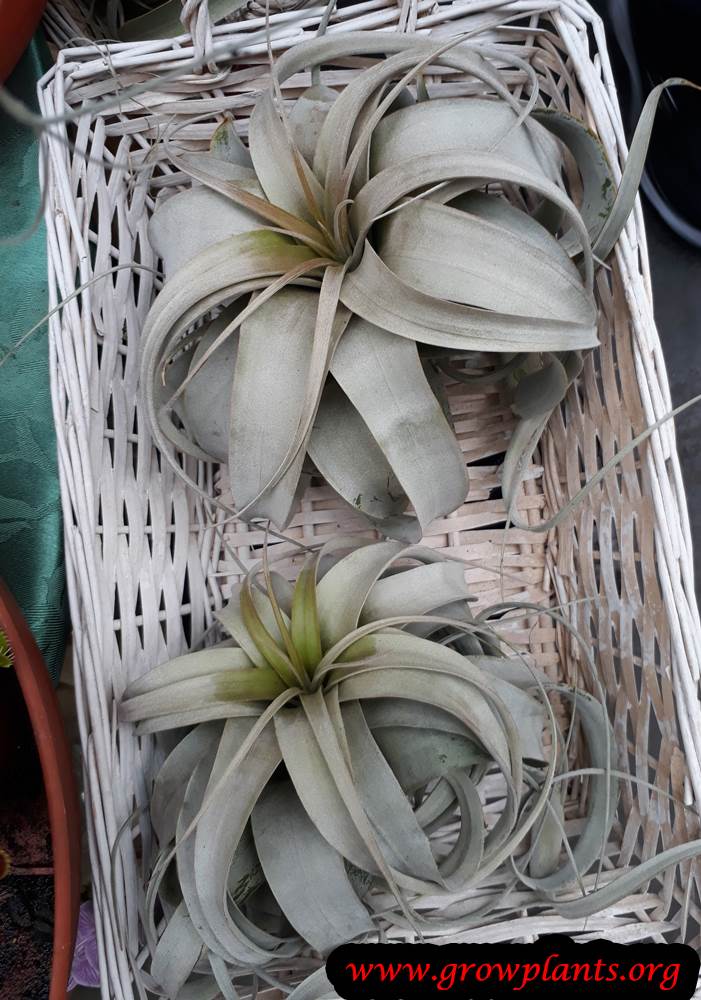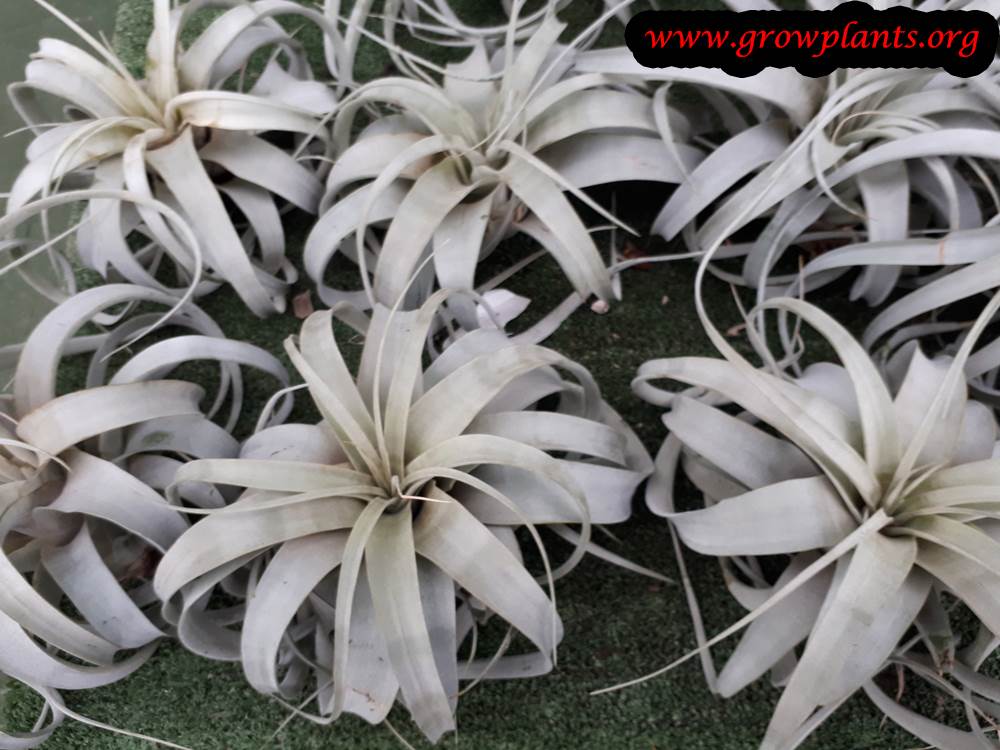


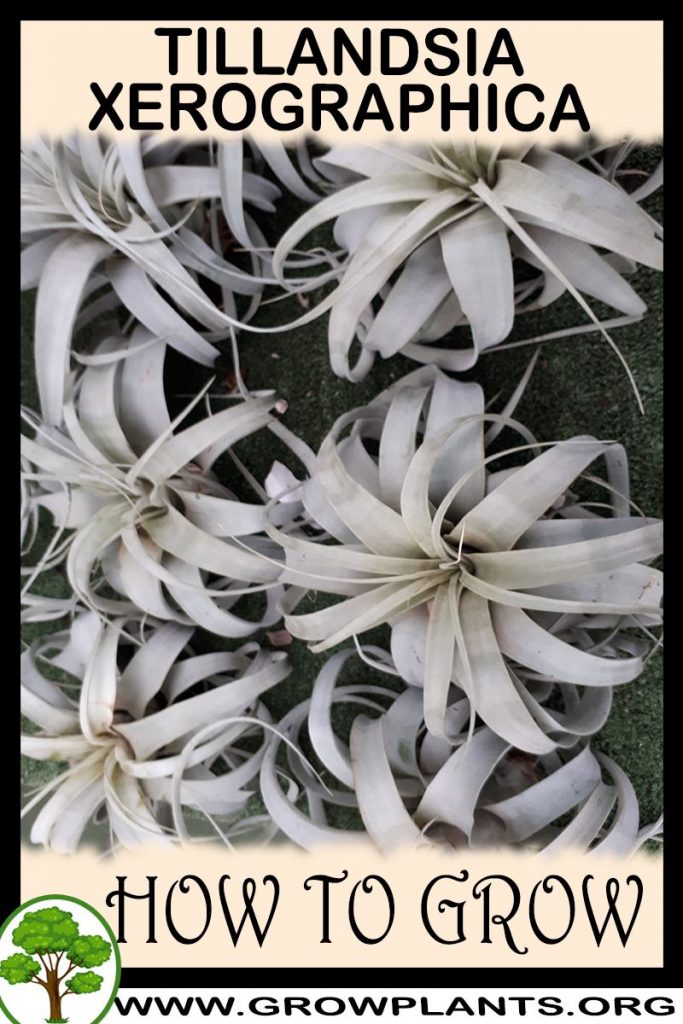
Plant Profile & Key Characteristics
Overview: King of air plants (Tillandsia xerographica) is an evergreen epiphytic air plant of the genus Tillandsia, a compact 10-30 cm ornamental grown clinging to objects rather than in soil. It absorbs water and nutrients through its leaves and makes an easy houseplant.
Quick Specifications
| Specification | Attribute |
|---|---|
| Plant Type / Life Cycle | Perennial (evergreen epiphyte) |
| Foliage Type | Evergreen |
| Mature Size | 10-30 cm (4-12 in) |
| Growth Rate | Slow |
| Root System | Epiphytic – only wiry roots that anchor the plant; water and nutrients are taken up through leaf scales (trichomes), not roots |
| Toxicity | Non-toxic |
| Hardiness | USDA zones 10b and warmer |
Growth Form & Structure
- Height & Spread: 10-30 cm (4-12 in); grown mounted, in a dish or hung rather than planted in soil, so a pot is used only as a stand, not filled with substrate
- Growth Habit & Form: Stemless (or short-stemmed) rosette of stiff leaves that clings to bark, rock or ornaments as an epiphyte
- Lifespan & Maturity: Slow-growing; each rosette flowers only once, then produces offsets (“pups”) that continue the clump
Anatomy & Physical Features
- Leaves & Foliage: Broad, silvery-grey leaves that curl into a large, sculptural rosette
Primary Uses & Landscape Value
- Functional & Ornamental Roles: Ornamental air plant for mounts, terrariums, driftwood, shells and hanging displays; an easy low-water houseplant
Care Guide: Planting, Soil & Watering
Overview: Tillandsia Xerographica is an epiphytic air plant that grows without soil, clinging to bark, cork or driftwood and drinking moisture straight from the air through its leaves. It thrives in bright, indirect light and frost-free warmth (hardy only to about zone 10b), needing just occasional misting or soaking with soft water rather than a rooted watering routine.
Quick Care Requirements
| Requirement | Ideal Condition |
|---|---|
| Planting Season | Year-round indoors; mount or place outdoors in spring to summer in frost-free areas |
| Growth Rate | Slow |
| Water Need | Low; mist or soak with soft water, then let it dry out completely |
Planting & Establishment
- Best Planting Season: There is no true planting – mount or set the plant in place any time of year indoors; if positioning it outdoors, do so in the warm season once all frost has passed.
- How to Mount:
- Attachment: Rest it in a shallow dish or wire holder, or fix it to cork, driftwood or a mounted board with plant-safe glue, wire or fishing line – never bury the base in soil.
- Positioning: Choose a spot with bright, indirect light and good air movement, away from heaters, air conditioners and strong drafts.
- Settling In: Once mounted, avoid moving or disturbing it – Tillandsia resent being shifted while they anchor themselves.
- Growth Speed & Expectations: A slow grower reaching only about 10-30 cm; each rosette flowers just once after several years, then offsets (‘pups’) carry the plant on.
Soil, Watering & Drainage Care
- Growing Medium & Drainage: No potting soil is needed – the keys are air flow and fast drying. If you sit it in a container, use it only as a holder (cork, shell or glass), never packed with wet substrate, so moisture never lingers around the base and rots it.
- Watering Schedule & Technique:
- Young / Newly Mounted: Treat it exactly like a mature plant – mist or briefly soak, then let it dry.
- Established: In summer, water about once a week (twice in hot, dry spots) by misting or dunking in soft rainwater or filtered water, then shake off the excess and let it dry within a few hours.
- Seasonal Adjustments: Cut back to once a week or every two weeks in winter – or barely at all in a cool, damp winter – and keep it above roughly 3°C.
Climate, Light & Hardiness
Tillandsia Xerographica is an epiphytic air plant suited to Mediterranean, subtropical, and desert climates outdoors, or easy indoor growing elsewhere. It wants bright but indirect light and, unlike most bromeliads, is notably more heat- and dry-air tolerant.
Quick Climate Specifications
| Climate Zones | Mediterranean, subtropics, desert |
|---|---|
| USDA Hardiness Zones | 10b+ |
| Cold Damage Begins | Below approximately 10°C (50°F), watering should be reduced and growth slows |
| Approx. Survival Minimum | May briefly tolerate temperatures down to around 3–5°C (37–41°F), but this is not recommended |
| Frost Tolerance | None |
| Light Conditions | Half shade to full shade (with plenty of bright light) |
Sunlight & Light Exposure
Optimal Light Setup
Give it bright light – even a little gentle sun is tolerated – but keep it away from intense, prolonged direct sun.
Best Exposure / Orientation
Hang or display near a bright window or in a lightly shaded outdoor spot, away from heaters, ventilators, and air conditioning drafts.
Temperature Extremes & Hardiness
USDA Hardiness & Regional Limits
Reliable for outdoor, year-round growth in USDA zone 10b and warmer; elsewhere it is best grown as a houseplant.
Cold Damage & Winter Protection
Keep above roughly 10°C (50°F) for comfortable growth; in winter reduce watering to about once every one to two weeks, or less in a wet, mild winter.
Frost Sensitivity
Frost sensitive; not suitable for outdoor exposure to freezing temperatures.
Wind, Humidity & Microclimate
Dry-Air Tolerance
More tolerant of typical indoor and desert dry air than most bromeliads, though it still benefits from occasional misting/soaking with soft, rain, or filtered water.
Microclimate Recommendations
A bright spot with good airflow so the plant dries fully after watering; avoid draft-prone spots right next to heaters or AC vents.
Growing in Pots, Balconies & Indoors
Tillandsia xerographica is a soil-free air plant (10-30 cm / 4-12 in) that the grower rates as a good houseplant. It draws its moisture from the air and from misting rather than from a pot of soil, which makes it one of the easiest and most sculptural plants to grow indoors.
Quick Details
- Container Size: No pot of soil needed – display it on a dish, mount or holder; if you use a container, do not bury it in sand
- Indoor Suitability: An excellent houseplant – grows well indoors with light and misting
- Best Spot: Bright, indirect light; a little gentle sun is fine, away from heaters and vents
- Soil & Drainage: None – it is grown out of soil entirely
- Watering in Pots: Mist or wash the plant, then let it dry fully in an airy spot; use rain or soft water
Indoors & On the Windowsill
- A great houseplant: The grower confirms it grows well indoors. Choose a spot with plenty of light (even a little direct sun), keep it away from heaters, air-conditioners and fans, and mist or soak it, then let it dry.
- Bathroom option: It can be grown in a bathroom, where humidity is high – just water less there, since the moist air does much of the work.
- Water quality: It is sensitive to hard water, so use rainwater or soft/filtered water to avoid marks and mineral build-up.
On a Balcony or Patio
- Light & shelter: A bright, sheltered spot with good airflow suits it; drying wind means it needs misting more often. After watering, make sure it dries out – it must never sit wet.
- Overwintering: Frost-tender, so bring it indoors before cold weather.
Displaying & Long-Term Care
- Mounting: Rest it in a shallow dish, wire holder or on bark/cork; the key rule from the grower is never to bury it in sand or soil, as the base will rot.
- Watering routine: Mist regularly, or soak/wash occasionally, always followed by a period to dry out completely in good air movement.
- Feeding: A very dilute foliar feed occasionally is all it needs.
Grower’s Container Tip
- Never bury it: Growing is possible on a mount or in a container, but do not bury the plant in sand or soil – keep the base open and let it dry between waterings.
Growing this plant in a greenhouse
A greenhouse can give tillandsia xerographica frost protection, cold protection, humidity control and extra warmth. In the right climate it may also be kept growing through winter, depending on how much warmth and light are provided.
Greenhouse at a glance
| Greenhouse suitability | Good - clearly useful |
|---|---|
| Main benefits | frost protection, cold protection, humidity control, extra warmth |
| Season extension | earlier spring & later autumn |
| Outdoor protection advisable below | about 10°C |
| Maintain greenhouse minimum | around 10°C for active growth |
| Suitable types | heated greenhouse, polycarbonate greenhouse |
| Heating | Heating is recommended in cold climates for continuous growth. |
Related greenhouse guides
- Greenhouses: How to Choose the Right Greenhouse
- Best Greenhouse Heaters
- Greenhouse Climate Control: Temperature, Ventilation and Humidity
- Polycarbonate Greenhouses: What to Look for Before Buying
Fertilizing & Feeding
A soil-free air plant that absorbs both water and nutrients through its silvery leaves: keep any fertilizer very dilute, apply it as a spray or brief soak rather than to any soil, and pause feeding in cold weather.
Quick Fertilizing Specs
| Feeding Level | Light feeder |
|---|---|
| Main Nutrient Priority | A very dilute balanced feed delivered by spray or soak, never to soil |
| Best Feeding Period | The active-growth months when the plant is warm and regularly misted |
| Organic Options | Not applicable; this plant has no soil or growing medium to enrich |
| Reduce/Stop Feeding | Stop feeding in cold winter conditions |
| Micronutrients | Usually met by a complete air-plant or bromeliad feed; correct only a diagnosed issue |
| Soil pH | Not applicable; grown without soil |
Feeding by Growth Stage
Active growth
Support slow, steady leaf growth on this soil-free epiphyte.
| Nutrient direction | A very dilute, balanced fertilizer applied as a fine spray or brief soak, since the plant absorbs nutrients only through its leaves. |
|---|---|
| Timing | During the warm months when the plant is actively growing and regularly misted or soaked. |
| Frequency | An occasional light feeding folded into the regular watering routine is enough for this slow grower. |
| Fertilizer types | A very dilute balanced fertilizer mixed into the spray or soak water, well below the label rate for soil plants, A fertilizer labeled for air plants or bromeliads |
| Precautions | Use soft, low-mineral water and let the plant dry fully afterward; hard water and trapped moisture at the base are the main causes of trouble for this species. |
Cold-season pause
Avoid stressing the plant with feeding while it is cold and growth has stopped.
| Nutrient direction | None – withhold fertilizer during cold weather. |
|---|---|
| Timing | During the coldest part of the year. |
| Frequency | No feeding at this stage; resume light feeding once warm active growth returns. |
| Fertilizer types | No feeding at this stage; hold off fertilizing until warm active growth resumes. |
| Precautions | Do not fertilize while the plant is cold and not actively growing; continue plain-water misting only. |
Nutrient Deficiency Signs & Corrections
Leaves look thin, pale, and growth is unusually slow even in good light.
| Possible causes | too little or too infrequent feeding for a plant with no soil reserve, insufficient light reducing the plant’s ability to use available nutrients, watering that is too light or infrequent to carry nutrients to the leaves |
|---|---|
| Appears first on | overall leaf color and new growth rate |
| What to check | recent feeding history, light levels, watering frequency and method |
| Possible correction | Add an occasional very dilute feed to the regular misting or soaking routine and confirm light and watering are adequate. |
Leaf tips brown, curl, or scorch, sometimes with a crusty residue at the leaf base.
| Possible causes | fertilizer applied too concentrated for a soil-free plant, hard, mineral-rich water building up on the leaves, water pooling and staying trapped at the leaf base after feeding |
|---|---|
| Appears first on | leaf tips and the base where leaves overlap |
| What to check | water hardness and source, fertilizer dilution used, how well the plant dries after feeding |
| Possible correction | Switch to soft or rain water, dilute any feed further, and always let the plant dry fully upside down after spraying or soaking. |
The base of the plant softens, darkens, or has a foul smell, and central leaves pull out easily.
| Possible causes | water or dilute fertilizer trapped at the base after feeding, poor air circulation preventing the plant from drying, overly frequent soaking without adequate drying time between |
|---|---|
| Appears first on | the base and innermost leaves |
| What to check | airflow around the plant, how the plant is positioned to dry after watering or feeding, frequency of soaking |
| Possible correction | Improve air circulation, always dry the plant upside down after watering or feeding, and reduce how often it is soaked. |
Pruning, Training & Seasonal Maintenance
Tillandsia Xerographica is a true air plant with no roots in soil and no woody structure, so pruning tolerance is very low: the only cuts are removing dead or infected leaf tips. It is also slow-growing and monocarpic in the strictest sense – a plant typically takes more than three years to bloom, and that single rosette flowers only once in its lifetime before declining as pups form at its base. Because of this, pruning is not tied to a season at all; it is done only when a leaf actually needs removing.
Quick Pruning & Maintenance Specs
| Pruning Tolerance | Very low – dead/infected leaf removal only |
| Primary Pruning Window | All year, only as needed |
| Typical Frequency | Infrequent, given very slow growth |
| Main Objective | Remove dead or infected leaf tissue |
| Young Plant Priority | Avoid any unnecessary handling while it establishes |
| Mature Plant Priority | Clear the rosette once its pups are independent, after its single bloom |
| Best Tool Type | Precision snips |
Pruning by Plant Age & Size
Newly Established
Handle as little as possible; remove only leaves that are clearly dead or damaged, since disturbing a young air plant can slow its already slow establishment.
Young / Formative
No structural training applies – there is no framework to build, only a single rosette to leave largely alone for years until it matures enough to bloom.
Mature / Established
After its once-in-a-lifetime bloom finishes and fades, the rosette itself will begin to decline over time while pups form around its base. Remove dead leaf material as it appears; the spent mother plant can eventually be separated from its pups once they are established.
Seasonal Pruning Schedule
Ongoing Sanitary
Objective: remove dead or infected leaf tissue as it appears. Remove: browned, dried, or visibly infected leaves. Do not remove: healthy silvery-green leaves, even loose-looking ones, since the leaf surface is how the plant absorbs moisture. Expected response: none – no regrowth is triggered. Flowering impact: none, since this species blooms only once regardless of pruning.
Structural Pruning & Training
Not applicable in the usual sense – there is no canopy or framework to train. The plant’s only structural change over time is the eventual replacement of the spent mother rosette by its pups.
Special Growth to Remove
- Dead or infected leaves: the only routine removal this plant needs.
- Spent bloom stalk: once fully dried after its one-time flowering, it can be trimmed away.
- Offsets/pups: retain attached until they have grown large enough to survive independently before considering separation.
Container & Small-Space Pruning
Grown without soil – mounted, hung, or simply set on a surface – rather than potted, so there is no root-to-canopy balance or compactness pruning to manage. The only size-related consideration is keeping mounted specimens from being crowded by neighboring plants, which is a placement issue rather than a pruning one.
Tools
Precision snips are the only tool needed, for trimming individual dead leaf tips.
Tool Hygiene & Disease Risk
Increased. Fungal issues are listed among this species’ problems, and Tillandsia are notably prone to rot when kept wet without adequate drying; use a clean blade for any leaf removal and make sure the plant dries fully afterward rather than sitting damp.
Cut Placement & Technique
Snip dead leaf tissue back to where it meets healthy tissue rather than pulling, which can tear at the base and open a wound in the surrounding leaves. After any cut made while the plant is wet, allow it to dry fully – this species must never be misted and left damp, since trapped moisture around a cut invites rot.
Heavy Pruning & Rejuvenation
Not tolerated at all – there is no woody or vegetative tissue to cut back and regrow from. The plant’s only path to renewal is its pups.
Post-Pruning Care
After removing any leaf, let the plant dry out fully before its next watering or misting cycle, in line with its normal care of drying between waterings. No feeding is needed after a trim.
Common Pruning Mistakes
- Pulling dead leaves off by hand instead of snipping, which can damage the leaf base.
- Spraying or washing the plant right after trimming and not letting it dry, inviting fungal rot at the cut.
- Removing leaves that only look loose or curled but are not actually dead – this species relies on every healthy leaf surface to absorb water.
When Not to Prune
Avoid trimming while the plant is wet from watering or high ambient humidity, since fungal problems are a known risk for this species. Avoid disturbing it during its rare, multi-year bloom event.
Recommended Tools (by task)
- precision_snips – for removing individual dead or infected leaf tips, the only cut this plant ever needs.
Propagation Guide
Tillandsia Xerographica is propagated almost exclusively from the daughter plants (pups) that form around the base of the mother rosette, since seed germination is difficult and vegetative propagation is needed to keep the exact same form. As a naturally slow-growing air plant, the technique itself is simple but patience is required, as pups take time to appear and to size up.
Quick Propagation Specs
| Best Propagation Method | Division of offsets (daughter plants) |
| Alternative Methods | Seed (difficult, slow, not recommended for keeping the same form) |
| Propagation Difficulty | Easy technique by offsets, though slow due to this species’ naturally slow growth; Difficult by seed |
| Seed True-to-Type | Not reliable for preserving a particular selection |
| Vegetative True-to-Type | Yes |
| Best Propagation Season | Spring |
Division, Offsets, Pups & Suckers
As with many Tillandsia, this species flowers once per rosette and, around and after that bloom, produces offsets at its base; those pups are the main route to new plants. Wait until a pup has grown a few leaves of its own before separating it from the mother, and do the separation in spring for best results. Once removed, treat the young offset the same as a fully mature plant — site it (mounted, hung, or resting on a support as usual for this species) and avoid moving or repositioning it too often while it settles in, since Tillandsia Xerographica establishes best left undisturbed.
Bloom & Flower Guide
Quick Details
- Bloom Season: Can flower at almost any time of year
- Time to First Bloom: Only when the plant is mature – often several years for this slow-growing air plant; it flowers once, then produces offsets (pups)
- Flower Appearance: Purple, rolled tubular flowers emerging from the bracts, each with one stigma and three stamens
- Edibility: Ornamental only – not grown for eating
Detailed Blooming Overview
Tillandsia xerographica is a large, silvery air plant grown mainly for its sculptural rosette. When mature it sends up a bold flower spike from which purple, rolled tubular flowers open among the bracts. Like other bromeliads it blooms only once, so the flowering is a highlight rather than a yearly event; afterwards the plant devotes its energy to producing pups.
Flower Characteristics
- Purple, rolled tubular flowers emerging from the bracts of the spike.
- Each flower shows one stigma and three stamens.
Bloom Care & Thinning
- Encouraging bloom: Give bright light, good air movement and regular misting or soaking; maturity, not season, is what triggers the spike.
- After flowering: Leave the pups attached until they are well grown – they replace the flowered rosette.
Pests, Diseases & Troubleshooting
Overview: Air plants are epiphytic bromeliads grown without soil, and they are among the most pest-free plants you can keep – the great majority of failures are cultural, above all rot from water trapped in the crown and mineral damage from hard water. When pests do appear they are chiefly mealybugs and scale. Good airflow, correct watering and soft water prevent almost every problem.
Quick Troubleshooting Overview
| Issue / Pest | Main Symptom | Primary Solution |
|---|---|---|
| Crown / base rot | Soft brown mushy centre, leaves pull out easily | Dry fast after watering; never leave water in the crown |
| Mealybugs | White cottony tufts in leaf bases, sticky residue | Alcohol swab / rinse; horticultural oil; isolate |
| Scale insects | Small brown or waxy bumps on leaves | Scrape off; horticultural oil; isolate |
| Hard-water damage | White crusty deposits, scorched leaf tips | Use rain/distilled water; avoid softened water |
| Dehydration | Rolled leaves, exaggerated curling, dry crispy tips | Soak and mist more often; improve humidity |
| Sunburn | Bleached or brown scorched patches | Move to bright indirect light; avoid harsh midday sun |
Common Pests & Management
- Mealybugs (Pseudococcidae):
- Symptoms: Small white cottony tufts wedged between the leaves and at the base of the plant, with sticky honeydew and, over time, weakened, stunted growth. The most likely insect pest on an air plant.
- Prevention & Control: Isolate the plant, then remove mealybugs by dipping in or swabbing with dilute alcohol and rinsing well. Improve airflow. For stubborn cases, treat with a light horticultural oil or insecticidal soap, then rinse and dry the plant thoroughly so no residue sits in the crown.
- Scale Insects (Diaspididae / Coccidae):
- Symptoms: Small, immobile brown, tan or waxy bumps along the leaves, sometimes with sticky residue; heavy infestations dull and weaken the foliage.
- Prevention & Control: Gently scrape or pick off the scales with a soft brush or fingernail and isolate the plant. Apply horticultural oil to smother remaining scales and crawlers, then rinse and allow the plant to dry fully.
- Aphids (Aphidoidea):
- Symptoms: Occasional small soft-bodied insects on tender flower spikes and new growth, with a little sticky honeydew; uncommon and usually minor on air plants.
- Prevention & Control: Rinse off under running water; a strong soak usually clears them. Only rarely is insecticidal soap needed – if used, rinse the plant well afterwards.
- Fungus Gnats / Damp Pests (Sciaridae):
- Symptoms: Small flies hovering around plants kept constantly damp or in decaying mounting material – a symptom of over-wet conditions rather than a true air-plant pest.
- Prevention & Control: Let plants dry properly between waterings, improve ventilation, and replace any soggy mount or moss. Yellow sticky traps catch the adults.
Diseases & Fungal Issues
- Crown / Base Rot (bacterial & fungal (Erwinia / fungal complex)):
- Symptoms: By far the number-one killer of air plants: the centre turns soft, brown and mushy, the plant loses colour, and the inner leaves pull out with a gentle tug. It follows water left sitting in the crown, especially in cool, still air.
- Treatment & Management: Prevention is the only real cure. After soaking or misting, turn the plant upside down and shake out trapped water, then dry it fully in bright, airy conditions within a few hours. Never leave water pooled in the centre and avoid watering late in the day. A plant that has begun to rot from the base cannot be saved and should be discarded to protect others.
- Fungal Leaf Spot / Rot (various fungi):
- Symptoms: Brown or black soft spots and patches on leaves in overly humid, stagnant conditions.
- Treatment & Management: Increase airflow, water earlier in the day, and avoid crowding. Remove affected leaves; ensure the plant dries quickly after each watering.
Growing Difficulties & Abiotic Problems
- Overwatering & Poor Drying (Rot):
- Cause & Symptoms: Water trapped in the crown or plants kept damp without drying is the leading cause of collapse, showing as a soft, discoloured, foul base.
- Correction Strategy: Soak or mist, then invert and shake out water and dry the plant fully in good light and air within a few hours. Mount so plants can drain; never sit them in water.
- Hard-Water Damage:
- Cause & Symptoms: This genus is sensitive to hard water: dissolved minerals leave white crusty deposits and scorch or brown the leaf tips, and softened (sodium) water is worse still.
- Correction Strategy: Water with rainwater, distilled or reverse-osmosis water; never use chemically softened water. Wipe off any mineral crust and, in hard-water areas, mist rather than soak with tap water.
- Under-Watering & Dehydration:
- Cause & Symptoms: Too little water shows as exaggerated leaf rolling, closing-in of the plant and dry, crispy, curling tips.
- Correction Strategy: Soak plants for 20–60 minutes then dry, or mist frequently, increasing both frequency and humidity in warm, dry or heated air. Xeric silver-leaved types need less; greener types need more.
- Sunburn & Light Problems:
- Cause & Symptoms: Harsh direct sun bleaches or scorches leaves with brown patches, while too little light causes fading, floppy growth and reluctance to flower.
- Correction Strategy: Give bright, indirect light or gentle filtered sun, avoiding hot midday exposure. Acclimatise gradually when moving plants to brighter positions.
What Helps – Products & Tools
Air plants rarely need chemicals – the key ‘products’ are soft water (rainwater, distilled or RO) and good airflow. For the occasional mealybug or scale, reach for a light horticultural oil or insecticidal soap followed by a thorough rinse, plus dilute alcohol on cotton buds for spot-treatment. Yellow sticky traps monitor damp-loving flies. Avoid heavy sprays and never leave residue in the crown.