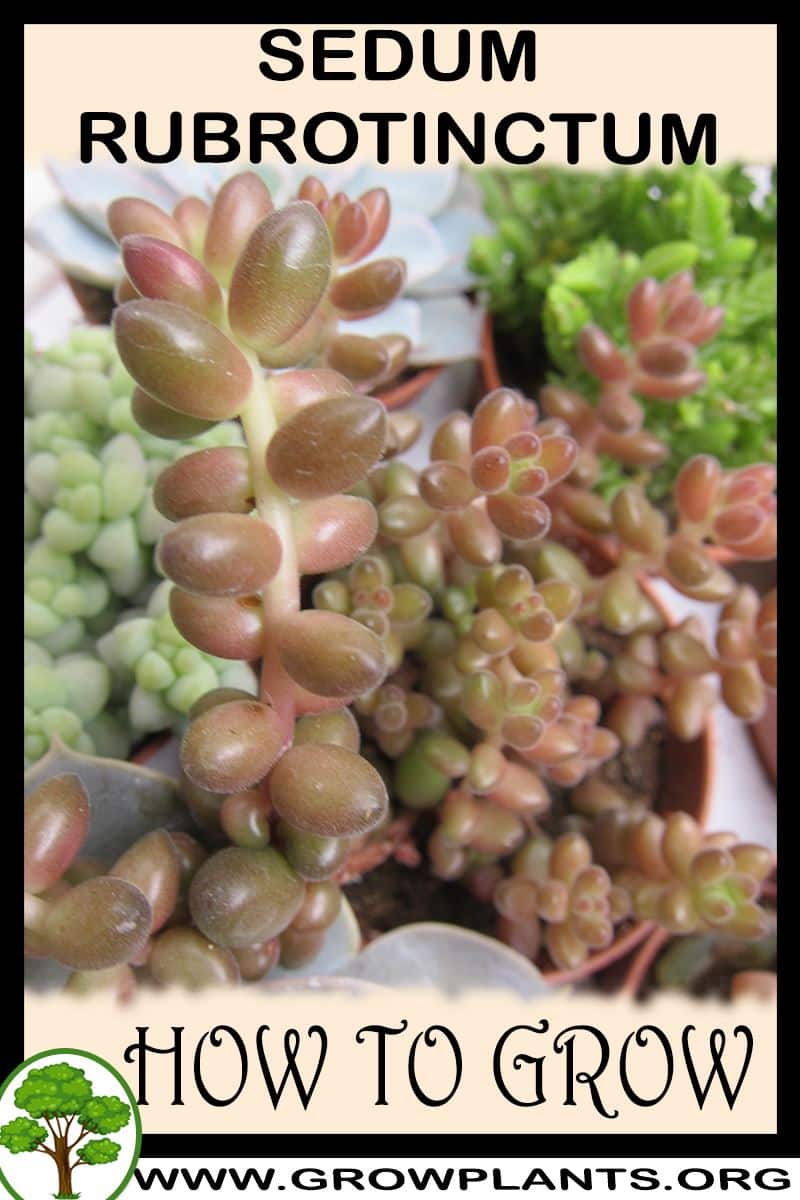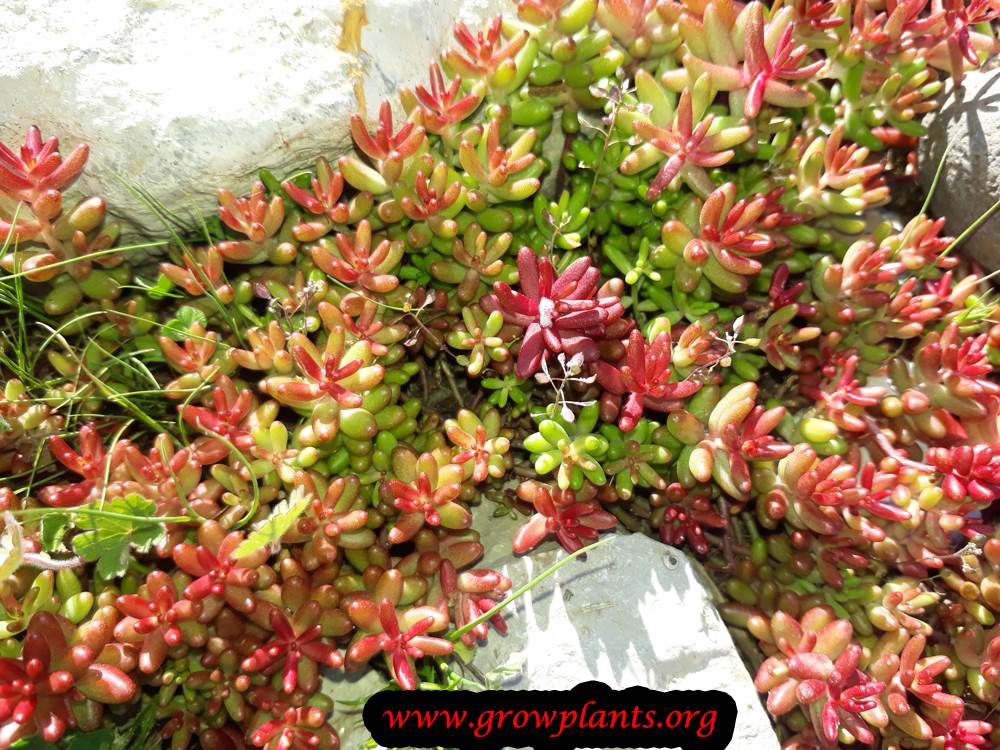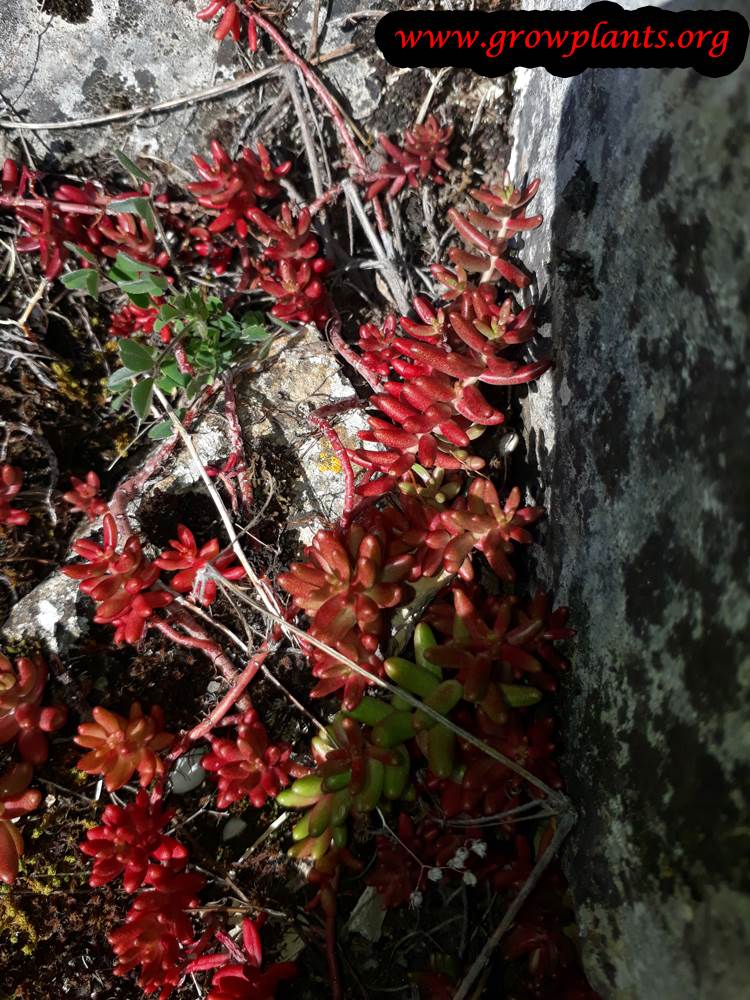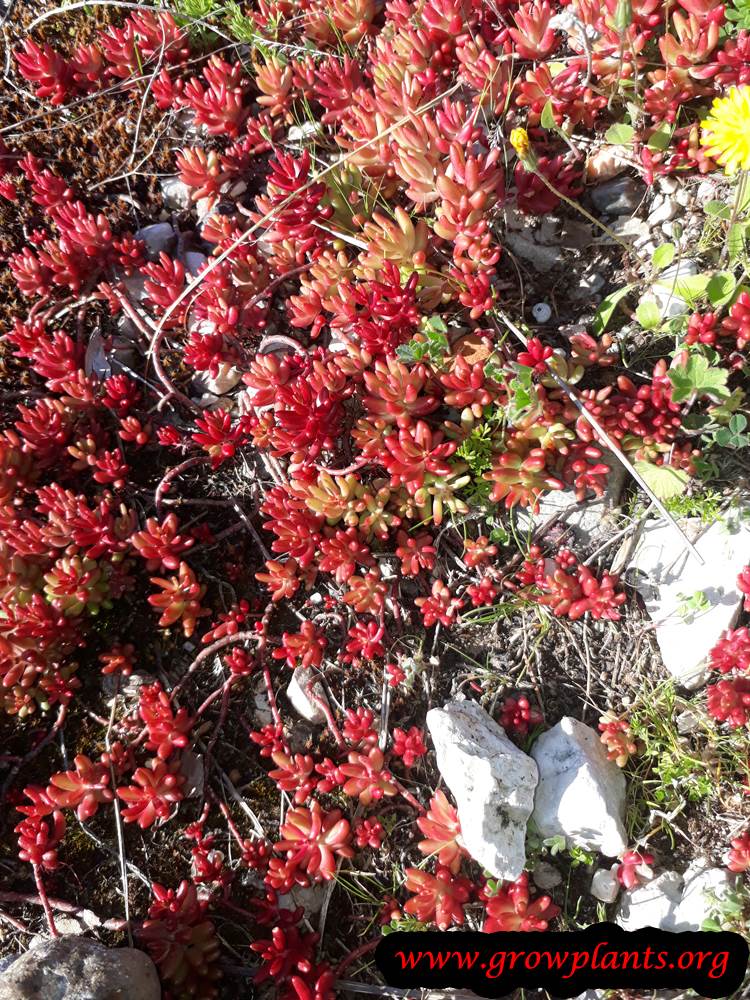


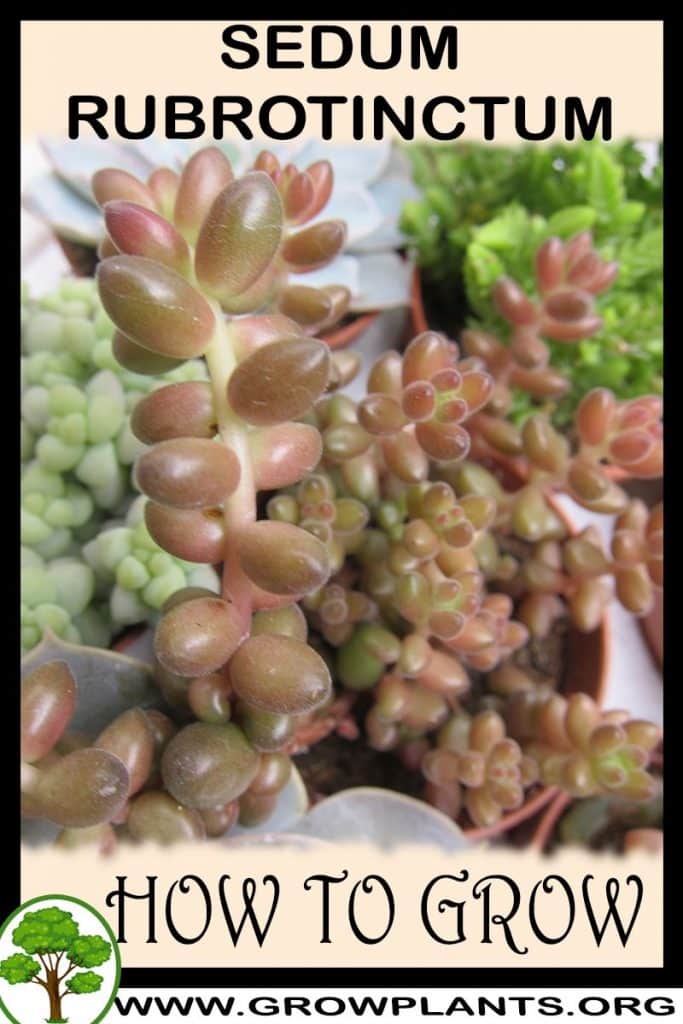
Plant Profile & Key Characteristics
Overview: Jelly bean plant (Sedum rubrotinctum) is a low, evergreen, drought-tolerant succulent groundcover, 5-15 cm (2-6 in) tall, grown for its fleshy foliage and star-like flower clusters. This slow-growing perennial is used mainly as ornamental groundcover in rock gardens, containers and green roofs (hardiness zone 5-10a (10b with care)).
Quick Specifications
| Specification | Attribute |
|---|---|
| Plant Type / Life Cycle | Perennial (evergreen succulent, groundcover) |
| Foliage Type | Evergreen (fleshy, succulent) |
| Mature Size | 5-15 cm (2-6 in), spreading |
| Growth Rate | Slow |
| Root System | Shallow, fibrous |
| Toxicity | Toxic to cats |
| Hardiness | USDA zone 5-10a (10b with care) |
Growth Form & Structure
- Height & Spread: Reaches 5-15 cm (2-6 in); a low, drought-tolerant groundcover that also does well in shallow, wide containers and can be grown indoors as a houseplant.
- Growth Habit & Form: Low, mat- or cushion-forming succulent subshrub that spreads into a dense evergreen groundcover.
Anatomy & Physical Features
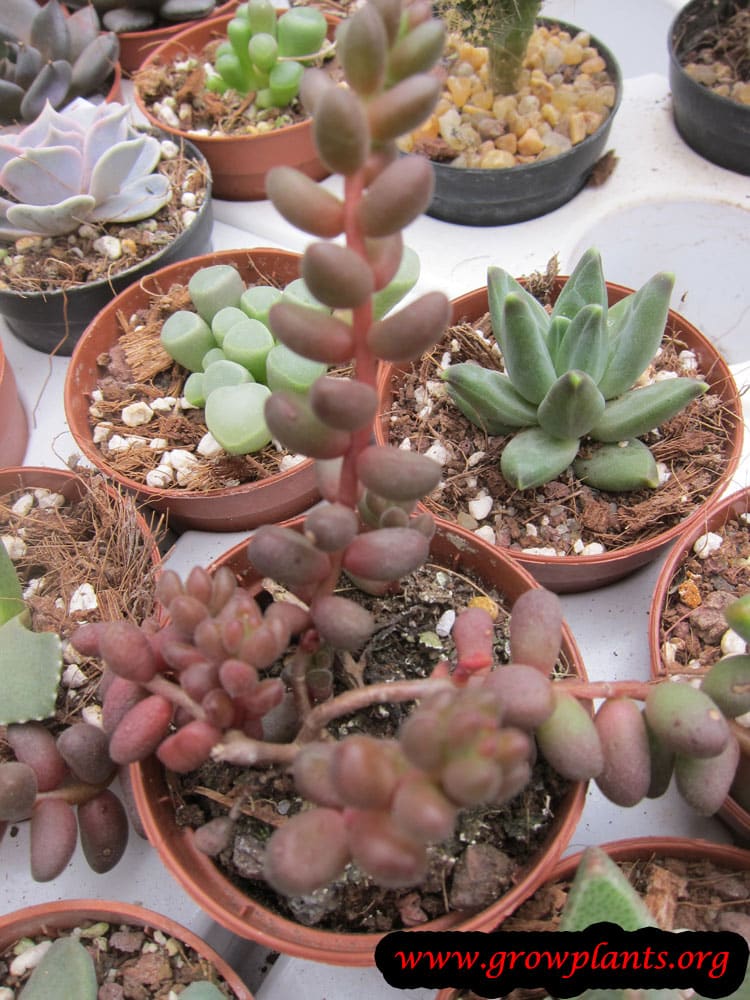
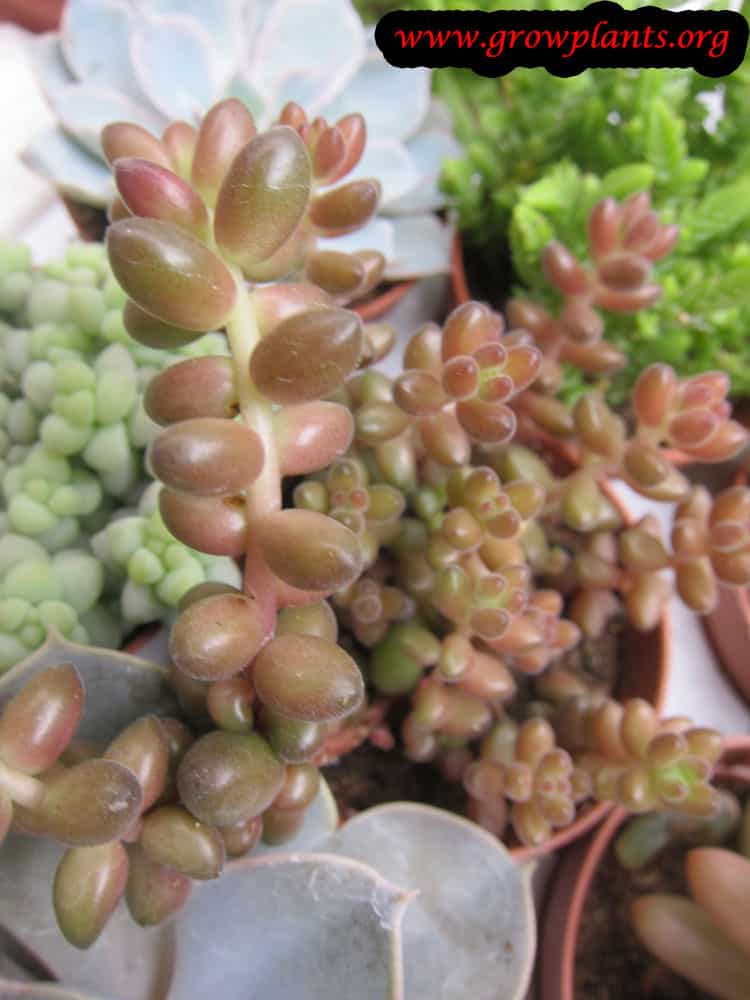
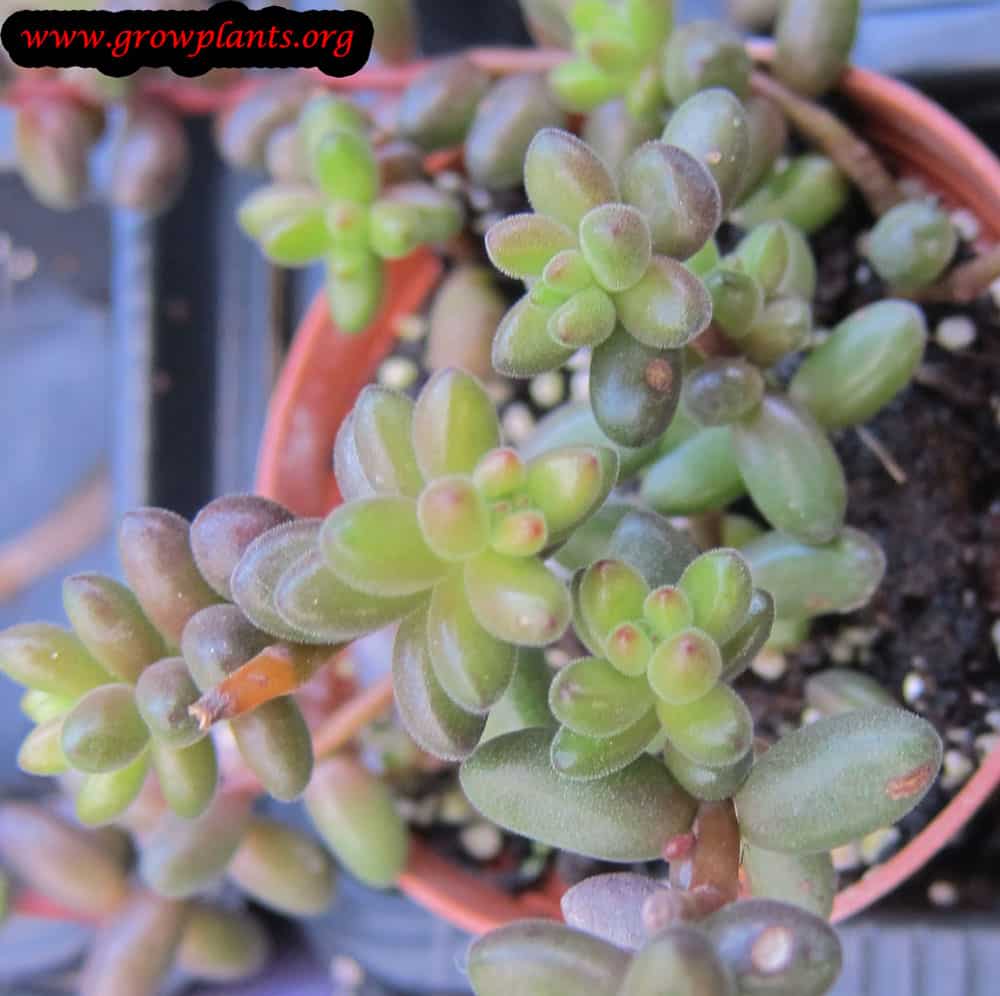
- Leaves & Foliage: Bean-shaped fleshy leaves, light green turning red or pink in sun, on short branching stems.
- Flower Characteristics: Yellow, crown-shaped flowers in clusters at the branch tips.
Primary Uses & Landscape Value
- Functional & Ornamental Roles: Ornamental groundcover, rock-garden, green-roof and container plant, houseplant and dish-garden succulent.
Care Guide: Planting, Soil & Watering
Overview: Sedum rubrotinctum (Jelly bean plant) is a hardy, drought-tolerant succulent that thrives in bright light and gritty, sharply draining soil. It stores water in its fleshy leaves, so it needs only occasional watering and quickly rots in heavy, wet ground.
Quick Care Requirements
| Requirement | Ideal Condition |
|---|---|
| Planting Season | Spring in zones 5–7; spring to summer in zones 8–9; spring to autumn zone 10a; year-round in zone 10b |
| Growth Rate | Slow |
| Soil Type | Light, sandy, well-draining soil — a cactus/succulent mix or soil opened up with grit |
| Water Need | Low — let the soil dry out completely between waterings |
Planting & Establishment
- Best Planting Season: Set out plants in the warmth of spring so the roots settle before winter; in the mildest zones the window stretches further (spring in zones 5–7; spring to summer in zones 8–9; spring to autumn zone 10a; year-round in zone 10b). In cold-winter areas grow it in containers that can be moved under cover.
- How to Plant:
- Hole Preparation: Dig a shallow hole just wide and deep enough for the small root ball — these succulents are shallow-rooted and resent sitting in a deep, water-holding pocket.
- Soil Amendments: Mix coarse sand, grit or perlite into the bed to sharpen drainage; aim for a lean, airy soil rather than a rich, moisture-retentive one.
- Planting Depth: Set the crown level with the soil surface so the fleshy stems and leaves rest on top — never bury them, which invites rot.
- Growth Speed & Expectations: Expect slow growth; as a spreading groundcover it knits together steadily into a low mat rather than shooting upward.
Soil, Watering & Drainage Care
- Soil Mix & Drainage Needs: Give it a light, well-aerated mix; in pots use a shallow, wide container of free-draining cactus/succulent soil with ample drainage holes. Waterlogged soil is the single biggest threat, quickly rotting the roots and stems.
- Watering Schedule & Technique:
- Young / Newly Planted: Water lightly after planting and then only once the soil has dried, just enough to help new roots settle — overwatering now is the main cause of failure.
- Established: Water deeply but infrequently, always letting the soil dry out completely first; established plants shrug off real drought.
- Seasonal Adjustments: Cut watering back sharply in winter while the plant rests, and water a little more often only during prolonged summer heat.
Note: Space plants roughly 20-30cm (8-12in) apart.
Climate, Light & Hardiness
Sedum rubrotinctum (Jelly Bean Plant) grows across Mediterranean, desert, subtropical, and temperate climates and also adapts well to indoor culture. It tolerates full sun to full shade, and per the site data it is a comparatively cold-tolerant Sedum, hardy well into zone 5.
Quick Climate Specifications
| Climate Zones | Mediterranean, Desert, Subtropical, Temperate |
| USDA Hardiness Zones | Approximately 5–10a, with 10b achievable with extra care |
| Optimal Temp Range | Approximately 15–27°C (59–80°F) |
| Cold Damage Begins | Tender growth can be marked as temperatures approach freezing |
| Approx. Survival Minimum | Cold tolerance depends heavily on drainage, exposure, and plant maturity; in the coldest part of its listed range, only established plants in a sheltered, sharply drained site would be expected to take hard winter lows |
| Frost Tolerance | Moderate (varies by site and maturity) |
| Light Conditions | Full Sun / Half Shade / Full Shade |
Sunlight & Light Exposure
Optimal Light Setup
Full sun brings out the jelly-bean leaves' best red tinting; the plant also tolerates half shade and full shade, which suits indoor growing.
Direct Sun Requirement
Direct sun deepens the color but is not mandatory - its broad light tolerance works for sunny beds or bright indoor rooms.
Shade & Heat Management
Its shade tolerance provides flexibility in hot-summer climates; no special heat management is usually needed.
Best Exposure/Orientation
A sunny to lightly shaded outdoor bed, or a bright windowsill indoors.
Temperature Extremes & Hardiness
USDA Hardiness & Regional Limits
The site data places it in hardiness zone 5–10a, extending to 10b with extra care - a wide range likely tied to drainage, exposure, and plant maturity rather than uniform performance throughout.
Cold Damage & Winter Protection
Sharp drainage and a sheltered site help in the colder part of its range; young or newly propagated plants are more cold-sensitive than mature clumps, and container specimens should be protected during hard freezes.
Frost Sensitivity
Cold tolerance varies by conditions, but frost can still damage exposed foliage, particularly on young growth.
Extreme Heat Tolerance
Good - as a drought-tolerant succulent it copes well with warm-climate summer heat.
Wind, Humidity & Microclimate
Humidity Preferences
Prefers drier air over constantly humid conditions, which raise the risk of rot.
Dry-Air Tolerance
High - well suited to arid and semi-arid climates and typical indoor room air.
Wind Tolerance
Moderate; its low, spreading habit copes reasonably well in open sites.
Rainfall & Seasonal Moisture
Well-drained, sandy soil (as the site recommends) matters most in wetter climates, where it helps prevent rot.
Microclimate Recommendations
A sunny, sharply drained, sheltered site suits it best in the cooler part of its range; container culture allows moving plants under cover during hard freezes.
Growing in Pots, Balconies & Indoors
Sedum rubrotinctum (jelly-bean plant) is a compact succulent that makes an easy, good-looking houseplant or patio-pot plant. It stays small, stores its own water and asks mainly for light and sharp drainage. Indoors it needs your brightest window – in a room’s weaker light it stretches and softens.
Quick Details
- Container Size: From about 5-8 L (bigger is fine); a wide, shallow pot roughly 10-15 cm deep and 70-150% wider than the root ball
- Indoor Suitability: A good little houseplant in a bright spot
- Best Spot: Bright light to full sun (reddens in strong light)
- Soil & Drainage: Free-draining cactus/gritty mix – drainage is everything
- Watering in Pots: Water only when the mix has dried out; pots must never stay soggy
Indoors & On the Windowsill
- As a houseplant: Yes – it grows happily indoors given enough light. A ready-made cactus and succulent soil mix provides that structure without mixing it yourself. Stand it at your brightest window (south or west facing) so growth stays tight and well coloured rather than pale and drawn.
- Windowsill growing: Its compact size suits a sunny sill; turn the pot now and then for even growth, and water only when the mix is dry.
- Overwintering: In cold climates a pot lets you bring it indoors to a bright, cool, frost-free spot over winter.
- Keep it safe: The plump leaves and their sap can irritate skin and are mildly toxic if eaten – handle with care and keep it away from children and pets.
On a Balcony or Patio
- Light, heat & wind: Give it the brightest spot you have; walls and railings throw back a lot of heat and pots dry fast, so check the mix often in warm weather. Move tender succulents under cover before frost.
- Practicalities: Raise the pot on feet so water drains away freely and does not pool on the balcony floor.
Choosing the Pot, Soil & Long-Term Care
- Pot & drainage: Use a pot with strong drainage holes and skip a standing saucer of water – wet feet are the fastest way to rot a succulent. Terracotta breathes and dries quickly, which suits it well; glazed or plastic holds moisture longer, so water more sparingly.
- Potting mix: A free-draining cactus/succulent mix, or a standard mix opened up with plenty of perlite, pumice or coarse sand; a layer of gravel, lava rock or pebbles in the base helps water clear.
- Feeding: Potted plants use up their soil, so feed lightly once or twice through the growing season with a dilute cactus or balanced feed – far less than a leafy houseplant needs.
- Refreshing the mix: After a couple of years the mix stops draining freely – tip the plant out, trim any tired roots and repot into fresh gritty mix.
Grower’s Container Tip
- Wide, shallow and root-pruned: Choose a container about 70-150% wider than the root ball but only 10-15 cm deep – wide and shallow beats deep. To keep the plant compact, lift it every so often and trim the roots so fresh ones regrow. Drainage matters most: use cactus mix or sandy soil with gravel, lava rock or pebbles, and renew the mix once it stops draining after a few years.
Fertilizing & Feeding
A light feeder: the classic jelly-bean-leaved sedum flushes red under bright sun and lean feeding, and needs little to no fertilizer once growth slows.
Quick Fertilizing Specs
| Feeding Level | Light feeder |
|---|---|
| Main Nutrient Priority | A dilute, low-nitrogen feed applied sparingly, to encourage the sun-stressed red flush on the jelly-bean leaves rather than plain green growth |
| Best Feeding Period | During the warm active growing season |
| Organic Options | A little compost worked into a light, sandy, well-ventilated soil |
| Reduce/Stop Feeding | Ease off as growth slows going into cooler weather |
| Micronutrients | Usually met by a complete fertilizer; correct only a diagnosed issue |
| Soil pH | Tolerates a wide range in a light, sandy, well-drained soil |
Feeding by Growth Stage
Warm-season growth and sun-color development
Support steady groundcover growth and the red flush on the bean-shaped leaves that develops in strong light.
| Nutrient direction | A weak, diluted low-nitrogen feed, applied only occasionally, keeps growth compact so the leaves color up rather than staying plain green. |
|---|---|
| Timing | During the warm growing season, avoiding the coldest months. |
| Frequency | An occasional light feeding during active growth is plenty; heavier feeding pushes green, unstressed growth that loses the red coloring. |
| Fertilizer types | A dilute, low-nitrogen liquid fertilizer, used sparingly, A little compost worked into a light, sandy, well-drained soil |
| Precautions | Feed sparingly and rely on bright light rather than fertilizer for the best red coloring; overfeeding produces soft, plain-green growth and raises the risk of rot. |
Cooler-season rest
Let this slow-growing succulent rest through the cooler part of the year without pushing tender new growth.
| Nutrient direction | None – withhold fertilizer while growth is slow or stopped. |
|---|---|
| Timing | During the cooler part of the year, when growth naturally slows. |
| Frequency | No feeding at this stage; resume only once active growth returns. |
| Fertilizer types | No feeding at this stage; do not fertilize until active growth resumes. |
| Precautions | Withhold fertilizer now; feeding a resting plant wastes nutrients and adds unnecessary stress heading into cooler weather. |
Nutrient Deficiency Signs & Corrections
Leaf color looks pale or washed out and growth, already slow for this succulent, becomes even slower over a full season.
| Possible causes | low available nitrogen in lean, well-drained soil that has gone unfed for a long time, nutrients leaching through fast-draining, sandy or gritty soil, general root stress from poor drainage or a waterlogged spot |
|---|---|
| Appears first on | older, lower leaves |
| What to check | how long since any feeding or soil amendment, drainage and soil texture around the root zone, overall plant vigor and leaf color |
| Possible correction | Apply a dilute, balanced or low-nitrogen fertilizer during the next active growing period and consider a light organic matter amendment. |
Leaf tips or margins brown and look scorched, especially on a container-grown plant.
| Possible causes | fertilizer salt buildup in a container with limited soil volume, feeding too often or too concentrated for this light-feeding succulent, poor drainage concentrating salts near the roots |
|---|---|
| Appears first on | leaf tips and margins |
| What to check | recent feeding frequency and strength, container or soil drainage and any visible salt crust on the surface, whether the plant is in-ground or containerized |
| Possible correction | Ease off feeding, water thoroughly to move accumulated salts through the drainage, then resume lighter feeding. |
New leaves emerge yellow with the veins staying green, while older leaves keep a normal color.
| Possible causes | iron unavailability in alkaline, compacted, or waterlogged soil, poorly aerated soil restricting root uptake, overwatering or planting too deep, limiting root function |
|---|---|
| Appears first on | newest leaves first |
| What to check | soil drainage and whether water pools around the base, planting depth relative to the root ball, recent watering pattern |
| Possible correction | Improve drainage and aeration first; correct with a chelated iron product per its label only if the pattern persists once drainage is fixed. |
Pruning, Training & Seasonal Maintenance
Sedum rubrotinctum (Jelly Bean plant) is a small subshrub — woodier at the base than the mat-forming Sedums in this group — that stays 5–15cm tall if kept compact, but sprawls and thins out if left unchecked. Its plump bean-shaped leaves detach easily, similar to Donkey’s Tail but less extreme, and readily root where they fall — a trait worth using deliberately (collecting drops for propagation) rather than fighting. Pinching is the main pruning task here, aimed at preventing the sparse, sprawling look this species gets without it.
Quick Pruning & Maintenance Specs
| Pruning Tolerance | Low–Moderate |
| Primary Pruning Window | Winter |
| Secondary Maintenance Window | Any time, for spent blooms or sprawling stems |
| Typical Frequency | Light pinching through the growing season, one grooming pass a year |
| Main Objective | Pinch stem tips for density; remove spent flower stems and shed/shriveled leaves |
| Young Plant Priority | Handle gently (leaves shed easily); leave undisturbed while establishing |
| Mature Plant Priority | Pinch sprawling stems to keep the subshrub base compact; cut back and re-root leggy growth |
| Best Tool Type | Small precision snips, or pinch by hand |
| Avoid Heavy Pruning During | Summer heat/drought stress; right after transplanting |
Pruning by Plant Age & Size
Newly Established
No pruning; handle minimally since leaves detach easily, and let the plant settle in.
Young / Formative
Pinch stem tips once a few sets of leaves have formed to encourage branching from a low, woody base rather than one upright sprawling stem — this is the main structural intervention this plant needs.
Mature / Established
Ongoing pinching of any stem that’s outgrowing the clump’s shape; cut back and re-root a stem that has gone bare-based and woody rather than trying to make it leaf out again in place.
Structural Pruning & Training
Regular pinching is the structural tool for this subshrub — without it, stems lengthen, the base goes bare and woody, and the plant flops open. Renewal pruning (cutting an old sprawling stem back to re-root, or replacing it with cuttings) is more effective than trying to force dense regrowth on old woody growth.
Special Growth to Remove
- Spent yellow flower clusters once bloom fades — cut at the stalk base.
- Shed or shriveled leaves accumulating around the base (or collect healthy shed leaves for propagation instead of discarding them).
- Bare, over-elongated stems — shorten and re-root.
Container & Small-Space Pruning
Commonly grown in shallow pots; pinching to keep it compact matters more in containers, where a sprawling habit quickly overruns a small pot’s edge. Root trimming at repotting (per the plant’s own container guidance) manages overall size.
Tools
Precision snips for clean cuts, though many routine pinches can be done by hand on this soft-stemmed subshrub.
Tool Hygiene & Disease Risk
Routine. Main pest pressure is slugs/snails, not disease; a clean blade avoids crushing the fleshy stems and unnecessary leaf shed.
Cut Placement & Technique
Pinch or cut just above a leaf node to encourage branching there; for propagation cuttings, cut at the base of the leaf or stem as the plant’s own propagation notes describe, and let leaf drops root where they naturally fall or collect them for potting.
Heavy Pruning & Rejuvenation
Whole-plant hard pruning isn’t well suited to this species; instead renew gradually by cutting and re-rooting individual leggy stems, or start fresh clumps from the readily-rooting fallen leaves.
Post-Pruning Care
Let cut or dropped leaves/stems callus a couple of days before potting, per the plant’s own propagation guidance; avoid heavy watering right after cutting or pinching.
Common Pruning Mistakes
- Skipping pinching until the plant is already sprawling and bare at the base.
- Discarding naturally shed leaves instead of using them to propagate replacements.
- Handling stems roughly, causing unnecessary leaf drop.
When Not to Prune
Avoid heavy pruning during summer heat/drought stress and immediately after transplanting.
Recommended Tools (by task)
| Task | Tool Category | Why |
| Pinching tips and removing spent blooms, any age plant | precision_snips | Fine, precise cuts on soft fleshy stems; small blade prevents crushing and excess leaf shed |
Propagation Guide
Sedum rubrotinctum is propagated most practically from healthy vegetative material. Stem cuttings are the safest general method; leaf cuttings can also be used where the species’ leaves detach cleanly and remain intact. Let cuttings dry in a shaded spot for a few days before planting.
Quick Propagation Specs
| Preferred Method | Stem cuttings |
| Leaf Cuttings | Useful where intact leaves are suitable for the method |
| Seed | Possible, but slower than vegetative propagation |
Stem Cuttings
Take a healthy stem section, allow the cut surface to dry briefly if needed, and place it in a clean, gritty, free-draining succulent medium.
Leaf Cuttings
Where suitable, remove a healthy intact leaf cleanly, allow any damaged surface to dry briefly, and place the leaf on or just into a well-drained medium.
Aftercare
Keep the medium only lightly moist and avoid waterlogging while roots and new growth form.
Note: Seeds typically germinate in 2-4 weeks and need light to sprout, so do not bury them.
Bloom & Flower Guide
Quick Details
- Bloom Season: Spring
- Flower Appearance: Small, yellow, star-shaped flowers in clusters at the ends of the stems
- Edibility: Not edible – the jelly-bean plant is mildly toxic if eaten and its sap can irritate skin; grow it for looks only
Detailed Blooming Overview
The jelly-bean plant is grown for its plump, red-tipped leaves, but in spring a mature, sun-grown plant sends up short stems topped with small yellow, star-shaped flowers. The blooms are nectar-rich and bring in bees, though the plant itself should be kept away from children and pets.
Flower Characteristics
- Small, yellow, star-shaped flowers
- Carried in loose clusters at the tips of the stems
- Nectar-rich and attractive to bees and hoverflies
Bloom Care & Thinning
- Encouraging bloom: Bright light and a cool, dry winter rest bring on the flowers; a shaded plant rarely blooms.
- Aftercare: Trim spent flower stems once they fade.
- Safety: The sap can irritate skin and the plant is mildly toxic if eaten – wash hands after handling and site it out of reach of children and pets.
Pests, Diseases & Troubleshooting
Overview: The jelly-bean plant, pork-and-beans or Christmas cheer is a tender Mexican sedum whose glossy green bean-shaped leaves flush bright red in sun. Like all stonecrops, Sedum rubrotinctum is far more often harmed by cultivation mistakes-above all overwatering-than by any pest. The insects it does attract (mealybugs and aphids under cover, the occasional slug) are few and easily managed by hand or with gentle organic sprays. Grow it hard in sharply drained gritty soil with strong light, water only when the soil is dry, and most problems never begin.
Quick Troubleshooting Overview
| Issue / Pest | Main Symptom | Primary Solution |
|---|---|---|
| Mealybugs | White cottony tufts tucked into leaf axils and rosette centres, sticky honeydew and sooty mould | Dab with alcohol, rinse, then insecticidal soap or neem |
| Aphids | Clusters of soft green/black insects on new growth and flower stems, distortion and sticky sap | Blast with water, insecticidal soap, encourage ladybirds |
| Root & stem rot | Blackened, mushy, translucent stems that collapse at the base | Withhold water, improve drainage, cut back to firm tissue and re-root |
| Etiolation | Stems stretch pale and floppy with wide gaps between leaves | Move to much brighter light; behead and re-root compact tips |
| Sunburn / scorch | Bleached white or brown scabby patches after a sudden move into full sun | Acclimatise gradually; shade during the fiercest midday sun |
Common Pests & Management
- Mealybugs (Planococcus citri / Pseudococcus spp.):
- Symptoms: Slow-moving, soft insects coated in white waxy fluff, hiding deep in leaf axils, rosette centres and among trailing stems. They excrete sticky honeydew that turns black with sooty mould; heavy infestations stunt and yellow the plant. Do not mistake the cottony masses for the natural waxy bloom on the leaves.
- Prevention & Control: Inspect new plants before introducing them and isolate any that are infested. Touch each colony with a cotton bud dipped in isopropyl alcohol, then rinse. For wider outbreaks spray insecticidal soap or neem oil, wetting the hidden crevices, and repeat weekly until clear. A bad potted infestation is best cured by unpotting, washing the roots (root mealybugs hide there too) and repotting into fresh gritty mix.
- Aphids (Aphis sedi and other Aphis spp.):
- Symptoms: Dense clusters of soft green, grey or black insects on tender new shoots and especially on the flower stalks, causing curling and sticky honeydew. Aphis sedi is the stonecrop specialist and swarms flowering heads.
- Prevention & Control: Knock them off with a firm jet of water, repeated every few days. Encourage ladybirds, lacewings and hoverflies, which clear light infestations on their own. If they persist, an insecticidal soap or a light neem spray in the cool of evening works well; avoid spraying open flowers to protect pollinators.
- Scale insects (Coccus / Saissetia spp.):
- Symptoms: Small, immobile brown or tan bumps stuck along stems and leaf undersides, often overlooked until honeydew and sooty mould appear and growth weakens.
- Prevention & Control: Scrape off light infestations with a fingernail or an alcohol-dipped bud. Smother the rest with horticultural oil or neem, coating the stems thoroughly, and repeat to catch newly hatched crawlers.
- Two-spotted spider mite (Tetranychus urticae):
- Symptoms: A problem of hot, dry, still indoor air: fine pale stippling on the leaves, a dulled bronzed look and, when severe, gossamer webbing spun over the growing tips.
- Prevention & Control: Raise humidity and airflow. Rinse the plant, then spray insecticidal soap or neem to the leaf undersides, repeating every 5–7 days to break the fast breeding cycle. Predatory mites give good control in a greenhouse.
- Slugs & snails (Deroceras, Cornu aspersum):
- Symptoms: Even under cover, slugs and snails chew holes in the soft beans and graze fallen leaves, leaving slime trails; damage is worst in damp, still conditions.
- Prevention & Control: Keep the potting surface dry and open, hand-pick after dark, and use grit or copper barriers around outdoor plants; iron-phosphate bait is a safe last resort.
Diseases & Fungal Issues
- Crown, stem & root rot (Pythium, Phytophthora, Fusarium, Rhizoctonia):
- Symptoms: By far the commonest killer of stonecrops. Stems and the base of the plant turn black, soft, translucent and foul-smelling, then collapse; roots are brown and mushy. It follows soggy soil, buried crowns or cold wet conditions.
- Treatment & Management: Prevention is everything-use a fast-draining gritty mix, pots with drainage holes, and water only when dry, never letting the plant sit wet. If rot appears, cut cleanly back into firm green tissue, let the cutting callus, and re-root it; discard badly rotted plants and the contaminated soil.
- Botrytis / grey mould (Botrytis cinerea):
- Symptoms: Fuzzy grey-brown mould on leaves, stems and faded flowers in cool, damp, crowded conditions; affected tissue rots and drops.
- Treatment & Management: Improve air movement, avoid overhead watering, and remove dead leaves and spent flower heads promptly. Thin congested growth; a copper or biological fungicide helps only if the underlying damp is corrected.
- Powdery mildew (Erysiphe/Golovinomyces spp.):
- Symptoms: A less frequent, white powdery film on leaves and stems in warm, humid, still air, sometimes distorting new growth.
- Treatment & Management: Increase spacing and airflow, remove affected parts, and treat if needed with a potassium-bicarbonate or sulphur spray.
Growing Difficulties & Abiotic Problems
- Overwatering & waterlogging:
- Cause & Symptoms: The single most common problem-leaves and stems turn yellow, translucent, soft and mushy, and the plant rots from the base. Caused by too-frequent watering, water-retentive soil or pots without drainage.
- Correction Strategy: Let the soil dry fully between waterings, switch to a gritty free-draining mix, and always use a pot that drains. When in doubt, water less-a stonecrop recovers from drought far more readily than from rot.
- Etiolation (stretching for light):
- Cause & Symptoms: In too little light the stems elongate, grow pale, and the leaves space out and point down, losing the tight compact form and any bright colour.
- Correction Strategy: Move to the brightest position available or add a grow light. Stretched growth will not re-compact, so behead the plant and re-root the tidy tips for a fresh, dense start.
- Leaf drop and skin irritation:
- Cause & Symptoms: The bean-like leaves detach very easily and each rooted bean makes a new plant; the milky sap can also irritate skin and eyes.
- Correction Strategy: Handle gently and site it out of the way to limit leaf drop; wear gloves or wash your hands after pruning to avoid the sap’s irritation.
- Cold & frost damage:
- Cause & Symptoms: This is a tender stonecrop; frost turns the leaves glassy, then brown and mushy, and hard freezes kill it outright.
- Correction Strategy: Grow it in a container that can be moved under cover before frost, keep it dry and cool but frost-free over winter, and give it bright light indoors.
What Helps – Products & Tools
For this stonecrop keep the toolkit simple and gentle: isopropyl alcohol on a cotton bud for spot-treating mealybugs, insecticidal soap and neem oil for aphids, scale and mites, and-outdoors-iron-phosphate slug pellets, copper barrier tape or sharp grit against slugs and snails. Beneficial nematodes deal with vine weevil grubs in pots, sulphur or potassium-bicarbonate spray checks rust and mildew, and a bag of horticultural grit or pumice is the best long-term insurance against the rot that causes most losses. The sap of jelly-bean sedums can irritate skin and eyes-wear gloves and wash after handling.
Varieties & Cultivars
- Sedum aurora — Learn more about Sedum aurora · Shop Sedum aurora on Amazon