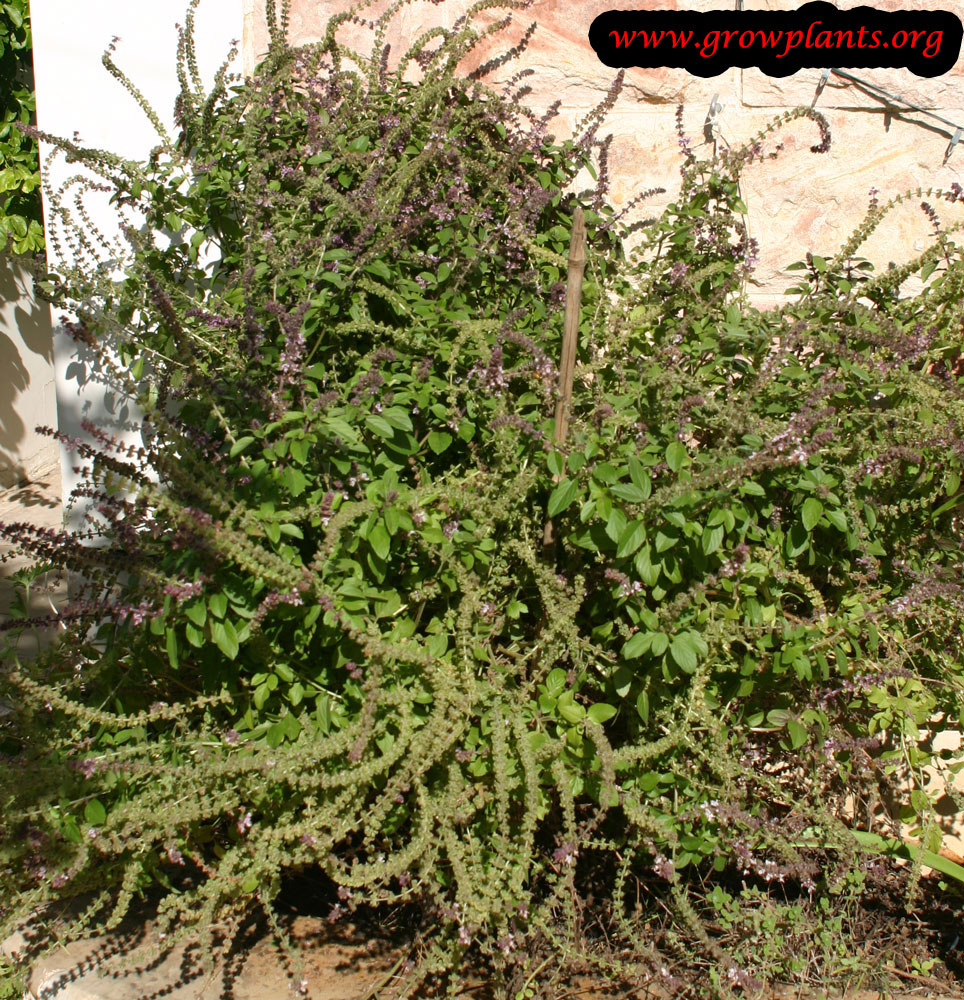
Plant Profile & Key Characteristics
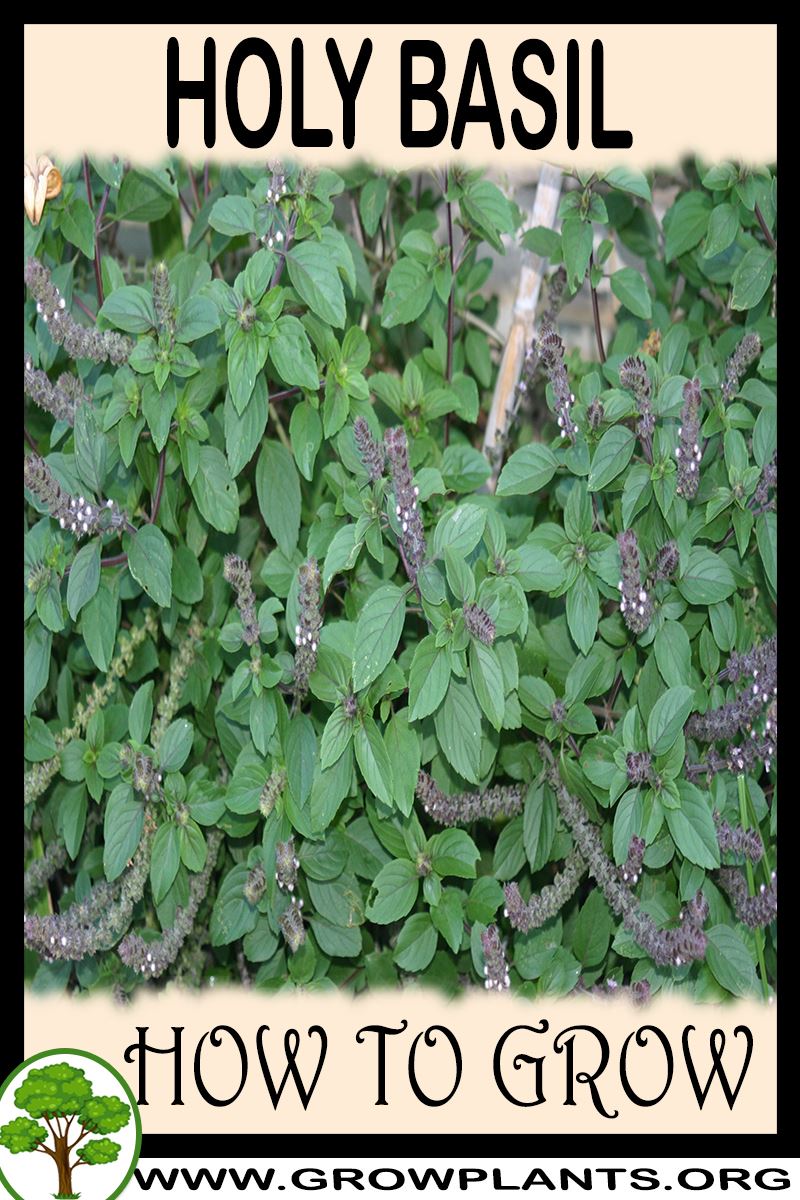
Overview: Holy basil (tulsi) is an aromatic, shrub-like culinary herb reaching about 0.3-2 m (1-6.5 ft). It is an evergreen perennial in warm frost-free climates and grown as an annual where winters are cold, valued for its strongly aromatic edible leaves and as an ornamental and medicinal plant.
Quick Specifications
| Specification | Attribute |
|---|---|
| Plant Type / Life Cycle | Perennial (frost-free) / Annual (cold winters) |
| Foliage Type | Evergreen (in warm climates) |
| Mature Size | 0.3-2 m (1-6.5 ft) tall |
| Growth Rate | Fast |
| Root System | Fibrous, shallow |
| Toxicity | Non-toxic / edible |
| Hardiness | USDA zone 10b+ (perennial); grown as annual in zones 5-10 |
Growth Form & Structure
- Height & Spread: 0.3-2 m (1-6.5 ft) tall in the ground; grows well in containers of about 5-30 L (1.5-8 gal).
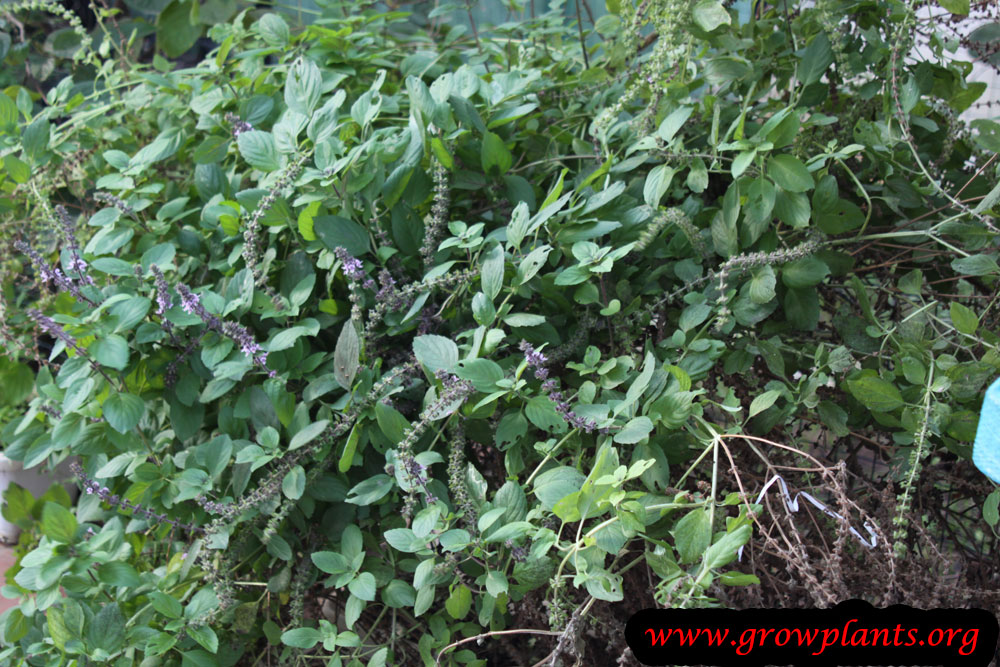
- Growth Habit & Form: Fast-growing, bushy shrub-like herb with many upright, leafy branching stems.
- Lifespan & Maturity: Reaches usable size quickly; perennial in frost-free zones, otherwise grown fresh each year.
Anatomy & Physical Features
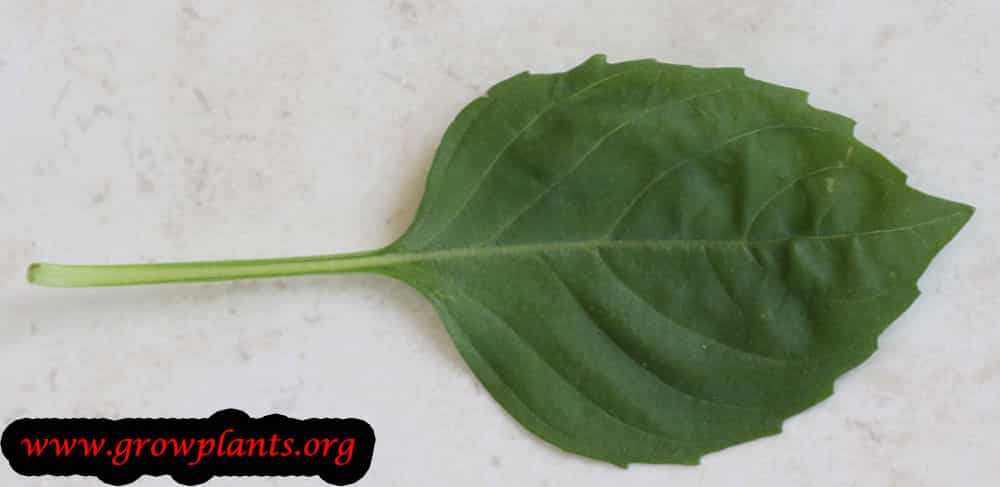
- Leaves & Foliage: Ovate leaves with a serrated edge, green and sometimes flushing purple, strongly aromatic with a pungent taste.
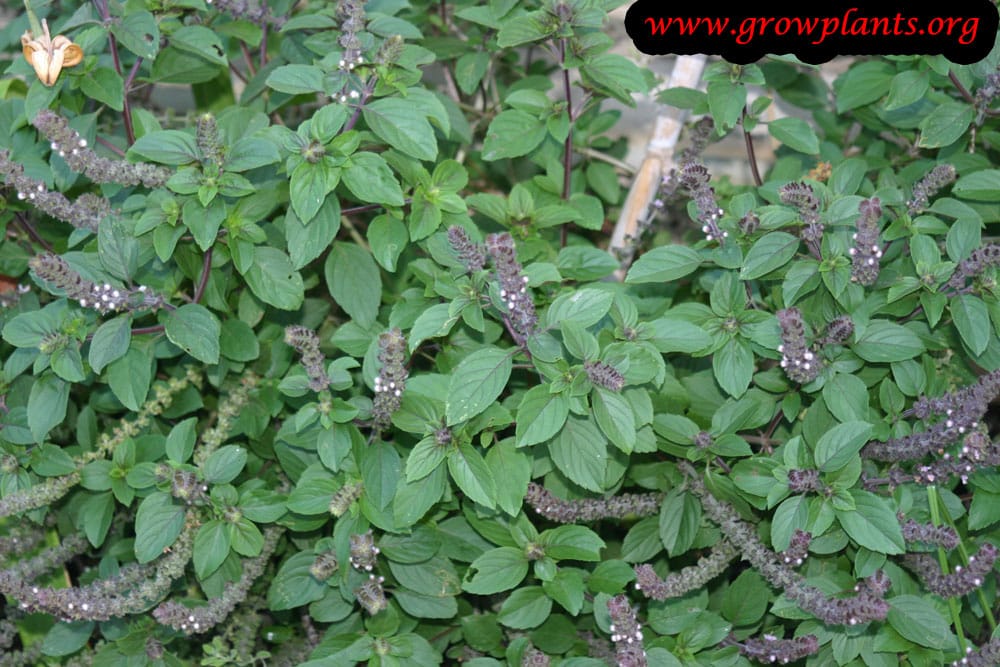
- Flower Characteristics: Small purple flowers on upright inflorescences that attract pollinators (see the Bloom guide).
Primary Uses & Landscape Value
- Edible Uses: Aromatic leaves used fresh as a culinary herb and in herbal teas.
- Functional & Ornamental Roles: Fragrant ornamental, pollinator plant and traditional medicinal / kitchen herb; best grown outdoors.
Note: Botanical name: Ocimum tenuiflorum.
Care Guide: Planting, Soil & Watering
Overview: Holy basil thrives in warm weather with full sun to part shade, growing best in rich, well-draining soil that is kept steadily moist. It is more forgiving of dryness than most basils – let the soil surface dry a little between waterings – but still wants fertile, sharply drained ground with plenty of organic matter.
Quick Care Requirements
| Requirement | Ideal Condition |
|---|---|
| Planting Season | In spring after the last frost (grown as an annual); spring to summer in zone 10b, spring to autumn in zone 11, and year-round in zone 12+ |
| Growth Rate | Fast |
| Soil Type | Rich, well-draining soil high in organic matter |
| Water Need | Low to Moderate – let the soil surface dry slightly between waterings |
Planting & Establishment
- Best Planting Season: As a tender perennial, plant in spring after all frost has passed where grown as an annual; in frost-free zones it can go in from spring through summer (zone 10b), spring through autumn (zone 11), and at any time of year in zone 12+.
- How to Plant:
- Hole Preparation: Dig a hole a little wider than the root ball and about the same depth, loosening the surrounding soil.
- Soil Amendments: Work in compost or well-rotted organic matter, and in heavy soil add perlite or vermiculite to open up drainage.
- Planting Depth: Set the transplant at the same level it grew in its pot, keeping the crown at soil level – do not bury the stem.
- Growth Speed & Expectations: In warm, sunny conditions basil grows quickly, giving harvestable leaves within a few weeks and reaching full size in a single season. It is a vigorous, aggressive grower, so give it room and prune to keep it in bounds.
Soil, Watering & Drainage Care
- Soil Mix & Drainage Needs: Basil demands sharp drainage and airy soil. In the ground, amend heavy clay to keep it open; in containers use a rich potting or peat-based mix lightened with perlite or vermiculite, always in a pot with drainage holes rather than a standing saucer of water, which invites root rot.
- Watering Schedule & Technique:
- Young / Newly Planted: Keep the soil lightly moist while seedlings and transplants establish, watering whenever the surface begins to dry.
- Established: Once established it is fairly drought-tolerant – water deeply but let the top of the soil dry before watering again, avoiding soggy conditions.
- Seasonal Adjustments: Water more in heat; as growth slows in cool weather cut back sharply. Where grown as an annual the plant finishes at first frost; a perennial kept over winter needs only occasional watering.
Climate, Light & Hardiness
Holy basil (Tulsi) is an evergreen perennial in warm, frost-free climates but is grown as a frost-killed annual wherever winters turn cold; it grows well from full sun through to almost full shade, with the choice of exposure shifting the balance between flowering and leaf size. It has no frost tolerance, so its zone range marks where it persists year-round versus where it is regrown each year.
Quick Climate Specifications
| Climate Zones | Tropical, Mediterranean, subtropical, temperate |
|---|---|
| USDA Hardiness Zones | Perennial in zone 10b+; grown as a frost-killed annual in zone 5–10 |
| Optimal Temp Range | approximately 20–30°C (68–86°F) |
| Cold Damage Begins | approximately below 10°C (50°F) - basil is prone to chilling injury well above freezing |
| Approx. Survival Minimum | outdoor top growth is killed at or near 0°C (32°F); in zone 10b+ it survives winter outright |
| Frost Tolerance | None |
| Light Conditions | Full Sun (best for flowering/pollinators) / Half Shade to Almost Full Shade (best for bigger leaves) |
| Wind Tolerance | Low–Moderate |
| Salt / Coastal Tolerance | Low |
Sunlight & Light Exposure
Optimal Light Setup
Full sun is optimal for the plant overall and for attracting pollinators, but the site data notes half shade to almost full shade produces bigger leaves with fewer flowers - useful if leaf harvest is the priority.
Direct Sun Requirement
Choose full sun for maximum flowering, or reduce sun deliberately if larger leaves matter more than bloom.
Shade & Heat Management
Because it is described as aggressive with heavy flowering in full sun, shade can double as a practical way to reduce trimming workload in hot, sunny climates.
Best Exposure / Orientation
A warm, sheltered spot works in either sun or shade, depending on whether flowers or leaves are the goal.
Temperature Extremes & Hardiness
USDA Hardiness & Regional Limits
Site data lists it as perennial in zone 10b+ and grown as an annual from zone 5 upward in colder climates; this reflects winter cold survival, not preferred growing temperature.
Cold Damage & Winter Protection
Basil suffers chilling injury well before actual frost; bring containers indoors or plan to replace the plant once nights turn cool in autumn where it is grown as an annual.
Frost Sensitivity
Fully frost-tender outdoors at every growth stage.
Extreme Heat Tolerance
Good in full sun and heat, provided watering is kept modest to average per the site's water-requirement data.
Frost-Free Growing Season
Where grown as an annual, needs a full frost-free stretch of warm weather; sow or plant in spring.
Wind, Humidity & Microclimate
Humidity Preferences
Appreciates moderate humidity with good airflow to avoid fungal issues.
Dry-Air Tolerance
Moderate to fairly good, in keeping with its site data preference for a small to average amount of water rather than heavy watering.
Wind Tolerance
Low to Moderate; tender stems and leaves do best with some shelter from strong wind.
Coastal / Salt Tolerance
Low; not adapted to salt spray or saline soils.
Rainfall & Seasonal Moisture
Needs modest, consistent moisture through the growing season rather than heavy watering.
Microclimate Recommendations
A warm, sheltered spot suits it well; growers wanting maximum leaf size can position it in part shade, while those wanting flowers for pollinators should choose full sun.
Growing in Pots, Balconies & Indoors
Holy basil (tulsi) is a first-rate container herb for a balcony, patio or sunny windowsill rather than a deep-indoor houseplant – it needs strong, direct light to stay compact and full of flavour, which a room’s interior rarely supplies. Like most basils, it also adapts well to a hydroponic system (DWC or NFT) – the strong light it already needs translates easily into grow-light setups, and basil is one of the most forgiving herbs for a hydroponic beginner.
Quick Details
- Container Size: 5-30 L (1.5-8 gal)
- Indoor Suitability: Not a deep-indoor houseplant; thrives on a bright, sunny windowsill with direct light
- Best Spot: Full sun to half shade; the sunniest balcony, patio or windowsill you have
- Soil & Drainage: Well-aerated, organic-rich mix (potting mix or peat/coir with perlite or vermiculite); must drain freely
- Watering in Pots: Keep the mix moist (not waterlogged) and let excess drain away; pots dry fast in heat
Indoors & On the Windowsill
- Houseplant limits: The grower does not rate it as a deep-indoor houseplant – away from a window the light is too weak and growth turns leggy and less flavourful.
- Windowsill growing: On a bright, sunny sill with direct light it does well – pick a compact plant, turn the pot now and then for even growth, and pinch out the tips.
- Overwintering indoors: Basil is tender, so in cold climates a big reason to pot it is to bring it inside before frost – keep it on a bright sill in the cold season to carry it over or extend the harvest.
On a Balcony or Patio
- Light & warmth: Give it the sunniest, most sheltered corner. Walls and paving reflect heat, which basil enjoys, but that also dries pots quickly – check moisture daily in hot weather and water more on warm days. A drip irrigation kit with a timer can take over that watering check automatically.
- Wind & practicalities: Shelter it from strong wind, which shreds soft leaves and dries the mix; make sure the pot drains freely and sits where run-off will not stain the floor.
Choosing the Pot, Soil & Long-Term Care
- Pot & drainage: The grower suggests a 5-30 L (1.5-8 gal) container with strong drainage holes. Skip a standing-water saucer under the pot to avoid root rot; terracotta breathes and dries faster, while glazed or plastic pots hold moisture longer.
- Potting mix: Use a well-aerated, organic-rich mix – potting compost, or peat/coir blended with perlite or vermiculite for drainage.
- Feeding: Potted herbs need feeding more often than those in the ground, as nutrients leach out with each watering – a light, regular feed through the growing season keeps the leaves coming.
- Repotting: Where it is kept as a perennial, the grower advises refreshing all or part of the mix about every two years; pot up if roots fill the container.
Growing this plant in a greenhouse
A greenhouse can give holy basil frost protection, cold protection, humidity control and extra warmth. In the right climate it may also be kept growing through winter, depending on how much warmth and light are provided.
Greenhouse at a glance
| Greenhouse suitability | Conditional - depends on your climate |
|---|---|
| Main benefits | frost protection, cold protection, humidity control, extra warmth |
| Season extension | earlier spring & later autumn |
| Outdoor protection advisable below | about 10°C |
| Maintain greenhouse minimum | around 10°C for active growth |
| Suitable types | heated greenhouse, polycarbonate greenhouse, lean-to |
| Heating | Heating is recommended in cold climates for continuous growth. |
Related greenhouse guides
- Greenhouses: How to Choose the Right Greenhouse
- Best Greenhouse Heaters
- Greenhouse Climate Control: Temperature, Ventilation and Humidity
- Best Lean-To Greenhouses
Fertilizing & Feeding
Holy basil (Tulsi) is a vigorous, often aggressive grower that blooms nearly year-round and is usually harvested in small quantities for tea and traditional use, so it does best on moderate, steady feeding rather than the heavier nitrogen that would push growth it does not really need.
Quick Fertilizing Specs
| Feeding Level | Moderate feeder |
|---|---|
| young_feeding | A gentle feeding once seedlings, transplants, or rooted cuttings are established and putting out new leaves |
| Main Nutrient Priority | Balanced feeding with restrained nitrogen, since this basil already grows vigorously and blooms almost continuously |
| Best Feeding Period | Through the warm growing season, or year-round in consistently warm, frost-free climates |
| Organic Options | Compost or aged organic matter worked into the soil, or a mild organic liquid feed |
| Soil pH | Prefers well-drained soil on the slightly acidic to neutral side |
| Reduce/Stop Feeding | Ease off feeding as growth slows in cooler months for plants grown as perennials outside their warmest hardiness range |
Feeding by Growth Stage
Establishment After Planting
Help young Holy basil build a healthy root system before its naturally vigorous growth and near-constant blooming take over
| Nutrient direction | A light, balanced feed supports steady root and shoot development without forcing weak growth |
|---|---|
| Timing | Soon after transplanting seedlings, rooted cuttings, or once direct-sown plants show their first true leaves, in warm weather |
| Frequency | A single light feeding at planting is usually enough while the plant establishes its root system |
| Fertilizer types | A diluted, balanced complete fertilizer formulated for edible herbs, Compost or aged organic matter mixed into the planting soil |
| Precautions | Avoid concentrated or high-nitrogen feeding on young transplants, which can scorch tender roots and produce soft, weak growth |
Active Growth and Continuous Bloom
Keep Holy basil healthy through its vigorous growth and near-continuous flowering, harvesting leaves as needed in modest amounts
| Nutrient direction | A balanced fertilizer with restrained nitrogen supports healthy foliage without adding to a plant that is already inclined to grow fast and flower heavily |
|---|---|
| Timing | Through the warm growing months, or continuously in consistently warm, frost-free conditions where the plant keeps growing and blooming |
| Frequency | Moderate, spaced-out feedings through the growing season are usually enough given how vigorously this basil already grows |
| Fertilizer types | A balanced water-soluble or granular fertilizer for edible herbs, Top-dressing with compost or worked-in organic matter |
| Precautions | Because this plant is already aggressive and blooms readily in full sun, extra nitrogen feeding is rarely needed and can push more growth than the plant’s modest harvest calls for |
Nutrient Deficiency Signs & Corrections
Older, lower leaves turn pale green to yellow and growth noticeably slows for a plant that is normally vigorous
| Possible causes | Insufficient nitrogen in the soil or feeding program, Nutrient leaching from frequent watering or a free-draining container mix, Root stress from compacted or waterlogged soil limiting nutrient uptake |
|---|---|
| Appears first on | Older lower leaves first, then progressing upward if uncorrected |
| What to check | Recent feeding history and soil richness, Drainage and how often the plant is watered, Root health and any signs of compaction or waterlogging |
| Possible correction | Confirm feeding history and root health, then resume a balanced feeding appropriate for the growing stage |
New leaves emerge pale yellow while the veins stay green
| Possible causes | High soil pH limiting iron availability, Waterlogged or poorly drained soil stressing the roots, Container growing in a mineral-poor or overly alkaline mix |
|---|---|
| Appears first on | Newest leaves at the growing tips |
| What to check | Soil or potting mix pH, Drainage and how the pot or bed holds water, Whether the container mix has gone unrefreshed for a long stretch |
| Possible correction | Correct soil pH toward the slightly acidic side, improve drainage, and if confirmed as iron-specific, apply a chelated iron product per its label |
Older leaf edges turn brown and scorched-looking while stems weaken
| Possible causes | Sandy or heavily leached soil low in potassium, Repeated watering in containers washing nutrients out of the mix, A feeding program weighted toward nitrogen with little potassium |
|---|---|
| Appears first on | Edges and tips of older, lower leaves |
| What to check | Feeding history for potassium content, Soil type and drainage, Watering frequency in containers |
| Possible correction | Switch to a balanced complete fertilizer that includes potassium rather than a nitrogen-only feed |
Pruning, Training & Seasonal Maintenance
Holy basil (Tulsi) is an aggressive, fast-growing basil that can reach 2 m and, per its own data, blooms almost continuously depending on climate. It is also widely grown for religious/ceremonial use and as a pollinator plant, so — more than most basils — whether and how much you deadhead is a genuine choice, not just a leaf-yield decision: its own guidance says to thin the blossom for better leaf harvest, but that this isn’t recommended if you want the flowers for pollinators. Where structural pruning is wanted, the safe main session is autumn/early winter, thinning the interior of this large, vigorous shrub.
Quick Pruning & Maintenance Specs
| Pruning Tolerance | High |
| Primary Pruning Window | Autumn / early winter — interior thin |
| Secondary Maintenance Window | Ongoing through its long/near-continuous bloom period, IF leaf harvest is the priority |
| Typical Frequency | One annual thin, plus optional ongoing deadheading |
| Main Objective | Manage the size of a large, vigorous grower while balancing leaf harvest against sustained bloom |
| Young Plant Priority | Pinch early to build branching before its long bloom cycle sets in |
| Mature Plant Priority | Thin crowded interior growth annually; choose whether to deadhead |
| Best Tool Type | Precision snips for deadheading; bypass secateurs for the thicker autumn thinning cuts |
| Avoid Heavy Pruning During | Right before frost, or when full deadheading would remove flowers relied on for pollinators/ceremonial use |
Pruning by Plant Age & Size
Newly Established
Minimal — pinch early to build branching before the long bloom period begins.
Young / Formative
Simple pinching; no framework needed even on this larger cultivar.
Mature / Established
Annual interior thin, plus the ongoing leaf-vs-bloom choice through the season.
Seasonal Pruning Schedule
Dormant/Winter – Autumn / Early-Winter Thin
Objective: control size and open the interior of this large (to 2 m), vigorous shrub. Remove crowded or crossing inner stems. Do NOT strip all canopy going into cooler weather in marginal zones. Response: renewed, more manageable growth. Flowering impact: resets/reduces bloom, so time it knowingly if pollinators rely on this plant.
Ongoing (through its long/near-continuous bloom season)
Optional deadheading: thin the blossom for better leaf quality and yield, or deliberately skip it to sustain flowers for pollinators or for ceremonial harvest of the flowering tops.
Special Growth to Remove
Spent flower spikes, if leaf harvest is the goal — genuinely optional here, per the plant’s own guidance.
Container & Small-Space Pruning
Grown in a notably larger container range (5–30 L) reflecting its bigger potential size; more regular pinching helps keep this vigorous, large-growing type in proportion in a pot.
Tools
Precision snips for deadheading; bypass secateurs for the thicker interior stems removed in the larger autumn thin.
Tool Hygiene & Disease Risk
Routine — clean, sharp tools are enough for its documented pest, aphids.
Cut Placement & Technique
True thinning cuts on interior stems at their point of origin; deadhead spikes back to a leaf pair.
Heavy Pruning & Rejuvenation
Tolerated — being vigorous and large-growing, it takes an annual interior thin well, and can be cut back harder if it’s gotten leggy, with strong new growth expected given its fast growth rate.
Post-Pruning Care
Water normally; watch for aphids; no special feeding needed beyond ordinary care given how fast it already grows.
Common Pruning Mistakes
- Deadheading it as hard as a purely culinary basil, without considering that many growers specifically want its continuous bloom for pollinators or ceremonial use.
- Letting the large habit go completely unthinned so the base gets congested and woody.
When NOT to Prune
Avoid the interior thin right before frost. Think twice before removing all flowers at once if pollinator support or ceremonial flowering tops matter to your reason for growing it.
Recommended Tools (by task)
- precision_snips — deadheading through the long bloom season.
- bypass_secateurs — the annual interior thin on this larger, more vigorous cultivar.
Propagation Guide
Holy basil is most easily started from seed, which stays close to type for the species; stem cuttings are a quick, reliable alternative when you specifically want to keep a named subspecies or chemotype (such as Krishna tulsi) identical to the parent rather than risk seedling variation. Both methods are easy for a home grower.
Quick Propagation Specs
| Best Propagation Method | Seed |
| Alternative Methods | Stem cuttings (softwood) |
| Propagation Difficulty | Easy |
| Seed True-to-Type | Usually true-to-type for the species; specific named subspecies are best kept exact by cuttings |
| Vegetative True-to-Type | Yes |
| Best Propagation Season | Spring as annual (hardiness zone 5-10); spring to summer as perennial in zone 10b, spring to autumn in zone 11, year-round in zone 12+ |
| Seed Germination Time | 2-3 weeks (1-2 weeks in Krishna tulsi) |
| Cutting Rooting Time | Not specified by site data; typically a couple of weeks under warm, humid conditions |
| Germination Temperature | 20-30°C (68-86°F), best around 25°C (77°F) |
| Seed Sowing Depth | 0.2-0.5 cm |
Growing from Seed
Seed Handling & Viability
Store seed at room temperature in a dry area until sowing.
Sowing Season
Spring when grown as an annual (hardiness zone 5-10). As a perennial, sow from spring to summer in zone 10b, spring to autumn in zone 11, and year-round in zone 12+.
Sowing Depth & Orientation
Sow very shallowly, 0.2-0.5 cm deep. In trays or cells, space seed about 1×3 cm apart; for direct sowing use a wider spacing of roughly 0.5×1 m (20×40 in).
Germination Conditions
Moist soil, almost full sun, and warmth – 20-30°C (68-86°F), ideally close to 25°C (77°F). Water at an average rate while germinating.
Germination Time
Typically 2-3 weeks; the Krishna tulsi type germinates faster, in about 1-2 weeks.
Seedling Care
Grow seedlings in full sun with moist soil.
Stem Cuttings
Cutting Type
Softwood stem/tip cuttings, taken from non-flowering growth.
Best Timing
During active warm-season growth, spring to summer.
Cutting Preparation
Take a stem tip with a few leaf nodes and strip the lower leaves – the site does not give an exact length, so use general basil-type cutting practice rather than a precise measurement.
Rooting Setup
A moist, well-drained medium (or even water) kept warm and humid encourages rooting.
Rooting Hormone
Optional – stems of this type typically root readily without it.
Rooting Time
Not specified by site data; commonly a couple of weeks under warm, humid conditions.
Bloom & Edible Flower Guide
Quick Details
- Bloom Season: Year-round in warm climates; mainly the warm months in temperate zones
- Time to First Bloom: Within a few months of sowing, in its first season
- Flower Appearance: Small purple flowers in whorls along slender terminal spikes
- Edibility: Flowers are edible and, like the leaves, are used in herbal (tulsi) tea
Detailed Blooming Overview
Holy basil, or tulsi, flowers freely – in a warm climate it can bloom almost year-round. The purple-tinged spikes are a magnet for bees and many other pollinators. Because flowering draws energy from the leaves, growers who want a heavy leaf harvest often pinch the spikes back, while those growing it for bees or for tulsi tea are happy to let it bloom.
Flower Characteristics
- Small purple to lilac flowers set in whorls along upright spikes.
- Aromatic, in keeping with the plant’s clove-like scent.
- Edible; the flowering tops are traditionally brewed with the leaves for tulsi tea.
Bloom Care & Thinning
- Managing the bloom: For the best leaf harvest, pinch off the flower spikes as they form; leave them in place if you are growing for pollinators or for tea.
- Pollination: Pollinated by bees and a wide range of other pollinators.
Fruit & Uses
Holy basil (Tulsi) is grown mainly for its aromatic, edible leaves, most commonly used fresh or dried to make an herbal tea, and also used more sparingly as a pungent culinary herb; no special preparation is required beyond steeping for tea.
Quick Edible Specs
| Edible Parts | Leaves |
|---|---|
| Main Use(s) | Herbal tea (most common use); pungent culinary herb in smaller amounts |
| Eaten Raw or Cooked | Fresh (chewed or added raw) or steeped/dried for tea; occasionally used cooked |
| Preparation Required | None for fresh leaves; dry or steep in hot water for tea |
| Harvest Season | Nearly year-round depending on climate |
| Time to First Harvest | Once the plant is established |
| Storage | Best fresh, or air-dried for later use as tea |
| Safety/Toxicity Caveat | No significant safety concerns for normal culinary/tea use of the leaves; as with other essential-oil-rich basils, best used in moderate culinary amounts |
Leaves & Greens
Aromatic, ovate leaves with a serrated edge, green but sometimes turning purple, with a strong flavour typical of this species. Thinning the flower spikes is recommended if leaves are the main goal, since letting the plant bloom heavily reduces leaf production (see Pruning/Blooming).
Harvesting
The site does not give a specific harvest window for this plant; leaves can generally be picked as needed once the plant is established, most of the year in warm climates.
Preparation, Uses & Safety
Holy basil’s best-known use is as an herbal tea, made from fresh or dried leaves steeped in hot water; the leaves are also chewed fresh or used sparingly as a pungent culinary herb in some dishes. No specific safety caveats beyond typical herbal-tea and culinary use; this is a general herb note, not a medical claim.
Pests, Diseases & Troubleshooting
Overview: Basil is a fast, soft-tissued annual herb that is largely trouble-free outdoors but suffers badly from a handful of specific problems: sap-sucking insects on the tender tips, and two fungal diseases – basil downy mildew and fusarium wilt – that can destroy a planting quickly in warm, humid, still air. Manage it culturally first: full sun, generous spacing for airflow, water at the base (never overhead), and harvest often to keep growth young and vigorous.
Quick Troubleshooting Overview
| Issue / Pest | Main Symptom | Primary Solution |
|---|---|---|
| Aphids | Curled, sticky new tips; clusters under leaves | Blast off with water, insecticidal soap, encourage ladybirds |
| Downy mildew | Yellowing between veins, grey-purple fuzz on leaf undersides | Airflow, resistant varieties, remove infected plants promptly |
| Fusarium wilt | Sudden one-sided wilt, brown streaks in stem | No cure – remove plant, rotate, use clean seed/soil |
| Japanese beetles / slugs | Ragged holes in leaves | Hand-pick, traps/barriers, night patrols for slugs |
| Whitefly / spider mite | Stippling, sticky honeydew, tiny white flies | Soap or oil sprays under leaves, raise humidity for mites |
Common Pests & Management
- Aphids (Aphis / Myzus spp.):
- Symptoms: Soft green, black or grey colonies clustered on the newest shoots and flower spikes; distorted, cupped tips and a sticky honeydew film that turns into black sooty mould.
- Prevention & Control: Knock colonies off with a firm jet of water; pinch out the worst tips. Encourage ladybirds, lacewings and hoverflies. For persistent infestations use insecticidal soap or a light horticultural oil, spraying the leaf undersides – safe on an edible herb if you follow the label and rinse before use.
- Whitefly (Trialeurodes vaporariorum):
- Symptoms: Clouds of tiny white flies rise when the plant is disturbed; leaves yellow, weaken and become sticky. Worse under cover.
- Prevention & Control: Yellow sticky traps to monitor and trap adults; insecticidal soap or oil on the undersides where nymphs feed. Good airflow and avoiding over-feeding with nitrogen both reduce build-up.
- Two-spotted spider mite (Tetranychus urticae):
- Symptoms: Fine pale stippling on leaves, a bronzed dull look, and fine webbing on tips in hot, dry conditions.
- Prevention & Control: Raise humidity and hose the foliage; mites hate moisture. Insecticidal soap or horticultural oil for hot spots; predatory mites under cover.
- Japanese beetles (Popillia japonica):
- Symptoms: Adults skeletonise leaves, chewing between the veins and leaving lace-like damage; most active in warm daylight.
- Prevention & Control: Hand-pick into soapy water early in the day when they are sluggish. Row cover during peak flights; keep pheromone traps well away from the plants (they attract more than they catch). Neem can deter feeding.
- Slugs & snails (Deroceras / Cornu spp.):
- Symptoms: Ragged holes and clean-edged notches on tender leaves overnight, with slime trails; seedlings can be grazed to the ground.
- Prevention & Control: Night patrols, beer traps, copper tape around pots, and a grit or crushed-shell barrier. Iron-phosphate pellets where pressure is high. Keep mulch clear of the stems.
Diseases & Fungal Issues
- Basil downy mildew (Peronospora belbahrii):
- Symptoms: The signature disease of basil – yellowing that is blocked by the leaf veins (angular yellow patches) on the upper surface, with a fuzzy grey-to-purple sporulation on the underside. Spreads explosively in humid, still air.
- Treatment & Management: Prevention is everything: grow resistant lines, space widely, water only at the base early in the day, and give strong airflow. Remove and bin affected plants at first sign – do not compost. Harvest young; there is no reliable home cure once established.
- Fusarium wilt (Fusarium oxysporum f. sp. basilici):
- Symptoms: Sudden wilting, often one-sided, with stunting, leaf drop and brown streaks in the stem tissue. Soil- and seed-borne and persistent.
- Treatment & Management: No cure. Pull and destroy infected plants, use certified clean seed and fresh mix, and rotate away from basil and other mints for several seasons. Solarise or replace bed soil where it recurs.
- Grey mould (Botrytis cinerea):
- Symptoms: Brown, water-soaked lesions on stems and cut ends bearing a fuzzy grey mould, especially on crowded or damaged tissue in cool damp weather.
- Treatment & Management: Improve airflow, remove dead and damaged material, avoid overhead watering, and don’t overcrowd. Prompt sanitation usually controls it without sprays.
- Damping-off & root rot (Pythium / Rhizoctonia spp.):
- Symptoms: Seedlings collapse at soil level; older plants yellow and rot at the base in soggy, cold mix.
- Treatment & Management: Sow in sterile, free-draining mix, water sparingly, give warmth and light, and never leave pots standing in water.
Growing Difficulties & Abiotic Problems
- Cold damage:
- Cause & Symptoms: Basil is frost-tender and chill-sensitive – below roughly 10 °C leaves blacken, pit and turn translucent even without frost.
- Correction Strategy: Plant out only once nights are reliably warm; protect or bring pots in when cool weather threatens.
- Bolting (premature flowering):
- Cause & Symptoms: Heat, stress or age push the plant to flower, after which leaves turn bitter and growth slows.
- Correction Strategy: Pinch out flower spikes and harvest the growing tips regularly to keep the plant leafy and productive.
- Sunscald & drought stress:
- Cause & Symptoms: Sudden strong sun or dry soil causes wilting, bleached or crisped leaf margins.
- Correction Strategy: Harden off before full exposure, keep soil evenly moist, and mulch to buffer moisture.
- Nutrient issues (nitrogen / general yellowing):
- Cause & Symptoms: Pale lower leaves and weak growth in poor or waterlogged soil.
- Correction Strategy: Feed lightly with a balanced organic fertiliser; avoid excess nitrogen, which softens tissue and invites aphids and mildew.
Species note: Holy basil (tulsi) is a short-lived aromatic perennial; its essential oils give useful natural insect resistance, but soft new growth still draws aphids and it remains vulnerable to downy mildew in humid air.
What Helps — Products & Tools
For an edible herb, keep it soft and low-residue: a firm water spray, insecticidal soap and light horticultural or neem oil handle the sap-suckers; yellow sticky traps monitor whitefly; iron-phosphate slug pellets and copper tape protect tender growth; and the fungal problems are managed mainly by airflow, wide spacing, base watering and resistant varieties rather than sprays. Always follow the label on edibles and rinse before eating.