Roses are less intimidating to prune than their reputation suggests — the goal is simply an open, healthy framework that flowers well. The single most important thing to get right is which type of rose you have, because both the timing and the technique differ between bush, shrub, climbing and rambling roses. Everything below is a framework; if you are unsure, confirm your rose type before making major cuts, because the wrong timing on a once-flowering rose can remove a whole year of blooms.
Why prune roses
Pruning removes dead, diseased and weak growth, opens the centre for airflow (reducing disease like powdery mildew and blackspot), and channels the plant’s energy into strong new flowering stems rather than a tangle of old wood. An unpruned rose does not die, but it tends to drift towards a congested bush with smaller flowers, more disease in the shaded centre, and bare, leggy bases. A few well-chosen cuts each year keep it productive and shapely for decades.
 Fiskars Bypass Pruning Shears, 5/8" Cut Capacity Garden Clippers
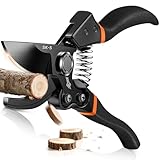 DECERK® 8.5" Professional Pruning Shears, Effortlessly Prunes 3/4" Branches
A clean, sharp pair of bypass pruning shears matters more for rose health than any other single tool: As an Amazon Associate we earn from qualifying purchases.
When to prune — climate and hemisphere
Rose timing is driven by dormancy and flowering habit, not by the calendar month, so translate the advice to your own climate. The main structural prune for repeat-flowering bush roses happens at the end of dormancy, just as the buds begin to swell but before strong new growth: that is late winter to early spring — roughly February–March in the Northern Hemisphere and July–August in the Southern Hemisphere. In mild, frost-free and subtropical climates roses barely go dormant, so prune at the coolest, quietest point of the year and expect to shape more often. In cold-winter zones (USDA 3–5), wait until the worst frosts have passed so fresh cuts are not killed back — pruning too early risks losing new growth to a late freeze. A useful cue in temperate gardens is to prune bush roses when spring-flowering shrubs like forsythia begin to bloom.
How to make the cut
Use sharp, clean pruning shears, and wear thick gauntlet gloves for thorny types. Cut about 5 mm (a quarter inch) above an outward-facing bud at a slight angle sloping away from the bud, so new growth heads outward into open space and rain runs off the cut rather than pooling on the bud. Remove dead, damaged, diseased and crossing or rubbing stems first — often this alone does most of the job. Cut back to healthy white pith; if the centre of a stem is brown, keep cutting lower until you reach clean, living wood. Wipe or dip blades between plants if disease is present, so you are not carrying blackspot or canker from bush to bush.
Hard vs light pruning — how much to take off
How much you remove depends on the rose and the effect you want. Hard pruning (cutting stems back to roughly 15–25 cm / 6–10 in with only a few buds each) suits vigorous hybrid teas and newly planted roses, and produces fewer but larger blooms on strong stems. Light pruning (removing perhaps a third of the growth) suits shrub roses, old garden roses and anything you want to keep large, and gives more, smaller flowers on a bigger framework. Most gardeners land in the middle: take out the dead and the oldest thick stems at the base, then shorten what remains by about a third to a half. When in doubt, prune more lightly — you can always take more off, but you cannot put it back.
By rose type
- Hybrid teas & floribundas (bush roses) — prune hard while dormant in late winter/early spring; reduce to an open, goblet-shaped framework of three to six strong outward-facing stems and remove thin, twiggy growth entirely.
- Shrub & old garden roses — lighter pruning; shape the bush, shorten long stems by up to a third, and remove one or two of the oldest stems at the base each year to renew it. Many once-flowering old roses are best tidied after they bloom.
- Climbing roses — prune in winter/dormancy; keep a permanent framework of main stems tied in horizontally (which encourages flowering along their length) and shorten the side shoots that flowered to two or three buds.
- Rambling roses — prune after flowering in summer, because most ramblers bloom on the previous year’s wood; remove some of the oldest stems entirely and tie in the vigorous new canes that will carry next year’s flowers.
- Groundcover & patio/miniature roses — low-maintenance; simply trim to shape and remove dead wood, with an occasional harder cut to renew them.
The old-wood vs new-wood principle is the same as for other flowering shrubs — prune ramblers and once-flowering types after they bloom, and hard-prune repeat-flowering bush roses in late winter. If you only remember one rule, make it this one.
Deadheading through the season
Repeat-flowering roses bloom more freely if you deadhead spent blooms through summer, cutting back to the first strong outward-facing leaf rather than just snapping off the flower. Stop deadheading in early autumn and leave the last flush of flowers if your rose sets hips — they give autumn and winter colour, feed birds, and signal the plant to harden off for cold. Once-flowering and rambling roses are not deadheaded for repeat bloom (they will not reflower anyway) and are pruned once, after flowering.
After pruning: feed, mulch, tidy
Once the main late-winter prune is done and growth is starting, feed with a rose fertilizer and mulch around the base with compost or well-rotted manure, keeping it clear of the stems. Crucially, rake up and bin (do not compost) all prunings and fallen leaves from around the plant — blackspot and other fungal diseases overwinter on this debris, so a clean-up after pruning is one of the cheapest disease-control steps you can take.
Common mistakes
- Pruning ramblers or once-flowering roses in winter and unknowingly cutting off the coming year’s flowers.
- Leaving dead, diseased and crossing stems that shade the centre and invite disease.
- Using blunt tools that crush and tear stems, leaving ragged wounds that die back.
- Pruning too early in a cold climate, so a late frost kills the fresh cuts.
- Being too timid for years, so the bush becomes a congested thicket of thin, unproductive wood.
Quick questions
When should I prune roses? Hard-prune repeat-flowering bush roses (hybrid tea, floribunda) at the end of dormancy in late winter/early spring; prune ramblers and once-flowering roses in summer, after they bloom.
Can I kill a rose by pruning it wrong? Almost never. The worst usual outcome is losing a season’s flowers by mistiming a once-flowering type, or a weaker year after an over-hard cut. Roses are resilient and forgiving.
How far back can I cut an old, neglected rose? Overgrown bush and shrub roses can be renovated hard over one or two dormant seasons — remove the oldest stems at the base and shorten the rest — and usually respond with vigorous new growth.
Do I seal the cuts? No need for most roses; clean angled cuts on healthy wood heal on their own. Wound sealants are only occasionally used where cane-boring pests are a known problem.
Related guides
Part of our pruning guides — find the right guide for any plant.