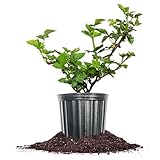
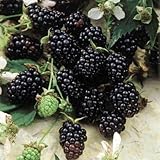
The marionberry — also written marion berry or marionberries — is a human-made Rubus hybrid: a thorny, semi-deciduous, evergreen-tending bramble grown as a vine on a trellis. It carries oval green leaves, often in groups of three, white five-petalled flowers of 1–3 cm, and glossy black aggregate fruit of 2–3 cm. It is vigorous, long-lived and generous, and almost everything that goes wrong with it comes from one of two things: not understanding how its canes work, or not putting the support in early enough.
How marionberry canes work — read this before you prune
The plant is perennial but its canes are not. The crown throws up a new set of canes each year; those canes spend their first year simply growing, and it is in the following year that they flower and fruit. Once a cane has fruited, it is spent and will not fruit again.
This explains most marionberry frustrations:
- A young plant that does not fruit is not sick. It takes 2–3 years to come into bearing, partly because the canes need to reach their second season.
- Cutting the whole plant down removes next year’s crop. The fresh canes you shear off in a tidy-up are precisely the ones that were going to fruit.
- The plant always looks like two plants in one. At any moment it holds this season’s fruiting canes alongside next season’s replacements. Being able to tell them apart is the entire purpose of trellising.
Growing marionberry from seed
Seed is possible but it is not the recommended route, and it is important to know why before you commit two or three years to it. The marionberry is a hybrid, so seedlings do not reliably reproduce the parent — you may get a bramble, but not necessarily this bramble, with its fruit size and quality. Vegetative propagation is what keeps the variety true.
If you want to raise seedlings anyway, the method is straightforward:
- Sow in spring.
- Use soil that is moist and well drained — the two together, not one or the other. Bramble seedlings rot in stagnant wet soil and stall in dry soil.
- Keep the soil constantly moist and never let it dry out. A single drying-out during germination or in the first weeks is usually fatal, because a seedling has no root reserve to fall back on.
- Use clean soil and keep other plants away from the seedbed. Bramble seedlings are slow and low for their first months, and competing weeds will out-root and shade them before they establish.
Propagation that keeps the variety true
For a plant that fruits like the one you tasted, use vegetative reproduction — this is the necessary method for marionberry, not merely the convenient one. Brambles are among the easiest plants to reproduce this way; they root readily from stems, and a rooted piece is genetically identical to the parent, so fruit size, flavour and cropping habit all carry over. It also reaches bearing age faster than a seedling. The simplest approach in a home garden is to work with the canes the plant already produces, rooting them and lifting the new plant once it is established on its own roots.
Climate and hardiness
Marionberry suits temperate, Mediterranean and subtropical climates and grows in hardiness zones 4–10, and with careful management in zone 11a. Zone 4 corresponds to winter lows of roughly −34 °C (−30 °F), so winter cold is not the limiting factor for this plant — sustained heat at the top of the range is what demands extra care, chiefly in the form of water and mulch.
Planting, step by step
You can plant in winter, spring or summer. Give the plant full sun — this is not a shade bramble, and light directly determines how much fruit ripens and how sweet it is.
- Dig a hole at least 50–100% larger than the root ball. Brambles root widely and shallowly rather than deeply, so loosening a broad area matters more than digging down.
- Mix the backfill: dead leaves, rich soil, organic matter and humus, blended together with the excavated soil.
- Set the plant in and backfill with that mixture, firming gently.
- Put the support in at planting time. A stake, post or trellis frame goes in now — driving a stake next to an established bramble later means cutting through its roots, and by then the canes are already sprawling and armed.
- Water in and mulch.
In the first season, thin the bloom until the plant is properly acclimatised. A young plant that carries a full crop spends its energy on a few berries instead of on roots and canes, and it pays for that for several years afterwards.
Trellising, thorns and safety
Trellising is listed first among this plant’s care requirements for good reason. Marionberry reaches 2–5 m (6–15 ft) and is a medium to fast grower, so an untrained plant becomes a dense, arching, thorny thicket within a couple of seasons — one you cannot reach into, pick from or prune safely.
Train as you go. Tie new canes to the support as they extend, and keep the current season’s new canes separate from the canes that are fruiting — on different wires or different sides of the frame. Do that and you never have to guess which cane is which at pruning time, and the whole crop presents itself on one accessible plane at harvest.
Two honest warnings. The thorns are the main difficulty with this plant; long sleeves and thornproof gloves are not optional equipment. And a dense, unmanaged thorny thicket is exactly the kind of cover snakes shelter in — another practical reason to keep the base of the plant open and the surroundings clear rather than letting a mound of tangled canes build up.
Water, feeding and mulch
Marionberry wants an average to large amount of water, with steady moisture especially as the fruit swells and ripens — a berry is mostly water, and drought at that stage gives small, seedy, disappointing fruit. Combine generous watering with genuine drainage; consistently wet is fine, waterlogged is not.
Fertilise in early spring as growth starts, and keep mulch and organic matter over the root zone year-round. Mulch does double duty on a bramble: it holds moisture over shallow roots and feeds the soil as it breaks down.
Pruning for easy picking
Prune once a year, in autumn or winter — the best moment is after the plant has finished fruiting. The stated goal is worth repeating, because it is unusual and it is right: prune in a way that makes the fruit easy to pick. On a thorny bramble, accessibility is not a luxury; a plant you cannot reach into is a plant that feeds the birds.
- Remove the canes that have already fruited. They are finished, and cutting them out at the base immediately releases light, air and space to the young canes carrying next year’s crop.
- Thin the inside branches. The congested interior gets no light, ripens nothing and holds humidity; opening it improves airflow and cuts disease pressure.
- Design the shape deliberately. Prune to a form you can walk around and reach through, rather than letting the plant decide its own outline.
Flowering, pollination and harvest
Marionberry flowers in spring — white blooms of 1–3 cm with five petals — pollinated by bees and other insects. The fruit follows through the spring harvest season.
The berry is an aggregate fruit, built from many small cells packed into a rounded-oval shape, 2–3 cm long and black when ripe. It has one distinguishing habit at harvest: the fruit comes away with the torus still inside it — the small pale core stays in the berry rather than remaining on the plant. That is the blackberry pattern rather than the raspberry one (a raspberry pulls off hollow), and it gives you a useful ripeness cue: a ripe marionberry releases cleanly, core and all, while one that has to be tugged is not ready.
You also have some latitude on timing — the fruit does not have to be picked fully ripe. Picking slightly early is a legitimate tactic when birds are working the row or when the fruit has to travel, at some cost in sweetness.
What to do with the crop
Marionberries ripen over a concentrated window, so plan the kitchen work before the crop arrives. Proven uses:
- Eaten raw, straight from the cane at full black.
- Cakes and baking.
- Cooked — into sauces, compotes and preserves.
- Juice.
No special treatment is needed on the fruit itself while it is on the plant; the only real work requirement is keeping the birds off it.
Growing marionberry in a container
This is not a houseplant and will not do well indoors, but it grows perfectly well in a large container outdoors.
- Start with a pot 40–60% larger than the root ball, and pot up each time the roots reach full capacity, until the plant is the size you want it.
- Change the soil in mid-winter, while the plant is least active and least disturbed by root work. Potting media lose their structure and viability over time, and replacing them is more effective long-term care than simply adding more fertiliser.
- Water an average amount with good drainage, and use water low in minerals where you can — salts build up in a pot in a way they never do in open ground.
- Mulch with pine, peat or another acid material mixed with humus and plenty of organic matter, to hold moisture in the root zone.
- Fit the trellis to the pot from the start. A container plant still produces multi-metre canes.
Pests and problems
- Redberry mite — a microscopic mite that feeds inside the developing fruit and stops individual drupelets from ripening, so a berry finishes partly black and partly hard and red. It is the standard cause of uneven, half-red brambles, and it shelters in the canes, which is one more reason to cut out spent canes promptly rather than leaving them in the plant.
- Aphids — on soft shoot tips and new canes, distorting growth and leaving honeydew. Treat them early on young canes, because those canes are next season’s crop.
- Birds — the main threat to the fruit itself. Net the plant as the berries begin to colour, holding the netting clear of the canes.
- Neglected thickets — the underlying problem behind most of the above. An untrellised, unpruned marionberry holds more disease, ripens less fruit and is miserable and hazardous to harvest.
For the full plant profile see our Marionberry growing page.
Related guides
For general seed-starting technique, see our seed germination guide.