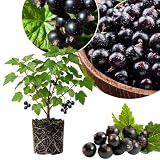
Black currant (Ribes nigrum, also sold as blackcurrant bush or cassis) is a shrub, not a tree — a point worth making because it is bought as a “black currant tree” often enough to cause real problems. Expect a multi-stemmed bush of 0.5 to 2 m (20 to 80 inches), growing at medium speed in ordinary conditions and fast in good ones. Everything about how you prune, plant and space it follows from the fact that it is a bush built on renewable stems rather than a permanent trunk.
Cold is a requirement, not a hazard
Black currants need chilling hours — a real accumulation of winter cold before the buds will break properly in spring. This is why the plant is happy across hardiness zones 3 to 9, and only manages zone 10a with careful handling. It suits temperate climates, cold Mediterranean climates and cold subtropical ones; in a mild-winter garden the bush survives but leafs out unevenly, flowers thinly and disappoints year after year for reasons that have nothing to do with your soil or watering.
Read that in reverse and it is good news: this is a fruit for gardeners whose winters are too cold for citrus or figs. Hardiness is not the limiting factor here — warmth is.
Soil, site and mulch
Black currants want soil that is rich, moist, well drained and slightly acid, and they want mulch. The two requirements are connected. Currant roots are relatively shallow and fine, so the plant is quick to feel a dry surface layer, and a mulch of organic matter keeps that zone evenly damp while slowly feeding the soil and lowering pH as it breaks down. Topping up organic matter each year is part of routine care, alongside fertilizing once annually and pruning once annually.
Grow in full sun for the heaviest crops. In hotter, less cold regions half shade is the better choice — a plant adapted to cool summers appreciates relief from afternoon heat more than it misses the light.
Watering runs from average to generous, and the right level depends on your cultivar and your soil as much as anything. On free-draining ground in a dry summer, lean towards more; the fruit swells in the weeks before harvest and a dry spell then costs you berry size directly.
Planting, including bare-root bushes
Plant in winter or spring. Summer planting is possible but best avoided. Bare-root plants have a much narrower window: winter to early spring only. Plant a bare-root currant later than that and it may simply die — it has no working root system to support leaves that the warming weather is about to force it to produce.
Planting a bare-root bush properly:
- Trim part of the roots and cut part of the top growth back. This looks brutal but it is the whole point of bare-root planting: you are balancing a reduced root system against the amount of top growth it has to supply, and the hard cut forces strong new shoots from the base of the bush.
- Enrich the planting soil with organic matter, humus and leaf litter mixed through it — material that also acidifies the soil as it decomposes, which is exactly what this plant wants.
- Increase watering after planting. A newly planted currant needs more water than an established one, right through its first season.
- Mulch once planted.
Pruning: the single job that decides your crop
Prune once a year, from the end of autumn to the beginning of winter, once the bush is dormant — anywhere through to mid-winter works. The one exception: if the bush carried only a light crop, it is better to prune straight after the fruiting season instead, so the plant puts its remaining season’s energy into the growth you have chosen to keep.
What to remove:
- Dead, weak and diseased branches first.
- Crossing branches, which rub, wound each other and let disease in.
- Old stems, and anything older than about four years. This is the heart of currant pruning. Black currants fruit best on young wood; a stem that has been in place for several years produces progressively less and shades the wood that would produce more. Cutting it out at the base is not damage — it is how you keep the bush renewing itself.
- Excess branches generally. Reduce the count so light reaches all the fruit.
That last point is worth dwelling on, because crowding causes two separate problems at once. A congested bush ripens poorer fruit, since berries in shade never develop properly, and it gets infected far more easily — still, damp air trapped inside a thicket is ideal for fungal disease and for the pests below. Openness is a disease-control measure as much as a fruiting one.
If you specifically want larger berries, reduce the number of fruit buds you leave. Fewer berries per stem means each one draws on a bigger share of the same resources. It is a straightforward trade of quantity for size, and worth doing on a bush grown for dessert fruit rather than for jam and cassis.
Work in gloves. Old currant wood can be prickly, and you will be reaching deep into the bush to cut stems at the base.
Propagation: why you should not start from seed
Black currants are propagated vegetatively for good reason. Seed is hard to work with, and more importantly seedlings do not reproduce the parent — you lose the fruit quality and the pest resistance that a named cultivar was selected for, on a plant that is already noted for being sensitive to a lot of pests. Take cuttings or suckers instead.
Cuttings
Take hardwood cuttings in late winter to early spring (any season is possible under glass). Root them in moist soil at high humidity; peat-based mix works best and rooting hormone noticeably improves the strike rate. Currants root readily — this is one of the easiest fruit bushes to multiply.
Suckers
The bush throws suckers from the base. Separate them in winter, while everything is dormant, and transplant them straight away. You get an instant, already-rooted plant identical to the parent.
If you do want to try seed
The seed needs cold stratification: hold it at 0 °C for two to three months before sowing. That period of cold is the seed’s equivalent of the chilling hours the bush itself demands — without it, germination is erratic. Sow at the beginning of spring, after the last frost, into rich, moist, well-drained soil in full sun. Make a shallow hole of only 2 to 4 mm and cover the seed lightly; buried too deep, it will not come up.
Pests and diseases
Black currants are sensitive to a wide range of pests, and three matter most:
- Gall (big bud) mite — microscopic mites feeding inside buds, which swell into fat, round, obviously abnormal buds over winter. Those buds never produce fruit. Pick off and destroy affected buds while pruning; they are easiest to spot on a bare bush.
- Aphids — they attack the shoot tips and undersides of leaves, causing puckering and distortion, and they arrive first on soft, crowded growth.
- Spider mite — a hot, dry-air pest, showing as fine speckling and a dull, bronzed look to the leaves. Keeping the plant properly watered and mulched works against it.
All three are held back by the same cultural measure: an open, well-pruned, uncrowded bush that dries and airs quickly after rain.
Harvest, containers and expectations
The fruit is black-purple and small, 0.5 to 1.5 cm, carried in clusters that follow the flowers — white, green or pink, 5 to 20 or more per cluster. Harvest runs from summer into autumn, with the exact window depending on cultivar, so planting two different cultivars stretches the picking season considerably.
Container growing works, with one condition: you must keep the plant small through pruning, since a bush that wants 2 m of frame will not sustain itself in a pot. Choose a container comfortably larger than the root ball, keep the mix rich and moist, and be aware that pots dry out fast — the opposite of what a currant wants.
One thing it will not do is live indoors. Black currant is not a houseplant; it is deciduous and needs a real winter, and no windowsill can supply the chilling it requires.
For the full plant profile see our Black currant plant growing page.
See also: rooting hormone for cuttings
See also: rooting hormone for cuttings
Related guides
Not sure which pruning approach applies? See our guide to choosing the right pruning method.