

Plant Profile & Key Characteristics
Overview: A trailing/climbing evergreen perennial grown as a houseplant for its striking purple, velvety-hairy foliage. It reaches about 50-100 cm and is usually trained on a support or allowed to trail.
Quick Specifications
| Specification | Attribute |
|---|---|
| Plant Type / Life Cycle | Perennial (evergreen, shrubby vine) |
| Foliage Type | Evergreen |
| Mature Size | 50-100 cm (20-40 in) |
| Growth Rate | Slow |
| Toxicity | Non-toxic / pet-safe |
| Hardiness | USDA zone 10b+ |
Growth Form & Structure
- Height & Spread: 50-100 cm; trails or climbs with support (the source notes it benefits from trellising).
- Growth Habit & Form: Soft-stemmed sprawling/climbing vine, best trained on a trellis or grown in a hanging pot.
- Lifespan & Maturity: A short-lived, somewhat weak perennial, usually refreshed from cuttings as older plants grow leggy.
Anatomy & Physical Features
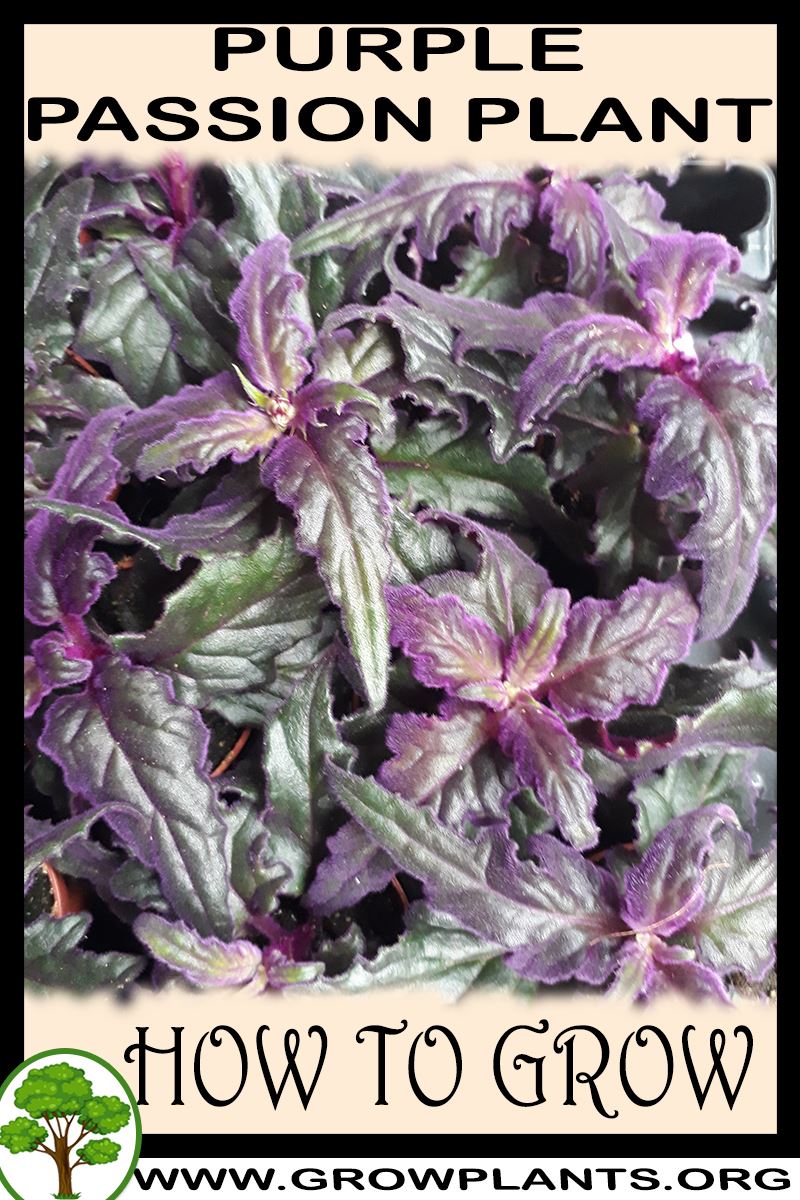
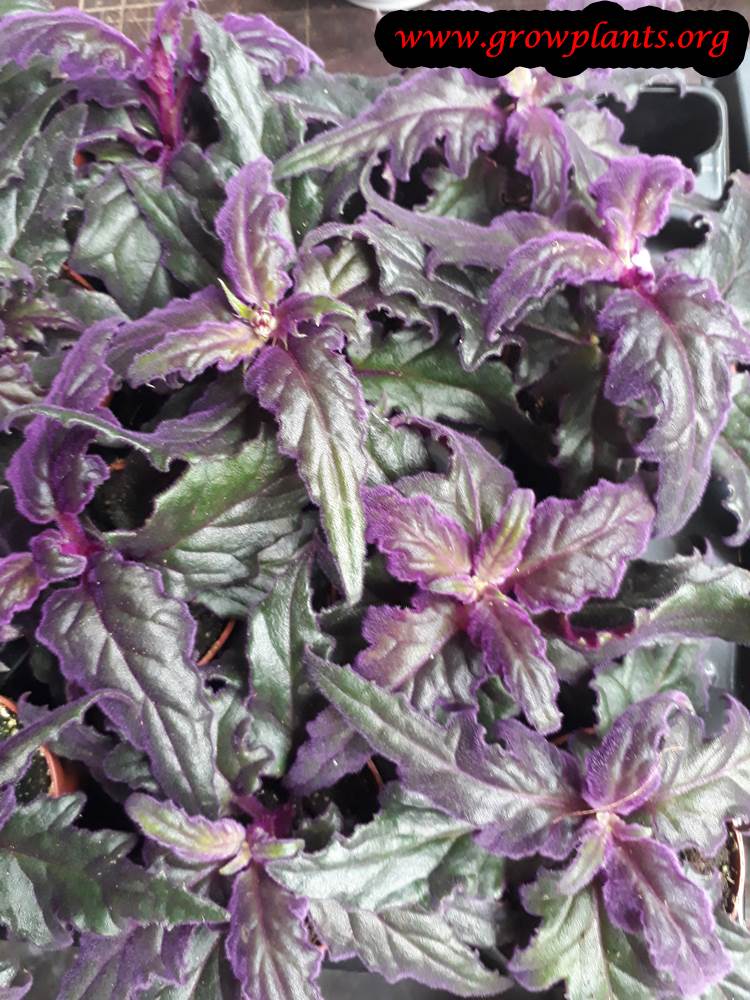
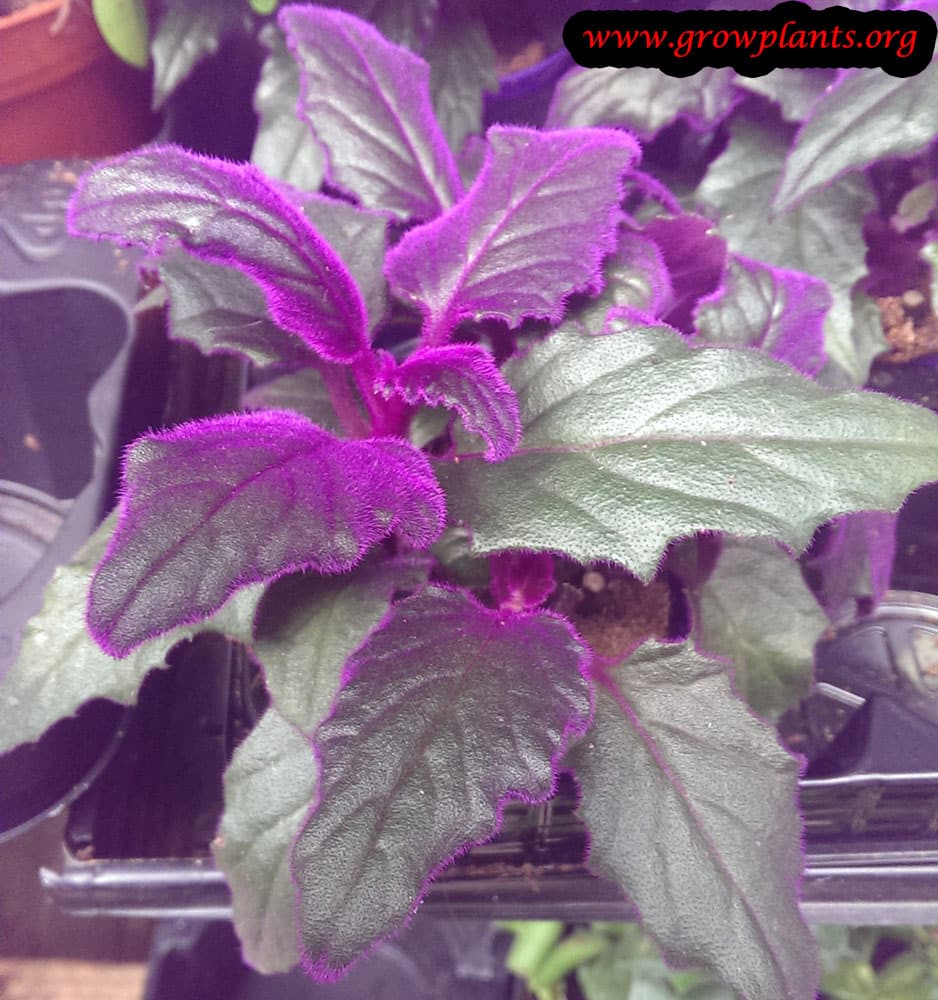
- Leaves & Foliage: Purple-green leaves covered in fine, velvety purple hairs – the main ornamental feature.
- Flower Characteristics: Small orange-yellow flowers with multiple needle-like stamens.
Primary Uses & Landscape Value
- Functional & Ornamental Roles: Ornamental foliage houseplant for containers and hanging baskets.
Care Guide: Planting, Soil & Watering
Overview: The purple passion plant is a tender trailing houseplant grown for its velvety, purple-haired foliage. It likes a rich, moisture-retentive but well-draining potting mix kept lightly moist, warm conditions, and a support to climb.
Quick Care Requirements
| Requirement | Ideal Condition |
|---|---|
| Planting Season | Year-round in warm, frost-free conditions (grown mainly as an indoor plant) |
| Growth Rate | Slow |
| Soil Type | Rich, moisture-retentive but well-draining potting mix |
| Soil pH | Slightly acidic |
| Water Need | Moderate — keep lightly and evenly moist, letting the surface dry slightly between waterings; avoid wetting the hairy leaves |
Planting & Establishment
- Best Planting Season: As a tender plant it is potted or planted year-round in warm indoor conditions; outdoors, plant only in the warm season and only in frost-free climates.
- How to Plant:
- Hole Preparation: Pot into a container a little larger than the root ball, or set it into a warm, sheltered, brightly lit spot, and provide a small trellis or support for the trailing stems to climb.
- Soil Amendments: Use a rich, free-draining potting mix with added organic matter; good drainage matters because the soft, sensitive stems rot easily if kept sodden.
- Planting Depth: Set the root ball so the crown sits at the soil surface; do not bury the soft stems.
- Growth Speed & Expectations: Expect a modest pace of growth, and note that the plant is soft and sensitive — handle it gently and pinch back stems to keep it bushy as it fills out and trails.
Soil, Watering & Drainage Care
- Soil Mix & Drainage Needs: Grow in a light, rich, free-draining potting mix; make sure the pot drains freely, as the fleshy, hairy stems and leaves are prone to rot in cold, wet soil.
- Watering Schedule & Technique:
- Young / Newly Planted: Keep the mix evenly moist while the cutting or young plant roots in, watering at the base to avoid wetting the velvety leaves.
- Established: Water when the top of the mix begins to dry, keeping it lightly moist but never waterlogged; water from below or at the soil to protect the foliage.
- Seasonal Adjustments: Water more freely in warm growth and reduce in cooler weather, always letting the surface dry a little between waterings.
Climate, Light & Hardiness
Purple passion plant is a tropical, velvety-leaved vine grown mainly as a houseplant, though it can also grow outdoors in tropical, Mediterranean, and subtropical climates from USDA zone 10b and warmer. It tolerates full sun to full shade, but direct sun should be avoided during the hottest part of summer.
Quick Climate Specifications
| Climate Zones | Tropical, mediterranean, subtropical |
|---|---|
| USDA Hardiness Zones | 10b and warmer |
| Light Conditions | Full sun (except peak summer heat) to full shade |
| Frost Tolerance | None |
Sunlight & Light Exposure
Optimal Light Setup
Adaptable from full sun to full shade, though bright, indirect light brings out the best purple leaf coloration.
Shade & Heat Management
Direct sun should be avoided during hot summer conditions, when it can scorch the fuzzy foliage; more shade is appropriate at that time of year.
Temperature Extremes & Hardiness
USDA Hardiness & Regional Limits
Reliable outdoors only from zone 10b and warmer; elsewhere it is grown as a houseplant, kept in warm, frost-free indoor conditions year-round.
Frost Sensitivity
Frost-tender, as typical of a tropical species; cold will damage or kill the plant.
Growing in Pots, Balconies & Indoors
Purple passion plant (Gynura aurantiaca) is a soft, velvety-leaved trailer grown for the purple sheen on its foliage – the grower confirms it makes a good houseplant and a good container plant. At 50-100 cm of spreading, trailing growth it is ideal for a pot on a bright windowsill, a shelf or a sheltered balcony.
Quick Details
- Container Size: A medium pot of about 5-15 L, or a hanging basket to show off the trailing stems
- Indoor Suitability: A good houseplant – it is grown mainly indoors for its coloured foliage
- Best Spot: Bright light: full sun (but not scorching midsummer sun), half shade or full shade
- Soil & Drainage: Free-draining, organic-rich potting mix
- Watering in Pots: Average – keep lightly moist; let the surface dry slightly between waterings and avoid wetting the hairy leaves
Indoors & On the Windowsill
- As a houseplant: The grower marks it ‘yes’. Bright, indirect light gives the strongest purple colour; too little light and the velvet fades to plain green. Keep it out of harsh midsummer sun, which scorches the leaves.
- Humidity & pinching: It enjoys normal-to-warm room conditions; pinch the tips to keep it bushy, as older plants get straggly – it is easy to renew from cuttings.
On a Balcony or Patio
- Light & shelter: On a balcony give it a bright but protected spot out of fierce midday sun and strong wind, which batter the soft leaves.
- Watering: Pots dry faster outside – keep the mix lightly moist, watering at the base to keep the fuzzy foliage dry.
Choosing the Pot, Soil & Long-Term Care
- Pot & drainage: A pot with good drainage holes. Use a pot with strong drainage holes and skip a standing water saucer – constantly wet feet are the quickest route to root rot. Terracotta breathes and dries quickly (good for plants that dislike wet feet); glazed or plastic pots hold moisture longer.
- Potting mix: A light, aerated, organic-rich potting mix – a peat- or coir-based blend with perlite or vermiculite for free drainage.
- Feeding & renewal: Potted plants exhaust their food faster than those in the ground, as watering leaches nutrients out; feed lightly but more regularly through the growing season. Replace leggy old plants every year or two from easy stem cuttings.
Fertilizing & Feeding
A light feeder: this trailing houseplant is grown for its velvety purple-green foliage rather than for vigorous growth, and its own care notes describe it as a weak, sensitive grower, so light, infrequent feeding suits it far better than a heavy feeding routine.
Quick Fertilizing Specs
| Feeding Level | Light feeder |
|---|---|
| Main Nutrient Priority | A balanced houseplant fertilizer with adequate nitrogen to support foliage color and trailing growth |
| Best Feeding Period | During active growth in the warmer months |
| Organic Options | A diluted balanced liquid feed is easier to control than granular products for this sensitive houseplant |
| Reduce/Stop Feeding | Feeding is best eased off and then withheld once growth slows or indoor light levels drop |
| Micronutrients | Iron and manganese are usually adequate from a complete houseplant fertilizer |
| Soil pH | Prefers slightly acidic, evenly moist, well-drained soil |
Feeding by Growth Stage
Establishment after planting or repotting
Let a newly planted or repotted purple passion plant settle in and recover roots before it is asked to support new growth with fertilizer.
| Nutrient direction | None – withhold fertilizer while the plant recovers from planting or repotting. |
|---|---|
| Timing | Immediately after planting or repotting. |
| Frequency | No feeding at this stage. |
| Fertilizer types | No feeding at this stage; let the plant settle into fresh or existing soil first. |
| Precautions | Do not fertilize until new growth confirms the plant has resumed active growth; this weak, sensitive grower is easily stressed by feeding too soon after disturbance. |
Active growth
Support steady trailing stems and the rich purple-green velvet foliage this vine is grown for.
| Nutrient direction | A balanced houseplant fertilizer with adequate nitrogen keeps foliage color and trailing growth going, applied lightly given this variety’s noted sensitivity. |
|---|---|
| Timing | Through the warmer months while the plant is actively producing new growth and trailing stems. |
| Frequency | Light, infrequent feeding is usually enough for this modest, slow-growing houseplant. |
| Fertilizer types | A balanced, diluted liquid houseplant fertilizer, A complete controlled-release houseplant fertilizer applied lightly |
| Routine trace nutrients | iron, manganese |
| Precautions | Because this plant is noted as weak and sensitive, favor a diluted, lighter feeding over a full-strength product, and keep soil evenly moist without letting it become waterlogged. |
Low-light or slow-growth period
Avoid pushing feed into a plant that has slowed under lower indoor light or cooler conditions.
| Nutrient direction | None – withhold fertilizer while growth is slow. |
|---|---|
| Timing | During shaded, low-light, or cooler indoor periods when new growth visibly slows. |
| Frequency | No feeding at this stage. |
| Fertilizer types | No feeding at this stage; resume light feeding only once active growth returns. |
| Precautions | Do not fertilize a plant that is not actively growing; unused fertilizer salts can build up in the soil and stress this sensitive houseplant. |
Nutrient Deficiency Signs & Corrections
Older leaves lose their rich purple-green color and trailing growth slows noticeably.
| Possible causes | low available nitrogen from infrequent feeding, old or compacted potting soil that has lost nutrients, insufficient light limiting nutrient uptake and growth |
|---|---|
| Appears first on | older, lower leaves |
| What to check | recent feeding history, light levels the plant is receiving, age and condition of the potting soil |
| Possible correction | Resume light, balanced feeding once active growth is confirmed, and consider repotting into fresh soil if it has not been changed in some time. |
New leaves emerge pale or yellowish while the veins stay darker.
| Possible causes | soil pH drifting outside the slightly acidic range this plant prefers, waterlogged, poorly drained soil limiting root uptake, low iron availability in an old potting mix |
|---|---|
| Appears first on | newest growth |
| What to check | soil pH and drainage, watering consistency, whether a complete fertilizer with iron has been used recently |
| Possible correction | Correct soil pH toward slightly acidic and apply a chelated iron product per its label if the pattern persists. |
Leaf edges brown or curl and lower leaves may drop despite regular watering.
| Possible causes | fertilizer salt buildup from feeding this weak-growing plant too heavily or too often, under-watering that concentrates salts in the soil, old potting soil with poor drainage |
|---|---|
| Appears first on | leaf tips and margins |
| What to check | recent fertilizer strength and frequency, drainage of the pot and soil mix, watering consistency |
| Possible correction | Ease off feeding, flush the soil thoroughly with water, and resume only light feeding afterward. |
Pruning, Training & Seasonal Maintenance
Purple passion plant is a soft-stemmed, trailing/scrambling subshrub grown almost entirely for its velvety purple foliage, so it tolerates frequent, light pruning very well and actually needs it to stay full – left alone, its stems stretch and go bare at the base within a season or two. It has no true dormant season in its warm growing range (hardiness zone 10b+) or indoors, so pinching and shaping can happen year-round rather than on a fixed calendar; pruning mainly affects density and habit here, not flowering, since the small orange-yellow flowers are usually pinched out as buds rather than left to open.
Quick Pruning & Maintenance Specs
| Pruning Tolerance | High – soft stems pinch and heal easily |
| Primary Pruning Window | Year-round (no fixed dormant season in its growing range) |
| Typical Frequency | Light pinching every 2–4 weeks during active growth |
| Main Objective | Keep habit compact and bushy, prevent bare/leggy stems, remove flower buds |
| Young Plant Priority | Repeated tip-pinching to establish multiple branch points early |
| Mature Plant Priority | Renewal by fresh cuttings once the base goes bare and woody, rather than rejuvenating the same plant |
| Best Tool Type | Fingers for pinching; precision snips for older, thicker stems |
| Avoid Heavy Pruning During | Cool, low-light periods when this naturally slow-growing plant is slow to push new growth |
Pruning by Plant Age & Size
Newly Established
Let a new plant or rooted cutting put on a couple of sets of leaves before the first pinch – pinching a barely-rooted cutting slows establishment rather than helping it.
Young / Formative
No formal training framework applies; this is pinch-training only. Pinch out the growing tip just above a node every few weeks to break apical dominance and force side shoots, producing a full plant instead of one or two long trailing stems.
Mature / Established
Continue routine pinching and trim back any stem that has outgrown the display. Treat an old plant with bare, woody-looking lower stems as a candidate for replacement by cuttings rather than for hard rejuvenation – this species is noted as weak/sensitive with age and roots readily from tip cuttings, so starting fresh is usually more reliable than trying to force an old base to refill.
Structural Pruning & Training
Because this is a scrambling/trailing subshrub rather than a self-supporting one, structure is managed entirely through pinching and length control rather than branch selection or a defined framework. Trim trailing stems back to a node to control spread in a hanging basket, or use light staking/a small trellis if an upright habit is preferred over trailing.
Special Growth to Remove
- Flower buds: the orange-yellow flowers are minor ornamentally and best pinched out in bud so the plant’s energy stays in foliage production.
- Leggy, sparse stems: stems that have stretched with few leaves (common in lower light) should be cut back to a leafy node or removed and replaced via cutting.
- Faded or damaged leaves: remove at the leaf base once colour fades or after pest damage.
Container & Small-Space Pruning
Grown almost exclusively as a houseplant or hanging-basket subject, so pruning here is chiefly about keeping the plant proportionate to its pot: pinch to control trailing length, and cut back by up to about a third to renew density if it thins out. Because it is naturally slow-growing, don’t expect (or force with heavy feeding) a fast rebound after a hard cut – regrowth will be gradual.
Tools
Fingers for routine pinching; clean precision snips for thicker stems on an older plant.
Tool Hygiene & Disease Risk
Routine – no serious transmissible disease is associated with this species; its main problems are spider mites and aphids, which are pest issues rather than tool-borne, so clean, sharp tools are sufficient without between-cut disinfection.
Cut Placement & Technique
Pinch or cut just above a leaf node, angled slightly so water doesn’t pool on the cut. When removing a whole stem for renewal, cut back close to a lower node or to the base rather than leaving a bare stub.
Heavy Pruning & Rejuvenation
Tolerates a hard cutback of leggy stems and can resprout from remaining nodes given warmth and light, but recovery is slow given this plant’s naturally slow growth rate. Because older plants also decline in fullness and colour regardless of pruning, propagating fresh stem cuttings is generally a more reliable way to “rejuvenate” a tired plant than repeated hard pruning of the same one.
Post-Pruning Care
Keep the plant in bright, indirect light and maintain even moisture after cutting back; skip heavy fertilizing immediately after a hard prune, and watch new growth closely for spider mites, a pest this species is prone to.
Common Pruning Mistakes
- Letting stems run long before the first pinch, producing a sparse, bare-based plant that pruning alone can’t fix.
- Leaving flower buds to open – they add little ornamentally and draw energy from foliage growth.
- Trying to rejuvenate a very old, bare-based plant instead of starting fresh from cuttings.
When NOT to Prune
Avoid heavy cutbacks during cool, low-light winter periods or right after cold stress, since this is a frost-tender, slow-growing plant that is slow to push new growth until conditions warm up again.
Recommended Tools (by task)
- Tip pinching, all ages: precision_snips – clean nips on soft stems where fingers alone can bruise tender growth.
Propagation Guide
Purple passion plant is propagated almost exclusively from stem tip cuttings, which root quickly and easily in water or a light potting mix. Seed is rarely used for this houseplant, so vegetative cuttings are both the standard and the recommended way to start new plants, and overall propagation difficulty is easy.
Quick Propagation Specs
| Best Propagation Method | Stem tip cuttings |
| Propagation Difficulty | Easy |
| Vegetative True-to-Type | Yes |
| Best Propagation Season | Spring–summer for fastest rooting; the site notes planting is possible all year, but cuttings root more slowly in cool, low-light periods |
| Cutting Rooting Time | Typically 1–3 weeks under warm, bright-indirect conditions |
Stem Cuttings
Cutting Type
Softwood tip cuttings, roughly 8–12 cm (3–5 in) long with 2–3 leaf nodes.
Best Timing
Spring through summer during active growth gives the fastest, most reliable rooting; indoors it can be attempted at other times given the site’s all-year planting window, though expect slower rooting in cooler, dimmer conditions.
Cutting Preparation
Cut cleanly just below a node and strip the lower leaves so none sit in the rooting medium; unlike succulents, this species does not need a long callusing wait before rooting.
Rooting Setup
Root in a glass of water or directly in a light, evenly moist, well-drained mix, in bright indirect light and average warmth. Because the site flags this plant as weak and sensitive and prone to spider mites and aphids, keep cuttings out of drafts, use clean tools and water, and inspect regularly.
Rooting Hormone
Not necessary — this species roots readily on its own — though a rooting hormone can modestly speed root initiation.
Rooting Time
Roots usually appear within 1–3 weeks under warm conditions; water-rooted cuttings can be potted into soil once roots reach a couple of centimeters.
Bloom & Flower Guide
Quick Details
- Bloom Season: Spring to summer
- Time to First Bloom: On mature, well-established plants, often once they begin to grow leggy
- Flower Appearance: Small orange-yellow flower heads with fine, needle-like stamens
- Edibility: Ornamental only – grown for its velvety purple foliage, not eaten
Detailed Blooming Overview
The purple passion plant is loved for its velvety, purple-haired leaves rather than its flowers. When a mature plant does bloom in spring or summer, it produces small orange to yellow, dandelion-like flower heads – but they carry a scent many gardeners find unpleasant, so a lot of growers simply pinch out the buds before they open.
Flower Characteristics
- Orange-yellow flower heads studded with multiple fine, needle-like stamens.
- Small and held on stalks above the trailing, purple-tinged foliage.
- Give off a scent most people find unpleasant, which is why they are often removed.
Bloom Care & Thinning
- Managing the bloom: if you dislike the smell, pinch off the flower buds as they form; flowering also tends to signal an ageing, leggy plant, so many growers take fresh cuttings around this time to keep the foliage looking its best.
- Pollination: the small flowers can attract insects, but they are of little ornamental value and are usually the least of the plant’s appeal.
Pests, Diseases & Troubleshooting
Overview: Purple passion plant (Gynura aurantiaca) is a fast, soft-stemmed trailing houseplant whose lush, velvety purple foliage is a magnet for sap-sucking insects – aphids, mealybugs, whitefly and spider mites – while its soft tissue rots readily if kept too wet or too cold. Grow it bright, warm and evenly (not soggily) moist, keep water off the fuzzy leaves, and manage pests early with gentle sprays because the hairy foliage marks easily.
Quick Troubleshooting Overview
| Issue / Pest | Main Symptom | Primary Solution |
|---|---|---|
| Aphids | Colonies on soft tips and buds, honeydew, distortion | Rinse off, insecticidal soap |
| Mealybugs | White cottony fluff in leaf axils and stems | Alcohol swab, insecticidal soap |
| Whitefly | Tiny white flies rising when disturbed, honeydew | Yellow sticky traps, soap/oil, repeat |
| Spider mites | Fine stippling, dull leaves, webbing in dry air | Raise humidity, rinse, soap/oil |
| Botrytis / root rot | Grey mould or soft blackened stem bases | Airflow, keep foliage dry, ease off watering |
Common Pests & Management
- Aphids (Aphis / Myzus spp.):
- Symptoms: Clusters of soft green or black insects on the newest shoots, buds and leaf undersides; curled, distorted growth and sticky honeydew; a very common problem on this soft, fast plant.
- Prevention & Control: Rinse off under a tap or with a gentle spray; pinch out badly infested tips. Treat with insecticidal soap, and avoid overfeeding with nitrogen, which drives the soft growth aphids love.
- Mealybugs (Pseudococcus spp.):
- Symptoms: White cottony tufts in leaf axils, along stems and on leaf undersides; honeydew, sooty mould and weakened, off-colour growth.
- Prevention & Control: Dab colonies with dilute alcohol on a cotton bud; treat with insecticidal soap or a light spray, repeating to catch the young. Inspect new plants and isolate.
- Whitefly (Trialeurodes vaporariorum):
- Symptoms: Tiny white moth-like flies that flutter up in a cloud when the plant is disturbed; nymphs on leaf undersides excrete honeydew and cause yellowing.
- Prevention & Control: Hang yellow sticky traps, spray leaf undersides with insecticidal soap or light oil, and repeat every few days to break the life cycle.
- Spider mites (Tetranychus urticae):
- Symptoms: Fine pale stippling, a dull bronzed look and fine webbing in the leaf axils; worst in hot, dry indoor air.
- Prevention & Control: Raise humidity and rinse the foliage; treat with insecticidal soap or light oil, covering leaf undersides, and repeat. Isolate affected plants.
Diseases & Fungal Issues
- Botrytis / grey mould (Botrytis cinerea):
- Symptoms: Fuzzy grey mould on soft leaves, stems or faded flowers, especially in cool, damp, stagnant air or where water sits on the hairy foliage; affected tissue rots and collapses.
- Treatment & Management: Improve airflow, water at the base and keep the foliage dry, and remove mouldy tissue promptly. Avoid crowding; a fungicide is rarely needed if culture is corrected.
- Root & stem rot (Pythium, Rhizoctonia):
- Symptoms: Soft, blackened stem bases and wilting despite wet soil; the plant collapses from the base. Caused by overwatering, cold, or soggy mix.
- Treatment & Management: Let the top of the mix dry between waterings, use free-draining compost, keep it warm, and re-root healthy top cuttings if the base is lost (it strikes very easily).
- Powdery mildew:
- Symptoms: White powdery patches on leaves in humid air with poor circulation.
- Treatment & Management: Improve ventilation and spacing; remove affected leaves and treat with a potassium-bicarbonate or sulphur fungicide if it spreads.
Growing Difficulties & Abiotic Problems
- Overwatering / cold-wet stress:
- Cause & Symptoms: Yellowing, wilting and soft rotting stem bases from soggy, cold compost; this soft plant rots quickly in the wet.
- Correction Strategy: Water when the surface dries, keep it warm and in free-draining mix, and never leave it standing in water.
- Loss of colour / legginess (low light):
- Cause & Symptoms: The vivid purple hairs fade to green and stems stretch and go bare in too little light.
- Correction Strategy: Give bright, indirect light for strong purple colour, and pinch regularly to keep growth bushy; take cuttings to renew leggy plants.
- Leaf marking from water:
- Cause & Symptoms: Water droplets sitting on the velvety hairs cause blotches and can trigger rot spots.
- Correction Strategy: Water at the base, avoid wetting the leaves, and keep humidity up by other means (pebble tray, grouping).
What Helps — Products & Tools
For purple passion keep insecticidal soap and a light horticultural/neem oil for aphids, mealybug, whitefly and mites, plus yellow sticky traps for whitefly, and a potassium-bicarbonate or sulphur fungicide in reserve for mildew. There is no spray for rot – the real "tools" are airflow, base watering, warmth and easy-rooting cuttings to renew the plant.