

Plant Profile & Key Characteristics
Overview: Osteospermum (African or Cape daisy) is an evergreen perennial (or annual) subshrub 20-50 cm tall, grown as a drought-tolerant ornamental. It flowers prolifically in a wide range of daisy colours from spring through autumn.
Quick Specifications
| Specification | Attribute |
|---|---|
| Plant Type / Life Cycle | Perennial (evergreen) in zone 9+, grown as an annual in colder zones |
| Foliage Type | Evergreen |
| Mature Size | 20-50 cm (8-20 in) |
| Growth Rate | Moderate to fast |
| Root System | Fibrous |
| Toxicity | Non-toxic |
| Hardiness | USDA zone 9+ (perennial) / 3-8 (as annual) |
Growth Form & Structure
- Height & Spread: 20-50 cm (8-20 in); well suited to containers.
- Growth Habit & Form: Bushy, mounding evergreen subshrub.
- Lifespan & Maturity: Short-lived perennial, often replaced every few years; fast to flower.
Anatomy & Physical Features
- Leaves & Foliage: Green leaves, some cultivars variegated with white or yellow margins.
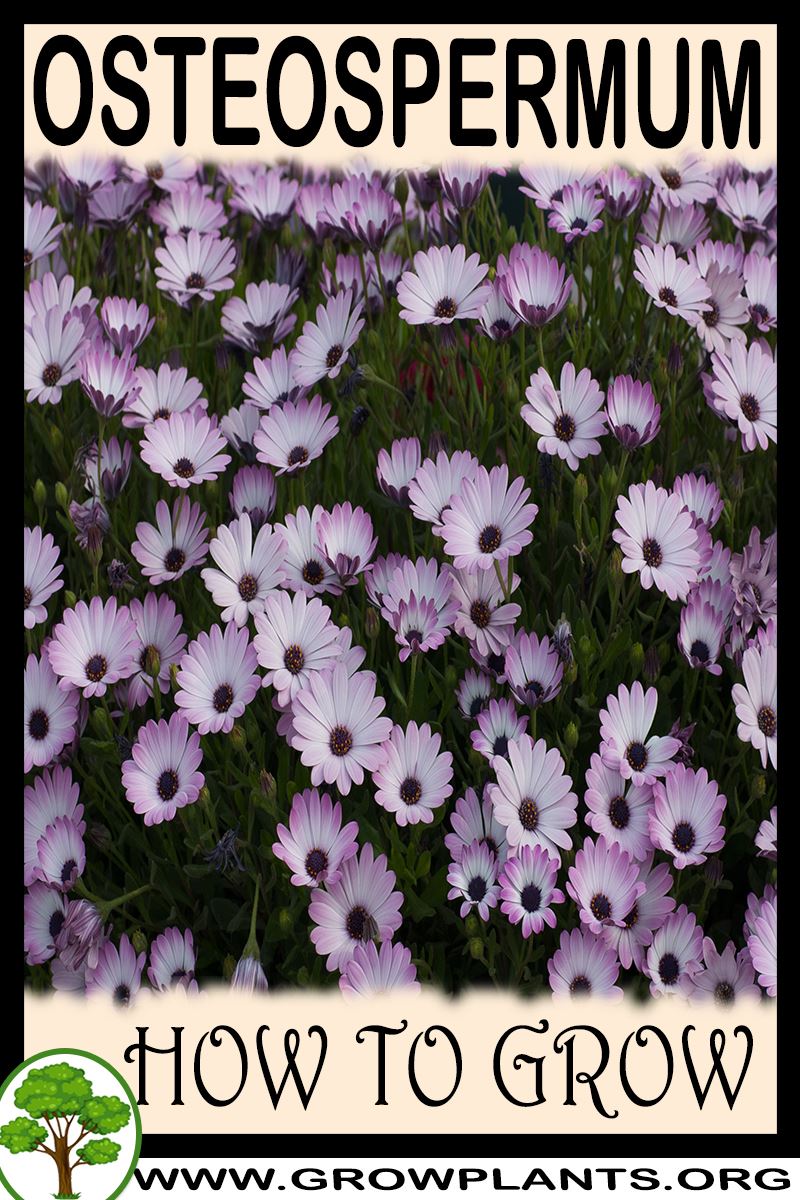
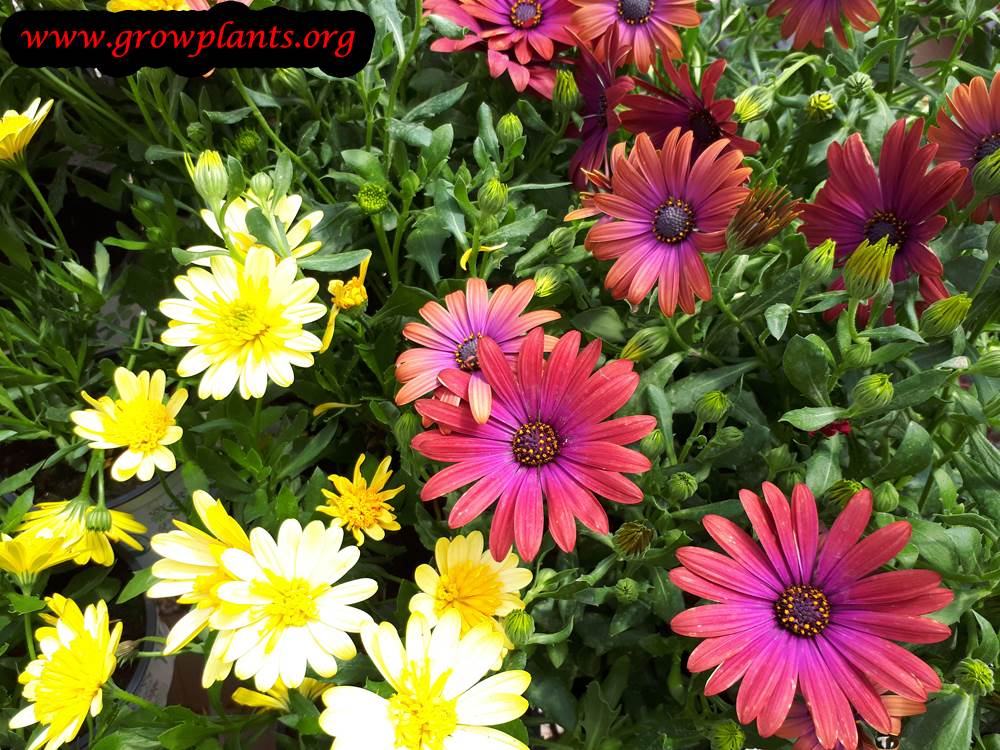
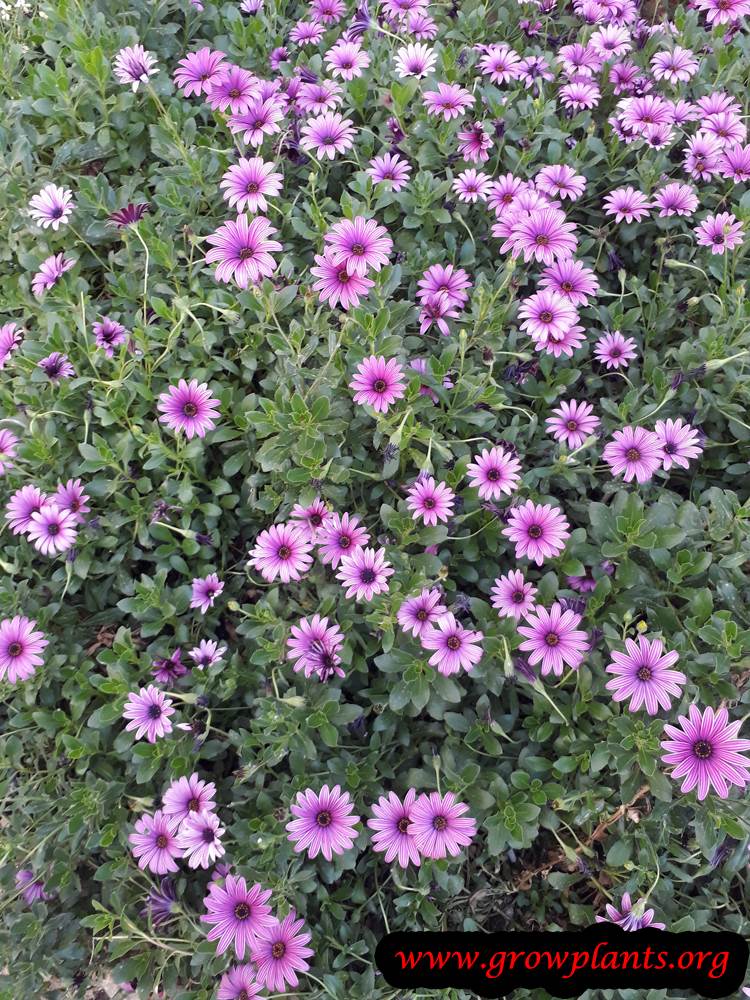
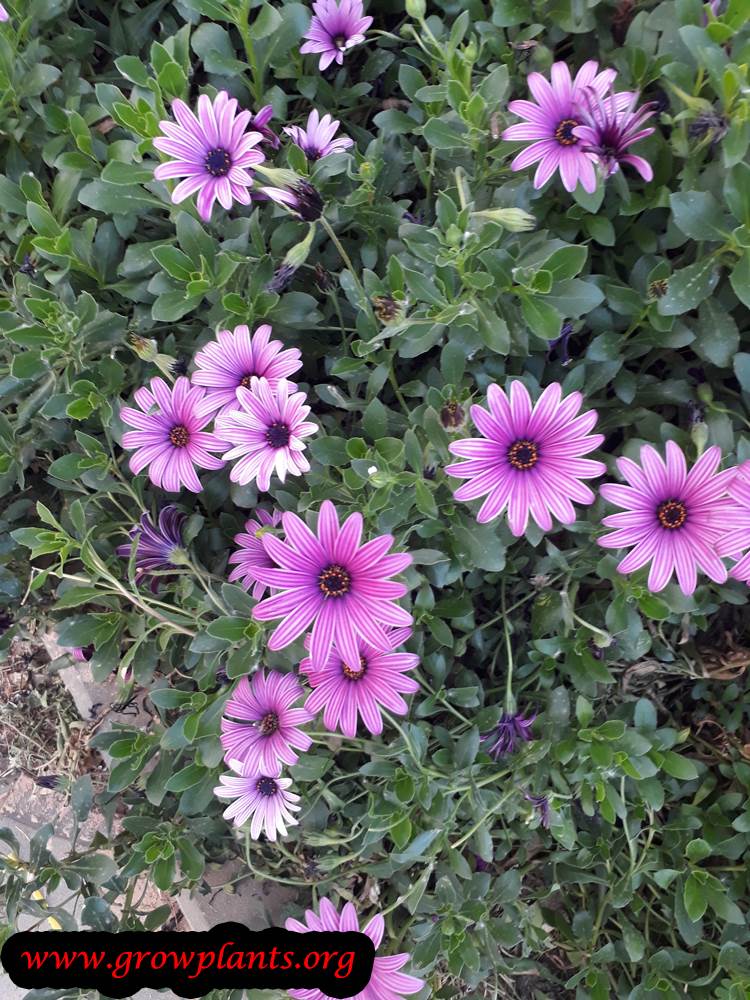
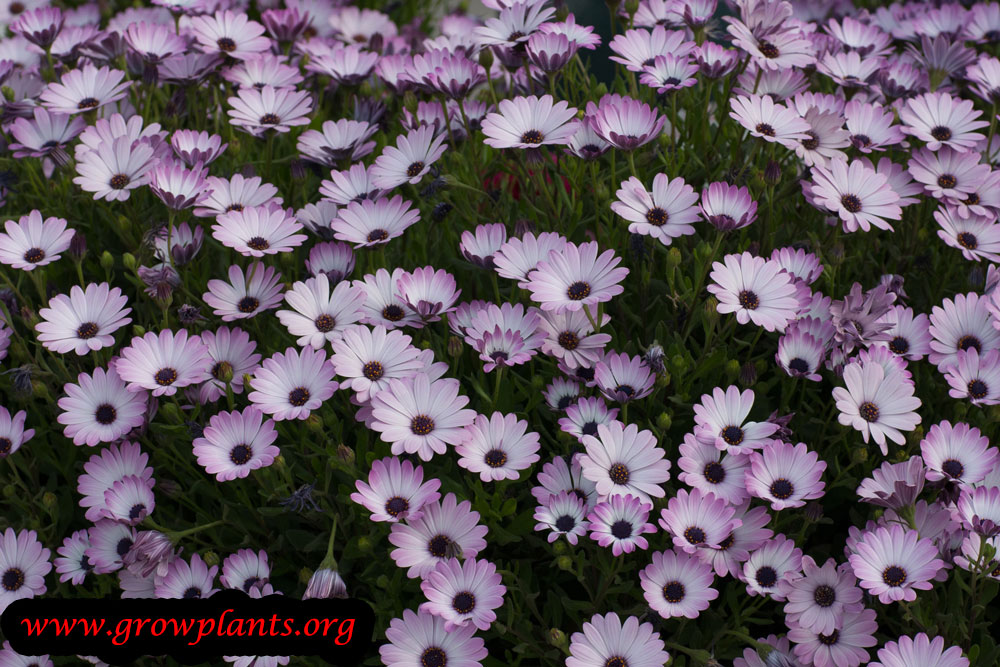
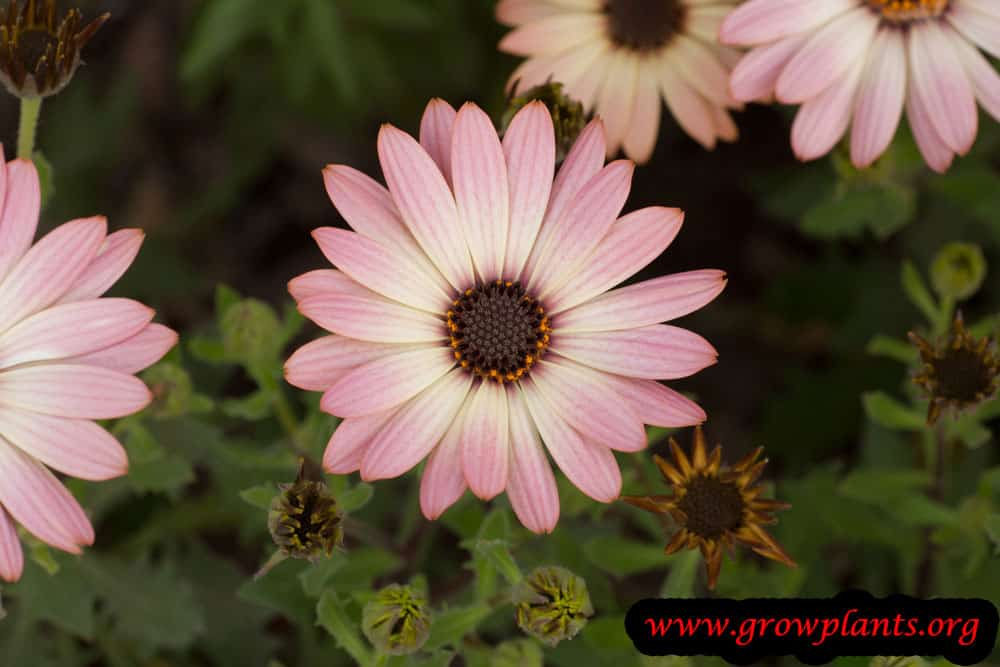
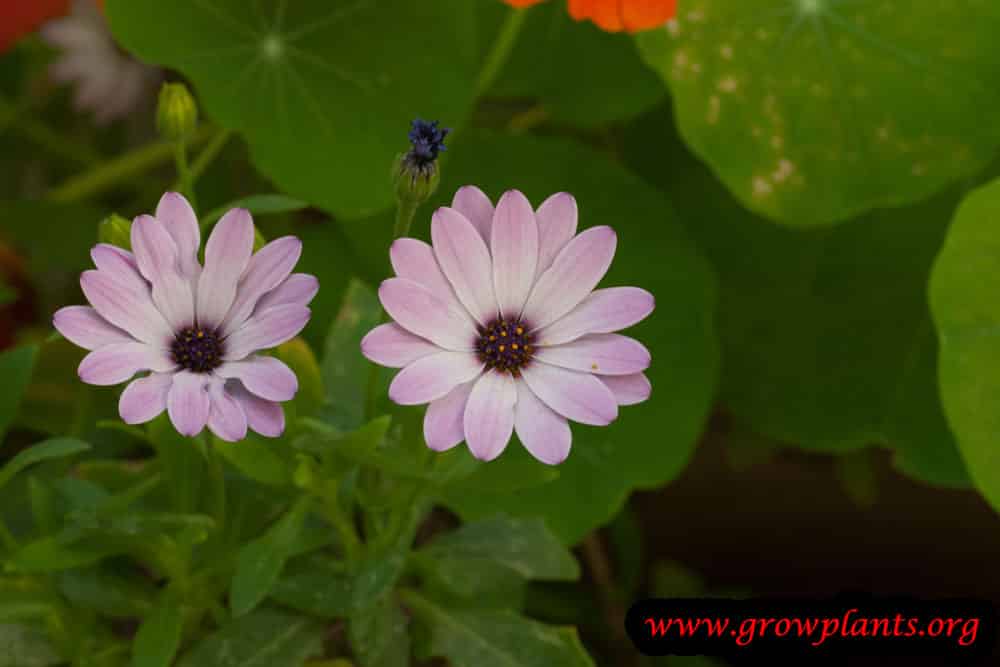
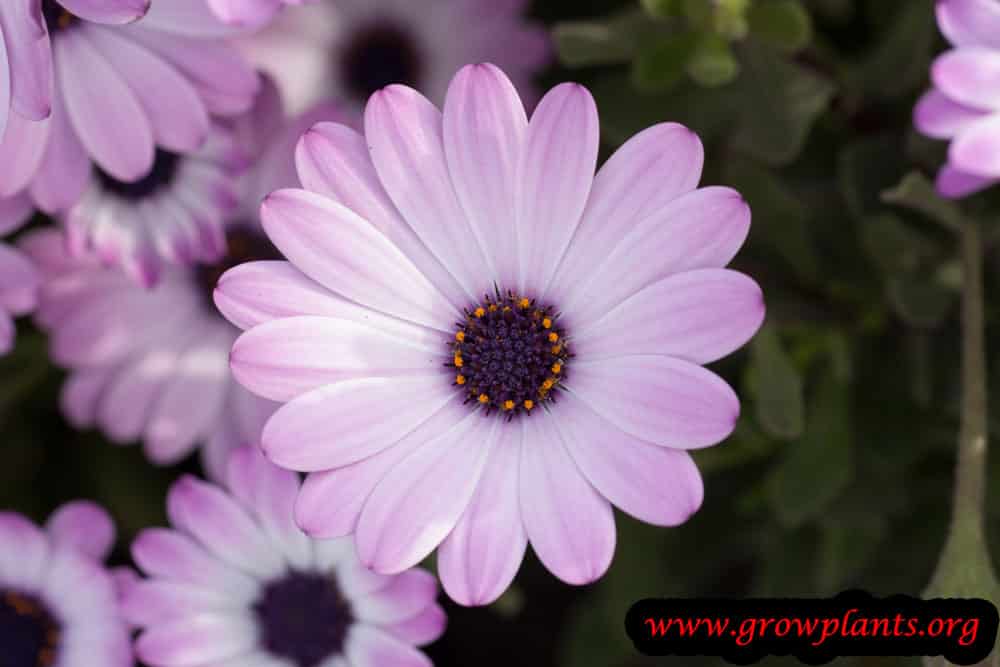
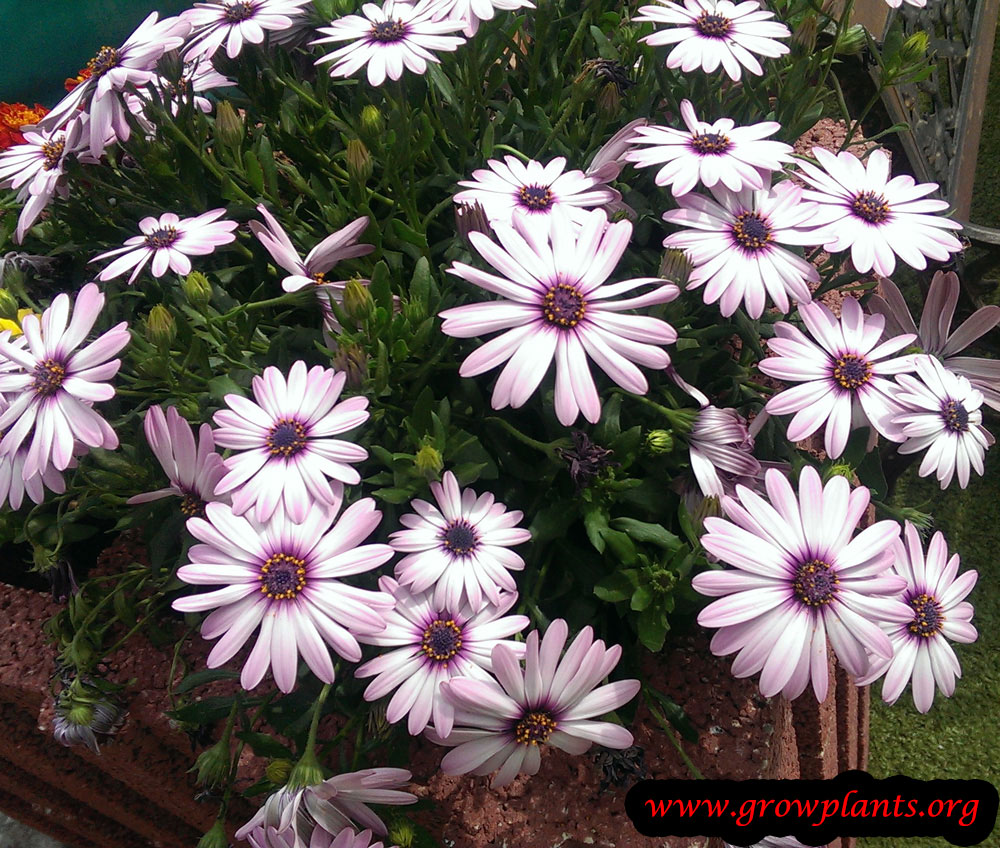
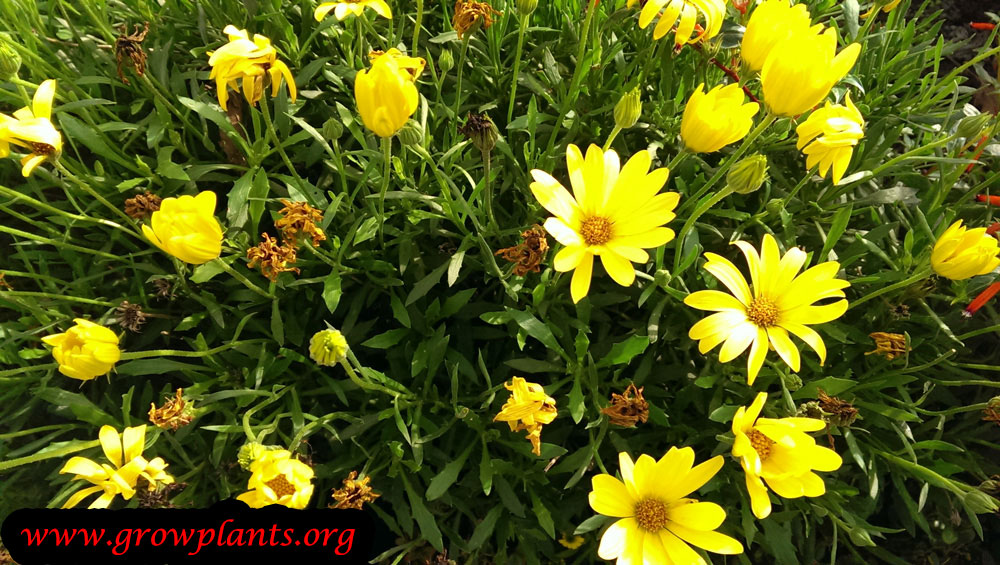
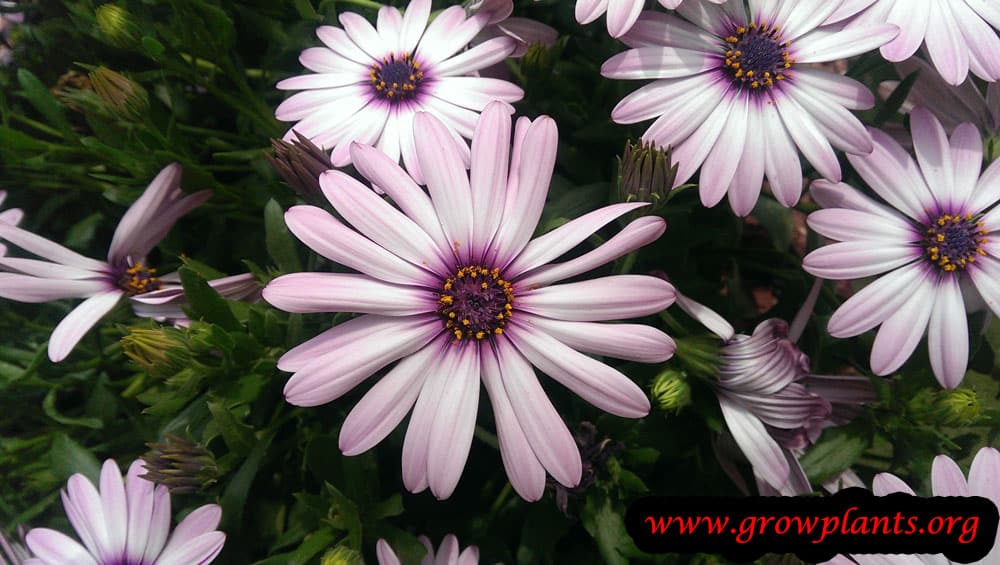
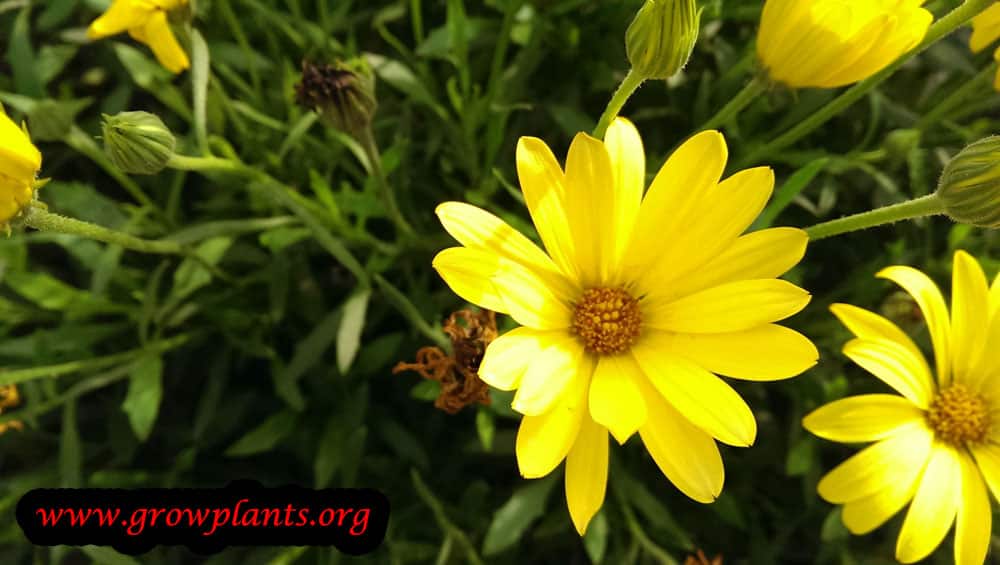
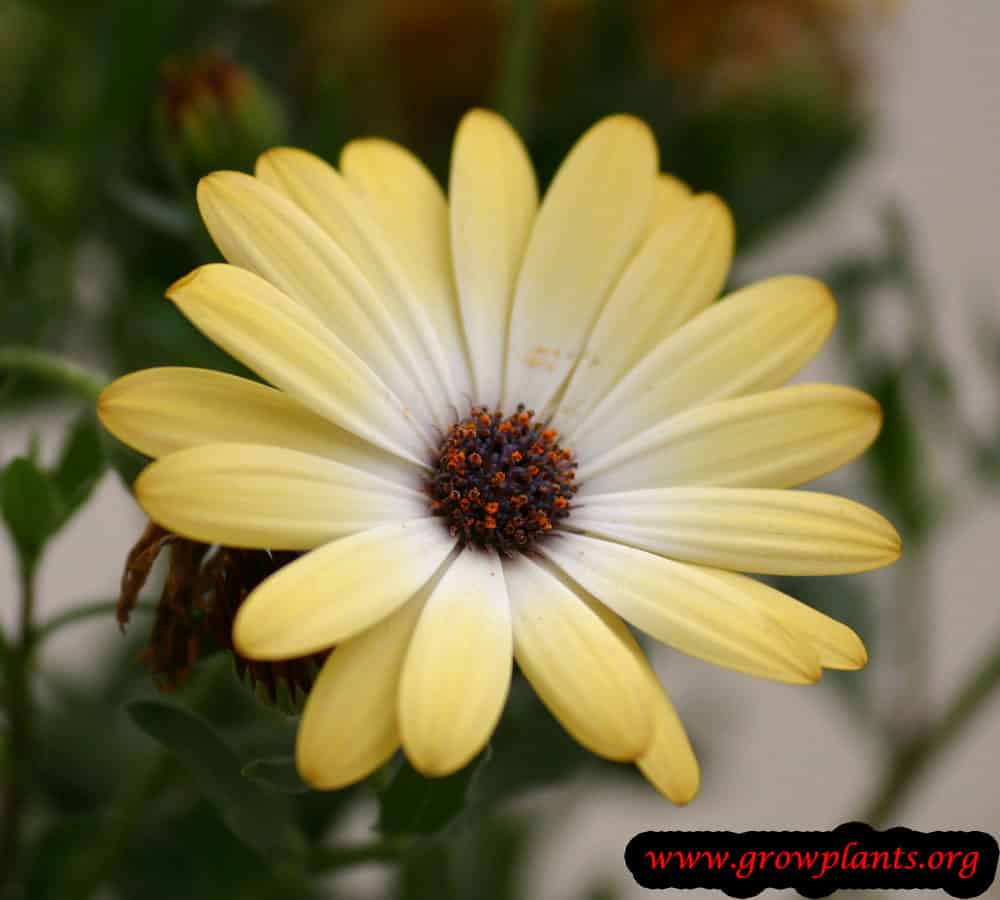
- Flower Characteristics: Round, many-petalled daisy flowers in white, purple, pink, orange, yellow or red, often bicoloured with a darker centre (full detail in the Bloom guide).
Primary Uses & Landscape Value
- Functional & Ornamental Roles: Ornamental bedding, borders and container plant; drought-tolerant and good for cutting.
Care Guide: Planting, Soil & Watering
Overview: Osteospermum (African daisy) is a free-flowering, drought-tolerant shrub that likes full sun and well-draining soil kept lightly moist. It performs best in frost-free conditions and dislikes waterlogged ground.
Quick Care Requirements
| Requirement | Ideal Condition |
|---|---|
| Planting Season | Spring to summer, after the last frost |
| Growth Rate | Moderate to Fast |
| Soil Type | Fertile, well-draining soil kept lightly moist |
| Water Need | Low to Moderate – keep lightly moist, never waterlogged |
Planting & Establishment
- Best Planting Season: Plant in spring to summer once the danger of frost has passed and the soil has warmed.
- How to Plant:
- Hole Preparation: Dig a hole a little wider than the root ball so the roots can spread into loosened soil.
- Soil Amendments: Mix in some compost or organic matter to enrich the bed, while making sure the soil still drains freely.
- Planting Depth: Set the root collar level with the surrounding soil; do not bury the stem base.
- Growth Speed & Expectations: Growth is moderate to fast, with a long flush of daisy flowers through the warm season; deadheading keeps it blooming.
Soil, Watering & Drainage Care
- Soil Mix & Drainage Needs: Use a well-draining soil that still holds a little moisture; it grows happily in containers with a good-quality, free-draining potting mix.
- Watering Schedule & Technique:
- Young / Newly Planted: Keep the soil lightly and evenly moist while the plant establishes.
- Established: Water moderately once established, letting the top of the soil dry slightly between waterings; it tolerates short dry spells.
- Seasonal Adjustments: Reduce watering in cool, wet winter weather and water more often during summer heat.
Climate, Light & Hardiness
African daisy is a drought-tolerant, full-sun-to-half-shade shrub suited to subtropical, tropical, Mediterranean, desert, and temperate climates. It behaves as a true perennial only where winters stay frost-free, and as an annual in colder gardens.
Quick Climate Specifications
| Climate Zones | Subtropics, tropics, Mediterranean, desert, temperate |
|---|---|
| USDA Hardiness Zones | Zone 9 and warmer as a perennial; grown as an annual in zones 3–8 |
| Cold Damage Begins | Approaching freezing |
| Frost Tolerance | Low |
| Light Conditions | Full sun / half shade |
Sunlight & Light Exposure
Optimal Light Setup
Full sun gives the most compact habit and heaviest bloom; half shade is tolerated with somewhat looser growth.
Temperature Extremes & Hardiness
USDA Hardiness & Regional Limits
Needs frost-free winters (roughly zone 9+) to persist as a perennial; in colder zones (3–8) it is grown as a warm-season annual instead.
Frost Sensitivity
Frost-sensitive at any age; even mature plants are killed back or killed outright by freezing temperatures.
Growing in Pots, Balconies & Indoors
Osteospermum (African daisy) is a sun-drenched, free-flowering daisy that thrives in pots and balcony containers – it is not a houseplant, but a compact plant can flower on a very bright, sunny sill.
Quick Details
- Container Size: A medium pot, about 7-15 L (2-4 gal), for a plant of 20-50 cm (8-20 in)
- Indoor Suitability: Not a room houseplant (the grower marks it “No”); only a bright, sunny windowsill will do indoors
- Best Spot: Full sun brings the most flowers; light shade is tolerated but reduces bloom
- Soil & Drainage: Free-draining, gritty or perlite-rich mix – it hates wet feet
- Watering in Pots: Low to moderate – let the top of the mix dry between waterings; it is fairly drought-tolerant
Indoors & On the Windowsill
- Houseplant limits: The grower marks it as not suitable indoors; in low light the flowers close and the plant stretches.
- Windowsill growing: A compact plant on the sunniest sill, in direct sun, will open its daisies through the day.
- Overwintering: Tender to frost; where winters are cold, overwinter the pot in a bright, cool, frost-free room and cut back lightly.
On a Balcony or Patio
- Light & wind: Loves a hot, sunny, sheltered balcony; the flowers close in dull light, so the brighter the better. Pots dry quickly against sunny walls – check them in hot spells.
- Practicalities: Deadhead for a longer show and make sure excess water drains away freely.
Choosing the Pot, Soil & Long-Term Care
- Pot & drainage: A 7-15 L pot with strong drainage holes; skip a standing water saucer to avoid root rot. Terracotta suits its dislike of wet roots.
- Potting mix: Free-draining and gritty – a general mix opened up with extra perlite or coarse sand.
- Feeding: Feed lightly through the growing season; potted plants lose nutrients to leaching, but too much feed gives leaves at the expense of flowers.
- Repotting: Pot up or refresh the mix every couple of years and trim back to keep it bushy.
Fertilizing & Feeding
Osteospermum is a drought-tolerant ornamental that flowers well on modest nutrition – it is best treated as a light-to-moderate feeder, since heavy feeding tends to produce excess foliage at the expense of its long bloom display.
Quick Fertilizing Specs
| Feeding Level | Light to moderate |
|---|---|
| Main Nutrient Priority | Balanced feeding to support steady bloom over the spring-to-autumn flowering period |
| Best Feeding Period | Through active growth in spring, summer, and autumn while the plant is in bloom |
| Organic Options | Well-drained soil enriched with compost at planting |
| Soil pH | Adaptable to a range of well-drained garden soils |
Feeding by Growth Stage
Spring establishment
Support root development and early foliage growth after planting
| Nutrient direction | Balanced feeding to build a healthy root system before the main bloom period |
|---|---|
| Timing | From spring or summer planting through early active growth |
| Frequency | Light, regular feeding while the plant establishes |
| Fertilizer types | Balanced complete fertilizer at a light rate, Well-drained soil enriched with compost at planting |
| Precautions | Avoid waterlogged, poorly drained soil, which stresses roots and can be mistaken for a feeding problem |
Spring-through-autumn bloom
Sustain the plant’s extended flowering display across spring, summer, and autumn
| Nutrient direction | Balanced feeding kept on the light side – this drought-tolerant daisy blooms best without excess nitrogen pushing soft, leafy growth |
|---|---|
| Timing | Through the main spring-to-autumn bloom period |
| Frequency | Feed sparingly through the bloom season |
| Fertilizer types | Balanced complete fertilizer for flowering plants, applied lightly |
| Routine trace nutrients | iron |
| Precautions | Overwatering combined with heavy feeding is a common cause of poor flowering in this drought-tolerant plant – err toward less of both |
Winter rest
Let the plant rest through its cool, slow-growth period
| Nutrient direction | None – withhold fertilizer while growth slows for the season |
|---|---|
| Timing | Winter, when growth is minimal or the plant has gone dormant |
| Frequency | No feeding at this stage |
| Fertilizer types | No feeding at this stage – allow the plant to rest until spring growth resumes |
| Precautions | Do not fertilize during the winter rest; resume feeding only once active spring growth is visible |
Nutrient Deficiency Signs & Corrections
Pale, washed-out foliage and reduced flower production
| Possible causes | Nitrogen deficiency, Poor, sandy soil low in organic matter, Root stress from overwatering |
|---|---|
| Appears first on | Older leaves lower on the plant |
| What to check | Soil organic matter and general fertility, Drainage and watering habits, Recent feeding history |
| Possible correction | Improve soil with compost and resume light balanced feeding appropriate to the season |
Yellowing between the veins on new leaves while veins stay green
| Possible causes | Iron deficiency, Alkaline or compacted soil reducing iron availability, Overwatered, poorly aerated roots |
|---|---|
| Appears first on | Newest growth at the shoot tips |
| What to check | Soil pH and drainage, Whether the yellowing is confined to new growth, Recent watering pattern |
| Possible correction | Improve drainage, correct soil pH where testing confirms an issue, and apply a chelated iron product per its label if needed |
Wilting and poor flowering that persists despite feeding
| Possible causes | Overwatering and root rot in this drought-tolerant species, Poor drainage, Underlying nutrient deficiency |
|---|---|
| Appears first on | Whole plant, often with lower stems affected first |
| What to check | Drainage and watering frequency, since this species dislikes wet feet, Root condition where the plant can be inspected, Container drainage if grown in a pot |
| Possible correction | Correct drainage and reduce watering frequency before assuming the problem is nutritional |
Pruning, Training & Seasonal Maintenance
Osteospermum (African/Cape daisy) is a fast-growing, somewhat woody-based perennial or annual bedding subshrub. It tolerates fairly hard cutting back, and its own facts describe year-round pruning tolerance centered on deadheading. In practice this genus is well known for two related issues that plain deadheading alone doesn’t fully solve: plants become leggy and sparse-flowering as stems age, and many cultivars slow or stall flowering in high summer heat. The main objective is therefore twofold – regular deadheading through the bloom season to sustain flower production, plus a harder cutback after the main spring/early-summer flush (or before a fresh autumn flush in mild climates) to renew compact, floriferous growth. Because flowers form on new growth, a post-flush cutback does not cost bloom – it resets the plant to produce more of it.
Quick Pruning & Maintenance Specs
| Pruning Tolerance | Moderate–High (tolerates a firm cutback within leafy growth) |
| Primary Pruning Window | After the main spring/early-summer bloom flush |
| Secondary Maintenance Window | Ongoing deadheading through the growing season |
| Typical Frequency | One firm cutback per main flush (1–2x/yr in mild climates) + continuous deadheading |
| Main Objective | Prevent legginess and summer flowering stall; sustain repeat bloom |
| Young Plant Priority | Pinch tips repeatedly to build a bushy, multi-stemmed base |
| Mature Plant Priority | Cut back by about one-third after each flush; deadhead continuously |
| Best Tool Type | Precision snips / hand shears |
| Avoid Heavy Pruning During | Peak summer heat stress |
Pruning by Plant Age & Size
Newly Established
Remove only damaged growth in the first weeks; let the plant establish before any cutback.
Young / Formative
Pinch growing tips repeatedly early on to force a dense, multi-branched base – unpinched plants grow leggier with fewer flowering stems. No formal training system applies to this low subshrub.
Mature / Established
Cut back by roughly one-third after the main flush to renew compact, floriferous growth; deadhead spent flowers continuously in between.
Seasonal Pruning Schedule
Post-Flowering (main flush)
Objective: renew compact shape and flowering vigor once the heaviest bloom period tapers. Remove: about one-third of the stems, cutting to a point with live leaves. Do not remove: stems back to completely bare wood. Expected response: a fresh flush of leafy growth and a new round of flowering within a few weeks. Flowering impact: positive over the season – a brief pause in bloom immediately after cutting, followed by renewed flowering.
Ongoing Sanitary
Objective: sustain flower production between the harder cutbacks. Remove: spent flower heads, cut to the next leaf node. Do not remove: healthy foliage or unopened buds.
Structural Pruning & Training
- Canopy density / legginess: stems age and thin without a cutback, with flowering retreating to the tips – the post-flush cut directly renews density.
- Height & spread control: cutting back keeps the plant near its mature ~20–50cm size given its fast/medium growth rate.
Special Growth to Remove
- Spent flower heads (deadhead to sustain bloom).
- Older, sparsely-flowering woody stems removed as part of the post-flush renewal cut.
Container & Small-Space Pruning
Osteospermum does well in containers (per facts). Pot-grown plants tend to stall in summer heat and decline faster than in-ground plantings, so deadhead more proactively and be willing to cut back harder mid-season to force a second flush rather than letting the plant coast on fewer, smaller flowers.
Tools
Precision snips or hand shears for both deadheading and the post-flush cutback – stems are soft-wooded and thin, so loppers or a saw are never needed.
Tool Hygiene & Disease Risk
Routine: clean tools are sufficient. Watch for aphids (per this plant’s own pest facts) on the soft regrowth that follows a cutback.
Cut Placement & Technique
Cut to just above a leaf or leaf bud, never into fully bare wood, since regrowth from old leafless stems is unreliable on this subshrub.
Heavy Pruning & Rejuvenation
A firm cutback of about one-third is well tolerated and is the standard way to counter this genus’s tendency to go leggy and stop flowering well; a badly overgrown, hollow-centered plant is better renewed from cuttings (propagation is straightforward per its facts) than forced back from bare wood.
Post-Pruning Care
Water normally after cutting back; avoid heavy feeding immediately after a hard cut, since the cutback itself is what triggers regrowth and excess fertilizer just produces softer, more pest-prone growth.
Common Pruning Mistakes
- Deadheading only and never doing the harder post-flush cutback, leading to a leggy, sparsely-flowering plant by mid-to-late season.
- Cutting hard during peak summer heat instead of right after the main flush.
- Cutting into bare wood expecting reliable regrowth.
When NOT to Prune
Avoid a hard cutback during peak summer heat stress; if flowering has stalled in heat rather than from lack of pruning, wait for cooler conditions rather than cutting back into a heat-stressed plant.
Pruning Troubleshooting
| Problem | Possible Cause | What to Check | Corrective Action |
| Leggy stems, flowers only near the tips | No cutback done after the main bloom flush | How long since any hard cut; density of stems near the base | Cut back by about one-third into live leafy growth to renew density |
| Flowering slows or stops in mid-summer | Heat stress rather than a pruning problem | Recent temperatures; whether the slowdown coincides with a heat spell | Do not hard-prune during the heat; maintain watering and wait for cooler conditions, then cut back to force an autumn flush |
| Stem fails to resprout after cutting | Cut made into completely bare, leafless wood | Whether live leaves remained below the cut | In future cut only to a point with live foliage; propagate from cuttings if the plant is now too bare |
Recommended Tools (by task)
- precision_snips – for routine deadheading and shaping.
- bypass_secateurs – for the firmer post-flush renewal cutback through thicker basal stems.
Propagation Guide
Osteospermum is most reliably propagated from stem cuttings, which is the only way to guarantee a specific named cultivar’s flower colour and form come true; seed is a viable alternative for growing the plant generally, but seedlings will not reliably match a particular cultivar. Overall propagation is easy, since cuttings root readily.
Quick Propagation Specs
| Best Propagation Method | Stem cuttings |
| Alternative Methods | Seed |
| Propagation Difficulty | Easy |
| Seed True-to-Type | No/cultivar-dependent – seed-grown plants will not reliably reproduce a specific named cultivar; cuttings guarantee cultivar identity |
| Vegetative True-to-Type | Yes |
| Best Propagation Season | Spring and summer, matching the plant’s planting season |
| Seed Germination Time | Typically a few weeks |
| Cutting Rooting Time | Usually roots within a few weeks in warm conditions |
| Germination Temperature | Around room temperature, roughly 18–22°C (64–72°F) |
| Seed Sowing Depth | Surface sow or barely cover; the seed is fine |
Growing from Seed
Sowing Season
Sow in spring or summer, matching the plant’s own planting season.
Sowing Depth & Orientation
Sow on the surface and press in lightly rather than burying, since the seed is fine.
Germination Conditions
Keep the medium lightly moist, warm and in full sun to bright light.
Germination Time
Typically a few weeks, with some variability in emergence.
Seedling Care
Grow on in well-drained, lightly moist soil; note that seedlings will not reproduce a specific cultivar’s exact flower colour or form.
Stem Cuttings
Cutting Type
Softwood tip cuttings, the standard way to keep a named cultivar true to type.
Best Timing
Spring through summer; in frost-prone climates, an autumn batch can be taken to carry stock plants through winter, since the species needs frost-free conditions to persist as a perennial.
Cutting Preparation
Trim just below a node and remove the lower leaves before inserting.
Rooting Setup
Insert into a well-drained, lightly moist mix, matching the plant’s own soil preference; keep humid until rooted.
Rooting Hormone
Optional – beneficial for faster, more even rooting but not essential.
Rooting Time
Usually a few weeks under warm, humid conditions.
Bloom & Flower Guide
Quick Details
- Bloom Season: Spring through autumn, with the strongest flushes in spring and autumn
- Time to First Bloom: Blooms quickly in its first season; as a tender perennial it flowers again each year in mild climates
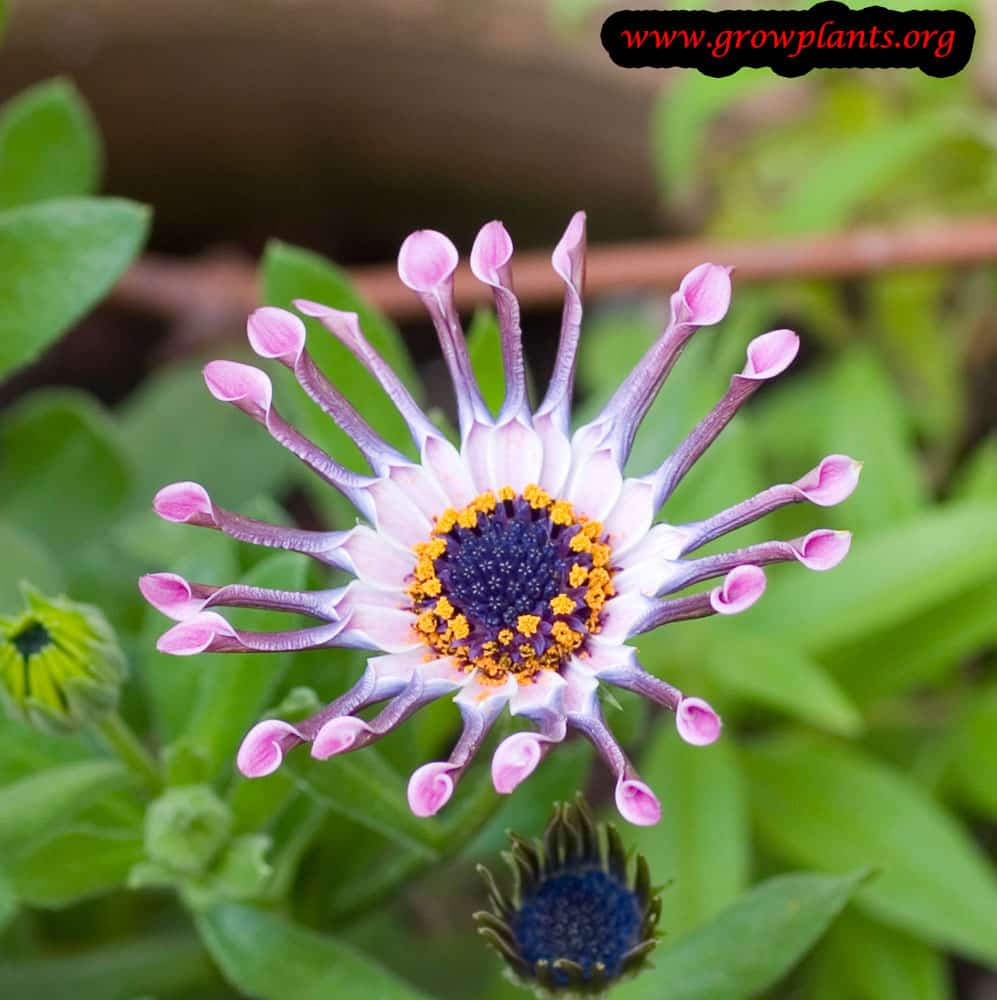
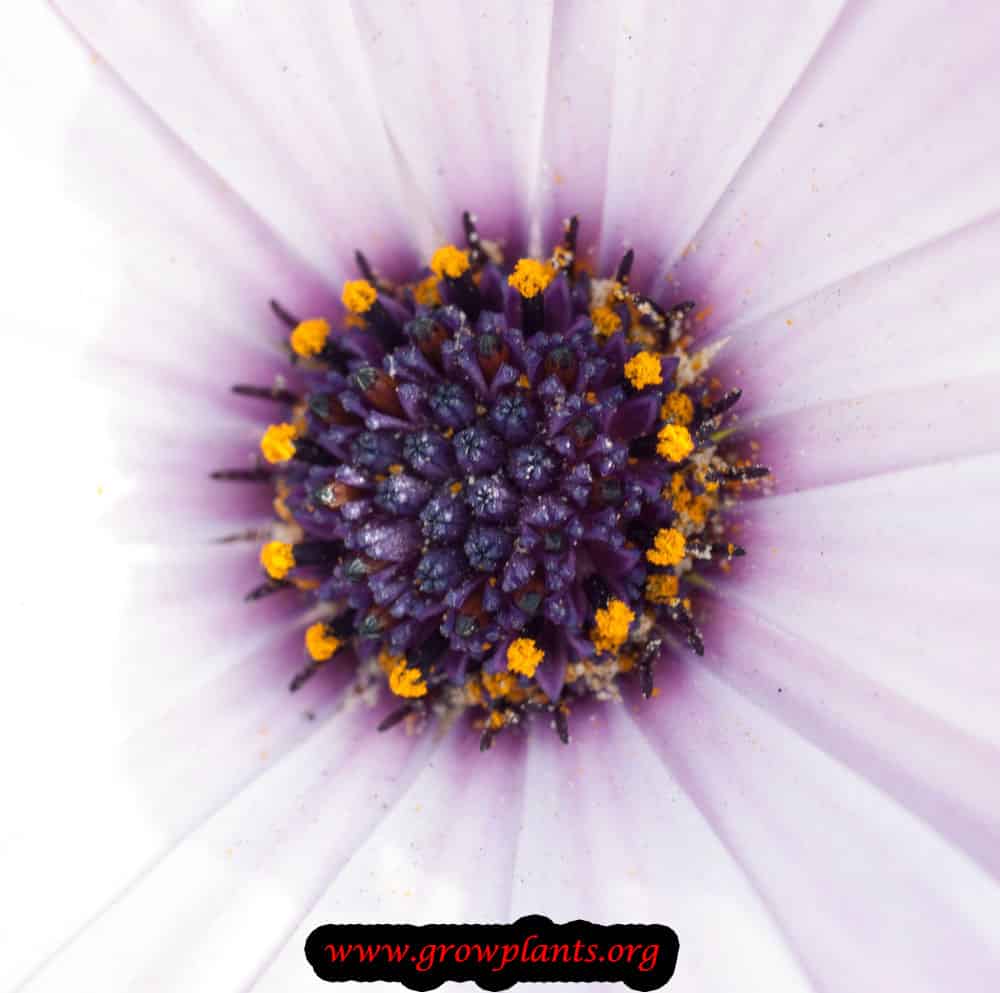
- Flower Appearance: Rounded, many-petalled daisies in white, purple, pink, orange, yellow or red, often with a darker or lighter eye and two-tone petals; some cultivars have distinctive spoon-shaped petals
- Edibility: Ornamental; not eaten
Detailed Blooming Overview
The Cape daisy is a sun-loving, drought-tough plant that flowers most heavily in the milder parts of the year. Many cultivars share a distinctive habit of closing their blooms at night and in cloudy, low-light conditions, opening again with the sun.
Flower Characteristics
- Bold daisies with a jewel-like central eye; some forms carry uniquely pinched, spoon-tipped petals.
Bloom Care & Thinning
- Managing the bloom: Deadhead to keep it flowering, and give it a light shear if it pauses during the heat of midsummer.
- Pollination: Pollinated by bees.
Pests, Diseases & Troubleshooting
Overview: African daisies are fast, free-flowering Asteraceae that attract the usual soft-plant sap-suckers – aphids, whitefly, thrips and spider mites – while their main diseases are fungal problems that appear in cool, damp, crowded or waterlogged conditions, chiefly downy mildew, grey mould and root rot. Grow them in full sun with good drainage and airflow and most trouble stays away.
Quick Troubleshooting Overview
| Issue / Pest | Main Symptom | Primary Solution |
|---|---|---|
| Aphids | Sticky, curled shoots and buds; honeydew | Water jet, insecticidal soap, beneficials |
| Whitefly | White clouds of insects; sooty mould | Yellow sticky traps, soap/neem |
| Thrips | Silvery flecking, distorted buds and petals | Blue sticky traps, soap/neem |
| Spider mites | Fine stippling and webbing in heat | Rinse foliage, raise humidity, neem/soap |
| Downy mildew | Yellow blotches with grey growth beneath | Improve airflow, avoid wet foliage, remove leaves |
| Root rot | Wilting, blackened base in wet soil | Improve drainage, water less |
Common Pests & Management
- Aphids (Aphididae):
- Symptoms: Dense clusters of green or black soft-bodied insects on new shoots, buds and flower stalks, with curling, stunting, sticky honeydew and sooty mould; also potential virus vectors.
- Prevention & Control: Knock them off with a water jet and encourage ladybirds, lacewings and hoverflies. Control ants that protect them. For heavier attacks use insecticidal soap or neem oil, spraying growing tips and bud clusters thoroughly.
- Whitefly (Trialeurodes vaporariorum):
- Symptoms: Tiny white moth-like insects that fly up in a cloud when the plant is disturbed, feeding on leaf undersides and coating lower foliage in honeydew and sooty mould, worst under cover.
- Prevention & Control: Hang yellow sticky traps to monitor and thin adults, and spray insecticidal soap or neem oil on leaf undersides, repeating to catch emerging young; encourage Encarsia parasitoids in greenhouses.
- Thrips (Frankliniella occidentalis):
- Symptoms: Slender insects whose rasping feeding causes silvery streaks and flecking on leaves and browning, distorted buds and petals; they hide deep in the flowers and can transmit viruses.
- Prevention & Control: Monitor with blue sticky traps, remove spent flowers and debris, and spray insecticidal soap or neem into the buds, repeating at intervals. Predatory mites help in protected culture.
- Spider mites (Tetranychus urticae):
- Symptoms: Fine pale stippling giving a dull, bronzed look, with delicate webbing on undersides in hot, dry conditions.
- Prevention & Control: Raise humidity and rinse the foliage, then treat leaf undersides with insecticidal soap or neem oil, repeating to break the cycle; avoid drought-stressing the plant.
- Leaf miners (Liriomyza spp.):
- Symptoms: Pale winding tunnels or blotches within the leaves where larvae feed between the surfaces.
- Prevention & Control: Pick off and destroy mined leaves, use sticky traps for the adult flies, and encourage parasitic wasps; only heavy infestations warrant a spray.
Diseases & Fungal Issues
- Downy mildew (Peronospora / Plasmopara spp.):
- Symptoms: Angular yellow blotches on the upper leaf surface with a greyish or purplish mould beneath, in cool, damp, humid conditions; leaves yellow and drop.
- Treatment & Management: Improve airflow and spacing, water at the base in the morning to keep foliage dry, and remove affected leaves. Where persistent, a copper-based fungicide gives protection, but cultural correction is primary.
- Grey mould (Botrytis cinerea):
- Symptoms: Soft browning and a fuzzy grey mould on flowers, buds and stems in cool, wet, crowded conditions; spent blooms are a common starting point.
- Treatment & Management: Deadhead regularly, thin for airflow, avoid overhead watering, and clear fallen debris. Remove affected parts promptly; fungicides are rarely needed if hygiene and ventilation are good.
- Root and crown rot (Phytophthora / Pythium spp.):
- Symptoms: Wilting despite moist soil, yellowing, and a darkened, softened base and roots – the result of heavy, waterlogged soil or overwatering.
- Treatment & Management: Grow in free-draining soil or raised beds, let the surface dry between waterings, and never leave pots standing in water. Remove collapsed plants; improve drainage before replanting.
- Verticillium wilt (Verticillium spp.):
- Symptoms: Progressive wilting and yellowing, often one-sided, with internal browning of the stem vascular tissue; soil-borne and long-lived.
- Treatment & Management: There is no chemical cure; remove and destroy affected plants, avoid replanting susceptible plants in the same soil, and rotate or use fresh clean compost in containers.
Growing Difficulties & Abiotic Problems
- Root rot from overwatering / poor drainage:
- Cause & Symptoms: Soggy soil suffocates roots and invites rot, showing as wilting, yellowing and collapse even though the soil is wet.
- Correction Strategy: Plant in well-drained soil, water when the surface dries, and use containers with free drainage; this is the commonest killer of these daisies.
- Flowering shut-down in heat or cold:
- Cause & Symptoms: Osteospermum can stall and close its flowers or stop budding in extreme heat or during cold snaps, a natural stress response.
- Correction Strategy: Site in full sun with steady moisture and deadhead regularly; blooming resumes as temperatures moderate – a light feed and a trim encourage the next flush.
- Legginess and shy flowering:
- Cause & Symptoms: In shade or without pinching the plants grow soft, sprawling and sparse-flowered.
- Correction Strategy: Give full sun, pinch young plants to branch, and deadhead spent blooms to keep growth compact and flowering heavy.
- Chlorosis / nutrient issues:
- Cause & Symptoms: Pale, yellowing leaves can follow waterlogging, cold roots or nutrient shortage in poor soil.
- Correction Strategy: Correct drainage first, then feed with a balanced fertiliser during active growth; avoid excess nitrogen, which favours leaf over flower.
What Helps – Products & Tools
Reach first for a water jet and beneficial insects, then insecticidal soap or neem oil for aphids, whitefly, thrips and mites, with yellow and blue sticky traps to monitor. For disease, a copper fungicide helps against downy mildew, while grey mould and the rots are best answered with deadheading, airflow and free-draining soil. Spray oils and soaps in the cool of the day and follow the label to protect pollinators drawn to the flowers.