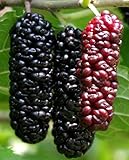
Black mulberry is an easy tree with two hard questions attached: will your tree ever fruit, and are you ready for what happens when it does. Morus nigra asks almost nothing in water or feeding, tolerates a climate band from zone 5 to zone 10, and can carry a startling crop of dark purple-black fruit. It also drops that fruit everywhere and brings birds, bats and insects with it. Both facts should shape where you plant it and how you prune it.
Male and female trees — why a seedling may never fruit
This is the single most important thing to understand about black mulberry, and the reason many gardeners wait years for nothing. Morus nigra carries male and female flowers on separate trees. The small white flowers grow in tight, cone-shaped clusters in spring, but only a female tree sets fruit, and it needs a male in the area for pollination by bees and flies.
A single seed-grown tree is therefore a gamble twice over: it may turn out male and never fruit at all, and even a female may crop poorly with no pollinator nearby. There are three ways around this.
- Plant two trees, one male and one female — the recommendation on the plant’s own care sheet, and the most reliable route where you have space.
- Buy a grafted tree. Grafting is not necessary for the tree to grow, but it is what insures the fruit: a known female of known quality, bearing sooner than a seedling.
- Start from a cutting taken from a tree you have seen fruiting. Vegetative propagation carries the sex and fruiting habit of the parent, which is exactly what seed does not do.
Started this way, expect fruit in about 2–3 years — fast for a fruit tree. A seedling takes longer, and in the worst case never repays the wait.
Climate, chilling and cold tolerance
Morus nigra is a deciduous tree for temperate and Mediterranean climates, hardy through zones 5–10. At the cold end that means winter minima in the region of −28.9 to −23.3°C (−20 to −10°F) — genuinely hardy, and in colder areas the tree tends to grow larger rather than smaller.
At the warm end the limit is different in kind: the tree needs a cool winter, though only a modest one. A short period at around 5°C (41°F) or below satisfies its chilling requirement. That is why black mulberry succeeds from temperate gardens right through to subtropical ones, while fruit trees with heavy chilling needs fail in mild winters — but in a frost-free tropical garden a tree that never gets that cool spell will leaf out unevenly and flower poorly.
Where to plant it — the mistake you cannot undo
The two listed difficulties of growing Morus nigra are that the fruit makes a great deal of mess and attracts a lot of insects. Ripe mulberries fall, and where they fall they stain paving, decking, car paint and anything below; the fruit also draws birds, bats and the Mediterranean fruit fly.
So the advice from people who have lived with one is simple: do not plant it next to the house, over a patio, a driveway or a path. Give it a spot where fallen fruit lands on grass or soil, and where you can lay a sheet under it at harvest without moving furniture.
Plant at the end of winter or in early spring, while the tree is dormant, so the roots establish before the first summer. Full sun gives the best crop, though the tree tolerates half shade.
Water and feeding
An established black mulberry is a low-water tree — a small amount of water suits it, and it is far more tolerant of dryness than most fruit trees. There is one clear exception, written into the care requirements: add irrigation during the fruit season.
The reason is mechanical. A mulberry is an aggregate fruit, built from many small fruitlets fused into a cone 2–6 cm long, and every one of those cells must fill with water in the last weeks before ripening. A tree that runs dry then gives you small, dry, seedy fruit, or drops it. Keep the tree lean the rest of the year and water it properly from fruit set to harvest.
Size, dwarf forms and containers
Left alone, Morus nigra reaches 3–15 m (10–45 feet) at a medium to fast growth rate, the larger sizes in colder regions. That range is wide because the tree responds so well to pruning — the height you end up with is largely your choice.
Dwarf black mulberry is genuinely useful here: it stays around 1–3 m, can be held smaller still — right down to bonsai — and grows happily in a planter or container. And the fruit does not suffer on a dwarf tree: it is essentially the same, some berries larger and some smaller, exactly as on a full-sized tree.
Pruning: keep it short on purpose
Prune at the end of autumn into the start of winter, once the tree is dormant and you can see the framework. The guiding principle is unusual for a fruit tree: keep it deliberately short.
The reason is harvest. A 15 m mulberry produces an enormous quantity of fruit ripening over a short window, and every berry you cannot reach ends up on the ground feeding birds. A tree held at a height you can walk under and reach into converts almost all of that crop into food.
What to cut:
- Dead or damaged branches, at any time you spot them.
- Inner branches, to open the crown — light and air in the centre improve ripening and keep fungal problems and lurking pests down.
- Renewal cuts, shortening older limbs so the tree keeps producing young, productive wood instead of extending endlessly outward.
- Height, every year. Letting a mulberry get away for three seasons and then cutting it hard is far tougher on the tree than an annual trim.
One-off: thinning the first year’s bloom
In the tree’s first bearing year it is worth thinning the bloom, and only that year. A young tree carrying a full crop before its frame and roots are built puts its energy into fruit instead of structure and is slower to reach real productivity. After that, let it carry everything it sets.
Harvest: timing and the sheet-and-shake method
Harvest comes at the end of spring in warm climates and at the beginning of summer in temperate ones, the berries ripening from red to dark purple and finally black. Fully ripe mulberries are almost liquid — they crush between your fingers and stain everything they touch — so pick slightly before the fruit is fully ready if you want to carry it anywhere or keep it for a day.
For any real quantity, do not pick berry by berry. Use the method mulberry growers have always used:
- Spread a sheet, blanket, tarpaulin or large piece of plastic over the ground under the canopy.
- Shake the branches, or tap them with a stick.
- The ripe fruit falls and the unripe fruit stays put — the tree does the sorting for you.
- Gather the corners of the sheet and tip the crop into a container.
This is another reason keeping the tree short matters: you can only shake what you can reach. Netting is possible but not recommended — on a tree of any size the net is awkward to fit, it snags on branches, and birds get caught in it. Harvesting promptly and thoroughly protects the crop better than netting does.
Pests and problems
- Silkworm. The classic mulberry insect — the caterpillars feed on the leaves, and on an established tree the damage is usually cosmetic.
- Birds and bats. Both will find a fruiting mulberry, and both are more of a nuisance below the tree than in it — a siting issue as much as a pest issue.
- Mediterranean fruit fly. Attacks the fruit itself. Prompt, complete harvesting and clearing fallen fruit off the ground removes the breeding material, and is the most effective control a home grower has.
Growing black mulberry from seed
Seed is easy to germinate but not the recommended way to start: you cannot know whether the seedling is male or female, you wait longer, and the quality is a lottery. Grow from seed for the experience or for a rootstock. If you do:
- Clean the seed thoroughly of all fruit pulp, then dry it and store it somewhere cold until sowing.
- Bury the seed over winter. The seed needs a cold, moist period before it germinates reliably — winter burial supplies it, mirroring what the tree’s own chilling requirement tells you about the species.
- Sow in spring, in a pot or container rather than open ground, about 1 cm deep, in moist soil in full sun with an average amount of water.
- Be patient. Germination takes anywhere from 1 to 7 weeks, so do not give up on a tray at three weeks.
- Grow the seedlings on in full sun, keeping them moist with a generous amount of water. Seedlings are far thirstier than the drought-tolerant mature tree.
Using the crop
Black mulberries are eaten fresh off the tree, and the surplus goes into jam, juice, shakes and cakes. The fruit is short-lived once picked, so plan the processing before you shake the tree.
For the full plant profile see our Morus nigra growing page.
See also: fruit tree grafting · grafting tools & supplies · rooting hormone for cuttings
See also: how to graft fruit trees · grafting tools
Not sure which pruning approach applies? See our guide to choosing the right pruning method.