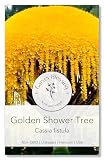
Cassia fistula — the golden shower tree — is one of the few large flowering trees that is genuinely easy to raise from seed, needs no grafting, and starts performing while you are still young enough to enjoy it. It is a perennial tree, evergreen or deciduous depending on how dry and cool its winter is, grown almost entirely for the shiny yellow flowers that hang in weeping clusters of a dozen or more and cover the whole canopy. The flowers are fragrant and pull in pollinators; the long brown seed pods that follow are 30–70 cm and hold 10–30 seeds apiece, each surrounded by edible pulp. The leaves are elliptic, glossy, and a normal to dark green.
Climate and Where It Will Actually Survive
Golden shower is a Mediterranean, subtropical and tropical tree, hardy in zone 10b and above, and workable in zone 10a with the right care. There is no route around that. It is not a plant for a cold-winter garden and it is not a houseplant — the light levels indoors will never produce the bloom that is the entire reason for growing it.
 30 Cassia Fistula Seeds / Golden Shower Tree / Yellow Flower / Bactyrilobium Fistula
 Cassia Seeds - Dried Loose Seeds from 100% Nature (08 oz)
Cassia fistula seed has a hard coat that benefits from scarifying before sowing: As an Amazon Associate we earn from qualifying purchases.
Give it full sun. It will grow in less, and you may see it recommended for sun to half shade, but flowering falls off in proportion to the light it loses. A golden shower in partial shade is a perfectly healthy green tree that never does the one thing you planted it for.
Soil and Watering — Drought Tolerant, but That Is Not the Same as Thirsty
Plant into rich, well-drained soil and mulch the surface. Water requirement is small to average. The tree is genuinely drought tolerant once it has a root system, but it prefers more water than the minimum it can survive on — drought tolerance is a survival trait, not a growth strategy. A tree kept just short of stress grows slowly and flowers modestly; one kept comfortably watered through the growing season builds the canopy that carries a heavy bloom.
You can reduce watering once the tree is established, because by then the roots reach well beyond the planting hole into soil moisture you are not supplying. Mulch matters most in summer — it keeps the surface roots cool and slows evaporation exactly when demand peaks.
Growing Cassia fistula From Seed
Seed is the recommended method, and the reason is simple: the tree is easy from seed, harder from cuttings, and does not need grafting at all. That removes the usual argument for buying a grafted specimen. Raising your own costs almost nothing and gives you a tree with an undisturbed taproot.
- Sow in spring. Sowing is possible from spring through to early autumn, but spring is clearly better — it gives the seedling a full warm season to establish before its first cool period.
- Soak the seed for about an hour before sowing. Cassia seed has a hard, water-resistant coat; soaking softens it so moisture can reach the embryo instead of running off the shell.
- The tree is not fussy about the seed-raising medium. What matters is that it drains and that you can keep it evenly damp.
- Keep the soil moist to wet, and use well-drained soil. Those two go together: constant moisture without drainage rots the seed.
- Give the seedlings a sunny position in full sun from the start.
If you want to try cuttings
Propagation by cutting is possible but distinctly harder. Start in early spring, or whenever you can hold a temperature around 26°C (79°F). You need moist peat soil, high humidity and a rooting hormone, and a greenhouse is strongly recommended — a small clear plastic box with ventilation holes does the same job on a windowsill. The humidity is the crux: a leafy cutting with no roots loses water faster than it can replace it, so the enclosure is what keeps it alive long enough to root.
When to Plant, and How
Planting season depends on how warm your winters are. In zone 10a, plant in spring to summer. In zones 10b–11, you have spring through autumn. In zone 12 and above you can plant all year. In every case spring is the safest choice, because the tree gets the longest possible run of warm growing weather before any cold.
- Dig a hole as deep as the current root ball plus an extra 50–100%. The generous width gives new roots loosened soil to run into instead of hitting a wall of compacted ground.
- Mix organic matter, humus and dried leaves into some of the soil and put it in the hole.
- Set the tree in place and loosen the outside of the root ball slightly before it goes in. Roots that have been circling in a pot will keep circling if you leave them; teasing them out redirects them into the surrounding soil.
- Backfill, then mulch with dead leaves to hold moisture in the soil.
- Water every day for the first two weeks, preferably in the morning. Watering early means the tree has water available through the hottest hours rather than sitting wet overnight.
Bloom: How Long Until Flowers, and When They Come
This is the question most people planting a golden shower actually want answered. Expect the first bloom 2–4 years after planting — seed-raised trees commonly start flowering and setting pods from around 2–3 years. That is remarkably fast for a tree of this size, and it is one of the strongest arguments for growing it from seed rather than paying for a large specimen.
The bloom season runs from spring into summer, and individual trees behave differently: some open their entire display at once, producing the spectacular all-yellow canopy the tree is famous for, while others flower over a longer, more staggered period. Neither is a fault. Pods follow the flowers and are harvested from summer into autumn.
Pruning for a Fuller Bloom
Prune after the bloom, or after the pods have been taken. The timing is not arbitrary — pruning before flowering removes the very wood that was about to bloom, and the display you cut off is the one you were waiting a year for. Once a year is enough.
The objective is to open up the branch structure so that every branch in the tree receives sun. Flowering is driven by light, so a canopy that has grown dense shades its own interior and the bloom retreats to the outer shell of the tree. Thinning to let light through is what converts a tree that flowers at the edges into one that flowers all over. Alongside pruning, fertilise once a year and keep the mulch topped up, especially through summer.
Pests
Golden shower is not a troubled tree. The pest to watch for is aphids, which cluster on soft new shoot tips and flower stalks, distorting growth and leaving sticky honeydew that goes on to grow sooty mould. Damage is usually cosmetic on an established tree, but on a young seedling a heavy infestation can check growth badly enough to matter — deal with it while the tree is small.
Uses of the Fruit and Leaves
Be clear-eyed about this: Cassia fistula is mostly grown as an ornamental, and there is not a great deal to do with a large quantity of pods. The pulp that sits next to the seeds inside the pod can be eaten, but only when fresh. Beyond that, the fruit is used mainly for beverages and for smoking, and medicinally as a laxative and for skin problems. The leaves have their own traditional medicinal use, chiefly for antibacterial purposes. Plant it for the flowers; treat the pods as a bonus rather than a crop.
Container and Bonsai Growing
A tree of 6–12 m (20–40 feet) sounds impossible in a pot, but golden shower can be kept as a dwarf of 2–3 m (6–9 feet) or trained as a bonsai, and container culture is the standard way to do it. Growth is medium, and can be fast with enough fertiliser, so restricting the roots is your main brake on size.
- Start with a pot 50–100% larger than the root ball.
- Each time the roots fill the container, move up one size, and keep doing so until the tree reaches the size you want it to hold at.
- Once it is at final size, stop potting on and maintain it by refreshing part of the soil instead.
- Keep it in the sunniest position you have — a container tree in shade will not flower, and the flowers are the point.
For the full plant profile see our Cassia fistula growing page.
See also: rooting hormone for cuttings
See also: rooting hormone for cuttings