

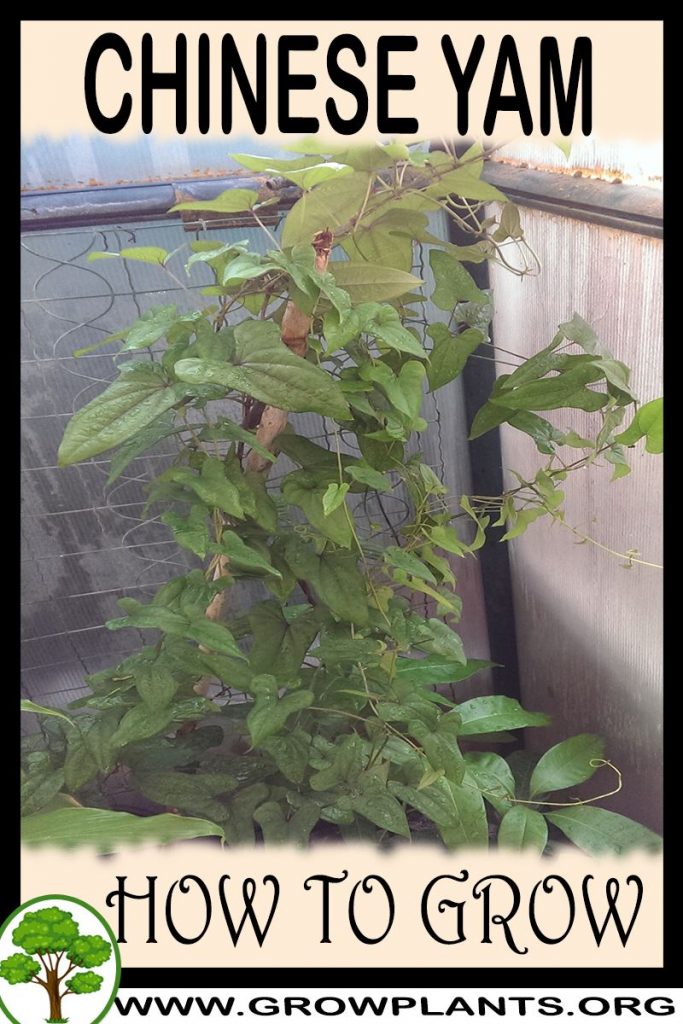
Plant Profile & Key Characteristics
Overview: Vigorous twining perennial vine to 2-3 m that dies back each year to a long, edible tuber. Grown for its starchy tuber (nagaimo) and aerial bulbils, and as an ornamental/medicinal plant – but it is aggressively invasive.
Quick Specifications
| Specification | Attribute |
|---|---|
| Plant Type / Life Cycle | Perennial (herbaceous, tuberous geophyte) |
| Foliage Type | Deciduous (herbaceous vine, dies back to the tuber) |
| Mature Size | 2-3 m (6-10 ft) vine |
| Growth Rate | Fast |
| Root System | Tuberous – a deep vertical edible tuber, 0.3-1 m long |
| Toxicity | Tuber and bulbils edible when cooked |
| Hardiness | USDA zone 5+ |
Growth Form & Structure
- Height & Spread: Twining stems 2-3 m (6-10 ft) long; needs a support to climb.
- Growth Habit & Form: Herbaceous climbing/twining vine growing from a deep tuber.
- Lifespan & Maturity: Fast-growing perennial; the tuber is lifted in autumn and aerial bulbils/fruit form within about half a year.
Anatomy & Physical Features
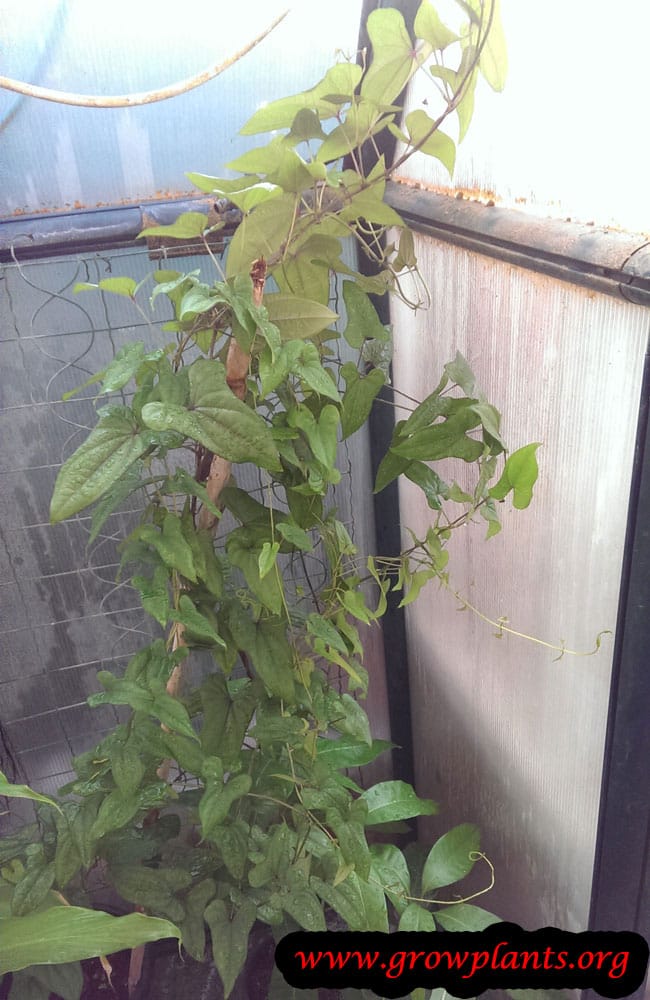
- Leaves & Foliage: Green, lobed heart-shaped leaves 5-10 cm, borne in opposite pairs.
- Flower Characteristics: Small pink-to-white flowers in clusters.
- Fruit Profile: Small brown aerial bulbils, like tiny potatoes, plus winged capsules.
Primary Uses & Landscape Value
- Edible Uses: Tuber eaten raw (grated), baked, cooked or fried; bulbils cooked or stir-fried.
- Functional & Ornamental Roles: Edible/medicinal crop and ornamental screening vine – plant with care, as it is invasive.
Care Guide: Planting, Soil & Watering
Overview: Chinese yam (Dioscorea opposita) is a vigorous climbing vine grown for its edible tuber, thriving in full sun to partial shade in moist, humus-rich soil. It likes steady moisture and humidity and grows fast once warm.
Quick Care Requirements
| Requirement | Ideal Condition |
|---|---|
| Planting Season | Through the warm season, from spring into autumn |
| Growth Rate | Fast |
| Soil Type | Deep, moist, humus-rich, well-draining soil |
| Water Need | Moderate to high — keep the soil consistently moist |
Planting & Establishment
- Best Planting Season: Plant through the warm season, any time from spring into autumn, giving the vine a support to climb.
- How to Plant:
- Hole Preparation: Prepare deep, loosened soil so the long tuber can grow down freely; dig a generous hole for the young plant or tuber piece.
- Soil Amendments: Work in plenty of compost and organic matter to build the rich, moisture-holding soil this vine prefers, and mulch young plants to keep the roots cool and damp.
- Planting Depth: Plant the tuber or crown so its top sits just below the soil surface, then mulch over it.
- Growth Speed & Expectations: Grows fast, quickly climbing its support — because it is aggressive and can be invasive, contain the area where it grows.
Soil, Watering & Drainage Care
- Soil Mix & Drainage Needs: Give it deep, rich, moisture-retentive but well-draining soil; in containers use a large, deep pot with a quality potting mix so the tuber has room and surplus water drains away.
- Watering Schedule & Technique:
- Young / Newly Planted: Keep the soil consistently moist while the young vine establishes, aided by a mulch layer.
- Established: Water regularly so the soil stays evenly moist through the growing season; the vine needs generous moisture in warm weather.
- Seasonal Adjustments: Water freely in summer heat and reduce watering in cool weather and over the dormant winter period.
Climate, Light & Hardiness
Chinese yam is an adaptable vining geophyte that grows across temperate, subtropical, Mediterranean, and desert climates, remaining perennial where winters aren't severe and behaving as an annual further north. Full sun suits it in most areas, with half shade preferred in desert heat.
Quick Climate Specifications
| Climate Zones | Temperate, subtropical, mediterranean, desert |
|---|---|
| USDA Hardiness Zones | 5 and warmer |
| Light Conditions | Full sun; half shade in desert climates |
Sunlight & Light Exposure
Optimal Light Setup
Full sun is best in most climates; in desert heat, half shade helps protect the vine from excessive sun and heat stress.
Temperature Extremes & Hardiness
USDA Hardiness & Regional Limits
The underground tuber survives winter cold from zone 5 upward, resprouting each year even though the vine dies back; where winters are too cold for the tuber to persist, it is grown as an annual instead.
Growing in Pots, Balconies & Indoors
Chinese yam (Dioscorea opposita) is a vigorous climbing vine grown for its long edible tubers – not a houseplant. It can be grown in a large, deep container outdoors with a sturdy trellis, but it needs real sun and root depth that a room cannot provide.
Quick Details
- Container Size: A large, deep pot so the tuber can run down, plus a tall support (the grower confirms container growing but gives no set size)
- Indoor Suitability: Not a houseplant; it is a large climbing vine needing sun and depth
- Best Spot: Full sun (half shade is fine in desert heat)
- Soil & Drainage: Deep, loose, free-draining mix for the long tubers
- Watering in Pots: Average to generous while in growth; keep the pot draining freely.
Indoors & On the Windowsill
- Houseplant limits: The grower marks it as not an indoor plant – it is a fast, tall vine that outgrows indoor space.
- Windowsill option: A sill cannot support its climbing habit or light needs; grow it outdoors on a trellis.
- Note: Grow it on a strong support and be aware it can spread vigorously – a deep container helps keep it contained.
On a Balcony or Patio
- Light and support: Give it full sun and a tall, sturdy trellis or netting to climb; containers dry fast, so check moisture often in heat.
- Practicalities: A deep, watered pot is heavy – secure the support and manage drainage runoff.
Choosing the Pot, Soil & Long-Term Care
- Pot and drainage: A large, deep container with strong drainage holes. Choose a pot with strong drainage holes; if you stand it on a saucer, empty the saucer promptly so the roots never sit in water. Terracotta breathes and dries faster, while glazed or plastic pots hold moisture longer.
- Potting mix: Use a well-aerated, organic-rich mix – a good potting soil, or peat/coir blended with perlite or vermiculite for drainage and air.
- Watering: Water regularly to keep the mix evenly moist – pots dry out far faster than open ground, so check often in heat – but never leave it standing wet.
- Feeding: Potted plants run through their soil faster because nutrients leach out with every watering, so feed a little more often than you would in open ground.
Fertilizing & Feeding
Chinese yam is a moderate feeder: nitrogen fuels its vigorous vine growth early on, then feeding shifts to potassium as the plant channels energy into its underground tuber, tapering off completely as the vine dies back in autumn.
Quick Fertilizing Specs
| Main Nutrient Priority | Nitrogen during vine and foliage growth, shifting to potassium during tuber bulking |
|---|---|
| Best Feeding Period | The main growing season while the vine is actively climbing and filling out |
| Soil pH | Tolerates a range of soil, but consistent moisture matters more than a precise pH |
| Reduce/Stop Feeding | Taper as the tuber bulks up and stop once the vine begins yellowing and dying back in autumn |
| Organic Options | Compost or aged manure worked into moist, humus-rich soil at planting and as a side-dress during vine growth |
Feeding by Growth Stage
Establishment After Planting
Help a newly planted tuber piece or cutting root in and put up its first vines
| Nutrient direction | Balanced feeding to support root establishment |
|---|---|
| Timing | At planting through the first vine growth |
| Frequency | A light initial feeding at planting, then minimal feeding until active vining is underway |
| Fertilizer types | A balanced, complete fertilizer or finished compost worked into moist, humus-rich soil at planting |
| Precautions | Chinese yam wants consistently moist soil and benefits from mulch while young; avoid letting the planting site dry out after feeding |
Vine and Foliage Growth
Support vigorous climbing vine and leaf growth, since this vegetative growth builds the energy the tuber will draw on later
| Nutrient direction | Nitrogen-forward feeding to fuel vine and leaf growth |
|---|---|
| Timing | Through the main growing season as the vine climbs and fills out |
| Frequency | Several light feedings spread through this active growth window |
| Fertilizer types | A nitrogen-forward complete fertilizer, or nitrogen-rich compost or aged manure |
| Routine trace nutrients | iron, manganese |
| Precautions | This vine can be vigorous to the point of invasive; keep it contained, and avoid overfeeding a plant that already grows fast |
Tuber Bulking
Shift energy from vine growth into sizing the underground storage tuber
| Nutrient direction | Shift toward a potassium-emphasis feed as the plant channels energy into its tuber |
|---|---|
| Timing | In the second half of the growing season, into autumn, as the tuber sizes up |
| Frequency | Feeding tapers off through this stage |
| Fertilizer types | A potassium-emphasis or low-nitrogen complete fertilizer |
| Routine trace nutrients | iron, manganese |
| Precautions | Keep soil evenly moist through bulking; letting it dry out limits tuber sizing regardless of feeding |
Tuber Maturation Before Harvest
Let the tuber finish sizing as the vine begins dying back for the season
| Nutrient direction | None – withhold fertilizer as the vine begins to yellow and die back in autumn |
|---|---|
| Timing | As the vine yellows and dies back ahead of the autumn tuber harvest |
| Frequency | No feeding at this stage |
| Fertilizer types | No feeding at this stage; let the tuber finish naturally as the vine dies back |
| Precautions | Do not fertilize once the vine begins dying back; the plant is winding down for its dormant period |
Nutrient Deficiency Signs & Corrections
Leaves are pale green and vine growth is noticeably slow during the main growing season
| Possible causes | Insufficient nitrogen, Soil that’s drying out between waterings, since this plant wants consistent moisture, Poor soil fertility at the planting site |
|---|---|
| Appears first on | Older leaves lower on the vine |
| What to check | Soil moisture consistency, Recent feeding history and soil fertility |
| Possible correction | Apply a nitrogen-forward feed and confirm the soil is staying consistently moist |
Leaf margins yellow and scorch on older leaves while the tuber develops smaller than expected
| Possible causes | Insufficient potassium during the tuber-bulking period, Inconsistent watering stressing the plant, Nutrient depletion from soil that hasn’t been amended |
|---|---|
| Appears first on | Older leaves, margins first |
| What to check | Feeding balance through the bulking stage, Watering consistency |
| Possible correction | Shift to a potassium-emphasis feed during bulking and keep watering even |
Yellowing leaves and weak growth occur even though feeding has been consistent
| Possible causes | Waterlogged, poorly drained soil causing root stress despite this plant’s moist-soil needs, Slug damage weakening young growth, Nutrient lockout from soil pH being outside the plant’s preferred range |
|---|---|
| Appears first on | Whole plant, especially new growth |
| What to check | Soil drainage versus just moisture retention, Signs of slug damage on leaves and shoots, Soil pH |
| Possible correction | Improve drainage while still keeping soil moist, address slug pressure directly, and adjust pH if testing shows it’s off before assuming a feeding problem |
Pruning, Training & Seasonal Maintenance
Chinese yam is a twining, herbaceous vine that dies back to its underground tuber each year and is noted as aggressive/invasive in cultivation. Its pruning is therefore mostly about containment, not shaping: cutting back the spent vine once it has died down in winter, and actively controlling how far the plant spreads by rhizome growth and by the small aerial bulbils it produces along the vine, which can root wherever they fall. Pruning has little effect on flowering, since the plant’s value is its underground tuber and its edible aerial bulbils rather than fruit.
Quick Pruning & Maintenance Specs
| Pruning Tolerance | High for the annual die-back vine; containment cuts needed year-round in growth season |
| Primary Pruning Window | Winter, once the vine has died back |
| Secondary Maintenance Window | Spring–autumn, for ongoing spread containment |
| Typical Frequency | Annual cutback plus routine monitoring for escaped growth |
| Main Objective | Remove spent top growth; prevent the vine and its bulbils from spreading beyond the growing area |
| Young Plant Priority | Provide a support/trellis for the twining habit as growth emerges |
| Mature Plant Priority | Winter cutback of dead vine; remove any volunteer shoots or rooted bulbils outside the intended bed |
| Best Tool Type | Bypass secateurs for vine cutback; garden spade for digging out escaped growth |
| Avoid Heavy Pruning During | Not applicable to the vine itself – but containment work should happen continuously, not only in winter, to stop spread getting ahead of you |
Pruning by Plant Age & Size
Newly Established
Install a trellis or support as soon as the twining vine emerges in spring; no cutting back needed while it’s establishing.
Young / Formative
Train the vine onto its support as it climbs; there is no branch-selection framework to build, only guiding the twining stems.
Mature / Established
Each winter, cut back the dead vine to the ground once it has fully died down (the tuber resprouts on its own the following season). Through the growing season, watch the perimeter of the bed for volunteer shoots from spreading rhizomes or rooted bulbils and remove them promptly.
Special Growth to Remove
- Dead winter vine: cut back to the base once fully died down; this is normal annual die-back, not a sign of poor health.
- Aerial bulbils: the small, potato-like propagules that form along the vine and are edible/harvestable in summer–autumn – harvest them if wanted, or remove and dispose of them (not on the compost pile) if containment is the priority, since any that fall and root will spread the plant further.
- Volunteer shoots/runners: dig out promptly wherever they appear beyond the intended growing area.
Container & Small-Space Pruning
Growing Chinese yam in a large container is one of the most effective ways to contain its invasive spread, since it physically blocks rhizome escape; still provide a trellis for the vine and cut the dead top growth back each winter.
Tools
Bypass secateurs for cutting the dead vine back in winter; a garden spade for digging out any rhizome or bulbil growth that has escaped the growing area.
Tool Hygiene & Disease Risk
Routine – slugs are the main pest of concern and aren’t spread by tools; clean sharp secateurs are sufficient.
Cut Placement & Technique
Cut the dead vine near ground level once it has fully browned off; when digging out escaped rhizome growth, remove the whole piece rather than breaking it, since fragments can resprout.
Heavy Pruning & Rejuvenation
The full winter removal of top growth is itself effectively an annual "hard prune" and is entirely normal for this species – it regrows completely from the tuber each spring, so there’s no rejuvenation concern in the woody sense.
Post-Pruning Care
No special aftercare needed after the winter cutback; after removing escaped growth, recheck the same area a few weeks later, since missed rhizome or bulbil fragments can resprout.
Common Pruning Mistakes
- Letting aerial bulbils drop and root unchecked, which is the main way this plant escapes cultivation.
- Composting bulbils or rhizome pieces instead of disposing of them, allowing them to spread further.
- Cutting the vine back mid-season while it’s still green and actively growing, rather than waiting for natural winter die-back.
When NOT to Prune
Avoid cutting the vine back while it’s still green and actively growing in the season – wait for natural winter die-back so the tuber has fully stored its reserves.
Recommended Tools (by task)
- bypass_secateurs – for the annual winter cutback of the dead vine.
- garden_spade – for digging out spreading rhizomes or rooted bulbils, the real containment task this plant needs.
Pruning Troubleshooting
| Problem | Possible Cause | What to Check | Corrective Action |
| Vine appearing outside the intended bed | Spread by rhizome growth or a rooted bulbil | Perimeter of the planting area for new shoots | Dig out the whole piece promptly; consider a container or root barrier |
| New patch appearing at a distance from the original planting | A dropped aerial bulbil rooted where it fell | Ground beneath and downhill of the vine in late summer/autumn | Harvest or collect bulbils before they drop; dispose of unwanted ones off-site |
Bloom & Flower Guide
Quick Details
- Bloom Season: Summer to autumn
- Flower Appearance: Very small pink-to-white flowers borne in slender clusters
- Edibility: Grown for its edible tuber – the tiny flowers are not eaten
Detailed Blooming Overview
Chinese yam is a twining vine grown for its long underground tuber, and its flowering is modest: small pink-to-white flowers appear along the stems in late summer and autumn, sometimes carrying a light cinnamon scent. Plants are usually either male or female (dioecious), so seed set is uncommon in cultivation. In practice the vine spreads mainly by its tubers and by tiny aerial bulbils rather than through its flowers.
Flower Characteristics
- Small pink-to-white flowers held in slender clusters.
- Individual plants are typically male or female (dioecious).
- Faintly cinnamon-scented in some plants.
Bloom Care & Thinning
- Managing the bloom: No special bloom care is needed – flowering is light and does not affect the tuber; simply leave the vine to grow.
Fruit & Uses
Chinese yam is grown for its long underground tuber, which is unusual among yams in being edible raw as well as cooked; it also produces small, potato-like aerial bulbils in the leaf axils that are edible once cooked.
Quick Edible Specs
| Edible Parts | Tuber, aerial Bulbils (‘fruit’) |
|---|---|
| Main Use(s) | Culinary (raw or cooked staple/vegetable); traditionally used medicinally (no specific health claims) |
| Eaten Raw or Cooked | Tuber: both · Bulbils: cooked |
| Preparation Required | Peel the tuber (gloves recommended — the sap can irritate skin); cook the bulbils |
| Harvest Season | Tuber: Autumn · Bulbils: Summer/Autumn |
| Time to First Harvest | Bulbils begin forming within roughly half a year of planting (site-stated); the underground tuber is lifted the following autumn |
| Storage | Whole, uncut tubers store reasonably in a cool, dry place; use bulbils promptly |
| Safety/Toxicity Caveat | Raw tuber sap can irritate skin on contact — handle and peel with care; bulbils should be cooked |
Roots & Tubers
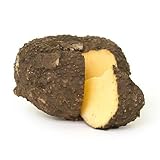
The tuber is large (roughly 0.3–1 m), with white flesh under a brown skin, and is lifted in autumn. Unlike many yams, it can be eaten raw (typically peeled and grated, giving a mucilaginous texture) as well as baked, cooked, or fried.
Fruit
The plant also produces small, round-to-shapeless, brown aerial growths in the leaf axils that the site describes as ‘fruit’ but are botanically the plant’s aerial bulbils (small tuber-like offshoots) rather than a true fruit. They form within about half a year, are best hand-picked without forcing them off the stem, and are cooked or stir-fried rather than eaten raw; watch for birds and rodents taking them.
Harvesting
Lift the main tuber in autumn as a single harvest; pick aerial bulbils by hand through summer and autumn as they mature and detach easily. Peeling the tuber can irritate skin, so gloves are recommended.
Preparation, Uses & Safety
The tuber is eaten raw (peeled and grated) or cooked (baked, boiled, fried); aerial bulbils are cooked or stir-fried. Wear gloves when peeling, since the tuber’s sap can cause skin irritation in some people. Chinese yam has a history of traditional medicinal use, though no specific health claims are made here.
Pests, Diseases & Troubleshooting
Overview: Dioscorea opposita (Chinese yam or nagaimo) is a hardy climbing vine grown for its long edible tuber, whose main pests are aphids (which spread yam viruses), yam beetle, spider mites, scale and soil nematodes, while its key diseases are yam anthracnose, leaf spots and the tuber rots. It is vigorous and fairly trouble-free in warm, well-drained, deep soil; the main problems are anthracnose in wet weather, nematode and rot damage to the tubers, and its tendency to become invasive from bulbils.
Quick Troubleshooting Overview
| Issue / Pest | Main Symptom | Primary Solution |
|---|---|---|
| Aphids | Colonies on shoots, honeydew, distortion; spread virus | Hose off, insecticidal soap; use virus-free planting stock |
| Yam beetle / chewing beetles | Holed leaves and gouged, tunnelled young tubers | Sanitation, soil hygiene; hand-pick, protect tubers |
| Root-knot / yam nematode | Galled, cracked, dry-rotting tubers; stunted vines | Clean seed tubers, rotation, solarise; avoid infested soil |
| Yam anthracnose | Dark leaf and stem spots, blight and shoot dieback in wet | Airflow, sanitation, resistant lines; copper fungicide |
| Tuber rot | Dry or soft rot of tubers in store or wet soil | Cure and store dry; harvest sound tubers, good drainage |
| Mosaic virus | Mottled, streaked, distorted leaves; weak vines | Rogue infected plants, control aphids, clean stock |
Common Pests & Management
- Aphids (Aphis / Myzus spp.):
- Symptoms: Colonies of soft green or black insects on the twining shoot tips and leaf undersides, causing curling, distortion and sticky honeydew; most importantly, they transmit yam mosaic and other viruses that reduce vigour and yield.
- Prevention & Control: Hose off and squash early colonies, and conserve ladybirds, lacewings, hoverflies and parasitic wasps. Use insecticidal soap or neem for build-ups, and above all plant virus-free tubers and control aphids to limit virus spread.
- Yam beetle and chewing beetles (Heteroligus and related spp.):
- Symptoms: Beetles that chew holes in the foliage and, more damagingly, gouge and tunnel into the developing tubers underground, leaving scars and entry points that let in rot; grubs may also feed on roots.
- Prevention & Control: Practise good soil hygiene and rotation, remove crop debris that shelters them, and hill or protect the tuber zone. Hand-pick where feasible and control heavy infestations with a suitable soil-targeted treatment, while conserving natural predators.
- Red spider mite (Tetranychus spp.):
- Symptoms: Fine pale stippling, bronzing and a dull look to the leaves with fine webbing on the undersides, worst in hot, dry weather and on drought-stressed vines late in the season.
- Prevention & Control: Keep vines well-watered and hose the foliage to knock mites back, and avoid drought stress. Horticultural oil or insecticidal soap controls infestations; avoid broad-spectrum sprays that kill the predatory mites and trigger flare-ups.
- Scale insects and mealybugs (Aspidiotus / Planococcus spp.):
- Symptoms: Brown or waxy scale and white cottony mealybugs on stems, leaf undersides and on stored tubers, with honeydew and sooty mould, weakening the vine and, on tubers in store, encouraging rot.
- Prevention & Control: Prune out and wipe off colonies, control ants that farm them, and inspect and clean seed tubers before planting and storage. Horticultural or neem oil smothers scale and mealybug; conserve their natural predators.
- Root-knot and yam nematodes (Meloidogyne spp. / Scutellonema bradys):
- Symptoms: Stunted, yellowing vines and poor yield above ground, and galled, cracked, brown dry-rotting tubers below, with the yam nematode causing the characteristic dry rot under the tuber skin that worsens in storage.
- Prevention & Control: Plant clean, nematode-free seed tubers in fresh or rotated ground, solarise or rest infested soil, and build soil organic matter and beneficial microbes. Discard heavily galled or dry-rotted tubers rather than replanting them, and store only sound, cured tubers.
Diseases & Fungal Issues
- Yam anthracnose (Colletotrichum gloeosporioides):
- Symptoms: Dark brown to black spots and blotches on leaves and stems that enlarge, blight the foliage and cause shoot-tip dieback (‘yam dieback’), sometimes defoliating vines; the most important yam disease, worst in warm, wet, humid weather.
- Treatment & Management: Grow resistant or tolerant lines where available, space and train vines for airflow, and remove and destroy infected foliage and debris. Rotate crops and use clean planting material; protect new growth with a copper or suitable fungicide during prolonged wet weather.
- Leaf spot and blight (Cercospora / Curvularia spp.):
- Symptoms: Brown or greyish leaf spots, sometimes with concentric rings or yellow halos, that merge and blight the foliage in wet, humid conditions, reducing the leaf area that fills the tuber.
- Treatment & Management: Improve airflow, avoid overhead watering, and remove badly spotted leaves and end-of-season debris. Rotation and clean stock reduce carryover; a copper fungicide protects the canopy under persistent damp pressure.
- Tuber dry rot and soft rot (Fusarium / Botryodiplodia / Penicillium / Erwinia spp.):
- Symptoms: Dry, brown, crumbly rot or soft, wet, foul-smelling rot of the tubers in the ground and especially in storage, entering through nematode damage, beetle wounds and bruises during harvest.
- Treatment & Management: Harvest carefully to avoid bruising and wounding, cure the tubers well, and store them cool, dry and airy on clean surfaces, discarding damaged ones. Control nematodes and beetles that create entry wounds, and treat cut seed pieces with a suitable protectant before planting.
- Yam mosaic and other viruses (Yam mosaic virus and related):
- Symptoms: Mottled, streaked or mosaic-patterned leaves, distortion, and reduced vigour and tuber yield; incurable, spread by aphids and, above all, carried in infected planting tubers from season to season.
- Treatment & Management: There is no cure. Start with clean, virus-tested planting material, rogue out and destroy symptomatic vines, and control the aphid vectors. Do not save seed tubers from virused plants, which is the main way the disease persists and builds up.
Growing Difficulties & Abiotic Problems
- Tuber cracking and poor tuberisation:
- Cause & Symptoms: Cracked, forked, stunted or poorly shaped tubers from stony or compacted soil, irregular water, or a shortage of the deep, loose, fertile ground this long-rooted yam needs.
- Correction Strategy: Grow in deep, loose, stone-free, well-drained soil (or in tubes/ridges for the long tubers), keep moisture even during tuber growth, and feed in balance. Avoid drought-then-flood cycles that split the tubers as they swell.
- Waterlogging and root rot:
- Cause & Symptoms: Yellowing, wilting, poor growth and rotting tubers where the soil is heavy and waterlogged, since the tubers rot in cold, wet, airless ground despite the vine’s vigour.
- Correction Strategy: Plant on ridges or mounds in free-draining soil, avoid low wet spots, and ease off watering as the tubers mature and the vine dies down. Harvest before the ground turns cold and wet for winter in cool climates.
- Frost dieback and winter management:
- Cause & Symptoms: The top growth is killed by frost and the vine dies back each year, which is normal; the hardy tuber survives in the ground in mild areas but can rot in cold, wet winters or spread invasively from bulbils.
- Correction Strategy: Expect annual dieback, mulch the tuber zone in cold areas, and harvest or protect as needed. Collect the small aerial bulbils to prevent unwanted spread, as Chinese yam can become invasive; grow it where its spread can be contained.
What Helps — Products & Tools
For Chinese yam the useful kit is insecticidal soap and neem for aphids (with virus-free seed tubers the real defence), horticultural oil for scale and mealybug, and clean, rotated, solarised soil against nematodes. On the disease side, resistant lines, airflow, sanitation and a copper fungicide manage anthracnose and leaf spots, while careful harvest, curing and dry storage prevent the tuber rots; viruses are controlled only by clean planting stock and aphid control. Collect bulbils to limit its invasive spread. The source pest names are unreliable and were not used.