

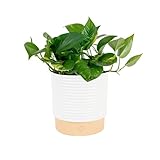

Plant Profile & Key Characteristics
Overview: Pothos (Scindapsus / Epipremnum aureus) is an evergreen, epiphytic climbing and trailing vine that can reach 5-20 m (15-60 ft), grown for its heart-shaped, often variegated leaves. Fast-growing and undemanding, it is one of the most popular houseplants worldwide, hardy outdoors only in the tropics (hardiness zone 10+).
Quick Specifications
| Specification | Attribute |
|---|---|
| Plant Type / Life Cycle | Perennial (evergreen vine) |
| Foliage Type | Evergreen |
| Mature Size | 5-20 m (15-60 ft) as a climber; far shorter indoors |
| Growth Rate | Fast |
| Toxicity | Toxic if ingested (insoluble calcium oxalate crystals) |
| Hardiness | USDA zone 10+ |
Growth Form & Structure
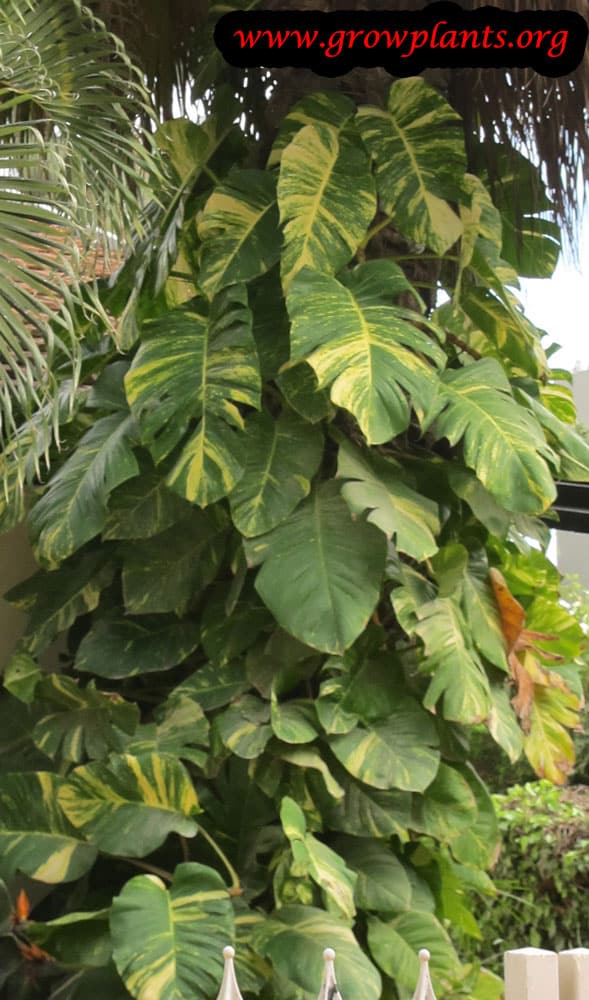
- Height & Spread: Climbs or trails 5-20 m (15-60 ft) outdoors; kept much shorter indoors, trained up a moss pole or left to trail from a pot.
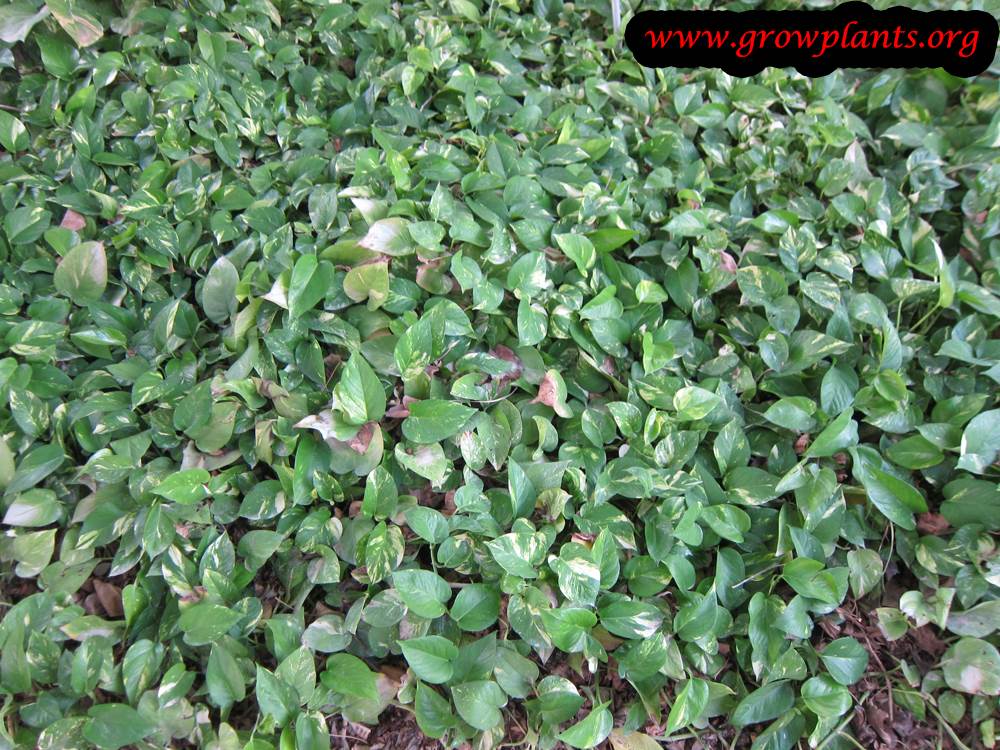
- Growth Habit & Form: Vigorous evergreen climbing and trailing epiphytic vine with clinging aerial roots; used as groundcover, edging, or trained upward.
Anatomy & Physical Features
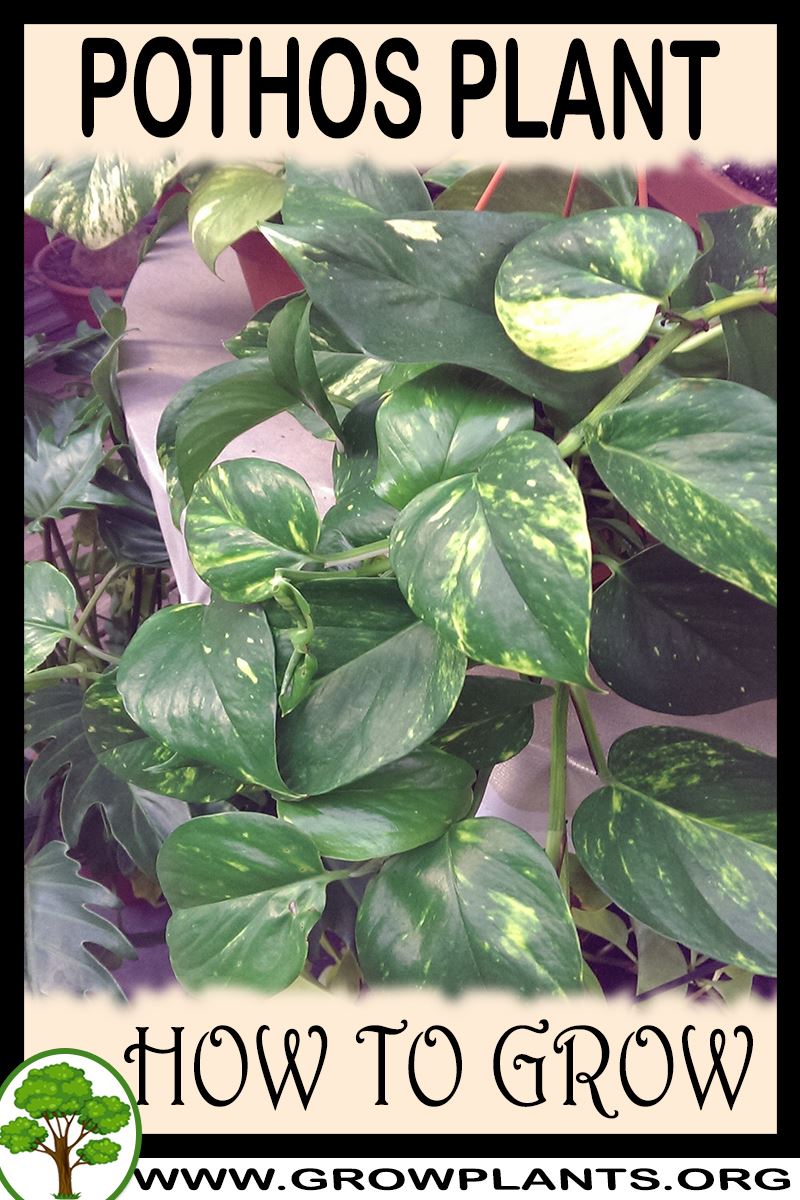
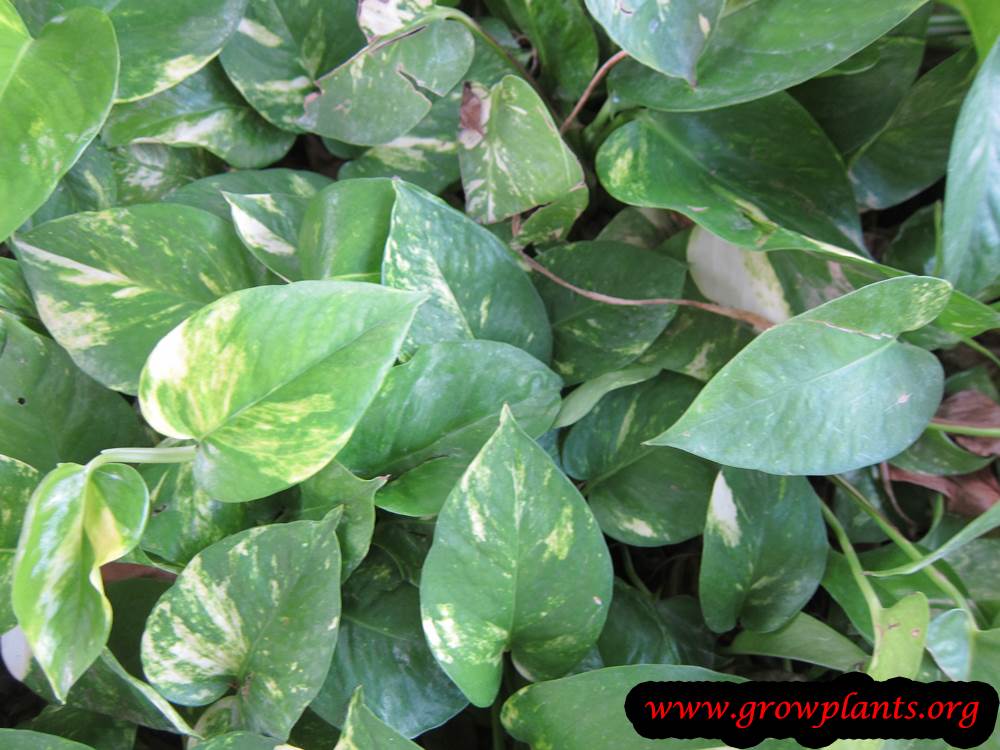
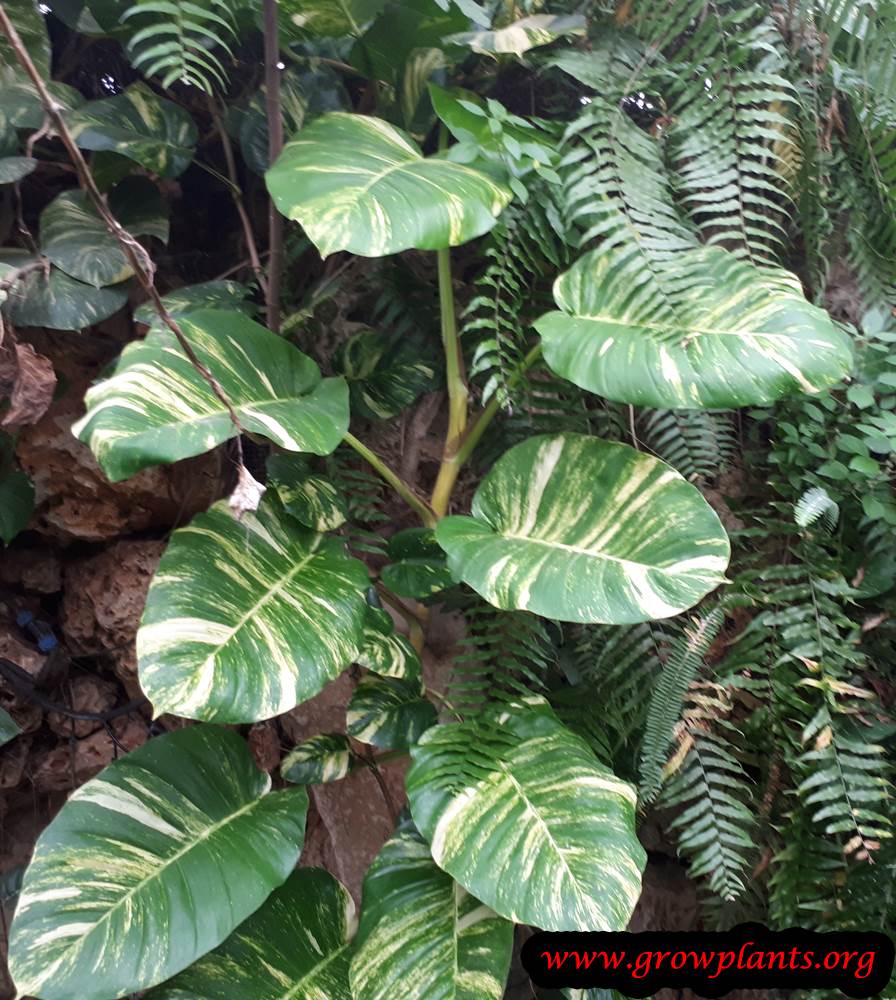
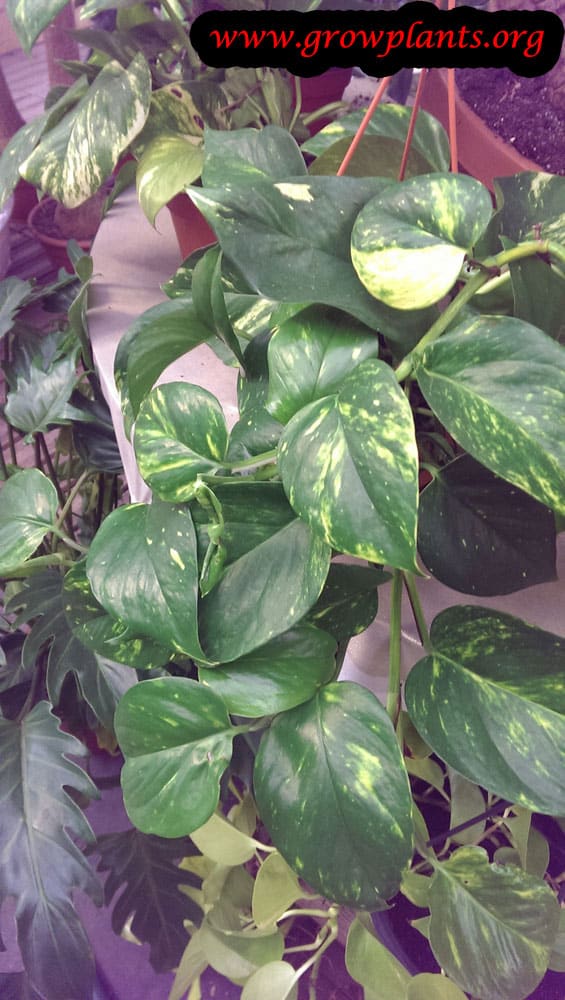
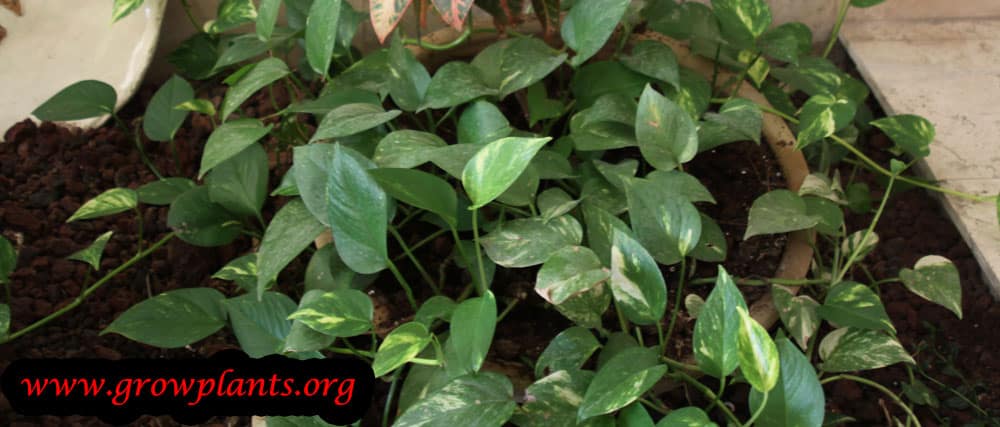
- Leaves & Foliage: Heart-shaped green leaves, commonly variegated with yellow or white.
- Flower Characteristics: Rarely flowers in cultivation; tiny green flowers on a spadix enclosed by a white showy bract.
Primary Uses & Landscape Value
- Functional & Ornamental Roles: Popular ornamental houseplant and container or hanging-basket plant; groundcover or climber in tropical gardens.
Care Guide: Planting, Soil & Watering
Overview: Pothos is a vigorous tropical vine that grows happily in warm, frost-free conditions and low to moderate light. It is easy-going about soil as long as it drains freely, and likes steady, moderate moisture without ever staying waterlogged.
Quick Care Requirements
| Requirement | Ideal Condition |
|---|---|
| Planting Season | Year-round in warm, frost-free climates; in spring where cooler, or any time as an indoor plant |
| Growth Rate | Fast |
| Soil Type | Well-draining, general-purpose potting mix rich in organic matter |
| Water Need | Moderate — keep lightly moist, letting the top few cm dry between waterings |
Planting & Establishment
- Best Planting Season: In warm climates plant year-round; where cooler, plant in spring once temperatures stay above about 10°C, or simply grow it indoors at any time of year.
- How to Plant:
- Hole Preparation: Dig a hole a little wider than the root ball and provide a moss pole or trellis, since this is a fast, climbing vine that can become aggressive.
- Soil Amendments: Enrich the soil with compost or organic matter and make sure it drains freely; a standard well-draining potting mix works well in containers.
- Planting Depth: Set the root ball so the crown sits level with the soil surface — do not bury the stems.
- Growth Speed & Expectations: Growth is fast; expect long trailing or climbing stems that fill space quickly and need regular trimming to stay in bounds.
Soil, Watering & Drainage Care
- Soil Mix & Drainage Needs: Provide a light, aerated, free-draining mix; in pots use quality potting soil with good drainage holes so water never pools around the roots.
- Watering Schedule & Technique:
- Young / Newly Planted: Keep the soil lightly and evenly moist while the plant roots in, but avoid leaving it soggy.
- Established: Water when the top few centimetres of soil feel dry, then water thoroughly; pothos tolerates an occasional missed watering better than constant wet feet.
- Seasonal Adjustments: Water more during warm, active growth and cut back in cooler months when growth slows.
Climate, Light & Hardiness
Pothos grows outdoors year–round only in warm, frost–free climates (tropical, Mediterranean, or subtropical, roughly zone 10 and above), and is otherwise grown as a houseplant. It prefers half to full shade and needs temperatures kept above about 10°C (50°F) to avoid cold damage.
Quick Climate Specifications
| Climate Zones | Tropics, Mediterranean, subtropics; also grown as a houseplant |
|---|---|
| USDA Hardiness Zones | 10+ |
| Cold Damage Begins | Below approximately 10°C (50°F) |
| Frost Tolerance | Very Low |
| Light Conditions | Half Shade to Full Shade |
Sunlight & Light Exposure
Thrives in indirect, filtered light from half shade to full shade; it does not need or want direct sun.
Optimal Light Setup
Bright, indirect light indoors or a shaded to semi–shaded spot outdoors keeps foliage color and variegation strongest.
Temperature Extremes & Hardiness
USDA Hardiness & Regional Limits
Reliable outdoors only from about zone 10 upward; outside that range it is grown as an indoor houseplant year–round.
Cold Damage & Winter Protection
The site notes it needs temperatures above roughly 10°C (50°F); indoor growers should keep it away from cold windows and draughts in winter.
Frost Sensitivity
Not frost tolerant; freezing temperatures will kill foliage and stems.
Wind, Humidity & Microclimate
Humidity Preferences
Appreciates moderate to high humidity, consistent with its tropical origins, though it adapts reasonably well to typical indoor conditions.
Growing in Pots, Balconies & Indoors
Pothos is one of the most reliable of all houseplants – the grower confirms it grows well indoors – thriving in the low-to-moderate light of ordinary rooms (it naturally prefers shade). It trails from shelves and baskets or climbs a support. It is toxic if chewed, so keep it away from pets and small children.
Quick Details
- Container Size: A pot or basket of about 5-15 L (1.5-4 gal); it adapts to most sizes
- Indoor Suitability: An excellent, very forgiving houseplant for low-to-bright indirect light
- Best Spot: Part to full shade; bright, indirect light suits it best
- Soil & Drainage: Standard free-draining potting mix
- Watering in Pots: Let the top few centimetres dry between waterings; it hates sitting wet
Indoors & On the Windowsill
- Safety first: The leaves and stems contain calcium oxalate crystals that irritate the mouth if chewed – keep it away from pets and small children.
- A true houseplant: Thrives indoors in almost any light except harsh direct sun; grow it trailing or up a moss pole and it needs little attention.
- Low-light tolerance: One of the best choices for a dim corner, staying green and healthy where fussier plants sulk.
On a Balcony or Patio
- Light & wind: A shaded, sheltered balcony suits it in warm weather; keep it out of direct sun and bring it in before cold.
- Practicalities: Tender – it is really an indoor plant, outdoors only as a warm-season accent.
Choosing the Pot, Soil & Long-Term Care
- Pot & drainage: A 5-15 L pot or basket with strong drainage holes; skip a standing-water saucer to avoid root rot. Terracotta breathes and dries faster; glazed or plastic holds moisture longer.
- Potting mix: A light, aerated, organic-rich mix – potting compost or peat/coir with added perlite or vermiculite for drainage.
- Feeding: Nutrients wash out of pots faster than open ground, so feed potted pothos more often – a balanced liquid feed through the active growing season.
- Repotting: Refresh the top layer of mix each year and renew it or pot up every couple of years; lightly trim the roots and top growth when you do.
Growing this plant in a greenhouse
A greenhouse can give pothos frost protection, cold protection, humidity control and extra warmth. In the right climate it may also be kept growing through winter, depending on how much warmth and light are provided.
Greenhouse at a glance
| Greenhouse suitability | Good - clearly useful |
|---|---|
| Main benefits | frost protection, cold protection, humidity control, extra warmth |
| Season extension | earlier spring & later autumn |
| Outdoor protection advisable below | about 10°C |
| Maintain greenhouse minimum | around 10°C for active growth |
| Suitable types | heated greenhouse, polycarbonate greenhouse |
| Heating | Heating is recommended in cold climates for continuous growth. |
Related greenhouse guides
- Greenhouses: How to Choose the Right Greenhouse
- Best Greenhouse Heaters
- Greenhouse Climate Control: Temperature, Ventilation and Humidity
- Polycarbonate Greenhouses: What to Look for Before Buying
Fertilizing & Feeding
A vigorous trailing foliage vine and light-to-moderate feeder: steady balanced feeding through active growth keeps the heart-shaped leaves full, with feeding paused after repotting and while growth is slow.
Quick Fertilizing Specs
| Feeding Level | Light to moderate feeder |
|---|---|
| Main Nutrient Priority | Balanced feeding with adequate nitrogen for vigorous trailing foliage |
| Best Feeding Period | Active growth in bright, warm conditions |
| Organic Options | Compost-enriched potting mix or a mild organic liquid feed |
| Reduce/Stop Feeding | Reduce or stop feeding after repotting and when light or growth drops |
| Micronutrients | Iron and manganese are usually supplied by a complete houseplant fertilizer; correct only if a deficiency is diagnosed |
| Soil pH | Prefers a well-drained, near-neutral potting mix |
Feeding by Growth Stage
Establishment after planting or repotting
Let roots recover and settle into fresh potting mix before pushing new growth.
| Nutrient direction | None – withhold fertilizer while roots recover from disturbance. |
|---|---|
| Timing | For a short period right after planting or repotting. |
| Frequency | No feeding at this stage. |
| Fertilizer types | No feeding at this stage; do not fertilize until new growth confirms the roots have settled in. |
| Precautions | Do not fertilize freshly disturbed roots; wait for visible new growth before resuming feeding. |
Active trailing growth
Support the vine’s characteristic fast, cascading foliage growth.
| Nutrient direction | A balanced houseplant fertilizer with adequate nitrogen keeps trailing stems and heart-shaped leaves full. |
|---|---|
| Timing | Through bright, warm active-growth periods, typically the longer daylight months. |
| Frequency | Light, regular feedings support steady growth without pushing weak, pale stems. |
| Fertilizer types | A balanced complete houseplant fertilizer, A mild organic liquid feed as an alternative |
| Routine trace nutrients | iron, manganese |
| Precautions | Avoid overfeeding, which can wash out leaf variegation and cause leggy, sparse vines. |
Low-light or cool-season slowdown
Let the plant coast through weaker light or cooler indoor conditions without forcing growth.
| Nutrient direction | None – withhold fertilizer while growth has slowed. |
|---|---|
| Timing | During shorter, duller days or cooler indoor conditions. |
| Frequency | No feeding at this stage. |
| Fertilizer types | No feeding at this stage; do not fertilize until brighter conditions and active growth return. |
| Precautions | Do not fertilize a plant that has slowed down; unused nutrients build up as salts in the potting mix. |
Nutrient Deficiency Signs & Corrections
Older leaves fade to pale green or yellow and new leaves come in smaller.
| Possible causes | low available nitrogen in aging potting mix, infrequent feeding relative to fast vine growth, roots crowded or pot-bound, limiting nutrient uptake |
|---|---|
| Appears first on | older, lower leaves |
| What to check | recent feeding history, how long since the potting mix was refreshed, root crowding in the pot |
| Possible correction | Resume a balanced complete fertilizer on a regular light schedule and refresh potting mix if it is old. |
New leaves show yellowing between the veins while the veins stay green.
| Possible causes | potting mix pH drifted too high, waterlogged, poorly draining mix, root stress limiting nutrient uptake |
|---|---|
| Appears first on | newest leaves |
| What to check | potting mix pH and drainage, watering habits and pot drainage holes, root health |
| Possible correction | Improve drainage, correct pH if it has drifted high, and apply a chelated iron product per its label. |
Leaf tips and margins brown or crisp despite regular watering.
| Possible causes | fertilizer salt buildup from feeding a slowed or dormant plant, infrequent flushing of the potting mix, under-watering that concentrates salts |
|---|---|
| Appears first on | leaf tips and margins |
| What to check | recent feeding frequency relative to growth, when the potting mix was last flushed with plain water, watering consistency |
| Possible correction | Halt feeding, flush the potting mix thoroughly with water to move salts out, then resume lighter feeding once growth is active again. |
Pruning, Training & Seasonal Maintenance
Pothos (grown here under the older name Scindapsus aureus) is a fast, tough epiphytic vine kept for its foliage, and pruning is purely vegetative housekeeping – it flowers only under conditions rarely met indoors, so cutting it back regularly to keep it compact does not cost any bloom. It tolerates cutting at almost any time; the goals are keeping its naturally aggressive trailing/climbing growth in bounds, filling it out, and clearing tired or reverted foliage, with no single required season since growth continues year-round in typical warm, indoor or tropical conditions.
Quick Pruning & Maintenance Specs
| Pruning Tolerance | High – regrows readily from hard cuts |
| Primary Pruning Window | Any time during active growth; effectively year-round indoors |
| Typical Frequency | Light trims every couple of months, or whenever runners outgrow their space |
| Main Objective | Restrain length; thicken up sparse growth |
| Young Plant Priority | Pinch early to set multiple growth points |
| Mature Plant Priority | Cut back bare, leggy vines; clear damaged or reverted leaves |
| Best Tool Type | Precision snips |
Pruning by Plant Age & Size
Newly Established
Leave it largely alone beyond removing damaged leaves until it is rooted in and actively growing.
Young / Formative
No structural training applies; pinch the growing tips every so often so several shoots develop near the base instead of one long single runner.
Mature / Established
Cut leggy, bare-based vines back to just above a healthy node to push new branching, and thin out overcrowded trailing stems that are shading their own lower leaves.
Seasonal Pruning Schedule
There is no meaningful fixed season for this plant in indoor or frost-free cultivation, since it grows continuously; the only timing consideration is that regrowth after a cutback slows noticeably during the shortest, coolest days of the year, so a hard cut then will take longer to fill back in.
Structural Pruning & Training
With no woody framework, structure is simply where you decide to guide or shorten the trailing/climbing stems on a pole, shelf or trellis; overall size and spread are governed entirely by how often and how hard it is cut back.
Special Growth to Remove
Remove yellowed or damaged leaves as they appear, and cut away any solid-green shoots on variegated forms as soon as they’re noticed, since that reverted growth is more vigorous and will crowd out the variegated stems over time.
Container & Small-Space Pruning
Grown almost exclusively in pots, prune mainly to keep the trailing habit tidy and full rather than to limit overall plant size; pinch regularly for compact growth and root cuttings from the trimmings to bulk up the same pot instead of discarding them.
Tools
Precision snips are sufficient for this thin, soft-stemmed vine.
Tool Hygiene & Disease Risk
Routine – clean, sharp snips; no notable tool-transmissible disease risk documented for this species.
Cut Placement & Technique
Cut just above a node (where the small aerial roots typically form), since that’s where new growth breaks; a cut left mid-internode tends to just die back to the next node without branching.
Heavy Pruning & Rejuvenation
Handles hard cutback well; an overgrown or thin, straggly plant can be reduced to a short length of stem and will fill back out within a growing season given reasonable light and warmth.
Post-Pruning Care
Water as normal; skip extra feeding right after a hard cut since the plant’s own reserves drive the regrowth, and check new growth for spider mites or aphids.
Common Pruning Mistakes
Letting it run unchecked until it is bare-stemmed with leaves only at the tips; ignoring reverted all-green shoots on variegated plants until they dominate; cutting in the middle of an internode instead of just above a node.
Recommended Tools (by task)
- Routine pinching and trailing-length control: precision_snips – the only tool this soft-stemmed vine needs.
- Training climbing stems onto a support: soft_ties_stakes – to guide growth onto a pole or trellis.
Propagation Guide
This trailing aroid vine is propagated almost entirely from stem or node cuttings rooted in water or a moist mix, since its nodes root readily and it is rarely grown from seed in cultivation. Propagation is easy and forgiving, making it a good candidate for beginners.
Quick Propagation Specs
| Best Propagation Method | Stem/node cuttings (water or soil) |
| Alternative Methods | Self-layering of a trailing stem pinned into soil; dividing a pot with multiple rooted stems |
| Propagation Difficulty | Easy |
| Vegetative True-to-Type | Yes |
| Best Propagation Season | Spring to summer for the fastest rooting, though possible year-round indoors with steady warmth |
| Cutting Rooting Time | Roots often visible in water within 1–3 weeks; a little longer when rooted directly in soil |
Stem Cuttings
Cutting Type
Stem/node cuttings carrying at least one node and one or two leaves.
Best Timing
Any time indoors with steady warmth above 10°C (50°F), though spring/summer growth roots fastest.
Cutting Preparation
Cut just below a node, trimming away any leaf that would sit below the waterline if rooting in water.
Rooting Setup
Stand cuttings in water (changed every few days) or insert directly into a moist, well-draining mix, in bright indirect light.
Rooting Hormone
Not necessary – nodes already carry visible root initials and root readily on their own.
Rooting Time
Often 1–3 weeks in water; somewhat longer when rooted directly in soil.
Air & Ground Layering
Trailing stems will frequently self-root where a node contacts moist soil; pegging a still-attached section into a nearby pot is a simple alternative to cuttings, and it can be cut free once rooted.
Division, Offsets, Pups & Suckers
A mature pot containing several rooted stems can be gently divided at the base into smaller clumps, as long as each division retains its own roots.
Bloom & Flower Guide
Quick Details
- Bloom Season: Through much of the year on mature tropical plants, but pothos almost never flowers in cultivation, especially indoors
- Flower Appearance: Tiny green flowers packed on a spike (spadix) wrapped in a creamy-white sheath (spathe), which is the showy part
- Edibility: None — pothos is toxic (calcium oxalate); no part should be eaten
Detailed Blooming Overview
Pothos is grown for its foliage, and its flowers are a rarity — houseplants effectively never bloom, and even outdoors it takes a large, mature plant. When it does flower, the bloom takes the classic arum form: a column of tiny true flowers (the spadix) sheathed by a pale, leaf-like spathe. The plant is toxic, so it stays strictly ornamental.
Flower Characteristics
- Tiny green flowers on a spadix enclosed by a creamy-white spathe.
Bloom Care & Thinning
- Encouraging bloom: Only large, mature plants in warm, bright conditions flower; there is little to manage, as the foliage is the point.
- Safety: Sap and tissue contain calcium oxalate crystals, irritating to mouth and skin and toxic to pets.
Pests, Diseases & Troubleshooting
Overview: Pothos (correctly Epipremnum aureum; the source’s Scindapsus aureus is an old synonym) is one of the toughest, most pest-resistant houseplants; its problems are mainly cultural-yellowing and root rot from overwatering, brown tips from dry air or salts, and lost variegation in low light. When pests appear they are the usual sap-suckers, all easily managed. Keep it in bright indirect light and let it dry between waterings.
Quick Troubleshooting Overview
| Issue / Pest | Main Symptom | Primary Solution |
|---|---|---|
| Mealybugs | White cottony tufts at leaf axils and stem nodes, sticky honeydew | Alcohol swab, insecticidal soap or neem |
| Spider mites | Fine stippling and webbing in hot, dry air | Rinse, raise humidity, neem or soap |
| Scale insects | Brown bumps on stems and leaf undersides | Scrape off, horticultural oil |
| Fungus gnats | Small black flies over constantly moist soil | Let soil dry, sticky traps, Bti drench |
| Root rot | Yellowing leaves, mushy black roots, wilting in wet soil | Reduce water, improve drainage, trim rot, repot |
Common Pests & Management
- Mealybugs (Planococcus citri):
- Symptoms: White, cottony, waxy insects tucked into leaf axils, along the stems and at the nodes, leaving sticky honeydew and sometimes sooty mould; they are the most frequent pest of an otherwise clean plant.
- Prevention & Control: Wipe or dab colonies with an alcohol-dipped cotton bud, then spray insecticidal soap or neem, wetting the crevices, and repeat weekly until clear. Isolate infested plants from the rest of the collection.
- Spider mites (Tetranychus urticae):
- Symptoms: In hot, dry indoor air the leaves lose their gloss and show fine pale stippling, with delicate webbing on the undersides and tips in bad cases.
- Prevention & Control: Raise humidity and airflow, shower the foliage, and spray insecticidal soap or neem to the leaf undersides every five to seven days until the mites are gone.
- Scale insects (Coccus, Saissetia, Aspidiotus spp.):
- Symptoms: Small immobile brown or tan bumps along the stems and leaf undersides, draining sap, weakening growth and, for soft scales, leaving honeydew.
- Prevention & Control: Scrape off by hand, prune badly infested vines, and smother the rest with horticultural or neem oil, repeating to catch the crawlers.
- Fungus gnats (Bradysia spp.):
- Symptoms: Small black flies running over and flying up from constantly moist soil; the larvae feed on organic matter and fine roots and thrive on overwatering.
- Prevention & Control: Allow the top of the soil to dry between waterings, use yellow sticky traps for adults and a sand top-dressing to deter egg-laying, and drench with Bti if larvae persist.
Diseases & Fungal Issues
- Root rot (Pythium, Phytophthora spp.):
- Symptoms: The plant’s main disease and the usual cause of decline: overwatering rots the roots, which turn brown, soft and mushy while leaves yellow, wilt and drop despite wet soil.
- Treatment & Management: Prevent by letting the soil dry between waterings and using a free-draining mix in a pot that drains. To treat, unpot, cut away all soft blackened roots, and repot into fresh open mix, watering sparingly until it recovers.
- Bacterial leaf spot (Pseudomonas cichorii, Xanthomonas campestris):
- Symptoms: Water-soaked, dark brown to black spots, often with a yellow halo, that enlarge on wet foliage; Pseudomonas can cause soft, translucent leaf lesions.
- Treatment & Management: Remove affected leaves, keep the foliage dry, water at the base, and improve airflow. Avoid overhead watering; copper sprays give limited protection to healthy growth.
- Rhizoctonia stem & leaf rot (Rhizoctonia solani):
- Symptoms: Brown, dry to slimy lesions on stems and lower leaves near the soil, with web-like brown fungal strands in humid, overcrowded, wet conditions, causing cuttings and stems to collapse.
- Treatment & Management: Use clean pots and fresh mix, avoid overcrowding and keeping foliage wet, and remove affected material; improve airflow and reduce surface moisture.
Growing Difficulties & Abiotic Problems
- Overwatering & yellow leaves:
- Cause & Symptoms: The commonest complaint: soggy soil starves the roots of air, leaves yellow (often several at once) and the plant wilts even though the soil is wet-the first stage of root rot.
- Correction Strategy: Let the top few centimetres of soil dry before watering, always use a pot with drainage, and reduce watering in low light and winter. Pothos tolerates drought far better than constant wetness.
- Brown, crispy leaf tips & edges:
- Cause & Symptoms: Dry air, letting the plant dry out too far, or a build-up of fertiliser salts and chlorine/fluoride in tap water scorch the leaf tips and margins brown.
- Correction Strategy: Water thoroughly and evenly, flush the pot occasionally to leach out salts, use filtered or stood water if tap water is harsh, and raise humidity a little; trim dead tips for appearance.
- Loss of variegation:
- Cause & Symptoms: The bright golden or white marbling fades to plain green in low light, as the plant makes more chlorophyll to compensate.
- Correction Strategy: Move it to brighter indirect light to restore and maintain the variegation, and prune back any all-green runners that appear.
- Leggy, sparse vines:
- Cause & Symptoms: In dim light the vines stretch, leaves shrink and the plant grows bare and sparse between nodes.
- Correction Strategy: Give brighter indirect light and pinch or prune the tips regularly to encourage fuller, bushier growth; the prunings root easily to fill out the pot.
What Helps – Products & Tools
Pothos rarely needs much: keep insecticidal soap, neem oil and isopropyl alcohol for mealybugs, mites and scale, plus yellow sticky traps and a Bti drench for fungus gnats. There is no substitute for the cultural basics-a free-draining mix, a pot that drains and disciplined watering-to prevent the root rot that causes most losses; a copper spray is an occasional aid for bacterial leaf spot.