

Plant Profile & Key Characteristics
Overview: Arrowhead plant (Syngonium podophyllum) is an evergreen trailing / climbing aroid, kept compact at 20-60 cm or trained as a vine to 1-10 m. It is a versatile perennial grown as a houseplant, groundcover or even a water plant.
Quick Specifications
| Specification | Attribute |
|---|---|
| Plant Type / Life Cycle | Perennial (evergreen) |
| Foliage Type | Evergreen |
| Mature Size | 20-60 cm as a compact plant; climbing to 1-10 m (3-30 ft) as a vine |
| Growth Rate | Moderate to fast |
| Toxicity | Toxic (calcium oxalate; irritant to people and pets) |
| Hardiness | USDA zone 11b+ (indoors elsewhere) |
Growth Form & Structure
- Height & Spread: Compact 20-60 cm, or climbing 1-10 m (3-30 ft) with support; excellent in containers and as a houseplant.
- Growth Habit & Form: Trailing / climbing aroid with aerial roots; can be kept bushy or trained up a moss pole.
- Lifespan & Maturity: Fast-growing and long-lived; very easily propagated from cuttings in water or soil.
Anatomy & Physical Features
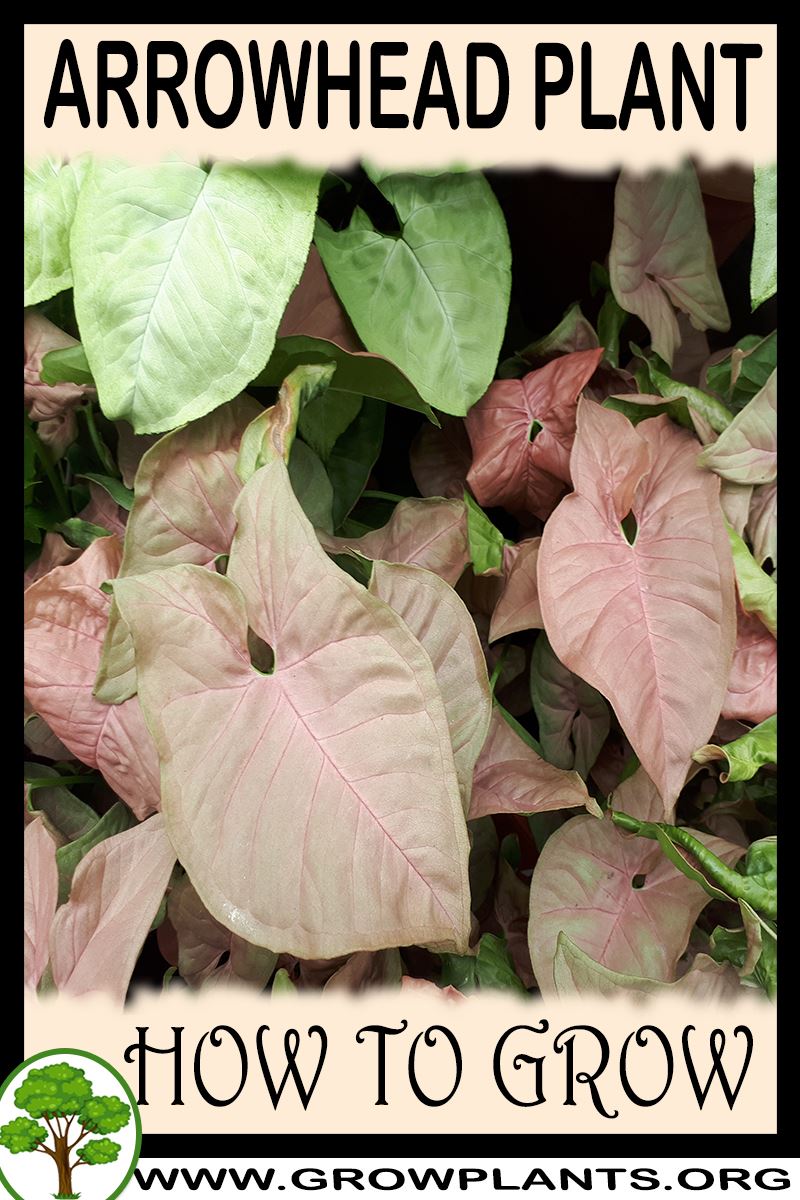
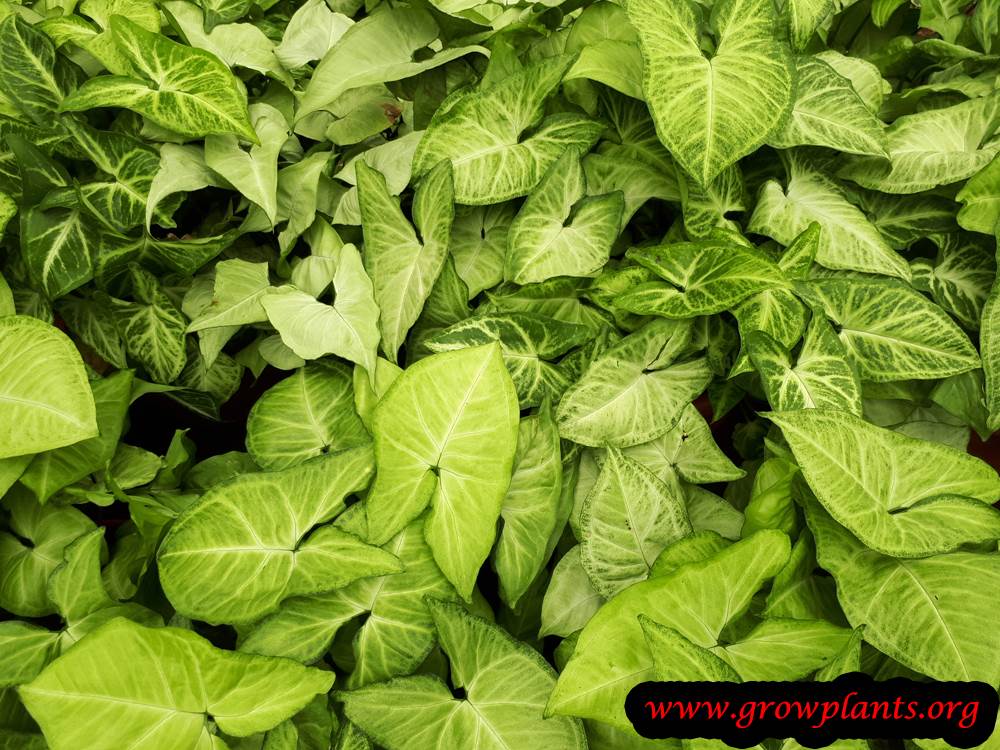
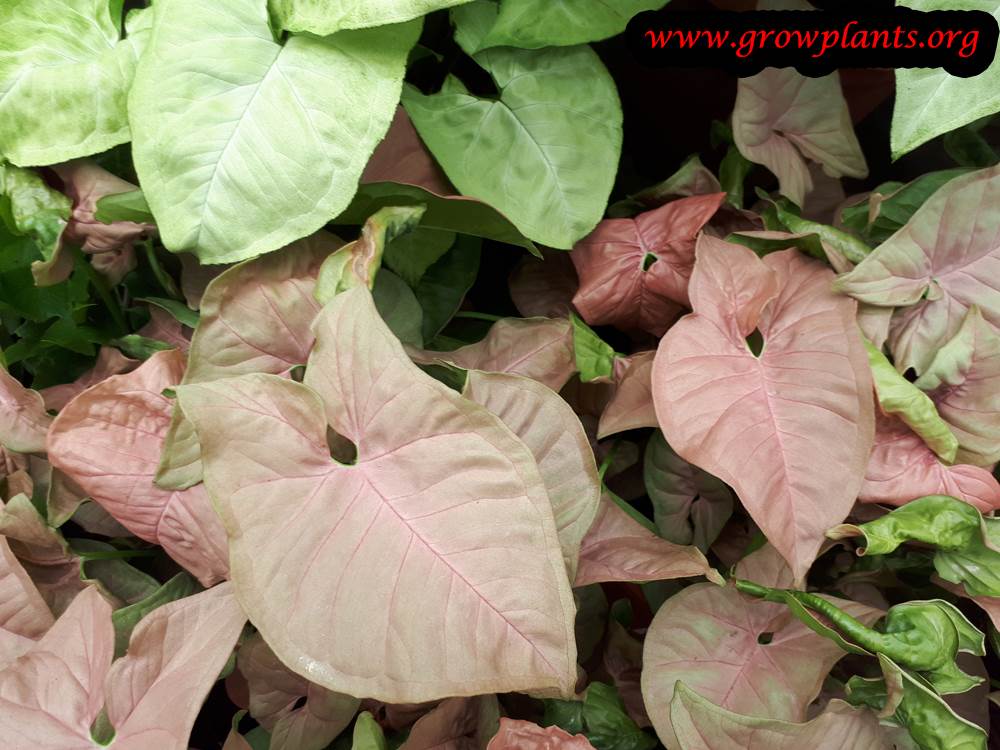
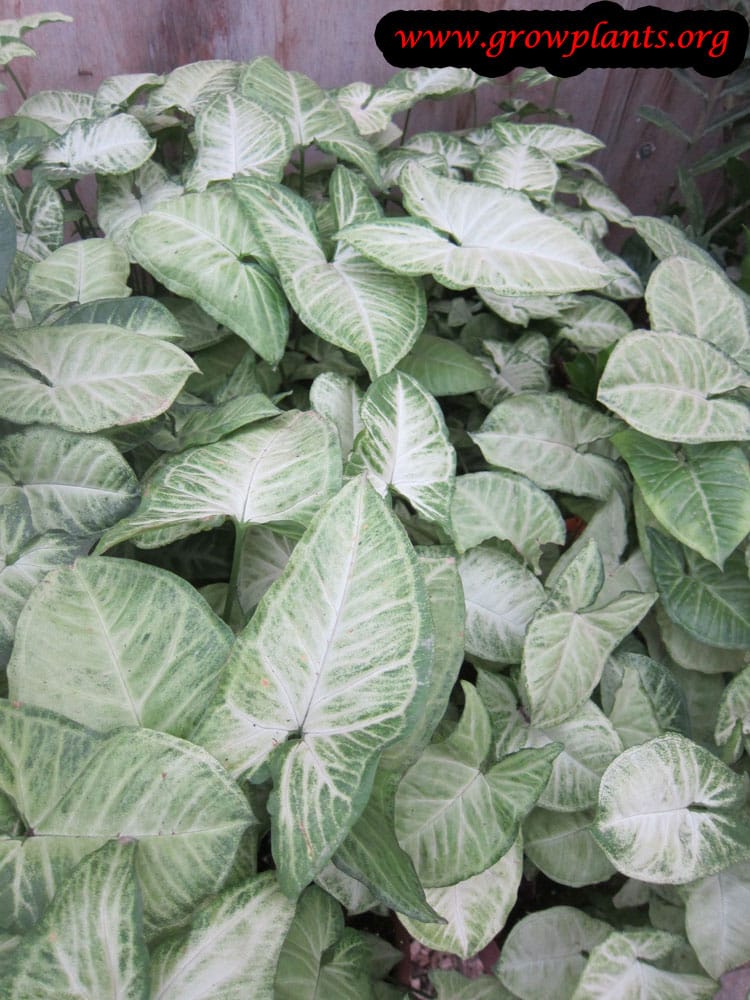
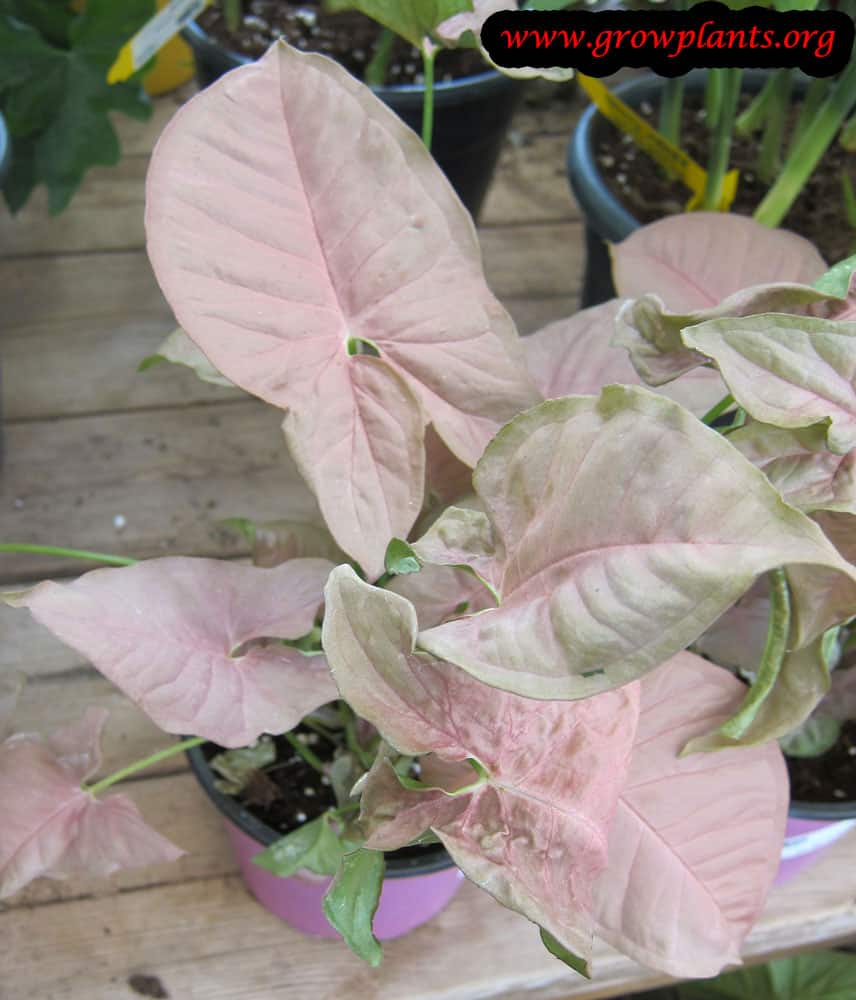
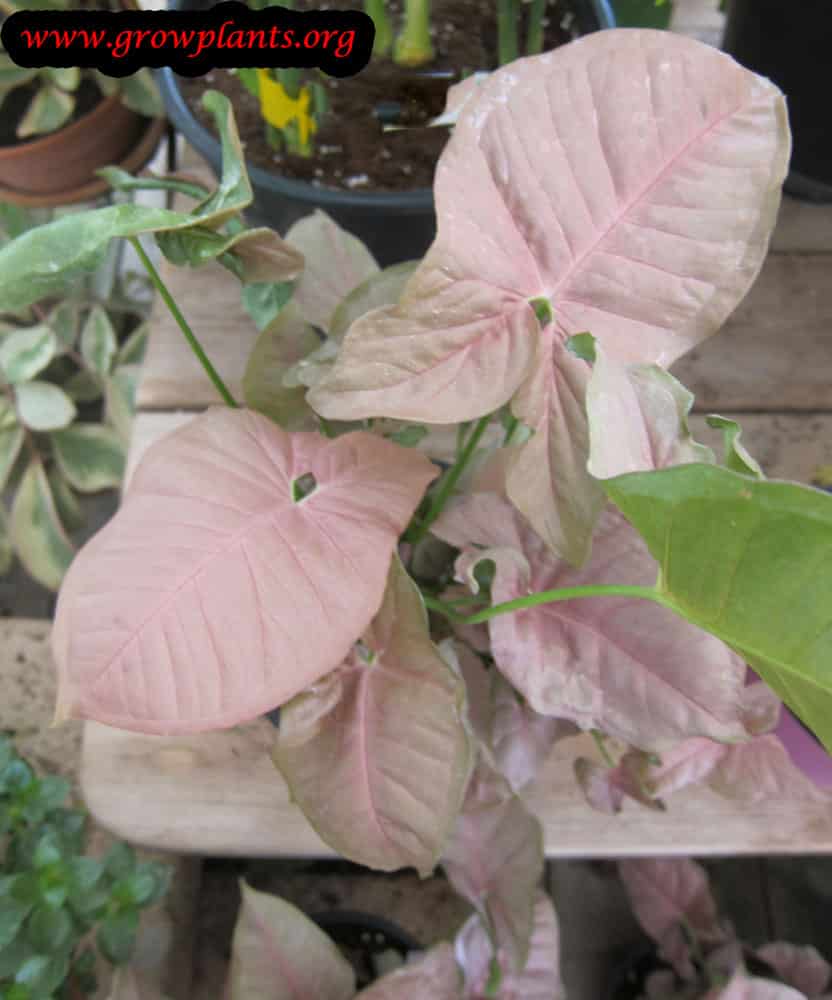
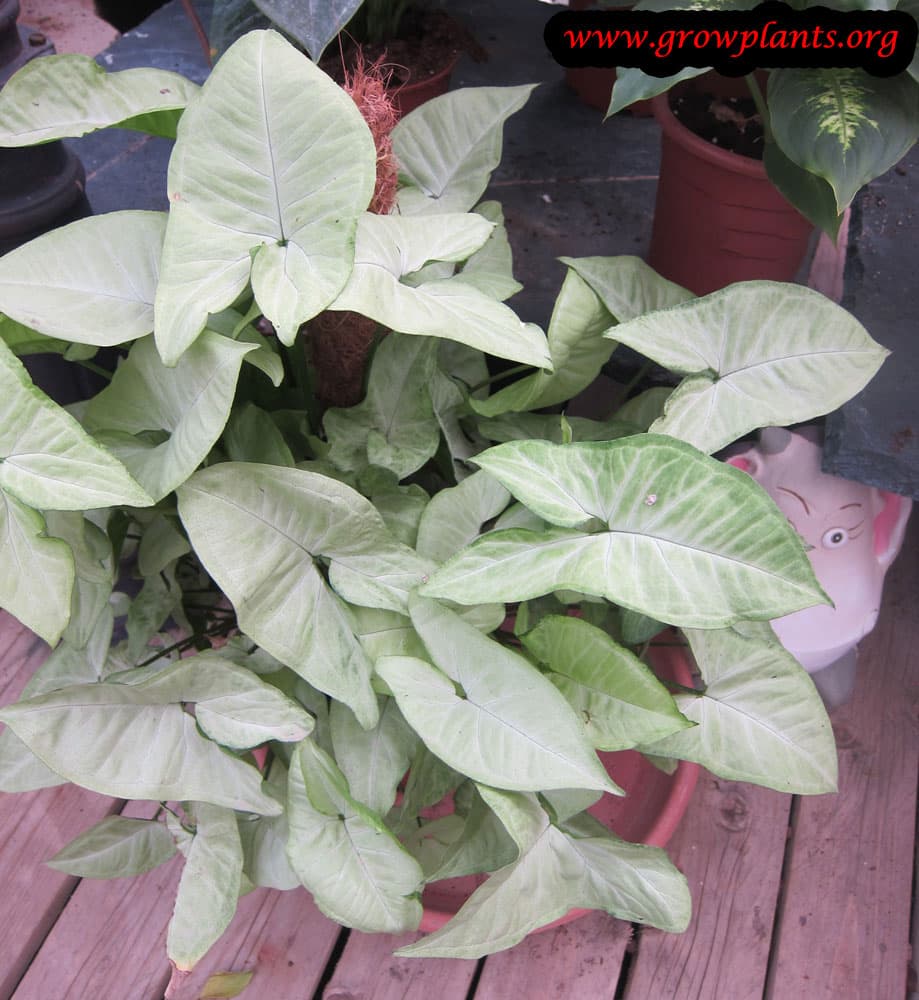
- Leaves & Foliage: Arrowhead to heart-shaped leaves, green or variegated with pink, yellow or white; colour needs adequate light.
- Flower Characteristics: White-to-cream spathe (bract) around a green spadix; rarely flowers indoors (full detail in the Bloom guide).
Primary Uses & Landscape Value
- Functional & Ornamental Roles: Popular houseplant; also used as groundcover, trained on a pole, or grown as a pond / aquatic plant.
Care Guide: Planting, Soil & Watering
Overview: Arrowhead plant is a fast-growing evergreen vine, usually grown as a houseplant, that thrives in warmth and high humidity with rich, moisture-retentive, well-aerated soil in half to full shade. It likes regular watering that keeps the soil consistently moist, and dislikes drying out.
Quick Care Requirements
| Requirement | Ideal Condition |
|---|---|
| Planting Season | Year-round indoors or in frost-free areas; spring to summer where grown outdoors |
| Growth Rate | Fast to moderate |
| Soil Type | Rich, moisture-retentive, well-aerated soil with humus |
| Water Need | Moderate to high – water regularly and keep the soil consistently moist |
Planting & Establishment
- Best Planting Season: It can be planted year-round indoors; outdoors, plant in spring to summer in zone 11b and in spring in zones 10b–11a, keeping it warm (ideally above 18°C).
- How to Plant:
- Hole Preparation: Dig or prepare a planting hole matching the root ball; in pots start small and pot on gradually as it fills the container.
- Soil Amendments: Mix in plenty of humus and organic matter, lightening the soil with perlite, peat or coco to hold moisture while staying airy, then mulch to keep the surface moist.
- Planting Depth: Set the plant at the same depth it grew before, with the crown at the surface; when trained as a vine give it a moss pole or trellis to climb.
- Growth Speed & Expectations: Growth is fast in warm, fertile, well-watered conditions, quickly forming a bushy clump or trailing vine.
Soil, Watering & Drainage Care
- Soil Mix & Drainage Needs: Provide a rich, water-absorbing yet well-draining mix – perlite and peat moss or coco work well; in pots ensure good drainage, and refresh part of the soil when potting on, since constant moisture degrades it over time.
- Watering Schedule & Technique:
- Young / Newly Planted: Water regularly after planting to keep the soil evenly moist – do not let it dry out – while roots establish.
- Established: Water regularly so the soil stays consistently moist but not waterlogged, and mist or raise humidity for lush, well-coloured leaves.
- Seasonal Adjustments: Water more in warm, dry conditions and keep humidity high; reduce watering somewhat in cooler weather while keeping the soil from drying fully.
Climate, Light & Hardiness
The arrowhead plant is a tropical evergreen vine grown outdoors in tropical, subtropical and mild Mediterranean climates and worldwide as a foliage houseplant, thriving in warm, humid shade. It is not frost tolerant, and the site frames its warmth needs precisely: comfortable above about 15°C (59°F) and best above 18°C (64°F).
Quick Climate Specifications
| Climate Zones | Tropical, subtropical, mild Mediterranean; elsewhere a houseplant |
|---|---|
| USDA Hardiness Zones | 11b+ outdoors; 10b–11a with winter protection (site data) |
| Optimal Temp Range | Approx. 18–27°C (64–81°F); comfortable above 15°C (59°F) |
| Cold Damage Begins | Below about 15°C (59°F) growth slows and foliage suffers |
| Approx. Survival Minimum | Keep above roughly 10°C (50°F); it does not tolerate frost |
| Frost Tolerance | None |
| Light Conditions | Half to full shade (bright, indirect light) |
Sunlight & Light Exposure
Optimal Light Setup
Bright, indirect light in half to full shade is ideal; per the site, variegated or paler leaves need more light than dark-green forms.
Shade & Heat Management
Direct sun scorches the leaves, so keep it shaded; the site notes it can even endure around 40°C (104°F) if grown in deep shade with plenty of water.
Best Exposure / Orientation
Indoors, an east- or north-facing window (or a few feet back from a bright one) suits it; outdoors, dappled shade under trees.
Temperature Extremes & Hardiness
USDA Hardiness & Regional Limits
Site data places it in zone 11b and warmer outdoors, or 10b–11a with a little winter protection. This zone frame is the outdoor cold limit - useful for anyone growing it in warm climates - while in colder regions it is kept as a houseplant.
Cold Damage & Winter Protection
Growth stalls below about 15°C (59°F), and prolonged cool, damp conditions cause leaf spotting and rot. In zones 10b–11a give winter protection outdoors; indoors, keep it away from cold draughts and chilly winter windows.
Frost Sensitivity
No frost tolerance - any freeze is fatal.
Extreme Heat Tolerance
Good in heat if shaded and kept moist; the site notes ideal summer temperatures stay below about 25°C (77°F), with higher heat tolerated only in deep shade with abundant water.
Wind, Humidity & Microclimate
Humidity Preferences
Loves high humidity; the site recommends misting the foliage and aerial roots.
Dry-Air Tolerance
Low - dry indoor air browns leaf edges, so group plants or use a humid microclimate.
Wind Tolerance
Low; protect from drying wind and cold draughts.
Microclimate Recommendations
A warm, humid, shaded and draught-free spot - such as a bright bathroom or a sheltered patio in the tropics - is ideal.
Growing in Pots, Balconies & Indoors
The arrowhead plant is grown mainly indoors – one of the easiest houseplants, prized for its patterned leaves – and it also grows well in containers in shade. Note the leaf pattern fades in poor light, while dark-leaved forms cope with less.
Quick Details
- Container Size: Small when grown as a vine; a shallow, wide pot when grown as a spreading groundcover
- Indoor Suitability: Yes – a popular, easy houseplant
- Best Spot: Half to full shade with light – bright indirect indoors; direct sun scorches
- Soil & Drainage: Aerated organic mix; free-draining
- Watering in Pots: Keep evenly moist – do not let it dry; it needs regular water
Indoors & On the Windowsill
- A true houseplant: Mostly grown indoors; give bright, indirect light – the leaf pattern fades in dark spots, while dark varieties tolerate lower light.
- Humidity & support: It enjoys humidity (mist the aerial roots); let it trail or give a moss pole to climb.
- Safety: All parts carry irritant sap (calcium oxalate) – keep away from children and pets, who may chew the leaves.
On a Balcony or Patio
- Shade & shelter: Best in bright shade on a balcony – direct sun burns the leaves; shelter from wind and never let the pot bake.
- Water: It likes water, so check often as pots dry – but ensure free drainage.
Choosing the Pot, Soil & Long-Term Care
- Pot & drainage: Strong drainage holes and no standing saucer water; match the pot to the habit (deeper and smaller for a climber, shallow and wide for a groundcover).
- Potting mix: Aerated organic mix – peat or coir with perlite.
- Feeding: Feed lightly through the growing season – potted plants leach faster.
Grower’s Container Tip
- Start small and pot up gradually: The grower starts arrowheads in a small pot and moves up in stages. Because the plant loves water and that breaks the mix down over time, when he pots up he removes part of the old soil rather than disturbing all the roots.
- Choose the pot by habit: For a climbing vine, a smaller, deeper pot with a support; for a groundcover effect, a shallow but wide pot.
Growing this plant in a greenhouse
A greenhouse can give arrowhead plant frost protection, cold protection, humidity control and extra warmth. In the right climate it may also be kept growing through winter, depending on how much warmth and light are provided.
Greenhouse at a glance
| Greenhouse suitability | Good - clearly useful |
|---|---|
| Main benefits | frost protection, cold protection, humidity control, extra warmth |
| Season extension | earlier spring & later autumn |
| Outdoor protection advisable below | about 15°C |
| Maintain greenhouse minimum | around 15°C for active growth |
| Suitable types | heated greenhouse, polycarbonate greenhouse |
| Heating | Heating is recommended in cold climates for continuous growth. |
Related greenhouse guides
- Greenhouses: How to Choose the Right Greenhouse
- Best Greenhouse Heaters
- Greenhouse Climate Control: Temperature, Ventilation and Humidity
- Polycarbonate Greenhouses: What to Look for Before Buying
Fertilizing & Feeding
A light to moderate feeder: feed with a balanced fertilizer only while the plant is in active growth, and hold off in low light or cool conditions. It grows fast in warm, humid conditions in rich, moisture-holding mix, so keep feeding steady but dilute while it is actively growing.
Quick Fertilizing Specs
| Feeding Level | Light to moderate feeder |
|---|---|
| Main Nutrient Priority | Balanced feeding with adequate nitrogen for healthy foliage |
| Best Feeding Period | Spring through the warm, brighter active growing season |
| Organic Options | Compost or worm castings worked into the potting mix, plus a diluted complete liquid feed |
| Reduce/Stop Feeding | Hold off feeding in low light, cool weather, and right after repotting |
| Micronutrients | Usually supplied by a complete fertilizer; correct only diagnosed iron or manganese shortages |
| Soil pH | Slightly acidic to near neutral |
Feeding by Growth Stage
Settling in after potting or repotting
Let fresh roots establish in new mix before any feeding begins.
| Nutrient direction | None – withhold fertilizer while the plant is not in active growth. |
|---|---|
| Timing | The first weeks after potting up or repotting into fresh mix. |
| Frequency | No feeding at this stage; resume only when active growth returns. |
| Fertilizer types | No feeding at this stage; hold off fertilizing until active growth resumes. |
| Precautions | Withhold fertilizer now; feeding a plant that is not actively growing wastes nutrients and risks salt buildup in the root zone. |
Warm-season active growth
Support steady, well-colored foliage while the plant is actively growing.
| Nutrient direction | A balanced complete fertilizer with adequate nitrogen to fuel leafy growth, kept dilute for a containerized plant. |
|---|---|
| Timing | Through the warm, brighter part of the year when new leaves are forming. |
| Frequency | Light, regular feeding spread across the active growing season. |
| Fertilizer types | A balanced complete liquid fertilizer, applied dilute, Compost or worm castings top-dressed into the mix |
| Routine trace nutrients | iron, manganese |
| Precautions | Keep feeding light and always water first; overfeeding a containerized foliage plant scorches roots and dulls leaf color. |
Low-light or cool-season slowdown
Let the plant coast through low light or cool conditions without pushing weak growth.
| Nutrient direction | None – withhold fertilizer while the plant is not in active growth. |
|---|---|
| Timing | During short winter days, low indoor light, or cool spells when growth stalls. |
| Frequency | No feeding at this stage; resume only when active growth returns. |
| Fertilizer types | No feeding at this stage; hold off fertilizing until active growth resumes. |
| Precautions | Withhold fertilizer now; feeding a plant that is not actively growing wastes nutrients and risks salt buildup in the root zone. |
Nutrient Deficiency Signs & Corrections
Older, lower leaves fade to pale green or uniform yellow and overall growth slows.
| Possible causes | low available soil nitrogen, nitrogen leaching from heavy watering or rain, thin, low-organic-matter soil |
|---|---|
| Appears first on | older, lower leaves |
| What to check | recent feeding history, soil organic matter, watering and drainage |
| Possible correction | Apply a nitrogen-containing complete fertilizer and build soil organic matter, then water evenly. |
New leaves yellow between the veins while the veins themselves stay green.
| Possible causes | low available iron, high soil pH locking up iron, cold or waterlogged roots limiting uptake |
|---|---|
| Appears first on | youngest leaves |
| What to check | soil pH, drainage and root health, whether symptoms are on new growth |
| Possible correction | Correct soil pH and improve drainage, then apply a chelated iron product per its label if new growth stays chlorotic. |
Leaf margins and tips brown or scorch and growth stalls despite adequate watering.
| Possible causes | fertilizer salt buildup in the root zone, under-watering that concentrates salts, excessive or too-frequent feeding |
|---|---|
| Appears first on | leaf margins and tips |
| What to check | recent fertilizer amounts, watering consistency, drainage, especially in containers |
| Possible correction | Ease off feeding, water thoroughly to flush accumulated salts from the root zone, then return to lighter feeding. |
Pruning, Training & Seasonal Maintenance
Arrowhead plant is a fast, evergreen aroid grown for its foliage, and it takes routine cutting well. The key decision is whether to keep it as a compact, bushy plant with juvenile arrow-shaped leaves — achieved by pinching the tips — or to let it climb, in which case the stems elongate and the leaves mature into larger, lobed adult forms. Otherwise pruning is simple grooming: remove dead leaves and spent flower stems, and cut back leggy vines (the offcuts root easily). The sap is a toxic irritant, so wear gloves.
Quick Pruning & Maintenance Specs
| Pruning Tolerance | High — resprouts readily from nodes |
| Primary Pruning Window | Any time in active growth (evergreen, no dormancy indoors) |
| Secondary Maintenance Window | Ongoing grooming year-round |
| Typical Frequency | Light pinching as needed; occasional cut-back of leggy stems |
| Main Objective | Control form (bushy vs climbing), keep tidy, propagate |
| Young Plant Priority | Pinch tips for a full, bushy habit |
| Mature Plant Priority | Cut back leggy vines; remove tired stems |
| Best Tool Type | Precision snips |
| Avoid Heavy Pruning During | Cold, low-light spells when regrowth is slow |
Pruning by Plant Age & Size
Newly Established
Remove only damaged leaves while the plant settles and roots into its pot.
Young / Formative
Pinch the growing tips regularly to force branching and keep the compact, arrow-leaved juvenile look. If you instead want a climber, provide a moss pole or trellis and leave the tips to run.
Mature / Established
Cut back long, bare or leggy vines to a node to restore fullness; remove tired outer stems. When grown as a dense groundcover-style pot, thin old stems and old roots (or move up a pot size) to keep it growing.
Seasonal Pruning & Ongoing Maintenance
As an evergreen tropical there is no seasonal pruning calendar — work with the plant’s growth rather than the seasons. Groom dead or yellowing leaves and spent flower stems whenever they appear, and do any harder cut-back during the warm, brighter months when it reshoots fastest.
Structural Pruning & Training
The main structural choice is pinching for bushiness versus training upward for a mature, lobed-leaf vine. Thin overcrowded stems in a full pot; on a climber, guide stems onto the support. Colourful variegated types need brighter light to keep their pattern, so do not let them sprawl into deep shade after cutting.
Special Growth to Remove
Remove spent flower (spathe) stems and dead leaves. The aerial/nodal roots along the stems can be left (they aid climbing and rooting) or trimmed for neatness — they are not unwanted growth. Cut stems can be rooted in water or moist soil to make new plants.
Container & Small-Space Pruning
This is almost always a container plant, so container pruning is the norm: pinch for compactness, and because it loves water the potting mix breaks down over time — when cutting back a congested plant, reduce old stems and old roots and replace part of the old soil rather than simply hard-cutting the top.
Tools
Precision snips are all that is needed for these soft stems; add a moss pole and soft ties if training it to climb. No secateurs, loppers or saw are ever required.
Tool Hygiene & Disease Risk
Routine for disease — wipe blades clean between plants. The real caution is the sap: it contains calcium oxalate and is a toxic skin, eye and mouth irritant, so wear gloves, keep cuttings away from children and pets, and wash your hands and blades afterwards.
Cut Placement & Technique
Cut just above a node (leaf junction) so a new shoot breaks there; pinch soft tips with snips or fingers. For propagation, cut below a node so the offcut has a root point.
Heavy Pruning & Rejuvenation
Fully tolerated. An overgrown, leggy plant can be cut back hard to short stubs with nodes and it will resprout into a fresh, bushy plant — a reliable way to rejuvenate a tired specimen.
Post-Pruning Care
Keep it warm, humid and evenly moist to speed regrowth; no feeding is needed to force the reshoot. Provide brighter (but not direct-scorching) light so variegation returns on the new leaves.
Common Pruning Mistakes
- Handling cut stems bare-handed and getting an irritant sap reaction.
- Letting it climb, then being surprised the leaves changed to a larger lobed adult form.
- Never pinching, ending up with long bare vines and few leaves.
When NOT to Prune
Avoid hard cutting in cold, dim conditions when the plant will be slow to recover, and do not prune hard right after repotting — let it re-root first.
Recommended Tools (by task)
- precision_snips — pinching, grooming and taking cuttings on soft stems.
- soft_ties_stakes — securing stems to a moss pole when grown as a climber.
Propagation Guide
Arrowhead plant is easiest from stem (node) cuttings, which root quickly in water or moist soil — the site’s recommended method — and this also keeps variegated leaf patterns true, since seedlings can vary. Seed is possible sown in spring but is less common; propagation is easy.
Quick Propagation Specs
| Best Propagation Method | Stem / node cuttings |
| Alternative Methods | Seed; division |
| Propagation Difficulty | Easy |
| Seed True-to-Type | Variable (seedlings may not match a variegated parent) |
| Vegetative True-to-Type | Yes |
| Best Propagation Season | Spring for seed; cuttings year-round indoors |
| Germination Temperature | 20–25°C (68–77°F) |
| Cutting Rooting Time | A few weeks in warm, humid conditions |
Growing from Seed
Sowing Season
Sow in spring; starting indoors gives the steadier temperature the seed prefers.
Germination Conditions
Keep at about 20°C, up to 25°C (68–77°F), with the soil moist and never allowed to dry out.
Stem Cuttings
Cutting Type
A stem cutting including a node; ideally a piece already carrying a fresh (aerial) root, though other stems also work.
Cutting Preparation
Cut below a node.
Rooting Setup
Root in water or directly in soil kept consistently wet; warmth and humidity speed it.
Rooting Hormone
Unnecessary.
Rooting Time
Usually a few weeks.
Division, Offsets, Pups & Suckers
Crowded, clump-like plants (as grown for groundcover) can be split into rooted sections when repotting.
Variegation note: coloured leaf patterns fade in poor light but are retained reliably through cuttings and division, not through seed.
Bloom & Flower Guide
Quick Details
- Bloom Season: Mainly spring to summer, but can bloom on and off all year
- Time to First Bloom: Only on mature plants – it seldom flowers indoors
- Flower Appearance: An aroid bloom – a finger-like spadix wrapped in a white-to-cream spathe, which is the showy part
- Edibility: Not edible – the plant contains calcium oxalate crystals and is an irritant
Detailed Blooming Overview
As in other aroids, the true flowers are tiny and packed onto the spadix (the “ice-pop”), while the cream spathe wrapped around it is the showy part. Indoors it rarely blooms; in warm conditions it may flower from spring through summer, and sometimes at other times of year.
Flower Characteristics
- Slender white spadix with green stamens.
- Surrounded by a white-to-cream spathe that covers the spadix.
Bloom Care & Thinning
- Managing the bloom: Grown mainly for its foliage, so many gardeners remove the occasional bloom to keep energy in the leaves.
- Safety: The sap is an irritant – handle with care and wash your hands afterward.
Pests, Diseases & Troubleshooting
Overview: Arrowhead vine is a forgiving Araceae houseplant whose problems are the usual indoor sap-suckers – spider mites, mealybugs, aphids, scale and thrips – favoured by warm, dry, still indoor air, plus fungus gnats in over-wet potting mix. Its most frequent troubles are actually cultural: root rot from overwatering and leaf-tip browning from dry air or salts. Steady humidity, good light and careful watering keep it healthy.
Quick Troubleshooting Overview
| Issue / Pest | Main Symptom | Primary Solution |
|---|---|---|
| Spider mites | Fine stippling and webbing, dull leaves in dry air | Raise humidity, rinse, miticidal oil/soap |
| Mealybugs | White cottony fluff in leaf axils and nodes | Alcohol swab, horticultural oil, check roots |
| Aphids | Curled sticky new growth | Rinse off, insecticidal soap |
| Scale insects | Brown bumps on stems and leaf undersides | Scrape off, horticultural oil |
| Root rot | Yellowing, wilting, mushy base in wet soil | Free-draining mix, water less, remove rotted roots |
| Leaf-tip browning | Brown crispy tips and edges | Raise humidity, flush salts, use softer water |
Common Pests & Management
- Spider mites (Tetranychus urticae):
- Symptoms: Fine pale stippling that dulls the leaves, with fine webbing on undersides and leaf-tip drying in warm, dry indoor air; a common problem in heated rooms.
- Prevention & Control: Raise humidity and rinse or wipe the foliage regularly, improve airflow, and treat active mites with a miticidal soap or light horticultural oil on the undersides, repeating at intervals; isolate affected plants.
- Mealybugs (Planococcus citri):
- Symptoms: White cottony, waxy clusters tucked into leaf axils, at stem nodes and on undersides, with sticky honeydew and sooty mould; root mealybugs can infest the root ball.
- Prevention & Control: Swab colonies with a cotton bud dipped in rubbing alcohol and rinse, isolate the plant, and spray horticultural or neem oil, repeating weekly to catch crawlers; check the roots when repotting and use fresh medium.
- Aphids (Aphis / Myzus spp.):
- Symptoms: Clusters of soft green insects on tender new shoots causing sticky, curled, distorted growth.
- Prevention & Control: Rinse off with tepid water, and spray insecticidal soap on the new growth; indoors, isolation and repeated soap sprays usually clear them quickly.
- Scale insects (soft & armoured):
- Symptoms: Immobile brown or waxy bumps along stems and leaf undersides and midribs, with honeydew from soft scales.
- Prevention & Control: Scrape off with a fingernail or soft brush, dab with alcohol, and apply horticultural oil to smother crawlers; prune out badly infested stems.
- Thrips (Frankliniella / Echinothrips spp.):
- Symptoms: Silvery streaking and pale flecking with dark faecal specks, and distorted, scarred new leaves; slender insects hide along the veins.
- Prevention & Control: Use blue sticky traps, rinse foliage, remove badly affected leaves, and treat with insecticidal soap or spinosad; isolate the plant, as thrips move readily between houseplants.
- Fungus gnats (Bradysia spp.):
- Symptoms: Small dark flies running over the soil surface and flying up when watered; larvae feed in the top of over-wet potting mix and can damage fine roots of seedlings.
- Prevention & Control: Let the soil surface dry between waterings, use yellow sticky traps for adults, and drench with Bacillus thuringiensis subsp. israelensis (Bti) or top the pot with a dry mineral layer; correcting overwatering solves it.
Diseases & Fungal Issues
- Root rot (Pythium / Rhizoctonia):
- Symptoms: Yellowing, wilting and a soft, mushy, darkened base and roots in soggy, poorly drained or overwatered mix – the leading cause of decline in this plant.
- Treatment & Management: Grow in a chunky, free-draining aroid mix, water thoroughly then let the top dry, and never leave the pot standing in water. Remove rotted roots, repot into fresh medium, and ease off watering in cool, low-light conditions.
- Bacterial leaf spot / blight (Xanthomonas, Erwinia):
- Symptoms: Water-soaked spots that turn brown to black, often with a yellow halo, sometimes rapidly rotting soft leaf tissue in warm, wet, humid conditions.
- Treatment & Management: Avoid overhead watering and leaf wetness, improve airflow, remove affected leaves promptly, and disinfect tools; do not mist infected plants. There is no cure for bacterial infection, so sanitation and dry foliage are the controls.
- Fungal leaf spot (Myrothecium, Cephalosporium, etc.):
- Symptoms: Brown circular spots, sometimes with concentric rings or dark fruiting bodies, on leaves kept too wet.
- Treatment & Management: Improve airflow, keep foliage dry, remove spotted leaves, and space plants; a copper fungicide is reserved for persistent fungal spotting.
- Stem / crown rot:
- Symptoms: Soft, collapsing rot at the stem base or crown in over-wet, cold conditions.
- Treatment & Management: Reduce watering, improve drainage and warmth, remove affected tissue, and propagate healthy top cuttings if the base is lost.
Growing Difficulties & Abiotic Problems
- Overwatering / root rot risk:
- Cause & Symptoms: Yellowing lower leaves, wilting despite wet soil, and a soft base from constantly soggy mix.
- Correction Strategy: Water only when the top of the mix has dried, use a free-draining medium and a pot with drainage, and reduce watering in low light and cool weather; this is the single most common care mistake.
- Leaf-tip and margin browning:
- Cause & Symptoms: Brown, crispy leaf tips and edges from low humidity, underwatering, or salt and fluoride/chloride buildup from tap water.
- Correction Strategy: Raise humidity, keep watering even, flush the pot periodically to leach salts, and use rainwater or filtered water if browning persists; trim dead tips cosmetically.
- Faded variegation / leggy growth:
- Cause & Symptoms: Loss of leaf colour and pattern and long, sparse, reaching growth in low light.
- Correction Strategy: Give bright, indirect light to keep variegation and compactness, and pinch or prune regularly to encourage bushy growth; provide a moss pole for the climbing, larger-leaved mature form.
- Cold damage:
- Cause & Symptoms: Blackened, limp foliage after exposure to cold drafts or temperatures below its tropical comfort range.
- Correction Strategy: Keep it warm and away from cold windows and drafts, and never let it chill; remove damaged leaves once new growth resumes.
- Sap irritation (safety note):
- Cause & Symptoms: The sap contains calcium-oxalate crystals that can irritate skin and are toxic if chewed by pets or children.
- Correction Strategy: Wear gloves when pruning sensitive skin, wash after handling, and keep the plant away from pets and small children; this is a handling note, not a disease.
What Helps – Products & Tools
Arrowhead vine needs only gentle indoor tools: rubbing alcohol and horticultural or neem oil for mealybugs and scale, miticidal soap for spider mites, insecticidal soap for aphids and thrips, blue/yellow sticky traps, and Bti for fungus gnats. For its real issues, a free-draining aroid mix, correct watering and humidity matter far more than any spray.