Plant Profile & Key Characteristics
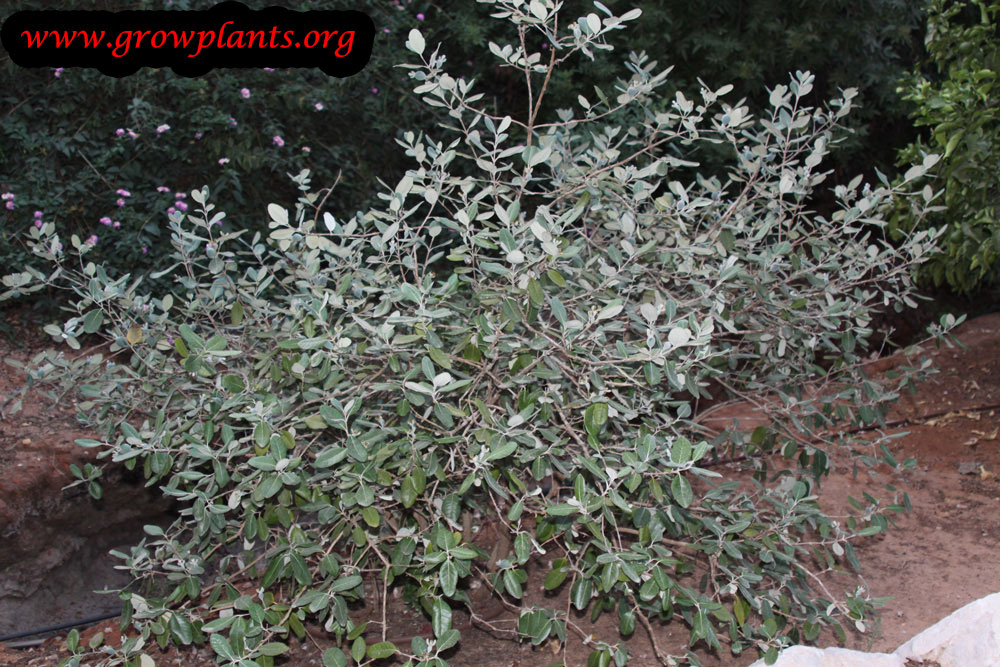
Overview: Feijoa (pineapple guava, Acca sellowiana) is an evergreen tree or large shrub of 2–7 m, grown for its edible fruit and edible flower petals as well as ornament. It is an evergreen perennial for Mediterranean, subtropical and tropical climates.
Quick Specifications
| Specification | Attribute |
|---|---|
| Plant Type / Life Cycle | Perennial (evergreen tree / large shrub) |
| Foliage Type | Evergreen |
| Mature Size | H: 2–7 m (6–21 ft) |
| Growth Rate | Moderate |
| Toxicity | Non-toxic / edible (fruit and flower petals) |
| Hardiness | USDA zone 8+ |
Growth Form & Structure
- Height & Spread: 2–7 m as a tree or large shrub; can be kept smaller in containers or as a clipped hedge.
- Growth Habit & Form: Bushy evergreen tree/shrub with a dense, rounded canopy; tolerates pruning and hedging.
- Lifespan & Maturity: Long-lived; begins bearing fruit in about 2–3 years, with fruit thinning recommended for the first two years.
Anatomy & Physical Features
- Leaves & Foliage: Evergreen leaves, grey-green above and silvery beneath.
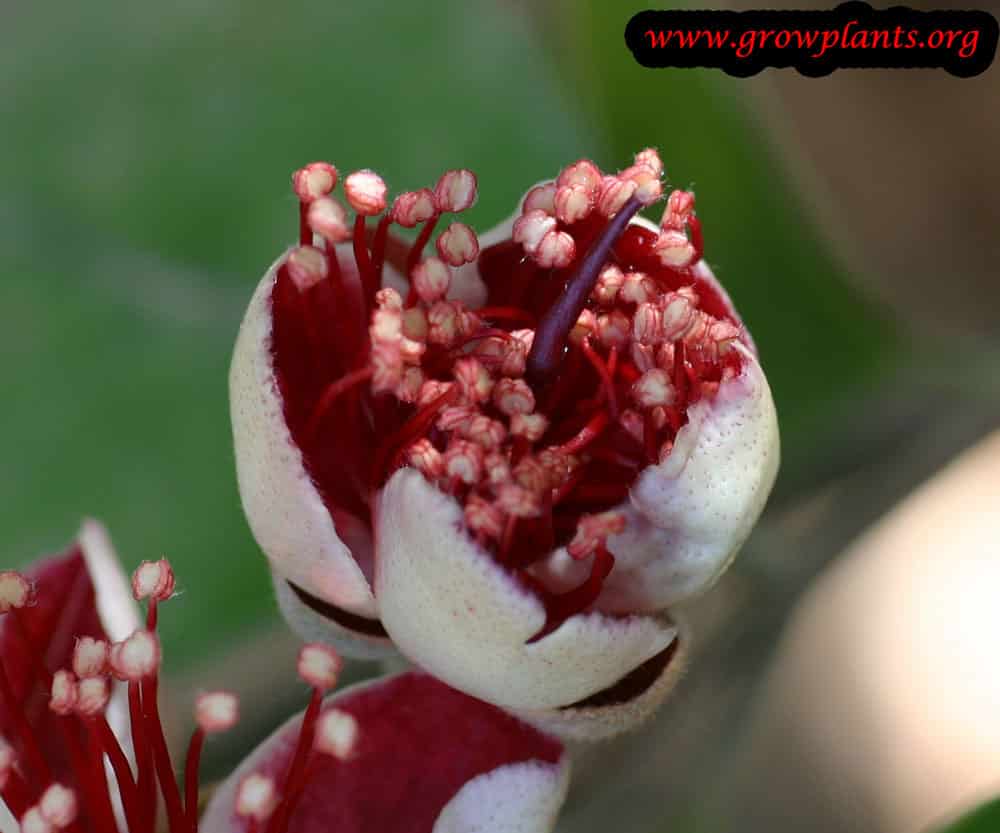
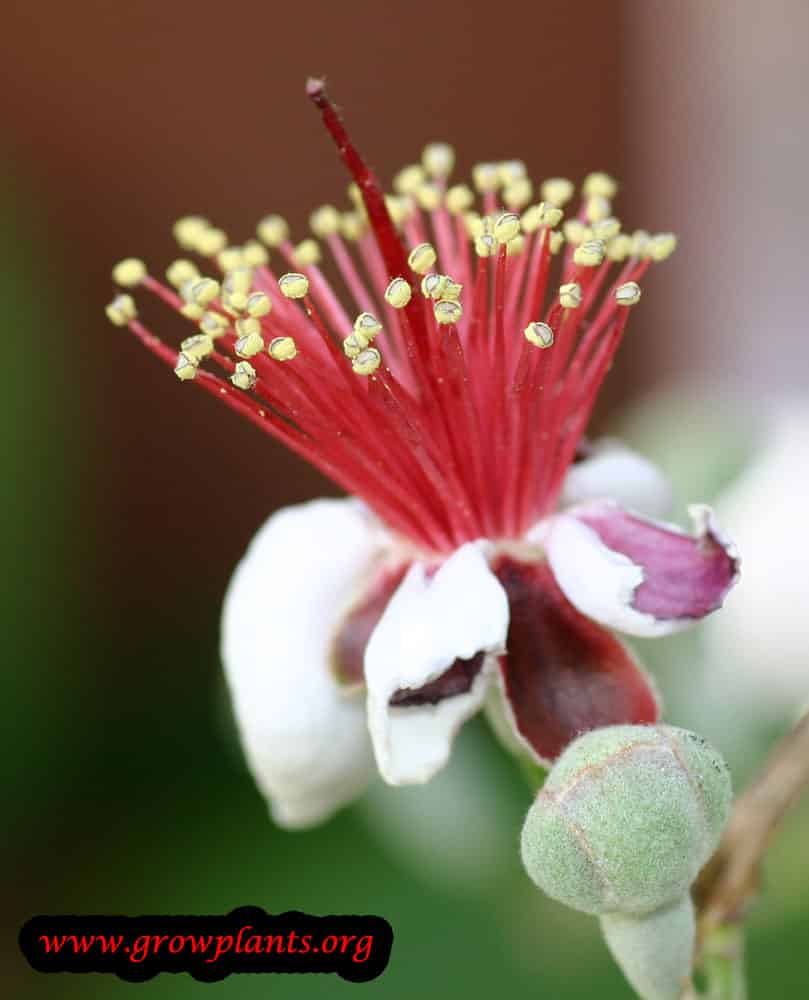
- Flower Characteristics: Showy white-and-red/pink flowers with thick, sweet edible petals; bee-pollinated.
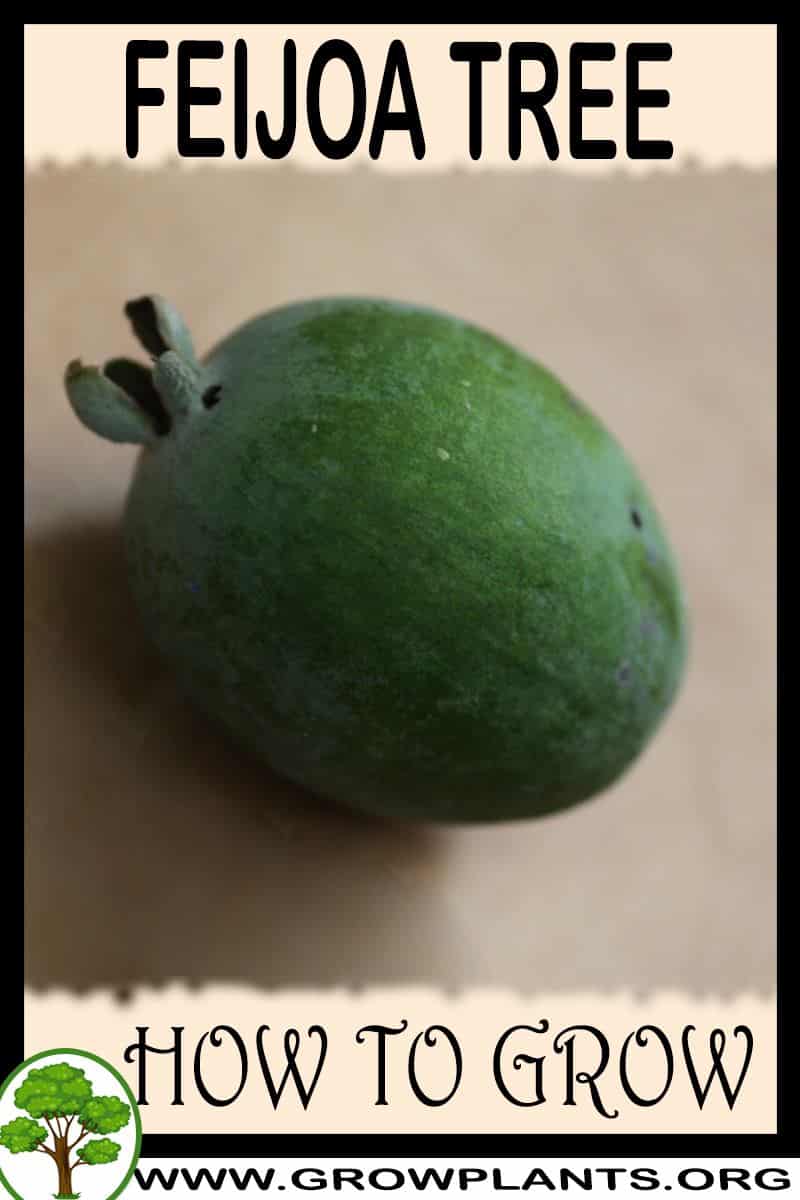
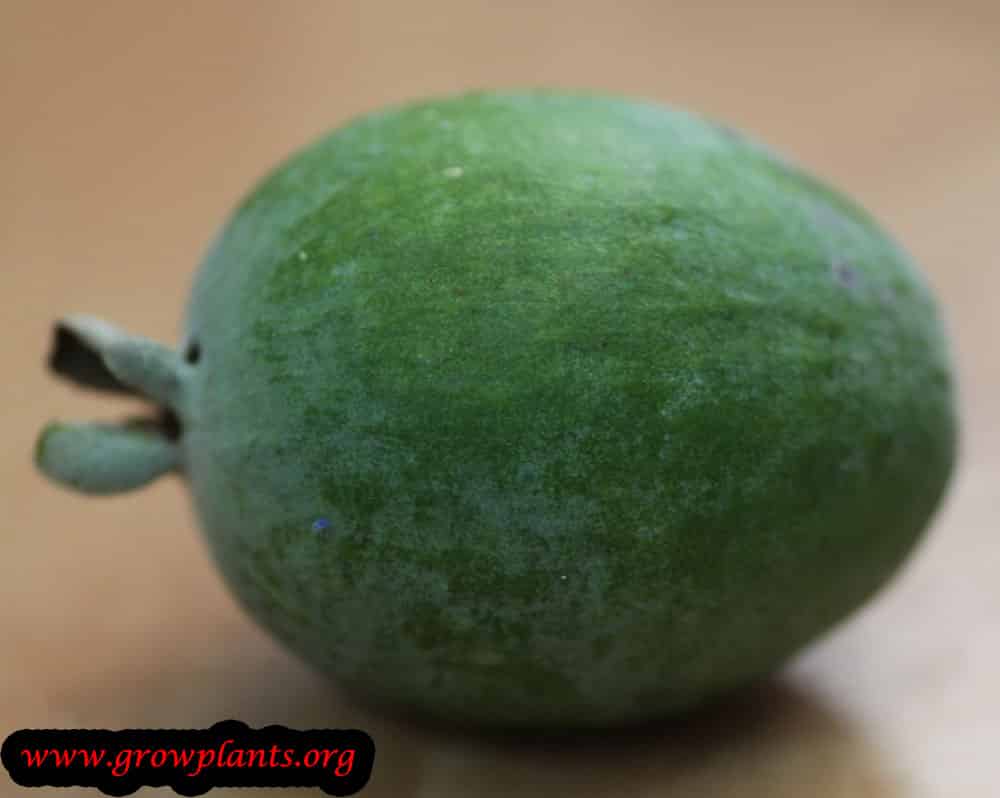
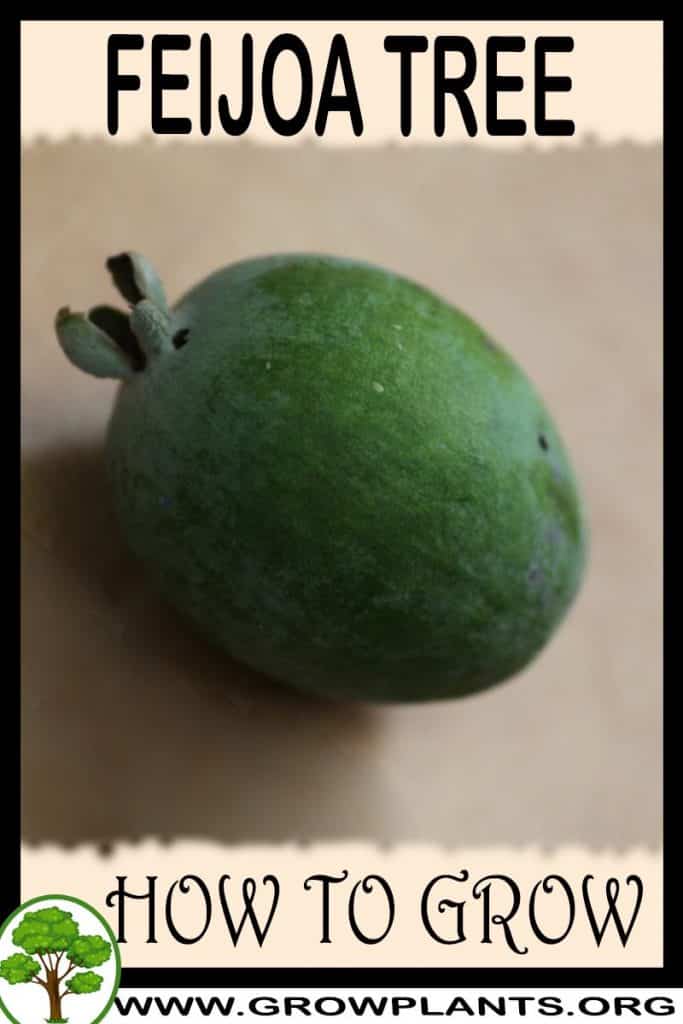
- Fruit Profile: Ellipsoid fruit with an inedible green rind and cream-white edible flesh, often described as tasting of pineapple.
Primary Uses & Landscape Value
- Edible Uses: Fruit eaten fresh or juiced and made into jams; the sweet flower petals are also edible and used in salads and drinks.
- Functional & Ornamental Roles: Dual-purpose fruit-and-ornamental tree, and an attractive evergreen hedge or screen.
Care Guide: Planting, Soil & Watering
Overview: Feijoa (Pineapple guava, Acca sellowiana) is a moderate-growing evergreen for full sun in Mediterranean, subtropical and tropical climates (hardiness zone 8+) that tolerates a wide range of soils but does best in fertile, well-draining ground. It needs moderate, regular water — especially while fruiting — yet is fairly drought-tolerant once established.
Quick Care Requirements
| Requirement | Ideal Condition |
|---|---|
| Planting Season | Warm season — spring, summer and autumn (also winter in the tropics) |
| Growth Rate | Moderate |
| Soil Type | Fertile, well-draining soil; tolerant of a wide range |
| Water Need | Moderate — regular water, best for fruiting; drought-tolerant once established |
Planting & Establishment
- Best Planting Season: Plant in the warm season — spring, summer or autumn — and in the tropics it can also go in during winter. Plant two different cultivars nearby for reliable fruit set.
- How to Plant:
- Hole Preparation: Dig a hole roughly twice the width of the root ball to loosen the surrounding soil, keeping it the same depth as the root ball.
- Soil Amendments: Improve the soil with organic matter or compost to boost fertility and drainage; feijoa is adaptable but rewards a well-prepared bed.
- Planting Depth: Set the plant at the same depth it grew in its pot, with the root collar level with the soil surface.
- Growth Speed & Expectations: Moderate-growing, reaching 2–7 m over time and taking readily to shaping as a shrub, small tree or hedge.
Soil, Watering & Drainage Care
- Soil Mix & Drainage Needs: Prefers a fertile, free-draining soil and dislikes waterlogging; in containers use a quality well-draining potting mix with ample drainage holes.
- Watering Schedule & Technique:
- Young / Newly Planted: Water regularly to keep the soil evenly moist while the young tree establishes its roots.
- Established: Water moderately and deeply once established; keep it consistent while flowering and fruiting for the best crop, though it tolerates short dry spells.
- Seasonal Adjustments: More during summer heat and fruit development; less in cool or wet weather.
Climate, Light & Hardiness
Feijoa (pineapple guava) is a subtropical fruit tree that also grows well in mediterranean and tropical climates. It grows in full sun to half shade and is one of the hardier subtropical fruit trees, tolerating a meaningful degree of winter cold.
Quick Climate Specifications
| Climate Zones | Mediterranean, subtropical, tropical |
|---|---|
| USDA Hardiness Zones | Approximately 8 and warmer |
| Frost Tolerance | Moderate |
| Light Conditions | Full Sun to Half Shade |
Sunlight & Light Exposure
Optimal Light Setup
Full sun to half shade suits this tree; full sun favors the best fruit set.
Temperature Extremes & Hardiness
USDA Hardiness & Regional Limits
Grown from roughly USDA zone 8 upward - relatively cold-hardy for a subtropical fruit tree, tolerating cooler mediterranean winters as well as warmer subtropical and tropical conditions.
Chilling Requirement
Site data does not indicate a meaningful chilling requirement; as with other subtropical fruits, it can generally flower and fruit without a substantial cold-winter chill period.
Growing in Pots, Balconies & Indoors
Feijoa (pineapple guava) is a 2-7 m (6-21 ft) evergreen shrub. The grower says it isn’t a houseplant but grows well in a container – one of the best fruiting shrubs for a large patio or balcony pot.
Quick Details
- Container Size: A large, deep container (grower didn’t state a size); bigger is better
- Indoor Suitability: Not a houseplant; an excellent patio container shrub
- Best Spot: Full sun to light shade
- Soil & Drainage: Aerated, organic-rich mix that drains freely
- Watering in Pots: Keep the mix lightly moist – pots dry faster than open ground; water once the surface starts to dry.
Indoors & On the Windowsill
- Houseplant limits: Not a houseplant – it needs strong sun to flower and fruit well.
- Windowsill growing: Too large for a sill; keep it in a container outdoors.
- Overwintering: Fairly cold-tolerant, but in hard-winter areas a potted plant can be moved to a bright, sheltered spot.
On a Balcony or Patio
- Light & wind: Give it the sunniest spot on the balcony or patio. Walls and paving reflect heat and pots dry quickly, so check moisture often; shelter and stake exposed plants against wind.
Choosing the Pot, Soil & Long-Term Care
- Pot & drainage: A deep pot with strong drainage holes; skip a standing-water saucer to avoid root rot. Terracotta breathes and dries faster, while glazed or plastic hold moisture longer.
- Potting mix: Well-aerated, organic-rich mix – peat or coir with perlite and a little organic matter; it must drain freely.
- Feeding: Potted plants use up their food faster because nutrients leach out with each watering, so feed a little more often than plants in open ground.
- Repotting: Refresh part of the mix and pot up every couple of years; for established plants, lightly prune the root ball and top growth when you repot.
Fertilizing & Feeding
A fairly resilient fruiting shrub-tree that responds well to a standard fruit-tree feeding routine, without needing an especially rich diet.
Quick Fertilizing Specs
| Feeding Level | Moderate – typical fruit-tree feeding suits this species well. |
|---|---|
| young_feeding | A nitrogen-forward complete fertilizer while the tree builds its framework, before it starts bearing. |
| mature_feeding | A balanced fertilizer with attention to potassium once the tree is flowering and fruiting. |
| Main Nutrient Priority | Balanced feeding, shifting toward potassium and boron support as fruit develops. |
| Best Feeding Period | The active spring-into-summer growing window, ahead of and during bloom. |
| Organic Options | Compost or well-rotted organic matter worked into the root zone, topped with mulch. |
| Micronutrients | Iron and manganese are usually supplied by a complete fruit-tree fertilizer. |
| Soil pH | Adaptable, but grows best in well-drained soil that isn’t strongly alkaline. |
| Reduce/Stop Feeding | Taper feeding once fruit is harvested and growth slows heading into the cooler season. |
Feeding by Growth Stage
Newly Planted Tree
Get a young feijoa’s roots established without forcing top growth ahead of the root system.
| Nutrient direction | Keep feeding light and balanced until steady new growth confirms the roots have taken hold. |
|---|---|
| Timing | The first growing season after transplanting, once new growth resumes. |
| Frequency | A few light feedings spread across the active growing season is usually enough. |
| Fertilizer types | A balanced, complete fertilizer for young fruit trees, Compost worked into the planting area |
| Precautions | Avoid heavy feeding right at planting; overly rich soil close to new roots can do more harm than good. |
Young, Non-Bearing Tree
Build a strong branch framework before the tree is expected to flower and fruit.
| Nutrient direction | Favor a nitrogen-forward, complete fertilizer to drive steady vegetative growth. |
|---|---|
| Timing | Through the tree’s active growing seasons, before it reaches bearing age. |
| Frequency | Regular light feedings during the warm growing months, easing off as growth slows. |
| Fertilizer types | A nitrogen-forward complete fertilizer for young trees, Composted organic matter |
| Routine trace nutrients | iron, manganese |
| Precautions | Remember feijoa often fruits better with a second, genetically different plant nearby for cross-pollination – a planting consideration, not a feeding one. |
Established, Approaching Fruiting
Transition the tree onto a balanced diet as it nears its first flowering and fruit set.
| Nutrient direction | Shift from a nitrogen-forward feed to a balanced, complete fertilizer. |
|---|---|
| Timing | As the tree matures, in the seasons leading into its first bloom. |
| Frequency | A modest, evenly spaced feeding routine through the growing season. |
| Fertilizer types | A balanced, complete fruit-tree fertilizer, Mulch renewed around, not against, the trunk |
| Routine trace nutrients | iron, manganese |
| Precautions | Keep fertilizer clear of the trunk and avoid pushing excess soft growth right before bloom. |
Mature, Fruit-Bearing Tree
Support flowering, the edible petals, and fruit development on a bearing tree.
| Nutrient direction | Keep a balanced approach with added potassium support as fruit fills out. |
|---|---|
| Timing | Around bloom in spring into summer, continuing through fruit development. |
| Frequency | A steady, moderate feeding routine through the growing season, easing off once fruit is harvested. |
| Fertilizer types | A balanced, complete fruit-tree fertilizer with potassium emphasis, Organic mulch to build long-term soil fertility |
| Routine trace nutrients | iron, manganese |
| Precautions | Avoid excess nitrogen at bloom time, which can push leafy growth at the expense of flowering and fruit set. |
Nutrient Deficiency Signs & Corrections
New leaves turn yellow between the veins while the veins stay distinctly green.
| Possible causes | High soil pH reducing iron availability, Poor drainage or compacted, waterlogged roots, A genuine iron shortfall in depleted soil |
|---|---|
| Appears first on | the newest growth |
| What to check | Soil pH if it can be tested, Drainage around the root zone, Whether the yellowing spares older leaves |
| Possible correction | Improve drainage first; if soil pH is elevated, correct it gradually and consider a chelated iron product per its label. |
Overall pale, yellow-green foliage and a noticeable slowdown in new growth.
| Possible causes | Insufficient available nitrogen, Nitrogen tied up or leached from sandy, fast-draining soil, Root stress from waterlogging limiting uptake |
|---|---|
| Appears first on | older leaves first |
| What to check | Growth rate compared with previous seasons, Recent feeding history, Soil drainage and moisture consistency |
| Possible correction | Apply a balanced or nitrogen-leaning fertilizer and watch for greener new growth over the following weeks. |
Scorched or browning margins on older leaves, sometimes with reduced fruit size.
| Possible causes | Potassium drawn down heavily during fruiting, Drought stress limiting nutrient movement, Salt buildup interfering with potassium uptake |
|---|---|
| Appears first on | older leaves, at the leaf edges |
| What to check | Timing relative to fruit load, Recent watering regularity, Any history of salty irrigation water |
| Possible correction | Feed with a balanced, potassium-inclusive fertilizer and keep watering even through fruit development. |
Pruning, Training & Seasonal Maintenance
Feijoa tolerates a wide range of pruning, from light annual tidying to hard renewal, and generally responds by resprouting vigorously rather than sulking. The safest and most effective window is late autumn into winter, once the current season’s fruit has finished (fruit is typically gathered from the ground as it drops rather than picked), when removing weak and dead wood shapes the plant without touching the coming season’s flower buds. Depending on how it is grown – as a specimen tree/large shrub or clipped into a hedge or screen – the pruning approach differs meaningfully.
Quick Pruning & Maintenance Specs
| Pruning Tolerance | Moderate–High |
| Primary Pruning Window | Autumn–Winter, after fruit drop |
| Typical Frequency | Annual light tidy; hard renewal only occasionally if needed |
| Main Objective | Remove weak/dead wood and keep an open, productive framework (specimen) or a dense clipped face (hedge) |
| Young Plant Priority | Establish 3–5 strong scaffold stems (specimen) or early lateral branching (hedge); avoid overcropping in the first two years while the plant establishes |
| Mature Plant Priority | Remove weak, thin branches that can’t support fruit weight; renew a portion of old wood periodically |
| Best Tool Type | Bypass secateurs for weak-wood removal; hedge shears only if grown as a clipped hedge |
| Avoid Heavy Pruning During | Spring flowering, since flowers (and the edible petals) and the crop that follows are lost with the cut wood |
Pruning by Plant Age & Size
Newly Established
Remove only damaged growth; because the first two years tend to need flower thinning while the plant is not yet established, avoid heavy structural cuts on top of that stress.
Young / Formative
As a specimen: select 3–5 well-spaced main stems and remove competing low growth. As a hedge or screen planting: pinch/head young growth early to encourage the dense branching a good hedge face needs.
Mature / Established
As a specimen: remove weak, spindly branches that cannot carry fruit weight (the exact issue the source guidance flags), and open the centre modestly for light. As a hedge: regular clipping to maintain a dense outer face, accepting that clipped plants carry less fruit than lightly pruned specimens.
Seasonal Pruning Schedule
Post-Harvest / Dormant (Autumn–Winter)
Objective: remove weak and dead wood before spring growth. Remove: thin, weak branches unable to support fruit, and any dead wood. Do not remove: healthy wood carrying next season’s flower buds, which form on the coming spring’s new growth. Expected response: stronger, better-supported branches for the next crop. Flowering/fruiting impact: positive, since it doesn’t touch wood that hasn’t yet produced this year’s flowering growth.
Flowering & Fruiting Wood
Feijoa flowers and fruits on the current season’s new growth, so winter pruning of the previous year’s wood does not remove already-formed flower buds; instead it shapes the framework that the new spring growth – and that growth’s flowers and fruit – will arise from.
Structural Pruning & Training
On a specimen plant, remove branches too thin or weak to hold a full fruit load, per the grower guidance, and keep the centre open enough for light and air; on a hedge, structure is subordinated to a dense, even clipped face.
Special Growth to Remove
Weak, thin or dead branches, as specifically noted for this species; excess flowers/young fruit in the first two years after planting, while the tree is still establishing.
Container & Small-Space Pruning
Feijoa grows well in a container and responds to pruning by staying compact rather than resenting it, so height and spread can be actively controlled with light annual heading back, and root maintenance handled through the container’s own repotting cycle.
Tools
Bypass secateurs for removing weak or dead branches on a specimen plant; loppers for thicker old wood being renewed; hedge shears only where the plant is being maintained as a clipped hedge rather than an open specimen.
Tool Hygiene & Disease Risk
Routine – aphids are the only pest noted, with no documented transmissible disease, so clean, sharp tools are enough.
Cut Placement & Technique
Cut weak or dead branches back to a healthy lateral or the branch collar rather than leaving stubs; on a hedge, shear to a consistent face while occasionally reaching in with secateurs to thin the interior and prevent it from going hollow.
Heavy Pruning & Rejuvenation
Tolerated – an overgrown or leggy feijoa can be cut back hard in winter and will resprout strongly, though expect reduced fruiting for a season or two while it rebuilds flowering wood; spreading a hard renewal over two winters reduces that gap.
Post-Pruning Care
Water normally through the following spring flush; avoid heavy feeding immediately after a hard cut, since the plant is already primed to push vigorous regrowth on its own.
Common Pruning Mistakes
Pruning hard in spring and removing the season’s flowers and fruit; leaving thin, overloaded branches unremoved until they break under fruit weight; shearing a specimen plant into a hedge shape by habit, which sacrifices its natural flowering form for no reason if it isn’t being grown as a hedge.
When NOT to Prune
Avoid pruning during spring flowering and early fruit set; avoid heavy work on very young, still-establishing plants beyond the recommended early flower thinning.
Recommended Tools (by task)
- Removing weak or dead branches on a specimen plant – bypass_secateurs: precise cuts sized to this shrub’s typical wood
- Renewal cuts on older, thicker wood – loppers: extra leverage for wood beyond secateur capacity
- Maintaining a clipped hedge or screen planting – hedge_shears: only relevant where feijoa is grown as a formal hedge rather than a specimen
Pruning Troubleshooting
| Problem | Possible Cause | What to Check | Corrective Action |
| Branches breaking or sagging under fruit | Thin, weak wood left unremoved | Branch diameter versus typical fruit load in that area | Remove weak branches in the winter pruning pass before they’re overloaded again |
| Little fruit despite regular clipping | Hedge shearing removing most of the current season’s flowering growth | Whether the plant is sheared during or just before spring flowering | Shift shearing to the post-harvest dormant window, or lightly thin instead of shearing if fruiting matters more than a formal shape |
| Sparse, leggy growth | No renewal pruning of old, unproductive wood | Age and density of interior branches | Remove a portion of the oldest wood each winter to stimulate fresh growth |
Propagation Guide
Feijoa can be grown from seed, but because it is largely cross-pollinated, seedlings vary in fruit quality, so the site notes that grafting or another vegetative method is necessary to reproduce a good, known cultivar true-to-type; semi-hardwood cuttings are also commonly used in cultivation for the same purpose. Propagation is Easy from seed and Moderate by cuttings or grafting.
Quick Propagation Specs
| Best Propagation Method | Vegetative propagation (cuttings or grafting) for named cultivars; seed for species plants or rootstock |
| Alternative Methods | Air layering (less common) |
| Propagation Difficulty | Easy (seed) – Moderate (cuttings, grafting) |
| Seed True-to-Type | Variable – fruit quality of seedlings is unpredictable |
| Vegetative True-to-Type | Yes |
| Best Propagation Season | Spring, within the site’s spring-summer-autumn planting season |
| Seed Germination Time | Not documented on site; commonly a few weeks to about a month under warm conditions |
| Cutting Rooting Time | Commonly several weeks to a couple of months |
Growing from Seed
Seed Handling & Viability
Clean the small seeds out of the ripe fruit pulp before sowing.
Sowing Season
Spring, within the site’s spring-summer-autumn planting season.
Sowing Depth & Orientation
Sow shallowly – the seed is small and should be barely covered.
Germination Conditions
Warm, consistently moist, bright conditions.
Germination Time
Not documented on site; generally not difficult, commonly within a few weeks to about a month.
Stem Cuttings
Cutting Type
Semi-hardwood tip cuttings.
Best Timing
Late spring to summer, during active growth.
Cutting Preparation
Take a cutting with a few nodes, strip the lower leaves, and reduce remaining leaf area to limit water loss.
Rooting Setup
A well-draining mix such as perlite or sand, under mist or a humidity dome.
Rooting Hormone
Often beneficial for more reliable rooting, though not strictly required.
Rooting Time
Commonly several weeks to a couple of months, and can be somewhat slow.
Grafting & Budding
Why Grafting Is Used
To reproduce a superior, known cultivar true-to-type, since seedling feijoa varies in fruit quality – matching the site’s own note that grafting is necessary.
Preferred Grafting Methods
Not detailed by the site; whip, cleft, or side-veneer grafting, or chip budding, onto seedling rootstock are the standard techniques.
Rootstock
Seedling feijoa.
Scion Selection
Healthy wood from a proven, good-fruiting cultivar.
Best Grafting Season
Spring, during active growth, within the site’s spring-summer-autumn planting season.
Graft Aftercare
Protect the union until it knits, and remove rootstock suckers below the graft.
Bloom & Edible Flower Guide
Quick Details
- Bloom Season: Spring to summer
- Flower Appearance: White petals flushed red-pink, with a prominent tuft of long red stamens
- Edibility: Edible – the thick, fleshy petals are sweet and can be eaten raw
Detailed Blooming Overview
Feijoa, or pineapple guava, is that rare plant whose flowers are as useful as its fruit. In late spring and summer it opens showy blooms with a burst of red stamens, and the plump white-and-pink petals are genuinely edible – sweet and a little marshmallowy. Because the petals can be picked without harming fruit set, the bloom offers a first harvest well before the fruit ripens.
Flower Characteristics
- Petals are white on the inside, blushed red to pink outside, and thick and fleshy.
- A striking tuft of long red stamens gives the flower its firework look.
Bloom Care & Thinning
- Harvesting the petals: The sweet petals can be eaten raw, added to salads and drinks, or used in jams; taking only some leaves plenty of flowers to set fruit.
- Thinning the bloom: In the first two years, before the tree is established, thinning the flowers helps it build strength.
- Pollination: The flowers are pollinated by bees; growing two different cultivars improves fruit set.
Fruit & Uses
Feijoa is grown for both its fruit and its edible flower petals. The fruit flesh is eaten fresh out of hand or juiced, while the sweet flower petals can be picked and eaten separately without harming the developing fruit.
Quick Edible Specs
| Edible Parts | Fruit, flowers |
|---|---|
| Main Use(s) | Culinary – fresh eating, juice (fruit); fresh eating, jam, beverages (flower petals) |
| Eaten Raw or Cooked | Raw (both fruit flesh and flower petals); fruit also juiced |
| Preparation Required | Fruit: halve and scoop out the flesh, the rind is not eaten; Flowers: pick petals only, leave the rest of the flower to set fruit |
| Harvest Season | Fruit: summer; Flowers: spring–summer bloom period |
| Time to First Harvest | A relatively quick tree to start bearing once established (see Propagation) |
| Storage | Fruit can be picked slightly under–ripe and left to finish ripening indoors |
| Safety/Toxicity Caveat | None known; the fruit rind is simply not eaten (bitter/tough rather than toxic) |
Fruit
The fruit is ellipsoid with a green, non–edible rind; inside, the creamy–white flesh is soft and aromatic, often compared to pineapple. Ripe fruit tends to drop, so it is commonly collected from the ground rather than picked from the branch, or picked slightly early and left to finish ripening on a counter. The flesh is eaten fresh with a spoon or juiced.
Flowers & Flower Buds
The flower petals are white flushed with red–pink and are sweet and fleshy enough to eat fresh, in salads, or made into jam or a beverage. Only the petals are picked and eaten – the central part of the flower is left in place so the fruit can still develop, meaning light petal–picking does not cost you the harvest.
Harvesting
Fruit ripens and often self–drops in summer, so gathering windfall fruit from the ground is a normal harvest method; fruit can also be picked a little before full ripeness and left to soften indoors. Flower petals are gathered during the spring–summer bloom.
Preparation, Uses & Safety
Fruit flesh is scooped out and eaten fresh or juiced; the rind is discarded. Flower petals are eaten fresh, or used in jams and beverages. No toxicity is associated with either part; the main preparation step is simply discarding the fruit rind, which is unpalatable rather than unsafe.
Pests, Diseases & Troubleshooting
Overview: Feijoa or pineapple guava (Acca sellowiana, family Myrtaceae) is a notably tough, largely pest-free evergreen fruiting shrub; its few real problems are fruit flies and birds attacking ripening fruit, sap-sucking scale, mealybugs and aphids on soft growth, and root rot in waterlogged soil. Grow it hard in free-draining soil and full sun, keep it open and clean, and most issues never take hold.
Quick Troubleshooting Overview
| Issue / Pest | Main Symptom | Primary Solution |
|---|---|---|
| Fruit fly | Stung, prematurely dropping fruit with soft, maggoty flesh | Trap and bait, remove fallen fruit, bag or net where pressure is high |
| Birds | Pecked, gouged ripening fruit | Net plants; harvest promptly as fruit softens and drops |
| Scale & mealybugs | Bumps or white cottony tufts on stems/leaves; honeydew and sooty mould | Horticultural oil, prune to open the canopy, protect predators |
| Aphids & thrips | Distorted, sticky new growth; silvery flecking on young leaves/flowers | Water jet, insecticidal soap, beneficial insects |
| Root rot | Wilting, dieback and dark roots in wet, heavy soil | Improve drainage, water less, plant on a mound |
Common Pests & Management
- Fruit flies (Ceratitis capitata / Bactrocera / Anastrepha spp.):
- Symptoms: Females sting ripening fruit to lay eggs, leaving small puncture marks; the flesh around them softens, browns and is tunnelled by white maggots, and fruit drops early. Pressure is highest in warm regions with a long fruit-fly season.
- Prevention & Control: Hang lure/protein-bait traps to monitor and reduce numbers, pick up and destroy all fallen and stung fruit (do not compost), and bag or net where infestation is heavy. Harvest fruit as it firms and drops naturally rather than leaving it hanging over-ripe.
- Birds (various species):
- Symptoms: Pecked, gouged and half-eaten fruit as it ripens and softens, and knocked-down fruit under the plant.
- Prevention & Control: Net vulnerable plants as fruit approaches ripeness, and pick promptly, since feijoa fruit is usually harvested as it drops. Scare devices give only short-term relief.
- Scale insects (Coccus hesperidum / Hemiberlesia spp.):
- Symptoms: Flat brown, tan or hard grey bumps along stems, twigs and leaf veins that do not brush off; soft scales excrete honeydew that blackens with sooty mould.
- Prevention & Control: Prune to open a congested canopy and improve light and airflow, scrape off light infestations, and spray horticultural oil to smother crawlers, repeating to catch generations. Ants farming scale for honeydew should be controlled, and parasitic wasps and ladybirds encouraged.
- Mealybugs (Planococcus citri):
- Symptoms: White, cottony waxy clusters in leaf axils, on shoot tips and around the fruit calyx, with sticky honeydew and sooty mould.
- Prevention & Control: Dislodge with a water jet, spot-treat with insecticidal soap or horticultural oil, and control ants that protect and spread them. Keep plants unstressed and encourage predators.
- Aphids (Aphis spp.):
- Symptoms: Colonies of green or black aphids on soft new shoots and flower buds, distorting growth and leaving honeydew.
- Prevention & Control: Hose off, use insecticidal soap on stubborn colonies, and rely on ladybirds, lacewings and hoverflies; avoid heavy nitrogen feeding.
- Thrips (Thrips / Frankliniella spp.):
- Symptoms: Silvery flecking and fine black specks on young leaves, flowers and fruit skin; can scar developing fruit.
- Prevention & Control: Tolerate light damage, use blue/yellow sticky traps to monitor, and treat heavy pressure with insecticidal soap or spinosad, protecting pollinators by spraying in the evening.
Diseases & Fungal Issues
- Fruit rot / anthracnose (Colletotrichum / Botrytis / Pestalotiopsis):
- Symptoms: Soft brown rotten patches on fruit (in the field or in storage), grey mould in damp weather, and dieback of blossoms; wounded or fruit-fly-stung fruit rots fastest.
- Treatment & Management: Harvest and store clean, undamaged fruit, remove mummified fruit and prunings, and keep the canopy open and dry. Copper sprays are rarely needed on this resistant plant but help in wet climates if rot is recurrent.
- Leaf spot (Cercospora / Pseudocercospora spp.):
- Symptoms: Small brown to purplish spots or blotches on leaves, occasionally causing some leaf drop in wet, humid conditions.
- Treatment & Management: Rake up fallen leaves, improve airflow, and avoid overhead watering; the plant usually shrugs this off without treatment.
- Phytophthora root & collar rot (Phytophthora spp.):
- Symptoms: Poor vigour, yellowing, wilting and branch dieback with darkened roots and a rotted collar in wet, heavy or poorly drained soil.
- Treatment & Management: Prevention is key: plant in free-draining soil or on a raised mound, avoid waterlogging and deep mulch against the trunk, and water deeply but infrequently. There is no easy cure once established.
Growing Difficulties & Abiotic Problems
- Poor fruit set:
- Cause & Symptoms: Flowers but little fruit, usually from inadequate cross-pollination (many cultivars need a second variety and bird/bee pollinators) or from heat/water stress at flowering.
- Correction Strategy: Plant compatible cultivars for cross-pollination, encourage pollinators, and keep plants evenly watered during flowering; some self-fertile cultivars set better alone.
- Fruit drop:
- Cause & Symptoms: Small fruit dropping after set, from water stress, heavy crop, or poor pollination.
- Correction Strategy: Maintain steady moisture (mulch, deep watering) through fruit development and avoid drought/flood swings; a light fruit thin can improve size on heavy crops.
- Iron/nutrient chlorosis:
- Cause & Symptoms: Yellowing leaves with green veins on very alkaline soils, or general paleness when underfed.
- Correction Strategy: Feed with a balanced fertiliser in the growing season, mulch with organic matter, and correct high pH or apply chelated iron where needally soils cause chlorosis.
- Sunburn / wind scorch:
- Cause & Symptoms: Bleached or browned foliage and scalded fruit on plants suddenly exposed to intense sun or hot, dry wind.
- Correction Strategy: Acclimatise gradually, shelter from harsh wind, and keep well-watered; feijoa is tough but young plants appreciate some protection while establishing.
What Helps – Products & Tools
Feijoa needs very little spraying: focus on fruit-fly traps and prompt removal of fallen fruit, plus netting against birds, as the main measures. Keep horticultural oil and insecticidal soap on hand for occasional scale, mealybug, aphid and thrips outbreaks, and reserve copper fungicide for wet-climate fruit rot. Free-draining soil and open pruning prevent nearly all disease.