

Plant Profile & Key Characteristics
Overview: Passiflora racemosa (red passion flower) is a vigorous evergreen climbing vine grown as an ornamental for its striking clock-faced red blooms. It is a tender perennial for frost-free tropical, subtropical and Mediterranean gardens (USDA zone 10b and warmer).
Quick Specifications
| Specification | Attribute |
|---|---|
| Plant Type / Life Cycle | Perennial (evergreen climbing vine) |
| Foliage Type | Evergreen |
| Mature Size | Climbing vine, several metres (source lists 5–40+ m for the genus) |
| Growth Rate | Fast |
| Hardiness | USDA zone 10b+ |
Growth Form & Structure
- Height & Spread: A vigorous climber that scrambles several metres up a trellis or support; also grown in large containers with a frame. Needs frost-free conditions and room for the fruit to fall.
- Growth Habit & Form: Tendril-climbing woody vine, fast and dense — can smother neighbouring plants if left unpruned.
Anatomy & Physical Features
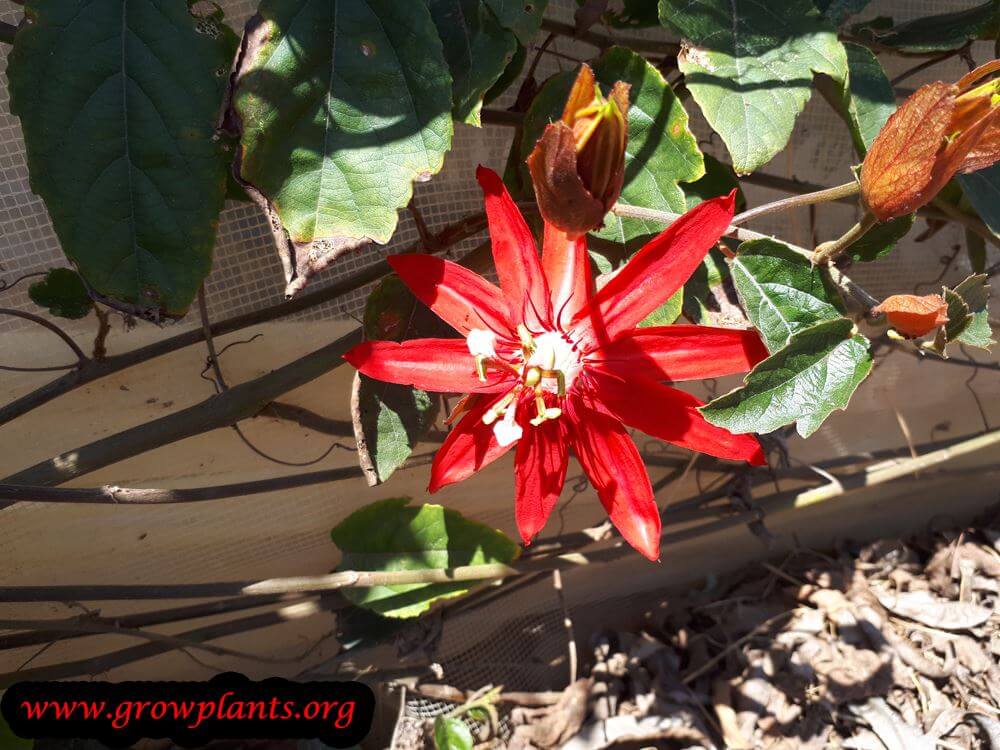
- Leaves & Foliage: Green, lobed leaves with 3–5 lobes.
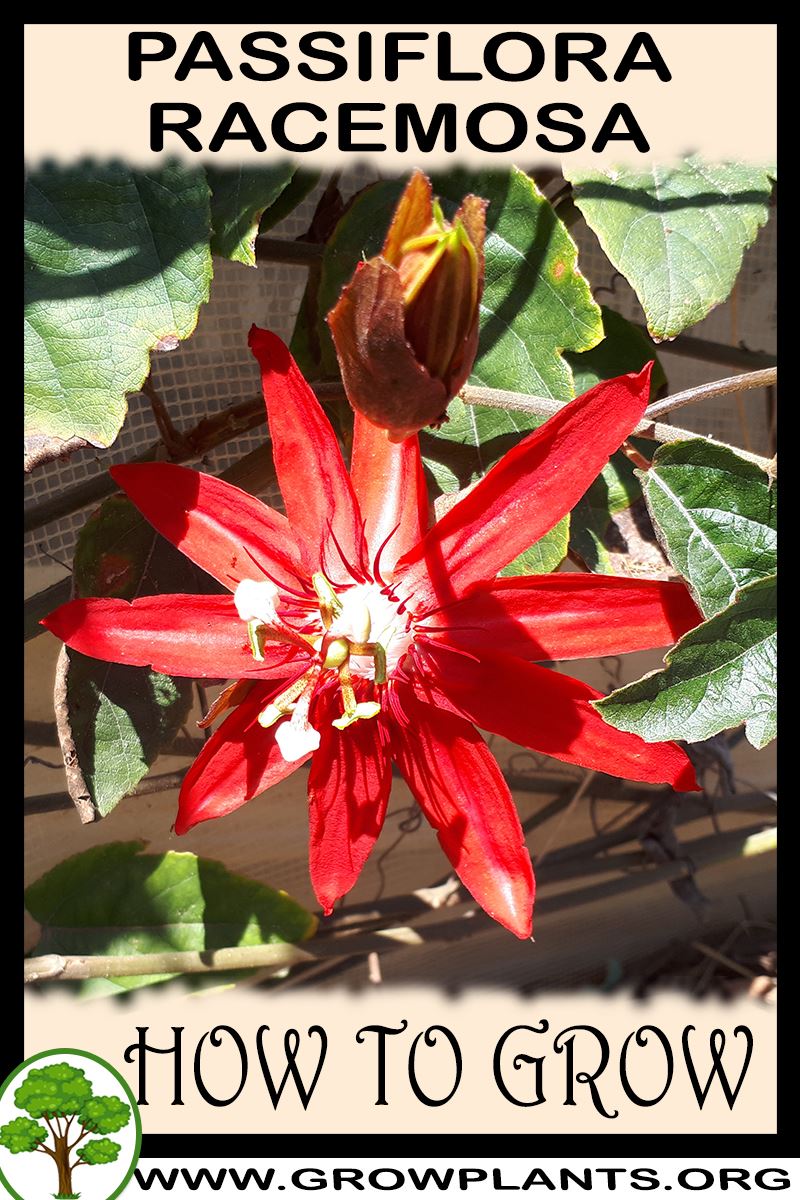
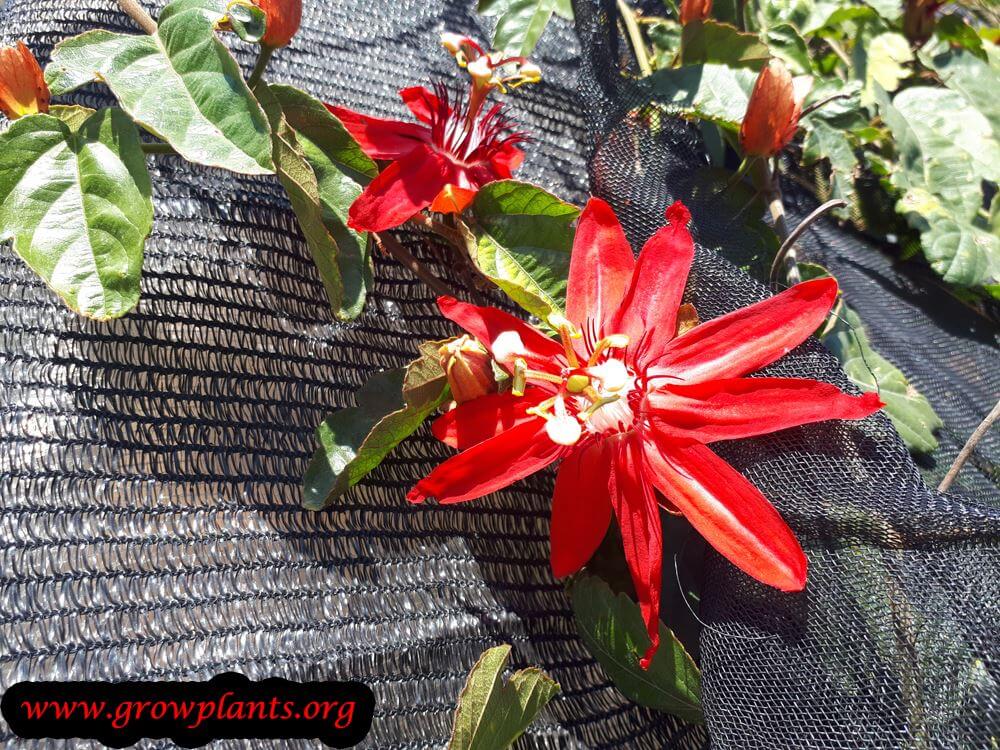
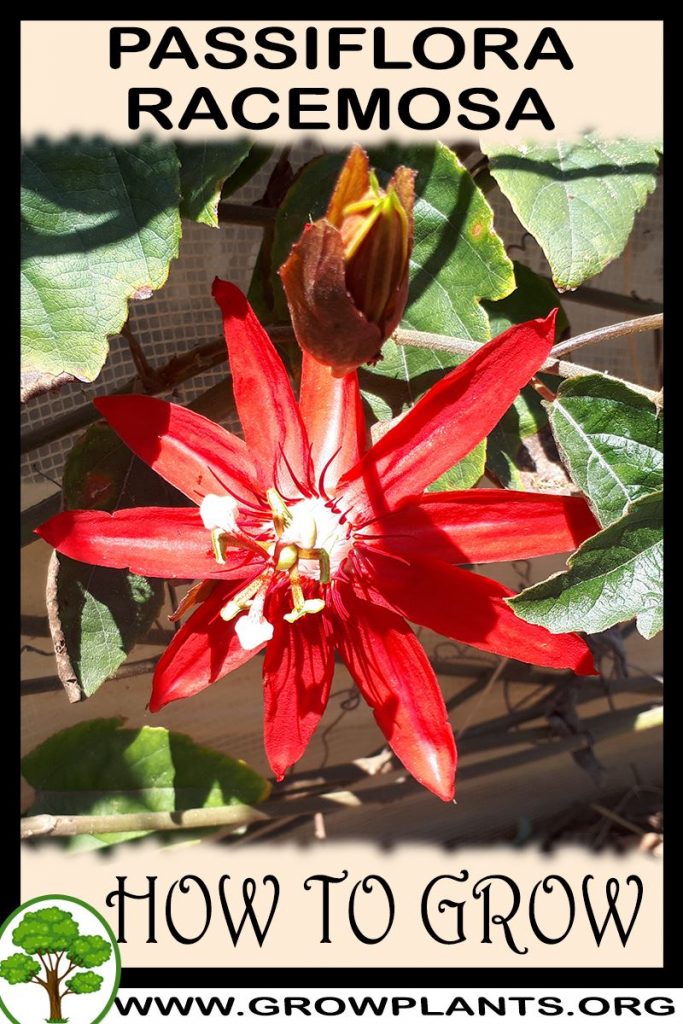
- Flower Characteristics: Round, clock-faced red flowers (full detail in the Bloom guide).
Primary Uses & Landscape Value
- Functional & Ornamental Roles: Ornamental flowering climber for trellises, arbours, fences and pergolas in warm, frost-free gardens.
Care Guide: Planting, Soil & Watering
Overview: The red passionflower is a fast, vigorous evergreen climber grown for its showy red flowers, thriving in full sun in warm, frost-free conditions on a trellis. It likes fertile, well-draining soil and steady, generous moisture.
Quick Care Requirements
| Requirement | Ideal Condition |
|---|---|
| Planting Season | In the warm season; frost-free zones only |
| Growth Rate | Fast |
| Soil Type | Fertile, well-draining |
| Water Need | Moderate to high |
Planting & Establishment
- Best Planting Season: Plant through much of the warm season; it is frost-tender (zone 10b+), so plant only where it stays above freezing. Give it a strong trellis to climb.
- How to Plant:
- Hole Preparation: Dig a hole a little wider than the root ball beside a sturdy support.
- Soil Amendments: Work in compost and organic matter for fertility, and ensure the soil drains freely.
- Planting Depth: Set the root ball level with the surrounding soil and firm gently.
- Growth Speed & Expectations: A fast, aggressive climber reaching many metres; keep it pruned and guided.
Soil, Watering & Drainage Care
- Soil Mix & Drainage Needs: Needs fertile, free-draining soil; in pots use a rich, well-draining mix with drainage holes and mulch.
- Watering Schedule & Technique:
- Young / Newly Planted: Keep the soil consistently moist while the vine establishes.
- Established: Water regularly and generously, especially while flowering.
- Seasonal Adjustments: More in summer heat and flowering; less in cool weather.
Climate, Light & Hardiness
Passiflora racemosa (red passion flower) is a vigorous tropical-to-subtropical vine that needs full sun and frost-free conditions to thrive outdoors. It has essentially no cold hardiness and is reliably grown outside only in consistently warm climates.
Quick Climate Specifications
| Climate Zones | Tropical, Subtropical, Mediterranean |
|---|---|
| USDA Hardiness Zones | 10b+ |
| Frost Tolerance | None (requires frost-free conditions) |
| Light Conditions | Full Sun |
Sunlight & Light Exposure
Optimal Light Setup
Give it full sun on a sturdy trellis or support; strong light drives the vigorous growth and clock-shaped red flowers this vine is grown for.
Direct Sun Requirement
Needs plenty of direct sun for good flowering; too little light reduces bloom.
Best Exposure & Orientation
A warm, sun-facing wall or trellis suits it well, also offering some shelter from cool air movement.
Temperature Extremes & Hardiness
USDA Hardiness & Regional Limits
Rated to USDA zone 10b+, meaning it needs an essentially frost-free climate for reliable year-round outdoor growth.
Cold Damage & Winter Protection
Even light frost is likely to damage or kill top growth; in marginal areas, container culture with winter protection under cover is safer than planting in the open ground.
Frost Sensitivity
Frost-tender with no meaningful cold tolerance - the plant needs frost-free conditions to persist outdoors.
Extreme Heat Tolerance
Good; as a tropical-to-subtropical vine it is well suited to hot summer conditions.
Wind, Humidity & Microclimate
Humidity Preferences
Naturally adapted to humid tropical air, though it also grows successfully through the drier summers typical of Mediterranean climates once established.
Microclimate Recommendations
A warm, sheltered position against a sunny wall or fence both boosts heat and buffers the vine from cool drafts, extending the range where it can be grown outdoors.
Growing in Pots, Balconies & Indoors
This is a vigorous, full-sun passionflower climber that can reach many metres on a support. The grower says it is not a houseplant but confirms it grows in containers; in a large pot with a strong trellis it can be kept while young or as a patio/conservatory climber, but it needs full sun and plenty of room to romp.
Quick Details
- Container Size: A large, deep, heavy-based pot with a sturdy trellis or frame; it is a big, hungry climber
- Indoor Suitability: Not a houseplant – too large and sun-hungry for a room; only a big sunroom or conservatory could hold it
- Best Spot: Full sun on a strong support; a warm, sheltered wall or trellis
- Soil & Drainage: Rich, free-draining, organic mix that holds moisture for a fast, thirsty grower
- Watering in Pots: Average to plenty of water – it grows fast and drinks heavily in heat; keep well watered but never waterlogged
Indoors & On the Windowsill
- Not a room houseplant: The grower says no. It is a rampant climber that quickly outgrows any indoor space and needs full sun to flower – a room simply cannot contain or light it.
- Conservatory climber: A large, bright sunroom or conservatory with a frame is the only realistic ‘indoor’ home; even then it needs regular pruning to keep it in bounds.
- Overwintering: Where winters are cold, a potted young plant can be kept frost-free and bright over winter and cut back hard, then grown on outdoors in the warm season.
On a Balcony or Patio
- Light & support: Give it the sunniest wall or railing with a strong trellis; the stems are heavy when clothed in leaf and flower. Shelter from strong wind, which tears the growth.
- Practicalities: A big climber in a pot is heavy and dries fast – use a large, stable container, water generously in heat, and prune to keep it manageable.
Choosing the Pot, Soil & Long-Term Care
- Pot & drainage: The biggest pot you can manage, with strong drainage holes and no standing-water saucer; a heavy base stops it toppling.
- Potting mix: A rich, organic, free-draining mix – it is a hungry, fast grower.
- Feeding: Feed regularly through the growing season; a vigorous potted climber leaches nutrients quickly and needs steady feeding to flower.
- Repotting & pruning: Pot on as it grows while young, then top up the mix and prune hard each year to control size and encourage flowering wood.
Fertilizing & Feeding
A fast-growing, vigorous flowering and fruiting vine that benefits from regular moderate feeding through its long growing season to fuel both foliage and bloom.
Quick Fertilizing Specs
| Feeding Level | Moderate – a vigorous vine with sustained nutrient needs |
|---|---|
| Main Nutrient Priority | Balanced feeding through vegetative growth, shifting toward potassium support once flowering and fruit set begin |
| Best Feeding Period | Through the main warm growing season while the vine is actively climbing and flowering |
| Organic Options | A layer of compost or organic mulch at the base supports steady root growth alongside regular feeding |
Feeding by Growth Stage
Establishment After Planting
Help a newly planted vine build a strong root system and begin climbing before demanding heavy feeding
| Nutrient direction | A balanced feed at modest strength to support root and early vine development |
|---|---|
| Timing | The first growing season after planting, once the vine begins active new growth |
| Frequency | Light, occasional feeding through the first season is enough while roots establish |
| Fertilizer types | Diluted balanced liquid feed, Compost worked into the planting area |
| Precautions | Avoid heavy feeding immediately after planting; let the root system establish first |
Vigorous Vegetative Growth
Support the vine’s fast climbing growth and dense foliage cover on its trellis or support structure
| Nutrient direction | A nitrogen-forward balanced feed to fuel active vine and leaf growth |
|---|---|
| Timing | Through the main growing season as the vine extends rapidly along its support |
| Frequency | Regular feeding through the growing season supports this vine’s fast pace of growth |
| Fertilizer types | Balanced granular or liquid feed with a nitrogen-forward ratio, Organic mulch or compost as a supplement |
| Routine trace nutrients | iron, manganese |
| Precautions | Keep this vigorous, spreading vine contained and well-supported, since strong feeding encourages fast, aggressive growth |
Flowering and Fruit Set
Support the distinctive clock-shaped red flowers and any resulting fruit through to maturity
| Nutrient direction | Shift toward a balanced feed with good potassium support as flowering and fruit development take over from vegetative growth |
|---|---|
| Timing | During the vine’s flowering period and while any fruit is developing and maturing |
| Frequency | A moderate, steady feeding pace through bloom and fruit development supports this stage |
| Fertilizer types | Balanced feed with potassium support, Complete fertilizer labeled for flowering vines |
| Routine trace nutrients | iron, manganese |
| Precautions | Leave adequate space below the vine for fruit to drop, and avoid excess nitrogen once flowering begins, which can favor foliage over flowers |
Nutrient Deficiency Signs & Corrections
Leaves develop pale or yellowish color between green veins
| Possible causes | Iron or manganese deficiency, often in alkaline or waterlogged soil, Root stress from poor drainage limiting nutrient uptake, Nutrient-depleted soil after a long stretch without feeding |
|---|---|
| Appears first on | Newest leaves near the growing tips |
| What to check | Soil drainage and pH tendency of the planting site, Feeding history over the current growing season, Root health if the plant can be inspected |
| Possible correction | Improve drainage where needed and resume balanced feeding with trace elements included |
Vigorous vine growth but few or no flowers appearing
| Possible causes | Excess nitrogen favoring leafy growth over flowering, Insufficient light, since flowering is reduced in shadier locations, Immature vine that has not yet reached flowering maturity |
|---|---|
| Appears first on | Whole-vine flowering response |
| What to check | Recent fertilizer type and nitrogen content, Hours of direct sun the vine receives, Age and size of the vine since planting |
| Possible correction | Shift toward a more balanced or potassium-supportive feed and confirm the vine has adequate sun exposure |
Flowers form but fruit fails to set or drops early before maturing
| Possible causes | Potassium shortfall during fruit development, Inconsistent watering causing stress during fruit set, Insufficient pollination |
|---|---|
| Appears first on | Developing fruit following flowering |
| What to check | Feeding balance and whether potassium-supportive feed was used during bloom, Watering consistency through fruit development, Presence of pollinators around the planting |
| Possible correction | Support fruit development with a balanced, potassium-supportive feed and keep watering consistent through fruit set |
Pruning, Training & Seasonal Maintenance
Passiflora racemosa is a vigorous, fast-growing evergreen flowering (and lightly fruiting) vine that tolerates substantial pruning. Its main objective is containing size and density on a trellis or support rather than shaping a freestanding form, and the safest heavy-cutback window is autumn/winter as growth slows – important given the plant’s own noted ability to overwhelm neighboring plants if left unchecked. Because it flowers mainly on new growth, dormant-season pruning removes old tangled stems without sacrificing the coming season’s bloom.
Quick Pruning & Maintenance Specs
| Pruning Tolerance | High |
| Primary Pruning Window | Autumn/Winter (structural cutback and size control) |
| Secondary Maintenance Window | Light tip-pinching/thinning during the growing season |
| Typical Frequency | One major cutback per year, plus ongoing thinning and training |
| Main Objective | Contain vigorous growth on its support, open up a tangled canopy, leave room beneath for fallen fruit |
| Young Plant Priority | Train leaders onto the support; pinch tips to build low branching |
| Mature Plant Priority | Annual thinning of old/tangled growth; cut back stems reaching into neighboring plants |
| Best Tool Type | Bypass secateurs for stems, loppers for thicker old growth |
| Avoid Heavy Pruning During | Peak flowering/fruit-set flush |
Pruning by Plant Age & Size
Newly Established
Tie and train the main shoots onto the support structure; remove only damaged growth and avoid a hard cutback while the plant is still building its framework.
Young / Formative
Trellis training: select and tie in 2–4 main leaders along the support, pinching their tips once to encourage the lateral branching that will carry more flowers.
Mature / Established
Annual thinning to remove overcrowded, twiggy, tangled growth; cut back wayward stems reaching into neighboring plants or trees, consistent with this species’ own noted aggressive growth habit.
Seasonal Pruning Schedule
Dormant/Winter
Objective: reset density and size before spring. Remove: crowded/crossing stems, weak thin growth, some of the previous season’s spent flowering laterals. Do not remove: the main framework vines tied to the support. Expected response: a vigorous flush of new growth and flowering stems in spring. Flowering impact: minimal loss, since flowers form on new growth.
Summer Canopy Management
Objective: stop the vine smothering its support or nearby plants mid-season. Remove: soft new growth straying off the trellis. Do not remove: developing fruit and open flowers. Expected response: better airflow and light into the canopy.
Flowering & Fruiting Wood
Passiflora racemosa flowers, and sets its passion-fruit-like fruit, on new growth produced in the current season rather than on old wood, so dormant-season structural pruning does not remove next season’s flower buds the way it would on a spur-fruiting tree. Pruning aggressively while flowering or fruit set is actively underway will, however, remove developing flowers and fruit from that particular flush.
Structural Pruning & Training
Select well-placed leaders for the trellis and remove competing, crossing or rubbing stems. Thin the canopy where it has become a dense tangle, since crowded, self-shading growth flowers less. Renewal-prune older, unproductive sections of vine back to a strong side-shoot to keep the plant youthful and floriferous.
Special Growth to Remove
- Tendrils that have wrapped around and are strangling the plant’s own stems or a support wire.
- Spent flower stalks.
- Excess new basal shoots, thinned if the vine is outgrowing what the trellis can support (own-root plant, so no rootstock-sucker concern).
Container & Small-Space Pruning
This species’ very large potential size (reported up to many meters) makes it a poor long-term fit for small containers. If grown in a large pot against a support, prune harder and more frequently than an in-ground vine to keep it in scale, and pair this with periodic root pruning at repotting so top growth is not left outrunning a restricted root system.
Tools
Bypass secateurs for routine stem and tendril work; loppers for older, thicker basal growth; soft ties/stakes for training leaders onto the trellis.
Tool Hygiene & Disease Risk
Routine – clean, sharp tools; no specific high-risk transmissible disease is documented for this species, though general sanitation remains good practice near other susceptible plants.
Cut Placement & Technique
Favor thinning cuts (removing a stem back to its point of origin) over heading cuts, to control size without stimulating an even denser regrowth flush. Cut just above a node/bud facing the direction new growth should go. Remove large old basal stems in stages rather than yanking them free, since the vine can be extensively tangled into its support.
Heavy Pruning & Rejuvenation
Well tolerated – an overgrown, tangled specimen can be cut back hard to its main framework in winter. Expect vigorous regrowth and a return to flowering within the same growing season, though very hard cutback will delay that season’s fruit.
Post-Pruning Care
Water normally; watch fresh regrowth for this species’ documented pests (ants tending sap-feeders, nematodes). Re-tie new leaders to the support promptly so regrowth does not flop or re-tangle.
Common Pruning Mistakes
- Leaving the vine unpruned until it has smothered nearby plants – the species’ own noted risk.
- Cutting back hard during active flowering/fruit set and losing that flush.
- Failing to retie new growth, letting it re-tangle into the same dense mass just thinned out.
When NOT to Prune
Avoid a hard structural cutback while flowers or developing fruit are present, if that flush’s fruit is wanted to mature and drop cleanly. Avoid heavy pruning right after transplanting, until the vine is established on its support.
Recommended Tools (by task)
- bypass_secateurs – routine stem, tendril and deadheading cuts on soft-to-medium vine growth.
- loppers – older, thicker basal stems during the annual winter thin.
- soft_ties_stakes – training new leaders onto the trellis/support as the vine grows.
Pruning Troubleshooting
| Problem | Possible Cause | What to Check | Corrective Action |
| Vine smothering its support or neighboring plants | Growth left unpruned too long | Density of tangled stems; distance reached beyond the support | Annual winter thin-back plus summer tip control |
| Little or no fruit set | Over-hard pruning removed current-season growth before it flowered, or flowers were cut off mid-season | Timing of the last major cut relative to bloom | Restrict structural pruning to the dormant season; avoid cutting during bloom/fruit set |
| Dense, tangled interior with fewer flowers | No thinning, self-shading | Light penetration into the canopy interior | Thin crowded/crossing stems, not just tip growth |
Propagation Guide
Passiflora racemosa is best propagated from semi-hardwood stem cuttings, which the site notes is necessary to reproduce the plant reliably. Seed is possible but germination can be slow and uneven, so cuttings are the more practical and dependable home method — overall a moderately easy vine to propagate.
Quick Propagation Specs
| Best Propagation Method | Semi-hardwood stem cuttings |
| Alternative Methods | Seed |
| Propagation Difficulty | Moderate |
| Vegetative True-to-Type | Yes – site notes vegetative reproduction is necessary |
| Best Propagation Season | Most of the year in frost-free conditions, best avoiding cold months |
| Seed Germination Time | Typically several weeks, often irregular |
| Cutting Rooting Time | A few weeks under warm, humid conditions |
| Germination Temperature | Around 21–29°C (70–85°F) |
Growing from Seed
Seed Handling & Viability
Fresh seed germinates more readily; viability declines the longer seed is stored, so sowing soon after collection is preferable.
Germination Conditions
Warm temperatures and consistent moisture help, but germination is often slow and staggered for Passiflora seed — expect uneven timing rather than a single flush.
Stem Cuttings
Cutting Type
Semi-hardwood tip or nodal cuttings from healthy, non-flowering growth.
Best Timing
Warmer months, matching the plant’s frost-free active growing period.
Rooting Setup
A well-drained, moist rooting medium with warmth and humidity supports rooting.
Rooting Hormone
Optional — can improve rooting consistency but is not strictly required.
Bloom & Flower Guide
Quick Details
- Bloom Season: Year-round in warm climates; spring where it is cooler
- Flower Appearance: Bright red, round, clock-face flowers with the intricate central crown typical of passionflowers
- Edibility: Ornamental only – grown for its striking flowers
Detailed Blooming Overview
Passiflora racemosa, the red passion flower, is a climbing vine grown for its vivid scarlet blooms. Unusually for the genus, the flowers hang in long racemes, so a well-grown plant drips with dangling red flowers rather than carrying them singly. Each has the classic clock-face form – a ring of red petals around a detailed central crown. In warm climates it can flower almost year-round; in cooler spots the show comes in spring.
Flower Characteristics
- Bright red, round and flat – the classic passionflower clock face.
- An intricate central crown of filaments over the reproductive column.
- Carried in hanging racemes, a signature of this species.
Bloom Care & Thinning
- Encouraging bloom: Full sun, warmth and support to climb bring the heaviest flowering.
- Pollination: Bees work the flowers – important if you hope for fruit to set.
- Training: Guide the vine onto a trellis so the racemes hang free and show well.
Fruit & Uses
Passiflora racemosa produces an oval fruit that is eaten once fully ripe, either fresh out of hand or made into juice, jams and other prepared foods. The pulp has a mild, grape-like flavour and is eaten raw, pulp and seeds together, with no cooking required.
Quick Edible Specs
| Edible Parts | Fruit (pulp and seeds) |
|---|---|
| Main Use(s) | Culinary – fresh eating, juice, jam/jelly, cake fillings, flavouring for drinks and sauces |
| Eaten Raw or Cooked | Raw once fully ripe; pulp/juice can also be cooked down for jams and jellies |
| Preparation Required | None to eat fresh; straining removes seeds when making juice or jelly |
| Harvest Season | Follows flowering, which can continue over much of the year in frost-free climates (see Blooming), so fruiting is not tied to one fixed season |
| Storage | Best used fresh soon after ripening, or processed into juice or jam for longer keeping |
| Safety/Toxicity Caveat | Only fully ripe fruit is eaten; as with other Passiflora, unripe fruit and other plant parts are not used for food |
Fruit
The oval fruit hangs from the vigorous climbing vine and is ready to pick once it has coloured from green to a yellow-green and gives slightly to gentle pressure. Because the vine grows so vigorously, keeping growth from becoming too dense gives the fruit room to develop and fall cleanly rather than being lost in tangled stems (see Pruning). Once opened, the pulp and small seeds are scooped out and eaten raw, or the pulp is strained and used for juice, jelly, jam, cake filling and other prepared foods.
Harvesting
Pick fruit once it has changed colour and softened slightly rather than while still hard and green. Because flowering — and therefore fruit set — can continue over a long season in warm climates, picking is an ongoing, repeat task rather than a single harvest window. See Pruning for how keeping the vine open helps the fruit develop and drop without being lost in dense growth.
Preparation, Uses & Safety
Ripe fruit is eaten fresh, pulp and seeds together, or processed into juice, jam, jelly, sauces and dessert fillings; no cooking or detoxification step is required for the ripe pulp itself. As a general precaution with passionflower fruit, only fully ripe fruit should be eaten — unripe fruit and other parts of the plant are not eaten.
Pests, Diseases & Troubleshooting
Overview: Passionflower vines are vigorous but soft-tissued climbers whose lush new growth attracts sap-feeding insects and leaf-chewing caterpillars, while dense, humid canopies invite fungal leaf spots and, in wet or compacted soils, root and collar rots. The management priority is open, well-ventilated growth on a sturdy support, restrained nitrogen, and prompt removal of infected material – reaching for products only after cultural steps.
Quick Troubleshooting Overview
| Issue / Pest | Main Symptom | Primary Solution |
|---|---|---|
| Caterpillars (fritillary/heliconian larvae) | Leaves skeletonised or stripped, black frass | Hand-pick; encourage birds/parasitic wasps; Bacillus thuringiensis if heavy |
| Aphids | Sticky honeydew, curled soft tips, sooty mould | Blast with water, insecticidal soap, protect ladybirds |
| Spider mites | Fine stippling, bronzing, webbing in dry heat | Raise humidity, hose foliage, horticultural oil |
| Scale & mealybugs | Bumps/cottony masses on stems, honeydew | Wipe off, prune infested wood, horticultural oil |
| Fusarium / collar rot | Sudden wilt, darkened stem base, vine collapse | Improve drainage, avoid crown burial, use resistant rootstock |
| Passionfruit woodiness virus | Mottled, distorted leaves, hard misshapen fruit | Control aphids, remove infected vines, use clean stock |
Common Pests & Management
- Passion-vine / fritillary caterpillars (Agraulis vanillae / Heliconius spp.):
- Symptoms: Chewed, skeletonised or fully stripped leaves, often on new growth, with dark frass and spiny orange-and-black larvae; passionflowers are the obligate host of heliconian butterflies, so some feeding is normal. Distinguish from looper damage by the spiny larvae and clustered feeding.
- Prevention & Control: Tolerate light feeding on established vines (it fuels beneficial butterflies); hand-pick or prune out clusters on young plants; encourage insectivorous birds and parasitic wasps; for heavy infestations use a Bacillus thuringiensis (Bt) spray, which targets caterpillars while sparing pollinators.
- Aphids (Aphis spp.):
- Symptoms: Dense colonies on tender shoot tips and flower buds, causing curling and stunting; sticky honeydew fosters black sooty mould and attracts ants that farm the aphids. Aphids also transmit passionfruit viruses.
- Prevention & Control: Dislodge with a firm water jet; pinch out badly infested tips; conserve ladybirds, lacewings and hoverflies; avoid heavy nitrogen that pushes soft growth. If needed, insecticidal soap or a light horticultural oil, applied in the cool of evening to protect bees.
- Two-spotted spider mite (Tetranychus urticae):
- Symptoms: Fine pale stippling and bronzing on upper leaf surfaces, with fine webbing beneath in hot, dry, dusty conditions; leaves dull and drop. Look-alike nutrient mottling lacks webbing.
- Prevention & Control: Raise humidity and hose the undersides of leaves regularly; avoid drought stress and dusty situations; release predatory mites where available; treat with horticultural oil or insecticidal soap, ensuring thorough undersurface coverage.
- Scale & mealybugs (Coccidae / Pseudococcidae):
- Symptoms: Immobile brown or waxy bumps along stems and leaf veins, or cottony white masses in leaf axils, with honeydew and sooty mould; a slow decline of vigour on heavily colonised vines.
- Prevention & Control: Wipe off light infestations with a damp cloth or alcohol-dipped swab; prune out badly encrusted wood; encourage lady beetles and parasitic wasps; smother survivors with horticultural oil, repeating to catch crawlers.
- Whitefly (Trialeurodes / Bemisia spp.):
- Symptoms: Tiny white moth-like insects that flutter up in clouds when foliage is disturbed; honeydew, sooty mould and yellowing on the lower canopy, especially under cover.
- Prevention & Control: Hang yellow sticky traps to monitor and reduce adults; encourage Encarsia parasitoid wasps; keep plants unstressed; treat persistent populations with insecticidal soap or horticultural oil on leaf undersides.
Diseases & Fungal Issues
- Fusarium wilt & collar rot (Fusarium oxysporum / F. solani):
- Symptoms: Progressive wilting despite moist soil, yellowing lower leaves, and a browning, sometimes girdling lesion at the stem base; internal vascular staining. Often fatal to seed-grown vines in warm, wet ground.
- Treatment & Management: Plant in free-draining soil and never bury the crown; avoid waterlogging and root wounds; on fusarium-prone sites graft desirable scions onto resistant rootstock such as Passiflora edulis f. flavicarpa; remove and destroy collapsed vines and do not replant passionflower in the same spot.
- Brown spot / Alternaria leaf & fruit spot (Alternaria passiflorae):
- Symptoms: Small brown spots with lighter centres and yellow halos on leaves, enlarging to blotches; sunken lesions on stems and fruit in humid weather, causing defoliation and fruit drop.
- Treatment & Management: Improve airflow with open pruning and wider spacing; avoid overhead watering late in the day; collect and destroy fallen leaves and fruit; where pressure is high apply a copper-based fungicide preventively, following label rates.
- Passionfruit woodiness & mosaic viruses (Passionfruit woodiness virus / Cucumber mosaic virus):
- Symptoms: Yellow mosaic, mottling and puckering of leaves, shortened internodes, and hard, thick-walled, misshapen fruit with little pulp. There is no cure once infected.
- Treatment & Management: Start with certified virus-free stock; rigorously control aphid vectors; disinfect pruning tools between plants; rogue out and destroy symptomatic vines promptly to protect neighbours.
- Root & crown rot (Phytophthora / Pythium spp.):
- Symptoms: Wilting, leaf yellowing and dieback with dark, soft, decayed roots and stem base in poorly drained or overwatered soil.
- Treatment & Management: Ensure sharp drainage and plant slightly high; water deeply but allow the surface to dry between soakings; improve heavy soil with organic matter and grit; remove severely affected plants and avoid replanting in infested ground.
Growing Difficulties & Abiotic Problems
- Poor fruit set:
- Cause & Symptoms: Insufficient pollination (few bees, self-incompatible clones), extreme heat, or excess nitrogen driving leaf at the expense of flower.
- Correction Strategy: Encourage carpenter and honey bees; hand-pollinate flowers at mid-morning with a soft brush; grow compatible cultivars nearby; balance feeding with more potassium and less nitrogen.
- Leaf yellowing / chlorosis:
- Cause & Symptoms: Nitrogen shortage on poor soils, or iron/magnesium lock-out in alkaline or waterlogged ground shows as interveinal yellowing on young leaves.
- Correction Strategy: Feed with a balanced fertiliser through the growing season; correct alkalinity and improve drainage; apply chelated iron or magnesium (Epsom salts) foliar feed for interveinal chlorosis.
- Sunburn & leaf scorch:
- Cause & Symptoms: Sudden exposure of tender vines to intense sun, or drought stress, causes bleached or brown papery patches on the most exposed leaves.
- Correction Strategy: Acclimatise plants gradually; keep roots consistently moist and mulched; provide light afternoon shade in the hottest climates.
- Winter/cold dieback:
- Cause & Symptoms: Frost kills tender top-growth; the vine may reshoot from the base in marginal climates but soft new growth is set back.
- Correction Strategy: Mulch the root zone heavily; grow tender species in containers to move under cover; cut back frost-damaged stems only once new growth resumes.
What Helps – Products & Tools
The passionflower toolkit is deliberately simple: a strong water jet and insecticidal soap for aphids and whitefly, horticultural (neem or paraffinic) oil for mites, scale and mealybugs, and Bacillus thuringiensis (Bt) for caterpillar outbreaks. Yellow sticky traps monitor whitefly, and a copper-based fungicide handles Alternaria brown spot in humid spells. Sharp drainage and clean, virus-free stock prevent most of the serious rots and viruses. Apply any oil or soap in the cool of evening to protect the bees these flowers depend on.