Plant Profile & Key Characteristics
Overview: An evergreen climbing vine of the genus Passiflora (blue passionflower) grown mainly as a hardy ornamental for its intricate clock-face flowers; the fruit is edible but bland. It is a fast, vigorous tendril climber and the most cold-tolerant of the passionflowers here.
Quick Specifications
| Specification | Attribute |
|---|---|
| Plant Type / Life Cycle | Perennial (evergreen vine) |
| Foliage Type | Evergreen |
| Mature Size | 5-40+ m climbing |
| Growth Rate | Fast |
| Toxicity | Ripe fruit edible but bland; unripe fruit and foliage contain cyanogenic compounds |
| Hardiness | USDA zone 7+ |
Growth Form & Structure
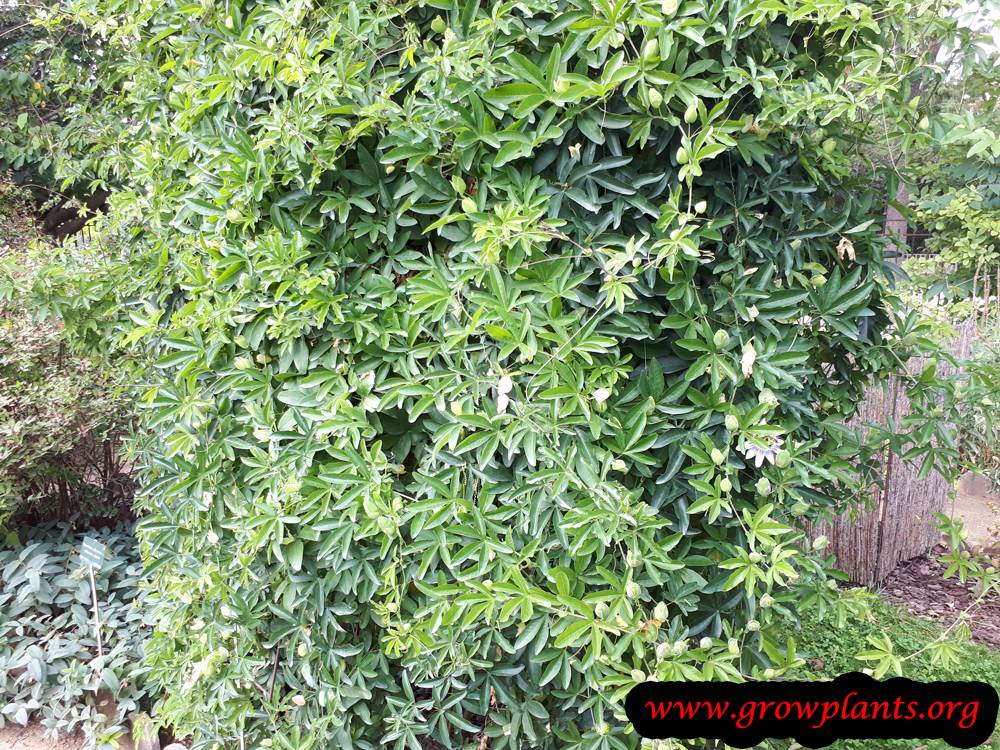
- Height & Spread: Vigorous climber to 5-40+ m; needs trellising and can smother nearby plants.
- Growth Habit & Form: Fast, twining tendril vine.
- Lifespan & Maturity: Begins bearing in about 1-2 years.
Anatomy & Physical Features
- Leaves & Foliage: Green leaves with 3-5 lobes.
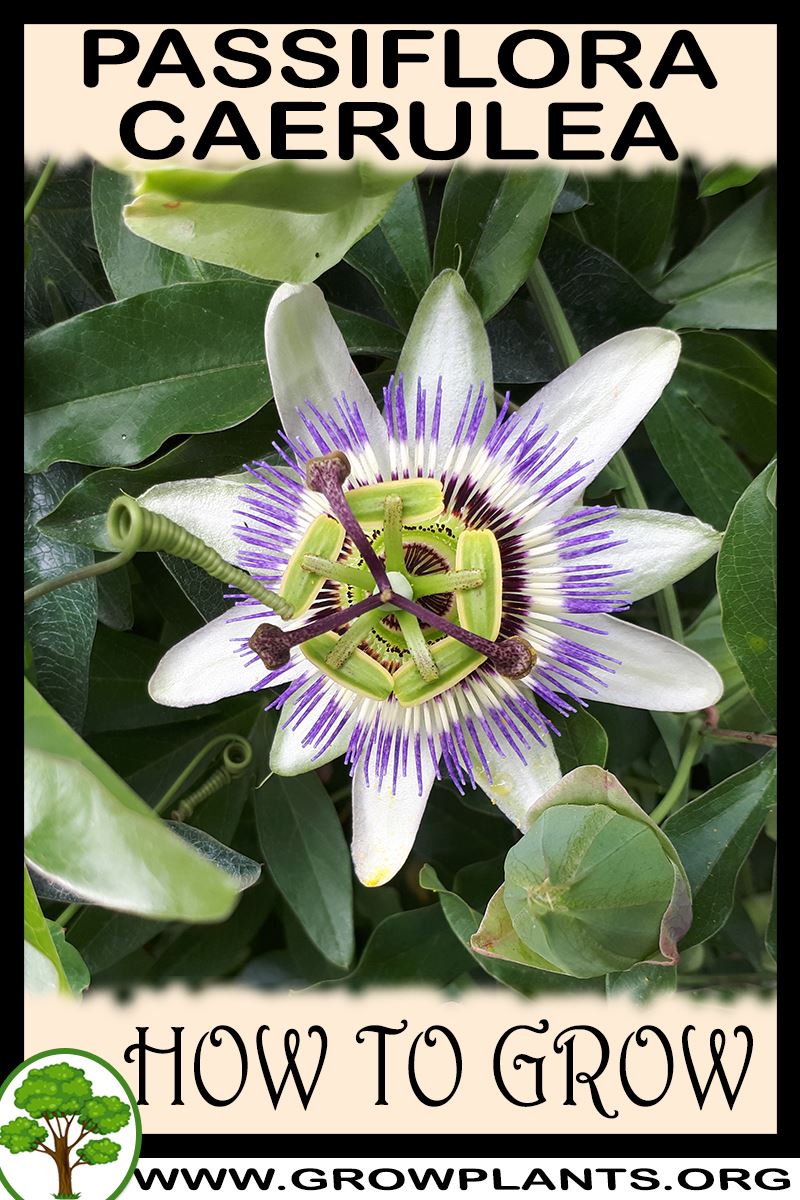
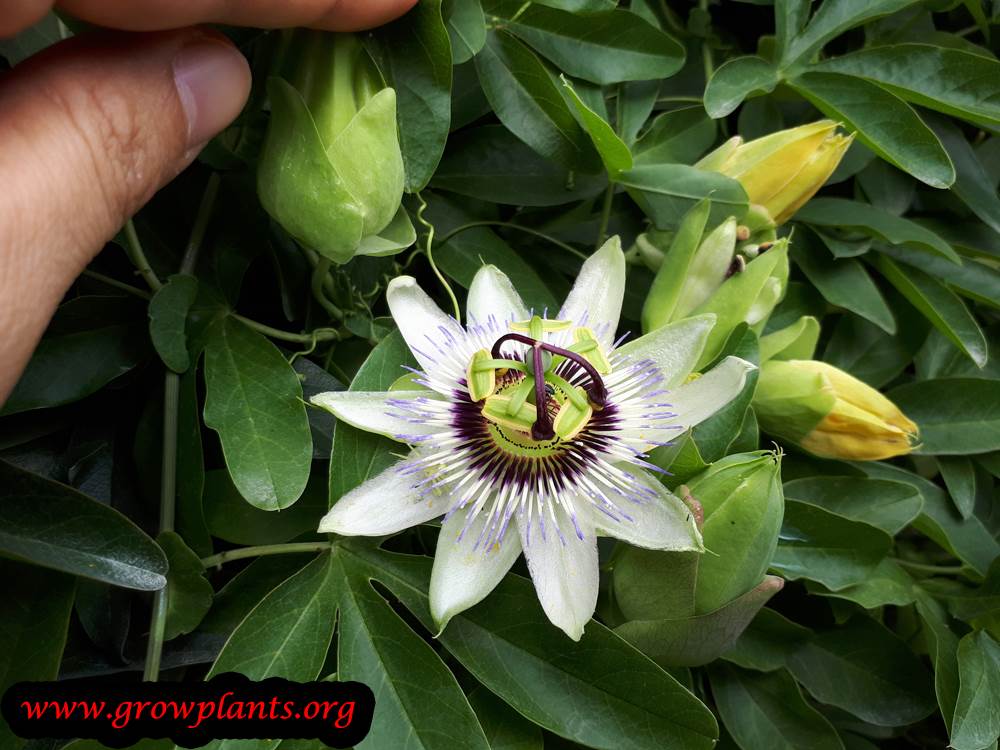
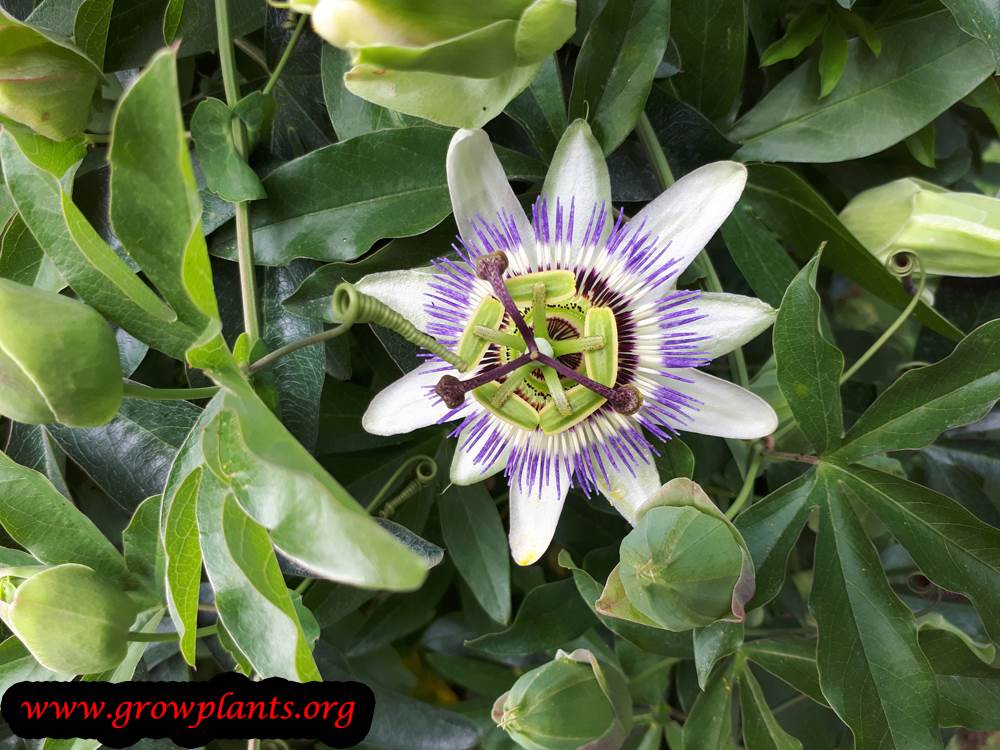
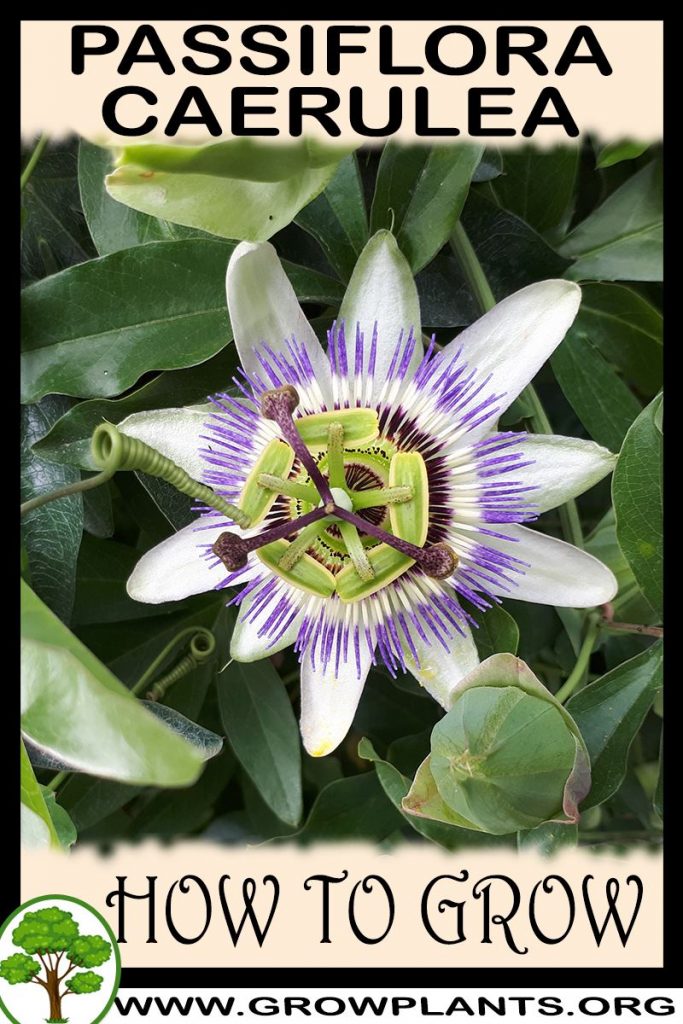
- Flower Characteristics: White, clock-face flowers with a purple or white centre.
- Fruit Profile: Yellow-orange, oval fruit with a thick, inedible rind and sweet pulp.
Primary Uses & Landscape Value
- Edible Uses: Fruit can be eaten fresh or used for juice and jams, though it is fairly bland.
- Functional & Ornamental Roles: Hardy ornamental climber for trellises, fences and screens.
Care Guide: Planting, Soil & Watering
Overview: The blue passionflower is a fast, vigorous evergreen-to-semi-deciduous climber, hardier than most passifloras (to around zone 7). It grows in full sun on a strong trellis in fertile, well-draining soil with steady moisture.
Quick Care Requirements
| Requirement | Ideal Condition |
|---|---|
| Planting Season | In the warm season; more cold-hardy than most passionflowers |
| Growth Rate | Fast |
| Soil Type | Fertile, well-draining |
| Water Need | Moderate to high |
Planting & Establishment
- Best Planting Season: Plant through much of the warm season; hardier than most passionflowers (to about zone 7), it may die back in cold winters and resprout. Provide a strong trellis with room for the fruit to fall.
- How to Plant:
- Hole Preparation: Dig a hole a little wider than the root ball beside a sturdy support.
- Soil Amendments: Work in compost and organic matter for fertility, and ensure the soil drains freely.
- Planting Depth: Set the root ball level with the surrounding soil and firm gently.
- Growth Speed & Expectations: A fast, aggressive climber reaching many metres; it can overwhelm neighbours, so keep it pruned and guided.
Soil, Watering & Drainage Care
- Soil Mix & Drainage Needs: Needs fertile, free-draining soil; in pots use a rich, well-draining mix with drainage holes and mulch.
- Watering Schedule & Technique:
- Young / Newly Planted: Keep the soil consistently moist while the vine establishes.
- Established: Water regularly and generously, especially while flowering and fruiting.
- Seasonal Adjustments: More in summer heat and cropping; less in cool weather, when it may die back.
Climate, Light & Hardiness
Passiflora caerulea grows in tropical, subtropical, mediterranean, and temperate climates in full sun, and is one of the more cold-tolerant passionflower species. It is listed hardy from about USDA zone 7 upward, though at the cooler end of that range top growth is commonly cut back by frost while the root system survives to resprout in spring.
Quick Climate Specifications
| Climate Zones | Tropical, subtropical, mediterranean, temperate |
|---|---|
| USDA Hardiness Zones | 7+ |
| Frost Tolerance | Moderate (roots); Low (top growth) |
| Light Conditions | Full Sun |
Sunlight & Light Exposure
Optimal Light Setup
Needs full sun for strong vine growth and reliable flowering and fruiting.
Temperature Extremes & Hardiness
USDA Hardiness & Regional Limits
Hardy from about zone 7 upward. The site data describes it as needing frost-free conditions for the vine itself, which fits this species’ well-documented habit at the cool end of its range: it behaves as a root-hardy, herbaceous-topped perennial, dying back to the ground after frost and regrowing vigorously the following spring.
Cold Damage & Winter Protection
In marginal zones, mulching the root zone heavily going into winter protects the crown even when the top growth is lost to frost; in genuinely frost-free areas the vine stays evergreen.
Frost Sensitivity
Vine and foliage are frost-tender and are cut back by freezing temperatures, though established roots are considerably hardier than the top growth.
Wind, Humidity & Microclimate
Wind Tolerance
As a vigorous, trellis-grown vine, it benefits from a support structure sheltered from the strongest winds to avoid damage to long stems.
Microclimate Recommendations
A warm wall or sheltered fence line both supports the vine’s climbing habit and offers extra winter protection at the cooler edge of its hardiness range.
Growing in Pots, Balconies & Indoors
Blue passionflower is a vigorous climber that can run to many metres – not a houseplant, but it can be kept in a large container on a sunny patio or balcony if given a strong trellis and hard pruning.
Quick Details
- Container Size: A large, heavy pot with a sturdy trellis
- Indoor Suitability: Not a houseplant – too vigorous and sun-hungry
- Best Spot: Full sun, outdoors
- Soil & Drainage: Fertile, free-draining mix
- Watering in Pots: Average to generous in growth; let excess drain
Indoors & On the Windowsill
- Not a houseplant: It needs full sun and grows far too large and fast for a room.
On a Balcony or Patio
- Container growing: Use a big, stable pot and a strong trellis or wires; it climbs vigorously and needs regular pruning to stay in bounds.
- Light & heat: Walls, railings and paving reflect heat and wind dries pots fast, so check moisture often and water more in hot spells.
Choosing the Pot, Soil & Long-Term Care
- Pot & drainage: A large pot with strong drainage holes; do not leave it standing in water.
- Potting mix: Fertile and free-draining – a good potting mix with added grit for drainage.
- Feeding: Container plants use up food faster because watering washes nutrients out – feed a little and often through the growing season.
- Long term: Prune hard each year to control its size and refresh part of the soil.
Fertilizing & Feeding
A vigorous, fast-growing vine that responds well to moderate feeding through its long active season, shifting from nitrogen-forward growth feeding toward a more balanced, potassium-aware mix as it flowers and sets fruit.
Quick Fertilizing Specs
| Feeding Level | Moderate feeder |
|---|---|
| Main Nutrient Priority | Nitrogen to build the vine, shifting to balanced/potassium-aware feeding for bloom and fruit |
| Best Feeding Period | Through the extended warm-season growth, flowering, and fruiting cycle |
| Organic Options | Compost or well-rotted organic matter worked around the root zone |
| Reduce/Stop Feeding | Ease off feeding as growth slows in cooler weather |
| Micronutrients | Usually met by a complete fertilizer; correct only diagnosed issues |
| Soil pH | Tolerates a wide range, doing best in well-drained soil |
Feeding by Growth Stage
Establishment on a trellis or support
Root the young vine in and get it climbing before pushing heavy growth.
| Nutrient direction | Light, balanced feeding supports steady root and stem establishment without forcing lush, unanchored growth. |
|---|---|
| Timing | From planting through the first season of establishing on its support. |
| Frequency | Light feeding as the vine settles in, increasing once it is climbing vigorously. |
| Fertilizer types | A balanced complete fertilizer, Compost worked into the planting area |
| Precautions | Avoid overfeeding a newly planted vine, which can outpace its root system and stress the plant. |
Vigorous vining growth
Fuel the vine’s fast-spreading stems and foliage across its support.
| Nutrient direction | A nitrogen-forward feeding supports the vine’s naturally fast, aggressive growth habit. |
|---|---|
| Timing | Through the main warm-season growth flush, before and alongside early flowering. |
| Frequency | Regular light feedings through the active growing season keep pace with its fast growth. |
| Fertilizer types | A nitrogen-leaning complete fertilizer, Organic matter renewed as a top-dressing |
| Routine trace nutrients | iron, manganese |
| Precautions | Because this vine grows aggressively and can overwhelm nearby plants, avoid excess nitrogen that pushes even more unchecked spread. |
Flowering and fruit development
Support the long flowering display and the development of fruit that follows.
| Nutrient direction | A balanced, potassium-aware fertilizer supports flowering and fruit development without pushing excess leafy growth. |
|---|---|
| Timing | During the extended bloom period and while fruit is forming and ripening. |
| Frequency | A steady, moderate feeding pace through the bloom-to-fruit cycle. |
| Fertilizer types | A balanced complete fertilizer with adequate potassium, Compost as a supplement to mineral feeding |
| Routine trace nutrients | iron, manganese |
| Precautions | Avoid excess nitrogen at this stage, which favors vine growth over flowering and fruit set. |
Nutrient Deficiency Signs & Corrections
Overall pale, yellow-green foliage and noticeably slowed vine growth.
| Possible causes | low available soil nitrogen, nutrient leaching from heavy watering or rain, competition from surrounding aggressive growth or weeds |
|---|---|
| Appears first on | older leaves and overall canopy vigor |
| What to check | recent feeding history, soil organic matter, watering and drainage |
| Possible correction | Apply a nitrogen-forward complete fertilizer and refresh organic matter around the root zone. |
New leaves show yellowing between the veins while veins remain green.
| Possible causes | alkaline soil pH restricting iron availability, waterlogged or compacted soil, true low soil iron |
|---|---|
| Appears first on | newest leaves |
| What to check | soil pH, drainage around the root zone, recent watering patterns |
| Possible correction | Correct overly alkaline soil and apply a chelated iron product per its label if chlorosis persists. |
Abundant flowering but few fruit develop or fruit drops early.
| Possible causes | excess nitrogen favoring vegetative growth over fruiting, insufficient pollinator activity, water stress during flowering |
|---|---|
| Appears first on | flowers and developing fruit |
| What to check | recent fertilizer nitrogen levels, pollinator visits during bloom, watering consistency during flowering |
| Possible correction | Shift to a more balanced, potassium-aware fertilizer and ensure even watering during flowering. |
Pruning, Training & Seasonal Maintenance
Passiflora caerulea is a fast-growing, vigorous evergreen vine that tolerates a high amount of pruning – in fact it needs regular cutting back, since left unchecked it can reach 5–40+ m and smother nearby plants and structures. The safest and most effective time to prune structurally is autumn to winter dormancy: because flowers and fruit are produced on the current season’s new growth rather than on old wood, a dormant-season cutback does not remove the coming year’s crop and instead stimulates fresh flowering laterals in spring.
Quick Pruning & Maintenance Specs
| Pruning Tolerance | High |
| Primary Pruning Window | Autumn – Winter (dormant/semi-dormant) |
| Secondary Maintenance Window | Light tip-training and thinning during active summer growth |
| Typical Frequency | One annual structural cutback plus ongoing summer training |
| Main Objective | Contain vigor on the support, keep growth open enough for fruit to be seen and to fall clear, renew flowering wood |
| Young Plant Priority | Establish and tie in main leaders on a trellis |
| Mature Plant Priority | Annual thinning and renewal of flowering laterals, size control |
| Best Tool Type | Bypass secateurs / loppers |
| Avoid Heavy Pruning During | Active flowering and fruit set (spring – summer) |
Pruning by Plant Age & Size
Newly Established
Minimal pruning – remove only damaged or dead growth and gently tie young stems to their support; do not cut back hard until the vine is anchored on its trellis.
Young / Formative
Train onto a sturdy trellis or wire support; select 2–4 main leaders and tie them in, pinching tips to encourage the lateral side-shoots that will carry flowers.
Mature / Established
Each dormant season, thin crowded or unproductive stems and cut side laterals back to 2–3 buds to renew flowering wood; control overall spread so the vine does not overrun neighboring plants.
Seasonal Pruning Schedule
| Dormant / Winter | Objective: renew flowering wood and control size. Remove: old unproductive laterals, congested crossing growth. Do not remove: the permanent main leaders/framework. Response: vigorous new flowering growth in spring. Fruiting impact: none – next season’s flowers form on the new growth this cut stimulates. |
| Summer Canopy Management | Objective: keep the vine open and off neighboring plants. Remove: excess vigorous tip growth, tendrils gripping unwanted structures. Do not remove: laterals currently carrying flowers/developing fruit. Response: redirected growth; fruiting largely undisturbed if only tipping is done. |
| Ongoing Sanitary | Remove dead, damaged, or pest-affected vine at any time. |
Flowering & Fruiting Wood
Passiflora caerulea flowers and fruits on the current season’s new growth produced from the permanent framework, not on old wood. This is why the dormant winter cutback of last year’s laterals does not cost you the coming crop – it forces the new flowering laterals. Cutting hard during active spring/summer growth, by contrast, removes developing flowers and immature fruit directly.
Structural Pruning & Training
Provide a strong trellis, wire, or fence; select and tie in main leaders as the permanent framework. Remove crossing and tangled tendril growth that gripped and damaged the support or nearby plants. Thin congested laterals each dormant season so light and air reach the vine and so ripening fruit is visible and can fall clear to be picked up from the ground.
Special Growth to Remove
- Root suckers – this species is noted as aggressive and capable of overwhelming other plants, so watch for and remove unwanted shoots arising away from the main stem.
- Tendrils that have gripped and are damaging host structures or desirable neighboring plants.
- Spent fruiting laterals once fruit has been harvested.
Container & Small-Space Pruning
Growing in a large container with its own trellis is possible; root restriction naturally moderates some vigor, but the vine’s inherent size potential means more frequent summer tip-pinching is needed to keep it in scale, in addition to the annual dormant cutback.
Tools
- Bypass secateurs – for stems and laterals up to about 2 cm.
- Loppers – for thicker, older woody base growth.
- Soft ties/stakes – for training new leaders onto the trellis.
Tool Hygiene & Disease Risk
Routine: clean, sharp bypass tools are sufficient. No specific high-risk transmissible pathogen is indicated for this species; general sanitation between plants is adequate.
Cut Placement & Technique
Use thinning cuts back to a main leader or strong lateral to relieve congestion. During dormant renewal, head laterals back to 2–3 buds, cutting just above an outward-facing bud so regrowth is directed away from the support structure.
Heavy Pruning & Rejuvenation
Tolerated well given the plant’s fast growth and vigor. An overgrown vine can be cut back hard to its main framework during winter dormancy; this sacrifices the earliest spring flowers but the vine rebounds quickly and is usually flowering again by summer.
Post-Pruning Care
Water normally; re-tie regrowing leaders to the support promptly since regrowth is fast and unsupported growth can flop or snap. Watch new shoots for ants (which farm sap-feeding pests) as noted for this species.
Common Pruning Mistakes
- Letting the vine grow into an unmanaged thicket that shades out or overwhelms neighboring plants.
- Cutting back hard in mid-summer and losing the current flower/fruit set.
- Leaving growth so congested that ripe fruit can’t be located once it has fallen.
When NOT to Prune
Avoid major structural cuts during active spring–summer flowering and fruit set, and avoid heavy pruning immediately after transplanting, before the vine is established on its support.
Recommended Tools (by task)
- soft_ties_stakes – securing young leaders to the trellis during formative training.
- bypass_secateurs – routine lateral thinning and the dormant-season renewal cuts.
- loppers – removing old, thickened framework wood on a mature vine.
Propagation Guide
Passiflora caerulea roots readily from stem cuttings, which is the most reliable way to keep a specific vine’s vigor and flower form, and the site notes vegetative propagation is recommended for this reason. Seed is viable and will grow the species reasonably true, but germination is slow and uneven, so propagation is considered easy by cuttings and moderate by seed.
Quick Propagation Specs
| Best Propagation Method | Stem cuttings |
| Alternative Methods | Seed; layering |
| Propagation Difficulty | Easy (cuttings); Moderate (seed) |
| Seed True-to-Type | Usually true-to-type for the species |
| Vegetative True-to-Type | Yes |
| Best Propagation Season | Spring through summer, during active growth |
| Seed Germination Time | Often several weeks, sometimes longer and irregular |
| Cutting Rooting Time | Typically a few weeks under warm, humid conditions |
| Germination Temperature | Around 20–25°C (68–77°F) |
| Seed Sowing Depth | Shallow, roughly 0.5–1 cm (0.2–0.4 in) |
Growing from Seed
Seed Handling & Viability
Fresh seed germinates more readily than old seed; viability declines with storage time, so sow reasonably soon after harvesting from ripe fruit.
Dormancy & Pre-Sowing Treatment
Cleaning the sticky pulp from the seed coat and soaking seed for a day before sowing can help even out germination, since the hard seed coat otherwise slows water uptake.
Sowing Season
Sow in spring or early summer when warmth is reliable.
Sowing Depth & Orientation
Sow shallowly, just covered with a light growing medium.
Germination Conditions
Keep the medium warm and evenly moist; germination is often slow and staggered, so patience is needed.
Germination Time
Timing varies widely with seed freshness and temperature, often several weeks and sometimes longer.
Seedling Care
Grow seedlings on in full sun once established, protected from frost until well rooted.
Stem Cuttings
Cutting Type
Semi-hardwood cuttings from healthy, non-flowering vine sections.
Best Timing
Spring to summer, during active growth.
Cutting Preparation
Take a section with a few nodes, remove lower leaves, and trim just below a node.
Rooting Setup
Insert into a moist, well-drained rooting medium and keep humid and warm until roots form; the vine’s fast growth habit generally supports quick establishment once rooted.
Rooting Hormone
Optional – can improve rooting speed and consistency but is not required.
Rooting Time
Typically a few weeks under warm, humid conditions.
Air & Ground Layering
Long trailing stems can be layered by pinning a section to moist soil (or wrapping with moist medium) and leaving it attached to the parent vine until it roots, then separating; useful given the vine’s vigorous, sprawling growth.
Bloom & Flower Guide
Quick Details
- Bloom Season: All year in mild climates (spring in cold areas)
- Flower Appearance: Intricate ‘clock-face’ flowers – white petals with a purple-and-white filament crown around the central column
- Edibility: Ornamental – grown for the striking flowers; the plant’s foliage and unripe parts contain cyanogenic compounds, so the flowers are not eaten
Detailed Blooming Overview
The blue passionflower produces one of the most extraordinary blooms in the garden – a flat, clock-like flower of white petals topped by a fringed crown of fine purple-and-white filaments, with the reproductive column standing at the centre. On this vigorous vine the flowers open in succession, nearly year-round in mild climates, and are worked mainly by large bees.
Flower Characteristics
- White flowers with a purple-and-white filament crown (corona).
- Distinctive clock-face form with a prominent central column.
- Borne singly along a vigorous climbing vine.
Bloom Care & Thinning
- Keep it flowering: Prune the vigorous vine in late winter so it flowers freely on new growth.
- Pollination: The flowers are pollinated mainly by bees.
Fruit & Uses
The edible part of Passiflora caerulea is the ripe fruit’s interior: a mass of seeds coated in a sweet, yellow-orange, gel-like pulp inside an oval fruit with a thick, inedible peel. Ripe fruit is eaten raw out of hand or processed into juice and jams; only fully ripe fruit should be eaten, as unripe fruit and other parts of the plant are not food-safe.
Quick Edible Specs
| Edible Parts | Fruit pulp and seeds (peel not edible) |
|---|---|
| Main Use(s) | Culinary – eaten raw, juice, jams |
| Eaten Raw or Cooked | Raw (also processed into juice or jam) |
| Preparation Required | Peel/discard the thick rind; use only fully ripe fruit |
| Harvest Season | Most of the year in warm climates; summer in cold climates |
| Time to First Harvest | Young vines take some time to mature before their first fruit set |
| Storage | Best eaten fresh once ripe, or processed promptly into juice/jam |
| Safety/Toxicity Caveat | Eat only fully ripe fruit pulp; do not eat the peel or unripe fruit – like other Passiflora, immature fruit and other plant parts may contain cyanogenic compounds |
Fruit
The oval fruit ripens to a yellow-orange color; inside, the seeds are individually coated in a sweet, yellow-orange pulp, while the thick outer peel is not eaten. Ripe fruit typically drops to the ground, and the site’s own guidance is to pick the fallen fruit rather than pull it from the vine. Large quantities of fruit can be eaten fresh, juiced, or made into jam. Birds are noted as a competing pest for the ripening fruit.
Harvesting
Harvest by collecting fruit once it has fallen, checking the ground beneath the vine regularly since fruiting can continue over most of the year in warm climates (summer only where winters are cold). Because fruiting is spread over a long season rather than a single flush, harvesting is an ongoing, repeated task.
Preparation, Uses & Safety
Cut or scoop the fruit open and eat the pulp-and-seed mass directly, or process it into juice or jam; discard the thick peel, which is not eaten. Only use fully ripe fruit – as with other Passiflora species, unripe fruit and other parts of the plant can contain cyanogenic compounds and should not be eaten.
Pests, Diseases & Troubleshooting
Overview: Passiflora (blue passion flower) is a fast, soft-growing climber with a rich pest and disease list. Its specialist pests are Heliconius / fritillary caterpillars that defoliate the vine, plus whiteflies, aphids, mites, scale, mealybugs, and root-knot nematodes; the source’s ‘ants’ are mostly a symptom of aphids/scale they farm. Its serious diseases are Fusarium wilt, Phytophthora root/collar rot, and viruses (woodiness virus). Grown mainly as an ornamental climber, though the same vine pests apply. The hardy blue passion flower is grown mainly as an ornamental; it is vigorous and self-seeds, though its egg-shaped fruits are largely insipid.
Quick Troubleshooting Overview
| Issue / Pest | Main Symptom | Primary Solution |
|---|---|---|
| Passion-vine caterpillars | Leaves rapidly skeletonised/defoliated | Handpick; Bt; tolerate on vigorous vines |
| Whiteflies & aphids | Sticky, mottled leaves; sooty mould; virus spread | Sticky traps; oil/soap; control ants |
| Root-knot nematodes | Galled roots, stunting, wilting, decline | Rotate; clean soil; resistant rootstock |
| Fusarium / Phytophthora wilt & rot | Sudden wilt, collar/root rot, vine death | Free-draining soil; resistant rootstock; remove plant |
| Woodiness / mosaic virus | Mottled, distorted leaves; hard, lumpy fruit | Control aphids; rogue out; clean tools |
| Base/collar rot | Soft, dark rot at the stem base; wilting | Improve drainage; avoid waterlogging |
Common Pests & Management
- Passion-vine caterpillars (Heliconius / Agraulis (Dione) spp.):
- Symptoms: Spiny orange, black, or reddish caterpillars – the larvae of Gulf fritillary and heliconian butterflies that specialise on Passiflora – feeding in groups and rapidly skeletonising or completely stripping the leaves.
- Prevention & Control: Handpick caterpillars and egg clusters and encourage birds and parasitic wasps; a vigorous vine often outgrows the damage and feeds welcome butterflies. Where defoliation is unacceptable, spray Bacillus thuringiensis (Bt) on young larvae, which spares pollinators.
- Whiteflies (Trialeurodes vaporariorum / Bemisia tabaci):
- Symptoms: Clouds of tiny white flies rising from the foliage when disturbed, with yellow-mottled, sticky leaves and sooty mould; they weaken the vine and transmit viruses.
- Prevention & Control: Hang yellow sticky traps and spray insecticidal soap or horticultural oil on leaf undersides in the evening, repeating to catch new hatchlings. Encourage Encarsia parasitoids and remove heavily infested lower leaves.
- Aphids & the ants that farm them (Aphis / Myzus spp. (tended by ants)):
- Symptoms: Soft green or black insects on shoot tips, buds, and undersides leaving stickiness and curled growth, spreading viruses; the ants the source notes are protecting and farming the aphids (and scale), not attacking the plant.
- Prevention & Control: Target the aphids – hose them off and use insecticidal soap or neem – and the ant problem resolves itself; sticky bands on stems and ant baits stop ants ferrying pests up the vine. Encourage ladybirds and lacewings.
- Spider mites, scale & mealybugs (Tetranychus / Coccus / Planococcus spp.):
- Symptoms: Mites cause fine stippling and webbing in hot, dry spells; scale forms brown bumps on stems; mealybugs make white cottony tufts in axils – all leave honeydew and sooty mould and sap vigour.
- Prevention & Control: Keep the vine well watered against mites and hose down foliage; use horticultural oil or insecticidal soap for all three, and rubbing alcohol to spot-treat mealybugs. Repeat every 1–2 weeks and encourage predators.
- Root-knot nematodes (Meloidogyne spp.):
- Symptoms: Knobbly galls on the roots with above-ground stunting, yellowing, wilting, and slow decline in warm soils – a genuine and serious problem for passionfruit, matching the source’s ‘nematodes’.
- Prevention & Control: Grow on resistant rootstock (e.g. grafting valued fruiting types), rotate planting positions, keep soil rich in organic matter and beneficial life, and solarise infested beds. Avoid replanting passionfruit into known infested ground.
Diseases & Fungal Issues
- Fusarium wilt & collar rot (Fusarium oxysporum / F. solani):
- Symptoms: Sudden yellowing and wilting of the whole vine, often from one side, with brown vascular staining and a rotted, discoloured collar and roots when cut; a major killer of passionfruit, worse in warm, wet, poorly drained soil.
- Treatment & Management: Plant in free-draining soil on a mound, avoid waterlogging and root wounds, and use resistant rootstocks where available. Remove and destroy affected vines and avoid replanting into the same soil; there is no cure once a vine is systemically infected, so prevention and drainage are key.
- Phytophthora root & crown rot (Phytophthora spp.):
- Symptoms: Wilting, dieback, and dark, water-soaked rot at the collar and roots in wet, heavy soil, with the vine collapsing despite moist ground.
- Treatment & Management: Ensure sharp drainage, plant high, and never let the base sit wet; improve heavy soil and avoid overwatering. Remove badly affected plants; a phosphonate/copper treatment can protect valued vines, but drainage is the real answer.
- Passionfruit woodiness virus & mosaic (PWV, CMV):
- Symptoms: Mottled, distorted, puckered leaves and – on fruiting types – small, hard, lumpy, thick-skinned fruit with little pulp; spread by aphids and by tools/propagation.
- Treatment & Management: Control aphids and whiteflies rigorously, buy clean stock, and disinfect tools between plants. Rogue out and destroy virus-affected vines, as there is no cure; replace with healthy plants in a fresh position.
- Brown spot, anthracnose & septoria (Alternaria / Colletotrichum / Septoria):
- Symptoms: Brown or grey spots and blotches on leaves, stems, and fruit, sometimes sunken (anthracnose) with pinkish spores, causing leaf drop and blemished, rotting fruit in warm, wet weather.
- Treatment & Management: Prune for airflow, remove infected leaves and fruit, and avoid overhead watering. Copper-based fungicides give protection in wet spells; clear fallen debris and mummified fruit to reduce carry-over.
Growing Difficulties & Abiotic Problems
- Aggressive / invasive vigour
- Cause & Symptoms: The vine grows explosively, smothering supports and neighbouring plants and self-seeding or suckering into unwanted areas (the source notes it can ‘kill other plants’).
- Correction Strategy: Give a strong dedicated support well away from valued plants, prune hard and regularly, and remove seedlings and suckers. Grow contained or in large pots where spread is a concern, and cut back after fruiting/flowering to control it.
- Poor flowering
- Cause & Symptoms: Lush leafy growth but few flowers in too much shade, with excess nitrogen, or on an over-vigorous vine.
- Correction Strategy: Give full sun, avoid heavy nitrogen feeding, and prune to encourage flowering wood; more light reliably means more bloom.
- Iron chlorosis & nutrient issues
- Cause & Symptoms: Yellowing leaves with green veins (iron/magnesium shortage), especially on new growth in alkaline or waterlogged soil, and general pale, weak growth when underfed.
- Correction Strategy: Feed regularly through the growing season with a balanced fertiliser plus trace elements, correct drainage, and apply chelated iron for interveinal yellowing. Mulch with organic matter and keep soil pH suitable.
- Cold & water stress
- Cause & Symptoms: Blackened new growth and dieback after frost, and wilting or leaf drop from erratic watering, as these vines are warm-climate and only half-hardy.
- Correction Strategy: Site in a warm, sheltered, sunny, frost-protected spot, keep watering even, and grow tender species in containers to move under cover. Prune out frost-damaged growth in spring.
What Helps – Products & Tools
Against the vine’s insects, use Bt and hand-picking for caterpillars, insecticidal soap, neem / horticultural oil, and yellow sticky traps for whiteflies, aphids, mites, scale, and mealybugs, plus ant baits / sticky stem bands to stop ants farming them. For disease, the real tools are free-draining soil / raised planting and resistant rootstock against Fusarium, Phytophthora, and nematodes, rigorous aphid control against viruses, and copper fungicide for leaf and fruit spots. Chelated iron corrects chlorosis.