


Plant Profile & Key Characteristics
Also known as: Milk peas, Beach peas, Wild peas
Overview: A trailing, evergreen herbaceous legume (milk pea) that scrambles or twines to about 0.3–2 m, carrying green, elliptic leaflets. It is grown as an ornamental for its pea-shaped purple-to-pink flowers and also fixes nitrogen, working as a groundcover or light climber.
Quick Specifications
| Specification | Attribute |
|---|---|
| Plant Type / Life Cycle | Perennial (occasionally annual) |
| Foliage Type | Evergreen (in frost-free climates) |
| Mature Size | 0.3–2 m (12–80 in) long/tall |
| Growth Rate | Moderate to fast |
| Hardiness | USDA zone 10 and warmer |
Growth Form & Structure
- Height & Spread: Trailing or twining stems reaching 0.3–2 m; grown in open ground, trained on a low support, or in a container.
- Growth Habit & Form: Sprawling to twining herbaceous legume that forms a loose groundcover or scrambles through nearby plants.
- Lifespan & Maturity: Fast-establishing perennial in frost-free climates, behaving as an annual where winters are cold.
Anatomy & Physical Features
- Leaves & Foliage: Green, elliptic leaflets on slender, trailing stems.
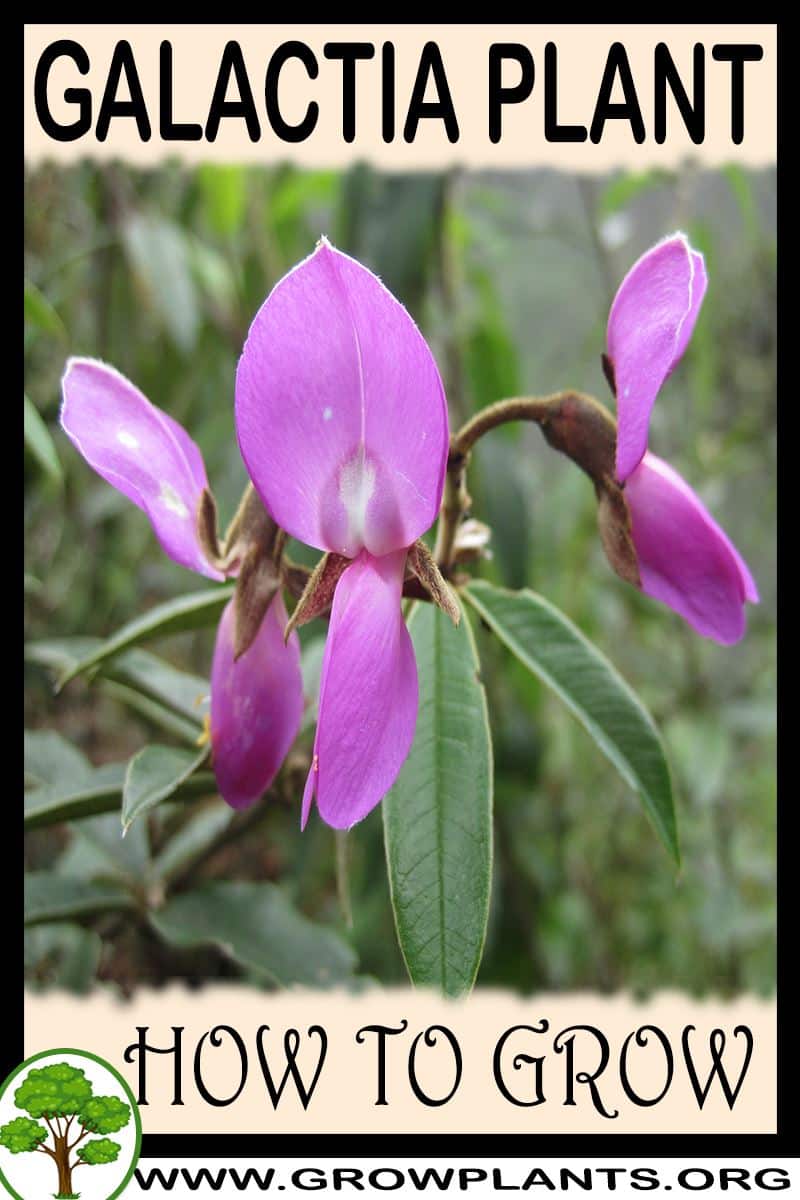
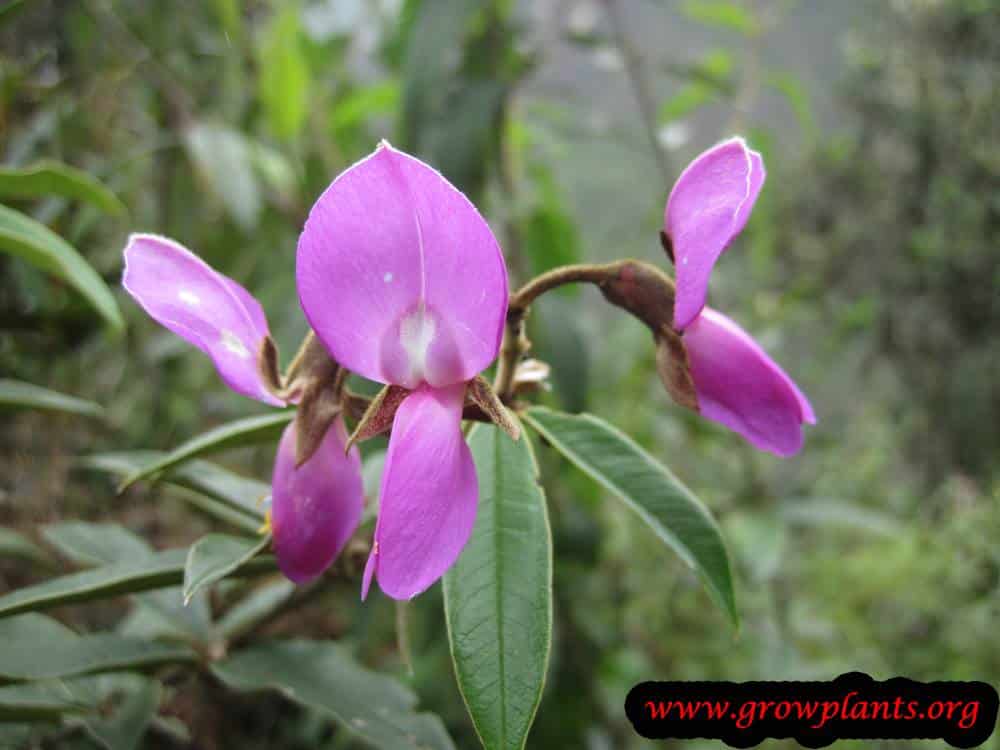
- Flower Characteristics: Small pea-shaped (papilionaceous) flowers in purple to pink, borne mainly in autumn.
Primary Uses & Landscape Value
- Functional & Ornamental Roles: Ornamental trailing plant and groundcover; a nitrogen-fixing legume useful for improving poor soils, and a nectar source for pollinators.
Care Guide: Planting, Soil & Watering
Overview: Galactia (milk peas) is a warm-climate legume that grows best in full sun to light shade in rich, fertile soil. It appreciates steady moisture — moderate to generous water — and, being nitrogen-fixing, is not a heavy feeder.
Quick Care Requirements
| Requirement | Ideal Condition |
|---|---|
| Planting Season | Warm season (spring to summer) |
| Growth Rate | Moderate to Fast |
| Soil Type | Rich, fertile soil that still drains freely |
| Water Need | Moderate to high — keep the soil evenly moist |
Planting & Establishment
- Best Planting Season: Plant during the warm season, from spring into summer, once the soil has warmed.
- How to Plant:
- Hole Preparation: Dig a hole roughly twice the width of the root ball to loosen the surrounding soil for the roots to spread.
- Soil Amendments: Blend in compost or well-rotted organic matter to build the rich soil this legume prefers; as a nitrogen-fixer it needs little extra feeding.
- Planting Depth: Set the plant so the root collar sits level with the surrounding soil; do not bury the stem or crown.
- Growth Speed & Expectations: A moderate-to-fast grower reaching anywhere from 30 cm to 2 m (1–7 ft) depending on how it is trained or supported.
Soil, Watering & Drainage Care
- Soil Mix & Drainage Needs: Use rich soil that still drains freely; in containers a good-quality potting mix works well. Sound drainage keeps the roots from sitting in water.
- Watering Schedule & Technique:
- Young / Newly Planted: Water regularly to keep the soil evenly moist while the roots establish.
- Established: Continue moderate to generous watering; this plant prefers consistent moisture rather than drying out.
- Seasonal Adjustments: Water more frequently in heat and reduce in cool weather.
Climate, Light & Hardiness
Galactia is a warm-climate, nitrogen-fixing vine suited to tropical, subtropical, and mild Mediterranean gardens; it has little tolerance for freezing conditions. It grows best in full sun to half shade.
Quick Climate Specifications
| Climate Zones | Tropical, Mediterranean, Subtropical |
|---|---|
| USDA Hardiness Zones | 10 and above |
| Frost Tolerance | Low |
| Light Conditions | Full Sun to Half Shade |
Sunlight & Light Exposure
Optimal Light Setup
Full sun to half shade both suit this vine.
Temperature Extremes & Hardiness
USDA Hardiness & Regional Limits
Suited to USDA zone 10 and warmer, essentially frost-free climates; it is not reliably cold-hardy and can be damaged or killed by freezing temperatures.
Frost Sensitivity
Sensitive to frost; grow only where winters stay reliably above freezing, or treat as a warm-season annual elsewhere.
Wind, Humidity & Microclimate
Humidity Preferences
As a tropical-to-subtropical legume, it is generally comfortable with the higher humidity typical of these climates.
Growing in Pots, Balconies & Indoors
Galactia is a sun-loving, scrambling or twining legume that can reach a couple of metres. The grower confirms it is not a houseplant but grows well in containers, so grow it in a pot with a support, outdoors in a warm, sunny spot.
Quick Details
- Container Size: 15-30 L with a trellis, obelisk or netting for it to climb – it can reach 30-200 cm
- Indoor Suitability: Not a houseplant; an outdoor climbing/scrambling plant for a sunny container
- Best Spot: Full sun to half shade – the sunnier the better for flowering
- Soil & Drainage: Free-draining potting mix; as a legume it is not fussy about richness
- Watering in Pots: Keep evenly moist through the growing season – it likes a fair amount of water – and ease off when cool
Indoors & On the Windowsill
- Not a houseplant: The grower marks it as unsuitable indoors – it needs full sun and room to climb that a house interior cannot offer.
- Windowsill: Only a large, very sunny sill with a small support could hold a young plant; it really belongs outdoors on a frame.
- Overwintering: In cold climates a pot lets you move this warm-climate legume to a bright, frost-free spot over winter, as it is not reliably hardy.
On a Balcony or Patio
- Light, wind & support: Give it the sunniest spot and a sturdy trellis or railing to climb; tie in and shelter the growth from strong wind. Pots against warm walls dry fast.
- Practicalities: A quick, leafy screen for a sunny balcony; let runoff drain and keep the support secure against the plant’s weight.
Choosing the Pot, Soil & Long-Term Care
- Pot & drainage: A pot with strong drainage holes; skip a standing-water saucer, which invites root rot. Terracotta breathes and dries faster (good for plants that hate wet feet); glazed or plastic pots hold moisture longer.
- Potting mix: Well-aerated potting mix – a peat-free or peat/coir blend opened up with perlite or vermiculite.
- Feeding: Feed sparingly – a weak balanced feed a few times in the growing season; these plants dislike rich conditions and lush, soft growth.
- Repotting: Refresh the top of the mix each year and pot on or divide every couple of years, lightly trimming roots and old growth to keep it vigorous.
Fertilizing & Feeding
A light feeder overall: as a nitrogen-fixing legume it draws much of its own nitrogen from root nodules, so fertilizing focuses on getting the vine established and supporting bloom rather than pushing extra nitrogen.
Quick Fertilizing Specs
| Feeding Level | Light feeder |
|---|---|
| Main Nutrient Priority | Balanced at planting, then low-nitrogen once the vine is established, since this legume fixes much of its own nitrogen |
| Best Feeding Period | During establishment and active warm-season vining growth |
| Organic Options | Compost or well-rotted organic matter worked into rich soil at planting |
| Micronutrients | Usually supplied by a complete fertilizer; correct specific issues only when diagnosed |
| Soil pH | Performs best in fertile soil; avoid strongly alkaline conditions, which this legume tends to respond to poorly |
| Reduce/Stop Feeding | Ease off feeding once the vine is well established and actively spreading on its own |
Feeding by Growth Stage
Establishment after planting
Help a young vine root into rich soil and begin forming the nitrogen-fixing nodules it relies on.
| Nutrient direction | A balanced complete fertilizer at modest strength to support early root and shoot growth. |
|---|---|
| Timing | At planting and through the first stretch of new growth in spring or summer. |
| Frequency | A light initial feeding is usually enough to get the vine established. |
| Fertilizer types | A balanced complete garden fertilizer at modest strength, Compost or well-rotted organic matter worked into the soil |
| Precautions | Avoid heavy nitrogen feeding at planting, which can discourage the vine from forming its own nitrogen-fixing root nodules. |
Active vining and spread
Support healthy stem elongation and leaf cover as the vine spreads or climbs, while letting nodulation supply most nitrogen needs.
| Nutrient direction | Keep nitrogen low and lean on a fertilizer that favors phosphorus and potassium to support root nodules and sturdy stems. |
|---|---|
| Timing | Through the warm growing season once the vine is established. |
| Frequency | Minimal feeding is usually enough once the vine is actively fixing its own nitrogen. |
| Fertilizer types | A low-nitrogen, phosphorus and potassium-forward fertilizer |
| Precautions | Extra nitrogen fertilizer tends to suppress nodule formation in this nitrogen-fixing legume, so keep applications light. |
Flowering
Support the pea-shaped flower display without overfeeding.
| Nutrient direction | A light, balanced feeding to support bloom while keeping nitrogen restrained. |
|---|---|
| Timing | As flower buds form and through the bloom period. |
| Frequency | Light feeding is usually enough through bloom. |
| Fertilizer types | A balanced complete fertilizer used sparingly |
| Precautions | Avoid rich, nitrogen-heavy feeding during bloom, which favors foliage over flowers in this vine. |
Nutrient Deficiency Signs & Corrections
New leaves turn pale yellow between dark green veins while older leaves stay green.
| Possible causes | high soil pH tying up iron, common in many legumes, poorly drained or waterlogged soil, root stress limiting nutrient uptake |
|---|---|
| Appears first on | the youngest leaves |
| What to check | soil pH, drainage around the root zone, recent watering pattern |
| Possible correction | Correct overly alkaline soil where practical and apply a chelated iron product per its label if chlorosis persists. |
Overall pale green leaves and weak new growth despite otherwise adequate care.
| Possible causes | poor formation of nitrogen-fixing root nodules, compacted or waterlogged soil limiting root and nodule health, recent heavy nitrogen feeding suppressing nodule activity |
|---|---|
| Appears first on | the whole plant, older leaves first |
| What to check | soil drainage and compaction, recent fertilizer history, root health if the plant can be inspected |
| Possible correction | Improve soil drainage and structure, ease off nitrogen feeding, and allow nodulation to recover before reassessing. |
Leaf margins yellow or scorch and stems come weaker than expected.
| Possible causes | low soil potassium, an imbalanced, nitrogen-heavy feeding history, leaching in light, sandy soils |
|---|---|
| Appears first on | older leaf margins |
| What to check | leaf margin condition, recent feeding balance, soil texture and drainage |
| Possible correction | Shift to a lower-nitrogen, potassium-forward fertilizer and improve soil organic matter. |
Pruning, Training & Seasonal Maintenance
Galactia is a soft-stemmed, twining and sprawling perennial legume grown as a groundcover or light climber rather than a structural plant, so it tolerates only light shaping cuts – there is no permanent woody framework to protect. The safest window is autumn into winter, once the autumn bloom flush has finished and growth begins to slow, so a trim does not sacrifice the current flowers. Because it is fast to medium growing and reshoots readily from the base, pruning here is about containing sprawl and keeping the plant tidy, not about training a fixed shape.
Quick Pruning & Maintenance Specs
| Pruning Tolerance | Moderate – cuts back and reshoots well, but has no woody framework to preserve |
| Primary Pruning Window | Autumn / Winter, after the bloom flush |
| Typical Frequency | Occasional shaping through the season, one seasonal cutback in autumn/winter |
| Main Objective | Contain sprawl and keep a tidy shape (“just for design”) |
| Young Plant Priority | Let it establish and spread; remove only damaged growth |
| Mature Plant Priority | Cut back wayward runners and thin congested growth before it smothers neighbouring plants |
| Best Tool Type | Precision snips / hand shears for soft, pea-vine stems |
| Avoid Heavy Pruning During | The autumn bloom flush |
Pruning by Plant Age & Size
Newly Established
Minimal intervention – remove only damaged or dieback growth while the plant fills in.
Young / Formative
No formal training system is used. If grown as a light climber over a support, guide runners onto it rather than cutting them back; if grown as a groundcover, pinch growing tips occasionally to encourage denser, bushier spread.
Mature / Established
Periodically cut back the sprawling mass to refresh growth and stop it running over neighbouring plants; since it reshoots freely from the crown this can be done fairly close without harm.
Seasonal Pruning Schedule
Autumn / Winter (post-bloom tidy): objective – contain size and refresh shape; remove leggy or sprawling stems, spent flowering stems, and any frost-nipped growth in the cooler part of its range; do not remove all top growth in one pass on an evergreen specimen. Expected response is fresh basal shoots through the next growing season, with no impact on the following autumn’s bloom since cutting happens after flowering finishes.
Structural Pruning & Training
The only structural concern is height and spread control – keeping the twining stems from overrunning nearby plants or a support. There is no crossing-branch or canopy-density issue on this soft-stemmed habit.
Special Growth to Remove
- Spent flowering stems, to keep the plant tidy after the autumn bloom
- Stems that have rooted where they touch the soil, if the spreading habit needs to be contained
Container & Small-Space Pruning
In a container the trailing habit stays more compact naturally; pinch growing tips regularly to keep it bushy rather than stringy, and trim trailing stems back to the pot’s edge as needed – more frequent light trims suit a container better than one hard seasonal cutback.
Tools
- Precision snips for pinching tips and most soft, pea-vine stem cuts
- Bypass secateurs for any thicker growth at the crown of an older plant
Tool Hygiene & Disease Risk
Routine – clean, sharp tools are sufficient; no significant transmissible disease risk is noted for this species.
Cut Placement & Technique
Pinch or cut just above a leaf node to encourage branching, and when removing a twining stem, cut it free of its support rather than pulling, to avoid tearing new growth.
Heavy Pruning & Rejuvenation
Tolerates being cut back close to the crown if it becomes leggy or tangled, since it is fast to medium growing and reshoots readily; expect full recovery within one growing season.
Post-Pruning Care
Water normally after cutting back; as a nitrogen-fixing legume it needs no extra feeding to push regrowth, so skip fertilizing immediately after pruning.
Common Pruning Mistakes
- Cutting hard just before or during the autumn bloom flush and losing the season’s flowers
- Leaving the sprawling growth unchecked until it has smothered neighbouring plants, requiring a much harder renovation cut
When NOT to Prune
Avoid heavy cutting during the autumn bloom flush, and avoid hard pruning during periods of summer heat stress.
Recommended Tools (by task)
- Precision snips – for pinching tips and most soft pea-vine stem cuts; the thin stems need a clean small cut, not crushing.
- Bypass secateurs – for thicker basal growth on an older crown that precision snips can’t manage cleanly.
- Soft ties/stakes – useful when training the twining stems onto a support as a light climber.
Propagation Guide
Galactia is a legume (Fabaceae), and the site marks seed as a straightforward starting method with vegetative reproduction not required, so seed is the most practical route for a home grower, with stem cuttings as a secondary option for a specific plant. Seed generally comes true for this un-hybridized genus, and overall propagation difficulty is Easy.
Quick Propagation Specs
| Best Propagation Method | Seed |
| Alternative Methods | Semi-hardwood stem cuttings; division of spreading clumps |
| Propagation Difficulty | Easy |
| Seed True-to-Type | Usually true-to-type |
| Vegetative True-to-Type | Yes |
| Best Propagation Season | Spring to summer |
| Germination Temperature | Warm, frost-free conditions typical of its tropical/subtropical range; no site-specific figure available |
Growing from Seed
Dormancy & Pre-Sowing Treatment
Like many legumes (Fabaceae), Galactia seed often has a hard outer coat that can slow water uptake; a brief soak, or light scarification of the seed coat, may improve and even out germination, though this is general legume practice rather than a species-confirmed requirement for this plant.
Sowing Season
Sow in spring to summer, matching the site’s planting season.
Germination Conditions
Warm temperatures and consistently moist, free-draining soil suit this warm-climate legume; exact figures are not established for this species.
Stem Cuttings
Cutting Type
Semi-hardwood cuttings from the twining stems, taken from healthy current-season growth.
Best Timing
Spring to summer, during active growth.
Rooting Setup
A moist, free-draining cutting medium with warmth and humidity, consistent with this plant’s rich-soil, average-to-big water preference.
Rooting Hormone
Optional; not established as required for this species.
Bloom & Flower Guide
Quick Details
- Bloom Season: Autumn
- Flower Appearance: Small pea-shaped flowers in purple or pink
- Edibility: Ornamental – grown as an ornamental (and nitrogen-fixing) plant, not for eating
Detailed Blooming Overview
Galactia, the milk peas, are trailing or twining legumes that flower in autumn with small, typical pea-family blooms in purple to pink. Like other legumes they fix nitrogen, quietly improving the soil around them.
Flower Characteristics
- Small pea-shaped (papilionaceous) flowers in purple or pink, with the classic upright banner and keel of the pea family
Bloom Care & Thinning
- Pollination: The pea-type flowers are built for bees, which trip the keel to reach the nectar.
- Easy-going: As a nitrogen-fixer it flowers well without rich feeding.
Pests, Diseases & Troubleshooting
Overview: Galactia (milkpea) is a twining legume in the bean family (Fabaceae), so its pest and disease pressures follow the general legume pattern rather than anything species-specific — sap-sucking insects on soft growth, chewing caterpillars and beetles on foliage and pods, and the fungal leaf diseases (rust, leaf spot) that trouble beans. As a nitrogen-fixing wild vine it is generally undemanding and fairly resilient; manage it culturally with airflow, sanitation and drainage, spraying only when a specific problem is confirmed. Because the source record gives only the genus, the profile below is family-level guidance — verify against the exact species once known.
Quick Troubleshooting Overview
| Issue / Pest | Main Symptom | Primary Solution |
|---|---|---|
| Aphids | Colonies on shoot tips and pods, honeydew and sooty mold | Water jet, beneficials, insecticidal soap |
| Pod borers / caterpillars | Holes in leaves and pods, frass, damaged seeds | Hand-pick, encourage parasitic wasps, Bt if needed |
| Rust | Orange-brown powdery pustules on leaf undersides | Airflow, remove infected leaves, sulfur fungicide |
| Spider mites | Fine stippling and webbing in hot, dry weather | Hose foliage, horticultural oil |
| Root rot | Wilt and collapse in wet, poorly drained soil | Improve drainage, avoid overwatering |
Common Pests & Management
- Aphids (esp. cowpea aphid, Aphis craccivora):
- Symptoms: Dense black or green colonies on tender shoots, flower stalks and developing pods; curled growth, honeydew and sooty mold. A common legume pest and a virus vector.
- Prevention & Control: Encourage ladybirds and lacewings, avoid heavy nitrogen, dislodge with water, and apply insecticidal soap or neem to undersides if colonies persist.
- Legume pod borers & caterpillars (Etiella, Maruca, Helicoverpa spp.):
- Symptoms: Chewed leaves, bored flowers and pods with entry holes and frass, damaged or hollowed seeds. Larvae often feed hidden inside pods.
- Prevention & Control: Hand-pick larvae, remove infested pods, and encourage parasitic wasps and birds. Bacillus thuringiensis (Bt) or spinosad targets young caterpillars; time sprays to early instars before they bore in.
- Bean leaf beetles & weevils (Chrysomelidae / Bruchinae):
- Symptoms: Round or ragged holes in leaves from adult beetles; seed weevils (bruchids) tunnel in maturing and stored seed, leaving exit holes.
- Prevention & Control: Clear crop debris, encourage ground beetles and birds, and hand-pick where practical. Row cover protects young growth; neem deters feeding. Store any harvested seed dry and sealed to stop bruchids.
- Spider mites (Tetranychus spp.):
- Symptoms: Fine pale stippling, bronzing and webbing on undersides in hot, dry, dusty conditions; leaves dry and drop.
- Prevention & Control: Keep plants unstressed and hose foliage to raise humidity and dislodge mites; release predatory mites, and use horticultural or neem oil, repeating weekly.
- Whitefly & leafhoppers:
- Symptoms: Clouds of tiny white flies or wedge-shaped hoppers rising from disturbed foliage; yellowing, honeydew, and possible virus transmission. Leafhopper feeding can cause “hopperburn” leaf-edge yellowing.
- Prevention & Control: Yellow sticky traps monitor and reduce them; encourage natural enemies; spray insecticidal soap or neem to undersides in the evening.
Diseases & Fungal Issues
- Rust (Uromyces / Phakopsora spp.):
- Symptoms: Orange to reddish-brown powdery pustules, mainly on leaf undersides, with yellow flecking above; heavy infection browns and drops leaves. A classic legume disease.
- Treatment & Management: Improve airflow and spacing, avoid overhead watering, and remove infected leaves. Sulfur fungicide protects new growth in persistent outbreaks.
- Leaf spots (Cercospora / Colletotrichum spp.):
- Symptoms: Brown to purplish angular or round spots on foliage, sometimes with yellow halos; severe spotting causes defoliation in warm, wet weather.
- Treatment & Management: Sanitation and base watering; remove spotted debris. Copper fungicide protects if spotting is persistent.
- Powdery mildew (Erysiphe spp.):
- Symptoms: White powdery film on leaves and stems in humid, crowded conditions; yellowing and early leaf loss.
- Treatment & Management: Open the canopy for airflow, full sun, and treat with sulfur or potassium bicarbonate if needed.
- Root & stem rot (Rhizoctonia, Fusarium, Pythium):
- Symptoms: Wilting, yellowing and collapse; darkened, rotten roots or stem base, worst in wet, poorly drained soil.
- Treatment & Management: Prevention through sharp drainage and moderate watering; remove and destroy collapsed plants and avoid replanting legumes in the same rot-prone spot.
- Mosaic & legume viruses:
- Symptoms: Mottled yellow-green leaves, distortion and stunting; spread by aphids and whitefly. No cure.
- Treatment & Management: Control the insect vectors, remove and destroy symptomatic plants, and manage weeds that host the viruses.
Growing Difficulties & Abiotic Problems
- Wet-soil root rot:
- Cause & Symptoms: As a wild vine of open, often sandy ground, Galactia resents waterlogging; soggy soil brings wilt and root collapse.
- Correction Strategy: Plant in free-draining soil in full sun and water moderately; avoid heavy, wet sites.
- Lime-induced chlorosis:
- Cause & Symptoms: On strongly alkaline soils, new leaves yellow between green veins from iron/manganese lock-out.
- Correction Strategy: Correct soil pH toward neutral and apply chelated iron as a short-term fix.
- Over-feeding (as a nitrogen fixer):
- Cause & Symptoms: Being a legume, it fixes its own nitrogen; excess nitrogen fertilizer produces lush, aphid-prone foliage at the expense of flowering.
- Correction Strategy: Skip nitrogen feeds; a low dose of phosphorus/potassium is plenty on poor soils.
What Helps — Products & Tools
Keep it simple and organic-first: insecticidal soap and neem oil for aphids, whitefly, leafhoppers and mites; Bt or spinosad for pod borers and caterpillars; yellow sticky traps to monitor sucking pests; sulfur fungicide for rust and powdery mildew; and copper fungicide for leaf spots. Cultural care — full sun, airflow, sharp drainage and no excess nitrogen — prevents most trouble on this tough legume.