Plant Profile & Key Characteristics
Overview: An evergreen fig tree 1-20 m (3-66 ft) tall, widely grown as an ornamental and popular houseplant, with small edible figs. Fast-to-moderate growing and easily kept dwarf.
Quick Specifications
| Specification | Attribute |
|---|---|
| Plant Type / Life Cycle | Perennial (tree) |
| Foliage Type | Evergreen |
| Mature Size | 1-20 m tall (3-66 ft); easily kept much smaller |
| Growth Rate | Moderate to Fast |
| Root System | Vigorous and spreading – can be invasive outdoors |
| Toxicity | Milky sap is a skin and eye irritant; the fruit is edible |
| Hardiness | USDA zones 10+ (zone 9 with winter protection) |
Growth Form & Structure
- Height & Spread: Up to 20 m (66 ft) outdoors but usually kept to a few metres, and grown indoors or in containers (25-50 L minimum) as a dwarf or bonsai.
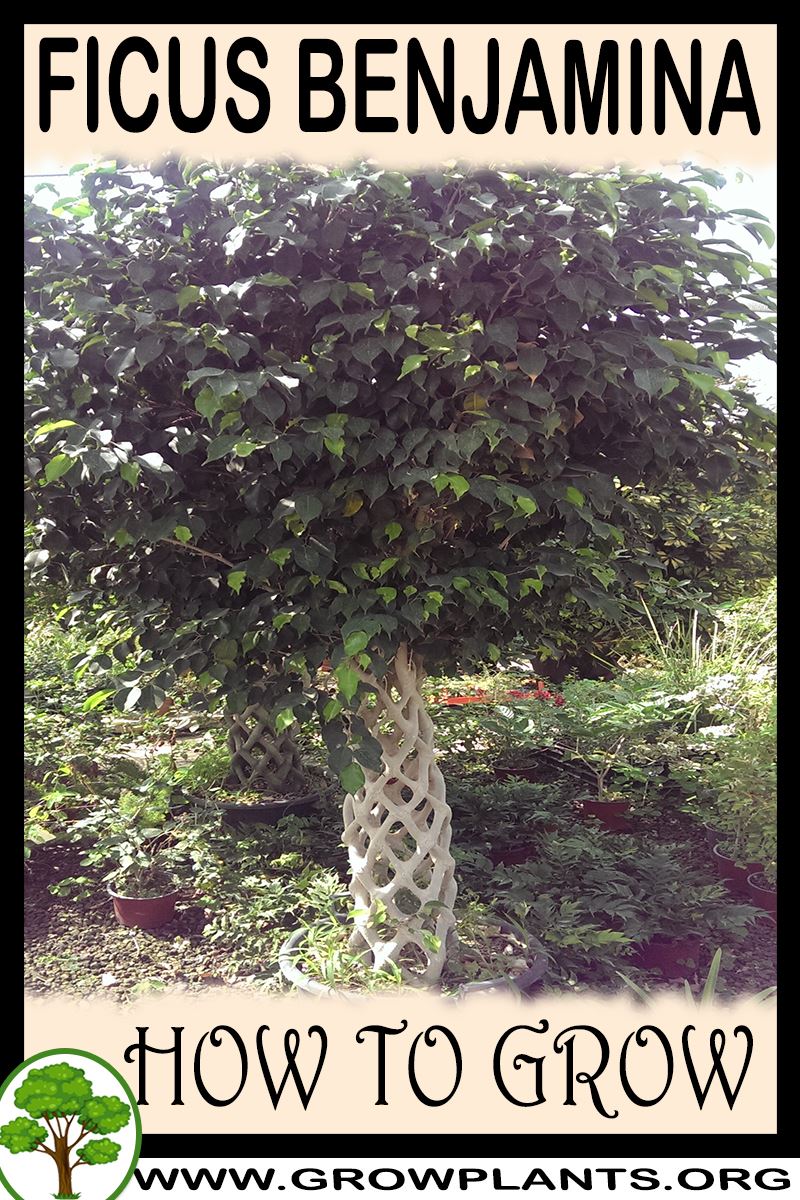
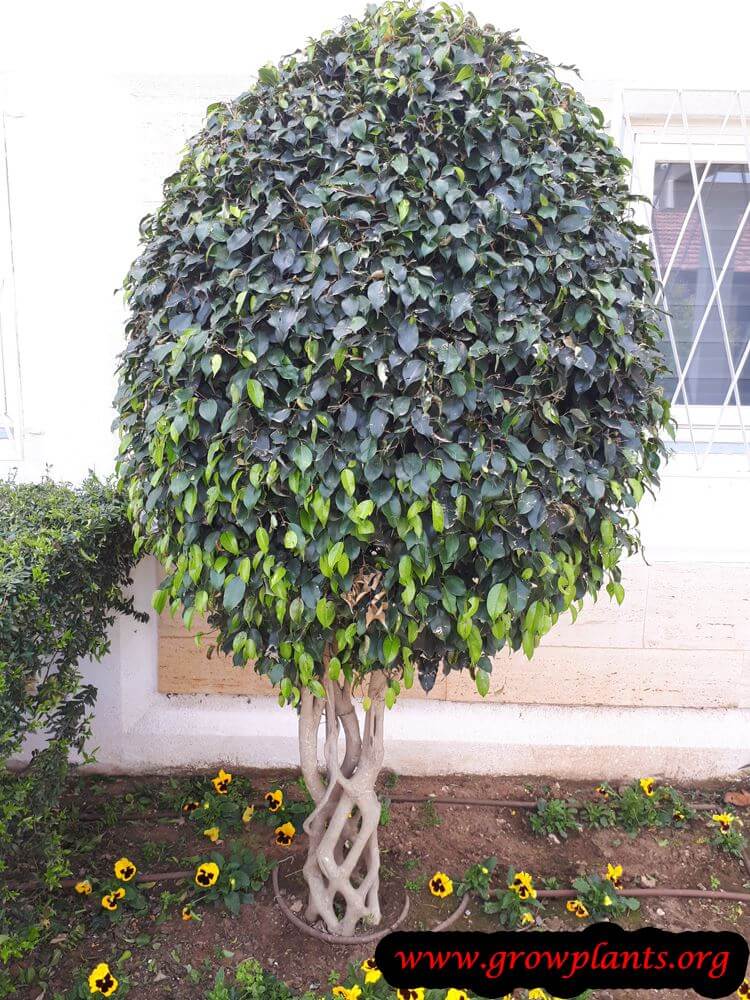
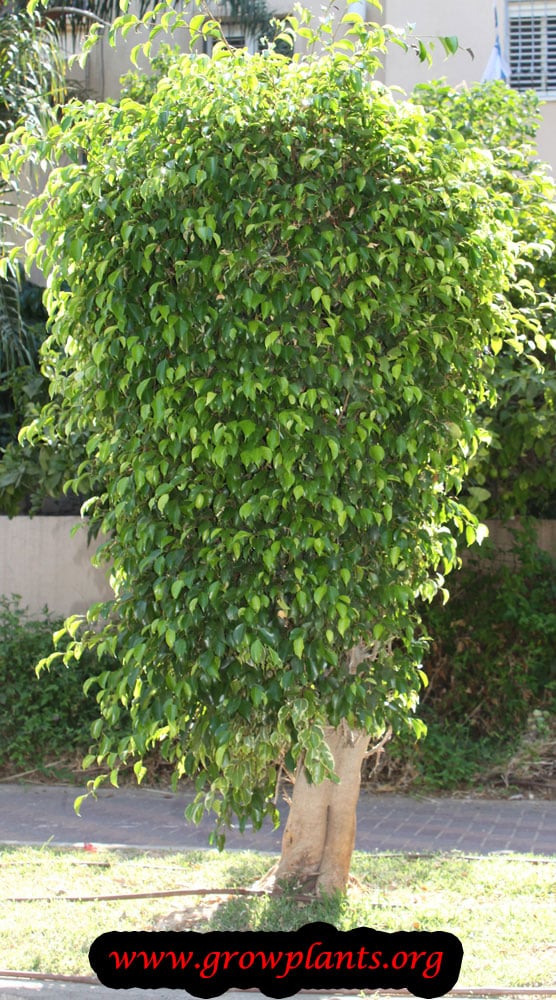
- Growth Habit & Form: Graceful tree with a dense, weeping canopy of arching branches.
- Lifespan & Maturity: Long-lived; begins fruiting in about 2-3 years.
Anatomy & Physical Features
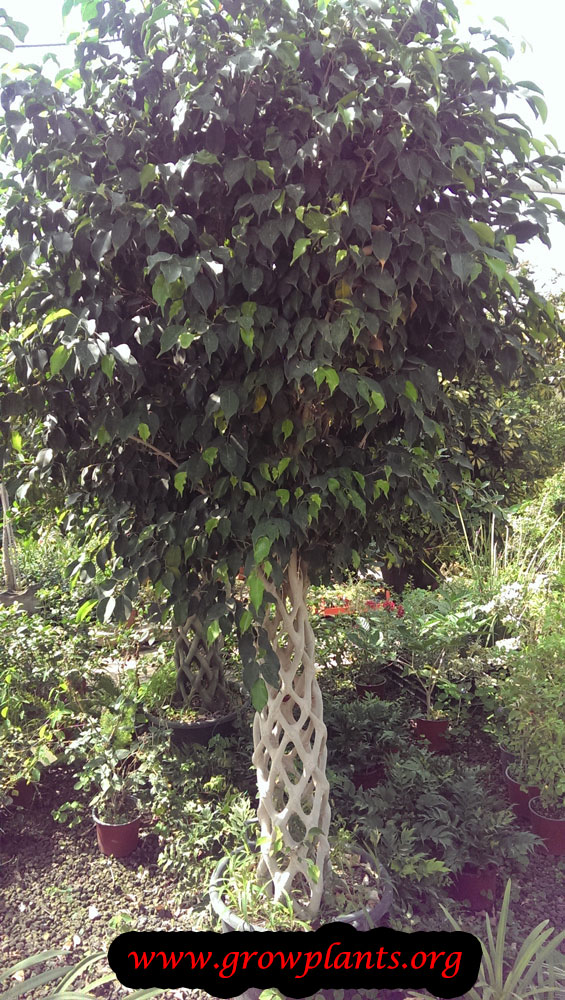
- Trunk & Bark: Pale, smooth trunk, often trained or braided as a houseplant.
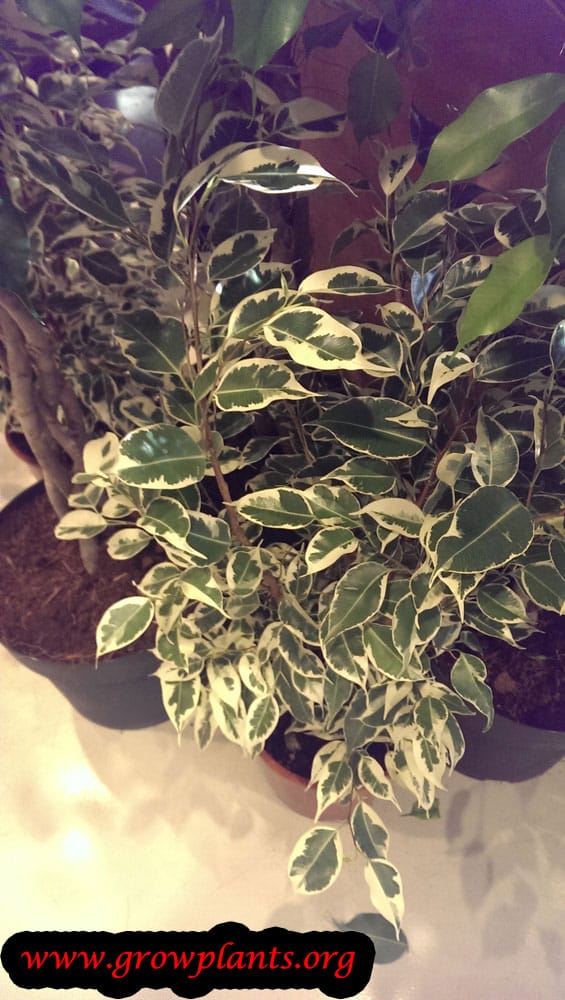
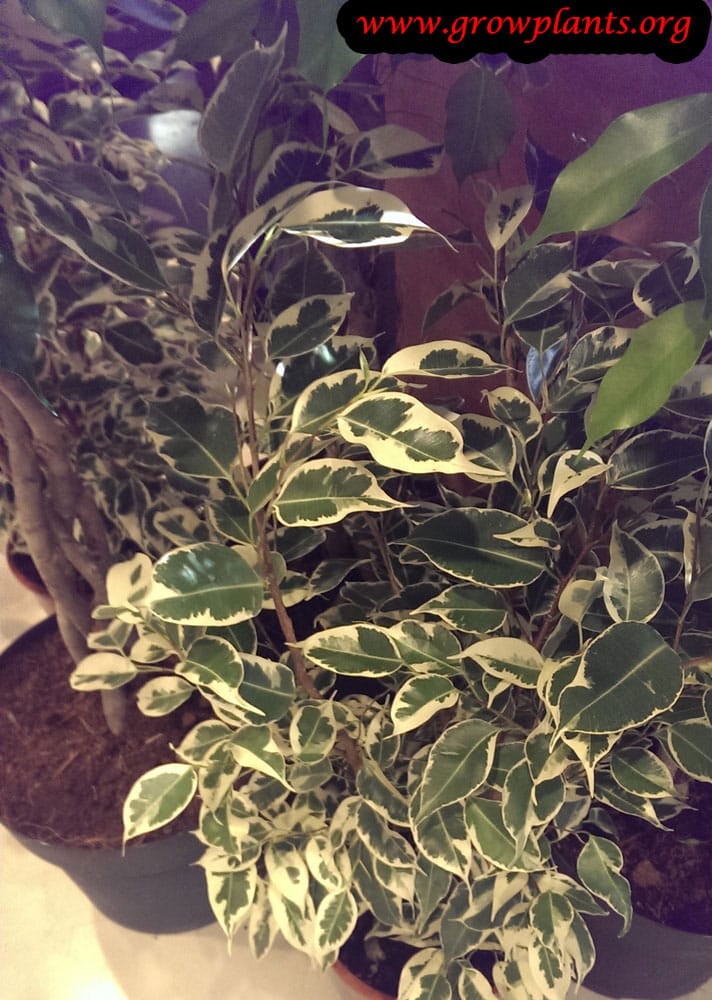
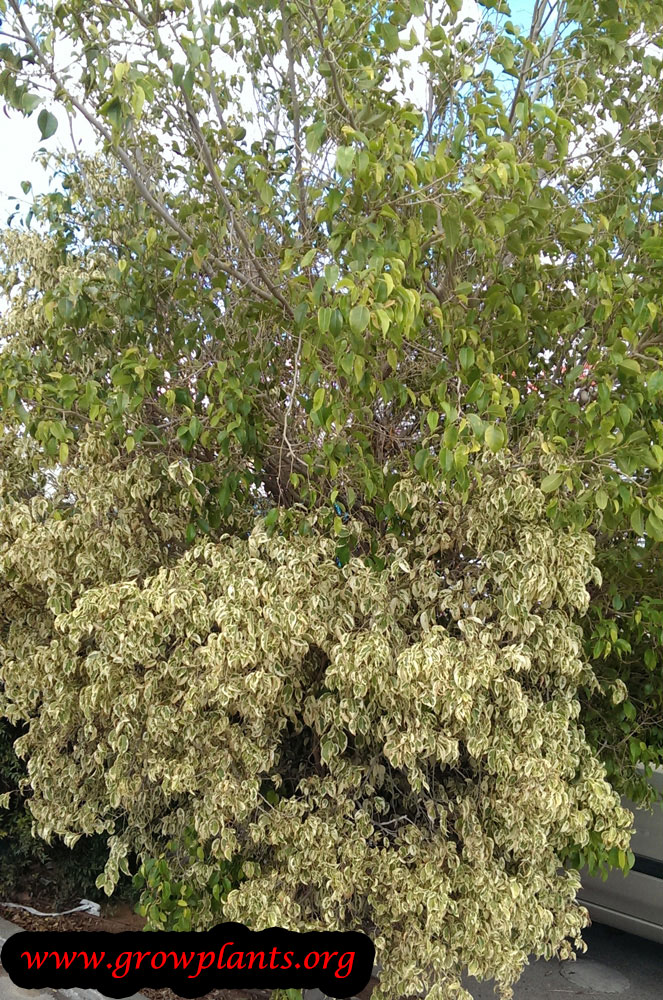
- Leaves & Foliage: Small, glossy light-to-dark green leaves; some cultivars are variegated white and green.
- Flower Characteristics: Tiny yellow flowers inside the fig (full detail in the Bloom guide).
- Fruit Profile: Small, round, red-purple edible figs (full detail in the Fruit guide).
Primary Uses & Landscape Value
- Edible Uses: Small figs can be eaten raw or made into jam.
- Functional & Ornamental Roles: A popular ornamental and indoor houseplant; also grown as a shade tree, bonsai or container specimen.
Care Guide: Planting, Soil & Watering
Overview: Ficus benjamina (weeping fig) is an evergreen fig grown outdoors in tropical, Mediterranean and subtropical climates (hardiness zone 10+, or 9 with winter care) and widely indoors as a houseplant. It prefers rich, well-draining soil kept lightly moist and mulched, tolerates full sun through full shade, and dislikes soggy roots.
Quick Care Requirements
| Requirement | Ideal Condition |
|---|---|
| Planting Season | Warm season, varying by zone (see below) |
| Growth Rate | Moderate to Fast |
| Soil Type | Rich, well-draining, mulched |
| Water Need | Low to Moderate – let the topsoil dry between waterings |
Planting & Establishment
- Best Planting Season: Plant in the warm season: spring in zone 9, spring to summer in zone 10a, spring to autumn in zone 10b, and year-round in zone 11 and above.
- How to Plant:
- Hole Preparation: Dig a hole noticeably wider and deeper than the root ball – roughly 70-100% larger – then backfill so the roots sit on firm, amended ground at root-ball depth.
- Soil Amendments: Mix plenty of organic matter, humus and dried leaves into the backfill to feed the young tree and improve the soil; top with mulch to hold moisture.
- Planting Depth: Set the tree so the root collar sits at soil level, loosen the outer roots of the root ball slightly, and firm the soil gently – not so hard that it compacts, not so loose that the tree wobbles.
- Growth Speed & Expectations: A moderate-to-fast grower reaching 1-20 m (3-60 ft) outdoors; it is easily kept compact as a container plant or bonsai through root and canopy pruning.
Soil, Watering & Drainage Care
- Soil Mix & Drainage Needs: Grow in rich, well-draining soil kept lightly moist and mulched; in containers use a potting or peat mix with perlite and organic matter, a pot about 50% larger than the root ball, and plenty of drainage holes so water never sits at the roots and rots them.
- Watering Schedule & Technique:
- Young / Newly Planted: For the first two weeks after planting, water every day, preferably in the morning, so the root ball never dries out while it establishes.
- Established: Once established, water moderately and deeply, letting the top few centimetres of soil dry before watering again; it is drought tolerant but will drop leaves if kept waterlogged.
- Seasonal Adjustments: Increase watering in hot weather – above about 30 C (86 F) young trees need noticeably more – and ease off in the cool season when growth slows.
Climate, Light & Hardiness
Weeping fig (Ficus benjamina) is a tropical evergreen tree grown outdoors in tropical, subtropical and mild Mediterranean climates and, very widely, as an indoor houseplant in full sun to full shade. It is cold-tender - the site data gives hardiness zone 10 and warmer, extending to zone 9 with the right overwinter care - and indoors it is comfortable at ordinary room temperatures but resents cold draughts and sudden change, which trigger leaf drop.
Quick Climate Specifications
| Climate Zones | Tropical, subtropical and mild Mediterranean (also grown indoors) |
|---|---|
| USDA Hardiness Zones | Zone 10 and warmer, to zone 9 with overwinter care (site data) |
| Optimal Temp Range | Warm, frost-free conditions; comfortable at normal indoor room temperatures |
| Cold Damage Begins | Foliage suffers as temperatures fall toward freezing (0 °C / 32 °F); indoors, keep it well above that and away from cold draughts |
| Approx. Survival Minimum | Little frost tolerance; established plants may survive a brief light frost, but hard frost damages or kills top growth. Young plants are more tender |
| Frost Tolerance | Low |
| Light Conditions | Full sun to full shade (bright, indirect light indoors) |
| Wind Tolerance | Low–Moderate |
Sunlight & Light Exposure
Optimal Light Setup
Outdoors it grows from full sun to shade; indoors it does best in bright, indirect light near a well-lit window. Steady light matters - a sudden drop in light, like a move to a darker spot, prompts leaf drop.
Shade & Heat Management
It tolerates shade but grows denser in good light; strong, direct glass-filtered sun can scorch tender indoor foliage, so bright but diffuse light is safest indoors.
Best Exposure / Orientation
Outdoors, a warm, sheltered, sunny to lightly shaded aspect; indoors, a bright spot out of cold draughts and away from heating vents and freezing winter windows.
Temperature Extremes & Hardiness
USDA Hardiness & Regional Limits
The site data gives zone 10 and warmer for open-ground culture, with zone 9 possible given careful overwinter protection. This describes the outdoor cold limit; in colder regions it is grown indoors year-round.
Cold Damage & Winter Protection
Cold damages the foliage as temperatures approach freezing; in zone 9 it needs a warm, sheltered spot and winter protection. As a houseplant, keep it warm, out of cold draughts and off freezing windowsills - chilling and abrupt change both cause the leaves to drop.
Frost Sensitivity
Low frost tolerance, varying with plant age and exposure; young plants are more cold-sensitive than mature ones.
Extreme Heat Tolerance
Good in warm, humid heat, reflecting its tropical origins; the source advises extra water above about 30 °C / 86 °F.
Wind, Humidity & Microclimate
Humidity Preferences
Prefers moderate to high humidity; dry indoor air can brown leaf tips, so it appreciates a more humid spot or occasional misting.
Dry-Air Tolerance
Moderate; it copes with normal room air but is happiest with some humidity, especially in heated winter rooms.
Wind Tolerance
Low to moderate outdoors; the fine, weeping foliage is easily tattered and dried by strong or cold wind, so shelter is best. Indoors, keep it away from draughty doorways and air-conditioning.
Rainfall & Seasonal Moisture
Adapted to warm climates with regular moisture; it grows most strongly where warmth and moisture combine.
Microclimate Recommendations
Outdoors, a warm, sheltered, frost-free pocket; indoors, a stable, warm, brightly-lit, draught-free position - consistency of light, warmth and humidity is the key to preventing leaf drop.
Growing in Pots, Balconies & Indoors
The weeping fig is one of the most popular of all indoor trees – the grower confirms it grows well as a houseplant. Naturally 1-20 m outdoors, it is easily held to room size in a pot as a dwarf or small tree, and it also does well on a shaded balcony.
Quick Details
- Container Size: Minimum 25-50 L (5-10 gal) for a floor specimen, sized up gradually
- Indoor Suitability: Yes – a genuine, easy houseplant in bright, indirect light
- Best Spot: Full sun to full shade; tolerant, but brightest indoors
- Soil & Drainage: Potting mix or peat with perlite and organic matter; free-draining
- Watering in Pots: Small to average – let the top of the mix dry between waterings
Indoors & On the Windowsill
- A genuine houseplant: The grower marks it yes for indoors. Give it a bright spot with indirect light and keep it away from cold drafts, which trigger leaf drop.
- Steady position: It dislikes being moved – settle it in one bright place rather than shifting it around.
- Overwintering: Happy indoors year-round; just keep it warm and out of cold drafts in winter.
On a Balcony or Patio
- Light & wind: Enjoys a warm, sheltered balcony in the frost-free season with bright light and shelter from wind; bring it back indoors before cold nights. Pots dry fast in sun, so check moisture regularly.
Choosing the Pot, Soil & Long-Term Care
- Pot & drainage: Use a pot with strong drainage holes and skip a standing-water saucer, which invites root rot; terracotta breathes and dries faster, while glazed or plastic holds moisture longer.
- Potting mix: A light, aerated organic mix – peat or coir with perlite or vermiculite – gives the roots both moisture and air.
- Feeding: Potted plants use up their feed faster because each watering leaches nutrients away, so feed a little more often than plants in open ground.
- Repotting: Refresh the top of the mix and pot up every couple of years; a light root and top prune at repotting keeps established plants vigorous.
Grower’s Container Tip
- Keep it dwarfed: In a pot you must limit both top and root growth and grow it as a dwarf or bonsai. Move up gradually – each container only about 50% bigger than the root ball until it reaches its final size; don’t start a small tree in a big pot, as too much unused soil goes stale.
- Pot size: Minimum around 25-50 L (5-10 gal), and bigger is better; make plenty of drainage holes.
- Soil & renewal: Potting mix or peat with perlite and organic matter works well. Every few years, rather than replacing all the soil in a large pot, swap out part of it from the side and top and trim back some of the root ball.
- Feeding & water: Feed at least once a year and add humus once or twice; water regularly, and if you use a saucer never let water stand more than a day – overwatering ruins both soil and roots.
Growing this plant in a greenhouse
A greenhouse can give ficus benjamina frost protection, cold protection, humidity control and extra warmth.
Greenhouse at a glance
| Greenhouse suitability | Good - clearly useful |
|---|---|
| Main benefits | frost protection, cold protection, humidity control, extra warmth |
| Season extension | earlier spring & later autumn |
| Outdoor protection advisable below | about 5°C |
| Maintain greenhouse minimum | around 5°C for active growth |
| Suitable types | unheated greenhouse, polycarbonate greenhouse |
| Heating | Heating is optional - useful mainly for winter growing in cold areas. |
Related greenhouse guides
- Greenhouses: How to Choose the Right Greenhouse
- Polycarbonate Greenhouses: What to Look for Before Buying
Fertilizing & Feeding
A light feeder indoors: dilute balanced feedings only while the plant is in active growth, held off after repotting and through low-light slowdowns, with attention to flushing salts from the pot.
Quick Fertilizing Specs
| Feeding Level | Light feeder |
|---|---|
| Main Nutrient Priority | Balanced feeding with adequate nitrogen for healthy foliage |
| Best Feeding Period | During active growth in the brighter, warmer months |
| Organic Options | Compost-based potting amendments or a diluted organic liquid feed |
| Reduce/Stop Feeding | Hold off feeding through low light and cool-season slowdown |
| Micronutrients | A complete houseplant fertilizer supplies iron and manganese; correct only diagnosed issues |
| Soil pH | Slightly acidic to near neutral |
Feeding by Growth Stage
Settling in after potting or repotting
Let fresh roots settle into new mix before any feeding.
| Nutrient direction | None – the fresh potting mix already carries nutrients. |
|---|---|
| Timing | Right after potting or repotting, while roots re-establish. |
| Frequency | No feeding at this stage. |
| Fertilizer types | No feeding at this stage; do not fertilize freshly potted roots until new growth appears. |
| Precautions | Do not fertilize a freshly repotted plant; wait for active new growth before feeding. |
Active growth
Sustain healthy, well-colored foliage during active indoor growth.
| Nutrient direction | A balanced complete fertilizer, kept dilute, leaning to nitrogen for foliage. |
|---|---|
| Timing | Through the brighter, warmer months when the plant is actively growing. |
| Frequency | Light feedings while the plant is actively growing. |
| Fertilizer types | A balanced complete houseplant fertilizer supplying trace nutrients, Diluted liquid feed during active growth |
| Routine trace nutrients | iron, manganese |
| Precautions | Keep feeding light and dilute; container plants are easily overfed and burned by salts. |
Low-light or cool-season slowdown
Let the plant idle through low light or cool conditions without forcing growth.
| Nutrient direction | None – withhold fertilizer while the plant is not in active growth. |
|---|---|
| Timing | During low-light winter months or when growth clearly slows. |
| Frequency | No feeding at this stage. |
| Fertilizer types | No feeding at this stage; do not fertilize until active growth resumes. |
| Precautions | Do not fertilize now; feeding a plant that is not actively growing wastes nutrients and can cause salt buildup. |
Nutrient Deficiency Signs & Corrections
Older, lower leaves fade to pale green or uniform yellow and overall growth slows.
| Possible causes | low available soil nitrogen, nitrogen leaching from heavy watering or rain, thin, low-organic-matter soil |
|---|---|
| Appears first on | older, lower leaves |
| What to check | recent feeding history, soil organic matter, watering and drainage |
| Possible correction | Apply a nitrogen-containing complete fertilizer and build soil organic matter, then water evenly. |
Interveinal yellowing appears on newer leaves, often with a fine netted pattern.
| Possible causes | low manganese availability in alkaline soil, poorly drained or cold soils, high soil alkalinity locking up manganese |
|---|---|
| Appears first on | new, young leaves |
| What to check | soil alkalinity and drainage, whether the newest leaves are affected first, soil temperature and moisture |
| Possible correction | Correct soil alkalinity and drainage and apply a labeled manganese product only if a deficiency is confirmed. |
Leaf margins brown or scorch and growth stalls despite adequate watering.
| Possible causes | fertilizer salt buildup in the root zone, under-watering that concentrates salts, excessive or too-frequent feeding |
|---|---|
| Appears first on | leaf margins and tips |
| What to check | recent fertilizer amounts, watering consistency, drainage, especially in containers |
| Possible correction | Ease off feeding, water thoroughly to flush accumulated salts, then return to lighter feeding. |
Pruning, Training & Seasonal Maintenance
Ficus benjamina (weeping fig) can reach 20 m in the ground but is grown across a huge size range, from a full outdoor shade tree down to a small dwarf/bonsai form or a classic indoor container specimen. Its own care guidance calls for pruning once a year and deliberately keeping the tree small, with weak branches the main target for removal. Winter is the general window, but pruning right after any fruit set (summer) avoids cutting into a developing crop, and the milky sap is a skin irritant worth handling with care.
Quick Pruning & Maintenance Specs
| Pruning Tolerance | Moderate–High |
| Primary Pruning Window | Winter (or after fruit set, where relevant) |
| Secondary Maintenance Window | Light shaping/pinching year-round, especially indoors |
| Typical Frequency | Once a year for structural pruning; ongoing light shaping as needed |
| Main Objective | Keep the tree small and remove weak branches |
| Young Plant Priority | Select strong scaffold branches; remove weak shoots; shape trunk/form while flexible |
| Mature Plant Priority | Annual size control; remove weak/crowded growth |
| Best Tool Type | Bypass secateurs for most work; loppers and a pruning saw only on larger, outdoor-grown specimens |
| Avoid Heavy Pruning During | Right after a house/location move, or other sudden environmental change, for indoor plants |
Pruning by Plant Age & Size
Newly Established
Remove only damaged growth at first; this is also the stage at which trunks are commonly shaped (e.g. staked, twisted or braided together while still pliable) if a trained ornamental form is wanted, since mature woody trunks can no longer be bent.
Young / Formative
Remove weak or poorly placed shoots to concentrate growth into a strong framework of scaffold branches; for container/houseplant specimens, this is also when pinching new tips encourages a fuller, bushier head rather than a few long, leggy stems.
Mature / Established
Since this species is almost always kept far below its potential 20 m size, mature pruning is annual maintenance: cutting back the past season’s growth and continuing to remove weak or crowded branches to hold a compact shape.
Structural Pruning & Training
Thin out weak or crossing branches to keep the canopy from becoming twiggy and congested, and use the annual cut-back to control height and spread, which is what keeps a tree capable of 20 m at a manageable, often indoor-friendly, size.
Special Growth to Remove
- Weak or spindly branches – specifically flagged for removal to keep the tree compact and structurally sound.
- Overly long, leggy shoots on container-grown plants – pinched or cut back to keep a full, bushy canopy rather than sparse, trailing growth.
Container & Small-Space Pruning
Very widely grown as an indoor container plant. Top pruning should be matched to root management: at repotting, only part of the soil needs replacing and part of the root ball can be trimmed back rather than fully disturbing the roots each time; take care not to let water sit in the base of the pot, since this fig doesn’t tolerate waterlogged roots. Indoors, light pinching/shaping can be done through the year rather than saving all cuts for one seasonal session.
Tools
Bypass secateurs handle the great majority of cuts on this species, including all typical houseplant/container work; loppers and a pruning saw are only relevant for larger, outdoor-grown specimens approaching tree size.
Tool Hygiene & Disease Risk
Routine to Increased: gall, scale, mealy bugs, thrips, whitefly and spider mite are all recorded on this species and tend to build up on the soft new growth that follows pruning, so check regrowth after any harder cut; no wood-boring pest is flagged for this species (unlike some other Ficus), so routine clean, sharp tools are adequate.
Cut Placement & Technique
Cut weak branches back to their point of origin rather than leaving stubs, and pinch soft new tips just above a leaf node to encourage branching. Handle cut material with care (or gloves) since the sap is a skin irritant.
Heavy Pruning & Rejuvenation
Tolerates hard cutting back well – this is the normal way the species is kept to dwarf, bonsai, or manageable indoor scale rather than its natural size – though a leaf-drop response after a sudden, severe cut (or after any abrupt environmental change) is common in this species and is usually temporary.
Post-Pruning Care
Keep the potting mix evenly moist but never waterlogged after pruning; skip extra feeding right after a hard cut since the plant is already being pushed into regrowth. For indoor plants, keep light and location stable after pruning – this species is notably sensitive to combined stress from cutting and relocation.
Common Pruning Mistakes
- Leaving weak, spindly branches in place instead of removing them as recommended, producing a crowded, twiggy tree.
- Combining a hard prune with a change of location or light level, which compounds this species’ well-known tendency to drop leaves under stress.
- Handling prunings without gloves and getting the irritant sap on skin.
When NOT to Prune
Avoid a heavy structural prune at the same time as repotting, relocating, or otherwise changing the plant’s growing conditions – stacking these stresses together increases the chance of significant leaf drop.
Recommended Tools (by task)
- Weak-branch removal, pinching, routine shaping (young & mature, especially container-grown): bypass_secateurs.
- Larger structural cuts on bigger outdoor-grown specimens: loppers, with pruning_saw for the heaviest limbs.
Pruning Troubleshooting
| Problem | Possible Cause | What to Check | Corrective Action |
| Sudden leaf drop after pruning | Combined stress from cutting plus a change in light/location/watering | Whether the prune coincided with a move or other environmental change | Keep conditions stable after pruning; expect recovery over following weeks |
| Weak, twiggy, overcrowded growth | Weak branches not removed as recommended | Number and vigour of thin competing shoots | Thin out weak branches at the next pruning |
| Pest build-up (scale, mealy bug, spider mite) on new growth | Soft regrowth following a hard cut | Pest presence concentrated on the newest shoots | Monitor and treat regrowth; avoid stacking repeated hard cuts |
Propagation Guide
Weeping fig is most reliably increased from semi-ripe (brown, fully grown) stem cuttings, with air layering useful for thicker or leggy stems. Seed germinates readily and is not difficult, but seedlings are variable and will not reproduce a cultivar’s leaf colour or variegation, so cuttings are preferred to keep a chosen form. Overall an easy-to-moderate plant to propagate.
Quick Propagation Specs
| Best Propagation Method | Semi-ripe stem cuttings |
| Alternative Methods | Air layering; seed |
| Propagation Difficulty | Easy to Moderate |
| Seed True-to-Type | Variable — cultivars (leaf colour/variegation) not reproduced from seed |
| Vegetative True-to-Type | Yes |
| Best Propagation Season | Spring to summer |
| Seed Germination Time | 7–21 days |
| Cutting Rooting Time | Typically several weeks under warm, humid conditions |
| Germination Temperature | 21–26°C (70–79°F) |
| Seed Sowing Depth | Surface to about 3 mm (1/8 in) |
Stem Cuttings
Cutting Type
Choose a brown, fully grown (semi-ripe to woody) shoot rather than soft new growth.
Best Timing
Warm season — spring through summer.
Cutting Preparation
The cut releases milky latex, which is a skin irritant — handle with care and let the cut end stop bleeding before insertion.
Rooting Setup
Keep the medium moist and humidity high; an enclosed box or greenhouse helps, but it must be well ventilated with moving air. Water by misting or fogging and never let the cutting dry out.
Rooting Hormone
Beneficial — use a rooting hormone formulated for woody stems.
Rooting Time
Typically several weeks under warm, humid conditions.
Air & Ground Layering
Air layering suits thicker woody stems and leggy plants: girdle or wound a section, wrap it in moist sphagnum and a sleeve, and keep it damp. Roots form over several weeks; sever below the roots once they are well developed and pot up.
Growing from Seed
Fig seed is minute. Seed-raised plants are viable but variable, so seed is a secondary option used mainly where large numbers are wanted rather than to reproduce a particular form.
Seed Handling & Viability
Store seed in a dry, dark place until sowing. The site recommends soaking the small seed for about 24 hours before sowing.
Sowing Season
Spring, summer or autumn. In hot climates avoid sowing in peak summer; in cold climates avoid autumn, so seedlings establish in the warmth of spring.
Sowing Depth & Orientation
Surface-sow onto light, moist medium or barely cover with about 3 mm (1/8 in) of mix.
Germination Conditions
Warmth of 21–26°C (70–79°F) with consistently moist medium and high humidity (a light fog gives the best results), in half shade to full sun. Sowing in a greenhouse or a small covered plastic box helps hold the humidity high.
Germination Time
Roughly 7–21 days under those warm, humid conditions.
Seedling Care
Space in small cells about 2×2 cm (1×1 in), or better 5×5 cm (2×2 in). Transplant only once seedlings have 5–7 leaves, not while very young. Harden off by gradually reducing humidity and slowly increasing sun exposure.
Bloom & Flower Guide
Quick Details
- Bloom Season: Spring
- Time to First Bloom: Rarely flowers in cultivation – mostly large, mature outdoor trees bloom
- Flower Appearance: Tiny yellowish flowers hidden inside a closed, fig-like receptacle (a syconium)
- Edibility: Ornamental – the enclosed flowers are not eaten
Detailed Blooming Overview
Like every fig, the weeping fig hides its true flowers inside a hollow receptacle that later ripens into a small fig. There is no showy open bloom to admire – the whole flowering happens out of sight, which is why potted and indoor specimens are seldom seen in flower at all.
Flower Characteristics
- Small yellowish flowers borne inside the closed syconium rather than out in the open.
- Male and female flowers sit together within the same structure.
Bloom Care & Thinning
- Managing the bloom: No thinning or deadheading is needed – the plant is grown for its foliage and graceful form, not its flowers.
- Pollination: In its native range the fig relies on a specific fig wasp to enter the receptacle and pollinate; bees and flies do not perform this job.
Fruit & Uses
Weeping fig is grown almost entirely as an ornamental and houseplant. Its small ripe figs are reported to be edible, but they are seedy and bland and are not a usual food, and the plant’s milky sap is a skin irritant – so if the fruit is eaten at all, use only fully ripe figs and avoid the sap.
Quick Edible Specs
| Edible Parts | Fruit (small fig) – marginal |
|---|---|
| Main Use(s) | Minor culinary (ripe fruit, occasionally jam); mainly ornamental |
| Eaten Raw or Cooked | Ripe fruit raw; also cooked into jam |
| Preparation Required | Eat only fully ripe fruit; avoid the irritant sap |
| Harvest Season | Summer |
| Time to First Harvest | A few years after planting, once the tree matures (see Care) |
| Storage | Best fresh; little used for storage |
| Safety/Toxicity Caveat | irritant milky latex; fruit is marginal, not a staple; keep foliage and sap away from pets |
Fruit
The fruit is a small, round fig ripening red-purple. Only fully ripe figs should be considered; unripe fruit and the plant’s sap are irritant. Its food use is limited – where eaten it is taken fresh or occasionally made into jam – and most plants are grown purely as ornamentals or houseplants.
Preparation, Uses & Safety
Safety first: the milky latex irritates skin, and the plant is commonly noted as toxic to pets, so handle with care and keep clippings away from animals. Treat this as a marginal edible only – eat just fully ripe fruit, avoid the sap, and do not rely on it as a food crop.
Pests, Diseases & Troubleshooting
Overview: The weeping fig is a popular indoor/landscape fig whose realistic problems are sap-sucking pests – scale, mealybug, spider mites and both ficus and greenhouse whitefly – plus leaf-curling Cuban laurel thrips, with anthracnose and root rot as the main diseases. Its signature quirk, though, is dramatic leaf drop whenever light, temperature or watering change, so stability and cultural care matter as much as pest control.
Quick Troubleshooting Overview
| Issue / Pest | Main Symptom | Primary Solution |
|---|---|---|
| Scale insects | Brown/waxy bumps on stems & leaves; honeydew | Prune, horticultural oil, encourage parasitoids |
| Mealybugs | White cottony tufts in axils/roots; honeydew | Alcohol swab, oil/soap, Cryptolaemus |
| Spider mites | Stippling, bronzing, webbing (dry indoor air) | Raise humidity, rinse, oil/predatory mites |
| Ficus / greenhouse whitefly | White flies rise; yellow flecking, honeydew | Sticky traps, oil/soap undersides, Encarsia |
| Anthracnose / leaf spot | Brown/black spots, leaf drop | Airflow, remove leaves, copper if severe |
| Sudden leaf drop | Leaves yellow & fall after a change | Stabilise light/temp/water; avoid moving |
Common Pests & Management
- Scale insects (Coccidae & Diaspididae (soft & armoured scale)):
- Symptoms: Brown, tan, black or waxy bumps and encrustations along stems, leaf veins and undersides that don’t rub off; soft scales drip honeydew that blackens with sooty mould, and heavy infestations yellow leaves and cause drop. A very common problem on indoor figs.
- Prevention & Control: Wipe off with a cloth and dilute alcohol, prune out badly encrusted stems, and wash honeydew from leaves. Encourage parasitic wasps and ladybirds outdoors; apply horticultural oil for thorough coverage of stems and leaf undersides, repeating to catch crawlers. Treat in the cool of the day.
- Mealybugs (Planococcus / Pseudococcus spp.):
- Symptoms: White cottony tufts in leaf axils, along veins and around the crown and roots, with honeydew and sooty mould; they weaken growth and disfigure indoor plants.
- Prevention & Control: Dab colonies with a cotton swab of dilute alcohol and rinse with a firm spray. Support Cryptolaemus and lacewings; use horticultural oil or insecticidal soap for persistent infestations and check the root zone at repotting for root mealybug.
- Spider mites (Tetranychus urticae):
- Symptoms: Fine pale stippling, bronzing and a dull, dusty look to the leaves, with fine webbing on undersides and in leaf axils; worst in the hot, dry air of heated rooms and on stressed plants.
- Prevention & Control: Raise humidity and airflow, wipe or rinse the leaves regularly, and release predatory mites where practical. Spot-treat with horticultural oil or insecticidal soap, repeating every 5–7 days, and keep the plant well-watered and unstressed.
- Ficus & greenhouse whitefly (Singhiella simplex / Trialeurodes vaporariorum):
- Symptoms: Tiny white flies rising from leaf undersides when disturbed, with yellow flecking, honeydew, sooty mould and, in heavy fig-whitefly attacks, marked yellowing and leaf drop.
- Prevention & Control: Monitor and reduce adults with yellow sticky traps, encourage Encarsia parasitoids, and rinse and treat leaf undersides with insecticidal soap or horticultural oil, repeating weekly until clear.
- Cuban laurel / ficus thrips (Gynaikothrips ficorum):
- Symptoms: Newly expanding leaves fold, pucker and curl into tight galls (especially on Ficus with small leaves), turning reddish then brown; the thrips shelter inside the folded leaves.
- Prevention & Control: Prune out and destroy curled, galled leaves where the thrips hide, encourage predatory mites, minute pirate bugs and anthocorids, and treat new flushes with insecticidal soap, horticultural oil or spinosad, targeting the vulnerable expanding leaves.
Diseases & Fungal Issues
- Anthracnose & fungal leaf spot (Colletotrichum / Cercospora / Phyllosticta spp.):
- Symptoms: Brown, tan or black spots and blotches on the leaves, often with yellow halos, coalescing into dead areas and causing leaf drop in warm, wet, humid or crowded conditions and where foliage stays wet.
- Treatment & Management: Improve airflow and avoid wetting the foliage, remove and destroy spotted and fallen leaves, and don’t crowd plants. A copper fungicide protects valued or repeatedly affected plants; correct the humidity/wet-leaf conditions that allow it.
- Root & stem rot (Pythium / Phytophthora / Rhizoctonia spp.):
- Symptoms: Wilting despite moist soil, yellowing, blackening at the stem base or roots and collapse; caused by overwatering, heavy soil, or pots without drainage – a leading killer of container figs.
- Treatment & Management: Use a free-draining mix and a pot with drainage, water only when the top of the mix dries, and never leave the pot standing in water. Remove badly affected plants; a biofungicide drench can protect valued specimens.
- Bacterial leaf spot (Xanthomonas / Pseudomonas spp.):
- Symptoms: Water-soaked angular spots, often with yellow halos, that turn brown and cause leaf yellowing and drop in warm, wet conditions with splashing water; notable on Ficus under humid production.
- Treatment & Management: Avoid overhead watering and leaf wetness, improve airflow and spacing, remove infected leaves, and sanitise tools. Copper sprays can suppress spread, but cultural control (dry foliage, airflow) is primary.
- Sooty mould (Capnodium spp. (secondary)):
- Symptoms: Black, soot-like fungal film coating leaves and stems wherever honeydew from scale, mealybug, whitefly or aphids has fallen; it blocks light and disfigures but doesn’t infect the plant directly.
- Treatment & Management: Control the underlying sap-sucking pests producing the honeydew; the sooty mould then weathers away or can be wiped/washed off the leaves.
Growing Difficulties & Abiotic Problems
- Sudden leaf drop:
- Cause & Symptoms: Rapid yellowing and shedding of leaves after a change in light, temperature, watering or location, or from draughts – figs (especially weeping types) are notorious for this stress response.
- Correction Strategy: Keep conditions stable: a fixed bright spot away from draughts, hot/cold vents and radiators, with steady even watering; avoid moving the plant, and expect some acclimation drop after any change that then recovers.
- Over- and under-watering:
- Cause & Symptoms: Yellowing lower leaves and root rot from constantly wet soil, versus wilting, browning leaf edges and leaf drop from letting the rootball dry out completely.
- Correction Strategy: Water when the top few centimetres of mix are dry, ensure free drainage, empty saucers, and never let the plant either sit wet or dry out to the point of wilting; consistency is everything.
- Low humidity, cold & edema:
- Cause & Symptoms: Brown, crisp leaf edges and tips in dry heated air; leaf blackening or drop after cold draughts or temperatures too low; and corky bumps/blisters on leaf undersides (edema) when roots take up water faster than leaves lose it.
- Correction Strategy: Raise humidity around indoor plants, keep them warm and out of cold draughts, and reduce watering in cool, dull, low-transpiration spells to prevent edema.
- Irritant latex:
- Cause & Symptoms: Milky sap released when leaves or stems are cut can irritate skin and eyes and stains surfaces.
- Correction Strategy: Wear gloves when pruning, keep the sap off skin and out of eyes, and wash any contact promptly; keep pets from chewing the foliage.
What Helps – Products & Tools
For ornamental figs the mainstays are horticultural (neem) oil and insecticidal soap for scale, mealybug, mites, whitefly and thrips; isopropyl alcohol on swabs for spot-treating scale and mealybug; yellow sticky traps for whitefly; and, for disease, a copper fungicide for anthracnose and bacterial/fungal leaf spot. Most real problems, though, are cultural – stable light and temperature, careful watering and good drainage prevent leaf drop and root rot. Wear gloves for the irritant latex and spray oils in the cool of the day.