

Plant Profile & Key Characteristics
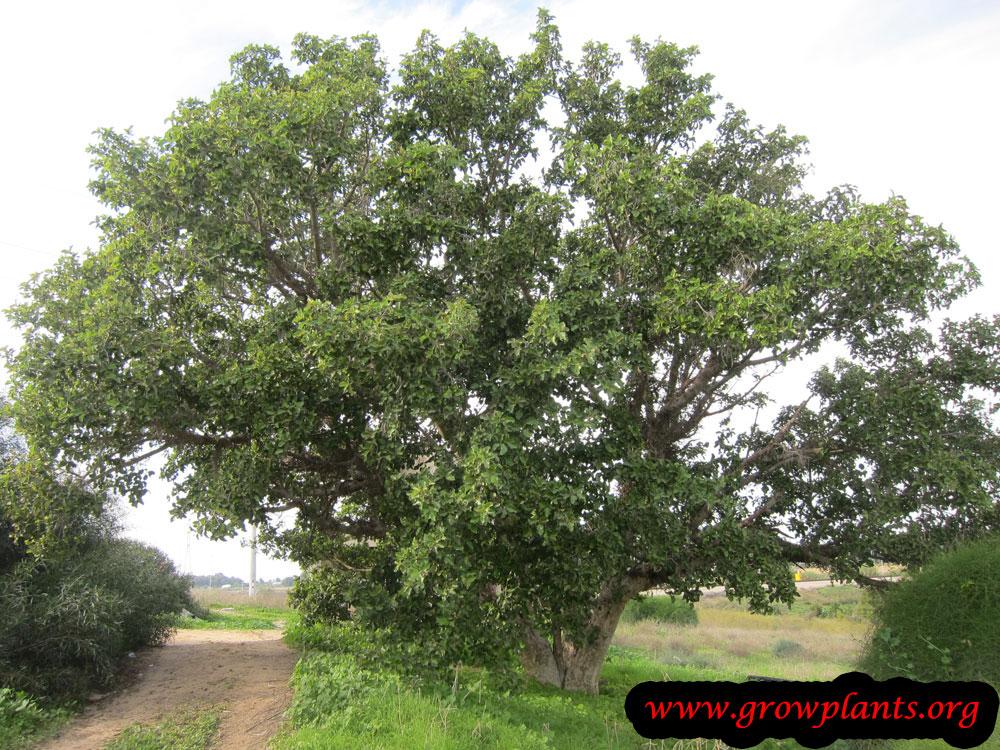
Overview: A large fig tree 10-20 m (33-66 ft) tall with edible figs borne on the trunk and branches. Evergreen to semi-deciduous, drought tolerant, grown for fruit, shade and as bonsai.
Quick Specifications
| Specification | Attribute |
|---|---|
| Plant Type / Life Cycle | Perennial (tree) |
| Foliage Type | Evergreen to Deciduous |
| Mature Size | 10-20 m tall (33-66 ft) |
| Growth Rate | Moderate to Fast |
| Root System | Vigorous and spreading – can be invasive; keep away from paving and pipes |
| Toxicity | Fruit edible; the milky sap is a skin and eye irritant |
| Hardiness | USDA zones 10+ |
Growth Form & Structure
- Height & Spread: 10-20 m (33-66 ft) with a broad canopy; can be dwarfed as bonsai or grown in large containers.
- Growth Habit & Form: Large, wide-spreading shade tree.
- Lifespan & Maturity: Long-lived; begins bearing fruit in about 3-5 years.
Anatomy & Physical Features
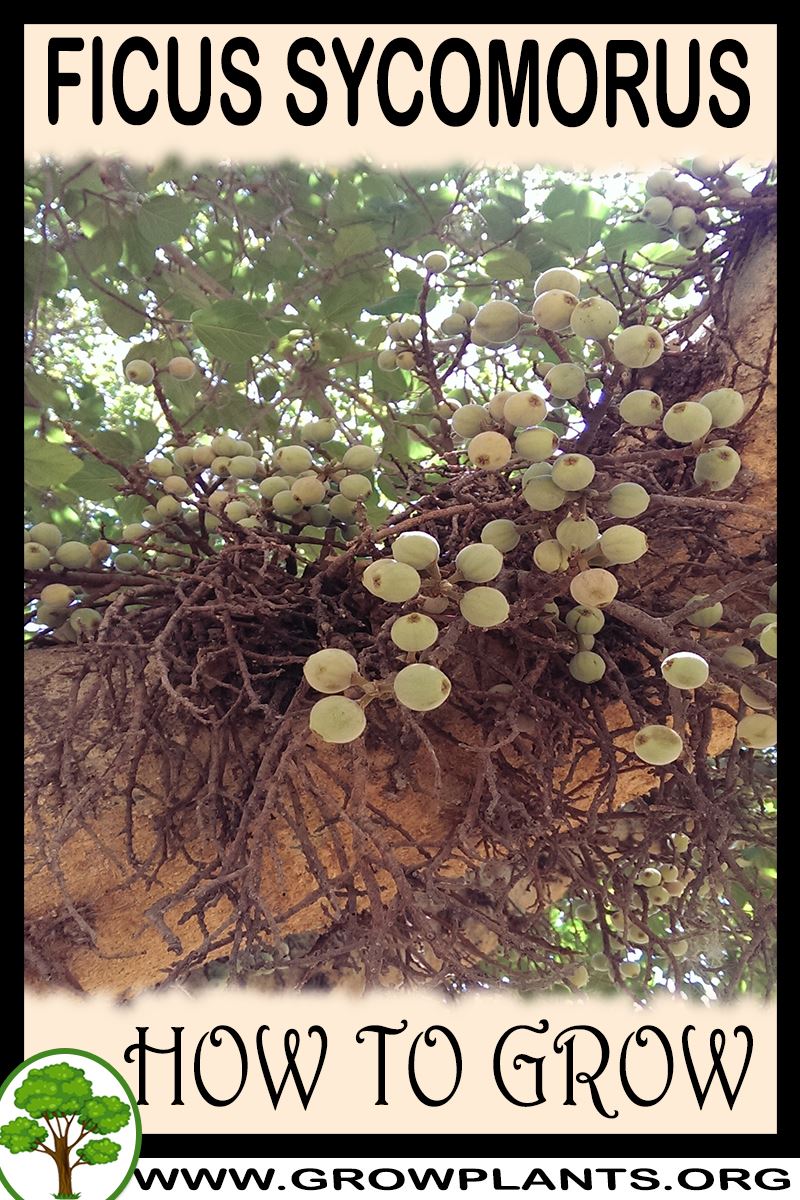
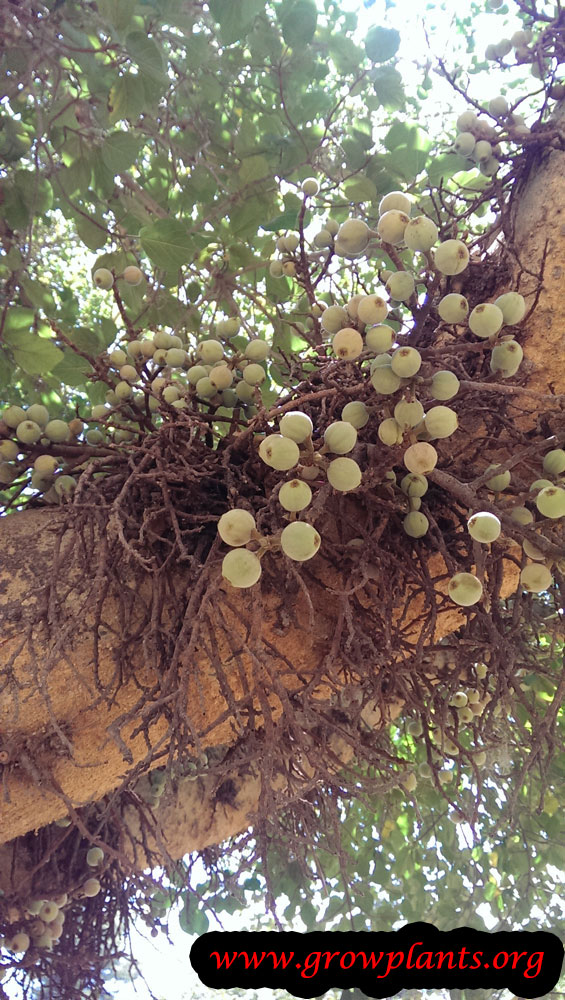
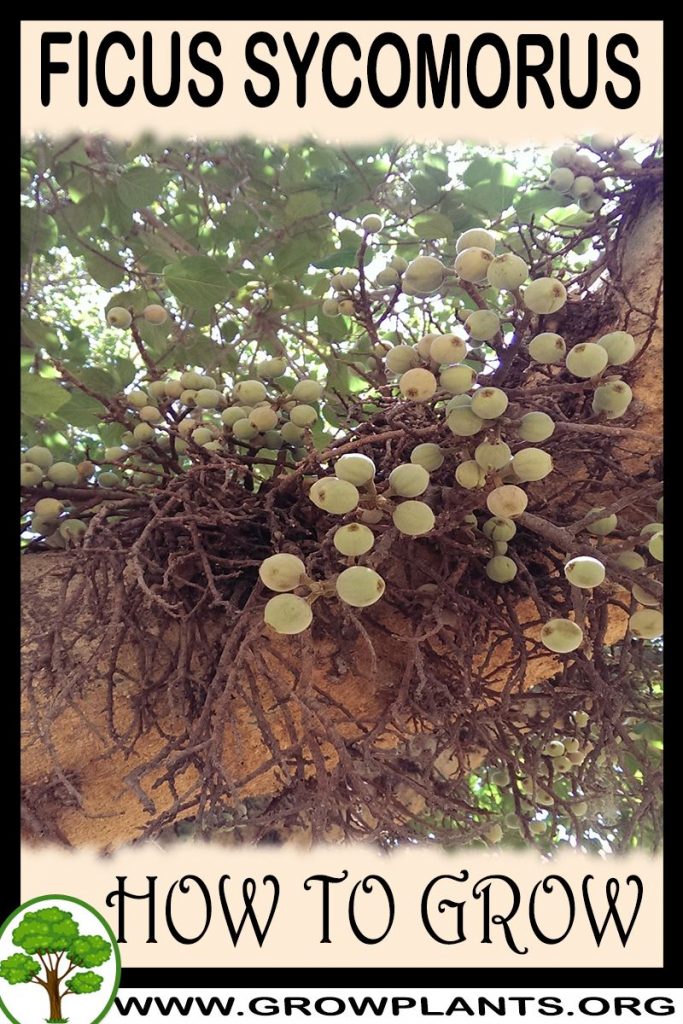
- Trunk & Bark: Stout trunk; figs are borne directly on the trunk and older branches (cauliflory).
- Leaves & Foliage: Green, elliptic leaves.
- Flower Characteristics: Flowers hidden inside the hollow fig, pollinated by fig wasps (full detail in the Bloom guide).
- Fruit Profile: Teardrop-shaped edible figs, purple or green (full detail in the Fruit guide).
Primary Uses & Landscape Value
- Edible Uses: Figs eaten fresh or made into jam, juice, dried fruit or fruit leather.
- Functional & Ornamental Roles: Grown for fruit, as a shade tree and as bonsai; drought tolerant, not an indoor plant.
Care Guide: Planting, Soil & Watering
Overview: Ficus sycomorus (sycamore fig) is a large, drought-tolerant fig tree for Mediterranean, desert and subtropical climates (hardiness zone 10+) that performs best in full sun. It grows in rich, well-draining soil kept lightly moist and mulched, and needs only modest water once established.
Quick Care Requirements
| Requirement | Ideal Condition |
|---|---|
| Planting Season | Warm season, varying by zone (see below) |
| Growth Rate | Moderate to Fast |
| Soil Type | Rich, well-draining, mulched |
| Water Need | Low to Moderate – drought tolerant once established |
Planting & Establishment
- Best Planting Season: Plant in the warm season: spring in zone 9, spring to summer in zone 10a, spring to autumn in zone 10b, and year-round in zone 11.
- How to Plant:
- Hole Preparation: Dig a hole noticeably wider and deeper than the root ball – roughly 70-100% larger – then backfill so the roots sit on firm, amended ground at root-ball depth.
- Soil Amendments: Mix plenty of organic matter, humus and dried leaves into the backfill to feed the young tree and improve the soil; top with mulch to hold moisture.
- Planting Depth: Set the tree so the root collar sits at soil level, loosen the outer roots of the root ball slightly, and firm the soil gently – not so hard that it compacts, not so loose that the tree wobbles.
- Growth Speed & Expectations: A moderate-to-fast grower that becomes a large tree, 10-20 m (30-60 ft); it can also be trained as a bonsai.
Soil, Watering & Drainage Care
- Soil Mix & Drainage Needs: Grow in rich, well-draining soil kept lightly moist and mulched; in containers use a potting or peat mix with perlite and organic matter, a pot about 50% larger than the root ball, and plenty of drainage holes so water never sits at the roots and rots them.
- Watering Schedule & Technique:
- Young / Newly Planted: For the first two weeks after planting, water every day, preferably in the morning, so the root ball never dries out while it establishes.
- Established: Once established the tree is drought tolerant and gets by on modest water, though a deeper, regular drink improves growth and fruit; always let the top of the soil dry before watering again and avoid waterlogging.
- Seasonal Adjustments: Increase watering in hot weather – above about 30 C (86 F) young trees need noticeably more – and ease off in the cool season when growth slows.
Climate, Light & Hardiness
The sycamore fig (Ficus sycomorus) is a warm-climate tree of Mediterranean, desert, subtropical and tropical regions, grown in roughly USDA zone 10 and warmer where it thrives in strong sun and heat. It is a tender, essentially frost-sensitive species: established trees take brief light frost but hard freezes damage foliage and young wood.
Quick Climate Specifications
| Climate Zones | Mediterranean, desert, subtropical, tropical |
|---|---|
| USDA Hardiness Zones | Approximately 10 and warmer |
| Optimal Temp Range | Warm, roughly 22–32 °C (72–90 °F) |
| Cold Damage Begins | Around light frost; young shoots and foliage are the first to suffer |
| Approx. Survival Minimum | Established trees briefly near freezing, roughly −2 to 0 °C (28 to 32 °F); harder cold kills top growth |
| Frost Tolerance | Low |
| Light Conditions | Full sun (young trees tolerate half shade) |
| Wind Tolerance | Moderate |
Sunlight & Light Exposure
Optimal Light Setup
Full sun gives the strongest growth and best fruiting; young trees accept half shade and are often started that way before moving into full sun as they establish.
Direct Sun Requirement
Abundant direct sun and summer heat drive vigorous growth and ripening - this is a tree for open, sun-drenched positions.
Best Exposure / Orientation
A hot, sheltered aspect suits it best; in marginal areas a warm sun-trap helps offset winter cold at the edge of its range.
Temperature Extremes & Hardiness
USDA Hardiness & Regional Limits
Reliable outdoors only in frost-free to nearly frost-free climates, roughly zone 10 and warmer. In cooler spots it needs a protected microclimate, and young trees are distinctly more cold-sensitive than mature, well-established specimens.
Cold Damage & Winter Protection
Unhardened new growth is the vulnerable point; a hard freeze can kill shoots and, in a severe event, larger wood. Where light frost is possible, a warm wall or overhead shelter and protecting young trees through their first winters makes a real difference.
Frost Sensitivity
Foliage and soft growth are frost-tender; the tree is best treated as frost-sensitive and kept out of frost pockets.
Extreme Heat Tolerance
Excellent - it flourishes in hot Mediterranean and desert summers, which suit both growth and fruiting.
Chilling Requirement
As a subtropical fig relative it has little or no meaningful winter-chill requirement, which is part of why it succeeds in mild-winter, low-chill climates.
Wind, Humidity & Microclimate
Dry-Air Tolerance
Very well adapted to hot, dry air - a classic desert and Mediterranean tree that shrugs off low humidity.
Wind Tolerance
Moderate; the large canopy can be wind-tattered and young trees benefit from some shelter while establishing.
Microclimate Recommendations
A warm, sheltered, sun-trapping position extends the growing season and buffers the occasional cold night at the cool edge of its range.
Growing in Pots, Balconies & Indoors
The sycamore fig is a large tree (10-20 m), not an indoor plant – the grower marks it no for houseplant use. Like other figs, though, it can be held for years in a big container as a dwarf or bonsai for a sunny patio.
Quick Details
- Container Size: Minimum 25-50 L (5-10 gal), and bigger is better; sized up gradually
- Indoor Suitability: Not a houseplant (per the grower) – a large tree best kept as a patio bonsai/dwarf
- Best Spot: Full sun
- Soil & Drainage: Potting mix or peat with perlite and organic matter; sharp drainage
- Watering in Pots: Small to average; avoid overwatering
Indoors & On the Windowsill
- Houseplant limits: The grower marks it no for indoors – it’s a sun-loving tree that needs strong outdoor light; only a bonsai could sit in a very bright room.
- Overwintering: Tender to frost – in cold climates keep it potted and move it to a bright, frost-free space over winter.
On a Balcony or Patio
- Light & wind: Give it the sunniest spot and shelter exposed plants from wind. Reflected heat dries pots fast, so check moisture regularly, and mind the weight of a large tub. The milky sap can irritate skin.
Choosing the Pot, Soil & Long-Term Care
- Pot & drainage: Use a pot with strong drainage holes and skip a standing-water saucer, which invites root rot; terracotta breathes and dries faster, while glazed or plastic holds moisture longer.
- Potting mix: A light, aerated organic mix – peat or coir with perlite or vermiculite – gives the roots both moisture and air.
- Feeding: Potted plants use up their feed faster because each watering leaches nutrients away, so feed a little more often than plants in open ground.
- Repotting: Refresh the top of the mix and pot up every couple of years; a light root and top prune at repotting keeps established plants vigorous.
Grower’s Container Tip
- Keep it dwarfed: In a pot you must limit both top and root growth and grow it as a dwarf or bonsai. Move up gradually – each container only about 50% bigger than the root ball until it reaches its final size; don’t start a small tree in a big pot, as too much unused soil goes stale.
- Pot size: Minimum around 25-50 L (5-10 gal), and bigger is better; make plenty of drainage holes.
- Soil & renewal: Potting mix or peat with perlite and organic matter works well. Every few years, rather than replacing all the soil in a large pot, swap out part of it from the side and top and trim back some of the root ball.
- Feeding & water: Feed at least once a year and add humus once or twice; water regularly, and if you use a saucer never let water stand more than a day – overwatering ruins both soil and roots.
Fertilizing & Feeding
A moderate feeder: Ficus sycomorus grows and fruits well on light, balanced feeding through the active season plus steady soil organic matter, rather than heavy or frequent fertilizing.
Quick Fertilizing Specs
| Feeding Level | Moderate |
|---|---|
| young_feeding | Nitrogen-leaning complete fertilizer to build the framework |
| mature_feeding | Balanced feeding with adequate potassium as it bears |
| Main Nutrient Priority | Nitrogen when young; balanced with adequate potassium as it bears |
| Best Feeding Period | From late dormancy through the active growing season |
| Organic Options | Compost, aged manure and mulch |
| Micronutrients | Usually supplied by a complete fruit-tree fertilizer; iron may need attention on alkaline soils |
| Soil pH | Tolerates a wide range; needs well-drained soil |
| Reduce/Stop Feeding | Ease back in late season and during dormancy |
Feeding by Growth Stage
Newly planted
Help the newly planted Ficus sycomorus settle in and push healthy roots and first shoots.
| Nutrient direction | A gentle, balanced complete fertilizer once new growth appears, kept light while roots establish. |
|---|---|
| Timing | The first growing season after planting, once the tree shows active new growth. |
| Frequency | Light feeding spread across the active growing season. |
| Fertilizer types | Balanced complete garden or fruit-tree fertilizer, Compost or well-rotted organic matter worked into the surface |
| Precautions | Keep fertilizer off the trunk and avoid heavy applications before roots establish. |
Young, pre-bearing tree
Build a strong framework of shoots and foliage on the young, non-bearing Ficus sycomorus.
| Nutrient direction | Lean a little more toward nitrogen to drive vegetative growth, supplied within a complete fertilizer. |
|---|---|
| Timing | Through the active growing seasons of the young, pre-bearing years. |
| Frequency | Several light feedings across the growing season. |
| Fertilizer types | Nitrogen-forward complete fruit-tree fertilizer, Compost and mulch for steady background nutrition |
| Routine trace nutrients | iron, manganese, zinc |
| Precautions | Avoid pushing soft, late-season growth with excess nitrogen, as it is prone to cold and pests. |
Established, beginning to bear
Support steady growth and the first crops as Ficus sycomorus begins to bear.
| Nutrient direction | Return to a balanced complete fertilizer that supplies nitrogen with adequate potassium. |
|---|---|
| Timing | From late dormancy into the active growing season as bearing begins. |
| Frequency | A few light feedings during the active growing season. |
| Fertilizer types | Balanced complete fruit-tree fertilizer, Compost or aged manure as organic backing |
| Routine trace nutrients | iron, manganese, zinc |
| Precautions | Feed to match the tree’s growth rather than a fixed schedule. |
Mature and bearing
Sustain reliable cropping and fruit quality on the mature, bearing Ficus sycomorus.
| Nutrient direction | Keep a balanced base with enough potassium as fruit develops, while avoiding excess nitrogen that favours leaves over fruit. |
|---|---|
| Timing | From late dormancy through fruit development in the active growing season. |
| Frequency | Light feedings early in the season, easing back as fruit ripens. |
| Fertilizer types | Balanced fruit-tree fertilizer with adequate potassium, Compost and mulch to maintain soil organic matter |
| Routine trace nutrients | iron, manganese, zinc |
| Precautions | Excess nitrogen can reduce fruiting and attract pests, so feed to match growth rather than a fixed schedule. |
Nutrient Deficiency Signs & Corrections
Older leaves turn pale green to yellow and shoot growth slows.
| Possible causes | Low soil nitrogen, Cold or waterlogged soil limiting uptake, Heavy grass or weed competition around the trunk |
|---|---|
| Appears first on | Older, lower leaves |
| What to check | Recent feeding history, Soil drainage and root health, Weed competition at the base |
| Possible correction | Apply a complete nitrogen-containing fertilizer as growth resumes and build soil organic matter with compost. |
Youngest leaves yellow between still-green veins.
| Possible causes | High soil pH reducing iron availability, Waterlogged or cold soils, A genuine iron shortage |
|---|---|
| Appears first on | Youngest leaves at the shoot tips |
| What to check | Soil pH, Drainage, Whether only new growth is affected |
| Possible correction | Correct soil pH where possible and apply a chelated iron product per its label. |
Margins of older leaves scorch and brown and fruit quality drops.
| Possible causes | Low soil potassium, Heavy fruit load drawing down reserves, Sandy soils that leach potassium |
|---|---|
| Appears first on | Margins of older leaves |
| What to check | Soil potassium status, Fruit load, Soil type and leaching |
| Possible correction | Feed with a potassium-containing complete fertilizer during fruit development. |
Pruning, Training & Seasonal Maintenance
Ficus sycomorus grows into a large shade/fruit tree (10–20 m), so pruning tolerance is moderate and the main objective is building a strong framework while young and then containing size on a mature tree. Its figs cluster directly on the trunk and older branches (cauliflory), so structural cuts into old wood should stay moderate rather than severe on a fruiting specimen. The safest window is winter dormancy.
Quick Pruning & Maintenance Specs
| Pruning Tolerance | Moderate |
| Primary Pruning Window | Winter dormancy |
| Secondary Maintenance Window | Light shaping on young trees during active growth |
| Typical Frequency | Light annual on mature trees; more attention while young |
| Main Objective | Scaffold framework, then size containment |
| Young Plant Priority | Select 3–5 well-spaced scaffold limbs; remove competing leaders |
| Mature Plant Priority | Maintain structure, remove damage; avoid heavy old-wood renewal |
| Best Tool Type | Loppers/pruning saw for structural cuts; secateurs for small growth; pole pruner on tall uncontained trees |
| Avoid Heavy Pruning During | Active summer/autumn fruit development, and extreme heat |
Pruning by Plant Age & Size
Newly Established
Remove only damaged growth and let the tree establish its scaffold.
Young / Formative
Modified-leader framework: select 3–5 well-spaced scaffold limbs and remove competing co-dominant leaders while the tree is small and cuts are easy.
Mature / Established
Maintenance-only pruning: remove dead, damaged, or crossing wood; contain size if the site is restricted, but avoid removing large sections of old trunk or limb wood where fig clusters form.
Seasonal Pruning Schedule
Dormant/Winter
Objective: main structural pruning. Remove: weak, crossing, or oversized growth. Don’t remove: large sections of fruit-bearing old wood on a mature specimen.
Post-Harvest
Objective: light cleanup after the summer/autumn fruit crop is picked, since this disturbs the current crop least. Remove: damaged or crowded growth.
Ongoing Sanitary
Remove dead or pest-damaged wood any time, especially anything showing borer entry holes.
Flowering & Fruiting Wood
Figs form cauliflorously in clusters directly on the trunk and older branches rather than only at branch tips — a defining trait of this species. Removing large sections of that old wood removes fruiting sites, and since the tree takes 3–5 years to resume bearing at scale, structural renewal on a mature fruiting tree should be staged gradually rather than done all at once.
Structural Pruning & Training
Select well-spaced scaffold branches while young; remove crossing or rubbing limbs; control height and spread where the tree’s mature 10–20 m size doesn’t fit the site; thin the canopy only moderately, since overthinning removes cauliflorous fruiting surface.
Special Growth to Remove
Trees are typically own-root (propagated by cutting rather than true rootstock grafting), so any basal shoots are true-to-type: remove for a single trunk, or keep a few for a multi-stem form. After any hard pruning, thin the resulting flush of vigorous watersprouts to keep the canopy from becoming too dense.
Container & Small-Space Pruning
Not suited as an indoor houseplant, but can be restrained as an outdoor container or bonsai subject; this requires root pruning at repotting and more frequent pinching than an open-ground tree to control its naturally fast, large-growing vigor.
Tools
Bypass secateurs for young shoots; loppers for scaffold-sized limbs; pruning saw for larger old-wood cuts near the trunk; pole pruner for upper-canopy work on a tall, uncontained mature tree.
Tool Hygiene & Disease Risk
Increased — Batocera rufomaculata (fig longhorn borer) is a documented pest of this species that enters through wounds and damaged bark. Remove and destroy infested wood promptly, make clean cuts to minimize entry points, and avoid pruning heat- or drought-stressed trees during periods of beetle activity.
Cut Placement & Technique
Favor thinning cuts over heading to preserve natural form; cut outside the branch collar; stage the removal of large limbs (three-cut method) to avoid bark tear on this fast-growing, relatively soft wood; avoid flush cuts.
Heavy Pruning & Rejuvenation
Tolerated in stages: an overgrown specimen can be reduced, but spread the work over two to three seasons rather than removing the whole crown at once, to avoid shocking the tree and to preserve some fruiting wood. Expect a vigorous regrowth flush, with fruiting resuming gradually as new cauliflorous sites mature.
Post-Pruning Care
Watch cut surfaces for borer entry; avoid heavy nitrogen feeding right after hard pruning, since it pushes vegetative regrowth at the fruit’s expense; watch previously shaded bark for sunscald if the canopy was opened significantly.
Common Pruning Mistakes
Topping the tree or removing large sections of old trunk wood expecting no effect on the fig crop; pruning during summer fruit development, which stresses the tree and increases pest susceptibility; leaving pruning wounds unmonitored for borer entry.
When NOT to Prune
Avoid heavy pruning during summer/autumn fruit development and harvest; avoid major cuts during extreme heat.
Recommended Tools (by task)
- bypass_secateurs — young, small-diameter growth; clean cuts on soft new wood.
- loppers — structural limbs on young to moderate trees; reaches scaffold wood beyond secateur capacity.
- pruning_saw — large old-wood limbs on a mature tree; needed for bigger-diameter cuts near the trunk.
- pole_pruner — upper canopy on a tall, uncontained specimen; this species genuinely reaches 10–20 m, putting upper growth out of reach.
Pruning Troubleshooting
| Problem | Possible Cause | What to Check | Corrective Action |
| Excess vigorous regrowth after pruning | Too much old wood removed at once | Timing and severity of the last cut | Switch to staged renewal over multiple seasons |
| Reduced fruiting after structural pruning | Cauliflorous fruiting wood removed from trunk/branches | How much older wood was cut | Allow 2–3 years for fruiting sites to regenerate; prune lightly going forward |
| Dieback or holes near cut surfaces | Batocera rufomaculata borer entry at wounds | Bark and cut surfaces for holes or frass | Remove and destroy infested wood promptly; avoid wounding during beetle activity |
Propagation Guide
Sycamore fig roots easily from large hardwood cuttings and truncheons, and this is the preferred method because a cutting keeps the fruit quality of a selected tree. Air layering also works on thicker stems. Seed germinates readily but gives variable trees, and outside its native range the fruit needs its specific fig wasp to set true crops. Overall easy to moderate.
Quick Propagation Specs
| Best Propagation Method | Hardwood stem cuttings / truncheons |
| Alternative Methods | Air layering; seed |
| Propagation Difficulty | Easy to Moderate |
| Seed True-to-Type | Variable — use cuttings to keep a selected tree’s fruit quality |
| Vegetative True-to-Type | Yes |
| Best Propagation Season | Spring to summer |
| Seed Germination Time | 7–21 days |
| Cutting Rooting Time | Typically several weeks under warm, humid conditions |
| Germination Temperature | 21–26°C (70–79°F) |
| Seed Sowing Depth | Surface to about 3 mm (1/8 in) |
Stem Cuttings
Cutting Type
Use brown, fully grown (hardwood) shoots; large branch cuttings and truncheons of this species root readily when kept warm and moist.
Best Timing
Warm season — spring through summer.
Cutting Preparation
The cut releases milky latex, which is a skin irritant — handle with care and let the cut end stop bleeding before insertion.
Rooting Setup
Keep the medium moist and humidity high; an enclosed box or greenhouse helps, but it must be well ventilated with moving air. Water by misting or fogging and never let the cutting dry out.
Rooting Hormone
Beneficial — use a rooting hormone formulated for woody stems.
Rooting Time
Typically several weeks under warm, humid conditions.
Air & Ground Layering
Air layer a thicker woody stem by girdling, wrapping in moist sphagnum, and keeping it damp; sever below the roots once they are well formed.
Growing from Seed
Fig seed is minute. Seed-raised plants are viable but variable, so seed is a secondary option used mainly where large numbers are wanted rather than to reproduce a particular form.
Seed Handling & Viability
Store seed in a dry, dark place until sowing. The site recommends soaking the small seed for about 24 hours before sowing.
Sowing Season
Spring, summer or autumn. In hot climates avoid sowing in peak summer; in cold climates avoid autumn, so seedlings establish in the warmth of spring.
Sowing Depth & Orientation
Surface-sow onto light, moist medium or barely cover with about 3 mm (1/8 in) of mix.
Germination Conditions
Warmth of 21–26°C (70–79°F) with consistently moist medium and high humidity (a light fog gives the best results), in half shade to full sun. Sowing in a greenhouse or a small covered plastic box helps hold the humidity high.
Germination Time
Roughly 7–21 days under those warm, humid conditions.
Seedling Care
Space in small cells about 2×2 cm (1×1 in), or better 5×5 cm (2×2 in). Transplant only once seedlings have 5–7 leaves, not while very young. Harden off by gradually reducing humidity and slowly increasing sun exposure.
Bloom & Flower Guide
Quick Details
- Bloom Season: Winter to spring
- Flower Appearance: Tiny flowers hidden inside the hollow fig (syconium) — you never see them out in the open
- Edibility: The flowers are not eaten; they are sealed inside the fig, and it is the fruit rather than the bloom that has any food value
Detailed Blooming Overview
The sycamore fig does not bloom the way most trees do. Its flowers line the inside of a hollow, fleshy structure — the fig, or syconium — so the whole “flower” is turned outside-in. Because the blooms are enclosed, pollination depends on a tiny fig wasp that enters through a small pore to reach them, a classic and very specific plant-and-insect partnership. In cultivation the crop is often hand-pollinated where the natural wasp is absent.
Flower Characteristics
- Flowers are borne inside the hollow fig, never visible externally.
- Appear mainly through winter and into spring.
Bloom Care & Thinning
- Pollination: Carried out by the specialist fig wasp; where that wasp is not present, hand pollination can be used.
- Managing the bloom: No thinning of the flowers themselves is needed — they develop within the figs.
Fruit & Uses
The sycamore fig is grown for its sweet, teardrop-shaped figs, which are eaten fresh straight from the tree. The ripe fruit is also cooked down into jams and juice, or dried and made into fruit leather.
Quick Edible Specs
| Edible Parts | Fruit (figs) |
|---|---|
| Main Use(s) | Culinary – eaten fresh, jams, juice, dried figs, fruit leather |
| Eaten Raw or Cooked | Raw when ripe, or processed (dried / cooked) |
| Preparation Required | None beyond rinsing; eat only fully ripe fruit |
| Harvest Season | Summer to autumn |
| Time to First Harvest | A few years after planting a young tree (see the growing / care notes) |
| Storage | Fresh figs keep only briefly; drying stores them long-term |
| Safety/Toxicity Caveat | The milky latex (sap) from stems and unripe figs can irritate skin and lips – handle with care and eat only ripe fruit |
Fruit
The figs are teardrop-shaped and turn purple or green as they ripen, softening to the touch. Pick them when they are full-coloured and give slightly under gentle pressure – unripe figs are firm and exude irritant latex. Birds compete heavily for ripening figs, so the fruit is often protected with netting.
Harvesting
Harvest through summer and autumn, gathering figs as each one softens rather than all at once. Cover developing fruit with a net to keep birds off. Ripe figs bruise easily, so pick and handle them gently.
Preparation, Uses & Safety
Ripe figs are eaten raw or turned into jam, juice, dried figs and fruit leather. Take care with the milky white latex that seeps from cut stems and unripe fruit: it can irritate skin and the mouth, so wash it off and eat only fully ripened figs.
Pests, Diseases & Troubleshooting
Overview: The sycamore fig is a large tropical/subtropical fig tree bearing trunk- and branch-borne edible figs; its realistic problems are scale, mealybug, spider mites, whitefly and fig-feeding insects, plus anthracnose/leaf spot and root rot, with fruit flies and its specialist fig wasps active on the figs. As a big vigorous tree it is generally tough, with sap-suckers and fruit pests the main concerns.
Quick Troubleshooting Overview
| Issue / Pest | Main Symptom | Primary Solution |
|---|---|---|
| Scale insects | Brown/waxy bumps on stems & leaves; honeydew | Prune, horticultural oil, encourage parasitoids |
| Mealybugs | White cottony tufts in axils/roots; honeydew | Alcohol swab, oil/soap, Cryptolaemus |
| Spider mites | Stippling, bronzing, webbing (dry indoor air) | Raise humidity, rinse, oil/predatory mites |
| Ficus / greenhouse whitefly | White flies rise; yellow flecking, honeydew | Sticky traps, oil/soap undersides, Encarsia |
| Anthracnose / leaf spot | Brown/black spots, leaf drop | Airflow, remove leaves, copper if severe |
| Sudden leaf drop | Leaves yellow & fall after a change | Stabilise light/temp/water; avoid moving |
Common Pests & Management
- Scale insects (Coccidae & Diaspididae (soft & armoured scale)):
- Symptoms: Brown, tan, black or waxy bumps and encrustations along stems, leaf veins and undersides that don’t rub off; soft scales drip honeydew that blackens with sooty mould, and heavy infestations yellow leaves and cause drop. A very common problem on indoor figs.
- Prevention & Control: Wipe off with a cloth and dilute alcohol, prune out badly encrusted stems, and wash honeydew from leaves. Encourage parasitic wasps and ladybirds outdoors; apply horticultural oil for thorough coverage of stems and leaf undersides, repeating to catch crawlers. Treat in the cool of the day.
- Mealybugs (Planococcus / Pseudococcus spp.):
- Symptoms: White cottony tufts in leaf axils, along veins and around the crown and roots, with honeydew and sooty mould; they weaken growth and disfigure indoor plants.
- Prevention & Control: Dab colonies with a cotton swab of dilute alcohol and rinse with a firm spray. Support Cryptolaemus and lacewings; use horticultural oil or insecticidal soap for persistent infestations and check the root zone at repotting for root mealybug.
- Spider mites (Tetranychus urticae):
- Symptoms: Fine pale stippling, bronzing and a dull, dusty look to the leaves, with fine webbing on undersides and in leaf axils; worst in the hot, dry air of heated rooms and on stressed plants.
- Prevention & Control: Raise humidity and airflow, wipe or rinse the leaves regularly, and release predatory mites where practical. Spot-treat with horticultural oil or insecticidal soap, repeating every 5–7 days, and keep the plant well-watered and unstressed.
- Ficus & greenhouse whitefly (Singhiella simplex / Trialeurodes vaporariorum):
- Symptoms: Tiny white flies rising from leaf undersides when disturbed, with yellow flecking, honeydew, sooty mould and, in heavy fig-whitefly attacks, marked yellowing and leaf drop.
- Prevention & Control: Monitor and reduce adults with yellow sticky traps, encourage Encarsia parasitoids, and rinse and treat leaf undersides with insecticidal soap or horticultural oil, repeating weekly until clear.
- Cuban laurel / ficus thrips (Gynaikothrips ficorum):
- Symptoms: Newly expanding leaves fold, pucker and curl into tight galls (especially on Ficus with small leaves), turning reddish then brown; the thrips shelter inside the folded leaves.
- Prevention & Control: Prune out and destroy curled, galled leaves where the thrips hide, encourage predatory mites, minute pirate bugs and anthocorids, and treat new flushes with insecticidal soap, horticultural oil or spinosad, targeting the vulnerable expanding leaves.
- Fig-fruit flies & borers (Ceratitis / Silba / Batocera spp.):
- Symptoms: Maggots and rot inside ripening figs (fruit flies), and boreholes with frass in trunks and branches (longhorn borers) on this large fig tree.
- Prevention & Control: Harvest figs promptly and remove fallen/mummified fruit, use fruit-fly traps where warranted, and keep the tree vigorous so it can wall off borers; cut out and destroy borer-infested wood.
Diseases & Fungal Issues
- Anthracnose & fungal leaf spot (Colletotrichum / Cercospora / Phyllosticta spp.):
- Symptoms: Brown, tan or black spots and blotches on the leaves, often with yellow halos, coalescing into dead areas and causing leaf drop in warm, wet, humid or crowded conditions and where foliage stays wet.
- Treatment & Management: Improve airflow and avoid wetting the foliage, remove and destroy spotted and fallen leaves, and don’t crowd plants. A copper fungicide protects valued or repeatedly affected plants; correct the humidity/wet-leaf conditions that allow it.
- Root & stem rot (Pythium / Phytophthora / Rhizoctonia spp.):
- Symptoms: Wilting despite moist soil, yellowing, blackening at the stem base or roots and collapse; caused by overwatering, heavy soil, or pots without drainage – a leading killer of container figs.
- Treatment & Management: Use a free-draining mix and a pot with drainage, water only when the top of the mix dries, and never leave the pot standing in water. Remove badly affected plants; a biofungicide drench can protect valued specimens.
- Bacterial leaf spot (Xanthomonas / Pseudomonas spp.):
- Symptoms: Water-soaked angular spots, often with yellow halos, that turn brown and cause leaf yellowing and drop in warm, wet conditions with splashing water; notable on Ficus under humid production.
- Treatment & Management: Avoid overhead watering and leaf wetness, improve airflow and spacing, remove infected leaves, and sanitise tools. Copper sprays can suppress spread, but cultural control (dry foliage, airflow) is primary.
- Sooty mould (Capnodium spp. (secondary)):
- Symptoms: Black, soot-like fungal film coating leaves and stems wherever honeydew from scale, mealybug, whitefly or aphids has fallen; it blocks light and disfigures but doesn’t infect the plant directly.
- Treatment & Management: Control the underlying sap-sucking pests producing the honeydew; the sooty mould then weathers away or can be wiped/washed off the leaves.
Growing Difficulties & Abiotic Problems
- Sudden leaf drop:
- Cause & Symptoms: Rapid yellowing and shedding of leaves after a change in light, temperature, watering or location, or from draughts – figs (especially weeping types) are notorious for this stress response.
- Correction Strategy: Keep conditions stable: a fixed bright spot away from draughts, hot/cold vents and radiators, with steady even watering; avoid moving the plant, and expect some acclimation drop after any change that then recovers.
- Over- and under-watering:
- Cause & Symptoms: Yellowing lower leaves and root rot from constantly wet soil, versus wilting, browning leaf edges and leaf drop from letting the rootball dry out completely.
- Correction Strategy: Water when the top few centimetres of mix are dry, ensure free drainage, empty saucers, and never let the plant either sit wet or dry out to the point of wilting; consistency is everything.
- Low humidity, cold & edema:
- Cause & Symptoms: Brown, crisp leaf edges and tips in dry heated air; leaf blackening or drop after cold draughts or temperatures too low; and corky bumps/blisters on leaf undersides (edema) when roots take up water faster than leaves lose it.
- Correction Strategy: Raise humidity around indoor plants, keep them warm and out of cold draughts, and reduce watering in cool, dull, low-transpiration spells to prevent edema.
- Irritant latex:
- Cause & Symptoms: Milky sap released when leaves or stems are cut can irritate skin and eyes and stains surfaces.
- Correction Strategy: Wear gloves when pruning, keep the sap off skin and out of eyes, and wash any contact promptly; keep pets from chewing the foliage.
What Helps – Products & Tools
For ornamental figs the mainstays are horticultural (neem) oil and insecticidal soap for scale, mealybug, mites, whitefly and thrips; isopropyl alcohol on swabs for spot-treating scale and mealybug; yellow sticky traps for whitefly; and, for disease, a copper fungicide for anthracnose and bacterial/fungal leaf spot. Most real problems, though, are cultural – stable light and temperature, careful watering and good drainage prevent leaf drop and root rot. Wear gloves for the irritant latex and spray oils in the cool of the day.