

Plant Profile & Key Characteristics
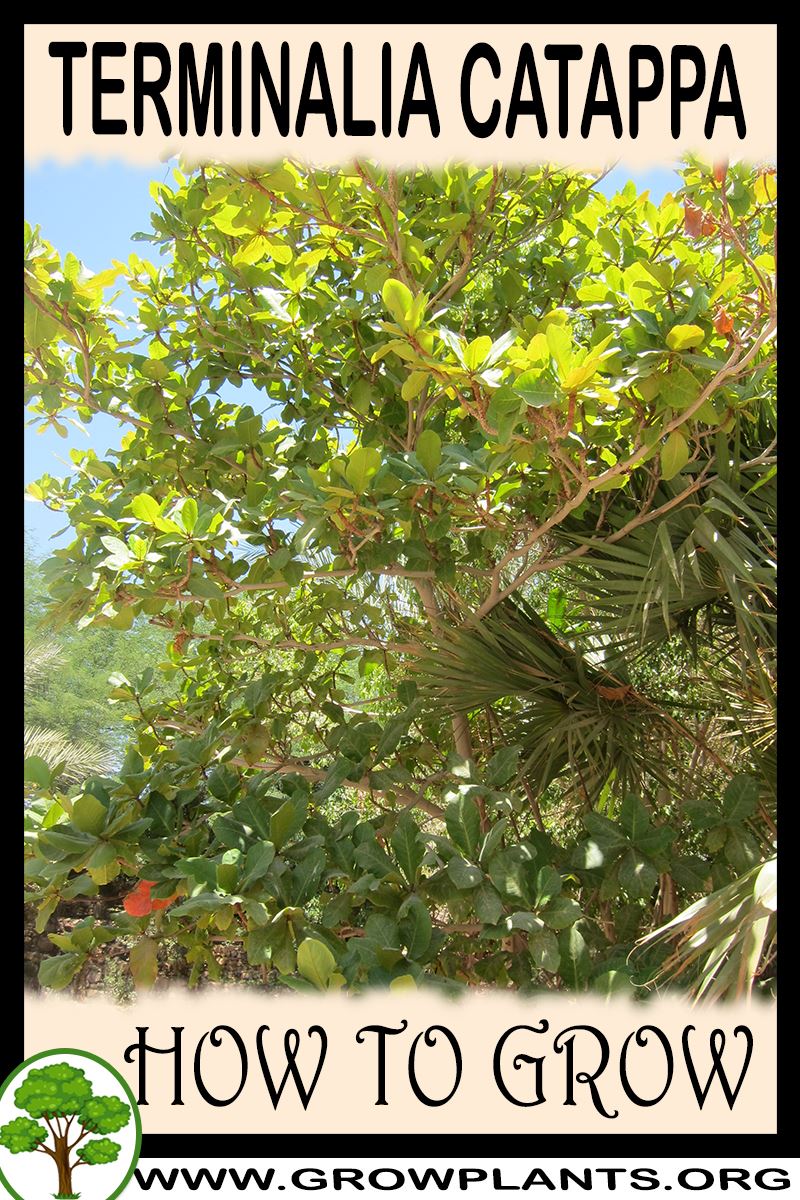
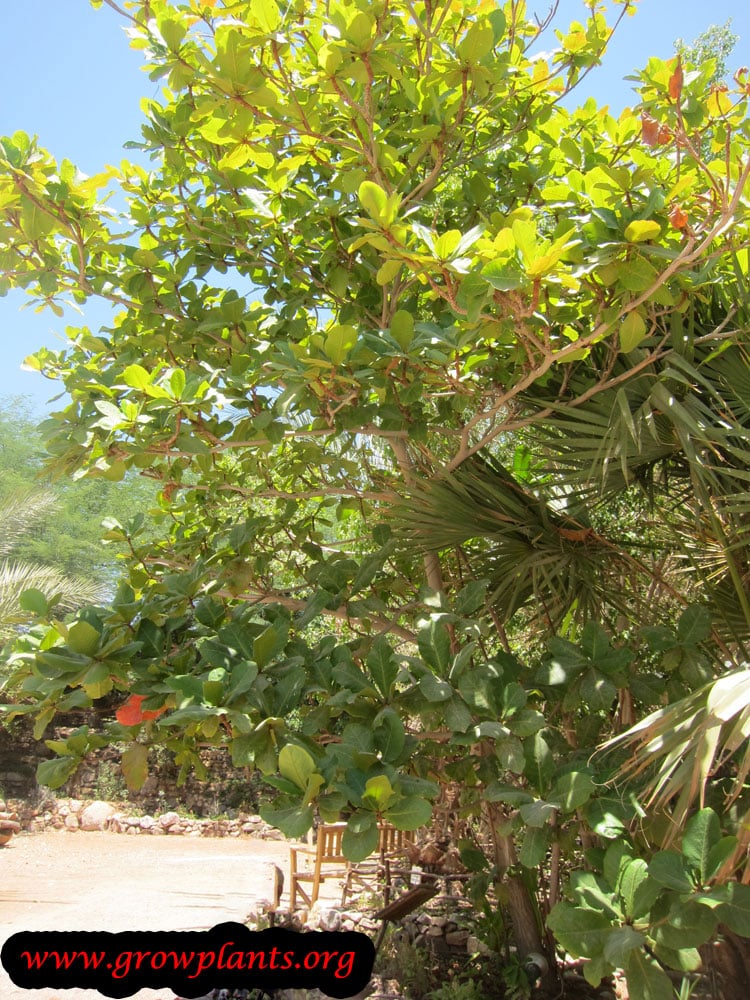
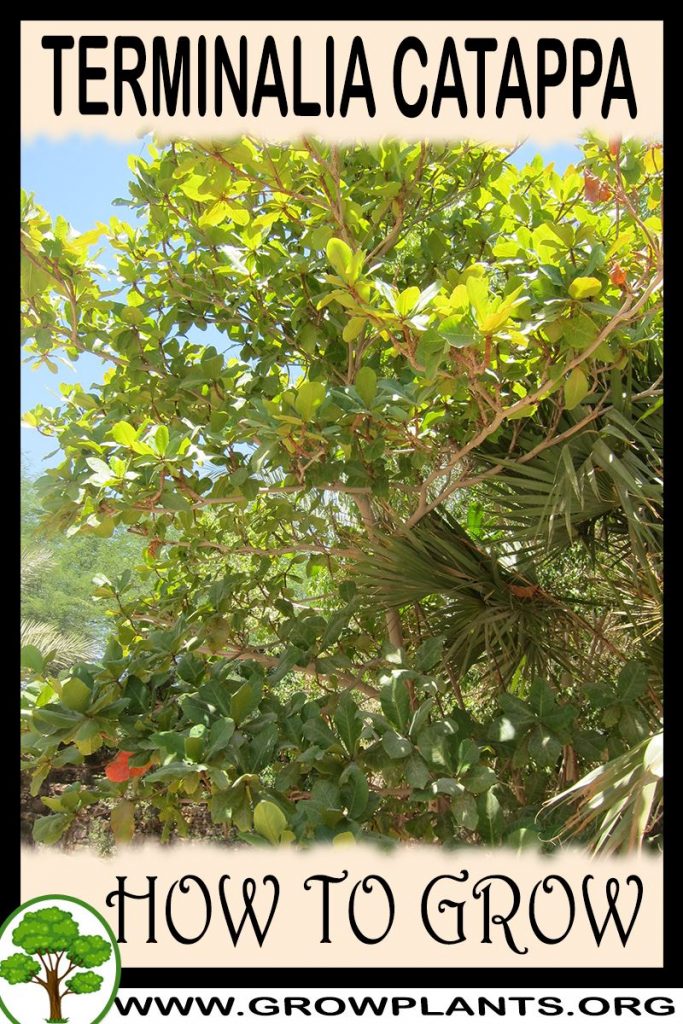
Overview: A large evergreen (dry-deciduous) tropical tree reaching 15-30 m (45-100 ft), instantly recognisable for its tiered, pagoda-like branching and broad leaves that flush red in the dry season. It yields edible fruit and an almond-like edible nut and is also a favourite shade tree.
Quick Specifications
| Specification | Attribute |
|---|---|
| Plant Type / Life Cycle | Woody perennial (large tree) |
| Foliage Type | Evergreen to dry-season deciduous |
| Mature Size | 15-30 m (45-100 ft) tall |
| Growth Rate | Fast |
| Toxicity | Non-toxic — both the fruit flesh and the kernel are edible |
| Hardiness | USDA zones 12 and warmer |
Growth Form & Structure
- Height and Spread: A large tree of 15-30 m (45-100 ft) needing plenty of room; not suited to container culture.
- Growth Habit and Form: Distinctive horizontal, tiered (‘pagoda’) branching that forms a broad, layered canopy of shade.
- Lifespan and Maturity: A fast-growing, long-lived shade tree; it typically begins bearing fruit in about 4-6 years.
Anatomy & Physical Features
- Leaves and Foliage: Large, ovate green leaves clustered at the branch tips that turn red before dropping in the dry season.
- Flower Characteristics: Small white star-shaped flowers carried in slender spikes.
- Fruit Profile: Ovate green-to-red fruit with a thin edible pulp around a single brown, almond-flavoured edible kernel.
Primary Uses & Landscape Value
- Edible Uses: Fruit eaten raw or juiced; the inner kernel eaten raw or roasted as an almond substitute.
- Functional and Ornamental Roles: Broad-canopied shade and street tree, coastal ornamental, and a traditional medicinal plant.
Care Guide: Planting, Soil & Watering
Overview: Sea almond is a large, fast-growing tropical tree (hardiness zone 12 and up) that thrives in full sun to part shade and sandy, well-drained soil. It takes moderate to generous watering and, as a coastal species, copes well with poor, sandy ground.
Quick Care Requirements
| Requirement | Ideal Condition |
|---|---|
| Planting Season | Year-round in frost-free tropical climates |
| Growth Rate | Fast |
| Soil Type | Sandy, well-drained soil |
| Water Need | Moderate to high |
Planting & Establishment
- Best Planting Season: In its frost-free tropical range it can be planted year-round; give it an open, sunny site with room to spread.
- How to Plant:
- Hole Preparation: Dig a hole two to three times the width of the root ball, loosening the surrounding soil for the wide-spreading roots.
- Soil Amendments: Sandy, free-draining soil suits it best; work in some organic matter, but sharp drainage is the priority.
- Planting Depth: Set the root collar level with the soil surface and avoid burying the trunk base.
- Growth Speed & Expectations: Grows fast into a large spreading tree (15–30 m), so it is best for open landscapes rather than containers.
Soil, Watering & Drainage Care
- Soil Mix & Drainage Needs: Sandy, well-drained soil is ideal, and the tree tolerates poor coastal ground; avoid heavy, waterlogged sites. It is too large for container growing.
- Watering Schedule & Technique:
- Young / Newly Planted: Water regularly while establishing to keep the root zone moist but not soggy.
- Established: Water moderately to generously and deeply, letting the surface dry between waterings.
- Seasonal Adjustments: Increase water in hot, dry periods and reduce during cool or wet weather.
Climate, Light & Hardiness
The Indian or sea almond (Terminalia catappa) is a strictly tropical, coastal tree that grows in full sun to light shade and thrives in constant warmth. It is very frost-tender, and the site rates it for hardiness zone 12 and warmer - essentially frost-free climates only.
Quick Climate Specifications
| Climate Zones | Tropical (and the warmest, frost-free subtropical margins) |
|---|---|
| USDA Hardiness Zones | 12+ (per site data) |
| Optimal Temp Range | Warm tropical, roughly 24–32 °C (75–90 °F) |
| Cold Damage Begins | Approximately below 10–12 °C (50–54 °F) |
| Frost Tolerance | None |
| Light Conditions | Full sun to partial shade |
| Wind Tolerance | High |
| Salt / Coastal Tolerance | High |
Sunlight & Light Exposure
Optimal Light Setup
A full-sun tree that develops its broad, tiered canopy best in strong, direct tropical light.
Direct Sun Requirement
Direct sun is preferred for vigorous growth and good fruiting; young plants nonetheless accept partial shade.
Shade & Heat Management
It handles fierce tropical sun and heat without difficulty and needs no shading once established.
Best Exposure / Orientation
An open, sunny, frost-free position - classically a warm coastal or lowland tropical site - suits it best.
Temperature Extremes & Hardiness
USDA Hardiness & Regional Limits
The site places it in zone 12 and above, confining reliable outdoor culture to genuinely tropical, frost-free regions. It has no meaningful cold tolerance and cannot be grown outdoors where winters bring frost.
Cold Damage & Winter Protection
Chilling injury can appear as temperatures fall toward roughly 10–12 °C (50–54 °F), well before any frost. In marginal areas it is grown only under fully frost-free, protected conditions.
Frost Sensitivity
Extremely high: even a light frost damages or kills foliage and young stems, and hard frost is fatal.
Extreme Heat Tolerance
Excellent - it is naturally adapted to hot, humid tropical lowlands and exposed beaches.
Wind, Humidity & Microclimate
Humidity Preferences
Prefers the high humidity of humid tropical and coastal climates, though its dry-season leaf drop (leaves turning red before falling) shows it also copes with a pronounced dry period.
Dry-Air Tolerance
Moderate; the seasonally deciduous habit lets it ride out drier months, but it favours humid air overall.
Wind Tolerance
High - a wind-firm shoreline tree well suited to exposed, breezy coastal sites.
Coastal / Salt Tolerance
High. As a native strand-line species (hence "sea almond") it withstands salt spray and grows close to the shore; this refers to airborne salt and coastal exposure, not to saline irrigation water.
Rainfall & Seasonal Moisture
Adapted to a tropical wet-and-dry rhythm, growing lushly in the rains and shedding leaves through the dry season.
Microclimate Recommendations
Give it the warmest, most sheltered-from-cold, frost-free microclimate available; a coastal or warm lowland setting is ideal.
Growing in Pots, Balconies & Indoors
Terminalia catappa (tropical almond) is a large tree (15-30 m / 45-100 ft), so the grower marks it as neither a houseplant nor a long-term container plant – and rightly so. You can keep a young seedling in a pot for its first few years, but it soon needs open ground to develop a deep root system and full canopy.
Quick Details
- Container Size: A large tub only while young (say 30-50 L / 8-12 gal for the first years); ultimately it needs open ground
- Indoor Suitability: Not a houseplant – it becomes a full-size tree and needs full sun to part shade
- Best Spot: full sun to part shade, planted in the ground outdoors
- Soil & Drainage: Deep, free-draining soil; a potted young tree needs an aerated mix that drains freely
- Watering in Pots: A potted young tree dries out far faster than one in the ground – check it often
Indoors & On the Windowsill
- Houseplant limits: Terminalia catappa (tropical almond) will not grow indoors – it demands full sun to part shade and quickly outgrows any room. Even a bright window only suits it at the seedling stage.
- Young plants: A seedling can spend its first year or two in a pot in a bright spot before being planted out.
- Overwintering young trees: This is a tender, tropical tree. In cold climates a young potted specimen must be sheltered in a bright, frost-free room for winter and returned outdoors once the weather warms.
On a Balcony or Patio
- Young specimen only: A young tree can stand on a large patio or balcony in full sun to part shade, but pots dry quickly and give no room for a taproot, so it will need moving into the ground within a few years.
Choosing the Pot, Soil & Long-Term Care
- Pot & drainage: If growing a young tree, use the largest tub you can with strong drainage holes; skip a standing water saucer to avoid root rot. Terracotta breathes and dries faster, while glazed or plastic holds moisture longer.
- Potting mix: An aerated, organic-rich mix – for example peat or coir with perlite or vermiculite.
- Watering: Keep a young potted tree evenly moist.
- Feeding: A potted tree exhausts its soil quickly and nutrients leach with every watering, so feed more often than a tree in open ground.
- Potting on: Move it into a larger container each year while young; once it is too big for pots, plant it out.
Growing this plant in a greenhouse
A greenhouse can give terminalia catappa frost protection, cold protection, humidity control and extra warmth.
Greenhouse at a glance
| Greenhouse suitability | Conditional - depends on your climate |
|---|---|
| Main benefits | frost protection, cold protection, humidity control, extra warmth |
| Season extension | earlier spring & later autumn |
| Outdoor protection advisable below | about 12°C |
| Maintain greenhouse minimum | around 12°C for active growth |
| Suitable types | heated greenhouse, polycarbonate greenhouse |
| Heating | Heating is recommended in cold climates for continuous growth. |
Related greenhouse guides
- Greenhouses: How to Choose the Right Greenhouse
- Best Greenhouse Heaters
- Greenhouse Climate Control: Temperature, Ventilation and Humidity
- Polycarbonate Greenhouses: What to Look for Before Buying
Fertilizing & Feeding
Terminalia catappa is a moderate feeder: build the soil with organic matter and give balanced, restrained feedings through the growing season, easing off toward dormancy.
Quick Fertilizing Specs
| Feeding Level | Moderate |
|---|---|
| young_feeding | Nitrogen-forward complete fertilizer to build the framework. |
| mature_feeding | Balanced complete fertilizer with adequate potassium at bearing. |
| Main Nutrient Priority | Nitrogen while young, shifting to balanced with potassium once bearing. |
| Best Feeding Period | Through the active growing season. |
| Organic Options | Compost, well-rotted manure and organic mulch. |
| Micronutrients | Watch for iron, zinc and manganese on alkaline soils. |
| Soil pH | Slightly acidic to near neutral. |
| Reduce/Stop Feeding | Ease off as growth slows heading into winter dormancy. |
Feeding by Growth Stage
Newly planted
Help the young Terminalia catappa settle in and push out roots after planting.
| Nutrient direction | Focus on root establishment; keep any feeding gentle and let roots reach into the surrounding soil. |
|---|---|
| Timing | From planting through the first season of establishment. |
| Frequency | Feed sparingly at this stage; well-prepared soil often carries the tree through the first months. |
| Fertilizer types | Well-rotted compost or organic matter worked into the planting area, A gentle complete fertilizer only if soil is poor |
| Precautions | Avoid strong or concentrated fertilizer against fresh roots. This fast-growing tropical tree does well on sandy, well-drained soil. |
Young tree (building the frame)
Drive steady shoot and canopy growth so the Terminalia catappa builds a strong framework before it starts bearing.
| Nutrient direction | Lean toward nitrogen to support vegetative growth, within a complete fertilizer. |
|---|---|
| Timing | Through the active growing season in the pre-bearing years. |
| Frequency | Several light feedings across the growing season rather than one heavy dose. |
| Fertilizer types | A nitrogen-forward complete fertilizer, Compost or other organic matter to build soil |
| Routine trace nutrients | iron, manganese, zinc |
| Precautions | Taper feeding as growth slows toward autumn so new shoots harden before cold weather. |
Established, approaching bearing
Keep the Terminalia catappa growing vigorously while it matures toward its first fruit and nuts crop.
| Nutrient direction | Shift toward a balanced complete fertilizer as the tree fills out. |
|---|---|
| Timing | During the active growing season as the tree nears bearing age. |
| Frequency | Light, spread-out feedings through the growing season. |
| Fertilizer types | A balanced complete fruit-tree fertilizer, Compost or mulch to maintain soil health |
| Routine trace nutrients | iron, manganese, zinc |
| Precautions | Watch for pale or yellowing new leaves on alkaline soils, a sign micronutrient availability is low. |
Mature, bearing fruit and nuts
Support consistent fruit and nuts yield and quality while keeping the mature Terminalia catappa healthy.
| Nutrient direction | A balanced complete fertilizer with adequate potassium to support the developing crop. |
|---|---|
| Timing | From the start of the growing season through crop development. |
| Frequency | Split light feedings across the growing season; adjust to the tree’s vigor and crop load. |
| Fertilizer types | A balanced complete fruit-tree fertilizer with potassium, Compost or organic mulch |
| Routine trace nutrients | iron, manganese, zinc |
| Precautions | Reduce feeding as the season ends so the tree can harden off before dormancy. |
Nutrient Deficiency Signs & Corrections
Interveinal yellowing on the youngest leaves, with veins staying green.
| Possible causes | High or alkaline soil pH locking up iron, Waterlogged or poorly drained soil stressing roots, Genuinely low available iron in the soil |
|---|---|
| Appears first on | Newest leaves at the shoot tips. |
| What to check | Soil pH and drainage, Whether symptoms track wet spells, Recent watering pattern |
| Possible correction | Correct pH and drainage first; where needed apply a chelated iron product per its label. |
Uniform pale-green to yellow older leaves with weak, slow growth.
| Possible causes | Low soil nitrogen, Leaching of nitrogen from sandy soil, Competition from grass or weeds at the root zone |
|---|---|
| Appears first on | Older, lower leaves first. |
| What to check | Overall shoot vigor and colour, Ground cover competition, Recent feeding history |
| Possible correction | Apply a nitrogen-containing complete fertilizer during active growth and keep the root zone weed-free. |
Small, narrow leaves, shortened internodes and rosetting of new shoots.
| Possible causes | High or alkaline soil pH reducing zinc uptake, Sandy, low-organic-matter soil, Cold, wet soil slowing root activity |
|---|---|
| Appears first on | New spring growth at the shoot tips. |
| What to check | Soil pH, Leaf size versus normal, Shoot spacing and rosetting |
| Possible correction | Correct soil pH and, where confirmed, apply a zinc product per its label. |
Scorching and browning along the margins of older leaves, with poor crop fill.
| Possible causes | Low soil potassium, Leaching from sandy soil, Heavy crop load drawing down reserves |
|---|---|
| Appears first on | Margins of older, lower leaves. |
| What to check | Crop load versus leaf health, Soil type and leaching, Feeding history |
| Possible correction | Use a complete fertilizer that supplies potassium through the growing season. |
Pruning, Training & Seasonal Maintenance
Terminalia catappa is a large, fast-growing tropical tree (15–30 m) that builds its own strongly tiered, horizontal “pagoda” branching with almost no help, so it tolerates only light pruning and needs it mainly for clearance and safety rather than shaping — the plant’s own facts describe pruning as “just for design.” The safest work is crown-raising while young and removing dead, storm-damaged or crossing wood thereafter; because it is evergreen to dry-deciduous in a frost-free tropical setting there is no true dormant window, and heavy cutting simply wastes the tree’s naturally graceful form.
Quick Pruning & Maintenance Specs
| Pruning Tolerance | Low to Moderate – light structural only |
| Primary Pruning Window | Dry season / after the main fruit drop (tropical – no dormancy) |
| Typical Frequency | Formative cuts in the first years, then occasional clean-up |
| Main Objective | Raise the crown for clearance; remove deadwood & storm damage |
| Young Plant Priority | Establish one clear central leader & a safe first tier of scaffolds |
| Mature Plant Priority | Deadwood, crossing limbs, storm breakage – preserve the tiered habit |
| Best Tool Type | Pruning saw & loppers (limb wood); pole pruner for height |
| Avoid Heavy Pruning During | Wet, stormy weather and just before the fruiting flush |
Pruning by Plant Age & Size
Newly Established
Do almost nothing beyond removing broken or clearly dead shoots — a young sea almond puts its energy into a fast, strong leader and its first horizontal whorls, and hard cutting now only sets it back.
Young / Formative
Train to a single dominant central leader and select a well-spaced first tier of scaffold branches; progressively remove the lowest limbs over two to three seasons to lift the crown for foot or vehicle clearance. Work with the natural tiered whorls — there is no need to impose a shape.
Mature / Established
Limit work to removing deadwood, rubbing or crossing limbs and storm-broken branches. Because it is a big brittle-wooded shade tree, keeping the scaffold sound is a safety task more than a cosmetic one.
Seasonal Pruning Schedule
Dry season / post-fruit-drop: the preferred time for any structural cut — wounds close in warm, drier air and you avoid the wet-weather infection risk. Remove deadwood and lift the crown; do not strip healthy tiers.
Ongoing sanitary: at any time cut out dead, cracked or hanging limbs after storms. Expect vigorous regrowth from a fast species — avoid over-cutting, which triggers dense watersprouting.
Flowering & Fruiting Wood
The small white flower spikes and the almond-like fruit/nut form on terminal shoots, and the tree takes 4–6 years to bear. Because bearing is terminal, hard heading of the outer canopy removes potential crop — but this is grown chiefly as a shade/ornamental tree, so fruiting is a secondary consideration and detailed harvest handling belongs to the edible guide.
Structural Pruning & Training
The only structural aims are a single strong trunk, adequate crown clearance and removal of any competing co-dominant leader with a weak included-bark union (a real failure point in big, fast trees). Thinning the interior is rarely needed — the tiered habit is naturally open.
Special Growth to Remove
This tree is grown from seed, not grafted, so there is no rootstock and no graft-union suckering to police. Remove only genuine basal sprouts and any dense watersprouts that erupt after a heavy cut.
Tools
Small shoots take bypass secateurs; limbs up to a few centimetres take loppers; scaffold-sized wood needs a sharp pruning saw. For a tall specimen a pole pruner (or a qualified arborist) handles the high crown-raising cuts safely.
Tool Hygiene & Disease Risk
Routine. Terminalia catappa carries no notable tool-borne pruning disease; keep blades clean and sharp so large cuts are smooth and close quickly. Disinfect only if you are cutting out obviously diseased or cankered wood.
Cut Placement & Technique
Cut just outside the branch collar — never flush — and leave no long stubs. Remove big limbs with a three-cut sequence (undercut, top cut, then the final collar cut) so falling wood cannot tear a strip of bark down the trunk.
Heavy Pruning & Rejuvenation
It resprouts readily and can tolerate crown-raising and modest reduction, but it should never be topped — topping ruins the elegant tiered form, provokes a thicket of weakly-attached watersprouts and creates large slow-healing wounds on a brittle tree. Spread any major reduction over several seasons.
Post-Pruning Care
In strong tropical sun, newly exposed bark and limbs can scald after the canopy is opened, so avoid removing too much at once. Keep the root zone watered through establishment of the cuts and monitor large wounds for decay. Feeding is not required simply because you pruned.
Common Pruning Mistakes
- Topping or hard-heading the tree, destroying the tiered pagoda form and forcing weak watersprout regrowth.
- Removing too much canopy at once in intense sun, causing bark sunscald.
- Flush cuts and long stubs on big limbs, which invite decay in the brittle wood.
- Fighting the natural horizontal whorls instead of simply raising and cleaning the crown.
When NOT to Prune
Avoid structural cuts in wet, stormy weather (higher infection and tear risk) and just before the fruiting flush if any crop is wanted. Do not hard-prune a newly transplanted tree — let it establish first.
Recommended Tools (by task)
- bypass_secateurs – clean removal of small shoots, deadwood tips and light interior clutter.
- loppers – branch wood a few centimetres thick when raising the crown.
- pruning_saw – scaffold-sized limbs and storm-damaged wood, with a collar cut.
- pole_pruner – high crown-raising cuts on a tall specimen from the ground.
Pruning Troubleshooting
| Problem | Possible Cause | What to Check | Corrective Action |
| Dense watersprouts after cutting | Over-heavy pruning / topping on a vigorous tree | How much live canopy was removed | Thin sprouts to a few well-placed shoots; prune lighter next time |
| Bark cracking / scald on exposed limbs | Too much canopy opened in strong sun | Sun exposure on newly bared wood | Retain more shade cover; reduce gradually over seasons |
| Torn bark strip below a removed limb | Heavy limb dropped without an undercut | Cut technique on large wood | Use the three-cut method; clean the ragged edge to sound bark |
| Weak, splitting co-dominant leader | Two competing leaders with included bark | Union angle and bark inclusion | Remove or subordinate one leader while young |
Propagation Guide
Indian almond is most reliably raised from seed taken from the fresh fallen drupes, and seedlings of the species are reasonably uniform; grafting is not required. Vegetative methods (semi-hardwood cuttings and air layering) work as backups but are rarely needed for this fast-growing tropical tree.
Quick Propagation Specs
| Best Propagation Method | Seed (from fresh drupes) |
| Alternative Methods | Semi-hardwood cuttings; air layering |
| Propagation Difficulty | Moderate (hard woody stone, slow uneven germination) |
| Seed True-to-Type | Usually true-to-type (species) |
| Vegetative True-to-Type | Yes |
| Best Propagation Season | Warm season |
| Seed Germination Time | Slow and staggered – typically several weeks to a few months |
| Germination Temperature | Warm, roughly 25–30°C (77–86°F) |
| Seed Sowing Depth | Shallow, about 2–3 cm (1 inch) |
Growing from Seed
Seed Handling & Viability
The seed sits inside a fibrous, corky, buoyant stone. Clean the fleshy pulp off fresh fruit and sow promptly — the seed is short-lived and viability falls once it dries out, so avoid long dry storage.
Dormancy & Pre-Sowing Treatment
The thick woody endocarp slows and unevens germination. Soaking the stones in water for a day or two, or carefully cracking the husk to expose the kernel, speeds and evens emergence. No cold treatment is needed.
Sowing Season
Sow in the warm season; in frost-free climates the tree can be started at almost any time of year.
Germination Conditions & Time
Keep the sowing medium warm, moist and well-drained. Expect irregular germination over several weeks to a few months depending on temperature and how the husk was treated.
Seedling Care
Seedlings grow fast; pot on into a deep container once the first true leaves harden, as the taproot develops quickly.
Stem Cuttings
Cutting Type & Timing
Semi-hardwood cuttings taken in the warm season are the practical vegetative option.
Rooting Setup & Hormone
Root in a free-draining medium under warm, humid, shaded conditions. Rooting hormone is beneficial but not essential; rooting is slower and less certain than seed.
Air & Ground Layering
Woody branches can be air-layered in the warm, humid season — girdle or wound the bark, wrap with moist medium, and separate once a firm root mass has formed. Useful mainly when a specific individual is worth cloning.
Bloom & Flower Guide
Quick Details
- Bloom Season: Can flower through much of the year in a tropical climate
- Flower Appearance: Small white, star-shaped flowers carried on slender spikes (inflorescences)
- Edibility: Ornamental and shade tree – grown for its almond-like nut; the flowers are not eaten
Detailed Blooming Overview
Terminalia catappa (sea almond / Indian almond) carries its flowers on slim spikes among the leaves, and in a warm tropical setting it can bloom over much of the year. The individual flowers are small, white and star-shaped, more subtle than showy, and are followed by the familiar almond-shaped fruit.
Flower Characteristics
- Small, white, star-shaped flowers.
- Grouped along slender spike-like inflorescences.
Bloom Care & Thinning
- Pollination: Pollinated by insects drawn to the small flowers.
- Encouraging bloom: A mature tree in full sun and steady tropical warmth flowers most freely.
Fruit & Uses
The sea/Indian almond has two edible parts: the fleshy fruit, eaten raw or juiced, and the almond-like kernel inside the hard stone, eaten raw or roasted. Both can be gathered year-round.
Quick Edible Specs
| Edible Parts | Fruit (flesh) and nut (kernel) |
|---|---|
| Main Use(s) | Fruit eaten raw or juiced; kernel eaten raw or roasted |
| Eaten Raw or Cooked | Both parts can be eaten raw; the kernel is also roasted |
| Preparation Required | Eat the fruit flesh; crack the stone for the kernel (nothing special) |
| Harvest Season | All year |
| Time to First Harvest | A few years from planting (see growing notes) |
Fruit
The ovate fruit ripens from green to red and is eaten raw or pressed for juice. Birds compete for ripe fruit, so pick promptly.
Seeds, Pods & Nuts
Inside the fruit’s hard stone is a brown, elliptic, almond-like kernel. It is eaten raw or roasted; extracting it just requires cracking the stone.
Preparation, Uses & Safety
Eat the fruit flesh fresh or as juice, and crack the stone to reach the kernel, which is eaten raw or roasted. The site records no special preparation or safety step.
Pests, Diseases & Troubleshooting
Overview: Tropical almond is a large, salt- and wind-tolerant coastal tree that is remarkably free of serious pests; its minor problems are leaf-eating caterpillars, scale and aphids on young growth, and in humid climates algal leaf spot and pink disease. Established trees need essentially no intervention.
Quick Troubleshooting Overview
| Issue / Pest | Main Symptom | Primary Solution |
|---|---|---|
| Leaf-eating caterpillars | Chewed, ragged leaves | Bt, hand-pick |
| Scale / aphids | Bumps or sticky new growth | Horticultural oil |
| Algal leaf spot | Greyish-orange velvety spots | Airflow, copper if severe |
| Pink disease | Pinkish crust, branch dieback | Prune out affected wood |
| Leaf scorch | Browned edges in extreme exposure | Water young trees |
Common Pests & Management
- Leaf-eating Caterpillars (Lepidoptera larvae):
- Symptoms: Irregular chewed holes, ragged leaf margins or skeletonised foliage, with dark frass (droppings) and sometimes rolled or webbed leaves sheltering the larvae.
- Prevention & Control: Inspect regularly and hand-pick caterpillars and egg clusters, especially at dusk. Encourage birds, predatory wasps and other natural enemies. For heavy pressure the biological spray Bacillus thuringiensis (Bt) selectively controls caterpillars while sparing beneficial insects.
- Scale Insects (Coccoidea):
- Symptoms: Small immobile brown, tan or waxy white bumps clamped to stems, twigs and leaf undersides. They exude honeydew that blackens with sooty mould; heavy infestations cause yellowing, dieback and reduced vigour.
- Prevention & Control: Scrub off light infestations with a soft brush or a cotton bud dipped in dilute alcohol, and prune out badly encrusted twigs. Conserve predatory ladybirds and parasitic wasps. Smother the vulnerable crawler stage with horticultural oil, timing repeat sprays for when young scales are active.
- Aphids (Aphidoidea):
- Symptoms: Clusters of tiny soft-bodied green, black or grey insects on new shoots, flower buds and leaf undersides. Feeding causes puckered, curled or yellowing young growth, and a sticky honeydew that fosters sooty mould and attracts ants.
- Prevention & Control: Knock colonies off with a firm jet of water and pinch out badly infested tips. Encourage ladybirds, lacewings and hoverflies, and avoid excess nitrogen that pushes soft sappy growth. For persistent outbreaks apply insecticidal soap or a light horticultural/neem oil, coating leaf undersides and spraying in the cool of evening to protect pollinators.
- Mealybugs (Pseudococcidae):
- Symptoms: White cottony masses tucked in leaf axils, growing points and along veins; feeding weakens the plant and leaves sticky honeydew followed by sooty mould. Some species also attack roots.
- Prevention & Control: Dab visible colonies with a cotton bud dipped in dilute alcohol and isolate affected plants. Avoid over-feeding with nitrogen. Encourage predators such as the mealybug destroyer ladybird, and treat with insecticidal soap or horticultural/neem oil, repeating until clear.
Diseases & Fungal Issues
- Algal Leaf Spot (Cephaleuros virescens):
- Symptoms: Raised greyish-green to orange velvety spots on leaves and sometimes twigs, common on broadleaf trees in warm, humid, high-rainfall areas; largely cosmetic but heavy spotting weakens foliage.
- Treatment & Management: Improve airflow by pruning and reduce prolonged leaf wetness. Keep trees vigorous with balanced feeding and mulch. A copper fungicide can be used on valued specimens where spotting is severe, but healthy trees usually tolerate it.
- Pink Disease (Erythricium salmonicolor):
- Symptoms: A smooth pinkish fungal crust on the bark of branches in wet tropical climates, girdling and killing the wood beyond so leaves above wilt and die back.
- Treatment & Management: Prune out and destroy affected branches well below the crust in dry weather, disinfecting tools. Improve airflow within the canopy and avoid dense, humid growth; a copper paste on cuts helps on valued trees.
- Fungal Leaf Spot (Cercospora / Colletotrichum spp.):
- Symptoms: Brown, tan or black spots, often with a yellow halo or concentric rings, that enlarge and merge in warm humid weather; severe spotting causes leaves to yellow and fall.
- Treatment & Management: Remove and destroy spotted leaves and fallen litter to reduce spores, and avoid overhead watering. Improve spacing and airflow. Copper-based fungicides can protect new growth if the problem recurs each season.
Growing Difficulties & Abiotic Problems
- Salt & Fertiliser Burn:
- Cause & Symptoms: Brown, scorched leaf edges and tips and a white crust on the soil surface, caused by salt build-up from over-feeding, hard water or de-icing/coastal salt.
- Correction Strategy: Flush containers and beds periodically with plenty of clean water to leach salts, feed at modest rates, and avoid fertilising stressed or dry plants. Where salt spray or run-off is the source, screen or resite the plant.
- Sunscald / Leaf Scorch:
- Cause & Symptoms: Bleached, tan or brown dead patches on the most exposed leaves or bark, appearing after a sudden move into strong sun, intense heat, or reflected heat, especially on soft or previously shaded growth.
- Correction Strategy: Acclimatise plants gradually to stronger light, provide light shade during fierce afternoon heat, and keep roots evenly moist so the plant can transpire. Site sensitive plants where they escape the harshest midday and reflected sun.
- Waterlogging & Poor Drainage:
- Cause & Symptoms: Stunted, yellowing plants with root dieback in heavy soils that stay wet, as saturated ground starves the roots of oxygen and invites rot.
- Correction Strategy: Improve soil structure with organic matter, plant on mounds or raised beds where drainage is poor, and avoid compacting wet soil. Match watering to the weather so the ground is never continuously saturated.
What Helps – Products & Tools
A robust coastal tree that seldom needs spraying; Bacillus thuringiensis (Bt) deals with any caterpillar flush and horticultural oil with scale or aphids on young trees. Copper fungicide is reserved for severe algal leaf spot or pink disease, and pruning out affected wood is usually enough.