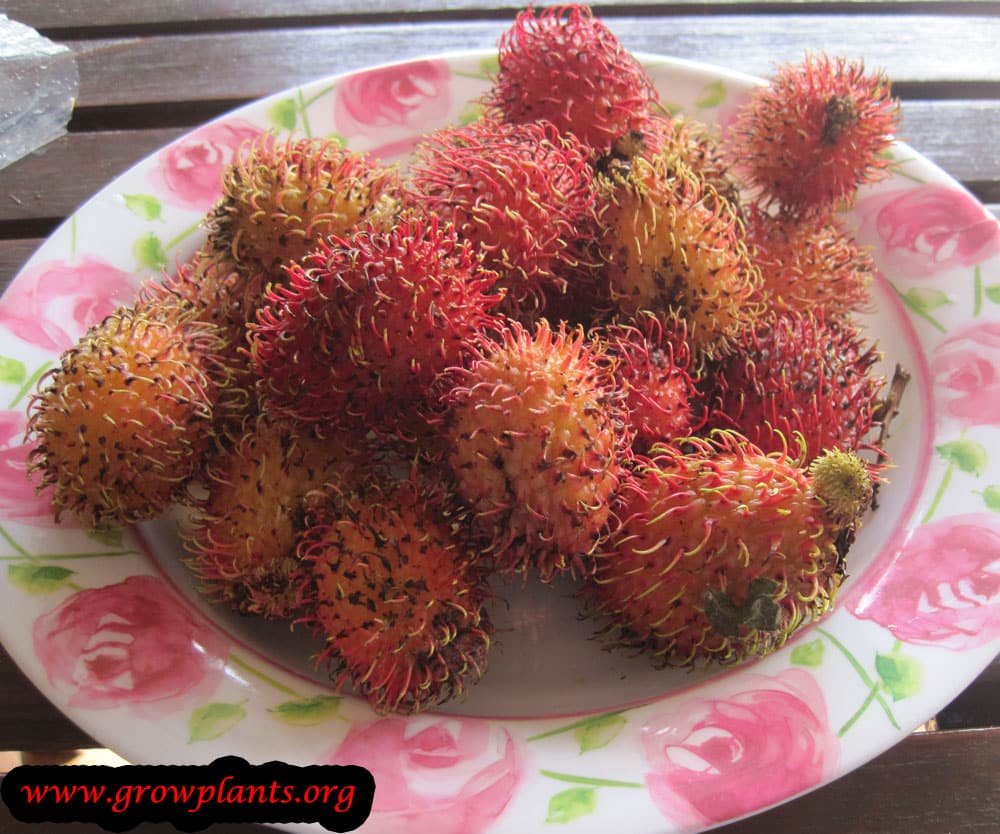
Plant Profile & Key Characteristics
Also known as: Chom chom fruit tree, Chom chom tree
Overview: The Rambutan (Nephelium lappaceum) is an evergreen tropical fruit tree 5-10 m (15-30 ft) tall, grown for its sweet, hairy-skinned lychee-like fruit. It needs a warm, humid tropical climate.
Quick Specifications
| Specification | Attribute |
|---|---|
| Plant Type / Life Cycle | Perennial tree |
| Foliage Type | Evergreen |
| Mature Size | 5-10 m (15-30 ft) tall |
| Growth Rate | Slow to Moderate |
| Toxicity | Non-toxic / edible fruit |
| Hardiness | USDA zones 13+ |
Growth Form & Structure
- Height & Spread: A medium tree reaching 5-10 m (15-30 ft); not suited to container growing.
- Growth Habit & Form: Evergreen fruiting tree; plants are dioecious, so male and female trees (or grafting both onto one tree) are needed for fruit.
- Lifespan & Maturity: Grafted or air-layered trees take about 3-6 years to bear fruit (longer from seed).
Anatomy & Physical Features
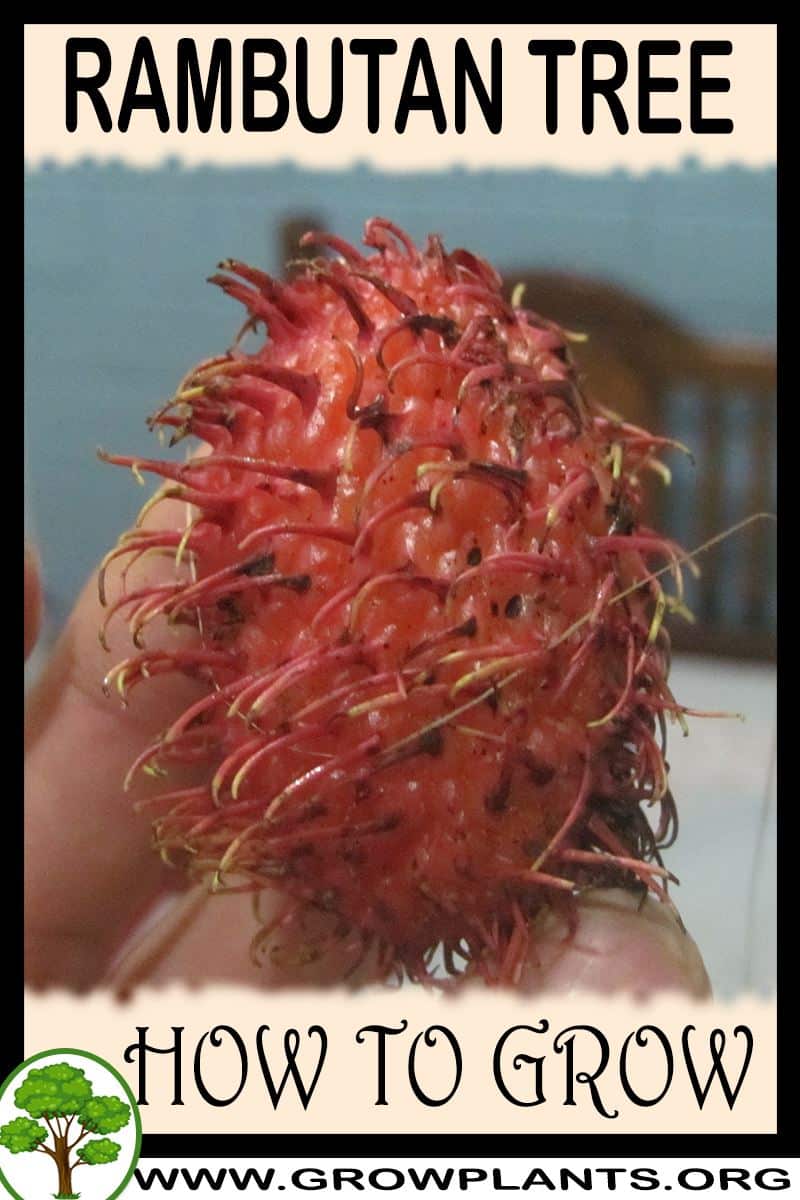
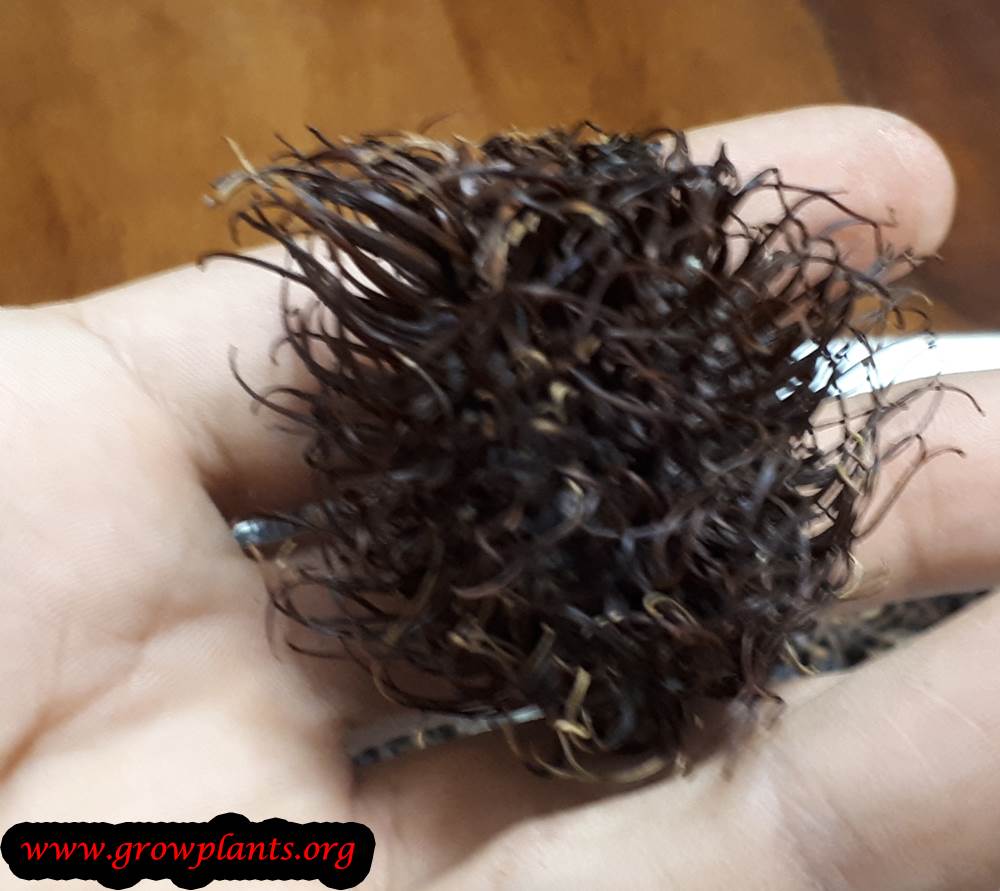
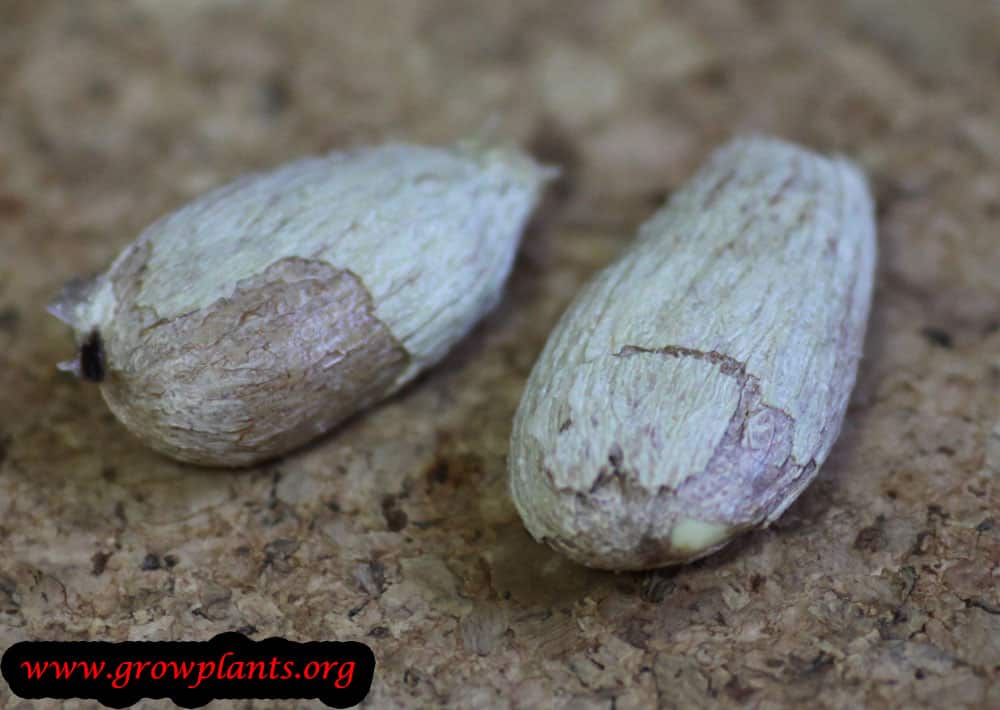
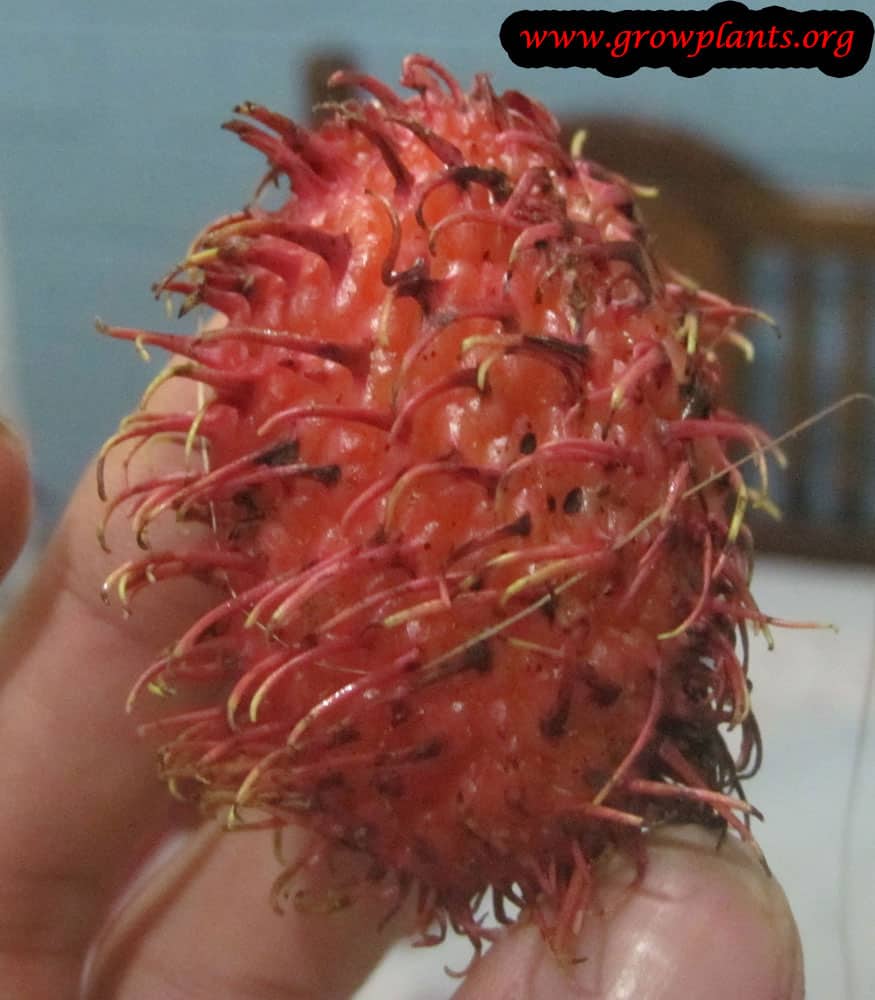
- Fruit Profile: Oval fruit with a yellow, orange or red skin covered in soft, pliable spines; white translucent lychee-like flesh and edible almond-flavoured seeds.
- Flower Characteristics: Tiny white flowers (1-2 mm); male and female borne on separate trees.
Primary Uses & Landscape Value
- Edible Uses: Fruit eaten fresh or made into jelly, jam and alcohol.
- Functional & Ornamental Roles: Grown chiefly as a tropical fruit and shade tree.
Care Guide: Planting, Soil & Watering
Overview: Rambutan is a tropical fruit tree that needs a rich, organic, well-drained yet moisture-retentive soil in a warm, humid, wind-sheltered position. It wants abundant water and high humidity, with mulch to hold moisture and feed the soil.
Quick Care Requirements
| Requirement | Ideal Condition |
|---|---|
| Planting Season | Warm season – spring to autumn |
| Growth Rate | Moderate to slow |
| Soil Type | Rich, organic, well-drained yet moisture-retentive |
| Water Need | High – keep the soil moist with high humidity |
Planting & Establishment
- Best Planting Season: Plant in the warm season, spring to autumn.
- How to Plant:
- Hole Preparation: Dig a hole larger than the root ball in a wind-sheltered spot.
- Soil Amendments: Mix organic matter, mycorrhiza and dead leaves with some sand into the backfill, then reduce the hole to the size of the root ball; mulch the surface afterwards.
- Planting Depth: Keep the root ball intact when planting, set the root collar at soil level, and mulch (without piling against the trunk).
- Growth Speed & Expectations: Moderate to slow.
Soil, Watering & Drainage Care
- Soil Mix & Drainage Needs: Rich, organic, well-drained yet moisture-retentive soil; mulch holds moisture and adds organic matter.
- Watering Schedule & Technique:
- Young / Newly Planted: Keep well watered through the first weeks after planting.
- Established: Regular, generous watering to keep the soil moist, with high humidity.
- Seasonal Adjustments: More water in heat and dry season; shelter from wind and cold.
Climate, Light & Hardiness
Rambutan is a lowland tropical fruit tree that needs warm, humid, frost-free conditions all year, thriving in full sun to half shade. It has essentially no tolerance for cold and is best suited to true tropical climates.
Quick Climate Specifications
| Climate Zones | Tropical |
|---|---|
| USDA Hardiness Zones | Essentially tropical – the site data lists a zone number outside the standard scale, so treat as suited only to consistently frost-free, warm climates |
| Frost Tolerance | None |
| Light Conditions | Full Sun / Half Shade |
| Wind Tolerance | Low |
Sunlight & Light Exposure
Optimal Light Setup
Grows well from full sun through half shade.
Shade & Heat Management
Some afternoon shade can be useful in the hottest, driest conditions, though full sun is generally preferred for fruiting.
Temperature Extremes & Hardiness
USDA Hardiness & Regional Limits
Suited only to consistently warm, frost-free tropical regions; it is not a plant for temperate outdoor culture.
Cold Damage & Winter Protection
The site care notes point to a cool-temperature threshold near 5°C (41°F) below which growth and health decline; protect from any cool spells, and keep young trees especially warm.
Frost Sensitivity
Highly frost sensitive – frost is likely to cause severe damage or kill the tree, particularly while young.
Wind, Humidity & Microclimate
Humidity Preferences
Requires high humidity for healthy growth.
Wind Tolerance
Sensitive to wind; site in a sheltered spot, especially for young trees.
Microclimate Recommendations
Choose a warm, humid, wind-sheltered, frost-free microclimate; in marginal climates this effectively means greenhouse or indoor protection during any cool season.
Growing in Pots, Balconies & Indoors
Rambutan (Nephelium lappaceum) grows into a 5-10 m (15-30 ft) tropical tree, so it is neither a houseplant nor, as the grower states, a long-term container plant. A young seedling can spend its first few years in a large pot, but it demands warmth, high humidity, constant moisture and full sun to part shade, and ultimately needs open ground in a frost-free climate.
Quick Details
- Container Size: Only a large tub while young; it ultimately needs open ground
- Indoor Suitability: Not a houseplant – a warm, humid-climate tree
- Best Spot: Full sun to half shade, warm and humid, outdoors
- Soil & Drainage: Rich, moisture-retentive but free-draining mix
- Watering in Pots: Big amount of water – keep the soil moist with high humidity
Indoors & On the Windowsill
- Not a houseplant: The grower confirms it will not grow indoors as a houseplant.
- Why: A fruiting tropical tree needs far more light, root room and humidity than a room can give.
On a Balcony or Patio
- Light, wind & heat: Give it the brightest spot it will tolerate; walls and railings reflect heat and dry pots quickly, so check moisture often and shelter or stake exposed growth.
- While young only: Keep a young tree on a warm, sheltered patio out of wind (it is wind-sensitive), and never let the pot dry.
Choosing the Pot, Soil & Long-Term Care
- Pot & drainage: Only a large tub suits a young tree; it soon outgrows any container. Use strong drainage holes and skip a standing-water saucer to avoid root rot. Terracotta breathes and dries faster; glazed or plastic holds moisture longer.
- Potting mix: A well-aerated, organic-rich mix – potting soil or peat/coir with perlite or vermiculite for free drainage.
- Feeding: Potted plants use up their soil faster as nutrients leach out with watering – feed lightly and regularly through the growing season.
- Long term: Move it to open ground in a frost-free spot once it is established.
Fertilizing & Feeding
A moderate feeder that responds well to rich, organic-matter-fed soil while young, shifting to a balanced, potassium-aware blend once flowering and fruiting begin.
Quick Fertilizing Specs
| Feeding Level | Moderate feeder |
|---|---|
| young_feeding | Nitrogen-forward complete fertilizer paired with organic matter and mulch |
| mature_feeding | Balanced fertilizer with potassium support through flowering and fruit fill |
| Main Nutrient Priority | Nitrogen while the canopy is developing, then balanced/potassium at bearing age |
| Best Feeding Period | The warm, humid active growing season |
| Organic Options | Compost, mycorrhizal inoculant, dead leaves, and mulch worked into the root zone |
| Reduce/Stop Feeding | Ease back on feeding as growth slows in cooler or drier stretches |
| Micronutrients | A complete fruit-tree fertilizer with routine iron, manganese, and zinc suits this rich-soil-loving tree |
| Soil pH | Prefers rich, well-drained soil over a strict pH target |
Feeding by Growth Stage
Newly planted tree
Get a young Rambutan through establishment using the rich, organic-matter-heavy planting method it responds well to.
| Nutrient direction | Rely on the organic matter, mycorrhizal inoculant, and mulch worked in at planting rather than a fertilizer feeding right away. |
|---|---|
| Timing | The first weeks after planting, before pushing into fertilizer feeding. |
| Frequency | A light feeding only once fresh growth confirms the roots are established, not at planting. |
| Fertilizer types | Organic matter, mycorrhizal inoculant, and mulch mixed into the planting hole, A light, diluted balanced fertilizer once new growth appears |
| Precautions | Keep watering consistent in the first weeks after planting, and avoid strong fertilizer on the still-settling root ball. |
Young, actively growing tree
Build canopy size and root reach, since a Rambutan tree needs several years of growth before it can bear fruit.
| Nutrient direction | A nitrogen-forward complete fertilizer supports steady canopy growth, backed by routine trace elements. |
|---|---|
| Timing | Through the warm, humid growing season while the tree is filling out. |
| Frequency | Regular light feedings through active growth, tapering off when growth slows. |
| Fertilizer types | A nitrogen-forward complete fruit-tree fertilizer, Mulch renewed regularly to keep organic matter and moisture up |
| Routine trace nutrients | iron, manganese, zinc |
| Precautions | This tree is noted as sensitive to wind, so avoid heavy feeding right before storm-prone periods that would push soft, breakage-prone growth. |
Established tree approaching bearing age
Carry a maturing tree through to its first flowering and fruit set, which grafted trees reach well before seed-grown ones.
| Nutrient direction | Shift toward a balanced complete fertilizer as the canopy matures and the tree nears reproductive age. |
|---|---|
| Timing | Through the active growing season as the tree matures. |
| Frequency | Regular light-to-moderate feedings during active growth, easing back as growth slows. |
| Fertilizer types | A balanced complete fruit-tree fertilizer, Organic mulch to sustain soil moisture and fertility |
| Routine trace nutrients | iron, manganese, zinc |
| Precautions | Keep nitrogen from dominating once the tree is old enough to flower, since overly lush growth can delay bearing. |
Mature, fruit-bearing tree
Support flowering, fruit set, and fill of the soft-spined fruit clusters through to harvest.
| Nutrient direction | A balanced fertilizer with attention to potassium supports fruit development once the tree is bearing. |
|---|---|
| Timing | Ahead of and during flowering and fruit development. |
| Frequency | Feedings timed around the bloom-to-harvest cycle, lighter once fruit nears maturity. |
| Fertilizer types | A balanced fruit-tree fertilizer with adequate potassium, Organic matter or compost as a seasonal top-dressing |
| Routine trace nutrients | iron, manganese, zinc |
| Precautions | Because a female and male tree are both needed for fruit set, feed both trees comparably so bloom timing stays in step; net or otherwise protect ripening fruit rather than compensating with extra fertilizer. |
Nutrient Deficiency Signs & Corrections
Pale, yellow-green foliage overall and slower canopy fill, most obvious on older growth.
| Possible causes | low available soil nitrogen, nutrient leaching from heavy rainfall or watering, mulch breakdown temporarily tying up nitrogen |
|---|---|
| Appears first on | older, lower leaves first |
| What to check | recent feeding history, rainfall and drainage, type and thickness of mulch |
| Possible correction | Apply a nitrogen-forward complete fertilizer suited to the tree’s stage and check that drainage is not washing nutrients away. |
Newest leaves emerge yellow with the veins remaining distinctly green, while older leaves stay normal.
| Possible causes | high soil pH limiting iron availability, waterlogged or poorly aerated roots, stress from recent transplanting |
|---|---|
| Appears first on | newest growth at branch tips |
| What to check | soil drainage and aeration, recent root disturbance, soil pH if it can be tested |
| Possible correction | Improve drainage first, then apply a chelated iron product per its label if the yellowing persists. |
New leaves are undersized and narrow, coming in bunched or rosetted rather than spreading normally.
| Possible causes | low soil zinc availability, elevated soil pH reducing uptake, heavy phosphorus feeding interfering with zinc |
|---|---|
| Appears first on | newest shoot tips |
| What to check | recent fertilizer composition, soil pH, shoot vigor at the growing tips |
| Possible correction | Apply a chelated zinc product per its label and moderate phosphorus in later feedings. |
Older leaf margins scorch or brown while the leaf center stays green, most noticeable during fruit development.
| Possible causes | low soil potassium relative to fruit demand, excess nitrogen diluting potassium uptake, inconsistent watering during fruiting |
|---|---|
| Appears first on | older leaf margins |
| What to check | fruit load against recent feeding, watering consistency through fruit development, nitrogen-to-potassium balance of recent fertilizer |
| Possible correction | Move toward a fertilizer proportionally higher in potassium during fruit development and keep watering even. |
Pruning, Training & Seasonal Maintenance
Rambutan is a wind-sensitive, purely tropical tree that tolerates only light, corrective pruning – mainly removing dead and weak branches. Its harvest (Autumn–Winter) and its recorded pruning window (Autumn–Winter) line up: the safest and most effective time to cut is right after harvest, giving the tree the full growing season ahead to push and mature the flush that will flower the following Spring–Summer.
Quick Pruning & Maintenance Specs
| Pruning Tolerance | Low |
| Primary Pruning Window | Post-harvest (Autumn–Winter) |
| Secondary Maintenance Window | Ongoing removal of wind-damaged or dead wood, any season |
| Typical Frequency | Light, occasional – corrective rather than routine |
| Main Objective | Remove dead, weak, or wind-broken wood; keep canopy manageable for netting against birds |
| Young Plant Priority | Wind shelter/staking; cut only visibly damaged growth |
| Mature Plant Priority | Sanitary maintenance and light height/spread control for harvest access |
| Best Tool Type | Bypass secateurs / loppers; saw only for larger storm-damaged limbs |
| Avoid Heavy Pruning During | Spring–Summer bloom; periods of strong wind exposure right after cutting |
Pruning by Plant Age & Size
Newly Established
Provide wind shelter or staking; remove only damaged or dead growth from transplanting. No structural cuts on young trees, which are noted as sensitive to wind and to establishing slowly at first.
Young / Formative
No formal training system is needed – the tree develops its own rounded canopy. On grafted trees (recommended to combine male and female flowering on one plant and to shorten the 3–6 year wait to first fruit), keep the graft union clear and free of competing basal growth.
Mature / Established
Remove dead, weak, or wind-broken wood after each harvest; keep the canopy at a height/spread that allows bird-exclusion netting to be fitted over the fruiting zone during ripening.
Seasonal Pruning Schedule
Post-Harvest (Autumn–Winter)
Objective: clean up dead/weak wood and lightly shape immediately after fruit is picked, so the tree has the following growing season to build the flush that will flower next Spring–Summer. Remove: dead, weak, and crossing branches. Do not remove: healthy terminal growth needed to carry the next flowering flush. Expected response: a fresh vegetative flush over the following months. Fruiting impact: positive when timed here; delaying cuts into the Spring bloom removes developing flower wood.
Ongoing Sanitary
Remove wind-snapped or storm-damaged branches as soon as they occur, cutting back to sound wood.
Flowering & Fruiting Wood
Rambutan flowers and fruits on terminal panicles of a matured growth flush, in the same pattern as its Nephelium relatives. Because bloom follows in Spring–Summer, structural pruning belongs in the preceding Autumn–Winter post-harvest window; cutting into terminal wood once the Spring flush is underway removes the coming crop.
Structural Pruning & Training
Limited to wind-damage removal and light height/spread control for harvest and netting access. No formal canopy-thinning program is warranted for this species.
Special Growth to Remove
On grafted trees, remove rootstock suckers and any vigorous shoots arising below the graft union that could out-compete the male/female scion combination the graft was chosen for.
Tools
Bypass secateurs and loppers handle routine dead/weak-wood removal; keep a pruning saw available for occasional larger storm- or wind-damaged limbs on a mature tree.
Tool Hygiene & Disease Risk
Routine – keep tools clean and sharp. Recorded pests (aphids, ants, termite, birds) are not spread by pruning cuts; bird pressure on fruit is managed with netting, not pruning.
Cut Placement & Technique
Use thinning cuts back to the branch collar or a healthy lateral rather than heading cuts. For wind-split limbs, cut back into sound wood beyond the split and avoid stubs, which are slow to seal in this tree’s humid growing conditions.
Heavy Pruning & Rejuvenation
Not part of routine care – pruning here is corrective, not structural. If storm damage forces a large reduction, expect slower regrowth and a lighter crop for a season or two afterward.
Post-Pruning Care
Water to support the flush that follows post-harvest pruning, especially in the first years of establishment; watch large wounds in this humid, high-rainfall environment for fungal issues, and hold off feeding purely to force regrowth after light corrective cuts.
Common Pruning Mistakes
Delaying pruning into the Spring bloom and removing developing flower wood; leaving young trees unstaked or unsheltered so wind causes more damage than any planned cut; letting the canopy grow too tall/spread to net effectively against birds at harvest.
When NOT to Prune
Avoid pruning during the Spring–Summer bloom, during or immediately before periods of strong wind, and on young trees beyond removing visibly damaged growth.
Recommended Tools (by task)
- bypass_secateurs – routine removal of dead and weak small branches.
- loppers – thicker crossing or wind-damaged branches.
- pruning_saw – occasional larger limb lost to storm or wind damage on a mature tree.
Pruning Troubleshooting
| Problem | Possible Cause | What to Check | Corrective Action |
| Poor fruit set | Missing compatible male/female graft combination | Whether the tree is a grafted male/female graft or single seedling | Graft in a compatible partner – not a pruning issue |
| Broken or split branches | Wind exposure on a wind-sensitive species | Site exposure and staking/shelter | Stake or shelter the tree; remove damaged wood cleanly at sound wood |
| Reduced flowering after pruning | Cuts made too close to or during Spring bloom | Timing of the last significant prune | Move structural cuts to the Autumn–Winter post-harvest window |
Propagation Guide
Grafting or air layering is the recommended way to propagate Rambutan, since the site notes these vegetative methods bring the tree into bearing sooner than seed and let a grower combine male and female wood on one tree; seed also germinates readily when very fresh, but a seed-grown tree may still need to be grafted later and can take longer to fruit. Overall difficulty is Moderate given the grafting/layering technique involved, though germinating fresh seed itself is easy.
Quick Propagation Specs
| Best Propagation Method | Grafting or Air Layering |
| Alternative Methods | Stem Cuttings; Seed (for seedling/rootstock trees) |
| Propagation Difficulty | Moderate |
| Seed True-to-Type | Variable – seedling fruit quality and sex are not guaranteed, and may still require grafting later |
| Vegetative True-to-Type | Yes |
| Best Propagation Season | Directly after the fruit ripens (autumn/winter harvest, per the site’s harvest season) |
| Seed Germination Time | 3–7 days |
| Seed Sowing Depth | 2–4 cm (~1–2 in) |
Growing from Seed
Seed Handling & Viability
Seed must be fresh – less than 5 days old – as germination chances drop with every day that passes. It is best kept inside the fruit until you are ready to sow; if immediate sowing is not possible, handle the seed very gently and hold it in well-moistened peat soil inside a closed, transparent nylon bag.
Sowing Season
Sow directly after the fruit ripens for best results.
Sowing Depth & Orientation
Sow about 2–4 cm (~1–2 in) deep. Sow each seed in its own separate pot rather than together.
Germination Conditions
High humidity, a sunny spot and warm weather are needed; keep the soil consistently moist with a big amount of water and never let it dry out.
Germination Time
Fast – typically just 3–7 days.
Seedling Care
Protect young seedlings from wind, to which they are very sensitive, in a sunny spot; once germinated, mulching the soil helps keep seedlings protected and moist.
Grafting & Budding
Why Grafting Is Used
Grafting is recommended to combine male and female wood on the same tree for reliable pollination, and – along with air layering – brings a tree into bearing considerably sooner than growing from seed, which may still need to be grafted later regardless.
Rootstock
A seedling-grown tree, raised individually as described above, is typically used as rootstock.
Scion Selection
Select scion wood from a known productive female (fruiting) tree, plus a male scion to ensure pollination.
Air & Ground Layering
Air layering is favored alongside grafting for bringing a tree into production sooner than seed. A healthy branch section is wounded or girdled, wrapped in a moist rooting medium, and kept consistently moist until it roots, after which it is severed and potted on to establish before planting out.
Bloom & Flower Guide
Quick Details
- Bloom Season: Spring to summer in tropical climates
- Time to First Bloom: Grafted trees usually flower within about 2-4 years; seedlings can take 5-6 years
- Flower Appearance: Tiny white to greenish flowers only 1-2 mm across, without showy petals, carried in large branched clusters; trees tend to bear either male or functionally female flowers, often on separate trees
- Edibility: The flowers are not eaten – rambutan is grown for its fruit
Detailed Blooming Overview
Rambutan flowers are small and easy to overlook, but they are rich in nectar and important for a good fruit set. Because the trees are functionally dioecious in habit, having a pollen-donor tree nearby helps female trees carry a heavier crop.
Flower Characteristics
- Tiny white to greenish flowers, about 1-2 mm across, with no showy petals.
- Borne in large terminal clusters (panicles); male and female flowers are usually on separate trees.
Bloom Care & Thinning
- Pollination: Chiefly by bees – honeybees are the main pollinators, so avoid spraying while flowers are open.
- Fruit set: Site a pollen-donor tree near female trees to improve set.
Fruit & Uses
Rambutan’s fruit is the primary food part – sweet, translucent flesh eaten fresh out of hand – while the single large seed is only traditionally eaten after thorough roasting, and never raw.
Quick Edible Specs
| Edible Parts | Fruit (flesh); Seed (roasted only) |
|---|---|
| Main Use(s) | Fresh eating, jelly, jam, alcohol (culinary) |
| Eaten Raw or Cooked | Fruit flesh: raw. Seed: roasted only – never raw |
| Preparation Required | Peel spiny skin for the fruit; roast the seed thoroughly, do not eat raw |
| Harvest Season | Autumn, winter |
| Time to First Harvest | Several years after planting (qualitative, see Propagation) |
| Storage | Best eaten fresh; net the tree if birds are a problem while fruit ripens |
| Safety/Toxicity Caveat | Raw seed contains compounds reported to be toxic or mildly narcotic – do not eat raw |
Fruit
Edible flesh is white, juicy, and lychee-flavored, wrapped in thin, hairy/spiny skin (yellow, orange, or red) that peels away easily once ripe. Fruit ripens in autumn into winter and can be picked slightly before it is fully ripe. Netting the tree can protect the crop from birds.
Seeds, Pods & Nuts
Safety note: the site describes the seed as edible with an almond-like taste and appearance. Rambutan seeds are documented elsewhere to contain compounds that are toxic or mildly narcotic when raw, and require thorough roasting before they are considered fit to eat, if eaten at all. Treat this as a minor, roasted-only traditional use – do not eat the seed raw, and do not treat “edible” alone as a safety green light.
Preparation, Uses & Safety
Fruit flesh is eaten fresh out of hand, or used for jelly, jams, and alcoholic preparations. If experimenting with the seed, roast it thoroughly first; raw seed is not considered safe to eat.
Pests, Diseases & Troubleshooting
Overview: Rambutan (Nephelium lappaceum) is a tropical Sapindaceae fruit tree, closely related to lychee and longan, and shares their pest and disease profile: sap-feeders and fruit-borers on flowers and fruit, anthracnose and stem canker in wet tropics, and vertebrate raiders at harvest. As a mainstream commercial fruit, rambutan is well known for scale and mealybug clusters on the hairy fruit and for anthracnose in wet weather. Manage with orchard hygiene, pruning for airflow, fruit protection, and targeted organic sprays.
Quick Troubleshooting Overview
| Issue / Pest | Main Symptom | Primary Solution |
|---|---|---|
| Mealybugs & scale | White/brown crust on shoots, fruit; honeydew | Prune; oil; control ants; predators |
| Fruit-piercing moth | Punctured, rotting fruit near ripening | Bag fruit; bait/light traps; sanitation |
| Fruit borer | Tunnels/frass in fruit and shoots | Remove infested fruit; prune; timely spray |
| Aphids & ants | Curled shoots; ants farming them | Control ants; water jet; soap |
| Anthracnose | Black spots on leaves, flowers, fruit | Prune airflow; copper; sanitation |
| Fruit rot / birds & bats | Rotting or eaten ripe fruit | Bag fruit; net; harvest promptly |
Common Pests & Management
- Mealybugs & scale insects (Pseudococcus / Coccidae):
- Symptoms: White cottony or brown crusty colonies on shoots, leaf undersides and especially clustered on the fruit, with honeydew and sooty mold; ants tend and spread them.
- Prevention & Control: Prune out infested shoots, control the ants that farm them (sticky bands on trunks), encourage ladybirds and parasitic wasps, and spray horticultural oil or insecticidal soap; protect fruit from clustering scale.
- Fruit-piercing moth (Eudocima spp.):
- Symptoms: Adult moths pierce ripening fruit at night, leaving puncture holes that ooze and rot on the tree.
- Prevention & Control: Bag developing fruit clusters, use bait or light traps and remove fallen fruit that attracts moths; harvest promptly as fruit colors.
- Fruit borer & shoot borer (Conopomorpha / Acrocercops spp.):
- Symptoms: Tunnels and frass in fruit, seeds and young shoots, causing fruit drop and shoot dieback.
- Prevention & Control: Remove and destroy infested fruit and prune bored shoots, maintain orchard sanitation, and time targeted sprays to egg-laying periods; bagging fruit gives good protection.
- Aphids & ants (Aphididae / Formicidae):
- Symptoms: Aphids curl and distort soft new shoots and flush growth, with ants farming them for honeydew.
- Prevention & Control: Control ants with trunk barriers, hose off aphids or use insecticidal soap, and encourage natural predators; the source’s ‘ants and termites’ are largely tending/secondary pests.
- Termites (Isoptera):
- Symptoms: Mud tunnels on the trunk and damage to stressed, dead or root wood rather than healthy tissue.
- Prevention & Control: Keep trees vigorous and unwounded, remove dead wood and debris around the base, and treat active nests only where they threaten young trees.
- Fruit flies (Bactrocera spp.):
- Symptoms: Stings in ripening fruit with maggots and internal breakdown.
- Prevention & Control: Use fruit-fly bait traps, bag fruit, harvest promptly, and collect and destroy fallen fruit to break the cycle.
Diseases & Fungal Issues
- Anthracnose (Colletotrichum gloeosporioides):
- Symptoms: Black to brown sunken spots on leaves, flowers and fruit, with flower blight, fruit spotting and post-harvest rot in wet, humid weather.
- Treatment & Management: Prune for an open, airy canopy, remove and destroy infected debris and mummified fruit, avoid overhead wetting, and apply a copper-based fungicide protectively during wet flowering and fruiting periods.
- Stem canker & dieback (Botryosphaeria / Dolabra spp.):
- Symptoms: Sunken, cracked cankers on branches with oozing and progressive twig and branch dieback.
- Treatment & Management: Prune out cankered wood well below the damage, disinfect tools, seal large cuts, and keep trees unstressed; protect wounds during wet weather.
- Powdery mildew (Oidium spp.):
- Symptoms: White powdery coating on flower panicles and young fruit, causing flower and fruitlet drop.
- Treatment & Management: Improve airflow, avoid excess soft growth, and apply sulfur or another suitable fungicide at flowering in humid conditions.
- Sooty mold (Capnodium spp.):
- Symptoms: Black film over leaves and fruit wherever sap-feeders leave honeydew.
- Treatment & Management: Control the mealybugs, scale and aphids beneath it; the mold then weathers away.
Growing Difficulties & Abiotic Problems
- Fruit drop & poor set:
- Cause & Symptoms: Erratic water, heat or wind at flowering, or poor pollination, cause heavy flower and fruitlet drop.
- Correction Strategy: Irrigate steadily through flowering and fruit set, shelter from hot drying wind, and maintain balanced nutrition rather than excess nitrogen.
- Fruit cracking / splitting:
- Cause & Symptoms: Irregular watering – drought then heavy rain or irrigation as fruit ripens – splits the skin.
- Correction Strategy: Keep soil moisture even with mulch and steady irrigation as fruit matures.
- Leaf scorch / nutrient issues:
- Cause & Symptoms: Wind, salt, or micronutrient shortage (iron, zinc) yellow and scorch leaf margins.
- Correction Strategy: Shelter trees, avoid salty water, and correct deficiencies with foliar or soil micronutrients (iron/zinc chelates).
- Vertebrate raiders:
- Cause & Symptoms: Birds, bats and squirrels strip ripening fruit – the biggest ‘pest’ of a ripe crop.
- Correction Strategy: Bag fruit clusters or net the tree as fruit colors, and harvest promptly.
What Helps – Products & Tools
Combine orchard hygiene and fruit protection with organics: horticultural oil and insecticidal soap for scale, mealybugs and aphids, ant/trunk barriers, fruit-fly bait traps, fruit bagging or netting against moths and vertebrates, and copper fungicide (or sulfur for mildew) for anthracnose and canker.