Plant Profile & Key Characteristics
Overview: Clamshell orchid (Prosthechea cochleata, syn. Encyclia cochleata) is an evergreen epiphytic orchid reaching 20-60 cm, grown for its distinctive shell-shaped, near-black-and-green flowers. This perennial is a popular houseplant and cut flower that can bloom much of the year.
Quick Specifications
| Specification | Attribute |
|---|---|
| Plant Type / Life Cycle | Perennial |
| Foliage Type | Evergreen |
| Mature Size | 20-60 cm (8-24 in) tall |
| Growth Rate | Slow |
| Root System | Epiphytic (aerial roots and pseudobulbs) |
| Toxicity | Non-toxic |
| Hardiness | USDA zones 10-12 |
Growth Form & Structure
- Height & Spread: 20-60 cm (8-24 in) tall, grown in pots or mounted in an airy bark medium with good drainage.
- Growth Habit & Form: Sympodial epiphytic orchid with pseudobulbs and strap-like leaves.
- Lifespan & Maturity: Perennial that can bloom for much of the year in the right conditions; individual flowers last about a month.
Anatomy & Physical Features
- Leaves & Foliage: Green, linear to elliptic leaves rising from a pseudobulb at the base.
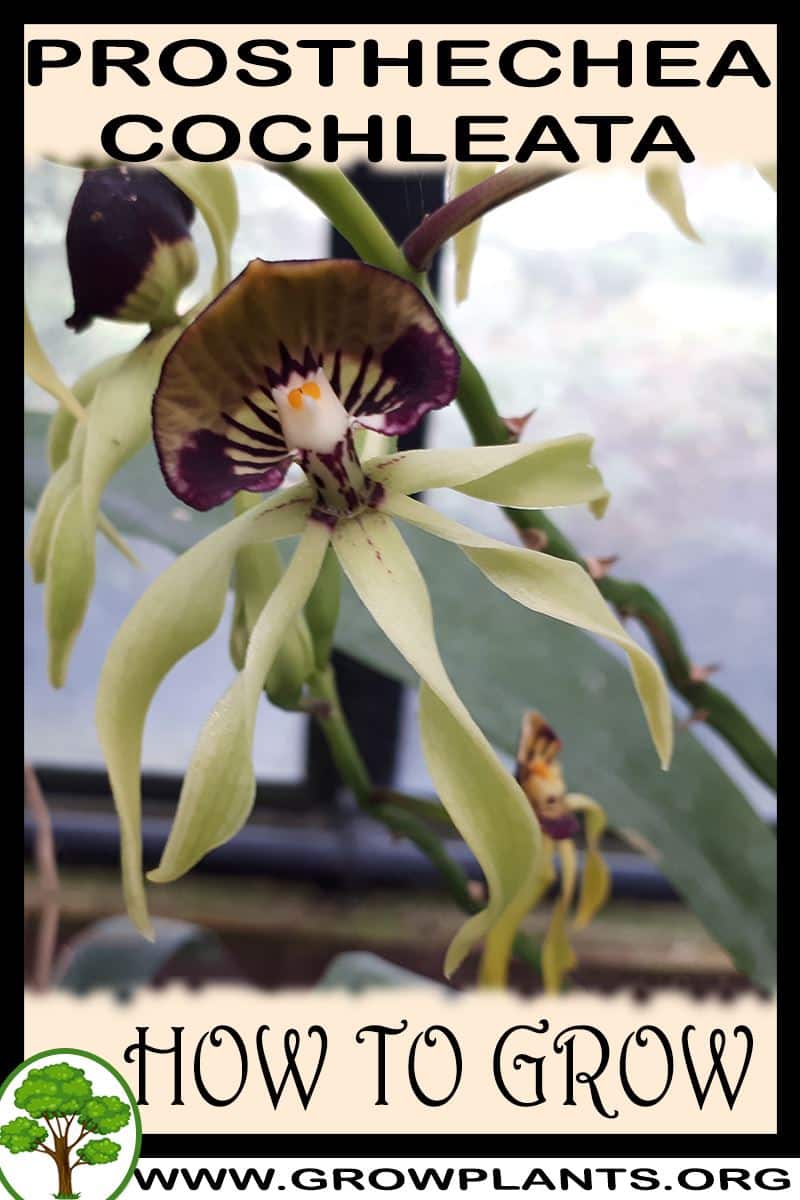
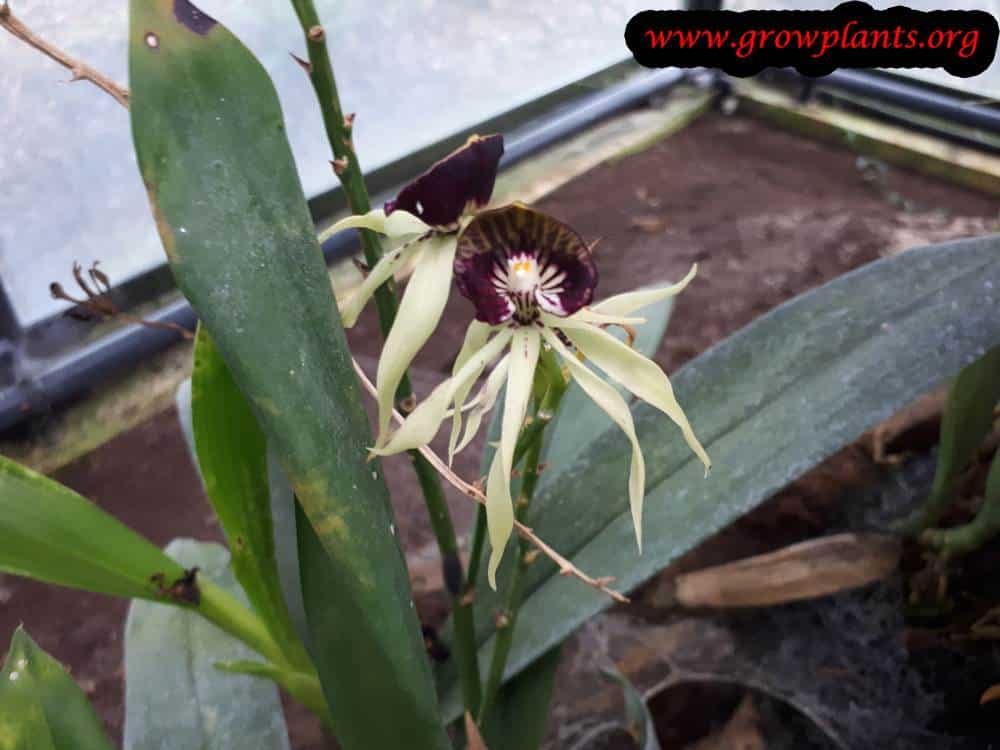
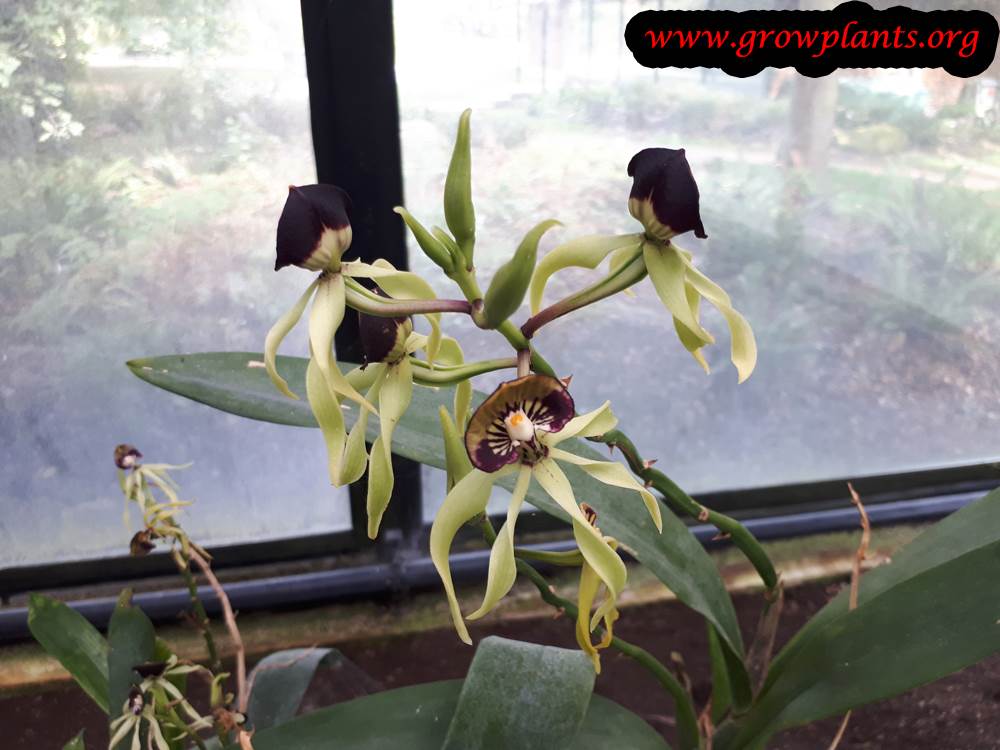
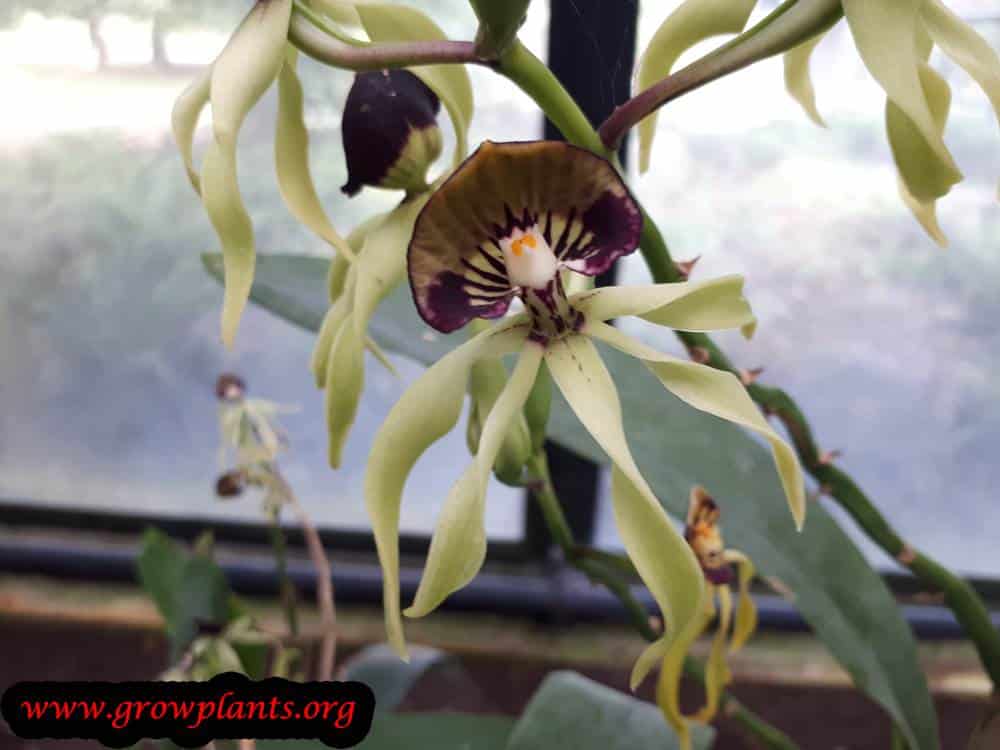
- Flower Characteristics: Non-resupinate ‘clamshell’/octopus-shaped bloom – dark purple-black hood over green-yellow ‘arms’, long-lasting.
Primary Uses & Landscape Value
- Functional & Ornamental Roles: Ornamental and collector’s orchid, houseplant, cut flower and mounted display.
Care Guide: Planting, Soil & Watering
Overview: The clamshell orchid is an epiphytic orchid that grows best in warm, humid conditions (bright but shaded, above 50% humidity) potted in an open bark or cork medium rather than soil. Water sparingly with clean water and let the roots breathe — a soggy, breaking-down mix quickly rots them.
Quick Care Requirements
| Requirement | Ideal Condition |
|---|---|
| Planting Season | Year-round (start in spring where summers are very hot or winters very cold) |
| Growth Rate | Slow |
| Soil Type | Open, fast-draining orchid mix — bark or cork chips, never garden soil |
| Water Need | Low — water when the medium approaches dryness |
Planting & Establishment
- Best Planting Season: Repot or start year-round; in climates with harsh winters or very hot summers, favour spring.
- How to Plant:
- Hole Preparation: Pot into a snug (not oversized) transparent pot of bark or cork; do not over-pot, and pot on about once a year as the roots grow.
- Soil Amendments: Use bark or cork chips, adding Styrofoam pieces for extra aeration; refresh the medium before it breaks down and turns acidic.
- Planting Depth: Seat the pseudobulbs at the surface with roots in the open medium; do not bury them in dense soil.
- Growth Speed & Expectations: Slow, gradually building a clump of pseudobulbs that can flower over much of the year given a day–night temperature difference.
Soil, Watering & Drainage Care
- Soil Mix & Drainage Needs: Use an open, sharply draining bark/cork medium in a pot with good aeration; free drainage and airflow around the roots are essential to prevent rot.
- Watering Schedule & Technique:
- Young / Newly Planted: After repotting, water lightly with clean rain or purified water, keeping the medium just damp.
- Established: Water when the medium is approaching dry, always with clean water, and maintain humidity above 50%.
- Seasonal Adjustments: Water a little more in warm growth; reduce when cool, always letting the medium dry between waterings.
Climate, Light & Hardiness
Prosthechea cochleata (clamshell orchid) is a frost-tender epiphytic orchid suited to tropical and subtropical climates, or grown as a houseplant elsewhere. It needs bright, indirect light and consistent warmth with high humidity, tolerating no more than USDA zone 10.
Quick Climate Specifications
| Climate Zones | Tropic, subtropics; also grown as a houseplant |
|---|---|
| USDA Hardiness Zones | 10–12 |
| Optimal Temp Range | Approximately 22–30°C (71–85°F) by day and 12–20°C (55–68°F) at night |
| Light Conditions | Bright, filtered light (full shade with plenty of light, not direct sun) |
| Frost Tolerance | None |
Sunlight & Light Exposure
Optimal Light Setup
Grows best in bright, filtered light – described as full shade but with a lot of light, meaning it should be protected from direct sun while still receiving strong ambient brightness.
Direct Sun Requirement
Direct sun is not required and can scorch the leaves; bright indirect light is preferred.
Temperature Extremes & Hardiness
USDA Hardiness & Regional Limits
Suited to USDA zone 10–12 outdoors, or year-round warmth indoors/in a greenhouse; a meaningful day-to-night temperature difference supports healthy growth and blooming.
Frost Sensitivity
Has essentially no frost tolerance as a tropical epiphyte and should be kept well above freezing at all times.
Cold Damage & Winter Protection
Night temperatures should stay within roughly 12–20°C (55–68°F); temperatures colder than this range can stress or damage the plant, so winter warmth (indoors or under cover) is essential outside zone 10–12.
Wind, Humidity & Microclimate
Humidity Preferences
Needs consistently high humidity, with the source data recommending more than 50% ambient humidity for healthy growth.
Microclimate Recommendations
Good airflow around the roots combined with high humidity and a clear day/night temperature difference best replicates this epiphytic orchid's natural growing conditions.
Growing in Pots, Balconies & Indoors
The cockleshell orchid is an easy-going epiphytic orchid and the grower confirms it as a houseplant. It is naturally a container (or mounted) plant, wanting bright but filtered light rather than direct sun – a classic windowsill orchid.
Quick Details
- Container Size: A small orchid pot – snug is fine; it flowers well slightly pot-bound
- Indoor Suitability: A good houseplant orchid for bright, filtered indoor light
- Best Spot: Full shade with plenty of light – bright but indirect, no scorching sun
- Soil & Drainage: Open, free-draining orchid bark mix, never ordinary potting soil – a bagged orchid potting mix and bark is an easy way to get this right
- Watering in Pots: Water then let the roots approach dryness; small amount overall – never soggy
Indoors & On the Windowsill
- A good houseplant: The grower confirms it. Stand it in bright, indirect light – an east or shaded south window – and it will flower on and off for much of the year.
- Orchid care: Grow it in an open bark mix in a pot with plenty of holes (or mount it); water by soaking then draining, and enjoy the humidity of a kitchen or bathroom.
- Warmth: Keep it frost-free and out of cold draughts; normal room warmth suits it well.
On a Balcony or Patio
- Light & warmth: In warm weather it enjoys a shaded, sheltered spot outdoors with bright dappled light and good air movement – never direct sun. Bring it in before it turns cold.
- Practicalities: Light and easy to move; hang it or stand it where excess water can drain freely after watering.
Choosing the Pot, Soil & Long-Term Care
- Pot & drainage: A free-draining orchid pot with generous holes; the roots need air and must dry between waterings – never leave it standing in water.
- Potting mix: A coarse orchid bark mix (bark, some perlite/charcoal) – never garden or peat soil around the roots.
- Feeding: Feed at low strength with an orchid feed during active growth; potted orchids need only weak, regular feeding.
- Repotting: Repot every couple of years as the bark breaks down, rather than because it is pot-bound.
Fertilizing & Feeding
A light feeder typical of epiphytic orchids: dilute, frequent feeding through active growth supports pseudobulb development and repeat flowering, with feeding eased back between growth flushes.
Quick Fertilizing Specs
| Feeding Level | Light feeder |
|---|---|
| Main Nutrient Priority | Balanced feeding formulated for orchids during active root and pseudobulb growth |
| Best Feeding Period | Through active growth, which can occur across much of the year given warm, humid conditions |
| Organic Options | Not typically applicable; fed through a bark or similar open orchid mix rather than garden soil |
| Micronutrients | Usually supplied by a complete orchid fertilizer; correct specific issues only when diagnosed |
| Soil pH | Grown in an open, fast-draining bark or similar orchid mix rather than soil |
Feeding by Growth Stage
New growth and pseudobulb development
Support new roots, leaves, and pseudobulbs as active growth resumes.
| Nutrient direction | A dilute, balanced orchid fertilizer to support steady root and pseudobulb growth. |
|---|---|
| Timing | As new growth emerges from the base of the most recent pseudobulb. |
| Frequency | Light, regular feeding at reduced strength while the mix is evenly moist. |
| Fertilizer types | A balanced complete orchid fertilizer diluted per its label |
| Precautions | Feed at reduced strength; orchids grown in bark mix are easily over-fertilized, which can burn roots. |
Flowering
Support long-lasting blooms without pushing excess vegetative growth during flowering.
| Nutrient direction | Continue balanced, dilute feeding, easing back slightly once flower spikes appear. |
|---|---|
| Timing | While flower spikes develop and blooms are open. |
| Frequency | Reduced, light feeding through the bloom period. |
| Fertilizer types | A balanced complete orchid fertilizer diluted per its label |
| Precautions | Avoid heavy feeding directly on open flowers or during peak bloom, which offers little benefit and raises salt risk. |
Between-flush rest and repeat flowering cycle
Match feeding to this orchid’s tendency to flower repeatedly across the year, resting briefly between flushes.
| Nutrient direction | Minimal feeding is usually enough during a short rest between growth flushes, returning to regular light feeding once new growth resumes. |
|---|---|
| Timing | Any brief pause between one flowering or growth flush and the next new growth. |
| Frequency | Feed sparingly during a rest period, then resume light regular feeding as new growth begins. |
| Fertilizer types | A balanced complete orchid fertilizer diluted per its label, applied sparingly during rest |
| Precautions | Watch for shriveling pseudobulbs, which signal a need for more consistent watering rather than more fertilizer. |
Nutrient Deficiency Signs & Corrections
Older leaves and pseudobulbs yellow, and new growth is thin or undersized.
| Possible causes | low or infrequent feeding, an orchid mix that has broken down and holds fewer nutrients, poor root health limiting uptake |
|---|---|
| Appears first on | older leaves and pseudobulbs |
| What to check | recent feeding history, condition and age of the orchid mix, root color and firmness |
| Possible correction | Resume light, regular balanced feeding during active growth and consider repotting into fresh mix if it is old and broken down. |
Root tips blacken or leaf tips turn brown and crisp, sometimes with a visible crust on the mix surface.
| Possible causes | overfeeding or feeding at too strong a dilution, salt buildup from fertilizer residue, insufficient flushing of the mix with plain water |
|---|---|
| Appears first on | root tips and leaf margins |
| What to check | recent feeding strength and frequency, presence of a salt crust on the mix, how thoroughly the mix is flushed when watered |
| Possible correction | Flush the mix thoroughly with plain water and reduce feeding strength or frequency going forward. |
Healthy foliage but few or no flower spikes form over an extended active period.
| Possible causes | insufficient light, nitrogen-heavy feeding relative to overall balance, insufficient day-to-night temperature difference |
|---|---|
| Appears first on | absence of flower spikes despite otherwise healthy growth |
| What to check | light exposure, recent feeding balance, day and night temperature range |
| Possible correction | Improve light exposure, keep feeding balanced rather than nitrogen-heavy, and allow a natural day-night temperature difference. |
Pruning, Training & Seasonal Maintenance
Prosthechea cochleata (clamshell orchid) is a sympodial epiphytic orchid growing from a chain of pseudobulbs; it has no branching framework to train, and pruning tolerance is low — care centres on removing the spent flower spike and old foliage, never cutting into a live pseudobulb. The right time to remove the flowering stem is once bloom is completely finished, since this species does not rebloom from the same spike the way some orchids do.
Quick Pruning & Maintenance Specs
| Pruning Tolerance | Low (spent spikes and dead leaves only) |
| Primary Pruning Window | After bloom, once the flower spike has fully faded and dried |
| Typical Frequency | Once per bloom cycle, plus occasional dead-leaf removal |
| Main Objective | Remove the spent inflorescence and old foliage; protect the pseudobulbs |
| Young Plant Priority | None – do not cut back young growth |
| Mature Plant Priority | Remove the faded flower stem at bloom’s end; remove individual yellowed leaves as they occur |
| Best Tool Type | Precision snips, sterilized between plants |
Pruning by Plant Age & Size
Newly Established
No pruning beyond removing any leaf damaged during handling or repotting.
Young / Formative
No structural training — sympodial growth is directed by the rhizome producing new pseudobulbs, not by cutting.
Mature / Established
After each bloom cycle, cut the spent flower stem once fully faded and dry. At repotting (needed roughly once a year per this plant’s own care notes), remove any fully dead or mushy roots and, if dividing the clump, any leafless, spent back bulbs.
Seasonal Pruning Schedule
| Post-Flowering | Objective: stop energy going into a spent spike and tidy the plant. Remove: the flower stem, cut back to its base or to just above the pseudobulb it arose from, once fully faded and dried. Do not remove: the pseudobulb or leaf itself, or a spike that still shows any green or fresh tissue, since flowering can continue for weeks. Response: none — this species does not rebloom from the same spike. Impact: energy is freed for the next new growth. |
Structural Pruning & Training
There is no framework to prune; an overgrown clump’s size is controlled by division at repotting rather than by cutting the plant back.
Special Growth to Remove
- Old, yellowed leaves — removed individually as they decline, cut close to the pseudobulb.
- Spent flower stem — see Seasonal Pruning Schedule.
- Dead or mushy roots, found and trimmed at repotting.
Container & Small-Space Pruning
Grown in a (often transparent) pot; this plant’s own care notes recommend repotting about once a year rather than moving straight to an oversized pot. While repotting, trim away any dead or rotten roots with a sterile blade, since leaving them in fresh mix invites rot.
Tools
- precision_snips — all cuts are on soft flower stems, leaves or roots.
Tool Hygiene & Disease Risk
High-risk: orchids as a group are highly susceptible to virus transmission (for example Cymbidium mosaic virus and Odontoglossum ringspot virus) carried on cutting tools between plants. Use a single-use blade or flame-/alcohol-sterilize between cuts whenever working on more than one orchid, even though this species’ own record notes only aphids and spider mites as pests.
Cut Placement & Technique
Cut the flower spike back to its point of origin at the pseudobulb rather than partway up, which leaves a long dead stub; when removing a leaf, cut close to the pseudobulb rather than tearing it away.
Post-Pruning Care
After cutting a spent spike or trimming roots, hold off on heavy watering for a day or two to let cut surfaces dry and reduce rot risk, consistent with this plant’s own preference for careful, well-drained watering with clean water.
Common Pruning Mistakes
- Cutting the flower spike while it is still green or could keep blooming.
- Reusing the same unsterilized blade across multiple orchids, risking virus spread.
- Leaving old flower stems to rot back into the pseudobulb instead of removing them once fully spent.
When Not to Prune
Avoid cutting the flower spike while any part of it is still green or flowering; avoid root-trimming or dividing outside the normal yearly repotting window, since this orchid’s own notes warn against over-potting and unnecessary disturbance.
Recommended Tools (by task)
- precision_snips — for spent spikes, dead leaves and root trimming, ideally a dedicated or sterilized blade given orchid virus risk.
- blade_disinfectant — to sterilize between cuts and between plants, given the high virus-transmission risk in this genus.
Propagation Guide
Prosthechea cochleata is best increased by dividing an established clump of pseudobulbs, since the site notes this orchid is very hard to start from seed. Seed propagation is technically possible but, as with most orchids, requires sterile laboratory conditions rather than home methods, so vegetative division is the practical choice and overall this is a moderate-difficulty plant to propagate by division.
Quick Propagation Specs
| Best Propagation Method | Division of pseudobulb clumps |
| Alternative Methods | Keikis (plantlets), where produced |
| Propagation Difficulty | Moderate (division); Specialist (seed) |
| Vegetative True-to-Type | Yes |
| Best Propagation Season | As new growth begins, typically after flowering |
Growing from Seed
Site notes seed starting is really hard for this orchid. Like most orchids, its seed lacks the stored nutrients of typical seed and normally needs a symbiotic fungus or sterile in-vitro (flask) culture to germinate, which is why it is rarely attempted by home growers.
Division, Offsets, Pups & Suckers
Divide a mature clump into sections of at least three to four pseudobulbs each, making sure every division keeps active growth points (eyes) and attached roots. The site notes this orchid’s roots fill its pot and need repotting about once a year, and cautions against potting it directly into an oversized pot – the same applies to fresh divisions: pot each one snugly rather than into an oversized container, using a free-draining bark/cork mix as the site’s care notes describe.
Bloom & Flower Guide
Quick Details
- Bloom Season: Most of the year, given the right conditions
- Flower Appearance: Distinctive upside-down flowers with a dark red-purple to near-black shell-shaped lip held uppermost and green-yellow, spidery segments below, suggesting an octopus or clam
- Edibility: Grown as an ornamental orchid
Detailed Blooming Overview
The cockleshell orchid is one of the most obliging of epiphytic orchids, opening its curious clam- or octopus-like flowers in succession up the stem over a long period. Individual blooms can last around a month, and a happy plant flowers for much of the year.
Flower Characteristics
- Shell-shaped dark lip carried uppermost, with green-yellow, arm-like segments, as the grower describes.
- Flowers open one after another along the spike, so the display is long and continuous.
Bloom Care & Thinning
- Light: Bright, indirect light supports steady flowering.
- Temperature: A difference between day and night temperatures helps trigger and sustain bloom, as the grower notes.
- Roots: Grow in a free-draining, airy medium and do not let the roots stay wet.
Pests, Diseases & Troubleshooting
Overview: The cockleshell orchid is an easy epiphytic orchid whose troubles are the standard orchid set: armoured scale and mealybugs hiding on pseudobulbs and leaf bases, and rots caused by a stale, soggy medium or water sitting in the crown. Grow it in an open, fast-draining orchid medium with bright filtered light, good airflow and water that drains away freely, and inspect the pseudobulbs regularly to catch scale early.
Quick Troubleshooting Overview
| Issue / Pest | Main Symptom | Primary Solution |
|---|---|---|
| Boisduval scale | White/brown scale crusting pseudobulbs and leaf bases | Scrub off; alcohol; horticultural oil; isolate |
| Mealybugs | White cottony tufts in sheaths and new growth | Alcohol swab; soap/oil; check roots and sheaths |
| Black/soft rot | Water-soaked black or mushy rot of leaves/pseudobulbs | Cut out to clean tissue; cinnamon/physan; drier, airier |
| Thrips | Silvery streaks and speckling on leaves and flowers | Blue sticky traps; soap/spinosad; remove spent flowers |
| Spider mites | Fine silvery stippling on leaf undersides in dry air | Raise humidity; wipe leaves; light oil if severe |
| Leaf-tip burn | Brown, dead leaf tips from salts/hard water | Flush medium; use rain/RO water; repot in fresh mix |
Common Pests & Management
- Boisduval scale (Diaspis boisduvalii):
- Symptoms: The classic orchid scale: white to pale-brown armoured scales and cottony male fluff crust the pseudobulbs, leaf bases and undersides, often hidden beneath dry sheaths, sapping the plant and causing yellow blotches and decline.
- Prevention & Control: Peel back and remove old sheaths where scale hides, scrub the pseudobulbs with a soft brush, and dab scale with rubbing alcohol. A horticultural oil smothers the crawler stage – repeat every couple of weeks – and isolate infested plants, as this scale spreads readily in a collection.
- Mealybugs (Pseudococcus / Planococcus spp.):
- Symptoms: White cottony masses hide in leaf axils, flower sheaths, new growth and among the roots, oozing honeydew and weakening the plant; root mealybug lurks unseen in the medium.
- Prevention & Control: Swab visible colonies with alcohol and follow with insecticidal soap or light oil, checking sheaths and repotting to inspect and wash the roots. Isolate affected plants and treat repeatedly, as mealybug is persistent.
- Thrips (Thysanoptera):
- Symptoms: Silvery streaking and pale speckling on leaves and, especially, on the flowers, which become distorted and discoloured; tiny slender insects hide in buds and blooms.
- Prevention & Control: Monitor with blue sticky traps, remove spent flowers where thrips breed, and spray insecticidal soap or spinosad in the evening. Good hygiene and isolating new plants limit them.
- Two-spotted (red) spider mite (Tetranychus urticae):
- Symptoms: Fine silvery stippling and a dull, pitted look to the leaf undersides in hot, dry air, with faint webbing in bad cases and a general loss of leaf gloss.
- Prevention & Control: Raise humidity and wipe or rinse the leaves – mites hate moist, moving air. Conserve predatory mites and use a light oil only if stippling spreads; improving humidity usually solves it.
- Aphids (Aphidoidea):
- Symptoms: Soft green aphids cluster on the tender new growth, developing flower spikes and buds, distorting blooms and leaving honeydew.
- Prevention & Control: Rinse them off the spike and buds with water and wipe them away; insecticidal soap clears heavier colonies without harming the flowers if used carefully.
- Fungus gnats & snails/slugs (Sciaridae / Gastropoda):
- Symptoms: Small dark flies hover around a constantly wet medium (their larvae feed on roots and decaying matter), while snails and slugs rasp new roots, buds and flowers, especially in humid conditions.
- Prevention & Control: Let the medium approach dryness between waterings to deter fungus-gnat larvae, use yellow sticky traps, and hand-pick or bait snails and slugs; a tidy, well-drained growing area limits both.
Diseases & Fungal Issues
- Black rot (Phytophthora / Pythium):
- Symptoms: Water-soaked, blackish, soft rot spreads rapidly through leaves and into the pseudobulbs and rhizome, especially when water sits in the crown or the medium stays cold and soggy; it can kill quickly.
- Treatment & Management: Cut out all affected tissue back to clean, firm green, dust the cuts with cinnamon or a physan/copper product, and move the plant somewhere warmer, airier and drier. Never let water pool in the crown, and improve air circulation.
- Bacterial soft / brown rot (Erwinia / Pectobacterium / Acidovorax):
- Symptoms: Sunken, water-soaked, foul-smelling brown or black spots spread fast through the fleshy leaves, sometimes oozing, particularly in warm, wet, still, over-humid conditions.
- Treatment & Management: Cut out infected tissue well into healthy green with a sterile blade, treat cut surfaces, and dramatically improve airflow while reducing leaf wetness and humidity. Isolate the plant; sanitation is the main control.
- Fungal leaf spot (Cercospora / Colletotrichum spp.):
- Symptoms: Brown to black spots, sometimes ringed or with yellow haloes, develop on the leaves in humid, stagnant conditions and can enlarge.
- Treatment & Management: Improve air movement, keep foliage dry (water early so leaves dry fast), and remove badly spotted leaves. A copper fungicide checks persistent outbreaks.
- Orchid viruses (Cymbidium mosaic virus / ORSV):
- Symptoms: Colour-break streaking or mosaic, chlorotic or necrotic flecks and rings on leaves, and distorted or broken flower colour; the plant slowly weakens and it is incurable.
- Treatment & Management: There is no cure – isolate and ideally discard confirmed virus-positive plants, and prevent spread by sterilising cutting tools between plants (flame or fresh blade) and controlling sap-sucking pests.
Growing Difficulties & Abiotic Problems
- Leaf-tip burn:
- Cause & Symptoms: Accumulated salts from fertiliser or hard/softened tap water, or letting the medium dry too hard, burn the leaf tips brown and dead.
- Correction Strategy: Water with rain, distilled or RO water where possible, flush the medium periodically to leach salts, feed weakly, and repot into fresh medium when it breaks down.
- Pseudobulb shrivel:
- Cause & Symptoms: Shrivelled, wrinkled pseudobulbs signal water stress – usually root loss from rot or an old, broken-down medium – rather than simple underwatering.
- Correction Strategy: Check and repot into fresh, open orchid medium, trim dead roots, and re-establish humidity and careful watering; healthy roots plump the pseudobulbs back up.
- Sunburn & bud blast:
- Cause & Symptoms: Too much direct sun scorches bleached patches on leaves, and sudden swings in temperature, light or humidity cause developing buds to yellow and drop (‘bud blast’).
- Correction Strategy: Grow in bright filtered light (no harsh midday sun) and keep conditions steady while in bud – avoid draughts, drying air and sudden moves – to carry the flowers through.
What Helps – Products & Tools
For the cockleshell orchid keep rubbing alcohol and a soft brush plus horticultural oil for scale and mealybug on the pseudobulbs, insecticidal soap or spinosad for thrips and aphids, and blue/yellow sticky traps for monitoring. For disease, cinnamon or a physan/copper product treats cut rot surfaces and leaf spot; the best ‘tools’ are an open, fresh, fast-draining medium, airflow, and clean (rain/RO) water.