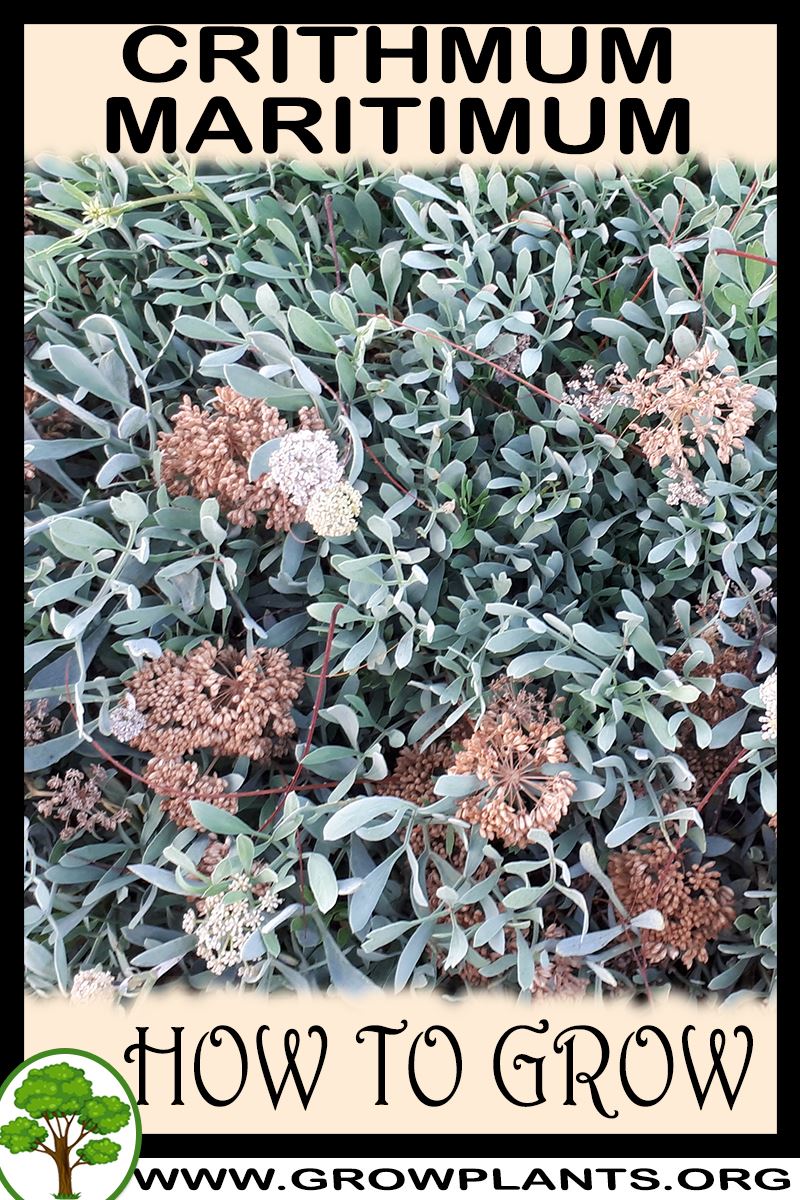
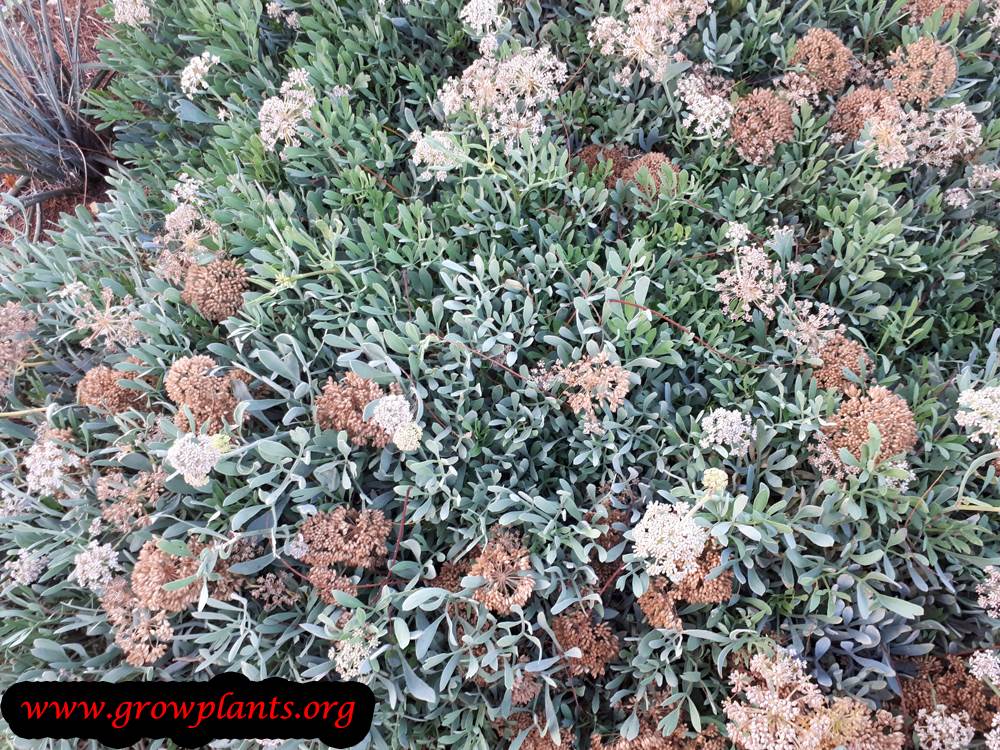
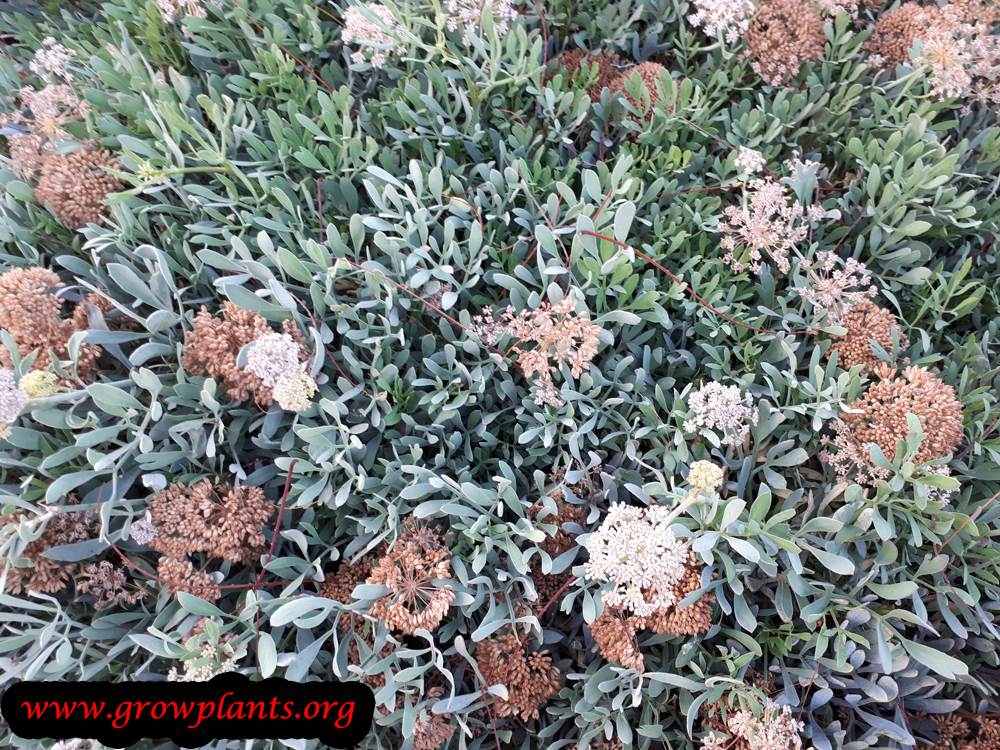
Plant Profile & Key Characteristics
Overview: Crithmum maritimum (Sea Fennel / Rock Samphire) is an evergreen perennial herb 30–50 cm (12–20 in) tall, with fleshy, aromatic linear leaves. It is grown as an edible and medicinal plant and as an ornamental coastal groundcover.
Quick Specifications
| Specification | Attribute |
|---|---|
| Plant Type / Life Cycle | Perennial herb |
| Foliage Type | Evergreen |
| Mature Size | 30–50 cm (12–20 in) tall |
| Growth Rate | Fast to moderate |
| Toxicity | Non-toxic – the leaves, stems and seed pods are edible |
| Hardiness | USDA zones 5–10a |
Growth Form & Structure
- Height & Spread: Low, bushy, spreading habit 30–50 cm (12–20 in) tall; well suited to coastal beds, rock gardens and containers.
- Growth Habit & Form: Sprawling, somewhat woody-based herb forming a dense low mound, tolerant of salt and rocky ground.
- Lifespan & Maturity: Long-lived perennial that can be vigorous once established.
Anatomy & Physical Features
- Leaves & Foliage: Fleshy, succulent-like green linear leaves with an aromatic, savoury scent.
- Flower Characteristics: Small green-yellow flowers in rounded umbels in spring to summer.
Primary Uses & Landscape Value
- Edible Uses: Young leaves and stems eaten cooked or pickled (rock samphire), a traditional coastal vegetable; also used medicinally.
- Functional & Ornamental Roles: Ornamental evergreen groundcover for coastal, rock and gravel gardens.
Care Guide: Planting, Soil & Watering
Overview: Sea fennel (Crithmum maritimum) is a tough coastal herb that grows in rich, rocky, sharply drained soil in full sun, and it needs only modest water once established. Give it a free-draining, gritty spot and let it dry between waterings.
Quick Care Requirements
| Requirement | Ideal Condition |
|---|---|
| Planting Season | Year-round in frost-free coastal climates; otherwise in spring |
| Growth Rate | Fast to moderate |
| Soil Type | Rich but rocky, gritty and sharply drained soil |
| Water Need | Low to moderate — drought-tolerant; let the soil dry between waterings |
Planting & Establishment
- Best Planting Season: Plant year-round in mild coastal areas, or in spring elsewhere, choosing an open, sunny position; it thrives even in poor, rocky ground.
- How to Plant:
- Hole Preparation: Dig a hole just wider than the root ball in a sunny, sharply drained spot, ideally rocky or gravelly ground.
- Soil Amendments: Keep it lean — add grit or coarse sand for drainage rather than rich feeding, mirroring its rocky seaside habitat.
- Planting Depth: Set the crown level with the soil surface and keep the stem base at ground level.
- Growth Speed & Expectations: Growth is fast to moderate and it can spread readily, so give it space or trim it back.
Soil, Watering & Drainage Care
- Soil Mix & Drainage Needs: Wants gritty, rocky, freely draining soil; it is adapted to lean coastal conditions and dislikes rich, soggy ground. In containers use a very free-draining mix and let the pot dry between waterings.
- Watering Schedule & Technique:
- Young / Newly Planted: Water lightly to settle young plants, keeping the soil just barely moist while they root in.
- Established: Water sparingly once established — it is drought-tolerant and prefers to dry out between waterings.
- Seasonal Adjustments: A little extra in prolonged summer heat; very little in cool or wet weather.
Climate, Light & Hardiness
Crithmum maritimum (sea fennel or rock samphire) is a tough, rock-and-cliff-dwelling coastal perennial that grows best in full sun and is naturally adapted to exposed, salt-laden sites. It is broadly hardy across USDA zone 5–10a, well suited to mediterranean, subtropical, desert, and temperate climates.
Quick Climate Specifications
| Climate Zones | Mediterranean, subtropical, desert, or temperate |
|---|---|
| USDA Hardiness Zones | Approximately 5–10a |
| Frost Tolerance | Moderate |
| Light Conditions | Full sun, and generally performs best there |
| Salt / Coastal Tolerance | High |
Sunlight & Light Exposure
Optimal Light Setup
Full sun is best; half shade is tolerated but the plant performs noticeably better with full sun exposure.
Direct Sun Requirement
Naturally adapted to full, unobstructed coastal sun.
Temperature Extremes & Hardiness
USDA Hardiness & Regional Limits
Hardy across USDA zone 5–10a, a wide range reflecting its toughness as a rocky, coastal-cliff species.
Cold Damage & Winter Protection
Well-drained, rocky or gritty soil helps it handle winter cold, since wet, poorly drained soil in cold conditions is more damaging than the cold itself.
Frost Sensitivity
Moderately frost-tolerant for a plant that also handles hot, dry coastal summers.
Wind, Humidity & Microclimate
Wind Tolerance
High – as a species that naturally grows on exposed sea cliffs, it is very tolerant of strong, salt-laden coastal winds.
Coastal / Salt Tolerance
Excellent salt-spray and coastal tolerance; it is one of the most naturally salt-adapted plants of the mediterranean coastline.
Growing in Pots, Balconies & Indoors
Rock samphire (Crithmum maritimum) is an edible coastal succulent herb. The grower does not rate it as a houseplant – it wants full sun and lean, sharp soil – but a compact plant can be grown in a pot on the sunniest windowsill or, better still, out on a hot balcony for kitchen picking.
Quick Details
- Container Size: A free-draining pot; add grit or sand for this lean-soil coastal plant
- Indoor Suitability: Not a true houseplant; only the sunniest windowsill suits it
- Best Spot: Full sun (a little part shade tolerated, but full sun is best)
- Soil & Drainage: Very free-draining, gritty/sandy, low-fertility mix
- Watering in Pots: Sparing to average; let it dry between waterings – it is drought- and salt-tolerant
Indoors & On the Windowsill
- Not a room plant: The grower marks it unsuitable as a houseplant; it needs far more sun than a room offers.
- Sunniest sill: On the brightest, sunniest windowsill you can grow a compact plant for occasional kitchen snips; keep it lean and on the dry side.
- Edible: The fleshy leaves are eaten cooked or made into a paste – a bonus of growing it within reach.
On a Balcony or Patio
- Hot & sunny: A hot, sunny, breezy balcony mimics its seaside home; it shrugs off salt spray and drought, so it is very low-maintenance in a gritty pot.
Choosing the Pot, Soil & Long-Term Care
- Pot & drainage: A pot with strong drainage holes and no standing saucer; mix in grit or coarse sand.
- Potting mix: Lean and gritty – it dislikes rich, wet soil; a sandy, free-draining blend is ideal.
- Feeding: Very little feeding – too much reduces the flavour and habit; a light feed at most once in the season.
- Refresh the mix and pot on about every two years, lightly root-pruning and top-pruning to keep it vigorous.
Fertilizing & Feeding
A tough, rocky-soil coastal herb grown mainly for its edible leaves; it is naturally adapted to lean, well-drained ground and needs only light feeding to stay productive.
Quick Fertilizing Specs
| Feeding Level | light |
|---|---|
| Main Nutrient Priority | A light, balanced fertilizer supports steady leaf production without pushing soft growth that is more prone to rot |
| Best Feeding Period | Through the main growing season while leaves are being harvested |
| Organic Options | A modest amount of compost or organic matter worked into rocky or lean soil at planting is usually enough |
| Soil pH | Naturally suited to rocky, well-drained soil and tolerates a wide pH range without special adjustment |
| Reduce/Stop Feeding | Ease off feeding as growth slows going into the cooler part of the year |
Feeding by Growth Stage
Establishment
Help the young plant root into rocky or lean soil before pushing top growth
| Nutrient direction | Light, balanced feeding that favors root development over lush foliage |
|---|---|
| Timing | Early in the growing season, shortly after planting |
| Frequency | A light feeding or two is usually enough while the plant establishes |
| Fertilizer types | A light, balanced fertilizer, A modest amount of compost worked into the planting area |
| Precautions | Avoid rich, heavily amended soil or generous feeding, which can lead to soft growth in a plant adapted to lean conditions |
Active Growth and Harvest
Support steady production of the edible young leaves through the harvest period
| Nutrient direction | Keep feeding light and balanced; a low-nitrogen approach preserves the plant’s naturally tough, flavorful leaves |
|---|---|
| Timing | Through the main growing season while leaves are being harvested |
| Frequency | Light feeding through the growing season is usually enough to sustain harvests |
| Fertilizer types | A light, balanced fertilizer with a modest nitrogen level |
| Precautions | Avoid heavy nitrogen feeding, which can produce softer, less flavorful leaf growth and increase disease risk in humid conditions |
Nutrient Deficiency Signs & Corrections
Pale green leaves and slower leaf production, more noticeable on older growth
| Possible causes | Nitrogen deficiency in very lean or heavily leached soil, Poor drainage limiting root uptake, Root crowding if grown in a container |
|---|---|
| Appears first on | Older leaves first |
| What to check | Recent feeding history, Soil drainage, Container size relative to root mass |
| Possible correction | A light, balanced feeding during active growth is usually enough to restore normal color and leaf production |
New leaves yellowing between the veins while the veins remain green
| Possible causes | High soil pH in alkaline rocky or coastal soil limiting iron availability, Overly wet soil restricting root function, General micronutrient shortage in very poor soil |
|---|---|
| Appears first on | Newest leaves at the growing tips |
| What to check | Soil pH and drainage, Whether yellowing is interveinal and confined to new growth, Recent watering pattern |
| Possible correction | Correct pH toward a more favorable range and apply a chelated iron product per its label if chlorosis persists |
Yellowing leaves and general decline despite regular watering, on a plant adapted to lean, fast-draining conditions
| Possible causes | Waterlogged soil causing root rot in a plant that prefers fast drainage, Overly rich soil holding excess moisture around the roots, Nutrient lockout caused by poor drainage rather than a true deficiency |
|---|---|
| Appears first on | Whole-plant decline, often starting with lower leaves |
| What to check | Soil drainage and any standing water, Watering frequency relative to this plant’s drought tolerance, Root condition if the plant can be checked |
| Possible correction | Improve drainage and reduce watering frequency before adjusting the feeding program |
Pruning, Training & Seasonal Maintenance
Crithmum maritimum (sea fennel, rock samphire) is a fleshy-leaved coastal perennial that forms a rounded clump with a slightly woody base over time. It tolerates light, frequent trimming well; the main objectives are keeping the clump compact, removing spent flower heads before they set the seed this species sheds freely (its own care notes flag it as aggressive/self-seeding), and giving an occasional spring rejuvenation cut to older, leggy plants. Regular harvesting of young leaves for the kitchen also functions as informal pruning that encourages bushy new growth, though harvest specifics belong to a separate guide.
Quick Pruning & Maintenance Specs
| Pruning Tolerance | Moderate to High |
| Primary Pruning Window | Any time for light trimming; early spring for a restorative cutback |
| Typical Frequency | Light, ongoing trims plus one spring tidy |
| Main Objective | Keep the clump compact, prevent excessive self-seeding, refresh leggy growth |
| Young Plant Priority | Leave largely untouched while the taproot establishes |
| Mature Plant Priority | Deadhead spent umbels; spring cutback if the clump has become woody/sparse |
| Best Tool Type | Precision snips |
| Avoid Heavy Pruning During | First growing season after planting, and in winter at the cold edge of its zone 5-10a range |
Pruning by Plant Age & Size
Newly Established
Avoid disturbing or cutting back hard while the plant is developing its taproot; light tidying of damaged foliage only.
Young / Formative
No structural training is needed – light pinching of stem tips helps build a denser, rounder clump.
Mature / Established
Deadhead the yellow-green umbels once flowering finishes, and give an annual light shear-back to keep the naturally sprawling clump compact.
Special Growth to Remove
- Spent flower umbels – removing these before seed sets is worth doing given how readily this species self-sows and spreads.
- Winter-damaged or frost-browned foliage, cleaned up in spring rather than mid-winter, at the colder end of its hardiness range.
Container & Small-Space Pruning
Grows well in containers, which also has the side benefit of limiting its self-seeding spread compared with open ground. Keep it compact with light, regular tip trims rather than one big yearly cut.
Tools
Precision snips for flower-stem and foliage trims; no woody-wood tools are needed even on an older, semi-woody-based clump.
Tool Hygiene & Disease Risk
Routine – clean, sharp snips are sufficient; no significant tool-transmissible disease is documented for this species.
Cut Placement & Technique
Trim spent flower stems down to a lower leaf junction rather than leaving bare stubs; when giving a spring rejuvenation cut, cut back into the leafy growth rather than into completely bare old wood, since the woody base does not resprout as reliably from very old tissue.
Heavy Pruning & Rejuvenation
An older clump that has become leggy or sparse in the centre responds well to a fairly hard cutback in early spring, similar to other Mediterranean coastal subshrubs, and typically regrows compact and full for the season.
Post-Pruning Care
Water lightly after a spring cutback to support regrowth; this plant thrives in lean, well-drained conditions, so avoid the temptation to feed heavily afterward.
Common Pruning Mistakes
- Leaving spent flower heads in place too long, letting this self-seeding species colonise more of the bed or nearby paving/rockwork than intended.
- Cutting back hard in the plant’s first season, before the taproot has properly established.
When NOT to Prune
Avoid hard pruning in the first season after planting while the taproot establishes, and avoid cutting back in winter at the colder end of its range (zone 5-6) – wait until early spring so existing foliage offers some protection to the crown over winter.
Recommended Tools (by task)
- precision_snips – the routine tool for deadheading, tip trims and the spring rejuvenation cutback on this fine-stemmed subshrub.
Propagation Guide
Crithmum maritimum (sea fennel) is grown mainly from seed, though germination in this Apiaceae-family herb tends to be slow and uneven, so fresh seed and cold stratification are often recommended over dried, unstratified seed. Softwood cuttings offer a faster, more reliable alternative for propagating a specific plant, though vegetative propagation is not required to keep the species true. Overall, propagation is moderate in difficulty due to erratic seed germination.
Quick Propagation Specs
| Best Propagation Method | Seed |
| Alternative Methods | Softwood cuttings |
| Propagation Difficulty | Moderate |
| Seed True-to-Type | Usually true-to-type |
| Vegetative True-to-Type | Yes |
| Best Propagation Season | Autumn to early spring for seed; late spring to summer for cuttings |
Growing from Seed
Seed Handling & Viability
Sowing fresh seed rather than older stored seed generally improves germination.
Dormancy & Pre-Sowing Treatment
A period of cold stratification is often recommended, as is typical for many Apiaceae-family seeds with slow or erratic germination.
Germination Conditions
Well-drained, gritty or rocky soil in full sun mirrors this plant’s natural coastal rock habitat and suits germination.
Germination Time
Germination can be slow and irregular, sometimes spread out over several weeks or more.
Stem Cuttings
Best Timing
Late spring to summer, using new, non-flowering growth.
Rooting Setup
Root softwood cuttings in a free-draining, gritty medium, echoing the plant’s preference for rocky, well-drained soil.
Rooting Hormone
Optional — may improve consistency but is not strictly required.
Bloom & Edible Flower Guide
Quick Details
- Bloom Season: Summer
- Flower Appearance: Flat-topped umbels of tiny greenish-yellow flowers in rounded ball-like clusters
- Edibility: Edible — the aromatic young umbels are edible, like the rest of this culinary coastal herb
Detailed Blooming Overview
Crithmum maritimum, sea fennel or rock samphire, is an aromatic coastal herb in the carrot family. In summer it carries flat-topped umbels of tiny greenish-yellow flowers, grouped into small ball-like heads. As with the plant’s prized leaves and stems, the young flowering umbels are aromatic and edible, carrying the same fresh, salty-herbal character.
Flower Characteristics
- Tiny greenish-yellow flowers gathered into rounded clusters.
- Clusters combine into a flat-topped umbel, typical of the carrot family.
- Aromatic, echoing the plant’s culinary leaves.
Bloom Care & Thinning
- Managing the bloom: If you value the tender leaves, pinch out some umbels to keep new leafy growth coming; the plant is very salt- and drought-tolerant.
- At the table: Use clean, unsprayed young umbels for their aromatic, herbal flavor.
Fruit & Uses
Sea fennel (rock samphire) is grown for its edible leaves, tender young stems and immature seed pods, long gathered from coastal cliffs and shorelines as a savoury, salty-aromatic vegetable. It is eaten both cooked and pickled, with the youngest growth occasionally used raw as a pungent garnish.
Quick Edible Specs
| Edible Parts | Young leaves, tender stems, immature seed pods |
|---|---|
| Main Use(s) | Culinary vegetable/condiment (traditionally pickled); historically also used medicinally |
| Eaten Raw or Cooked | Both – very young leaves can be used raw as a garnish; more often cooked or pickled |
| Preparation Required | None for a quick rinse of fresh young leaves; pickling in vinegar/brine or cooking for the classic preparations |
| Harvest Season | All year, taking young leaves once the plant is established |
| Time to First Harvest | Once the plant is established and producing new growth (see Propagation/Care for establishment timing) |
| Storage | Fresh leaves keep only briefly refrigerated; pickled in vinegar it stores for months – the traditional way to preserve it |
| Safety/Toxicity Caveat | No known toxicity; it is a strongly flavoured, salty herb, so use in culinary amounts rather than large quantities |
Leaves & Greens
The linear, fleshy green leaves are the main edible part. Young, tender leaves are harvested from the base of the plant once it is established, and picking can continue through the year in mild coastal conditions. They are traditionally cooked into a paste or used as a cooked vegetable; the youngest leaves can also be eaten raw in small amounts as a salty, aromatic garnish. Tender young stems are picked and used the same way as the leaves.
Seeds, Pods & Nuts
The immature, still-green seed pods are also an edible part and are prepared the same way as the leaves, most often pickled. Only young, unripe pods are used; once they mature and dry they are no longer a culinary part.
Harvesting
Pick young, tender leaves and stems from the base of the plant; harvesting can be done repeatedly through the growing season rather than as a single event, and light regular picking keeps new growth coming (see Pruning for general cutting guidance).
Preparation, Uses & Safety
The classic preparation is pickling in vinegar or brine, which gives sea fennel its traditional tangy, salty character and was historically how coastal foragers preserved it. It is also cooked into a paste or added as a cooked vegetable/herb to dishes, and very young leaves can be used sparingly raw as a garnish. The site notes a traditional medicinal use as well, though no specific health claims are made here. There is no known toxicity, but as with any strongly flavoured herb it should be used in moderate, culinary quantities, and any wild-foraged material should be correctly identified before eating.
Pests, Diseases & Troubleshooting
Overview: Rock samphire is a tough, aromatic coastal halophyte that is genuinely close to pest- and disease-free – its salty, resinous, succulent foliage deters most insects, and its natural home on sea cliffs tells you what it needs: lean, sharply-drained soil and sun. Almost every problem in cultivation is cultural, and traces back to the one thing it cannot abide: wet, heavy, rich soil. Grow it hard and dry and it is virtually trouble-free.
Quick Troubleshooting Overview
| Issue / Pest | Main Symptom | Primary Solution |
|---|---|---|
| Root rot | Yellowing, wilting, collapse in wet/heavy soil | Sharp drainage; grit/sand; water sparingly |
| Slugs & snails | Rasped holes in soft new growth (seedlings mainly) | Grit/copper barriers; hand-pick; protect seedlings |
| Aphids | Occasional colonies on soft tips; minor honeydew | Hose off; insecticidal soap only if heavy |
| Overwatering / rich soil | Soft, floppy, poorly-flavoured, disease-prone growth | Grow lean and dry; no rich feeding |
| Powdery mildew | White film in humid, crowded, still air | Space plants; improve airflow; usually minor |
Common Pests & Management
- Slugs & snails (Gastropoda):
- Symptoms: The main nuisance, and mostly at the seedling and soft-new-growth stage: rasped holes and grazed shoots with slime trails, worst in mild damp weather. Established, resinous plants are largely left alone.
- Prevention & Control: Protect young plants with grit or copper barriers, keep the surrounding area clear of damp debris, and hand-pick after dark. Iron-phosphate bait can be used sparingly around seedlings. Mature clumps rarely need protection.
- Aphids (Aphididae):
- Symptoms: Occasional small colonies of green or dark aphids on the softest new tips, causing slight distortion and a little honeydew. Uncommon on this pungent plant and rarely damaging.
- Prevention & Control: Dislodge with a jet of water and encourage ladybirds and hoverflies. Insecticidal soap is enough in the rare event of a heavy colony; avoid feeding lush growth that attracts them.
- Leaf-mining / caterpillars (occasional) (various Apiaceae feeders):
- Symptoms: Now and then a caterpillar of an umbellifer-feeding moth or butterfly, or a minor leaf miner, may nibble the foliage – incidental rather than a real threat.
- Prevention & Control: Simply pick off the culprit by hand. The plant’s vigour and aromatic oils keep such damage trivial; no spraying is warranted.
Diseases & Fungal Issues
- Root & crown rot (Pythium / Phytophthora):
- Symptoms: The principal ‘disease’, and really a consequence of wet feet: in heavy, poorly-drained or over-watered soil the roots and crown rot, and the plant yellows, wilts and collapses – often over winter.
- Treatment & Management: There is no spray fix; the cure is cultural. Grow in very free-draining, gritty or sandy, low-fertility soil (raised beds, gravel, crevices), water sparingly, and never let it stand wet. In containers use a sharp mineral mix and empty saucers after watering.
- Powdery mildew (Erysiphaceae):
- Symptoms: An occasional white, powdery film on foliage in humid, crowded, poorly-ventilated conditions – uncommon on plants grown in their preferred open, airy, sunny spot.
- Treatment & Management: Space plants and improve airflow; remove affected growth. A sulphur or potassium-bicarbonate fungicide clears stubborn cases but is seldom needed if the plant is grown lean and open.
Growing Difficulties & Abiotic Problems
- Wet, heavy or rich soil (the key issue):
- Cause & Symptoms: Everything this plant dislikes comes down to too much water and fertility: on damp, heavy or richly-fed soil it grows soft and floppy, loses its flavour, and rots at the root.
- Correction Strategy: Replicate its cliff habitat – lean, gritty, sharply-drained soil, full sun, and minimal or no feeding. Water only to establish, then let it fend for itself; it is highly drought-tolerant.
- Winter wet:
- Cause & Symptoms: Cold combined with standing moisture is the commonest killer, rotting the crown over the dormant season.
- Correction Strategy: Ensure perfect winter drainage – a gravel mulch around the crown, a raised or sloping site, or overhead protection in very wet-winter areas – and keep container plants dry and airy over winter.
- Excess shade:
- Cause & Symptoms: In too little light the plant becomes drawn, weak and pale, and its characteristic dense, succulent, well-flavoured growth is lost.
- Correction Strategy: Grow in full sun. Move shaded container plants to the brightest, most open position available.
What Helps – Products & Tools
This plant needs very little: the most valuable ‘tools’ are grit, coarse sand or a gravel mulch to guarantee the sharp drainage it demands, plus slug barriers (grit/copper) around seedlings. Products are rarely required – insecticidal soap for a rare heavy aphid colony, and a sulphur or potassium-bicarbonate fungicide for the occasional powdery mildew. Above all, resist feeding and over-watering. If harvesting for the kitchen, follow any product label’s edible-crop guidance and prefer non-chemical control.