Plant Profile & Key Characteristics
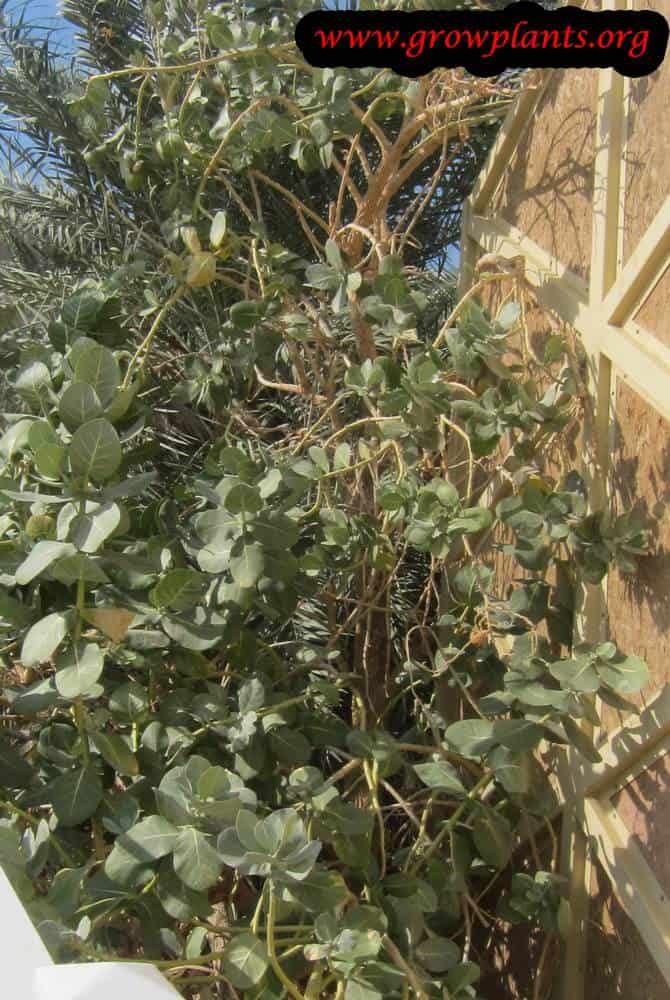
Overview: An evergreen desert shrub or small tree 1-3 m (3-10 ft) tall with thick grey-green leaves and milky latex. It is grown as a drought-tolerant ornamental and hedge plant and used medicinally, but all parts are poisonous.
Quick Specifications
| Specification | Attribute |
|---|---|
| Plant Type / Life Cycle | Perennial |
| Foliage Type | Evergreen |
| Mature Size | 1-3 m (3-10 ft) tall |
| Growth Rate | Moderate to slow |
| Root System | Deep taproot |
| Toxicity | Poisonous (toxic milky latex; fruit poisonous; sap irritant) |
| Hardiness | USDA zone 9+ |
Growth Form & Structure
- Height & Spread: 1-3 m (3-10 ft) tall; grown in the ground in warm dry climates or in large containers.
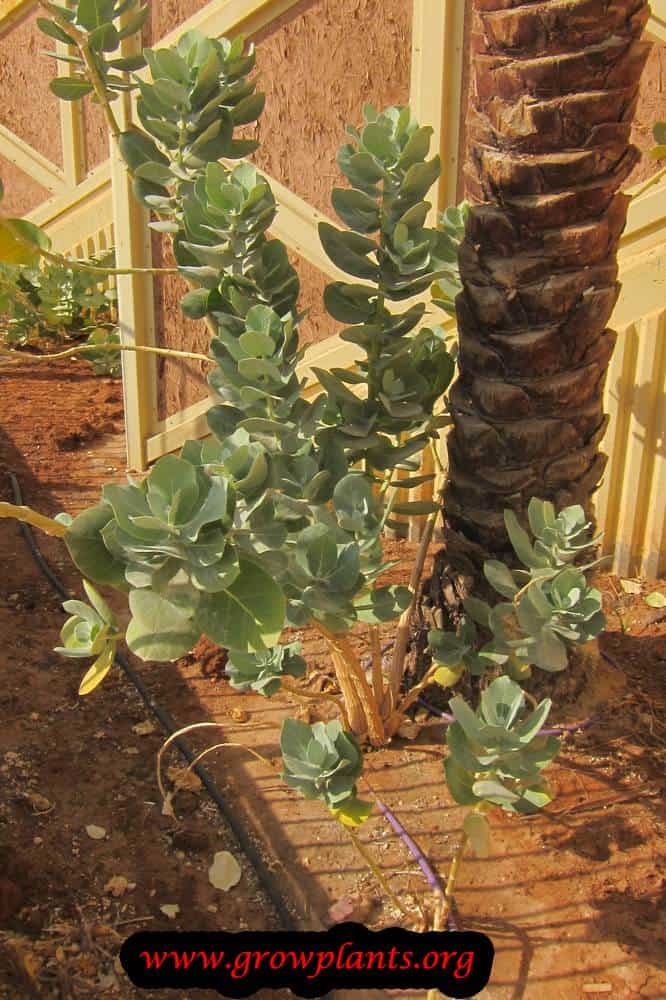
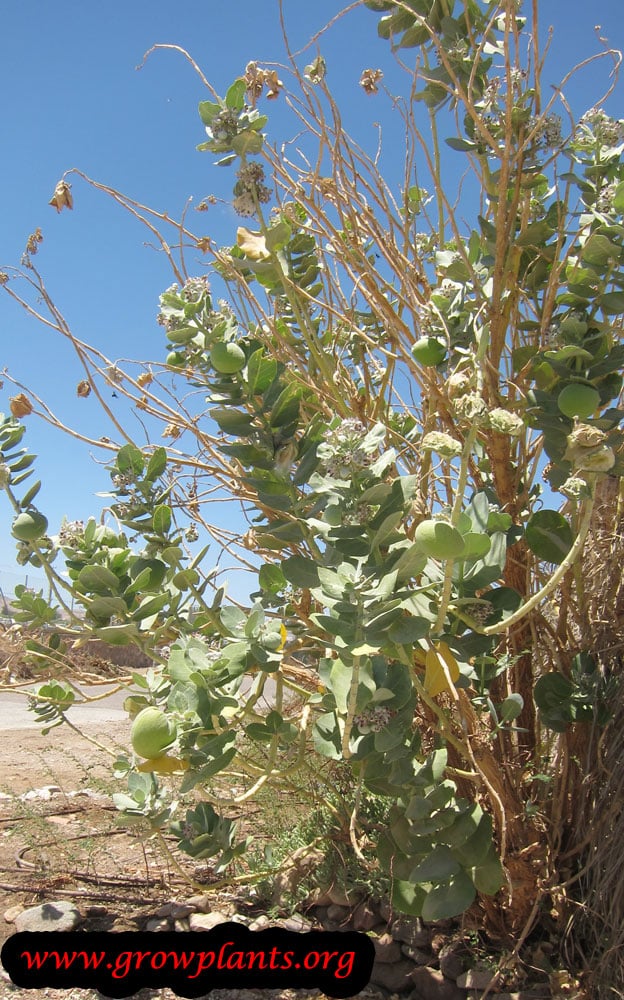
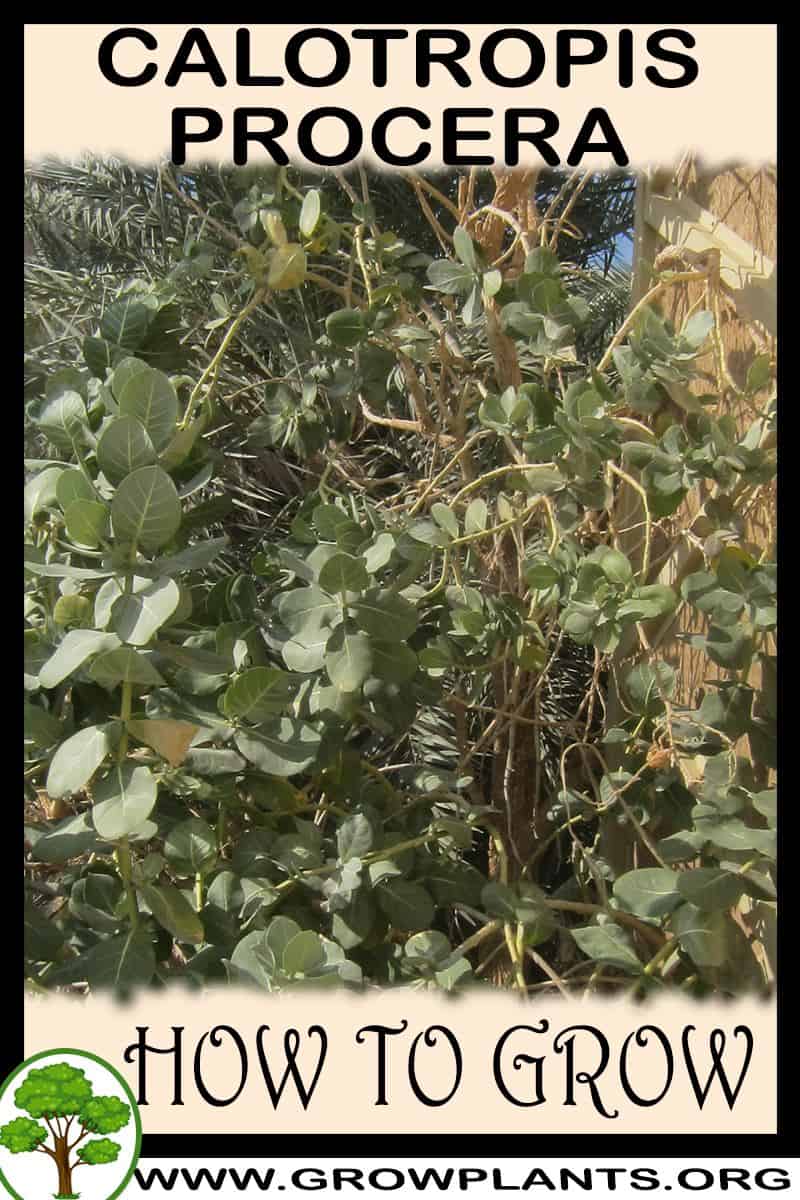
- Growth Habit & Form: Erect, sparsely branched shrub or small tree with a stout stem and thick, soft, grey-green foliage.
- Lifespan & Maturity: Perennial with moderate to slow growth; very drought and heat tolerant once established.
Anatomy & Physical Features
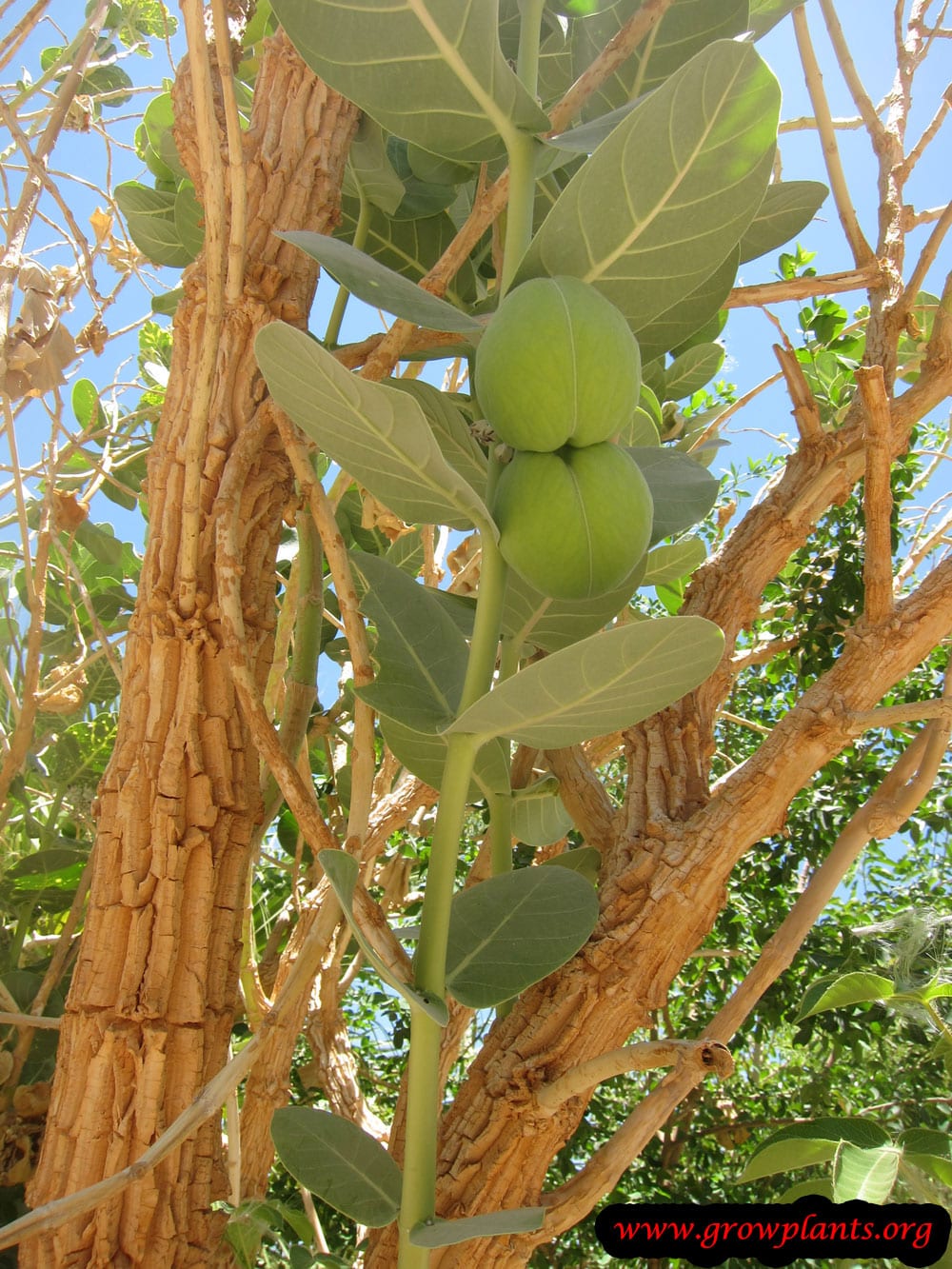
- Leaves & Foliage: Large, thick, egg-shaped to elliptic grey-green leaves that exude milky latex when cut.
- Flower Characteristics: Clusters of five-petalled white-and-purple flowers (full detail in the Bloom section).
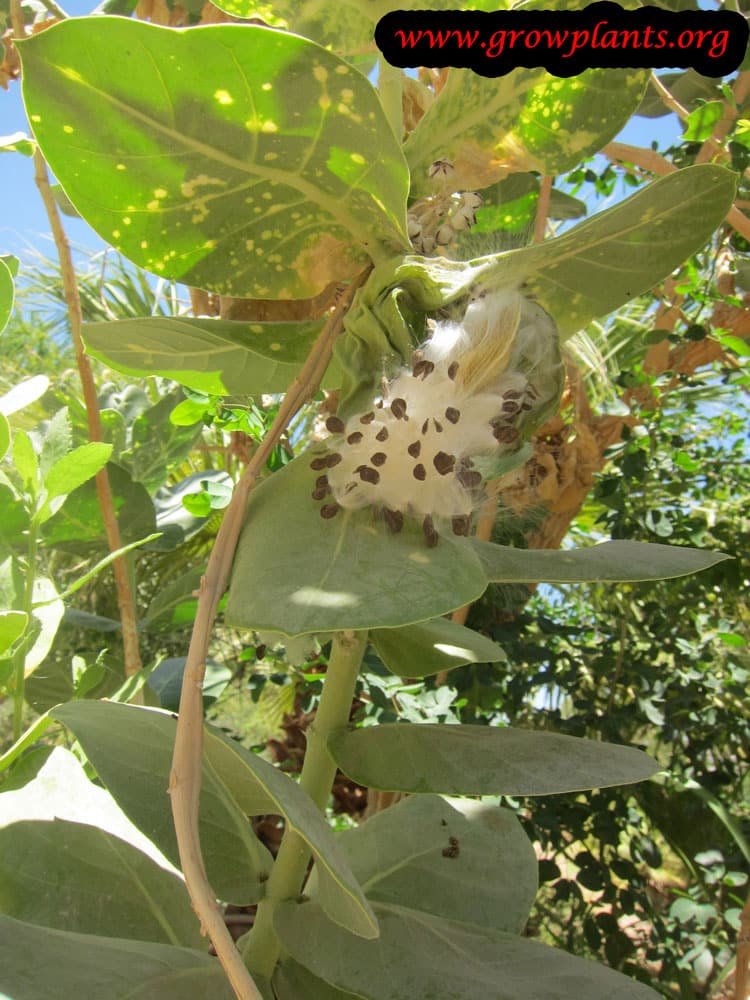
- Fruit Profile: Inflated, egg-shaped green pod (“apple of Sodom”) that is poisonous (full detail in the Fruit section).
Primary Uses & Landscape Value
- Functional & Ornamental Roles: Drought-tolerant ornamental and informal hedge/screen for arid gardens; also used as a traditional medicinal plant. Handle with care because of the toxic sap.
Care Guide: Planting, Soil & Watering
Overview: A tough, drought-tolerant desert shrub that thrives in poor, sandy, sharply drained soils and full sun. It needs very little water and resents wet feet.
Quick Care Requirements
| Requirement | Ideal Condition |
|---|---|
| Planting Season | Spring, or autumn to winter in hot desert climates |
| Growth Rate | Slow to Moderate |
| Soil Type | Sandy, sharply drained |
| Water Need | Low – drought tolerant, let the soil dry between waterings |
Planting & Establishment
- Best Planting Season: Plant in spring, or in autumn to winter in hot desert climates.
- How to Plant:
- Hole Preparation: Dig a hole slightly wider than the root ball in sandy ground.
- Soil Amendments: Amend heavy soil with coarse sand or grit for drainage rather than rich organic matter.
- Planting Depth: Set the root collar at soil level.
- Growth Speed & Expectations: Slow to moderate, reaching 1-3 m (3-10 ft).
Soil, Watering & Drainage Care
- Soil Mix & Drainage Needs: Prefers sandy, fast-draining soil; excellent drainage is essential to prevent root rot.
- Watering Schedule & Technique:
- Young / Newly Planted: Water occasionally to establish young plants.
- Established: Very drought tolerant – water sparingly, letting the soil dry out fully between waterings.
- Seasonal Adjustments: Minimal water in winter; a little more only in extreme summer heat.
Climate, Light & Hardiness
Calotropis procera (Apple of Sodom) is a rugged evergreen shrub of hot desert, subtropical and Mediterranean climates, thriving in full sun to half shade on poor, sandy ground. It is exceptionally heat- and drought-tolerant but frost-sensitive, restricting it to warm, largely frost-free regions.
Quick Climate Specifications
| Climate Zones | Desert, tropical, subtropical and Mediterranean |
| USDA Hardiness Zones | Approx. 9+ |
| Optimal Temp Range | Hot, roughly 22–35°C (72–95°F) |
| Cold Damage Begins | Around 2–5°C (36–41°F) |
| Approx. Survival Minimum | Near 0°C (32°F) briefly; frost damages or kills the top-growth |
| Frost Tolerance | Low |
| Light Conditions | Full sun to half shade |
| Wind Tolerance | Moderate to high |
| Salt / Coastal Tolerance | Moderate |
Sunlight & Light Exposure
Optimal Light Setup
Full sun suits it best and mirrors its native open, sun-baked habitats; it accepts half shade but grows more openly there.
Temperature Extremes & Hardiness
USDA Hardiness & Regional Limits
Grown outdoors in roughly zone 9 and warmer. The rating reflects a winter-cold limit, not a heat ceiling: it is one of the most heat-adapted shrubs available and struggles only where frost is regular.
Cold Damage & Winter Protection
Chilling injury begins around 2–5°C (36–41°F) and frost blackens the soft growth; in marginal areas an established plant may resprout from the base after a light frost.
Frost Sensitivity
Frost tolerance is low - occasional light frost may be survived by mature plants, but sustained or hard frost is damaging to fatal.
Extreme Heat Tolerance
Heat tolerance is outstanding; it grows through desert summers and intense sun that few shrubs endure.
Wind, Humidity & Microclimate
Dry-Air Tolerance
Adapted to arid air, it handles very low humidity with ease.
Coastal / Salt Tolerance
It grows on sandy, sometimes saline desert and coastal-fringe soils, giving it moderate tolerance of salty ground and spray - tolerance of saline substrate rather than a requirement for it.
Microclimate Recommendations
A hot, open, free-draining, sunny site is ideal; in cooler-winter areas choose the warmest frost-protected microclimate.
Growing in Pots, Balconies & Indoors
Calotropis procera (apple of Sodom) is a desert shrub, 1-3 m, with grey leaves and copious milky latex. It is not a houseplant, but it can be grown in a large pot in a very hot, sunny spot. Every part is poisonous, so site it with care.
Quick Details
- Container Size: A large, deep pot, roughly 20-40 L (5-10 gal) (general guide)
- Indoor Suitability: Not a houseplant – a large, toxic desert shrub
- Best Spot: Full sun to half shade; loves heat
- Soil & Drainage: Sharp, free-draining, sandy mix
- Watering in Pots: Water sparingly – it is very drought-tolerant and hates wet feet
Indoors & On the Windowsill
- Houseplant: The grower’s answer is No – and its toxic latex makes it a poor choice near living space.
- Windowsill growing: Not suitable; it needs intense outdoor heat and sun and grows into a shrub.
On a Balcony or Patio
- Light & wind: Give it the hottest, sunniest spot; it thrives on reflected heat and tolerates wind and drought. Let pots dry well between waterings.
- Practicalities: Use a heavy, well-draining pot and keep it out of reach of children and pets.
Choosing the Pot, Soil & Long-Term Care
- Pot & drainage: A large, deep pot with strong drainage; Use a pot with strong drainage holes and skip a standing-water saucer to avoid root rot; terracotta breathes and dries out faster, while glazed or plastic pots hold moisture longer.
- Potting mix: Use a gritty, fast-draining cactus and succulent mix, adding extra perlite, pumice or coarse sand; wet, heavy soil rots the roots.
- Feeding: Little needed – feed lightly if at all.
- Repotting: Top up fresh mix each season and renew the soil or pot up about every couple of years, lightly trimming the root ball and top growth of established plants.
- Safety: Highly toxic – the milky sap is poisonous and severely irritates skin and eyes, and all parts are dangerous if eaten. Never grow it where children or pets could reach it, and wash your hands after handling.
Growing this plant in a greenhouse
A greenhouse can give calotropis procera frost protection and cold protection. In the right climate it may also be kept growing through winter, depending on how much warmth and light are provided.
Greenhouse at a glance
| Greenhouse suitability | Conditional - depends on your climate |
|---|---|
| Main benefits | frost protection, cold protection |
| Season extension | earlier spring & later autumn |
| Outdoor protection advisable below | about 5°C |
| Maintain greenhouse minimum | around 5°C for active growth |
| Suitable types | unheated greenhouse, polycarbonate greenhouse, lean-to |
| Heating | Heating is optional - useful mainly for winter growing in cold areas. |
Related greenhouse guides
- Greenhouses: How to Choose the Right Greenhouse
- Best Lean-To Greenhouses
- Polycarbonate Greenhouses: What to Look for Before Buying
Fertilizing & Feeding
A light feeder: an occasional light balanced feeding through the warm season plus organic matter is plenty for this tough, drought-tolerant shrub, with feeding eased off while growth is slow.
Quick Fertilizing Specs
| Feeding Level | Light feeder |
|---|---|
| Main Nutrient Priority | Balanced feeding with adequate nitrogen for foliage |
| Best Feeding Period | Spring through the warm active growing season |
| Organic Options | Compost, humus, and other organic matter |
| Reduce/Stop Feeding | Ease off feeding through cool weather |
| Micronutrients | Usually met by organic matter and a complete fertilizer; correct only diagnosed issues |
| Soil pH | Slightly acidic to near neutral; tolerates lean, well-drained ground |
Feeding by Growth Stage
Spring flush of growth
Support fresh growth as the shrub resumes activity in the warm season.
| Nutrient direction | A balanced complete fertilizer with adequate nitrogen for healthy foliage and stems. |
|---|---|
| Timing | As growth resumes in spring or the warm season. |
| Frequency | A light feeding at the start of active growth. |
| Fertilizer types | A balanced complete fertilizer, Compost or other organic matter |
| Precautions | Keep feeding light; this is a tough, drought-tolerant shrub that needs very little. |
Warm-season active growth
Maintain steady growth through the warm season.
| Nutrient direction | Occasional light balanced feeding sustains growth without forcing soft, floppy stems. |
|---|---|
| Timing | Through the warm active growing season. |
| Frequency | An occasional light feeding as needed. |
| Fertilizer types | A balanced complete fertilizer, Compost as a top-dressing |
| Precautions | Avoid overfeeding this drought-adapted shrub, which does best on lean, well-drained soil. |
Cool-season rest
Let the shrub rest through cool weather without pushing new growth.
| Nutrient direction | None – withhold fertilizer while the plant is not in active growth. |
|---|---|
| Timing | During cool weather and slowed winter growth. |
| Frequency | No feeding at this stage. |
| Fertilizer types | No feeding at this stage; hold off fertilizing until active growth resumes. |
| Precautions | Do not fertilize a resting plant; feeding now wastes nutrients and risks salt buildup. |
Nutrient Deficiency Signs & Corrections
Older, lower leaves fade to pale green or uniform yellow and overall growth slows.
| Possible causes | low available soil nitrogen, nitrogen leaching from heavy watering or rain, thin, low-organic-matter soil |
|---|---|
| Appears first on | older, lower leaves |
| What to check | recent feeding history, soil organic matter, watering and drainage |
| Possible correction | Apply a nitrogen-containing complete fertilizer and build soil organic matter, then water evenly. |
Interveinal yellowing on older leaves while the veins themselves stay green.
| Possible causes | low soil magnesium, high-potassium feeding competing with magnesium uptake, leaching in light, sandy soils |
|---|---|
| Appears first on | older, lower leaves |
| What to check | soil magnesium status, how potassium-heavy recent feeding has been, soil texture and leaching |
| Possible correction | Apply a labeled magnesium source such as Epsom salt or a dolomitic amendment and rebalance feeding. |
Leaf margins brown or scorch and growth stalls despite adequate watering.
| Possible causes | fertilizer salt buildup in the root zone, under-watering that concentrates salts, excessive or too-frequent feeding |
|---|---|
| Appears first on | leaf margins and tips |
| What to check | recent fertilizer amounts, watering consistency, drainage, especially in containers |
| Possible correction | Ease off feeding, water thoroughly to flush accumulated salts, then return to lighter feeding. |
Pruning, Training & Seasonal Maintenance
Apple of Sodom is a drought-adapted desert shrub that needs very little pruning — occasional shaping and removal of dead wood is all it asks. It tolerates being cut back and reshoots on new growth, where it also flowers. The overriding practical issue is its copious caustic milky latex, which is dangerous to the eyes, so protection matters far more than any seasonal rule.
Quick Pruning & Maintenance Specs
| Pruning Tolerance | Moderate to High — reshoots after cutting back |
| Primary Pruning Window | Warm, dry weather (spring into summer) |
| Secondary Maintenance Window | Any time for dead-wood removal |
| Typical Frequency | Occasional — shaping only |
| Main Objective | Size and shape control; remove deadwood |
| Young Plant Priority | Establish a single or multi-stem framework |
| Mature Plant Priority | Remove dead and crossing wood; light shaping |
| Best Tool Type | Bypass secateurs; loppers for older stems |
| Avoid Heavy Pruning During | Cold snaps and around children or pets (fresh sap) |
Pruning by Plant Age & Size
Newly Established
Remove only damaged shoots; let the young shrub build its natural, sparse desert form.
Young / Formative
Choose whether to grow it as a single-stemmed small tree or a multi-stemmed shrub and remove competing stems accordingly. Beyond that it needs no formal training.
Mature / Established
Take out dead, weak or crossing wood and lightly shorten to keep it in scale. It carries a naturally open canopy, so heavy thinning is unnecessary.
Seasonal Pruning Schedule
Warm dry season: the safest time for any shaping cut — wounds dry quickly and the plant reshoots readily. Flowers follow on the new growth in spring and summer.
Ongoing sanitary: remove dead branches whenever noticed.
Flowering & Fruiting Wood
Bloom is carried on new growth, so cutting back stimulates fresh vegetative shoots and then flowers; a hard cut delays that season’s bloom only briefly while new wood matures. The fruit is a poisonous inflated pod — remove it if you do not want self-seeding.
Structural Pruning & Training
Keep it minimal: remove deadwood and the occasional crossing stem. The plant’s sparse structure rarely needs density management.
Special Growth to Remove
- Dead and broken wood.
- Root suckers where it tries to spread — dig or cut them out if you are containing it.
- Poisonous pods if you wish to prevent seeding.
Container & Small-Space Pruning
In a pot it stays smaller and is easily kept in shape with light tip pruning; keep it on the dry side and avoid overwatering the fresh cuts.
Tools
Bypass secateurs for shoots and loppers for older basal stems. No saw or shears are needed on this open shrub.
Tool Hygiene & Disease Risk
Disease risk is routine — a clean sharp blade is enough. The dominant hazard is the abundant latex: wear goggles and gloves, keep the sap away from your face, and wash tools and skin afterwards. This is a safety measure, not tool sterilisation.
Cut Placement & Technique
Cut just outside the branch collar and back to a junction; use thinning cuts rather than shearing, and expect a bleed of latex from every wound.
Heavy Pruning & Rejuvenation
Tolerated — an old, leggy plant can be cut back hard and will reshoot from lower wood. Do this in warm weather so the large wounds dry cleanly.
Post-Pruning Care
Do not overwater this desert plant after pruning; hard cutting already forces regrowth without feeding. Wash off all sap and dispose of the toxic prunings safely.
Common Pruning Mistakes
- Pruning without eye protection — the latex can seriously injure the eyes.
- Overwatering after a hard cut, which invites rot in a plant built for drought.
- Composting the toxic pods and prunings where they can seed or poison.
When NOT to Prune
Avoid cutting just before cold weather, and do not prune where fresh dripping sap can reach children, pets or your own eyes.
Recommended Tools (by task)
- bypass_secateurs — clean shaping cuts on green and semi-woody shoots.
- loppers — for older basal stems when reshaping or rejuvenating.
Pruning Troubleshooting
| Problem | Possible Cause | What to Check | Corrective Action |
| Leggy, sparse habit | Natural open form or old wood | Age and vigour of stems | Cut back hard in warm weather to force lower reshooting |
| Rot or dieback after cutting | Overwatering wet wounds | Soil moisture and drainage | Keep dry after pruning; prune only in warm dry spells |
| Unwanted spread | Root suckers and self-seeding | New shoots away from the crown; ripe pods | Remove suckers and cut pods before they open |
Propagation Guide
Calotropis (apple of Sodom) is grown mainly from seed — its plumed, wind-borne seed germinates readily in warm, well-drained soil — with semi-hardwood stem cuttings as a vegetative alternative. A drought-tolerant plant of hot climates, it is Easy to Moderate.
Quick Propagation Specs
| Best Propagation Method | Seed |
| Alternative Methods | Semi-hardwood stem cuttings |
| Propagation Difficulty | Easy–Moderate |
| Seed True-to-Type | Comes true as a species; the plumed seed is wind-dispersed |
| Vegetative True-to-Type | Yes (cuttings reproduce the parent) |
| Best Propagation Season | Spring / warm season |
| Germination Temperature | Warm, roughly 20–30°C (68–86°F) |
| Grafting Required | No |
Growing from Seed
Seed Handling & Viability
The pods release many silky-plumed seeds; sow fresh into free-draining, sandy soil.
Germination Conditions
Germinates readily and fairly quickly in warm conditions.
Seedling Care
Keep seedlings on the dry side in gritty, sandy soil — the plant resents wet feet.
Stem Cuttings
Cutting Type & Setup
Take semi-hardwood cuttings, let the cut milky latex dry, then set in a gritty, well-drained medium kept warm and barely moist. The latex is poisonous, so handle with care.
Bloom & Flower Guide
Quick Details
- Bloom Season: Spring to summer
- Time to First Bloom: Once the shrub is established (perennial)
- Flower Appearance: White-green flowers marked with purple, five petals, borne in clusters
- Edibility: ⚠️ Not edible – the plant has toxic milky sap and the fruit is poisonous; grown as an ornamental only
Detailed Blooming Overview
Sodom apple is a tough, drought-tolerant shrub that carries clusters of white-green, purple-marked five-petalled flowers through spring and summer.
Flower Characteristics
- Appearance & habit: Five-petalled white-green flowers, purple-tinted, in clusters.
- Safety: All parts exude a toxic milky latex; keep away from eyes, skin, children and pets.
Bloom Care & Pollination
- Pollination: Insects, including bees.
Pests, Diseases & Troubleshooting
Overview: Calotropis is a tough, drought- and heat-loving milkweed shrub whose toxic, milky latex makes it resistant to most generalist pests; the insects that do attack it are the specialist milkweed feeders that tolerate its cardenolides. It has few diseases and thrives on neglect in hot, dry ground – its real weaknesses are cold and wet feet. Note that the sap is poisonous and irritant, so handle with care.
Quick Troubleshooting Overview
| Issue / Pest | Main Symptom | Primary Solution |
|---|---|---|
| Oleander aphid | Bright yellow aphids massing on shoots | Hose off, encourage predators, soap |
| Milkweed bugs | Orange-black bugs on pods and stems | Tolerate, hand-pick heavy numbers |
| Tussock / milkweed moth | Defoliating hairy caterpillars | Hand-pick, tolerate as specialist feeders |
| Whitefly / mealybugs | Sticky honeydew, sooty mould | Soap / oil, encourage beneficials |
| Root rot | Wilt and collapse in wet soil | Improve drainage, ease off water |
| Cold / frost damage | Blackened, wilted soft growth | Protect or site in warm frost-free spot |
Common Pests & Management
- Oleander aphid (Aphis nerii):
- Symptoms: Its signature pest: dense colonies of bright yellow aphids with black legs massed on soft shoot tips, flower stalks and pods, producing sticky honeydew and sooty mould and distorting new growth.
- Prevention & Control: Blast the yellow colonies off with a water jet and encourage ladybirds, lacewings and hoverfly larvae, which relish them. Where needed, treat with insecticidal soap or neem in the cool of the day; the plant tolerates aphids well and rarely needs strong measures.
- Milkweed bugs (Spilostethus pandurus, Oncopeltus species):
- Symptoms: Striking orange/red-and-black seed bugs, adults and clustered nymphs, feeding on the pods, seeds and stems; mostly cosmetic, though heavy feeding reduces seed set.
- Prevention & Control: Tolerate them as part of the milkweed community, or hand-pick and reduce clusters on ornamental plants. Chemical control is seldom warranted and would harm the beneficial insects the plant supports.
- Milkweed tussock and tiger moths (Euchaetes egle and related, Danaus larvae):
- Symptoms: Hairy tufted caterpillars (and the larvae of milkweed butterflies) that chew and can defoliate stems, tolerating the toxic sap that repels other insects; you may see rapid leaf loss and frass.
- Prevention & Control: These specialist feeders are usually tolerated – the shrub regrows readily. Hand-pick if defoliation is unacceptable on a specimen plant; avoid broad insecticides, which would also kill the butterflies the plant hosts.
- Whitefly and mealybugs (Bemisia tabaci, Planococcus species):
- Symptoms: White flying insects or cottony mealybug tufts on soft growth and leaf undersides, with honeydew and sooty mould, mostly on sheltered or stressed plants.
- Prevention & Control: Encourage natural enemies and rinse off colonies; treat persistent infestations with insecticidal soap or horticultural oil, covering leaf undersides. Keep plants unstressed and airy.
- Spider mites (Tetranychus species):
- Symptoms: Fine stippling and bronzing with webbing in very hot, dry, dusty conditions, especially on sheltered container plants.
- Prevention & Control: Hose down foliage and treat with horticultural oil or insecticidal soap if needed; outdoor plants in open sun rarely suffer badly.
Diseases & Fungal Issues
- Root and collar rot (Pythium, Phytophthora, Fusarium species):
- Symptoms: Wilting, yellowing and collapse of plants standing in wet, cold or poorly drained soil, with dark rotten roots and stem bases – the main way this desert shrub is lost.
- Treatment & Management: Prevention is straightforward: plant in free-draining or sandy soil, water sparingly and never let the roots sit wet, especially in cool weather. Remove collapsed plants; the species otherwise resents pampering.
- Leaf spots (Alternaria, Cercospora species):
- Symptoms: Brown or dark angular spots and blotches on the leaves in humid conditions or on crowded, over-watered plants; usually minor and cosmetic.
- Treatment & Management: Improve airflow, avoid overhead watering and remove affected leaves. Rarely needs fungicide; keeping the plant lean and sunny prevents most spotting.
- Rust and sooty mould (rust fungi / sooty moulds on honeydew):
- Symptoms: Occasional orange rust pustules on leaves, or black sooty mould coating growth wherever sap-suckers leave honeydew.
- Treatment & Management: Remove rust-affected leaves and control the underlying aphids, whitefly or mealybugs to eliminate sooty mould; both clear up once the sap-suckers are managed.
Growing Difficulties & Abiotic Problems
- Toxic irritant sap:
- Cause & Symptoms: Not a disorder of the plant but a key handling issue: the copious milky latex is poisonous and severely irritating to skin, eyes and mucous membranes.
- Correction Strategy: Always wear gloves and eye protection when pruning or handling, wash off any sap promptly, and keep cuttings and plant parts away from children, pets and livestock. This is a safety note rather than a treatment.
- Cold and frost damage:
- Cause & Symptoms: As a tropical/subtropical shrub it blackens and wilts in cold, and soft growth is killed by frost.
- Correction Strategy: Grow in a warm, frost-free position or protect or bring under cover in cold weather; in marginal climates treat it as a container or tender plant.
- Waterlogging and over-care:
- Cause & Symptoms: Rich, wet, coddled conditions cause soft weak growth prone to rot and sap-suckers – the opposite of what this desert plant wants.
- Correction Strategy: Give it full sun, lean free-draining soil and minimal water once established; avoid heavy feeding and overwatering.
- Poor drainage root death:
- Cause & Symptoms: Heavy, compacted or waterlogged soil rots the deep taproot and kills otherwise tough plants.
- Correction Strategy: Plant on well-drained or raised ground, or in gritty container mix, and let the soil dry between waterings.
What Helps – Products & Tools
This shrub needs very little: its toxic latex does most of the pest defence for it. Where action is required, use a water jet, insecticidal soap or neem/horticultural oil for aphids, whitefly, mealybugs and mites, and hand-picking for the specialist milkweed caterpillars and bugs. The most important measures are cultural – sharp drainage, full sun and restraint with water – plus gloves and eye protection because of the poisonous sap.