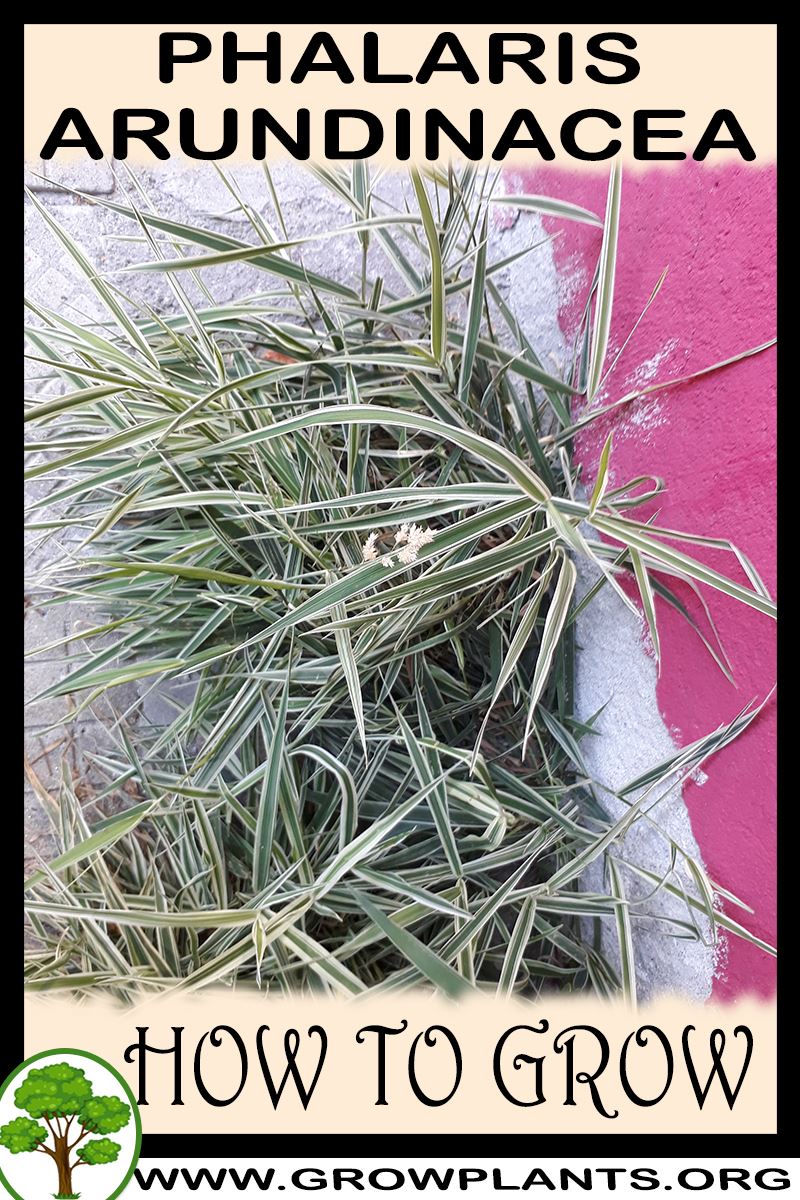
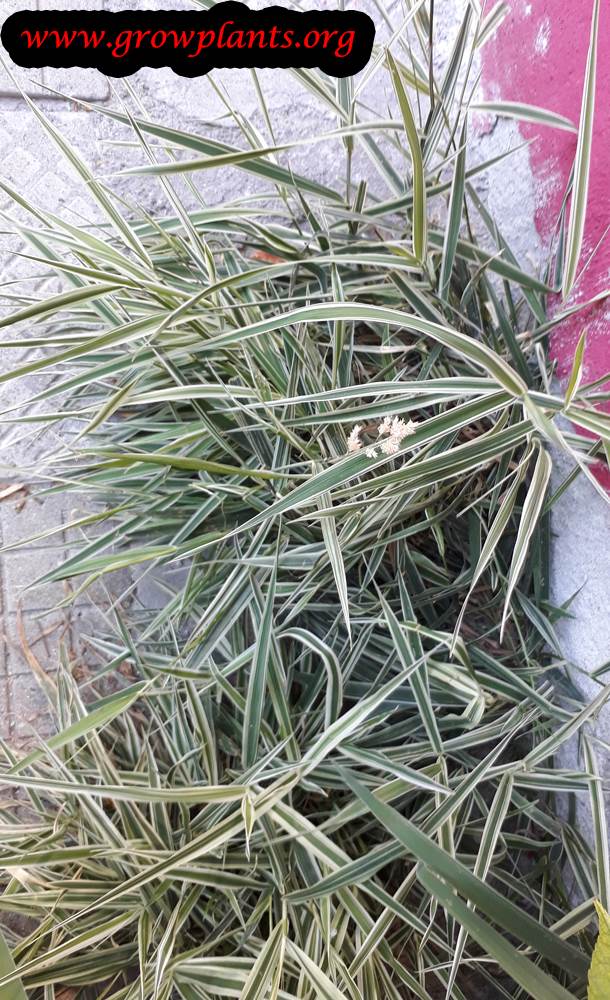
Plant Profile & Key Characteristics
Overview: A vigorous rhizomatous perennial grass 0.5-2 m (1.6-6.5 ft) tall, often grown in its white-striped variegated form. It is used as an ornamental and erosion-binding grass, though its running roots make it aggressively spreading.
Quick Specifications
| Specification | Attribute |
|---|---|
| Plant Type / Life Cycle | Perennial (occasionally grown as an annual) |
| Foliage Type | Semi-evergreen (dies back in cold winters) |
| Mature Size | 0.5-2 m (1.6-6.5 ft) tall |
| Growth Rate | Fast to moderate |
| Root System | Spreading rhizomes (aggressive, can be invasive) |
| Hardiness | USDA zones 2-10 |
Growth Form & Structure
- Height & Spread: Upright canes 0.5-2 m (1.6-6.5 ft) tall spreading indefinitely by rhizome; best contained in a pot or a sunken barrier to check its running roots.
- Growth Habit & Form: Running, clump-then-colony grass; erect leafy stems arise from a network of creeping rhizomes to form dense stands.
- Lifespan & Maturity: A persistent perennial that quickly builds into a colony; foliage dies back in hard winters and regrows from the rhizomes.
Anatomy & Physical Features
- Leaves & Foliage: Linear arching leaves, plain green or (in the popular ribbon-grass forms) green striped with white.
- Flower Characteristics: Small green-yellow flowers in narrow, beard-like plumes in summer to autumn.
Primary Uses & Landscape Value
- Functional & Ornamental Roles: Grown as a variegated ornamental grass, groundcover and bank binder for erosion control and damp ground; best sited where its spread can be managed.
Care Guide: Planting, Soil & Watering
Overview: Reed canary grass is a vigorous moisture-loving grass that thrives in full sun to part shade in consistently moist, even wet ground. It is adaptable and undemanding about soil but spreads aggressively, so it is often best contained.
Quick Care Requirements
| Requirement | Ideal Condition |
|---|---|
| Planting Season | From spring through autumn in the warm season |
| Growth Rate | Fast |
| Soil Type | Moisture-retentive, tolerant of heavy or wet soil |
| Water Need | High — keeps growing in moist to boggy ground |
Planting & Establishment
- Best Planting Season: Plant from spring through autumn during the warm growing season.
- How to Plant:
- Hole Preparation: Dig a hole as deep as the root ball and a little wider; to curb its spread, plant within a buried barrier or a bottomless container.
- Soil Amendments: No special enrichment is needed; it grows in a wide range of soils, including damp, heavy ground.
- Planting Depth: Set the root ball level with the surrounding soil, keeping the crown at the surface.
- Growth Speed & Expectations: Expect fast, spreading growth to a stand 0.5–2 m tall.
Soil, Watering & Drainage Care
- Soil Mix & Drainage Needs: Unlike most plants it welcomes wet feet, but ordinary moist, well-structured soil is fine; in a container it can also sit in a saucer of water.
- Watering Schedule & Technique:
- Young / Newly Planted: Keep the soil consistently moist while young plants root in.
- Established: Water regularly and generously to keep the ground moist; it will not object to periodically saturated soil.
- Seasonal Adjustments: Water more in summer heat; it naturally slows and can be cut back in autumn and winter.
Climate, Light & Hardiness
Reed canary grass is an exceptionally cold-hardy, moisture-loving grass suited to mediterranean, subtropical, and temperate climates, growing well in full sun to half shade. It is one of the hardiest ornamental grasses covered on this site, tolerant of severe winters down to USDA Zone 2.
Quick Climate Specifications
| Climate Zones | mediterranean, subtropical, and temperate |
| USDA Hardiness Zones | Zones 2–10 |
| Optimal Temp Range | Approximately 13–27°C (55–81°F) during active growth |
| Cold Damage Begins | Approximately 0°C (32°F) – foliage dies back with frost as part of its normal autumn/winter cycle |
| Approx. Survival Minimum | Roughly −45 to −40°C (−50 to −40°F) for the root system, in line with USDA Zone 2 |
| Frost Tolerance | High |
| Light Conditions | Full Sun / Half Shade |
| Wind Tolerance | Moderate |
Sunlight & Light Exposure
Optimal Light Setup
Full sun gives the most vigorous growth, though it also performs well in half shade.
Shade & Heat Management
It is comfortable in partial shade and across a broad range of summer temperatures, from cool temperate to warmer subtropical climates, provided the soil stays moist.
Best Exposure / Orientation
Streamsides, pond margins, and other consistently moist open sites suit it best.
Temperature Extremes & Hardiness
USDA Hardiness & Regional Limits
Reliably hardy through USDA Zones 2–10, an unusually wide range that reflects its origin as a tough, cold-climate wetland grass; the top growth dies back with winter cold and regrows from the roots each spring.
Cold Damage & Winter Protection
Winter dieback of the foliage is normal and expected; no protection is needed within its very broad hardy range.
Frost Sensitivity
High tolerance overall; new spring shoots can be nipped by a late hard frost but the plant regrows readily.
Extreme Heat Tolerance
Good through the warmer end of its range, though it is chosen primarily for cold-hardiness and moist sites rather than for heat or drought.
Wind, Humidity & Microclimate
Humidity Preferences
Prefers consistently humid, moist conditions rather than dry air.
Wind Tolerance
Moderate; the upright canes can lean in strong open wind.
Rainfall & Seasonal Moisture
Native to consistently moist, often waterlogged temperate habitats, so it is adapted to climates with reliable rainfall or standing water rather than seasonal drought.
Microclimate Recommendations
Low-lying, damp, or waterside microclimates match its native wetland habitat and suit it far better than dry, exposed sites.
Growing in Pots, Balconies & Indoors
Phalaris arundinacea (reed canary grass) is a spreading ornamental grass (0.5-2 m / 20-80 in), not a houseplant, but it grows well in a container – and a pot is a smart way to enjoy it, since it contains its running roots. Indoors the light is too weak; grow it outdoors in full sun to half shade.
Quick Details
- Container Size: A medium to large pot; a solid container is ideal for holding in this grass’s vigorous, spreading roots.
- Indoor Suitability: Not a houseplant; grow it outside on a balcony or patio.
- Best Spot: Full sun to half shade.
- Soil & Drainage: Moisture-retentive mix – this grass likes damp conditions and even tolerates wet soil.
- Watering in Pots: Keep it well watered; it takes average to generous water and dislikes drying out, but the pot should still drain.
Indoors & On the Windowsill
- Houseplant limits: The grower confirms it is not an indoor plant – it needs full sun to half shade and open air.
- Overwintering: Hardy and dies back for winter; a potted plant can stay outdoors and reshoots in spring.
On a Balcony or Patio
- Light & wind: Give it a bright spot; it copes with some shade. Reflected wall heat dries pots fast, and this moisture-lover suffers if it dries out – check and water often in warm weather.
- Practicalities: A container keeps its running roots in check – a real benefit with this vigorous grass. Ensure runoff drains away cleanly.
Choosing the Pot, Soil & Long-Term Care
- Pot & drainage: A sturdy pot with drainage holes; because it likes moisture, glazed or plastic that holds water suits it better than fast-drying terracotta. Avoid fully stagnant water, though.
- Potting mix: A rich, moisture-retentive potting mix (coir or peat with some perlite for aeration).
- Feeding: Feed lightly through the growing season, as potted plants leach nutrients faster than those in the ground.
- Repotting & division: It fills a pot fast; lift and divide the clump every couple of years, trim the roots and refresh the mix to keep it healthy and controlled.
Fertilizing & Feeding
Reed canary grass is a vigorous, spreading perennial grass grown for its foliage, and it is known to be an aggressive, even invasive grower in favorable moist sites. It generally does not need heavy feeding to thrive; the priority is keeping growth even and well colored rather than pushing extra vigor into an already fast-spreading plant.
Quick Fertilizing Specs
| Feeding Level | Light feeder; established plantings rarely need more than minimal supplemental nutrition |
|---|---|
| Main Nutrient Priority | A balanced feeding approach with modest nitrogen to maintain good foliage color and density |
| Best Feeding Period | Spring into the main warm-season growth flush |
| Soil pH | Adaptable to a broad range of soil conditions, including consistently moist sites |
| Reduce/Stop Feeding | Feeding is not needed once growth slows going into autumn and winter dormancy |
| Organic Options | Compost worked into the soil at planting supports steady growth without forcing excess vigor |
| Micronutrients | No routine micronutrient program is typically needed beyond what a complete fertilizer supplies |
Feeding by Growth Stage
Establishment after planting
Help newly planted divisions or plugs root in and begin spreading
| Nutrient direction | Balanced feeding with an emphasis on root establishment over top growth |
|---|---|
| Timing | The first growing season after planting or dividing |
| Frequency | A light feeding at planting and again as the season progresses is generally enough |
| Fertilizer types | A balanced, complete fertilizer, Compost worked into the planting area |
| Precautions | Because this species spreads readily, avoid over-feeding at establishment in areas where its spread needs to be contained |
Active spring and summer growth
Maintain healthy, well-colored foliage through the main growing season
| Nutrient direction | Balanced to modestly nitrogen-leaning feeding to support foliage color, kept light given the plant’s naturally vigorous habit |
|---|---|
| Timing | Spring through summer while the clump is actively producing new foliage |
| Frequency | Minimal feeding is usually enough once the planting is established; established stands often need little beyond what the site already provides |
| Fertilizer types | A balanced, complete fertilizer used sparingly |
| Routine trace nutrients | iron, manganese |
| Precautions | Avoid heavy nitrogen feeding, which can accelerate this already fast-spreading grass’s growth and encroachment on surrounding plantings |
Autumn and winter dormancy
Let the clump harden off naturally ahead of its autumn-winter cutback and rest period
| Nutrient direction | None – withhold fertilizer while growth is slowing and through dormancy |
|---|---|
| Timing | Autumn through winter, coinciding with the season’s natural cutback and pruning window |
| Frequency | No feeding at this stage |
| Fertilizer types | No feeding at this stage – resume only when active spring growth resumes |
| Precautions | Do not fertilize during the dormant season; late feeding can trigger tender new growth right before pruning and cold weather |
Nutrient Deficiency Signs & Corrections
Foliage that looks faded, pale green, or has lost its typical variegated contrast
| Possible causes | Nitrogen deficiency, Soil that has become depleted after years without any organic matter input, Root competition from surrounding dense plantings |
|---|---|
| Appears first on | Older foliage first, then general clump-wide fading if uncorrected |
| What to check | Overall clump density and vigor compared to previous seasons, Whether the site has ever received any feeding or compost, Root crowding from nearby aggressive plantings |
| Possible correction | Apply a balanced complete fertilizer lightly during active growth, or work compost into the surrounding soil |
New foliage showing yellowing between the veins while veins remain greener
| Possible causes | Iron deficiency related to consistently wet, poorly aerated soil limiting root function, High soil pH reducing iron availability, Root stress from prolonged waterlogging |
|---|---|
| Appears first on | Newest leaf growth |
| What to check | How saturated the soil stays and for how long after rain or irrigation, General soil pH in the planting area, Root condition if the clump can be inspected |
| Possible correction | Improve aeration and drainage where possible, and apply a chelated iron product per its label if the chlorosis persists |
Pruning, Training & Seasonal Maintenance
Phalaris arundinacea (reed canary grass) is a cold-hardy (zone 2-10), moist-soil rhizomatous grass with a genuine autumn/winter dormant season, unlike the near-year-round-blooming subtropical grasses elsewhere in this group. Its own care facts pair "dead leaves" removal with "controlling" – in practice, cutting back manages appearance and can reduce seed-head spread if done before seed set, but does not stop the rhizome spread that makes this species a documented wetland invasive; where containment matters, physical rhizome control is a separate task from pruning.
Quick Pruning & Maintenance Specs
| Pruning Tolerance | High – tolerates a full cutback |
| Primary Pruning Window | Autumn to winter, as the top growth dies back |
| Secondary Maintenance Window | Before seed set in summer, if limiting self-seeding matters |
| Typical Frequency | Once a year, plus optional pre-seed-set removal of flower heads |
| Main Objective | Tidiness and reducing seed-based spread; does not control rhizome spread |
| Young Plant Priority | Establish first season; no cutback needed while still filling in |
| Mature Plant Priority | Annual autumn/winter cutback; rhizome containment where spread is unwanted |
| Best Tool Type | Hedge shears or hand shears |
| Avoid Heavy Pruning During | Active summer growth, when the plant is still using the foliage rather than dormant |
Pruning by Plant Age & Size
Newly Established
Leave the young planting to fill in through its first growing season; remove only clearly damaged growth.
Young / Formative
No structural training applies to the foliage; the main formative decision, given its documented invasive spread, is whether to install a rhizome barrier before the planting establishes.
Mature / Established
Annual autumn/winter cutback of the dieback foliage; check the planting margins periodically for rhizome spread beyond the intended area regardless of how the top growth is cut.
Seasonal Pruning Schedule
| Dormant/Winter | Objective: tidiness as the top growth dies back. Remove: cut dead/browned foliage back near ground level. Do not remove: any foliage still green and functional in milder-zone plantings. Response: fresh shoots rise from the crown and rhizome in spring. Bloom impact: none – flowering is on the current season’s new growth. |
| Ongoing Sanitary | Objective: limit seed-based spread. Remove: flower/seed heads before they mature and shed, where self-seeding into surrounding areas is a concern. Do not remove: foliage still actively growing. |
Structural Pruning & Training
Cutting back the foliage does not contain this species – it spreads by rhizome as well as seed. Where its documented wetland-invasive tendency is a concern, use a physical rhizome barrier or grow it in a container, and remove any rhizome or shoot found beyond the intended boundary.
Special Growth to Remove
- Rhizome runners/shoots emerging outside the planting area – dig out and remove; cutting the visible growth does not stop the rhizome underneath.
- Flower/seed heads – remove before shedding if limiting self-seeding matters, particularly near waterways given its moist-soil habit.
- Dead or browned foliage – remove during the autumn/winter cutback.
Container & Small-Space Pruning
Growing in a container is one of the more effective ways to keep this rhizome-spreading, moist-soil grass out of surrounding beds or waterways. Container specimens still get the same autumn/winter cutback as in-ground plantings.
Tools
- Hedge shears or hand shears – efficient for the annual dieback cutback.
- Precision snips – removing individual seed heads before shedding.
Tool Hygiene & Disease Risk
Routine – no disease issue is flagged for this species; clean, sharp tools are sufficient. Given its wetland habit, avoid discarding cut foliage or seed heads into or near water bodies, where fragments or seed could establish.
Cut Placement & Technique
Cut the dieback foliage back near ground level, above the crown; bundle before cutting for easier cleanup on a larger planting.
Heavy Pruning & Rejuvenation
The annual autumn/winter cutback is the routine reset this species needs; it regrows readily from the crown and rhizome each spring given its fast-medium growth rate.
Post-Pruning Care
No feeding needed to force regrowth. In consistently moist or wetland-adjacent plantings, watering is rarely a post-cutback concern; simply allow the site’s natural moisture to support spring regrowth.
Common Pruning Mistakes
- Assuming the cutback controls the plant’s spread – it does not; rhizome containment is a separate task.
- Cutting during active summer growth rather than waiting for autumn/winter dieback.
- Discarding cut foliage or seed heads into or near waterways, given this species’ documented wetland-invasive behavior.
When NOT to Prune
Avoid cutting during active summer growth; the natural autumn/winter dieback window is both the plant’s own signal and the least disruptive time.
Recommended Tools (by task)
- hedge_shears – efficient for the annual dieback cutback on a larger planting.
- precision_snips – targeted removal of seed heads before they shed.
- garden_spade – removing rhizome runners that have crossed a containment boundary.
Propagation Guide
Plain green reed canary grass grows readily from seed and also spreads on its own by creeping rhizomes, so division of an existing clump is the faster, guaranteed-identical option. If propagating a variegated, green-and-white form, division is the reliable method, since seed-grown plants of variegated selections typically come up plain green rather than true to the parent. This grass is Easy to propagate by either method, and its rhizome spread is why it is noted as invasive.
Quick Propagation Specs
| Best Propagation Method | Rhizome/clump division |
| Alternative Methods | Seed (plain green forms only) |
| Propagation Difficulty | Easy |
| Seed True-to-Type | Usually true-to-type for plain green plants; variegated (green-and-white) selections do not come true from seed |
| Vegetative True-to-Type | Yes, including variegation |
| Best Propagation Season | Spring, summer or autumn, matching the plant’s recorded planting season |
Growing from Seed
Sow plain green forms in spring through autumn in a sunny to lightly shaded, moist site. Specific germination timing is not documented for this plant; allow several weeks and expect some unevenness, as is typical for this grass genus. Do not rely on seed to reproduce a variegated selection.
Division, Offsets, Pups & Suckers
Lift and divide the spreading rhizome clump in spring as new growth begins, or in autumn, separating sections that each carry roots and at least one or two shoots. Replant promptly at the original depth and water well until established. Because the rhizomes spread readily, site divisions where their outward growth can be contained or monitored.
Bloom & Flower Guide
Quick Details
- Bloom Season: Summer into autumn
- Time to First Bloom: Usually within the first season or two, once established
- Flower Appearance: Small green-yellow flowers packed into narrow, beard-like spikes that fade to straw
- Edibility: Ornamental only – grown as a foliage and structure plant, not for eating
Detailed Blooming Overview
Reed canary grass flowers quietly compared with its showier grass cousins. Through summer it lifts narrow, feathery spikes of tiny green-yellow flowers that gradually age to a soft straw colour. The popular variegated form is grown mainly for its striped foliage, with the flowers a modest bonus.
Flower Characteristics
- Small green-yellow flowers gathered into slim, beard-like spikes.
- The flower heads dry to straw and can be used in arrangements.
- Wind-pollinated, with plain, petal-less grass flowers.
Bloom Care & Thinning
- Encouraging bloom: Grows in full sun to part shade and tolerates damp ground; flowering is reliable once the clump is established.
- Tidying: Cut spent stems back after flowering to keep the clump neat; a hard cut-back can also refresh tired foliage.
- Keeping it in bounds: Reed canary grass spreads vigorously by rhizomes and seed and is invasive in wetlands, so site it where it can be contained and remove seed heads if spread is a concern.
Pests, Diseases & Troubleshooting
Overview: Reed canary grass, usually grown as the variegated ornamental ‘Picta’, is an exceptionally tough wetland grass with virtually no serious pests or diseases – its reputation is instead for aggressive, invasive spreading by rhizome. Occasional aphids or mites appear only on stressed plants, and rust may mark leaves in humid conditions. Management is far more about containment and tidying than about pest control.
Quick Troubleshooting Overview
| Issue / Pest | Main Symptom | Primary Solution |
|---|---|---|
| Invasive spreading | Rhizomes overrunning borders/wetland | Grow in a barrier or container; cut back hard |
| Leaf rust | Orange pustules on leaves | Cut back, improve airflow, remove debris |
| Aphids | Minor clusters on stressed plants | Usually needs no action; water jet if heavy |
| Scorched, tatty foliage | Brown, ragged leaves by late season | Shear to the ground to force fresh growth |
Common Pests & Management
- Aphids (Aphidoidea spp.):
- Symptoms: Small soft-bodied green, black or grey insects clustered on young leaf blades of stressed plants; causes curled, distorted foliage, sticky honeydew and sooty mould. Look-alikes: whitefly (which flies up when disturbed).
- Prevention & Control: Encourage ladybirds, lacewings and parasitic wasps; blast colonies off with a firm jet of water; remove badly infested tips. Persistent outbreaks respond to insecticidal soap or a light horticultural oil applied to leaf undersides in the cool of the evening to protect pollinators.
- Two-spotted spider mite (Tetranychus urticae):
- Symptoms: Fine pale stippling on leaves, faint webbing on undersides and leaf axils, and a dusty bronzed look in warm dry conditions. Tiny moving specks visible with a hand lens.
- Prevention & Control: Raise humidity and hose foliage regularly, as mites thrive in hot dry air; introduce predatory mites (Phytoseiulus persimilis) under cover. Treat hotspots with insecticidal soap or horticultural oil, ensuring thorough coverage of leaf undersides.
Diseases & Fungal Issues
- Rusts (Puccinia spp.):
- Symptoms: Orange, brown or yellow powdery pustules on leaf blades, mainly in humid, crowded conditions; heavy infection browns the foliage.
- Treatment & Management: Cut back and remove affected growth, thin clumps and clear debris to improve airflow; resistant vigorous clumps usually shrug it off without fungicide.
- Leaf spots & smuts (various fungi):
- Symptoms: Minor spotting or streaking on blades, largely cosmetic on this robust grass.
- Treatment & Management: Remove affected foliage and give the clump a hard shear; rarely needs treatment.
Growing Difficulties & Abiotic Problems
- Invasive rhizome spread:
- Cause & Symptoms: Vigorous creeping rhizomes let this grass escape and dominate borders, ponds and wetlands, crowding out other plants.
- Correction Strategy: Confine it to a sunken container or a solid root barrier, or a pond basket; cut back and divide regularly, and remove strays before they establish.
- Mid-season scorch / tattiness:
- Cause & Symptoms: Heat, drought or old growth leaves foliage brown, ragged and reverted to green on variegated forms.
- Correction Strategy: Shear the whole clump to the ground in mid-season to force a flush of fresh, brightly variegated leaves; keep moist for best colour.
- Reversion of variegation:
- Cause & Symptoms: Variegated ‘Picta’ can throw all-green shoots that outcompete the variegated ones.
- Correction Strategy: Cut out green-reverting shoots at the base as soon as they appear to keep the clump variegated.
What Helps – Products & Tools
This grass needs almost no pest or disease products; its essential ‘tool’ is a physical root barrier or container to contain its spread, plus shears for a hard mid-season cut-back. Only if rust becomes heavy in a damp season would airflow-improving pruning (rather than fungicide) be the answer. Leave the odd aphid to natural predators.