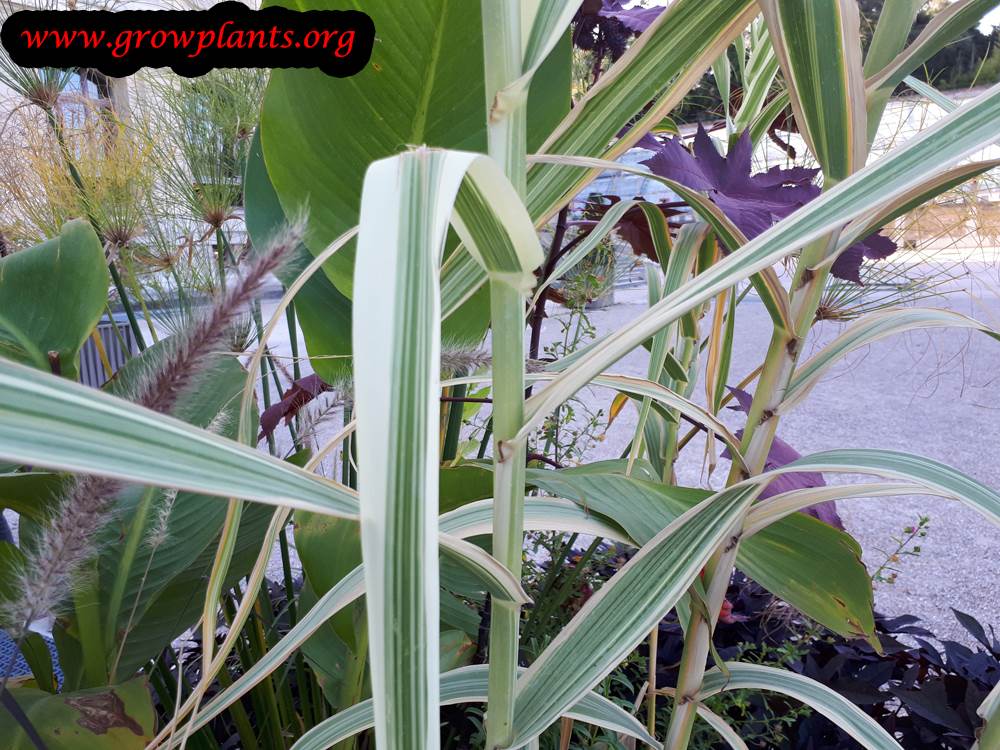

Plant Profile & Key Characteristics
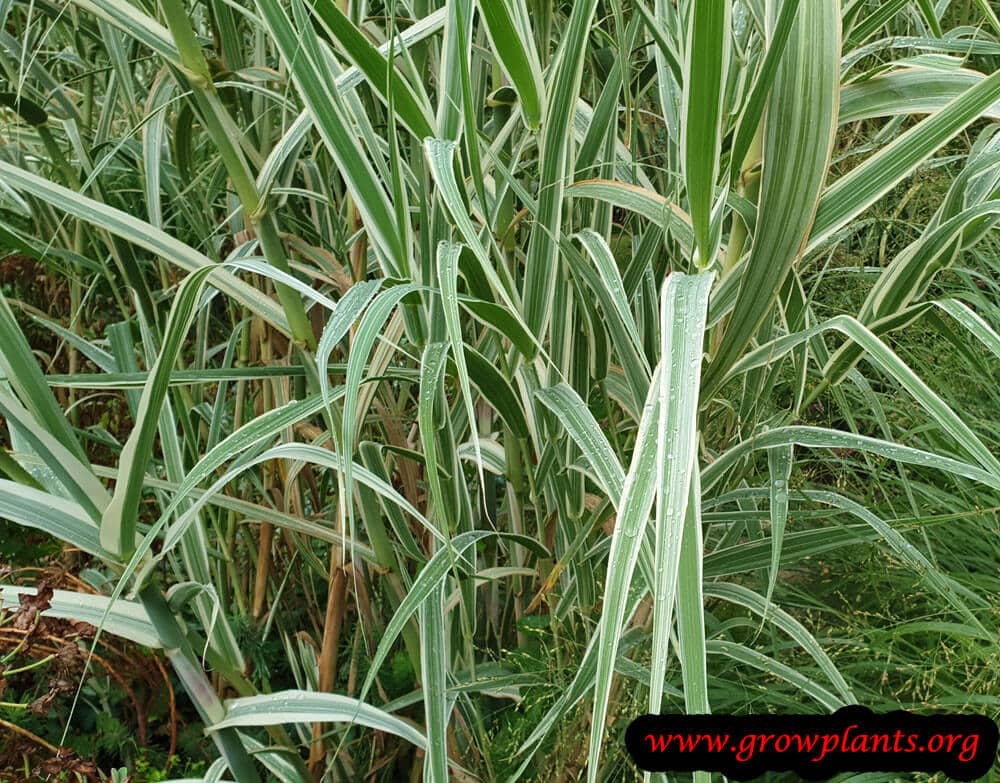
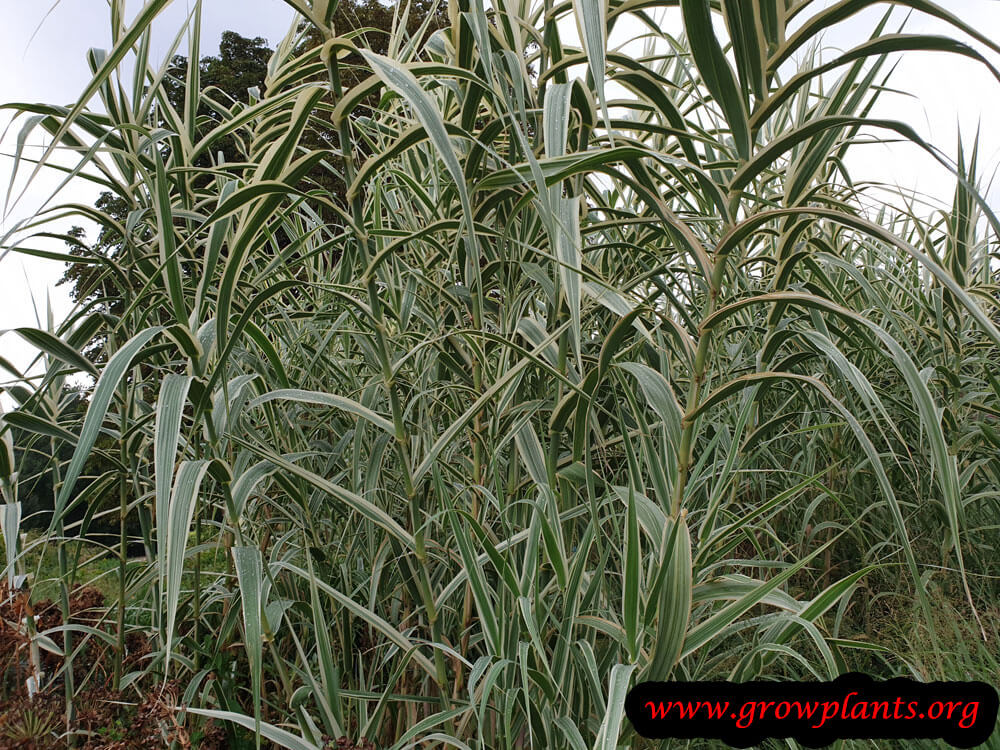
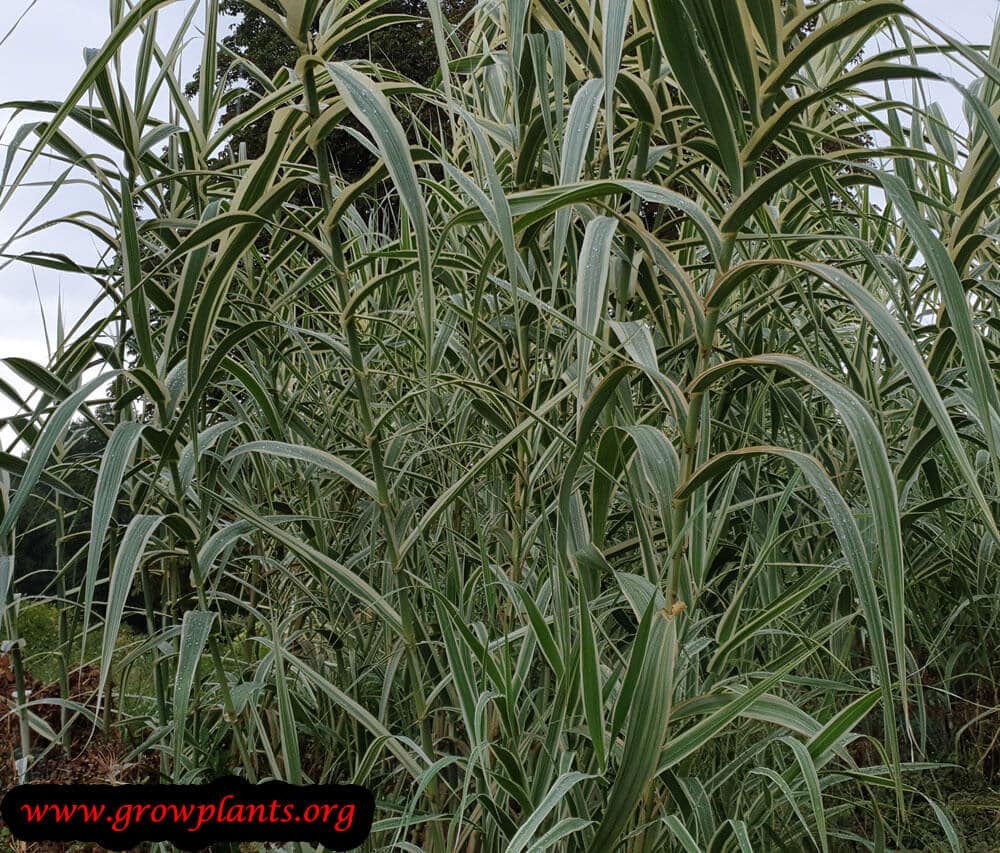
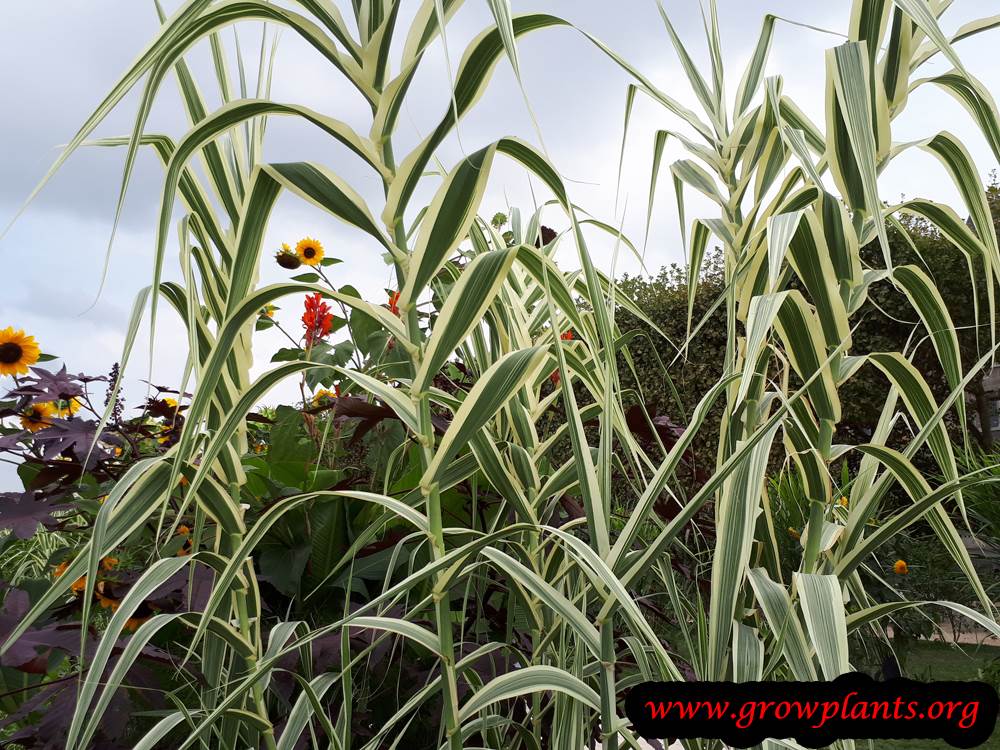
Overview: Variegated giant reed (Arundo donax ‘Versicolor’) is a tall evergreen rhizomatous grass reaching 2-8 m, grown for its bamboo-like canes clad in white-striped leaves. This vigorous perennial spreads aggressively and should be contained.
Quick Specifications
| Specification | Attribute |
|---|---|
| Plant Type / Life Cycle | Perennial |
| Foliage Type | Evergreen (semi-evergreen in cold) |
| Mature Size | 2-8 m (6-25 ft) tall |
| Growth Rate | Fast |
| Root System | Rhizomatous, spreading (highly invasive) |
| Toxicity | Toxic – foliage contains alkaloids |
| Hardiness | USDA zones 6-11 |
Growth Form & Structure
- Height & Spread: Tall canes 2-8 m (6-25 ft); spreads aggressively by rhizomes in the ground, so containment or container growing is recommended.
- Growth Habit & Form: Giant rhizomatous reed grass with tall, bamboo-like canes and arching variegated leaves.
- Lifespan & Maturity: Perennial; fast-growing, with canes persisting year to year.
Anatomy & Physical Features
- Leaves & Foliage: Green leaves with white stripes, to 20-50 cm, rough/hairy and unpleasant to touch, clasping the canes.
- Flower Characteristics: Feathery, plume-like white beard-like flower heads in summer.
Primary Uses & Landscape Value
- Functional & Ornamental Roles: Ornamental screen, accent and windbreak, and waterside planting; use with caution as it is invasive.
Care Guide: Planting, Soil & Watering
Overview: Variegated giant reed is a towering, fast-spreading grass that grows best in full sun to part shade and is remarkably adaptable — it prefers wet ground, even boggy margins, but tolerates dry soil once established. It is highly invasive, so contain its roots.
Quick Care Requirements
| Requirement | Ideal Condition |
|---|---|
| Planting Season | Year-round in mild conditions |
| Growth Rate | Fast |
| Soil Type | Adaptable — thrives in moist to wet soil, tolerates dry ground |
| Water Need | Adaptable — prefers ample water but tolerates drought once established |
Planting & Establishment
- Best Planting Season: Plant year-round in mild climates; spring planting gets it growing fastest.
- How to Plant:
- Hole Preparation: Dig a hole about twice the width of the root ball; because it spreads aggressively, plant within a root barrier or contained bed.
- Soil Amendments: Not fussy — a little compost helps, but it grows in most soils; the priority is containing the running rhizomes.
- Planting Depth: Set the crown at soil level; firm and water in well.
- Growth Speed & Expectations: Fast and vigorous, quickly reaching 2–8 m and spreading strongly by rhizome — delimit it to keep it in bounds.
Soil, Watering & Drainage Care
- Soil Mix & Drainage Needs: Tolerates a wide range from wet to dry, but grows lushest in moist, fertile ground; ensure it cannot escape into waterways.
- Watering Schedule & Technique:
- Young / Newly Planted: Water generously to establish; it roots quickly in moist soil.
- Established: Water freely for lushest growth, though established clumps tolerate dry spells.
- Seasonal Adjustments: More water in summer heat for best growth; it tolerates reduced winter moisture.
Climate, Light & Hardiness
Variegated giant reed thrives in warm-temperate to subtropical climates, tolerating both moist ground and dry spells once established; it does best in full sun to half shade, and although its top growth is killed back by frost each winter, the underground rhizome is exceptionally cold hardy for a reed grass.
Quick Climate Specifications
| Climate Zones | Mediterranean, Temperate, Subtropical |
|---|---|
| USDA Hardiness Zones | 6–11 |
| Cold Damage Begins | Foliage is damaged at first frost, around 0°C (32°F) |
| Approx. Survival Minimum | Established rhizomes typically survive brief cold into the zone 6 range, roughly −20 to −15°C (−4 to 5°F), though all top growth is lost |
| Frost Tolerance | High (rhizome) / Low (foliage) |
| Light Conditions | Full Sun to Half Shade |
| Wind Tolerance | High |
| Salt / Coastal Tolerance | Moderate |
Sunlight & Light Exposure
Optimal Light Setup
Full sun produces the densest canes with the most vivid white variegation; half shade is tolerated but growth becomes thinner and less colorful.
Direct Sun Requirement
Needs several hours of direct sun daily for compact, well-variegated growth; too much shade causes lanky, greener growth with less striping.
Shade & Heat Management
Tolerates intense summer heat without difficulty; light shade in the hottest climates can reduce leaf scorch but is not required.
Best Exposure / Orientation
Open, sunny sites near water margins or moist ground suit it best; also useful as a tall screening planting in full sun.
Temperature Extremes & Hardiness
USDA Hardiness & Regional Limits
Reliable outdoors in zones 6–11; north of zone 6 the rhizome is unlikely to survive winter.
Cold Damage & Winter Protection
Foliage and canes are killed back by the first hard frost. In zones 6–7, cut old canes back in late winter and mulch the root zone for extra insurance.
Frost Sensitivity
Top growth is frost-tender, but this is largely cosmetic since the plant regrows vigorously from the rootstock each spring.
Extreme Heat Tolerance
Handles long, hot summers well, especially with reliable soil moisture.
Wind, Humidity & Microclimate
Humidity Preferences
Adaptable to both humid subtropical and drier Mediterranean air.
Dry-Air Tolerance
Tolerates dry air once established, though growth is lusher with consistent moisture.
Wind Tolerance
Very wind tolerant and often used as a windbreak; very tall canes may lodge in severe storms.
Coastal / Salt Tolerance
Generally tolerates coastal exposure and some salt spray.
Rainfall & Seasonal Moisture
Naturally a wetland/riverbank plant that prefers consistently moist ground, but adapts to seasonal dry spells once established.
Microclimate Recommendations
Because it spreads aggressively by rhizome, site it where its moisture-loving habit can be contained rather than near natural waterways.
Growing in Pots, Balconies & Indoors
Variegated giant reed (Arundo donax ‘Versicolor’) is a towering grass of 2-8 m (6-25 ft) that the grower grows in containers but not as a houseplant. A large, strong pot is actually the smart way to grow it, since it contains this very vigorous, invasive plant’s running roots.
Quick Details
- Container Size: A very large, strong tub (40 L+ / 10 gal+) that can hold vigorous roots
- Indoor Suitability: Not a houseplant; it is a giant grass that needs full outdoor light
- Best Spot: Full sun to half shade
- Soil & Drainage: Any reasonable mix; it is unfussy and tolerates a range from dry to wet
- Watering in Pots: Flexible – it takes anything from modest to generous water; it thrives near water but tolerates drought
Indoors & On the Windowsill
- Houseplant limits: Not an indoor plant – it is a huge reed that needs full outdoor light and space.
- Containing it: This is a highly invasive spreader – a strong, sealed container is the safest way to grow it, keeping its running roots from escaping into the ground.
On a Balcony or Patio
- Light & wind: It stands tall and catches wind – give it a heavy, stable tub and a spot where the canes won’t be whipped about; it is otherwise very tough.
- Practicalities: Account for the weight of a full pot and make sure drainage water can run away freely without staining the balcony.
Choosing the Pot, Soil & Long-Term Care
- Pot & drainage: Use a very strong, large container – the vigorous roots can crack flimsy pots; strong drainage, though it also copes with damp.
- Potting mix: Well-aerated and organic-rich – a quality potting mix, or peat/coir with perlite or vermiculite.
- Feeding: Potted plants use up their soil faster as nutrients leach out with each watering – feed lightly through the growing season.
- Repotting: Divide it every year or two – it fills a pot fast; cut old canes to the base to refresh it.
Fertilizing & Feeding
A light feeder – this vigorous, spreading plant needs little encouragement to grow and generally performs best with minimal fertilizing
Quick Fertilizing Specs
| Feeding Level | light |
|---|---|
| Main Nutrient Priority | Light, balanced feeding only – this plant rarely needs encouragement to grow |
| Best Feeding Period | Spring through summer during active growth, if feeding is used at all |
| Soil pH | Adapts to a wide range of soil, including wetter sites |
| Reduce/Stop Feeding | Stop feeding through the winter slowdown in cooler parts of its range |
| Organic Options | Organic matter worked into the soil at planting, especially on leaner sites |
Feeding by Growth Stage
Establishment After Planting
Support root and rhizome establishment after planting
| Nutrient direction | Balanced feeding kept light to support root and rhizome establishment |
|---|---|
| Timing | The first growing season after planting |
| Frequency | A light feeding once new growth is underway |
| Fertilizer types | A balanced, complete fertilizer applied sparingly, Organic matter worked into the soil at planting, especially in leaner sites |
| Precautions | Keep feeding minimal – this is an aggressive, fast-spreading plant that does not need encouragement to grow |
Active Growth
Maintain healthy variegated foliage color and cane growth through the growing season
| Nutrient direction | Light, balanced feeding is usually enough; this vigorous grower rarely needs more |
|---|---|
| Timing | Spring through summer during active growth |
| Frequency | Feeding is rarely needed beyond an occasional light application |
| Fertilizer types | A balanced, complete fertilizer, applied sparingly if growth or foliage color seems to need it |
| Precautions | Avoid heavy nitrogen feeding – it encourages this already-aggressive, spreading plant to grow even more vigorously and can reduce leaf variegation |
Winter Slowdown
Let the plant rest through its winter slowdown in cooler climates
| Nutrient direction | None – withhold fertilizer while growth is slowed or canes are dormant |
|---|---|
| Timing | Late autumn through winter in cooler parts of its growing range |
| Frequency | No feeding at this stage |
| Fertilizer types | No feeding at this stage – resume only once active growth returns in spring |
| Precautions | Do not fertilize during winter slowdown or die-back; feeding now offers no benefit and can stress the plant |
Nutrient Deficiency Signs & Corrections
Reduced variegation and overall paler, less vigorous canes
| Possible causes | Low nitrogen availability, though uncommon for this vigorous plant, Very poor or long-depleted soil, Root competition and crowding in a dense stand |
|---|---|
| Appears first on | Older canes and lower leaves first |
| What to check | Overall vigor and leaf color across the stand, General soil condition, Stand density and crowding |
| Possible correction | Apply a light, balanced feeding only after ruling out crowding; thinning a dense stand often helps more than fertilizer |
Interveinal yellowing on new leaves while the veins stay green
| Possible causes | High soil pH limiting iron availability, Stagnant or poorly aerated wet soil restricting root function, Root stress from recent disturbance |
|---|---|
| Appears first on | Newest leaves at the cane tips |
| What to check | Soil pH and aeration, Whether yellowing is interveinal and limited to new growth, Standing water or stagnant conditions around the roots |
| Possible correction | Correct soil pH toward neutral where practical and apply a chelated iron product according to its label |
Interveinal yellowing on older leaves while the veins stay green
| Possible causes | Magnesium deficiency in leached or sandy soil, Heavy potassium feeding interfering with magnesium uptake, Waterlogged soil limiting root function |
|---|---|
| Appears first on | Older leaves first |
| What to check | Soil texture and leaching potential, Recent heavy feeding history, Soil drainage and root health |
| Possible correction | Apply a balanced fertilizer with adequate magnesium or a chelated magnesium product according to its label |
Pruning, Training & Seasonal Maintenance
Arundo donax versicolor (variegated giant reed) is a fast-growing, cane-forming grass that behaves much like an oversized ornamental grass or bamboo: it tolerates hard, whole-clump cutbacks well, and the main pruning objectives are containing its size and spread – this species is documented as aggressive and invasive – and periodically renewing the clump by removing old canes. It can be cut back at almost any time of year, though a late-winter cutback of the whole clump before spring shoots emerge gives the tidiest results with the least disruption to that season’s growth.
Quick Pruning & Maintenance Specs
| Pruning Tolerance | High – regrows vigorously from the base/rhizome even after being cut hard |
| Primary Pruning Window | Late Winter/Pre-Growth, cutting old canes down before new shoots emerge |
| Secondary Maintenance Window | Ongoing through the year, to remove damaged canes or control spread |
| Main Objective | Contain size/spread and renew the clump by removing old canes |
| Young Plant Priority | Establish the clump; begin containment measures early given its documented invasive habit |
| Mature Plant Priority | Remove old, weathered or lodged canes at the base; keep the clump within its intended footprint |
| Best Tool Type | Loppers for individual canes – hedge shears are not appropriate, since this is a cane grass, not a hedge plant |
| Avoid Heavy Pruning During | No strong restriction; if limiting spread is the goal, avoid leaving cut cane sections where they can root |
Pruning by Plant Age & Size
Newly Established
Minimal pruning; focus instead on physically containing the clump (a root barrier or a contained planting area) from the start, since this species spreads aggressively by rhizome.
Young / Formative
No formal training system – this is a cane-forming grass, not a branching shrub or tree; canes simply emerge from the base and are managed as a group.
Mature / Established
Renewal management: remove the oldest, most weathered or leaning canes at ground level each year, or cut the whole clump down in late winter, to keep fresh upright growth; control spread at the clump’s edge.
Seasonal Pruning Schedule
| Stage | Objective | Remove | Do Not Remove | Response / Impact |
| Pre-Growth/Late Winter | Renew the clump before new shoots emerge | Old canes, cut to the ground | N/A – this is a full reset | Vigorous new cane growth from the base in spring, consistent with this species’ fast growth rate; no cost to summer bloom |
| Ongoing (year-round) | Contain spread and remove damage | Canes escaping the intended planting area; storm-damaged canes | Healthy canes within the intended footprint | Keeps the clump inside its bounds |
Structural Pruning & Training
- Cane selection/renewal: remove the oldest or most weathered canes at the base in favor of fresh growth
- Height & spread control: the central task for a species that reaches 2–8 m and is documented as aggressive/invasive – contain spread with a physical barrier and cut back canes that cross beyond the intended area
- Canopy density: thinning for airflow isn’t a real concern here; the goal is footprint and tidiness
Special Growth to Remove
- Old, weathered or lodged (leaning/fallen) canes
- Any canes or rhizome growth spreading beyond the intended planting area, given this species’ invasive tendency
Container & Small-Space Pruning
Growing this species in a container is itself a containment strategy for its aggressive spread. Cut old canes back hard in late winter as with an in-ground clump, and expect to divide or root-prune periodically, since this fast, rhizomatous grower will fill a container quickly.
Tools
- Loppers, for cutting individual canes, which are woody-textured and too thick for hand snips
- Pruning saw, for the thickest base canes on a large, established clump
Tool Hygiene & Disease Risk
Routine – no specific disease is flagged for this species in the available data. The bigger risk here is not disease but the noted invasive spread, so avoid leaving viable cane sections or rhizome fragments where they could root.
Cut Placement & Technique
Cut canes low, close to the ground/rhizome, when doing the late-winter renewal so old stubs don’t accumulate; when removing an individual damaged cane, cut it at its base rather than partway up.
Heavy Pruning & Rejuvenation
Well tolerated – the whole clump can be cut down to the ground in late winter, similar to how large ornamental grasses or bamboo are renewed, and this fast-growing species will resprout to full height again the same season.
Post-Pruning Care
After a hard late-winter cutback, water at this species’ normal wet-to-average preference to support the vigorous spring flush; no need to fertilize purely because it was cut back, since it is already fast-growing. Dispose of cut canes carefully rather than composting where they might resprout, given the invasive habit.
Common Pruning Mistakes
- Trying to shape this cane grass like a hedge with shears instead of removing whole canes at the base
- Leaving cut canes or rhizome fragments on site, where they can root and worsen the plant’s documented spread
- Relying on pruning alone to control its footprint instead of also using physical containment
When NOT to Prune
No strong seasonal restriction is noted; the main caution is disposal – avoid leaving cut material where it can re-root given the invasive habit.
Recommended Tools (by task)
- loppers – for cutting individual canes at the base during renewal or containment
- pruning_saw – for the thickest base canes on a large, established clump
Propagation Guide
Variegated Arundo donax is propagated entirely vegetatively, by dividing the spreading rhizome or rooting sections of the cane, since the site lists no seed method for this plant. Vegetative propagation is not required in the sense of being technically demanding – the site notes it is really easy – and it is also the only way to keep the white-striped variegated leaves true, since seed-raised plants would not reliably retain this coloring.
Quick Propagation Specs
| Best Propagation Method | Rhizome division |
| Alternative Methods | Cane (culm) cuttings |
| Propagation Difficulty | Easy |
| Vegetative True-to-Type | Yes (required to preserve the variegated leaf coloring) |
| Best Propagation Season | All year, per the site’s planting season, though growth is fastest in spring/summer |
| Cutting Rooting Time | Typically a few weeks under warm, moist conditions given the plant’s fast growth rate |
Rhizomes, Tubers, Bulbs & Corms
Rhizome Division
Dig up a section of the spreading rhizome mat with at least one or two growth buds/shoots attached, then replant it directly at a similar depth in moist to average soil (the plant prefers wet land but tolerates drier conditions, per the site’s care overview). Because this species spreads aggressively, the site recommends delimiting/containing the planting area when pruning or dividing to keep it in bounds.
Stem Cuttings
Cutting Type
Sections of mature cane (culm), each including at least one or two nodes.
Cutting Preparation
Lay cane sections horizontally, partly buried, in moist soil or shallow water; each node carries a bud capable of producing new roots and shoots.
Rooting Setup
Keep the medium consistently moist; given the plant’s tolerance for wet ground, cane sections root readily without special humidity control.
Rooting Hormone
Unnecessary – this species roots vigorously from cane sections without hormone treatment.
Rooting Time
Typically a few weeks given the plant’s fast growth rate.
Bloom & Flower Guide
Quick Details
- Bloom Season: Summer, where it flowers at all.
- Flower Appearance: A tall, feathery, silvery-white plume (a grass flower head) held above the striped foliage.
- Edibility: Ornamental only – grown for its variegated foliage and plumes, not for eating.
Detailed Blooming Overview
Arundo donax is a giant reed, and like other grasses its “flower” is a large, soft plume rather than a petalled bloom. The variegated ‘Versicolor’ form is grown mainly for its cream-and-green leaves and tends to flower only in long, warm seasons, producing little or no viable seed – which helps keep this vigorous plant in check.
Flower Characteristics
- Feathery, beard-like white plumes.
- A typical grass inflorescence, held well above the leaves.
- Sparse or absent on the variegated form.
Bloom Care & Thinning
- Managing the bloom: Cut old canes and plumes back in late winter to make way for fresh growth.
- Pollination: Wind-pollinated, as with grasses generally.
Pests, Diseases & Troubleshooting
Overview: Variegated giant reed is a huge, vigorous grass that is remarkably free of pests and diseases – so robust that its plain green form is a notorious invasive weed in warm regions, controlled only by introduced biological agents. For the gardener, the real ‘problems’ are cultural: the variegated form reverting to green, its lesser winter hardiness, and its potential to spread aggressively by rhizome. Pests, when they appear, are minor.
Quick Troubleshooting Overview
| Issue / Pest | Main Symptom | Primary Solution |
|---|---|---|
| Reversion to green | Plain green shoots appear among the variegated ones | Cut out green shoots at the base as they arise |
| Invasive spread | Rhizomes run and colonise well beyond the clump | Root barrier or large container; remove strays; don’t dump prunings |
| Winter dieback | Variegated form browns/dies back in cold winters | Mulch the crown; grow in shelter; cut back in spring |
| Aphids | Occasional clusters on soft new growth | Rinse off; insecticidal soap (rarely needed) |
| Rust/leaf spot | Occasional pustules or spots on foliage | Airflow; remove affected leaves (seldom serious) |
| Leaf-edge browning | Scorched margins from salt or drought | Even moisture; avoid salty water; the plant is otherwise tough |
Common Pests & Management
- Aphids (Aphidoidea):
- Symptoms: Occasionally small colonies of soft aphids gather on the soft young growth, with a little honeydew; damage is negligible on this enormously vigorous grass.
- Prevention & Control: Rinse them off with water or leave them to natural predators; treatment is almost never needed.
- Scale insects (Diaspididae (incl. Rhizaspidiotus donacis)):
- Symptoms: Small armoured scales can occasionally encrust the canes and leaf sheaths; interestingly, a specific Arundo scale has been deliberately introduced as a biological control against the invasive plain species.
- Prevention & Control: On garden plants, prune out heavily scaled canes and use a horticultural oil if needed; the plant’s vigour easily outpaces light infestations.
- Spider mites (Tetranychus spp.):
- Symptoms: Fine pale stippling on the leaves in hot, dry, dusty conditions; rarely significant on this tough grass.
- Prevention & Control: Hose down foliage in hot spells; the plant shrugs off minor mite activity and sprays are seldom warranted.
Diseases & Fungal Issues
- Rust (Puccinia spp.):
- Symptoms: Occasional yellow-to-orange or brown pustules on the leaves in damp conditions; uncommon and rarely serious on this very disease-resistant grass.
- Treatment & Management: Remove affected leaves and improve airflow; the plant readily regrows clean and fungicide is essentially never needed.
- Leaf spot (fungal spp.):
- Symptoms: Minor brown spots may appear on the foliage in wet, crowded conditions but rarely affect the plant’s vigour.
- Treatment & Management: Cut back and remove affected foliage; new growth comes clean. No chemical control is normally warranted.
Growing Difficulties & Abiotic Problems
- Reversion to green:
- Cause & Symptoms: Variegated giant reed periodically throws plain green (non-variegated) shoots, which are more vigorous and can gradually dominate the clump if left.
- Correction Strategy: Cut out any all-green shoots right at the base as soon as they appear, to preserve the variegation.
- Winter tenderness & dieback:
- Cause & Symptoms: The variegated form is less hardy than the plain species; hard winters brown and kill the top growth and can damage the crown in cold climates.
- Correction Strategy: Mulch the crown heavily for winter, grow in a sheltered spot (or a container moved under cover in very cold areas), and cut old canes to the ground in spring to let fresh growth emerge.
- Invasive spreading:
- Cause & Symptoms: Even the variegated form spreads by stout rhizomes and can colonise beyond its intended area; the plain species is highly invasive in warm regions.
- Correction Strategy: Contain with a deep root barrier or grow in a large container, remove stray shoots, and never dump prunings or rhizome pieces in the wild, as fragments root readily.
- Leaf-edge scorch:
- Cause & Symptoms: Salt-laden water or drought can brown the leaf margins of this otherwise unfussy grass.
- Correction Strategy: Provide even moisture (it enjoys damp soil and waterside sites) and avoid salty water; it tolerates a very wide range of conditions otherwise.
What Helps – Products & Tools
Giant reed barely needs a product cupboard – the odd rinse or insecticidal soap for aphids and a horticultural oil for the rare scale, with no real need for fungicide. The important ‘tools’ here are a spade and a root barrier: cutting out green reversions, containing the rhizomes, and mulching the crown for winter matter far more than any pest spray.