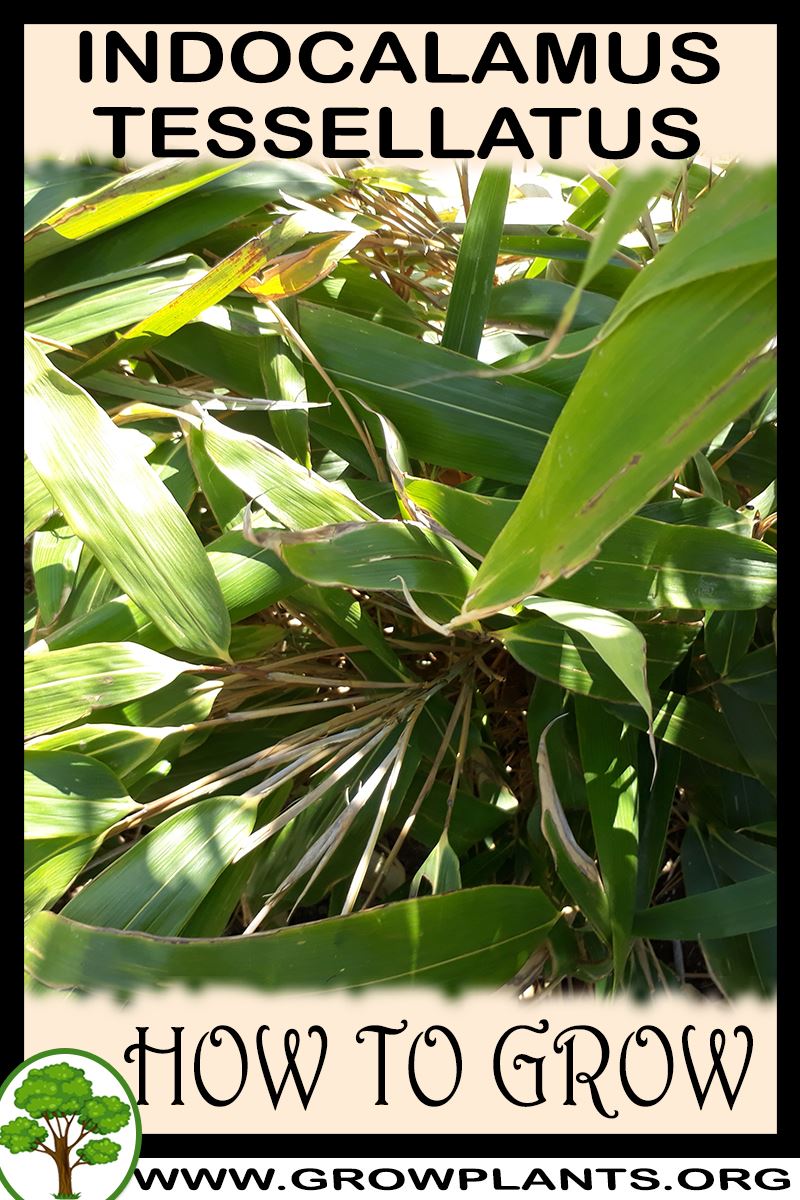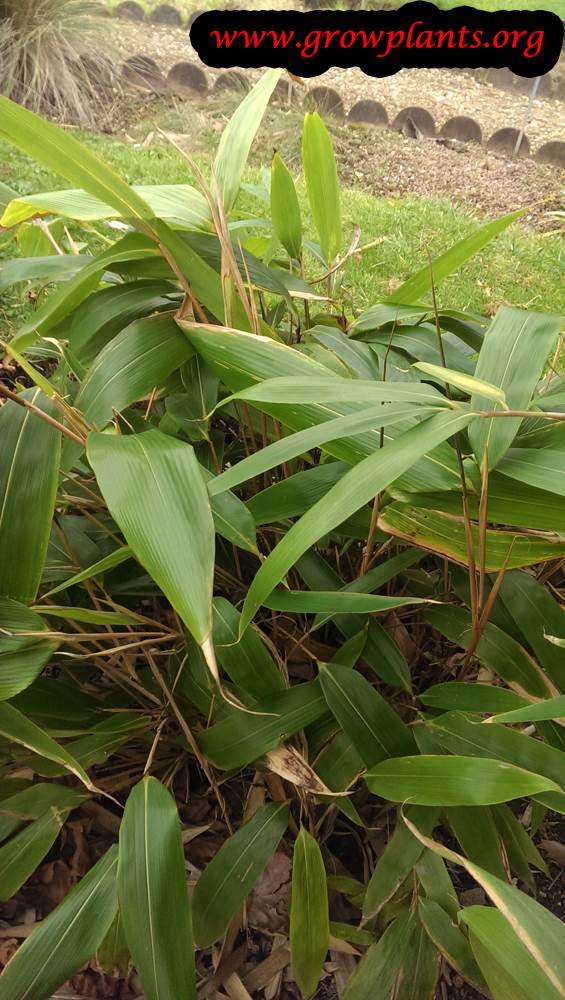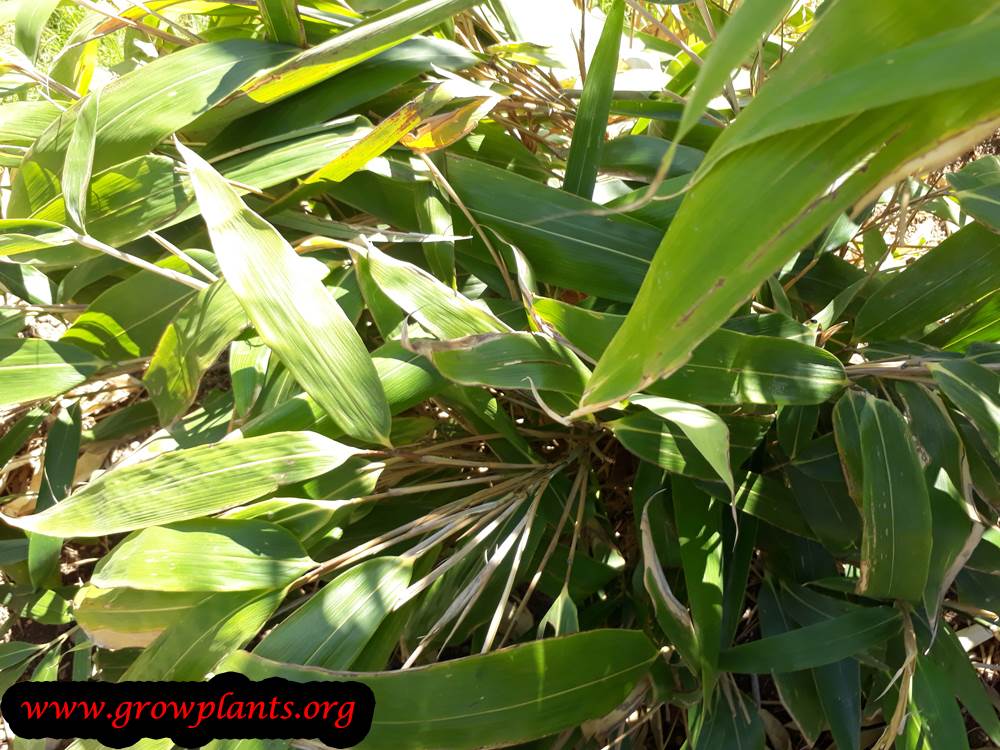

Plant Profile & Key Characteristics
Overview: A dwarf running bamboo of 1-2 m (3-7 ft) grown as an ornamental for its exceptionally large leaves. A vigorous evergreen perennial that spreads aggressively by rhizomes.
Quick Specifications
| Specification | Attribute |
|---|---|
| Plant Type / Life Cycle | Perennial (evergreen bamboo, grass family) |
| Foliage Type | Evergreen |
| Mature Size | 1-2 m tall (3-7 ft) |
| Growth Rate | Moderate to Fast |
| Root System | Rhizomatous – running/spreading (aggressive) |
| Toxicity | Non-toxic |
| Hardiness | USDA zones 6-10 |
Growth Form & Structure
- Height & Spread: Reaches 1-2 m (3-7 ft) tall and spreads indefinitely by rhizomes unless contained; also grown in containers to restrain it.
- Growth Habit & Form: Low, thicket-forming running bamboo with slender canes; forms dense ground-covering stands.
- Lifespan & Maturity: Long-lived perennial that establishes and spreads quickly.
Anatomy & Physical Features
- Leaves & Foliage: Very large, broad green linear leaves up to about 40 cm (16 in) – the plant’s main ornamental feature.
- Flower Characteristics: Small, insignificant flowers, rarely produced (see the Bloom guide).
Primary Uses & Landscape Value
- Functional & Ornamental Roles: Ornamental groundcover and low screen for its bold foliage; best grown with a root barrier or in containers because of its running habit.
Care Guide: Planting, Soil & Watering
Overview: Large-leaved bamboo is a vigorous evergreen for full sun to full shade in temperate to subtropical climates. It grows best in rich, moist but well-draining soil with generous water.
Quick Care Requirements
| Requirement | Ideal Condition |
|---|---|
| Planting Season | Spring, summer or autumn |
| Growth Rate | Moderate to Fast |
| Soil Type | Rich, moist but well-draining soil |
| Water Need | Moderate to High – keep consistently moist |
Planting & Establishment
- Best Planting Season: Plant during the growing season, in spring, summer or autumn.
- How to Plant:
- Hole Preparation: Dig a hole about twice the width of the root ball; consider a root barrier, as this bamboo spreads aggressively.
- Soil Amendments: Mix plenty of organic matter into the backfill to enrich the moist soil it prefers.
- Planting Depth: Set the top of the root ball level with the soil surface.
- Growth Speed & Expectations: A moderate to fast, spreading grower – contain it to keep it in bounds.
Soil, Watering & Drainage Care
- Soil Mix & Drainage Needs: Rich, moisture-retentive but well-draining soil suits it; it grows well in containers, which also help restrain its running roots.
- Watering Schedule & Technique:
- Young / Newly Planted: Water frequently after planting to keep the soil consistently moist while it establishes.
- Established: Water regularly and generously; bamboo appreciates plentiful moisture but not stagnant waterlogging.
- Seasonal Adjustments: Water more in summer heat and less in winter.
Climate, Light & Hardiness
This large-leaved bamboo is a cold-hardy, highly adaptable species for temperate, subtropical, and Mediterranean climates, also grown indoors. It tolerates full sun through full shade and rich, consistently moist soil.
Quick Climate Specifications
| Climate Zones | Temperate, Subtropical, Mediterranean |
|---|---|
| USDA Hardiness Zones | 6–10 |
| Frost Tolerance | High |
| Light Conditions | Full Sun to Full Shade |
Sunlight & Light Exposure
Optimal Light Setup
Tolerates the full range from full sun to full shade, making it flexible for different garden positions.
Temperature Extremes & Hardiness
USDA Hardiness & Regional Limits
Hardy in USDA zones 6–10, tolerating cold winters typical of temperate climates; note that this species spreads aggressively where conditions suit it, so cold is rarely the limiting factor for containment.
Wind, Humidity & Microclimate
Rainfall & Seasonal Moisture
Prefers consistently moist, rich soil rather than a pronounced dry season.
Growing in Pots, Balconies & Indoors
This large-leaved bamboo can be grown indoors – the grower confirms both houseplant and container use. It tolerates shade as well as sun, which helps indoors, and because it is an aggressive spreader a pot is also the practical way to stop its running roots taking over a garden.
Quick Details
- Container Size: A large, sturdy pot, 20-40 L or more, to support 1-2 m canes
- Indoor Suitability: Can be grown as a houseplant in bright light; tolerates shade
- Best Spot: Full sun to full shade – very adaptable
- Soil & Drainage: Rich, moisture-retentive but free-draining mix
- Watering in Pots: Keep well watered – bamboo is thirsty and pots dry fast; average to generous water
Indoors & On the Windowsill
- Houseplant care: Give it the brightest spot you can indoors and keep it well watered and humid; thin out old or weak canes to keep it fresh.
- Windowsill growing: Too large for a sill long-term, but a young clump enjoys a bright window before moving to a floor-standing pot.
- Containing it: Even indoors, a strong-walled pot keeps this vigorous runner in check.
On a Balcony or Patio
- Light & wind: Thrives in sun or shade on a balcony; wind can shred the big leaves, so give some shelter, and water often as it dries quickly.
- Weight & runoff: A large watered bamboo pot is heavy – make sure the balcony can take it, and manage drainage runoff.
Choosing the Pot, Soil & Long-Term Care
- Pot & drainage: A large, strong pot with strong drainage holes and no standing-water saucer to avoid root rot; terracotta breathes and dries faster, glazed or plastic holds moisture longer – roots are powerful, so avoid thin containers it can burst.
- Potting mix: Rich, a well-aerated, organic-rich potting mix – peat or coir blended with perlite or vermiculite.
- Feeding: Potted plants are fed more often than those in the ground, as watering steadily leaches nutrients from the mix – bamboo is hungry; feed regularly through the growing season.
- Repotting: Divide and refresh the mix every couple of years before the pot becomes root-bound.
Fertilizing & Feeding
A moderately vigorous feeder that rewards steady nitrogen-forward feeding during active growth – but keep an eye on its aggressive spreading habit rather than restricting feeding alone to control it.
Quick Fertilizing Specs
| Feeding Level | Moderate feeder |
|---|---|
| Main Nutrient Priority | Nitrogen-forward to support vigorous leafy cane growth |
| Best Feeding Period | Spring through summer active growth |
| Soil pH | Prefers rich, moisture-retentive soil; tolerant of a range of pH |
| Reduce/Stop Feeding | Stop feeding as growth slows heading into winter |
| Organic Options | Organic matter and mulch support the rich soil this bamboo favors |
Feeding by Growth Stage
Establishment After Planting
Help new canes and rhizomes establish before the plant reaches its natural vigorous growth rate
| Nutrient direction | A balanced feeding direction supports steady root and cane establishment |
|---|---|
| Timing | During the first growing season after planting |
| Frequency | A light feeding as new growth begins helps this plant establish |
| Fertilizer types | A diluted, balanced, general-purpose fertilizer |
| Precautions | This bamboo spreads aggressively – consider a root barrier at planting rather than relying on feeding restraint alone to control spread |
Active Growing Season
Support vigorous new cane and broad-leaf growth through the main growing season
| Nutrient direction | A nitrogen-forward feeding direction supports the lush, leafy growth this bamboo is grown for |
|---|---|
| Timing | Through spring and summer while new canes and leaves are actively developing |
| Frequency | Regular light feedings through the growing season support steady, vigorous growth |
| Fertilizer types | A nitrogen-forward, general-purpose or lawn-type fertilizer; organic matter and mulch also support steady growth |
| Precautions | Because this bamboo is already fast and aggressive, avoid excessive feeding in confined garden spaces where spread needs to be managed |
Winter Slowdown
Let the plant rest through the coldest part of the year without pushing new growth
| Nutrient direction | None – withhold fertilizer while growth is slow or paused |
|---|---|
| Timing | Winter, while growth is minimal |
| Frequency | No feeding at this stage |
| Fertilizer types | No feeding at this stage – withhold fertilizer until active growth resumes |
| Precautions | Do not fertilize during the winter growth pause |
Nutrient Deficiency Signs & Corrections
Leaves are noticeably pale green to yellow and new canes are thinner than expected
| Possible causes | Insufficient nitrogen for this vigorous, leafy grower, Overcrowded, congested clumps competing for nutrients, Leaching from heavy watering or rainfall |
|---|---|
| Appears first on | Older leaves first, then spreading to new growth if severe |
| What to check | Clump density and whether thinning is overdue, Feeding history, Watering and drainage |
| Possible correction | Thin overcrowded canes and resume regular nitrogen-forward feeding during active growth |
Leaf tips and margins turn brown and dry, especially in exposed sites
| Possible causes | Drought or water stress, Salt buildup from over-fertilizing, Wind exposure or low humidity |
|---|---|
| Appears first on | Leaf tips and margins first |
| What to check | Soil moisture and watering consistency, Recent feeding rate, Site exposure to wind or sun |
| Possible correction | Improve watering consistency, flush excess fertilizer salts with a thorough watering, and provide some shelter from harsh wind or sun |
New leaves emerge yellowish with veins staying greener
| Possible causes | Soil pH outside the favorable range for micronutrient uptake, Poorly drained or compacted soil limiting root function, Root stress in a newly divided or transplanted clump |
|---|---|
| Appears first on | Newest leaves first |
| What to check | Soil pH and drainage, Recent transplanting or division, Whether yellowing is interveinal |
| Possible correction | Correct pH and drainage issues, or apply a chelated micronutrient product per its label if the deficiency persists |
Pruning, Training & Seasonal Maintenance
Indocalamus tessellatus is a running bamboo grown for its large, bold leaves, and pruning it is a different exercise from pruning a shrub or tree: there is no branch framework to shape, so the two real tasks are removing dead or damaged culms and leaves, and containing the spreading rhizome system, which is flagged as aggressive. Maintenance can be done year-round since old, dead canes and stray shoots appear on an ongoing basis rather than on a single seasonal schedule.
Quick Pruning & Maintenance Specs
| Pruning Tolerance | High (for culm thinning/containment; there is no framework to over-prune) |
| Primary Pruning Window | Year-round, as needed |
| Typical Frequency | Ongoing – check for stray shoots through the growing season, thin old culms once a year |
| Main Objective | Contain rhizome spread; remove dead/damaged culms and leaves; manage density |
| Young Plant Priority | Establish a containment boundary (barrier, container edge, or regular edging) before the clump spreads |
| Mature Plant Priority | Thin old, weak or dead culms at the base; keep new shoots inside the intended footprint |
| Best Tool Type | Loppers or a pruning saw for tough culms at the base; precision snips for leaf and small-shoot work |
| Avoid Heavy Pruning During | No strict seasonal restriction, though very cold spells slow regrowth of any cut culms |
Pruning by Plant Age & Size
Newly Established
Focus on containment from the start rather than shaping – install or check a rhizome barrier or firm container edge, since it is much easier to control spread early than to remove an established colony later.
Young / Formative
No structural training applies in the branch-and-leader sense; instead, guide the clump’s outline by removing any new culms that emerge outside the intended planting area as soon as they appear.
Mature / Established
Thin out old, weak or unproductive culms at ground level each year to keep the stand vigorous and let light reach younger canes, and continue removing any shoots that push beyond the containment boundary.
Seasonal Pruning Schedule
Ongoing Sanitary
Objective: keep the stand healthy and contained. Remove: dead or broken culms, damaged or browned leaves, and any new shoots emerging outside the desired footprint, as they appear through the growing season. Do not remove: healthy young culms that are within the intended area, since these are next season’s leaf-bearing canes. Expected response: continued vigorous shoot production, given its fast-to-medium growth rate. Flowering impact: not applicable – bamboo flowering, when it occurs, is an unpredictable, species-wide event unrelated to routine pruning.
Special Growth to Remove
- New shoots (runners) emerging outside the intended planting area – the single most important removal task given this species’ documented aggressive spread; cut below ground at the rhizome if possible, not just at soil level.
- Old, dead or broken culms, removed at the base to make room for fresh canes.
- Damaged or browned leaves, which can be trimmed away individually.
Container & Small-Space Pruning
Growing this bamboo in a container is itself a containment strategy, since it stops rhizome spread into the surrounding garden; within the pot, thin crowded culms periodically and divide the clump when it becomes root-bound, rather than letting density build indefinitely.
Tools
- Loppers or a small pruning saw for cutting through mature, fibrous culms at the base.
- Precision snips for trimming individual leaves and thin new shoots.
Tool Hygiene & Disease Risk
Routine – clean, sharp tools are sufficient; no major transmissible disease is documented for this species that would require disinfecting between cuts.
Cut Placement & Technique
Cut culms as close to ground level as practical when removing them, since bamboo culms do not branch back from a stub the way woody shrubs do – a tall leftover stub simply stays as dead cane rather than resprouting.
Common Pruning Mistakes
- Delaying removal of stray shoots until they have hardened into full culms, by which point containment is far harder.
- Assuming a rhizome barrier, once installed, needs no further checking – runners can eventually grow over or under an inadequate barrier.
- Leaving old, dead culms in place indefinitely instead of thinning them out, which crowds the stand and blocks light to new shoots.
Recommended Tools (by task)
- loppers – cutting through mature culms at the base when thinning or removing dead canes.
- precision_snips – trimming damaged leaves and removing thin, newly emerged stray shoots.
Pruning Troubleshooting
| Problem | Possible Cause | What to Check | Corrective Action |
| Bamboo spreading beyond its intended area | Rhizome barrier missing, too shallow, or breached; stray shoots not removed promptly | Trace new shoots back to the barrier line and inspect the barrier’s condition and depth | Remove stray shoots at the rhizome, and repair or extend the containment barrier |
| Thinning, weak-looking culms | Overcrowded stand with old culms never thinned out | Check culm density and the proportion of old, weak canes | Thin the oldest and weakest culms at the base to let light and vigour reach younger canes |
Propagation Guide
Indocalamus tessellatus is most reliably increased by dividing an established clump’s spreading rhizome, taking advantage of the same running growth habit behind its noted aggressive spread; seed is a true alternative but is rarely practical, since like most bamboos this species flowers only at long, irregular intervals, so viable seed is seldom available. Difficulty is easy by division.
Quick Propagation Specs
| Best Propagation Method | Rhizome Division |
| Alternative Methods | Seed (when available) |
| Propagation Difficulty | Easy |
| Vegetative True-to-Type | Yes |
| Seed True-to-Type | Usually true-to-type, though seed is rarely available |
| Best Propagation Season | Spring, as new growth begins |
Rhizomes, Tubers, Bulbs & Corms
Because Indocalamus tessellatus spreads by running rhizomes, new plants are most easily started by digging a rooted rhizome section that carries at least one or two culms with their attached roots, ideally in spring as new growth begins. Keep divisions well watered and shaded until they re-establish, since bamboo divisions can wilt readily before new roots form.
Growing from Seed
Bamboos, including Indocalamus species, typically flower only at long, irregular intervals – sometimes many years apart – so viable seed is rarely available to home growers. When seed can be sourced, sow it fresh, since bamboo seed tends to lose viability quickly, in a moist, humus-rich medium in full sun to partial shade.
Bloom & Flower Guide
Quick Details
- Bloom Season: Summer, in the rare years it flowers
- Flower Appearance: Small, insignificant grass-like flowers
- Edibility: Grown as an ornamental; the flowers are not eaten
Detailed Blooming Overview
Bamboos are famous for how seldom they flower. This large-leaved bamboo may go many years – even decades – without blooming, and when it does the flowers are small and easy to miss. As a member of the grass family its flowering is quiet and functional rather than showy, and, as with many bamboos, a heavy flowering can leave the plant weakened afterward.
Flower Characteristics
- Small, insignificant flowers, typical of the grass family.
Bloom Care & Thinning
- Pollination: Like other grasses, bamboo flowers are wind-pollinated.
- If it flowers: Keep the plant well fed and watered afterward, as flowering can take a lot out of it.
Pests, Diseases & Troubleshooting
Overview: This broad-leaved dwarf bamboo is vigorous and largely pest-resistant; its main insect issues are bamboo mites and sap-suckers whose honeydew feeds sooty mold, while its truly aggressive rhizomes are more of a management problem than any pest. Keeping plants unstressed and well-watered prevents most trouble.
Quick Troubleshooting Overview
| Issue / Pest | Main Symptom | Primary Solution |
|---|---|---|
| Bamboo mites | Fine stippling, rectangular chlorotic patches, webbing under leaves | Hose foliage, miticidal oil, keep unstressed |
| Bamboo aphids | Sticky leaves, sooty mold, ants farming them | Water jet, insecticidal soap, control ants |
| Scale & mealybugs | Bumps/cottony masses on culms and leaves, honeydew | Oil/soap, prune worst canes |
| Sooty mold | Black coating on honeydew-covered leaves | Control sap-suckers, wash foliage |
| Leaf tip burn | Brown, scorched leaf tips and margins | Steady water, flush salts, shelter from wind |
| Rhizome spread | Shoots invading beyond the intended area | Rhizome barrier, root pruning, containment |
Common Pests & Management
- Bamboo mites (Schizotetranychus / Stenotarsonemus spp.):
- Symptoms: Fine pale stippling that forms characteristic rectangular chlorotic patches along the veins, with fine webbing and sometimes tiny debris nests on the leaf undersides; foliage looks dull and mottled.
- Prevention & Control: Keep plants well-watered and unstressed, hose foliage forcefully to knock mites and webbing off, improve airflow, and treat undersides with a light horticultural oil or miticidal soap, repeating to catch new hatches.
- Bamboo aphids (Takecallis / Melanaphis spp.):
- Symptoms: Colonies of pale or dark aphids on leaf undersides and new shoots leaving sticky honeydew that turns black with sooty mold; ants often attend them.
- Prevention & Control: Blast with water, encourage ladybirds and lacewings, bait the attending ants, and use insecticidal soap or neem on heavy colonies in the evening.
- Scale insects & mealybugs (Coccoidea / Pseudococcidae):
- Symptoms: Immobile brown or waxy bumps and white cottony masses on culms, sheaths, and leaf undersides, with honeydew, sooty mold, and weak growth.
- Prevention & Control: Prune out heavily infested canes, wash light cases, and smother crawlers with horticultural oil; control ants that spread and protect them.
- Grasshoppers & caterpillars (occasional) (Orthoptera / Lepidoptera):
- Symptoms: Chewed and ragged leaf margins from occasional chewing insects, rarely serious on established plants.
- Prevention & Control: Tolerate light feeding, hand-pick where practical, and use Bacillus thuringiensis for significant caterpillar activity.
Diseases & Fungal Issues
- Sooty mold (secondary):
- Symptoms: Black powdery coating over leaves and culms, growing on the honeydew of aphids, scale, and mealybugs; it blocks light rather than infecting tissue.
- Treatment & Management: Control the sap-sucking insects producing the honeydew, then wash the mold off with water; it clears once the pest source is gone.
- Rust & fungal leaf spot (Puccinia, others):
- Symptoms: Orange-brown rust pustules or brown leaf spots and blotches in humid, crowded, or poorly ventilated conditions.
- Treatment & Management: Improve airflow by thinning canes, avoid overhead watering, remove badly affected leaves, and only rarely is fungicide needed on vigorous bamboo.
- Root rot (Pythium, Fusarium):
- Symptoms: Yellowing, weak new shoots, and dieback in constantly waterlogged soil.
- Treatment & Management: Ensure the site drains, avoid persistent waterlogging, and improve heavy soil with organic matter before planting.
Growing Difficulties & Abiotic Problems
- Leaf tip & margin burn:
- Cause & Symptoms: Brown scorched leaf tips and edges from drought, salty or hard water, fertilizer excess, cold drying wind, or low humidity.
- Correction Strategy: Water deeply and consistently, flush salts with occasional heavy watering, shelter from harsh wind, and avoid over-fertilizing; established plants recover with steady care.
- Winter yellowing / leaf drop:
- Cause & Symptoms: Yellowing and shedding of older leaves in cold or after a hard winter, often normal renewal rather than disease.
- Correction Strategy: Provide shelter in cold climates, mulch the root zone, and allow the plant to flush fresh leaves in spring; remove tattered old canes.
- Aggressive rhizome spread:
- Cause & Symptoms: The most practical ‘problem’ — running rhizomes send shoots well beyond the intended area.
- Correction Strategy: Install a deep rhizome barrier or grow in a contained bed or large pot, and root-prune the perimeter annually to keep it in bounds.
What Helps — Products & Tools
Bamboo needs little spraying: a strong water jet, insecticidal soap, and light horticultural oil handle bamboo mites, aphids, scale, and mealybugs, while controlling those sap-suckers clears the sooty mold. The most useful ‘tool’ is often physical — a rhizome barrier for containment. Bacillus thuringiensis covers the rare caterpillar.