

Plant Profile & Key Characteristics
Overview: A small bulbous perennial (pink rain lily) that sends up 20-50 cm stems of pink-and-white crocus-like flowers, often triggered by rain. Grown as an ornamental flowering bulb for borders and containers.
Quick Specifications
| Specification | Attribute |
|---|---|
| Plant Type / Life Cycle | Perennial (bulb / geophyte) |
| Foliage Type | Deciduous (dies back) |
| Mature Size | 20-50 cm (8-20 in) |
| Growth Rate | Moderate |
| Root System | Bulb (geophyte) |
| Toxicity | Toxic if eaten – bulbs and foliage contain lycorine alkaloids (Amaryllidaceae) |
| Hardiness | USDA zone 8-10 |
Growth Form & Structure
- Height & Spread: 20-50 cm; multiplies into clumps of bulbs and suits pots.
- Growth Habit & Form: A clump of narrow, grassy leaves with solitary funnel-shaped flowers on short stems.
- Lifespan & Maturity: Perennial bulb; foliage dies back and reappears, with flowering flushes following rain.
Anatomy & Physical Features
- Leaves & Foliage: Narrow, grass-like green leaves in linked clumps, appearing around and after flowering.
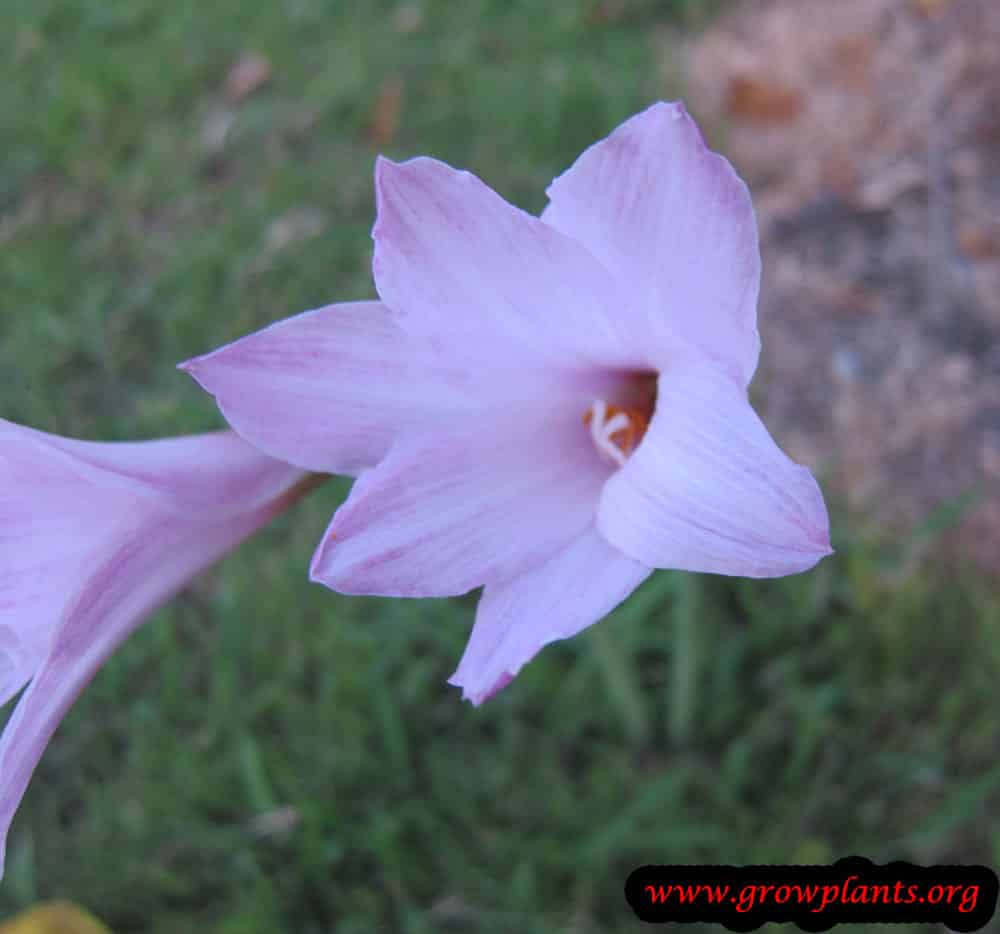
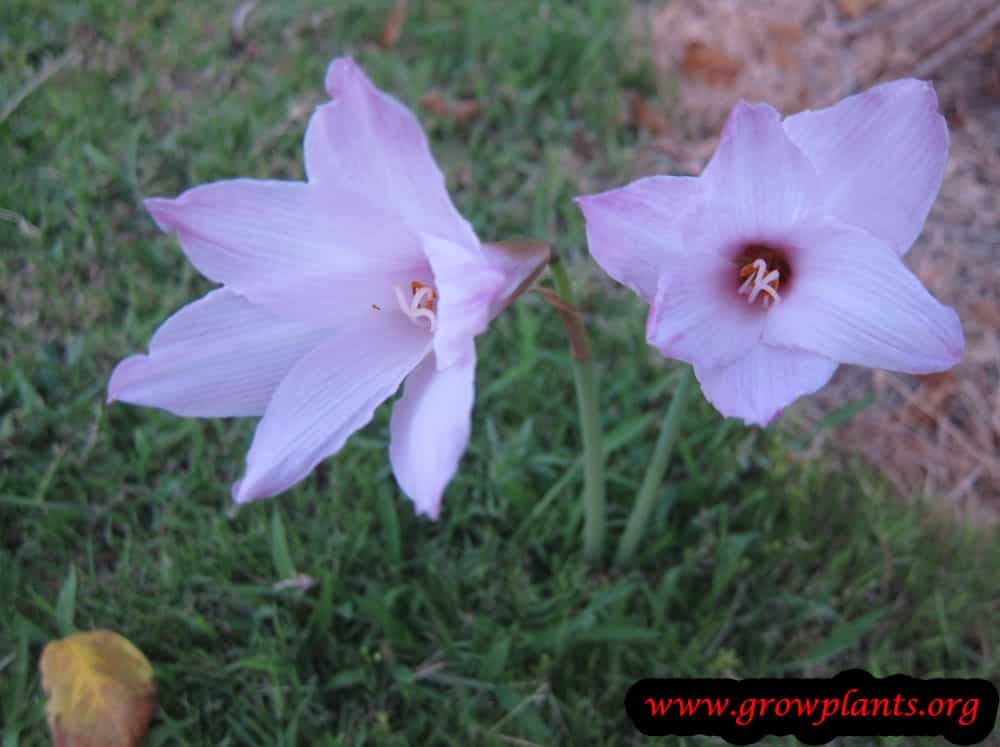
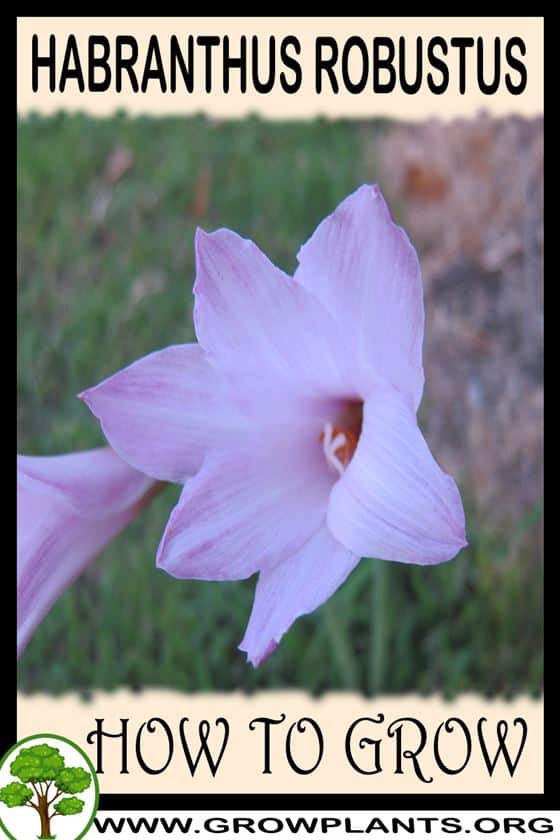
- Flower Characteristics: Funnel-shaped flowers, white to pink (often white flushed pink), with 6 petals and 6 yellow stamens.
Primary Uses & Landscape Value
- Functional & Ornamental Roles: Ornamental flowering bulb and cut flower for borders and containers.
Care Guide: Planting, Soil & Watering
Overview: The pink rain lily is a summer-to-autumn flowering bulb that bursts into bloom after rain. It grows best in full sun with well-draining soil, moderate moisture during growth, and a drier rest once the foliage dies back.
Quick Care Requirements
| Requirement | Ideal Condition |
|---|---|
| Planting Season | Plant the bulbs in the warm season through to autumn and winter, ahead of the rains |
| Growth Rate | Moderate |
| Soil Type | Well-draining soil |
| Water Need | Moderate — water during active growth and flowering, then reduce as the leaves die back and the bulb rests |
Planting & Establishment
- Best Planting Season: Plant the bulbs during summer through autumn (and into winter in mild climates), so they are settled in before the rains that trigger flowering.
- How to Plant:
- Hole Preparation: Dig a hole in freely draining ground and set the bulb so its neck sits at or just below the surface.
- Soil Amendments: Work in compost and, if needed, grit to improve drainage, since the bulb rots in cold, waterlogged soil.
- Planting Depth: Plant the bulb a few centimetres deep with the pointed neck upward; do not bury it too deeply.
- Growth Speed & Expectations: Growth is moderate; the flowers often appear first, flushed out by rain, with the strappy leaves following.
Soil, Watering & Drainage Care
- Soil Mix & Drainage Needs: Grow in well-draining soil or a free-draining potting mix; the dormant bulb is prone to rot if left wet, so good drainage is essential.
- Watering Schedule & Technique:
- Young / Newly Planted: Water in newly planted bulbs to settle them, then keep the soil just moist until growth appears.
- Established: Water moderately during active growth and flowering, letting the surface dry between waterings.
- Seasonal Adjustments: Ease off watering as the foliage dies back and keep the resting bulb on the dry side, resuming as growth restarts with warmth and rain.
Climate, Light & Hardiness
Habranthus robustus (pink rain lily) is a deciduous geophyte of Mediterranean, subtropical and temperate climates that needs full sun and well-drained soil; flowering is triggered by the first seasonal rains after a dry spell. Its USDA zone 8–10 rating gives it moderate winter cold tolerance.
Quick Climate Specifications
| Climate Zones | Mediterranean, Subtropical, Temperate |
|---|---|
| USDA Hardiness Zones | 8–10 |
| Frost Tolerance | Moderate |
| Light Conditions | Full Sun |
Sunlight & Light Exposure
Optimal Light Setup
Needs full sun - no shade tolerance is noted for this species.
Direct Sun Requirement
Yes, essential for healthy growth and flowering.
Best Exposure / Orientation
An open, unshaded bed or border position.
Temperature Extremes & Hardiness
USDA Hardiness & Regional Limits
Hardy outdoors across USDA zones 8–10, a moderate range spanning mild Mediterranean, subtropical and temperate winters.
Cold Damage & Winter Protection
No special winter protection is generally needed within its zone range.
Frost Sensitivity
Moderate frost tolerance, consistent with its zone-8 rating.
Wind, Humidity & Microclimate
Rainfall & Seasonal Moisture
This is a classic "rain lily" - flowering is directly cued by the first rains following a dry spell, so a climate or watering routine with a clear dry-to-wet transition suits it better than constant, unvarying moisture.
Microclimate Recommendations
An open, sunny bed that experiences a distinct seasonal rainfall onset gives the most reliable bloom response; container culture is a practical option where the local climate doesn't provide this pattern naturally.
Growing in Pots, Balconies & Indoors
Habranthus robustus is a small rain-lily-type bulb that the grower does not rate as a houseplant, but it grows readily in pots. It is a full-sun plant, so its natural home is a bright patio or balcony, with a very sunny windowsill the only realistic indoor option.
Quick Details
- Container Size: A modest pot; cluster several bulbs for the best flush of flowers
- Indoor Suitability: Not a houseplant; only a sun-drenched sill will do indoors
- Best Spot: Full sun
- Soil & Drainage: Free-draining potting mix
- Watering in Pots: Average; water in growth, ease right off when dormant
Indoors & On the Windowsill
- Houseplant limits: The grower marks it as unsuitable indoors – it needs full sun that rooms rarely provide.
- Windowsill growing: A bright, direct-sun sill can support a pot of bulbs, especially through the flowering flush.
- Overwintering: Where it is tender, a pot lets you move the bulbs somewhere frost-free and dryish for their rest.
On a Balcony or Patio
- Light & exposure: Give it the sunniest position; these bulbs reward heat and light with sudden flushes of bloom after watering.
- Practicalities: Pots dry fast in reflected wall heat – water in growth, but let the mix dry between soakings.
Choosing the Pot, Soil & Long-Term Care
- Pot & drainage: A modest, free-draining pot of clustered bulbs – use a container with strong drainage holes; skip a standing-water saucer to avoid root rot.
- Pot material: Terracotta breathes and dries fast (good where you tend to overwater); glazed or plastic pots hold moisture longer.
- Potting mix: a light, aerated potting mix – peat or coir blended with perlite or vermiculite, plus some organic matter/compost.
- Feeding: Potted plants exhaust their feed faster because water washes nutrients out, so feed a little more often than plants in open ground during active growth.
- Repotting: Refresh the top of the mix each growing season and pot up or divide roughly every couple of years, trimming crowded roots.
Fertilizing & Feeding
A light feeder: an occasional light balanced feeding during rain-triggered bloom and leaf flushes is enough, with feeding withheld while the bulb rests between flushes.
Quick Fertilizing Specs
| Feeding Level | Light feeder |
|---|---|
| Main Nutrient Priority | Balanced feeding to support leaf growth and repeat flowering |
| Best Feeding Period | During active growth after rain triggers flowering and leaf growth |
| Organic Options | Compost or organic matter worked into well-drained soil |
| Reduce/Stop Feeding | Feeding eases off once leaves die back and the bulb rests |
| Micronutrients | Usually met by organic matter and a complete fertilizer |
| Soil pH | Near neutral, well-drained |
Feeding by Growth Stage
Rain-triggered bloom and leaf flush
Support the flush of flowers and leaves that follows rainfall.
| Nutrient direction | A light, balanced feeding supports flowering and the leaf growth that follows without pushing soft growth. |
|---|---|
| Timing | After rains trigger flowering, through the following leaf growth. |
| Frequency | An occasional light feeding during this active flush is enough for a small bulb. |
| Fertilizer types | A balanced, diluted complete fertilizer, Compost or organic matter worked into the soil |
| Precautions | Keep feeding light and avoid waterlogging, which the bulbs tolerate poorly. |
Dormant rest between flushes
Let the bulb rest between rain-triggered growth flushes.
| Nutrient direction | None – withhold fertilizer while the bulb is resting between flushes. |
|---|---|
| Timing | Between rain-triggered growth flushes, when leaves are absent or dying back. |
| Frequency | No feeding during this rest. |
| Fertilizer types | No feeding at this stage; do not fertilize a resting bulb. |
| Precautions | Do not fertilize while the bulb is dormant; feed only as new growth resumes. |
Nutrient Deficiency Signs & Corrections
Leaves are pale or yellow-green and flowering flushes are weak.
| Possible causes | low soil nitrogen, thin, low-organic-matter soil, heavy leaching from frequent watering |
|---|---|
| Appears first on | newest leaves |
| What to check | soil organic matter, recent feeding history, drainage and watering pattern |
| Possible correction | Work compost or a diluted balanced fertilizer into the soil as new growth begins. |
New leaves show interveinal yellowing while veins stay green.
| Possible causes | high soil pH limiting iron availability, waterlogged soil reducing root function, compacted or poorly drained planting site |
|---|---|
| Appears first on | newest emerging leaves |
| What to check | soil pH and drainage, planting site conditions, root health |
| Possible correction | Improve drainage and soil conditions; apply a chelated iron product per its label if chlorosis persists. |
Leaf tips brown or bulbs fail to sprout despite adequate watering.
| Possible causes | fertilizer salt buildup from overfeeding, waterlogged soil, fungal rot in wet, resting bulbs |
|---|---|
| Appears first on | leaf tips and the bulb base |
| What to check | recent fertilizer amounts, soil drainage, bulb firmness when dormant |
| Possible correction | Reduce feeding, improve drainage, and avoid fertilizing dormant bulbs. |
Pruning, Training & Seasonal Maintenance
Habranthus robustus, grown partly as a cut flower, is a geophyte that tolerates almost no pruning. Blooms appear with the first rains before the leaves emerge; the leaf set that follows is left to grow until fully dry, then removed in summer per the source – its one scheduled pruning event, alongside occasional removal of spent flower stems after each bloom flush.
Quick Pruning & Maintenance Specs
| Pruning Tolerance | Low |
| Primary Pruning Window | Summer, once all leaves are dry |
| Secondary Maintenance Window | After each bloom flush (mainly autumn, occasionally spring), removing spent flower stems |
| Typical Frequency | Once yearly for leaves, plus after each bloom |
| Main Objective | Clear dry foliage; tidy spent flower stems without disturbing the bulb |
| Young Plant Priority | None – leave a newly planted bulb’s first leaves untouched |
| Mature Plant Priority | Remove leaves only once fully dry; deadhead after bloom |
| Best Tool Type | Precision snips |
| Avoid Heavy Pruning During | While leaves are green, and while the bulb is actively flowering |
Pruning by Plant Age & Size
Newly Established
No cutting on a newly planted bulb; let it complete its first leaf cycle.
Young / Formative
No structural training applies to a bulb.
Mature / Established
Cut spent flower stems after each bloom (cutting stems for vase use serves the same purpose); remove the full dry leaf set once fully dried in summer.
Seasonal Pruning Schedule
Post-Flowering (mainly autumn, occasionally spring)
Objective: tidiness and, where flowers are cut for vase use, harvest. What to remove: spent or cut flower stems. What not to remove: leaves, which are only just emerging with or after the rains that trigger bloom.
Summer (dormancy prep)
Objective: prepare the bulb for rest. What to remove: leaves once fully dry, per the source. What not to remove: any leaf still green. Expected response: clean dormancy supporting the next rain-triggered bloom.
Special Growth to Remove
- Spent flower stems after each bloom flush.
- Fully dry leaves in summer – never green ones.
Container & Small-Space Pruning
Habranthus robustus grows well in containers per the source. The same dry-leaf-only rule applies; pots also make the slugs and snails the source lists as pests easier to spot and control before they damage new growth.
Tools
- precision_snips – all cuts are through soft leaf and flower-stem tissue.
Tool Hygiene & Disease Risk
Routine – clean, sharp snips are enough; the source’s pest note (slugs, snails) is not tool-transmitted.
Cut Placement & Technique
Cut spent or harvested flower stems close to the base; cut or pull dry leaves at the base, leaving green tissue in place.
Heavy Pruning & Rejuvenation
Not applicable – there is no woody growth to rejuvenate on this bulb.
Post-Pruning Care
After the summer leaf removal, water lightly per the source’s average water need and hold off heavy watering until rains trigger the next bloom flush.
Common Pruning Mistakes
- Cutting green leaves before they have finished feeding the bulb.
- Disturbing the bulb while new leaves and flower stems are just emerging after rain.
When NOT to Prune
Never cut green, actively growing leaves; avoid pruning while the bulb is in active flower.
Recommended Tools (by task)
- precision_snips – the only tool this soft-tissue geophyte needs, for both flower-stem harvest/deadheading and the summer dry-leaf cutback.
Propagation Guide
Pink rain lily can be grown either from seed or by separating the offset bulbs it forms around the base of the mother bulb; because the site notes vegetative propagation isn’t required to keep this species true, seed-raised plants come true-to-type too, though bulb division reaches flowering size faster. Propagation is easy.
Quick Propagation Specs
| Best Propagation Method | Bulb offset division |
| Alternative Methods | Seed |
| Propagation Difficulty | Easy |
| Seed True-to-Type | Yes (species) |
| Vegetative True-to-Type | Yes |
| Best Propagation Season | Bulbs are generally lifted and divided within the plant’s normal planting window (summer through winter); the site’s own data doesn’t give a more specific division month |
Growing from Seed
The site’s own data does not detail germination specifics for this species; as with related rain lilies, seed can be sown in warm, moist, well-drained conditions, though bulb-grown plants typically reach flowering size faster than seedlings.
Rhizomes, Tubers, Bulbs & Corms
Bulb Offset Division
Established plants naturally form offset bulbs around the base of the mother bulb. These can be separated and replanted at the same depth once the clump is dug up or repotted; because vegetative propagation isn’t required for this species, timing is flexible rather than critical.
Bloom & Flower Guide
Quick Details
- Bloom Season: Autumn (occasionally spring)
- Time to First Bloom: Bulbs bloom in their first season, flushing after rain
- Flower Appearance: Upward-facing, crocus-like flowers in white, pink, or white flushed with pink, with six petals and six yellow stamens
- Edibility: Not edible – like other rain lilies it contains toxic alkaloids
Detailed Blooming Overview
Pink rain lily earns its name by flowering after the first rains: the blooms appear first, with the narrow leaves following. In a warm season the bulbs can throw up several flushes of flowers, each short-lived but freely produced.
Flower Characteristics
- Six petals in white, pink, or white with pink, and six yellow stamens.
- Held upright on short stalks, opening after rain.
Bloom Care & Thinning
- Encouraging bloom: A dry spell followed by watering (or rain) triggers fresh flushes; deadhead spent flowers to keep things tidy.
- Foliage: Let the leaves die back naturally to feed the bulb.
- Safety: Contains toxic alkaloids (lycorine) – not for eating.
Pests, Diseases & Troubleshooting
Overview: The rain lily (Habranthus robustus) is a tough, mostly trouble-free Amaryllidaceae bulb that bursts into pink flowers after rain, and like its relatives (Zephyranthes, Hippeastrum) its main risks come from moisture – bulb rot and fungal leaf spots in soggy soil – plus the sap-feeders and bulb pests typical of the family. Grow it in free-draining soil with a dry rest and it rarely needs any intervention.
Quick Troubleshooting Overview
| Issue / Pest | Main Symptom | Primary Solution |
|---|---|---|
| Bulb / narcissus fly | Soft, hollowed bulbs, no growth, larvae inside | Firm soil over necks, discard soft bulbs |
| Mealybugs | White fluff at leaf bases and on bulb/roots | Alcohol swab, soap; inspect at replanting |
| Aphids | Colonies on flower stalks and leaves, virus risk | Rinse off, insecticidal soap |
| Spider mites | Stippled, dull leaves in hot dry conditions | Raise humidity, rinse, soap/oil |
| Bulb rot / leaf spot | Soft rotten bulb or red-brown leaf blotches | Improve drainage, dry rest, remove affected parts |
Common Pests & Management
- Narcissus / bulb fly (Merodon, Eumerus spp.):
- Symptoms: Bulbs feel soft and hollow, fail to sprout or throw only weak, grassy leaves; a fat larva may be found inside the bulb base.
- Prevention & Control: Firm soil over the bulb necks after the leaves die down to deny egg-laying access, and dig up and destroy any soft, infested bulbs. Buy healthy firm bulbs and inspect at planting.
- Mealybugs, incl. root mealybug (Pseudococcus / Rhizoecus):
- Symptoms: White cottony deposits tucked at the leaf bases, on the bulb and among roots; slow decline and poor flowering, especially on pot-grown plants.
- Prevention & Control: Swab with dilute alcohol and treat with insecticidal soap; at replanting, wash the bulb and roots and inspect, discarding old infested soil.
- Aphids (Aphis spp.):
- Symptoms: Colonies on flower stalks and soft leaves with honeydew and distortion; important mainly as virus vectors in Amaryllidaceae.
- Prevention & Control: Rinse off with water and treat with insecticidal soap; remove and destroy any plant with persistent streaked, mottled virus symptoms.
- Spider mites & thrips (occasional):
- Symptoms: Fine stippling and dull, bronzed leaves (mites) or silver flecking on foliage and flowers (thrips) in hot, dry conditions.
- Prevention & Control: Improve airflow and humidity, rinse foliage, use sticky traps for thrips, and treat with insecticidal soap or light oil.
Diseases & Fungal Issues
- Bulb / basal rot (Fusarium, Sclerotium, bacterial soft rot):
- Symptoms: Soft, brown, foul-smelling rot of the bulb and basal plate; foliage yellows and pulls away easily. Almost always from waterlogged soil or storing wet bulbs.
- Treatment & Management: Grow in free-draining soil, give a drier rest period, and never let bulbs sit in cold wet ground. Lift and discard rotten bulbs; dust cut/healthy bulbs with sulphur before replanting.
- Red blotch / leaf scorch (Stagonospora) & fungal leaf spot:
- Symptoms: Red or red-brown spots, streaks and blotches on leaves, stalks and bulb scales – the classic Amaryllidaceae "red blotch" – worse in damp conditions.
- Treatment & Management: Remove affected leaves, avoid overhead watering, improve airflow, and treat persistent cases with a suitable fungicide; start with clean stock.
- Rust (Puccinia):
- Symptoms: Orange-brown powdery pustules on the leaves in humid conditions.
- Treatment & Management: Remove infected leaves, improve airflow and spacing, and apply a fungicide only if severe.
Growing Difficulties & Abiotic Problems
- Overwatering / waterlogging:
- Cause & Symptoms: Yellowing, soft bulbs and rot in soggy, poorly drained soil – the main killer of rain lilies.
- Correction Strategy: Plant in gritty, free-draining soil, water generously only in active growth (mimicking rain), and keep drier when dormant.
- Shy flowering:
- Cause & Symptoms: Few flowers from too much shade, overcrowding, or constant moisture with no dry-then-wet cycle.
- Correction Strategy: Grow in full sun, allow a dry rest, and let a downpour (or a good soak after dryness) trigger the characteristic flush of bloom; divide congested clumps.
- Frost damage:
- Cause & Symptoms: Foliage and bulbs damaged by hard frost in cold climates.
- Correction Strategy: Mulch in borderline areas or lift and store bulbs dry over winter where frosts are severe.
What Helps — Products & Tools
Rain lilies need little: insecticidal soap and light oil for aphids, mealybug, mites and thrips, sulphur dust for treating bulbs at planting, and a fungicide only if red blotch or rust takes hold. The essential "tools" are free-draining soil, a dry rest and firm soil over the bulb necks to keep bulb fly out.