Plant Profile & Key Characteristics
Overview: Dahlia Tour du monde is a tuberous herbaceous perennial of the genus Dahlia, forming a bushy clump about 0.3–1.5 m (1–5 ft) tall and grown for its showy orange blooms. Its soft foliage dies back each year, and the plant is valued purely as an ornamental for beds, borders and as a cut flower.
Quick Specifications
| Specification | Attribute |
|---|---|
| Plant Type / Life Cycle | Herbaceous perennial (tuberous geophyte) |
| Foliage Type | Deciduous (dies back each year) |
| Mature Size | 0.3–1.5 m (1–5 ft) tall, ~0.3–0.6 m (1–2 ft) wide; occasionally larger |
| Growth Rate | Moderate |
| Root System | Fleshy tuberous roots (storage tubers) |
| Hardiness | USDA zones 8–11 in the ground; tubers lifted and stored over winter in colder zones |
Growth Form & Structure
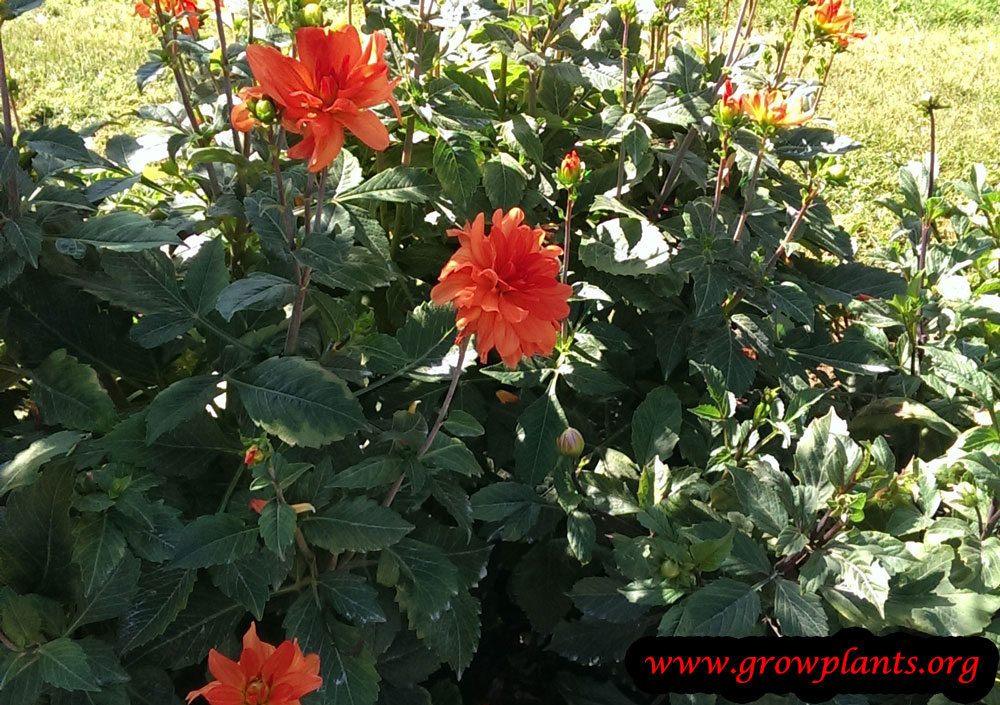
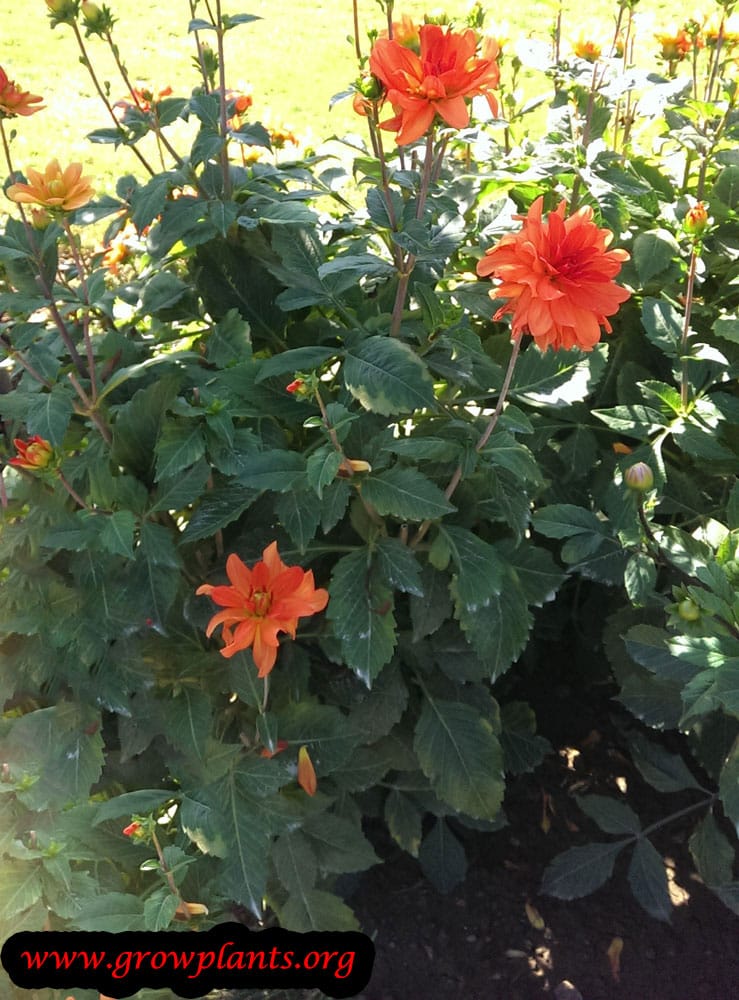
- Height & Spread: In the ground it forms an upright, bushy clump 0.3–1.5 m (1–5 ft) tall and about 0.3–0.6 m (1–2 ft) across, occasionally larger; it also grows well in large containers, where it tends to stay more compact.
- Growth Habit & Form: Upright, branching herbaceous clump rising from underground tubers, with hollow stems and a bushy outline.
- Lifespan & Maturity: Grown from a tuber, it flowers in its first season and returns each year from the same tubers; long-lived where the tubers are protected from hard frost.
Anatomy & Physical Features
- Leaves & Foliage: Green leaves, elliptic to lanceolate or deeply lobed with serrated margins, arranged pinnately along the stems.
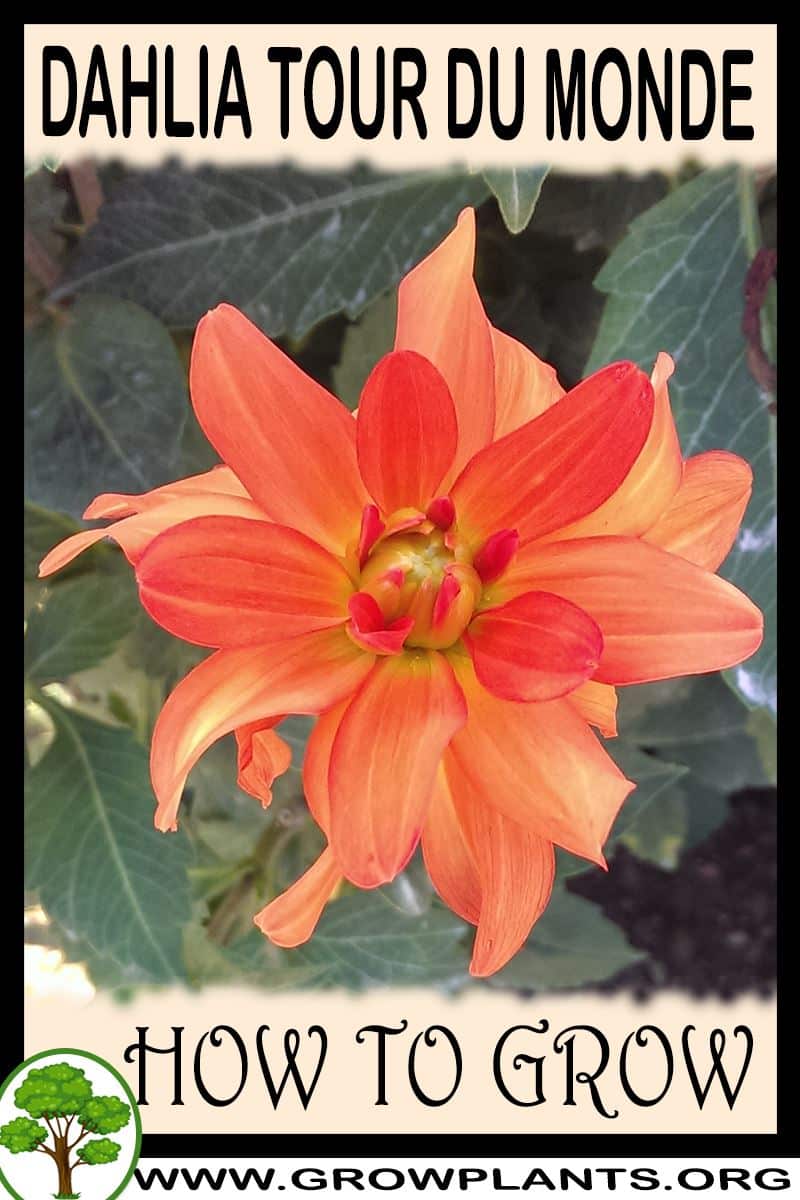
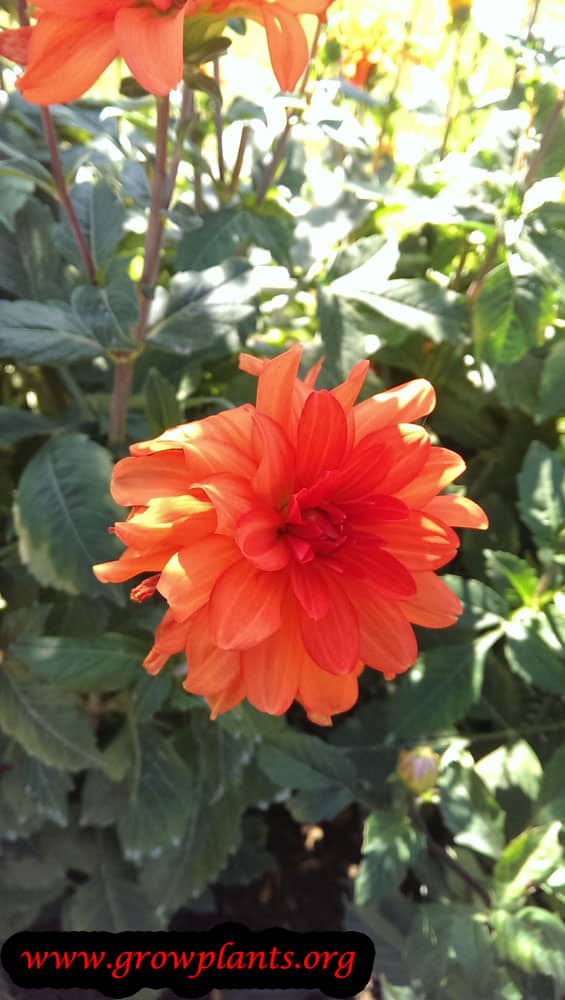
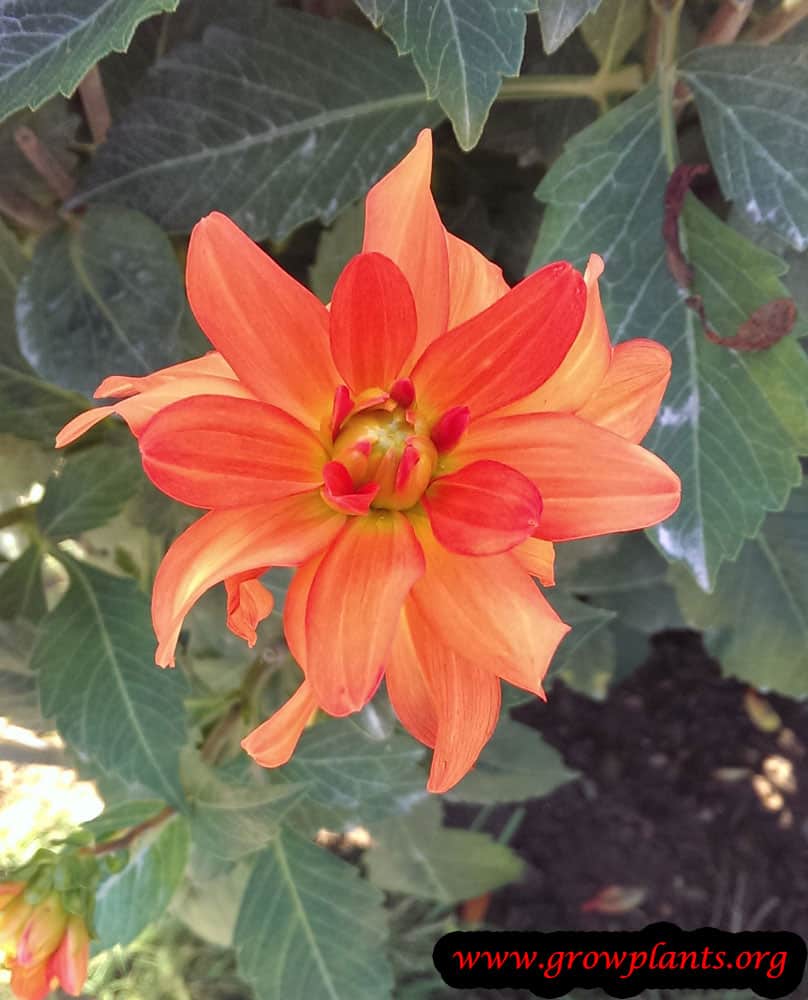
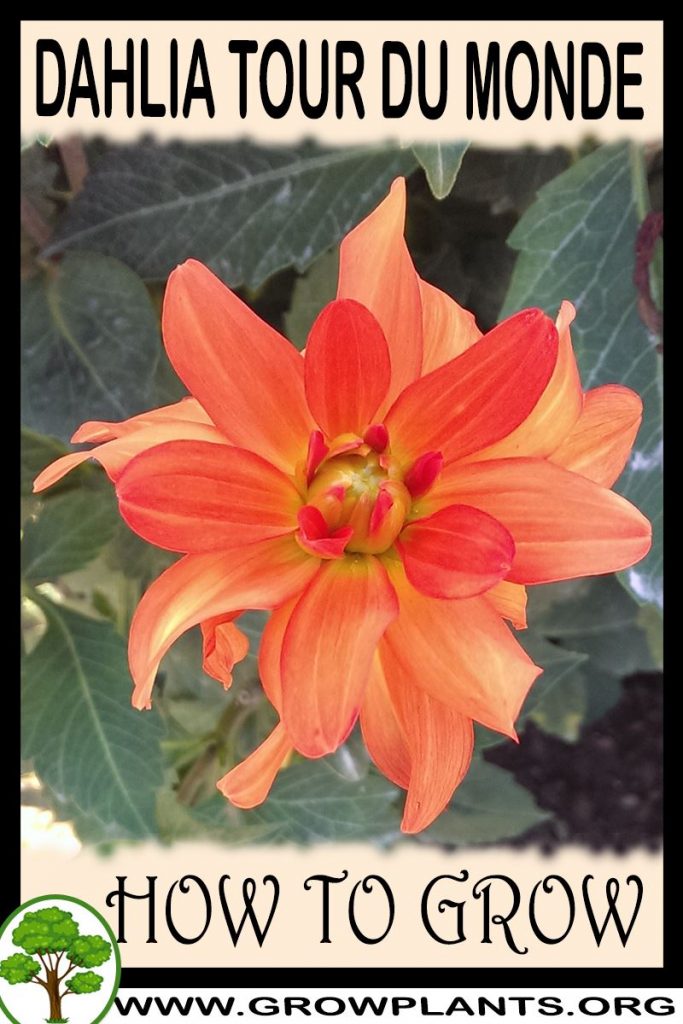
- Flower Characteristics: Light-to-dark orange double blooms with wavy, pointed petals. Flowering runs from late spring through autumn; see the Blooming guide for full detail.
Primary Uses & Landscape Value
- Functional & Ornamental Roles: A leading ornamental for beds and borders and an excellent long-stemmed cut flower; well suited to large patio containers (grown outdoors, not as an indoor houseplant) and useful for attracting pollinators.
Care Guide: Planting, Soil & Watering
Overview: This dahlia grows best in full sun and fertile, well-draining soil enriched with organic matter, performing well in mild zones (roughly 8–11) where the tubers can stay in the ground year-round. Its moisture needs are moderate — keep the soil evenly moist through active growth and flowering, but never waterlogged, as the tubers rot easily in soggy ground.
Quick Care Requirements
| Requirement | Ideal Condition |
|---|---|
| Planting Season | Spring, after the last frost (mid-spring in colder areas) |
| Growth Rate | Moderate |
| Soil Type | Rich, fertile and well-draining |
| Water Need | Moderate — keep evenly moist, letting the surface dry between waterings |
Planting & Establishment
- Best Planting Season: Plant the tubers in spring once the soil has warmed and the risk of frost has passed; in colder areas wait until mid-spring. In mild zones (about 8–11) tubers can overwinter in the ground, while in cold zones (2–7) and very hot zones (12+) they are lifted and stored over winter.
- How to Plant:
- Hole Preparation: Dig a hole a little wider than the tuber and loosen the soil at the base so the roots can establish easily.
- Soil Amendments: Work in compost or well-rotted organic matter to enrich the bed and improve drainage; avoid heavy, high-nitrogen feeds, which push leafy growth at the expense of flowers.
- Planting Depth: Lay the tuber horizontally with the growing eye facing up, covered by about 5–10 cm of soil; set the crown just below the surface and do not bury the emerging stem.
- Growth Speed & Expectations: A moderate grower that reaches roughly 0.3–1.5 m (occasionally taller) in a single season under good conditions.
Soil, Watering & Drainage Care
- Soil Mix & Drainage Needs: Provide loose, fertile, sharply draining soil — excess moisture around the tuber is the main cause of rot. In pots, use a quality free-draining potting mix rather than heavy garden soil, and make sure the container has drainage holes.
- Watering Schedule & Technique:
- Young / Newly Planted: Water sparingly after planting and keep the soil barely moist until shoots emerge, which stops the dormant tuber from rotting; increase watering once active growth begins.
- Established: Water deeply and regularly through the growing and flowering season, letting the top few cm of soil dry before watering again.
- Seasonal Adjustments: Water more often in summer heat and peak bloom, then taper off as the season ends and the foliage dies back; withhold water while dormant tubers are lifted and stored over winter.
Climate, Light & Hardiness
Dahlia Tour du monde grows best in mild, sunny climates with warm days and cool nights, doing well in mediterranean, subtropical, desert (with irrigation) and temperate gardens, and it flowers most heavily in full sun. It is frost-tender: the tubers are only reliably left in the ground over winter in USDA zones 8–11, while in colder zones (2–7) and in very hot, largely frost-free zones (12+) growers typically lift and store the tubers, effectively growing it as a seasonal plant.
Quick Climate Specifications
| Climate Zones | Subtropical, Mediterranean, Desert (irrigated), Temperate, Tropical |
|---|---|
| USDA Hardiness Zones | 8–11 in-ground; tubers can be lifted & stored to grow the plant through winter in zones 2–7 and 12+ |
| Optimal Temp Range | Approximately 15–25°C (59–77°F) |
| Cold Damage Begins | Around 0°C (32°F), at first light frost |
| Approx. Survival Minimum | Foliage and flowers are killed by the first frost; an established tuber may briefly survive near freezing only where the surrounding soil itself does not freeze |
| Frost Tolerance | Low |
| Light Conditions | Full sun |
| Wind Tolerance | Low–Moderate |
| Salt / Coastal Tolerance | Low–Moderate |
Sunlight & Light Exposure
Optimal Light Setup
Full sun for at least 6–8 hours a day gives the strongest stems and heaviest flowering; flowering drops off noticeably in shadier spots.
Direct Sun Requirement
Direct sun is genuinely needed for good bud set and compact growth; deep or prolonged shade produces weak, floppy stems and few flowers.
Shade & Heat Management
In climates with intense summer heat, light afternoon shade or dappled cover helps protect blooms from sun-scorch and colour fading, and keeps flowering going through the hottest weeks.
Best Exposure / Orientation
An open, unobstructed bed or border with morning sun is ideal; in hot-summer regions, some relief from harsh mid-afternoon sun is beneficial. Avoid deep shade cast by buildings, walls or overhanging trees, which weakens stems and reduces flowering.
Temperature Extremes & Hardiness
USDA Hardiness & Regional Limits
Reliably grown as an in-ground perennial in USDA zones 8–11, where mild winters let the tuberous roots overwinter safely in the soil. In colder zones (2–7), freezing ground would destroy the tubers, so gardeners lift them in autumn and store them indoors over winter, replanting in spring - effectively growing the plant as an annual. The site data also flags very hot, largely frost-free zones (12+) for lifting: without a distinct cool dormant period, tubers left in warm, damp soil year-round are prone to rot, so growers there often lift and store them too, or replant fresh each season.
Cold Damage & Winter Protection
Foliage and flowers are damaged by the first touch of frost and collapse quickly afterward. Where the clump is left in the ground in borderline zones, a thick mulch layer over winter helps buffer the tubers from cold; in harder-freezing areas, lifting and dry, frost-free storage is the more reliable method.
Frost Sensitivity
Frost-sensitive throughout the growing season; even a light frost blackens leaves and flowers, and repeated hard freezes will kill unprotected tubers left in the ground.
Extreme Heat Tolerance
Tolerates hot summers reasonably well with full sun and steady moisture, but prolonged extreme heat can reduce flower size and cause buds to abort; in the hottest climates, some afternoon shade helps sustain bloom quality.
Frost-Free Growing Season
Where grown as a seasonal, lifted-tuber plant, allow a full frost-free growing season - from after the last spring frost to before the first autumn frost - for the tubers to develop fully and flower over an extended period.
Wind, Humidity & Microclimate
Humidity Preferences
Grows well across a range of humidity levels; moderate humidity with good air movement around the foliage helps reduce fungal leaf and stem problems.
Dry-Air Tolerance
Tolerates dry air reasonably well given adequate soil moisture, though very hot, dry spells can stress blooms and shorten flower life.
Wind Tolerance
Tall growth (0.3–1.5 m, sometimes more) on relatively soft, hollow stems makes this plant vulnerable to wind damage and toppling once in full flower; stake plants or choose a sheltered spot in windy gardens.
Coastal / Salt Tolerance
Not noted as a coastal specialist; salt spray and saline soils are generally not well tolerated, so it is best planted away from direct beachfront exposure or given a sheltered, inland-facing spot near the coast.
Rainfall & Seasonal Moisture
Adapts to climates with regular seasonal rainfall or supplemental irrigation through the growing season, but does not tolerate prolonged waterlogged soil or a hot, humid wet season, both of which favour tuber rot.
Microclimate Recommendations
Choose a warm, sunny, wind-sheltered spot with well-drained soil; raised beds or a slight slope help move cold air and excess water away from the tubers in borderline-hardy zones.
Growing in Pots, Balconies & Indoors
Dahlia Tour du monde is not a true houseplant, but it makes a superb container plant for a sunny balcony or patio, and its blooms are excellent for cutting. Indoors the light is simply too weak – only a very sunny windowsill suits a compact cultivar, and even then the plant much prefers to be outside in full sun.
Quick Details
- Container Size: About 10-15 L (2-4 gal) for compact/patio types; 30 L or more for tall cultivars that reach up near 1.5 m
- Indoor Suitability: Not a deep-indoor houseplant; a dwarf cultivar can bloom on a bright, sunny windowsill
- Best Spot: Full sun – it needs the brightest, sunniest spot you can offer on a balcony or patio
- Soil & Drainage: Aerated, organic-rich mix (peat or coir with perlite or vermiculite); must drain freely – wet tubers rot
- Watering in Pots: Keep evenly moist through the growing season – pots dry fast; never let it sit waterlogged
Indoors & On the Windowsill
- Houseplant limits: This dahlia will not thrive as a room houseplant – it needs full sun to flower and naturally dies back to a dormant tuber, so it is grown as a seasonal container plant rather than year-round indoor greenery.
- Windowsill growing: If you want it indoors, choose a compact or dwarf (patio) cultivar and the sunniest windowsill you have, with several hours of direct sun; in weaker light it grows leggy and flowers poorly.
- Overwintering the tuber: In cold climates a pot is a real advantage – after the top growth is cut back, lift and store the tuber in a dry, frost-free place, or simply move the whole pot somewhere cool and frost-free until growth restarts in the warm season.
On a Balcony or Patio
- Light & wind: Give it the sunniest position you have – dahlias flower best in full, direct sun. Tall cultivars are top-heavy and brittle, so stake them early and shelter the pot from strong wind. Walls and paving reflect heat, so container plants dry quickly – check moisture daily in hot spells. A drip irrigation kit with a timer can take over that watering check automatically.
- Practicalities: A full, well-watered pot is heavy – make sure the balcony can take the weight, and stand it where drainage runoff will not stain or pool.
Choosing the Pot, Soil & Long-Term Care
- Pot & drainage: Use a pot with strong drainage holes sized to the cultivar; skip a standing-water saucer, since sitting in water rots the tuber. Terracotta breathes and dries faster (safer against rot), while glazed or plastic pots hold moisture longer in heat.
- Potting mix: A well-aerated, organic-rich mix – peat or coir blended with perlite or vermiculite for free drainage.
- Feeding: Potted plants need feeding more often than those in the ground because nutrients wash out – feed lightly through the growing season, favouring a low-nitrogen (higher potassium) feed, as too much nitrogen gives leaves at the expense of flowers.
- Tuber & repotting: Start each season with fresh mix; if you keep the tuber in its pot, refresh the top of the mix and pot on as the clump grows every year or two.
- Safety: Dahlias are mildly toxic if eaten and can irritate skin – keep pots out of reach of curious children and pets, and wash hands after handling tubers.
Growing this plant in a greenhouse
A greenhouse can give dahlia tour du monde frost protection and cold protection.
Greenhouse at a glance
| Greenhouse suitability | Conditional - depends on your climate |
|---|---|
| Main benefits | frost protection, cold protection |
| Season extension | earlier spring & later autumn |
| Outdoor protection advisable below | about 5°C |
| Maintain greenhouse minimum | around 5°C for active growth |
| Suitable types | unheated greenhouse, polycarbonate greenhouse |
| Heating | Heating is optional - useful mainly for winter growing in cold areas. |
Related greenhouse guides
- Greenhouses: How to Choose the Right Greenhouse
- Polycarbonate Greenhouses: What to Look for Before Buying
Fertilizing & Feeding
Tour du monde is a light-to-moderate feeder like most decorative dahlias; restrained, steady feeding through the growing season builds sturdy stems and consistent blooms without pushing soft, over-lush foliage.
Quick Fertilizing Specs
| Feeding Level | Light to moderate feeder |
|---|---|
| Main Nutrient Priority | Balanced feeding with nitrogen kept in check so vegetative growth doesn’t crowd out flowering |
| Best Feeding Period | Active growth from spring planting through the summer and autumn bloom season |
| Soil pH | Prefers slightly acidic to near-neutral, well-drained soil |
| Reduce/Stop Feeding | Feeding tapers off and stops as foliage dies back in autumn and the tuber goes dormant |
| Organic Options | Well-rotted compost worked into the soil at planting time |
Feeding by Growth Stage
Spring Growth After Planting
Build a sturdy framework of stems and leaves from the newly planted tuber before flowering begins
| Nutrient direction | Balanced feeding that supports steady growth without forcing soft, weak stems |
|---|---|
| Timing | After spring planting, once new shoots emerge and are actively growing |
| Frequency | Light, regular feeding through the early growing season, easing off if growth looks overly lush |
| Fertilizer types | A balanced, general-purpose flowering-plant fertilizer, Well-rotted compost worked into the soil around the planting hole |
| Precautions | Because excess nitrogen is known to weaken stems and reduce flowering in dahlias, avoid nitrogen-rich feeds even during vigorous early growth |
Bloom Season Feeding
Support Tour du monde’s orange blooms, ranging light to dark across the petals, through its extended spring-to-autumn flowering season
| Nutrient direction | Balanced feeding that keeps nitrogen moderate so energy goes toward flower and stem quality rather than excess foliage |
|---|---|
| Timing | Through the main bloom period, spanning spring into summer and autumn |
| Frequency | Continue light, regular feeding through the active bloom season; ease back if flowering slows or foliage becomes overly lush |
| Fertilizer types | A balanced flowering-plant fertilizer, Diluted liquid feed worked in during regular watering |
| Precautions | Avoid nitrogen-heavy feeding, which can produce lush foliage and fewer or weaker blooms in dahlias |
Autumn Dieback and Tuber Storage
Let the plant wind down naturally as foliage dies back and the tuber goes dormant or is lifted for winter storage
| Nutrient direction | None – withhold fertilizer entirely as the plant enters dormancy |
|---|---|
| Timing | From the end of the bloom season through winter dormancy |
| Frequency | No feeding at this stage |
| Fertilizer types | No feeding at this stage; withhold all fertilizer while foliage dies back and the tuber rests or is lifted for winter storage |
| Precautions | Do not fertilize dormant or stored tubers; excess moisture and feeding at this stage raise the risk of rot |
Nutrient Deficiency Signs & Corrections
Older, lower leaves turn pale yellow-green and overall growth looks stunted or thin
| Possible causes | Insufficient nitrogen supplied through the soil or feeding program, Waterlogged or compacted soil limiting root uptake, Naturally sandy or leached soil low in organic matter |
|---|---|
| Appears first on | Older, lower leaves first |
| What to check | Confirm feeding has been consistent through the active growing season, Check drainage and soil compaction around the root zone, Rule out root or tuber damage limiting uptake |
| Possible correction | If confirmed, apply a balanced flowering-plant fertilizer per its label during active growth and work organic matter into the soil |
New leaves emerge pale yellow while the veins remain distinctly green
| Possible causes | High soil pH limiting iron availability, Waterlogged or poorly drained soil, Root stress from compacted or cold, wet soil |
|---|---|
| Appears first on | Newest growth at the shoot tips |
| What to check | Check soil drainage and look for signs of root stress, Consider a soil pH test through a local extension service, Rule out plain nitrogen deficiency as the cause of yellowing |
| Possible correction | Correct underlying drainage or pH issues first; a chelated iron product applied per its label can help correct a confirmed deficiency |
Leaf edges and tips turn brown or scorched-looking, with weaker stems and smaller blooms
| Possible causes | Low potassium availability in the soil, Excess nitrogen feeding that outpaces other nutrients, Drought stress or inconsistent watering during bloom |
|---|---|
| Appears first on | Older leaf margins first |
| What to check | Review recent feeding for excess nitrogen relative to other nutrients, Check watering consistency through the bloom season, Rule out salt buildup from repeated over-fertilizing |
| Possible correction | Shift to a balanced fertilizer with adequate potassium per its label rather than a nitrogen-heavy feed |
Pruning, Training & Seasonal Maintenance
Dahlia Tour du monde is a tuberous herbaceous perennial that dies back to the ground each year, grown for its orange (light to dark), fully double Decorative blooms with wavy petals; pruning here means shaping soft current-season growth, not permanent wood, since new stems grow from the tuber every spring. It tolerates frequent light pinching, disbudding and deadheading through the growing season, with no woody winter pruning – the productive windows are early growth (pinch for branching) and post-frost dormancy (cut back and lift). Early tip removal multiplies flowering stems; ongoing deadheading sustains reblooming.
Quick Pruning & Maintenance Specs
| Pruning Tolerance | Moderate – soft, fast-regrowing herbaceous tissue; no permanent wood |
| Primary Pruning Window | Spring, from 3-4 leaf pairs (pinching), through summer bloom (deadheading/disbudding) |
| Secondary Maintenance Window | Autumn/Winter cutback after first frost blackens foliage, before lifting |
| Typical Frequency | Weekly light maintenance through bloom season; one full cutback at season’s end |
| Main Objective | Build branching for more flowering stems, support heavy blooms, prolong flowering |
| Young Plant Priority | Pinch the growing tip above a node once 3-4 leaf pairs have formed |
| Mature Plant Priority | Deadhead continuously, disbud if larger blooms wanted, thin crowded basal shoots, stake before flower weight develops |
| Best Tool Type | Precision snips for pinching/deadheading; bypass secateurs for thicker basal stems at cutback |
| Avoid Heavy Pruning During | Active bud set before a bloom flush; wet weather (grey mold risk in dense double heads) |
Pruning by Plant Age & Size
Newly Established
No pruning needed beyond removing frost- or slug-damaged shoot tips in the first weeks after emergence.
Young / Formative
Pinch the growing tip above a node once 3-4 leaf pairs are present (roughly 30-40cm) to force 2-4 lateral branches.
Mature / Established
Prioritize continuous deadheading; disbud for larger show-quality blooms or leave buds for more numerous smaller flowers.
Seasonal Pruning Schedule
Pre-Growth / Early-Spring
Objective: multi-stemmed framework. Remove: growing tip at 3-4 leaf pairs. Do not remove: lower leaves/uncrowded side shoots. Expected response: 2-4 new lateral stems within 1-2 weeks. Flowering impact: more flowering stems, slightly later first bloom.
Summer Canopy Management
Objective: sustain reblooming, support heavy heads. Remove: spent heads at the first strong lateral/node, overcrowded basal shoots. Do not remove: firm unopened buds. Expected response: continuous new buds. Flowering impact: direct – deadheading drives reblooming.
Dormant / Winter
Objective: prepare for storage/dormancy. Remove: all top growth to a short stub once frost blackens foliage. Do not remove: top growth before frost blackens it. Expected response: dormancy; lift (cold zones) or leave in place (zones 8-11). Flowering impact: none until next spring.
Structural Pruning & Training
No permanent framework; the only structural work is pinching for branching and staking, since heavy double blooms can lean or snap stems once flowering.
Special Growth to Remove
Spent flower stems (cut to the first strong lateral); thin excess basal shoots on crowded clumps. No rootstock suckers, watersprouts or runners apply.
Container & Small-Space Pruning
Suited to planter/container growing; pinch earlier and slightly harder for compact size, stake early against toppling, water more after cutback as container soil dries faster.
Tools
Precision snips for pinching/deadheading; bypass secateurs for thicker basal stems at cutback; soft ties or stakes once flower weight develops. No saw or hedge shears apply.
Tool Hygiene & Disease Risk
Increased risk: Dahlia mosaic virus and other sap-transmissible viruses are common in dahlia stock and spread on cutting blades; disinfect blades between plants and cultivars.
Cut Placement & Technique
Pinch just above a node. Deadhead by cutting back to the first strong lateral bud or node, distinguishing rounded spent flowers from firm pointed buds before cutting.
Heavy Pruning & Rejuvenation
Not applicable in the woody sense. Full top growth is removed once yearly as dormancy management. Congested clumps are rejuvenated by dividing the tuber at lifting, not by pruning top growth.
Post-Pruning Care
No feeding needed after pinching/deadheading – the plant is already on its normal routine and soft-tissue wounds close within days; watch cuts for aphids or slugs. After autumn cutback, focus on curing/drying the lifted tuber.
Common Pruning Mistakes
Mistaking a firm unopened bud for a spent flower and cutting off developing buds; deadheading by pulling petals only instead of cutting to a node; delaying staking until heavy blooms have already caused leaning/snapping; cutting back and lifting before frost has fully blackened the foliage.
When NOT to Prune
Avoid hard cutback before the first killing frost blackens top growth. Avoid deadheading or pinching in wet weather – dense double flowerheads trap moisture and favor grey mold. Avoid pinching during active bud set right before a bloom flush. Avoid heavy stem removal immediately after transplanting spring divisions.
Recommended Tools (by task)
- Young plant, pinching growing tips: precision_snips – clean small cuts on soft hollow stems.
- Mature plant, staking at/before flowering: soft_ties_stakes – heavy double blooms can lean or snap unsupported stems.
- Any age, between-plant cuts: blade_disinfectant – sap-transmissible mosaic virus spreads on blades.
Pruning Troubleshooting
| Problem | Possible Cause | What to Check | Corrective Action |
| No side branching, single tall stem | Growing tip never pinched | Leaf-pair count at first pinch | Pinch above a node once 3-4 leaf pairs present |
| Fewer or smaller blooms than expected | Side buds not disbudded or basal shoots overcrowded | Bud clusters and basal shoot count | Disbud to the central bud, or thin excess basal shoots |
| Stems leaning or snapped after wind/rain | Staking installed too late | Stake timing vs plant height/flower weight | Stake at planting or by 30-40cm height |
| Grey mold/browning on flowerheads after deadheading | Cutting on wet foliage; moisture trapped in dense double bloom | Recent weather and foliage moisture | Deadhead only when dry; remove affected blooms off-site |
Propagation Guide
Dahlia Tour du monde is propagated by dividing its tuberous clump, since vegetative propagation is required to keep this cultivar’s orange, wavy-petaled flower form true; seed-grown plants would not reproduce it. Division is a routine home-garden method, making overall propagation Easy to Moderate.
Quick Propagation Specs
| Best Propagation Method | Tuber (clump) division |
| Alternative Methods | Basal stem cuttings from sprouted tubers (for faster multiplication) |
| Propagation Difficulty | Easy to Moderate |
| Vegetative True-to-Type | Yes – required to preserve this named cultivar |
| Best Propagation Season | Spring (mid-spring in cold climates), per site data |
| Cutting Rooting Time | Typically a few weeks under warm, humid conditions |
Division, Offsets, Pups & Suckers
In cold areas the tuber clump is lifted at season’s end after the foliage is cut back (site data); in warm areas only spent flowers and dead leaves need removal and tubers can often overwinter in place. Divide in spring once growth eyes are visible near the old stem base, keeping at least one eye and a sound tuber section per division. Use a clean, sharp knife, let cuts dry briefly before planting, and discard soft or rotten pieces; well-drained soil helps avoid the bulb rot the site notes.
Stem Cuttings
To multiply a valued clump faster, basal shoots from a pre-sprouted tuber can be taken in late winter/early spring with a small piece of crown attached and rooted in a light, well-drained mix under warm, humid conditions; rooting hormone is optional. This supplements, rather than replaces, standard division for home growers.
Bloom & Edible Flower Guide
Quick Details
- Bloom Season: From late spring through autumn, flowering heavily in summer and carrying on until the first hard frost.
- Time to First Bloom: Roughly 8 to 10 weeks after tubers are planted in spring.
- Flower Appearance: Orange blooms shading from light to dark; many wavy petals, ovate to elliptic with a pointed tip and a broader base.
- Edibility: Edible – the ray-petal florets can be eaten and are often used fresh as a colourful garnish; flavour ranges from mild to slightly bitter, so the pale base of each petal is usually trimmed away. Grown mainly as an ornamental and cut flower.
Detailed Blooming Overview
Dahlia Tour du monde is a tuberous, herbaceous perennial of the genus Dahlia (family Asteraceae), grown as an ornamental and as a cut flower. What looks like a single bloom is really a flower head of many small florets – the showy outer petals are ray florets. In the Decorative group, it carries fully double blooms with broad, flat petals and no visible central disc. It is hardy in the ground in zones 8 to 11; in colder zones the tubers are lifted and stored over winter, then replanted in spring. Flowering builds through summer and continues until the first frost cuts the top growth back.
Flower Characteristics
- Form: Decorative group – fully double blooms with broad, flat petals and no visible central disc.
- Colour & petals: Orange blooms shading from light to dark; many wavy petals, ovate to elliptic with a pointed tip and a broader base.
- Flower head: A composite head of many florets; the outer ray florets create the colourful display.
- Edible petals: The ray florets are edible; flavour varies by cultivar from mild to bitter, and the white petal base is best removed before eating.
Bloom Care & Thinning
- Pinching for more flowers: Pinch out the growing tip while plants are young to encourage bushier growth and more flowering stems.
- Disbudding: For fewer but larger show blooms, remove the two side buds beside each central bud; leave all the buds if you prefer a greater number of smaller flowers.
- Deadheading: Remove spent blooms regularly to keep fresh buds coming all season – spent buds are cone-shaped while new buds are round, which makes them easy to tell apart.
- Support: Taller plants and heavy blooms benefit from staking so the stems do not bend or snap.
- Cutting: As a cut flower, cut in the cool of the morning when blooms are almost fully open – dahlias open little further once cut.
- Pollination: The densely double blooms show little open centre, so they offer less to pollinators than single, open-centred dahlias; grow a few open forms nearby if you want to feed bees.
Bloom Health & Protection
- Earwigs: Earwigs shelter inside the blooms and chew ragged holes in the petals; a loosely rolled newspaper or a straw-stuffed pot set on a cane nearby traps them for removal in the morning.
- Aphids & thrips: These sap-feeders gather on buds and can distort or discolour opening flowers; a strong jet of water or an insecticidal soap or neem-oil treatment usually keeps them in check.
- Grey mould (Botrytis): In damp, crowded conditions opening blooms can rot under a fuzzy grey mould; generous spacing and good airflow help, and affected blooms are best removed promptly.
- Powdery mildew: Late in the season a white powdery film can coat the leaves around the flowers; better airflow and, if needed, a sulfur-based fungicide help slow its spread.
Fruit & Uses
Note: Dahlia Tour du monde is a Decorative-group show dahlia grown for its light-to-dark orange flowers, not for eating; like the wider Dahlia genus its tuberous roots and petals are technically edible, but this is a marginal, taste-test-first food rather than a reliable homegrown vegetable. Tubers can be eaten raw or cooked similarly to jicama, and the petals can be used sparingly as a fresh garnish, but flavour and texture vary widely and can be bitter or woody in a decorative hybrid like this one.
Quick Edible Specs
| Edible Parts | Tuberous roots (tubers), flower petals |
|---|---|
| Main Use(s) | Culinary (root-vegetable substitute), edible-flower garnish |
| Eaten Raw or Cooked | Tubers raw or cooked (boiled, roasted, baked); petals raw |
| Preparation Required | Peel and wash tubers; cooking improves texture/flavour and is recommended; rinse petals and remove the pale, bitter base |
| Harvest Season | Tubers: lifted in autumn once foliage dies back – the same time the site recommends taking the bulb out of the ground for winter in cold areas; petals: through the spring/summer/autumn bloom season |
| Time to First Harvest | Tubers only after a full season of growth from a planted tuber/bulb (see Propagation) – not from a fresh, undivided division |
| Storage | Tubers store like other dahlia storage tubers – cool, frost-free, slightly humid; petals best used fresh the day they are picked |
| Safety/Toxicity Caveat | Dahlia is listed as mildly toxic to dogs, cats and horses (possible GI upset) – keep plants away from pets; this is a decorative cultivar, not bred for eating – taste-test a small cooked amount first, eat only unsprayed plant material, and introduce tubers gradually since their inulin content can cause digestive gas in some people |
Roots & Tubers
The fleshy tuberous roots that form on the clump are the main edible part. They can be sliced thin and eaten raw, like jicama or radish, or cooked – boiled, roasted or mashed as a root vegetable. Because this is a show cultivar bred for its orange flower rather than for eating, taste ranges unpredictably from mildly sweet and nutty to bitter or woody; wash and peel before use, and cook to soften texture and mellow raw bitterness.
Flowers & Flower Buds
The orange (light-to-dark), multi-petalled flowers – wavy, ovate-to-elliptic petals with a pointed tip and wider base – can be picked and the petals used fresh as a salad garnish. Pull petals from the base, discard the green calyx, and use only a few per dish; flavour is mild to slightly bitter, not a leafy-green substitute.
Harvesting
Lift the tuber clump in autumn once the foliage dies back or is cut down – the same digging the site recommends for winter storage in cold areas (see Care/Pruning). Set aside a few tubers to eat but keep enough with a growing eye to replant or overwinter, since eating the whole clump removes next year’s propagation stock. Pick petals through the bloom season and use them soon after picking.
Preparation, Uses & Safety
Wash and peel tubers, taste a small cooked piece before committing more since palatability varies by plant and season; cooking (boiling, roasting, steaming) generally gives a better result than raw. Use petals sparingly, fresh, as a garnish. Avoid any plant material treated with non-food-safe pesticides or fungicides, keep plants out of reach of dogs, cats and horses, and introduce tubers in small amounts first. No medical claims are made here beyond noting dahlia tubers have a history of food use in parts of Central America.
Pests, Diseases & Troubleshooting
Overview: Dahlias are vigorous, soft-tissue tuberous perennials whose lush foliage and long-lasting blooms attract a predictable set of chewing and sap-sucking pests, with slugs and earwigs the two standouts and powdery mildew the classic late-season disease. Most trouble is prevented culturally — good spacing and airflow, tidy beds, firm staking, careful watering at the base, and clean lifting and storage of the tubers over winter. Reach for organic and barrier methods first, keeping any sprays targeted and pollinator-safe because the open blooms are a magnet for bees.
Quick Troubleshooting Overview
| Issue / Pest | Main Symptom | Primary Solution |
|---|---|---|
| Slugs & snails | Ragged holes and slime trails, young shoots stripped overnight | Hand-pick after dark; iron-phosphate pellets; grit or copper barrier rings |
| Earwigs | Petals and flower buds chewed ragged; irregular holes in blooms | Trap in rolled cardboard or straw-stuffed upturned pots; clear debris |
| Aphids | Sticky honeydew, distorted shoot tips, sooty mould, virus spread | Blast off with water; insecticidal soap; encourage ladybirds and lacewings |
| Thrips | Silvery flecking, streaked petals; can transmit spotted wilt virus | Blue sticky traps; remove weeds; insecticidal soap or spinosad if severe |
| Powdery mildew | White powdery film on leaves, worst late in the season | Improve airflow, remove lower leaves; sulphur or potassium-bicarbonate spray |
| Tuber rot | Soft, foul-smelling tubers in wet soil or winter storage | Improve drainage; cure and dry tubers; store cool, dry and airy |
Common Pests & Management
- Slugs & Snails (Deroceras & Helix spp.):
- Symptoms: The number-one enemy of young dahlias — emerging shoots and new tubers are shredded or grazed to the ground overnight, with tell-tale silvery slime trails and ragged-edged holes. Damage is heaviest in mild, damp weather and on newly planted tubers.
- Prevention & Control: Patrol beds after dark with a torch and hand-pick; clear leaf litter, boards and pot rims where they shelter. Ring vulnerable shoots with sharp grit, crushed shell or copper tape, and set beer traps. Where pressure is high, use iron-phosphate pellets (safe around pets and wildlife) sparingly. Encourage frogs, ground beetles and birds.
- Earwigs (Forficula auricularia):
- Symptoms: The signature dahlia flower pest — they feed at night, chewing ragged holes in petals and gnawing developing buds, so blooms open lopsided or tattered. Hide by day deep inside the flower or under debris. (They also eat aphids, so populations are worth managing rather than eradicating.)
- Prevention & Control: Trap them with loosely rolled corrugated cardboard or straw-stuffed upturned pots set on canes among the plants, emptied each morning. Keep the bed clear of litter and hollow stems. Grease-band stakes to block climbers. Reserve any spot treatment for heavy infestations and never spray open blooms during the day when bees are active.
- Aphids (Aphis fabae & Myzus persicae):
- Symptoms: Colonies of green or black soft-bodied insects cluster on shoot tips, buds and leaf undersides, causing curled, distorted growth, sticky honeydew and sooty mould. Critically, they are efficient vectors of dahlia mosaic and other viruses, so control protects the whole stock.
- Prevention & Control: Dislodge colonies with a firm jet of water; pinch out infested tips. Encourage ladybirds, lacewings and hoverflies. Treat persistent colonies with insecticidal soap or a light horticultural-oil spray, applied in the evening to spare pollinators. Avoid excess nitrogen, which fuels soft, aphid-prone growth.
- Thrips (Frankliniella occidentalis):
- Symptoms: Tiny slender insects that rasp leaves and petals, leaving silvery flecking, pale streaks and distorted, discoloured blooms. Most important as the vector of tomato spotted wilt virus (TSWV), which causes ring-spots and stunting.
- Prevention & Control: Hang blue sticky traps to monitor and reduce numbers; remove weeds that host them. Encourage predatory mites and minute pirate bugs. For outbreaks use insecticidal soap or spinosad, rotating products; rogue out any virus-symptomatic plants promptly.
- Two-spotted Spider Mite (Tetranychus urticae):
- Symptoms: In hot, dry conditions leaves take on a fine pale stippling, then bronze and dry, with delicate webbing on the undersides. Worst on stressed, under-watered plants and in still air.
- Prevention & Control: Raise humidity and keep plants well watered; hose down leaf undersides. Introduce predatory mites (Phytoseiulus persimilis) under cover. Treat with horticultural oil or insecticidal soap, ensuring thorough coverage of leaf undersides; avoid broad-spectrum insecticides that kill mite predators.
- Capsid Bugs (Lygocoris pabulinus):
- Symptoms: Sap-sucking at shoot tips and buds kills small patches of tissue; as leaves expand these become many ragged, tattered holes, and buds may abort or open distorted. The bugs themselves are fast-moving and easily missed.
- Prevention & Control: Keep beds and surrounding weeds tidy to reduce breeding sites. Damage is usually cosmetic and tolerable; for repeated severe attacks an evening application of an approved contact insecticide at first sign can be used, but cultural tidiness is normally enough.
- Caterpillars & Cutworms (noctuid moth larvae, Agrotis spp.):
- Symptoms: Caterpillars chew irregular holes in leaves and buds, while soil-dwelling cutworms sever young stems at the base, felling whole shoots overnight. Look for droppings and for larvae curled in the surface soil by day.
- Prevention & Control: Hand-pick larvae at dusk; fit cardboard or foil collars around young stems against cutworms. Hoe soil to expose larvae to birds. Biological Bacillus thuringiensis (Bt) sprays control leaf-feeding caterpillars selectively without harming beneficials.
Diseases & Fungal Issues
- Powdery Mildew (Golovinomyces cichoracearum):
- Symptoms: The classic late-season dahlia disease — a white to greyish powdery coating spreads over upper leaf surfaces, which may yellow and dry. Favoured by crowding, dry roots and cool humid nights, it rarely kills but disfigures foliage and weakens plants.
- Treatment & Management: Space plants for good airflow, remove congested lower leaves, and keep roots evenly watered (drought stress worsens it). Clear and destroy affected debris. At first signs apply sulphur, potassium bicarbonate or a suitable fungicide, repeating as directed; choose resistant cultivars where possible.
- Grey Mould / Botrytis (Botrytis cinerea):
- Symptoms: In damp weather blooms and buds rot with brown, water-soaked patches and a fuzzy grey mould, especially on ageing or densely petalled flowers and after rain. Can spread back into stems.
- Treatment & Management: Deadhead spent and spotted blooms promptly and bin them; improve spacing and airflow; avoid overhead watering late in the day. Remove and destroy affected tissue. A protectant fungicide helps in persistently wet spells; good hygiene is the main defence.
- Dahlia Mosaic Virus & Tomato Spotted Wilt Virus:
- Symptoms: Mosaic virus causes pale mottling, vein-banding, stunting and puckered leaves; spotted wilt adds ring-spots, necrotic flecks and distorted growth. Both are spread by insect vectors (aphids and thrips respectively) and by taking cuttings/divisions from infected stock — there is no cure.
- Treatment & Management: Rogue out and destroy symptomatic plants and their tubers promptly to protect the collection. Control aphids and thrips, disinfect cutting tools between plants, and propagate only from healthy, vigorous stock. Manage weeds that harbour virus and vectors.
- Verticillium & Fusarium Wilt (Verticillium dahliae, Fusarium oxysporum):
- Symptoms: Soil-borne fungi invade the water-conducting tissue, causing leaves to yellow, wilt and die — often one side or the lower foliage first — with brown staining visible in cut stems. Plants collapse in warm weather despite moist soil.
- Treatment & Management: No cure once infected: remove and destroy affected plants and do not compost them or their tubers. Practise rotation, avoid replanting dahlias in known infected ground for several years, improve drainage, and start with clean stock in fresh or well-drained soil.
- Tuber Storage / Bacterial Soft Rot (Pectobacterium / Erwinia spp.):
- Symptoms: Lifted tubers turn soft, slimy and foul-smelling in storage, or rot in cold, waterlogged ground. Fungal storage rots appear as sunken, mouldy patches. Entry is usually through wounds made at lifting.
- Treatment & Management: Lift after the first frost, handle gently to avoid bruising, and cure tubers so cut surfaces dry before storing. Keep them in a cool, dry, airy, frost-free place in dry medium; inspect through winter and discard any that soften before rot spreads.
Growing Difficulties & Abiotic Problems
- Tuber Rot in Wet or Cold Storage / Waterlogged Soil:
- Cause & Symptoms: Dahlia tubers are prone to rotting when kept too wet or too cold — in heavy, waterlogged soil over winter, or in damp storage. Tubers go soft, dark and mushy and fail to sprout.
- Correction Strategy: Plant in free-draining soil enriched with organic matter and never let dormant tubers sit in soggy ground. Where winters are wet or cold, lift, cure and store dry. Water plants generously in growth but ease off as they die back.
- Frost Blackening:
- Cause & Symptoms: Dahlias are frost-tender; the first hard frost blackens foliage and stems overnight, and prolonged freezing kills unprotected tubers in the ground.
- Correction Strategy: After the first frost blackens the tops, cut back and either lift and store the tubers frost-free, or in mild areas leave them in place under a deep dry mulch. Plant out only once frost danger has passed.
- Failure to Bloom / All Leaf and No Flower:
- Cause & Symptoms: Lush foliage with few flowers usually signals too much nitrogen or too little light; plants in shade or over-fed also grow soft and flop.
- Correction Strategy: Give a full-sun position and feed with a higher-potassium (bloom) fertiliser rather than high-nitrogen feeds. Pinch out the growing tip of young plants to encourage branching, and deadhead regularly to keep new buds coming.
- Weak Stems, Flopping & Disbudding Needs:
- Cause & Symptoms: The tall, brittle, hollow stems and heavy blooms snap or flop in wind and rain, and crowded buds give smaller flowers.
- Correction Strategy: Stake plants at planting and tie in as they grow; pinch young plants to build a sturdy branched framework. For larger show blooms, disbud (remove the two side buds below each terminal bud); shelter from strong wind.
What Helps — Products & Tools
For this plant the useful toolkit is: iron-phosphate slug pellets plus grit or copper barriers and beer traps for slugs and snails; rolled-cardboard or straw-pot earwig traps; insecticidal soap and light horticultural/neem oil for aphids, thrips and spider mites; blue and yellow sticky traps for monitoring; Bacillus thuringiensis (Bt) for caterpillars; sulphur or potassium-bicarbonate spray for powdery mildew; a protectant fungicide and rigorous deadheading for Botrytis; and sturdy stakes with soft ties for support. Spray any oils or soaps in the evening to protect bees on the open blooms.