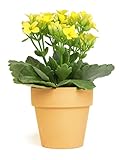
Kalanchoe blossfeldiana (Flaming Katy) is grown indoors chiefly for its long-lasting flower clusters. Give it a bright window, water sparingly, and it will hold its blooms for weeks – getting it to flower again afterwards takes a deliberate dark-and-light routine, since this species only sets buds in response to long nights.
Light and placement indoors
Give it your brightest indoor spot – a south- or west-facing windowsill is ideal. Bright light keeps growth compact and colourful; in weaker light the plant stretches, fades, and flowers poorly. It doesn’t need harsh direct midday sun and can scorch through unfiltered glass in summer.
Watering and drainage
As a succulent, it stores water in its leaves and needs the soil to dry out between waterings – water thoroughly, then leave it alone until the mix is dry again. A free-draining cactus/succulent mix in a pot with drainage holes is essential; standing water or a soggy mix is the fastest way to rot the stem and roots.
Temperature and humidity
Normal room temperature suits it well; keep it away from cold drafts and frost, since it has essentially no cold tolerance. It copes with average indoor humidity but appreciates a little more than very dry, centrally-heated winter air.
Deadheading
Snip off individual flower clusters as they fade, cutting back to a leaf node. This keeps the plant tidy, redirects energy into the next flush, and – since this species can self-seed in warm climates – limits unwanted seeding.
Reblooming: uninterrupted darkness matters most
Kalanchoe blossfeldiana is a short-day plant, and what actually controls flowering is the darkness being complete and unbroken – not just its length. The plant is sensitive to light pollution during the dark period: a single interruption (a lamp switched on nearby, a hallway light, a phone screen, even a streetlight through a window) can reset the process and prevent buds from forming at all, even if the total hours of darkness were otherwise correct.
To bring a spent plant back into flower, give it about 14 hours of genuinely uninterrupted darkness each night – a closet, a covered box, or a fully dark room all work, as long as no light reaches the plant at any point during that period – paired with bright light the rest of the day. Keep this up for roughly six weeks to get flower buds to form; full reflowering can take up to about 12 weeks from the start of the routine. Avoid checking on the plant with a flashlight during the dark hours, and keep the room below about 27°C (80°F) at night, since heat during the dark period can delay flowering even when the darkness itself is correct.
Common indoor problems
Stretched, pale, sparsely-flowering growth almost always means too little light. A collapsing or mushy stem points to overwatering or poor drainage. Fuzzy grey mould on spent flower heads (botrytis) is more likely in still, humid air – remove faded blooms promptly and improve airflow around the plant.
Quick questions
Why won’t my kalanchoe rebloom? The most common cause is light leaking into the dark period – even a brief interruption can stop bud formation. It needs about six weeks of genuinely uninterrupted nights (14+ hours of complete darkness) to set new buds.
How often should I water kalanchoe indoors? Only once the soil has dried out – it’s a succulent, and overwatering is the main way indoor plants are lost.
Is kalanchoe safe around pets? No – all parts are toxic to cats and dogs if eaten, with the flowers being the most toxic part.
Related guides
{“@context”:”https://schema.org”,”@type”:”Article”,”headline”:”Kalanchoe Indoor Care: Light, Watering & Reblooming”,”description”:”Kalanchoe blossfeldiana indoor care: light, watering, deadheading, and the short-day dark-period method to get it to rebloom.”,”mainEntityOfPage”:{“@type”:”WebPage”,”@id”:”https://www.growplants.org/gardening/kalanchoe-indoor-care”},”author”:{“@type”:”Organization”,”name”:”GrowPlants”,”url”:”https://www.growplants.org”},”publisher”:{“@type”:”Organization”,”name”:”GrowPlants”,”url”:”https://www.growplants.org”},”datePublished”:”2026-09-12T00:55:17+00:00″,”dateModified”:”2026-09-12T08:40:37+00:00″}