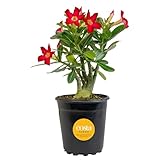
The desert rose, Adenium obesum, is a succulent shrub grown for two things at once: a swollen, sculptural trunk that makes it one of the great bonsai subjects, and flat five-petalled flowers in purple, pink, white, yellow, orange, black or combinations of more than one colour. It is a tough plant in the way desert plants are tough – it will forgive drought and heat almost indefinitely, and forgive frost and standing water not at all. Nearly all successful desert rose growing comes down to respecting that asymmetry.
What the plant actually wants
Adenium is at home in desert, Mediterranean and subtropical climates, and grows in hardiness zones 10b to 12. It reaches 0.5–2 m (20–80 inches) and grows at a medium to slow pace, which is precisely why it makes such a good bonsai: a slow-thickening trunk is a trunk you can shape.
Two requirements are non-negotiable:
- Well-drained soil. The plant carries its own water reserve in its trunk and stems, so wet roots offer it nothing and rot it fast.
- Frost-free conditions. A desert rose cannot survive frost, full stop.
Beyond that it is unusually adaptable on light. It will grow anywhere from full sun through half shade to full shade, but the qualifier matters: it still needs light. Full shade here means a bright shaded position, not a dark corner. Water requirement is small to average – it is a plant you underwater on purpose.
 Bonide Bontone II Rooting Powder, 1.25 oz Ready-to-Use Dust for Houseplants and Transplants Speeds
 Garden Safe Take Root Rooting Hormone 2 Oz, Promotes Rooting, 2 Pack
Rooting hormone can improve success rates when propagating desert rose from cuttings: As an Amazon Associate we earn from qualifying purchases.
It is summer deciduous by nature, dropping its leaves in the dry season. Keep the water going and it will hold them and stay evergreen instead. That is a useful piece of information rather than a rule: a desert rose that suddenly sheds leaves has usually not been attacked by anything, it has just been allowed to dry out and reverted to its natural habit.
Grow it in a pot, even if you could plant it out
Container growing is not a compromise for this plant, it is the recommendation, and it solves the frost problem outright. Because a desert rose cannot take frost, growing it in a pot lets you bring it indoors to overwinter and take it back outside when the risk passes. It grows perfectly well as an indoor plant and equally well in a planter or flowerpot, so nothing is lost.
Planting season reflects this: autumn, winter and spring are the planting months, avoiding the peak of summer heat. Outdoors, do not plant in winter in a cold climate — spring or autumn are the safer choices. Indoors, you can pot one up at any time of year.
Seed or cutting? Start with a cutting
Both work, and this is the single most useful decision to get right.
Cuttings or a bought plant are the recommended route, for three reasons: it is easier, it is faster, and — the one that actually decides it for most people — it guarantees the flower colour. Desert rose colours vary enormously, and seedlings do not reproduce their parent. If you have fallen for a particular flower, the only way to get that flower is to propagate the plant vegetatively. That is also the only situation in which grafting or vegetative propagation is necessary: to keep a specific cultivar true.
Seed is still a perfectly reasonable option if you are relaxed about the outcome. It is not a sophisticated or difficult process, just slower and unpredictable — and unpredictable is not always bad, since a batch of seedlings gives you a range of colours and, often, more interesting variation in trunk shape.
Growing desert rose from seed, step by step
- Sow in spring or autumn. In a colder climate, choose spring, so the seedlings have the whole warm season to establish before they meet their first cold weather.
- Set the seed 0.5 cm deep in well-drained soil. Deeper is a common mistake; a small seed buried too far exhausts itself before it reaches the light.
- Give it full sun to half shade — germination needs light and warmth, not a dark propagator.
- Keep the soil moist but not too wet, and do not overwater. This is the phase where most desert rose seed is lost. Seedlings are the one stage of this plant’s life that needs steady moisture, and also the stage least able to survive being sodden. Damp, never saturated.
- As the seedlings grow, taper the watering down toward the small-to-average amount an adult plant wants, rather than switching abruptly.
Pruning: decide what you want first
Pruning a desert rose can be done at any time of year, and if you prefer a single annual session, spring or autumn is the natural slot. Removal work is straightforward and should be done whenever you see it:
- Dead or weak branches
- Diseased or infected stems — take these out immediately rather than waiting for a pruning season
- Spent flowers
Everything else is design pruning, and here you have to make a choice, because the two things people want from a desert rose pull in opposite directions:
If you want to show off the trunk
Leave fewer branches at the base. Stripping the lower growth exposes the swollen caudex, which is the bonsai look and the reason many people buy the plant in the first place. The trade-off is fewer flowering points low down and a taller, more open silhouette.
If you want maximum flowering
Encourage branching over the whole plant. Flowers are carried on the branch tips, so more tips means more flowers — shortening growth to provoke side branches across the entire plant, rather than clearing the base, gives you a fuller, more floriferous shrub and a trunk you see less of.
Neither is more correct. Just do not do half of each and then wonder why the plant looks neither sculptural nor full.
Watering and feeding
Water sparingly. A desert rose needs only a small to average amount of water, and the single most common way to kill an established one is generosity. Because it stores water in trunk and stems, it can go through a dry spell that would flatten most shrubs, and it has no mechanism for coping with roots that never dry out.
Feeding is equally undemanding: once or twice a year is enough. How much you actually need depends on the cultivar, the soil you are growing in, and how much organic material that soil already contains — a plant in a rich, well-made potting mix may need almost nothing, while one in lean sand in the same pot for years will want its annual feed.
Flowering
The bloom season runs through autumn, winter and spring — which is worth pausing on, because it means the desert rose flowers in exactly the months when most garden plants are doing nothing. That is a large part of its value in a warm-climate garden, and the reason an indoor specimen earns its windowsill.
The flowers are flat with five petals in the standard form, though double-petalled and fully double forms exist, and the colour range covers purple, pink, white, yellow, orange, black and multicoloured combinations. Since colour does not come true from seed, a specific flower you have seen and want is a cutting-or-buy proposition.
Pests and problems
Aphids are the pest to watch for. They colonise soft new growth and flower buds, where their feeding distorts the developing tissue, and on a plant grown for the perfection of its flowers that damage shows immediately. Check new shoots and buds rather than the older, tougher growth.
The two other problems are not really pests at all: root rot from overwatering or poor drainage, and frost damage. Both are avoidable, and both are far more likely to kill your plant than any insect.
Toxicity: take this one seriously
The desert rose is poisonous to humans and animals. This is not a mild caution. The plant itself is not edible in any part, and the pollen is very toxic. Grow it as an ornamental only, keep it out of reach of children and pets, and wash your hands after pruning. It is a beautiful plant with a genuinely dangerous constitution, and the two facts sit together comfortably as long as nobody tries to eat it.
For the full plant profile see our Desert rose plant growing page.