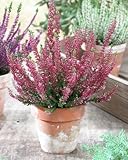
Calluna vulgaris – heather, or Scotch heather – is an easy plant in the right soil and a hopeless one in the wrong soil. There is no middle ground and no fertilizer that fixes it. If you understand that single point, everything else about growing heather becomes straightforward.
What you are growing
Calluna is a perennial evergreen shrub or subshrub, grown almost entirely as an ornamental for its flowers, occasionally as bonsai, and rarely for medicinal use. It reaches only 20–50 cm (8–20 in) and grows at a medium to fast rate, which means it fills a space quickly without ever becoming a management problem in terms of size.
Everything about it is small. The green leaves are just 1–2 mm, packed tightly along the stems. The flowers are 1–3 mm, shaped from a closed bell through to a trumpet, and carried at the ends of the stems – so a heather in bloom reads as a haze of colour across the top of the plant rather than as individual flowers. Colours run pink, purple, red, blue and white.
Heather needs acidic soil to thrive — a dedicated ericaceous compost makes this far easier: As an Amazon Associate we earn from qualifying purchases.
It is hardy in zones 4–9, and can be grown in zone 10 with the right care. Zone 4 means winter lows around −34°C (−30°F), so cold is not what limits heather – heat is.
Acid soil: the one non-negotiable
Heather needs soil that is acidic, rich and well drained. The acidity requirement is absolute. In alkaline or even neutral soil, iron and several other nutrients become chemically unavailable no matter how much of them is present, and the plant yellows, stalls and dies slowly while you stand over it wondering what it wants. Heathers are also adapted to associate with specialised soil fungi that only function in acid, low-fertility ground.
The practical consequences:
- If your garden soil is alkaline, grow heather in a container with an acidic medium rather than fighting the bed. It is a far higher success rate for far less work.
- Mulch. It keeps the surface moist and, as it breaks down, helps hold the soil acidic.
- Fertilize only once a year. Heather is not a hungry plant and heavy feeding does it no favours.
- Keep the area weed-free. Heather is short and dense at the base, and it loses the competition badly to anything taller.
Light: sun, but not scorching sun
Calluna will grow in full sun, half shade or full shade – though in full shade it needs whatever light it can get in warm weather, and it will bloom poorly there. It survives shade but prefers sun, and sun is where the flowering is.
The exception matters: heather burns in hot summers in full sun. This is the plant’s real weakness, and it follows from its build. Tiny leaves and a shallow, fine root system mean the plant has almost no water reserve; a hot, exposed afternoon dries it out faster than it can replace the moisture, and the foliage scorches. In a cool temperate climate, plant it in full sun without hesitation. In a warm one, give it morning sun and afternoon shade – that is not shade tolerance, that is heat protection.
Water
Heather wants an average to large amount of water, on well-drained soil. Again the two go together: it is a plant of moist, sharply drained, acidic ground, and it wants steady moisture without standing wet. Do not let it dry out in hot weather, and do not let it sit in a saucer of water.
Planting season
Planting time shifts with your zone, and the pattern is consistent – the colder the climate the earlier you plant, so the plant has the growing season ahead of it:
- Zones 4–6: spring.
- Zones 7–9: spring to summer.
- Zone 10a: spring to autumn.
- Zone 10b: autumn to winter – the cool part of the year, which in a hot climate is the safe window.
In warmer climates autumn planting is the better choice generally, and where the climate is mild enough, planting can be done at almost any time of year.
Pruning
Prune in spring or summer, and the natural moment is after flowering has finished – though heather tolerates pruning at any time of year. What you are removing is dead stems, spent flower stems and dead leaves. Taking off the finished flower stems keeps the plant compact rather than letting it sprawl open and woody at the base.
The hard rescue cut
There is one more aggressive option worth knowing. If the plant is badly attacked by pests, cut it right down to 3–6 cm above the ground. This sounds drastic, but on a small, fast-growing subshrub it is a reasonable trade: you remove the entire infested canopy in one pass instead of chasing an infestation through thousands of tiny leaves you cannot effectively spray into.
Pests and diseases
The main pests are spider mites, scale insects and weevils. Spider mites in particular thrive in exactly the hot, dry conditions that also scorch the plant – so an under-watered heather in a warm summer is being hit twice for the same reason. Scale insects sit fixed to the stems under a protective covering, which is what makes them hard to treat and makes the hard cut-back a genuinely practical answer. Weevils damage foliage as adults and, more seriously, roots as larvae.
Growing heather in a pot
Container growing is the answer for anyone with alkaline soil, and Calluna takes to it well.
- Start with a pot 50–70% larger than the root ball – use the lower end of that range for a larger plant.
- Use a potting mix, or peat soil with perlite. This is the easy route to the acidity and the drainage the plant requires, in one medium.
- Once roots reach full capacity in the pot, move up a size, repeating until the plant is at the size you want it.
- Refresh the soil every few years. Potting media lose their structure and viability over time and simply stop working. If you cannot lift the plant out, replace part of the soil from the side of the pot instead, and prune both the top growth and the roots to rebalance the plant.
- Stand the pot on a tray. When you water, let the tray fill – but it must be dry again by the end of the same day. If water is still sitting there, either the mix is wrong or there are not enough drainage holes.
Calluna can also be trained as bonsai, which its small leaves and dense twiggy growth suit unusually well.
Growing heather indoors
Heather can be kept indoors, with two requirements. It needs plenty of light – indoors is normally where heathers fail to flower. And it must be kept well away from a heater: dry radiant heat damages the tiny leaves and stops it blooming. A bright, cool room is far better than a warm, dim one.
Propagation: cuttings, and the seed warning
Calluna propagates by seed or cuttings, and grafting is not necessary. For a garden plant, cuttings are the better choice for one specific reason: they guarantee the flower colour. Seedlings do not come true, so a named pink cultivar raised from its own seed will give you a mixture.
Seed itself is genuinely easy: sow into moist, acidic soil in autumn, in full sun, and it germinates readily. In fact it is too easy – Calluna can become invasive, and that free-seeding vigour is exactly the mechanism. If you are growing it outside its native range, deadheading the spent flower stems before seed drops is more than a tidiness measure.
Flowering season and cultivars
Calluna blooms in summer and autumn – mostly from the end of summer into autumn, and rarely on into winter. That late season is much of its value: it is flowering when most of the garden has finished.
Cultivars are chosen almost entirely on flower colour:
- ‘Alicia’ – white.
- ‘Allegro’ – purple.
- ‘Amethyst’ – pink.
- ‘Dark Beauty’ – red, and an award-winning cultivar.
- ‘Silver Knight’ – purple with a grey-silvery cast.
- ‘Sandy’ – listed as the yellow one. Since the species’ flower colours run pink, purple, red, blue and white, treat yellow here as a foliage characteristic: this is a golden-leaved heather, valued for colour outside the flowering season.
Mixing cultivars is the standard way to use Calluna, and because the plants are uniform in size and habit, a group of different colours reads as one continuous sweep rather than as separate specimens.
For the full plant profile see our Calluna vulgaris growing page.
For the equipment that makes propagating easier (heat mats, humidity domes, rooting hormone), see our propagation equipment guide.