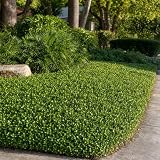
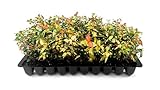
Asiatic jasmine is the plant you choose when you have a difficult piece of ground and you want it covered. It is an evergreen vine of the genus Trachelospermum, fast to medium growing, hardy from zone 7 upward, happy in temperate, Mediterranean, subtropical and tropical climates, and equally willing to climb a fence or spread flat as a carpet. It also attracts pollinators, and in summer it carries fragrant white-to-yellow five-petalled flowers in clusters.
All of which makes it sound uncomplicated. It is not. The same vigour that makes Asiatic jasmine an excellent ground cover makes it aggressive, and in some settings invasive, and that single fact should shape every decision you make about it — where you plant it, whether you plant it in the ground at all, and how you prune it.
Asiatic jasmine, star jasmine, and true jasmine
Worth clearing up before you buy, because the names are used loosely in the trade. Asiatic jasmine is Trachelospermum asiaticum. Its close relative Trachelospermum jasminoides is star jasmine or confederate jasmine, and the two are routinely sold under each other’s names. Broadly, Asiatic jasmine is grown for foliage and for its ability to cover ground, and star jasmine is grown as a climber for a showier, heavier scented flower display.
Neither is a true jasmine — that is the genus Jasminum, a different plant altogether. The practical consequence: care advice written for Jasminum does not necessarily apply here, and if you are buying specifically for a wall of fragrance rather than a carpet of leaves, check the botanical name on the label.
The leaves are elliptic and dark green, but variegated forms are common and can carry green, pink, red, white, yellow or several colours at once — which is largely why the plant is grown as ground cover rather than left to flower on a fence.
Site, light, water and cold
Asiatic jasmine wants full sun to half shade and an average amount of water once established. It reaches 0.5–5 m (2–15 feet) depending entirely on what you give it to grow on: run up a support it behaves like a vine, given open ground it runs sideways.
On cold, the plant has two different tolerances and it pays to know which one applies to you. Established in the ground, it is hardy in zone 7 and above, where winter minimums fall to around −18 °C (0 °F). Young plants, newly planted ones and anything in a container are far more exposed — a pot freezes through in a way that garden soil does not — and those are best kept above about 5 °C (41 °F) until they are properly rooted in. The rule of thumb: buy and plant in spring, and give the plant a full season before it faces a winter.
It is not a houseplant. It will grow perfectly well in a planter, flowerpot or container, but it is an outdoor plant — the container is for control, not for the living room.
How to plant it
Planting season is spring, summer or autumn, with spring the best of the three. Start from a plant, a cutting or seed; unusually, all three work about equally well, and there is no need to graft.
- Dig a hole larger than the pot the plant came in. Extra room means loose, uncompacted soil for the first roots to move into.
- Mix organic material into the planting hole. This is what feeds the plant through establishment and holds moisture around the young root ball.
- Set the plant in and cover it with soil, and — this is the step people get wrong — do not press or push the soil down. Compacting the backfill drives out the air and squeezes closed the very spaces the new roots need to grow into. Firm just enough that the plant stands up.
- Water heavily at first. A newly planted vine needs a big amount of water while it establishes, considerably more than its long-term requirement.
- Once it has taken hold and is visibly growing, reduce the watering to the average amount it actually wants. Continuing to water a settled plant as though it were newly planted encourages exactly the runaway growth you will later be fighting.
Growing Asiatic jasmine from seed
Seed is easy and worth using, particularly when you are covering a large area and buying dozens of plants would be expensive.
- Sow in spring.
- Set the seed 0.5 cm deep.
- Use moist, well-drained soil — moist to germinate, well-drained so the seedlings do not sit in water.
- Give an average amount of water, and choose full sun if you can; germination and early growth are both better for it.
Using it as ground cover — and the catch
To work as ground cover, Asiatic jasmine needs one simple thing: space to crawl and spread. It is a strong plant and it does the job with very little help. That is the whole appeal — an evergreen carpet on a slope, under trees or across ground where you would rather not mow.
The catch is that the plant does not know where you wanted it to stop. It is aggressive, and it can be invasive: given the chance it will spread into beds, up into shrubs and out beyond the area you intended. Before you plant, be honest about whether you have a boundary it will actually respect.
Containment: the only method that really works
There is one dependable way to hold it: grow it in a container. A flowerpot or planter physically limits the root run, and since the plant spreads by running and rooting as it goes, that is the point at which it can be stopped. Growing an ornamental ground cover in pots sounds odd, but for a small courtyard, a balcony, or anywhere adjoining a neighbour’s ground it is the sensible choice — and it is why container growing is genuinely recommended for this species rather than merely tolerated.
The second line of defence is pruning. The formal pruning season is winter, and pruning is officially just for design — but with this plant it doubles as control. Cut it back to keep it inside its boundaries and to keep the growth fresh, and do not let a season slide by unpruned on the assumption you can catch up later.
Trellising is the third element. Give it something deliberate to climb — a fence, a wire, a frame — and you direct the vigour upward, where you can see it, rather than letting it wander at ground level where you cannot.
How to kill Asiatic jasmine or get it back under control
If it has already run away from you, this is the sequence that works. Expect it to take time; a single afternoon will not do it.
- Prune first and contain the area. Get the top growth off so you can see what you are dealing with and stop the plant extending further while you work.
- Find the roots. The vine roots as it runs, so the plant you are looking at is usually anchored in several places, not one. Locating those anchor points is what separates removal from endless trimming.
- Leave a stub of branch above ground at each root. Cutting everything flush is a mistake — a length of stem gives you a handle to pull the root out by. Cut down toward the ground but keep enough to grip.
- Keep cutting back regrowth over a long period. Every time the plant pushes new shoots and you remove them, it spends reserves it cannot replace. Sustained denial of leaf is what genuinely weakens it, and it is the most reliable tool you have.
- Salt on the cut stumps will speed the process up. Use it with real restraint: salt does not stay where you put it, and if you intend to plant anything else in that ground, too much will make the soil hostile long after the jasmine has gone.
And the honest conclusion, which is worth accepting early: once it is in open ground the only way to genuinely contain Asiatic jasmine is to grow it in a flowerpot. Everything else is management.
Pests and safety
Scale insect is the pest to watch for. Scales attach themselves to stems and the undersides of leaves as small, immobile, shell-like bumps, feed on sap, and are easy to mistake for part of the bark — on a dense evergreen mat they can build up unnoticed for a long time. A heavy infestation produces sticky honeydew and sooty mould, and the tangled interior of an unpruned ground cover is ideal habitat. Regular pruning to keep the growth open and fresh is as much a pest measure as a cosmetic one.
The plant is poisonous, so treat it as ornamental only, and take reasonable care when handling and pruning it — particularly around children and pets, and particularly with a plant that covers ground at exactly the height a small child or a dog moves through.
Before you buy
- It is aggressive and potentially invasive. Plan the boundary before you plant.
- It needs half shade to full sun.
- It needs somewhere to climb or somewhere to spread — without either it is an unhappy plant.
- Buy and plant in spring.
- Keep young plants above about 5 °C (41 °F); established plants take zone 7 winters.
- If in any doubt about space, plant it in a container.
For the full plant profile see our Asiatic jasmine growing page.
If the plant needs repotting, see our guide to choosing the right pot or planter.