

Plant Profile & Key Characteristics
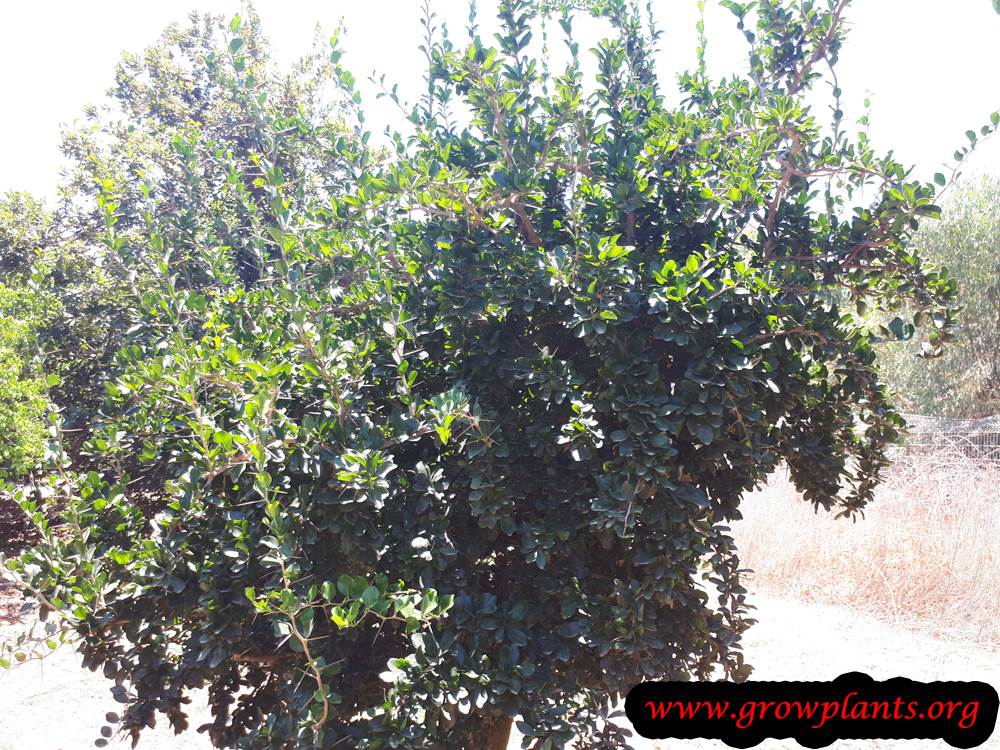
Overview: Thorny shrub to small tree, 3-6 m, grown for its tart, apricot-flavoured yellow-orange fruit and as an impenetrable thorny hedge. Drought-tolerant; usually needs both male and female plants to fruit.
Quick Specifications
| Specification | Attribute |
|---|---|
| Plant Type / Life Cycle | Perennial (shrub to small tree) |
| Foliage Type | Evergreen (semi-deciduous in cooler areas) |
| Mature Size | 3-6 m tall (10-20 ft) |
| Growth Rate | Moderate |
| Toxicity | Edible fruit |
| Hardiness | USDA zone 9+ |
Growth Form & Structure
- Height & Spread: 3-6 m (10-20 ft) tall; also grows in containers.
- Growth Habit & Form: Dense, very thorny shrub to small tree – a classic barrier hedge.
- Lifespan & Maturity: Moderate growth; bears fruit about 2-3 years from planting.
Anatomy & Physical Features
- Trunk & Bark: Armed with stout thorns; prune to open the canopy.
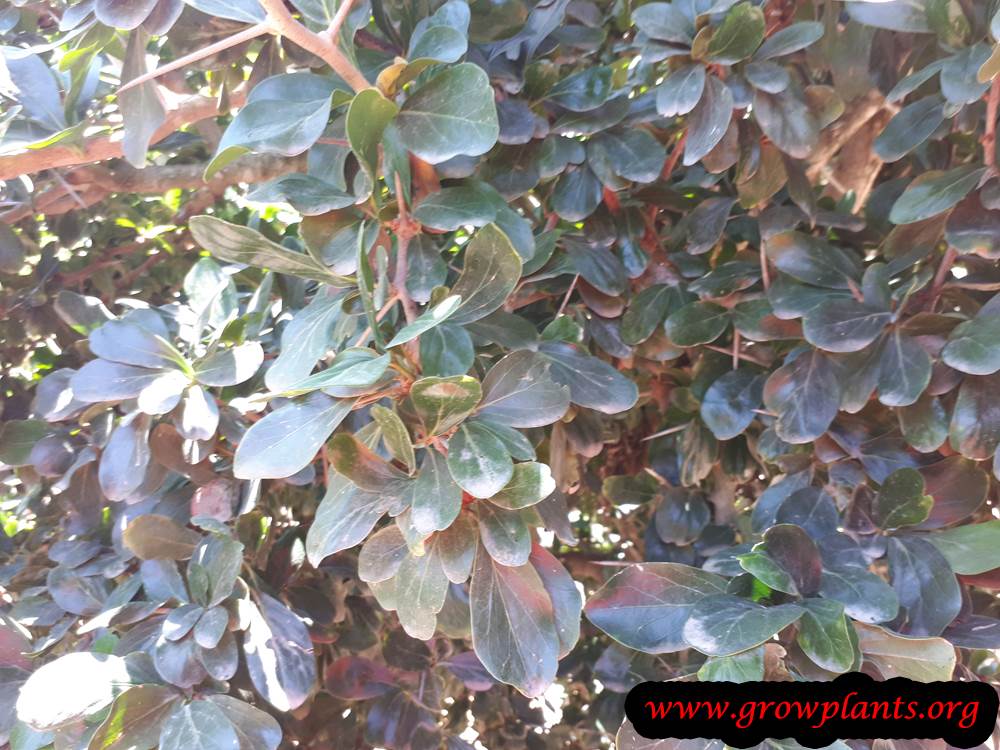
- Leaves & Foliage: Small green oval leaves, each subtended by a thorn.
- Flower Characteristics: Tiny green flowers, with male and female on separate plants; fly- and bee-pollinated.
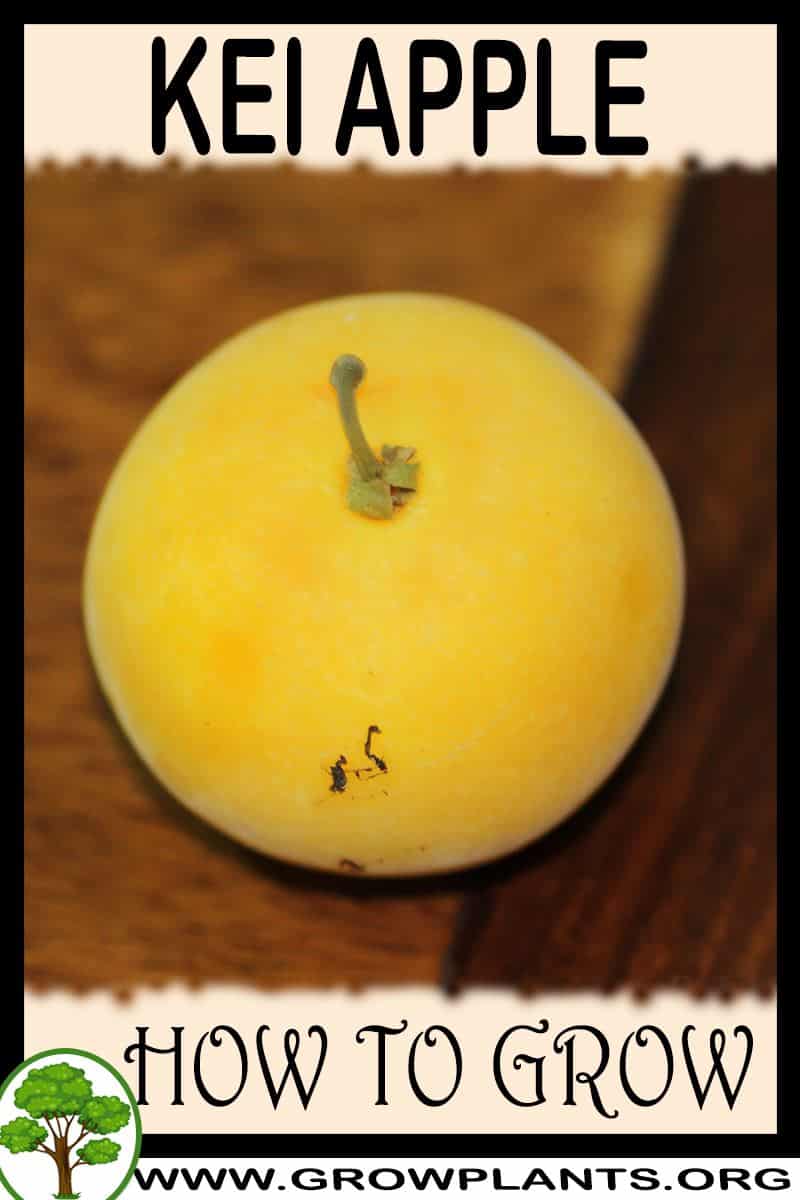
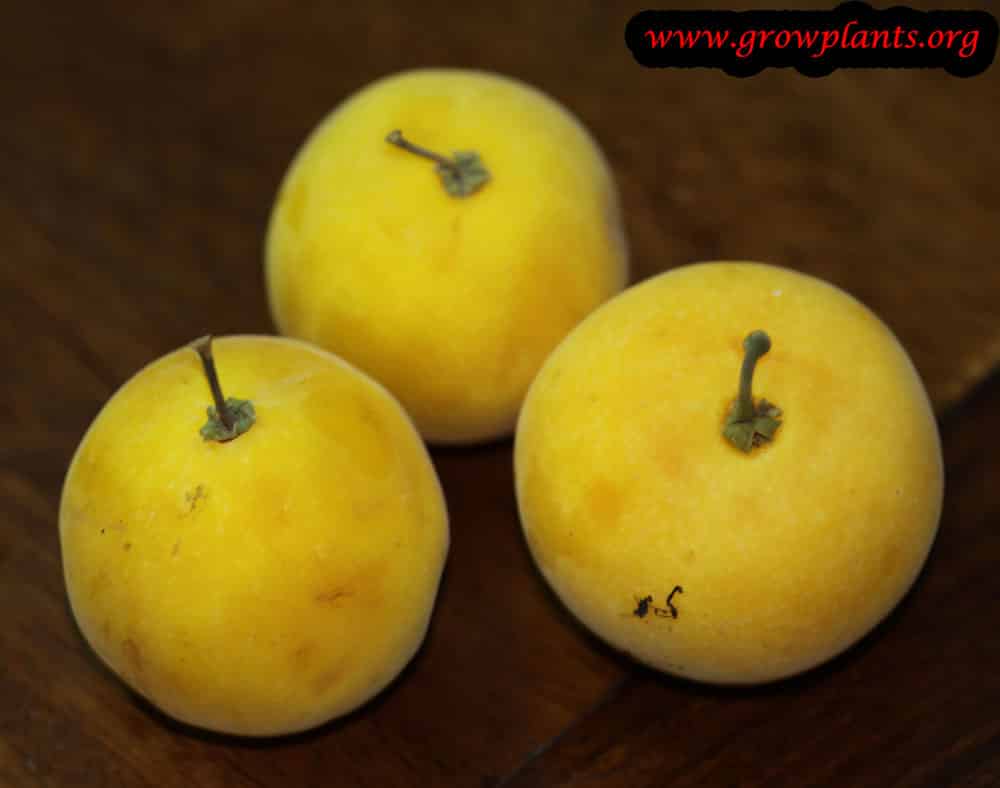
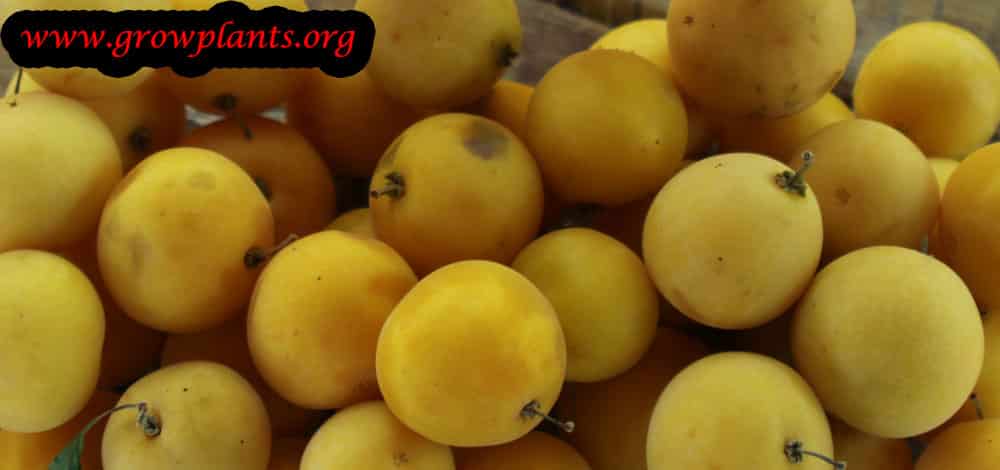
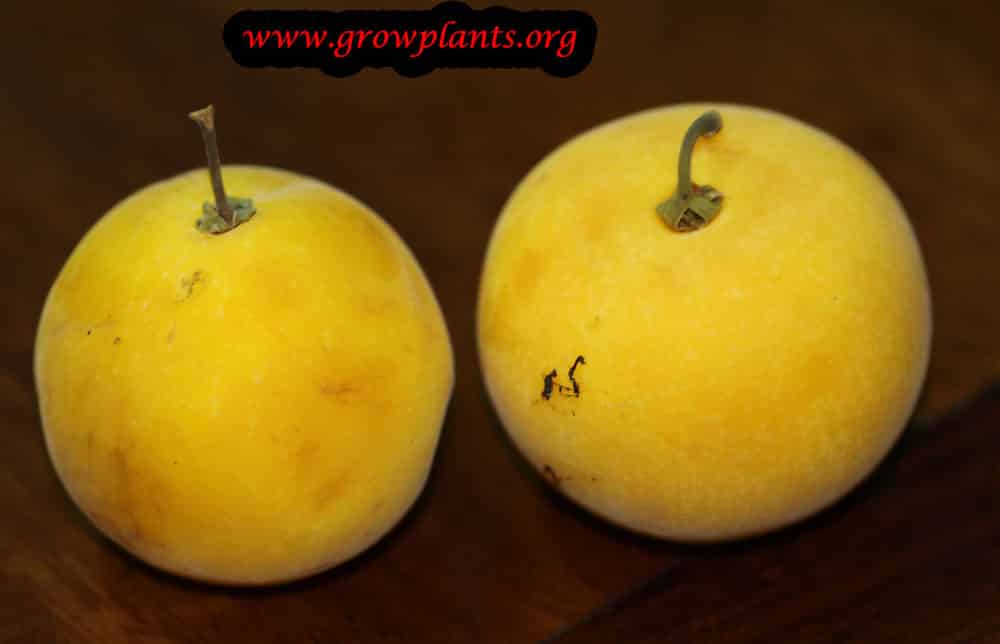
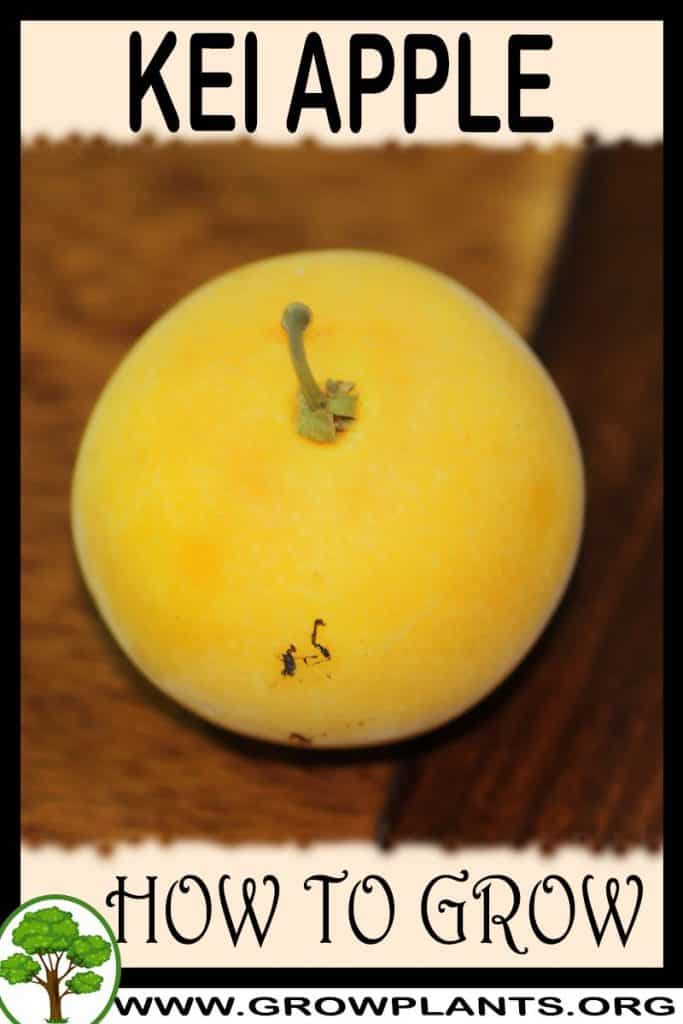
- Fruit Profile: Round yellow-orange fruit 2-4 cm, juicy and tart with a sweet, apricot-like flavour.
Primary Uses & Landscape Value
- Edible Uses: Fruit eaten fresh or made into jam and juice.
- Functional & Ornamental Roles: Drought-tolerant fruiting shrub and dense thorny security/hedge; windbreak.
Care Guide: Planting, Soil & Watering
Overview: Kei apple (Dovyalis caffra) is a thorny, drought-tolerant shrub to small tree that grows best in full sun to partial shade in well-draining soil. It needs only light watering once established and makes a tough hedge.
Quick Care Requirements
| Requirement | Ideal Condition |
|---|---|
| Planting Season | From late winter through spring into summer, in frost-free areas |
| Growth Rate | Moderate |
| Soil Type | Well-draining soil |
| Water Need | Low — drought-tolerant once established |
Planting & Establishment
- Best Planting Season: Plant from late winter through spring and into summer in frost-free areas; remember that both a male and a female plant are usually needed for fruit.
- How to Plant:
- Hole Preparation: Dig a hole wider than the root ball so the roots spread into loosened soil, setting the plant at the depth it grew before.
- Soil Amendments: Loosen the surrounding soil and improve drainage on heavy ground; this tough plant does not need rich soil.
- Planting Depth: Set the plant with the root collar level with the surrounding soil — do not bury the stem base.
- Growth Speed & Expectations: Grows at a moderate pace into a dense, thorny shrub that takes well to clipping as a hedge.
Soil, Watering & Drainage Care
- Soil Mix & Drainage Needs: Provide well-draining soil; in containers use a free-draining potting mix so excess water escapes freely and roots never sit wet.
- Watering Schedule & Technique:
- Young / Newly Planted: Water regularly to keep the soil lightly moist while the young plant establishes.
- Established: Once established it is drought-tolerant — water sparingly and only when the soil has dried out.
- Seasonal Adjustments: Water a little more in prolonged heat and cut back in cool, wet weather.
Climate, Light & Hardiness
Kei apple is a deciduous, drought-tolerant hedging shrub-to-small-tree for Mediterranean, subtropical, and tropical climates, doing best in full sun to half shade. It is more cold-tolerant than its relative Dovyalis hebecarpa, reflecting its African savanna-fringe origin.
Quick Climate Specifications
| Climate Zones | Mediterranean, Subtropical, Tropical |
|---|---|
| USDA Hardiness Zones | 9+ |
| Approx. Survival Minimum | approximately −6.7°C (20°F) at the zone 9 boundary, for an established, dormant plant |
| Frost Tolerance | Moderate |
| Light Conditions | Full Sun / Half Shade |
Sunlight & Light Exposure
Optimal Light Setup
Full sun to half shade.
Direct Sun Requirement
Beneficial but flexible.
Best Exposure / Orientation
An open, sunny site; commonly used as hedging, which suits sunny boundary plantings.
Temperature Extremes & Hardiness
USDA Hardiness & Regional Limits
Zone 9+ is comparatively cold-tolerant among this group's fruiting shrubs, consistent with its deciduous habit and drought-tolerant, savanna-fringe origin.
Cold Damage & Winter Protection
Deciduous habit helps it cope with winter cold within its hardiness range; little special protection is usually needed.
Frost Sensitivity
Moderate; more frost-tolerant than most of the tropical fruiting shrubs in this batch.
Extreme Heat Tolerance
Very good, reflecting its African origin; also notably drought tolerant.
Wind, Humidity & Microclimate
Dry-Air Tolerance
High – a drought-tolerant species often used as a tough hedging plant.
Rainfall & Seasonal Moisture
Adapted to seasonal, sometimes sparse rainfall; copes well with dry spells.
Microclimate Recommendations
Well suited to open, sunny, exposed boundary or hedge plantings given its drought and moderate cold tolerance.
Growing in Pots, Balconies & Indoors
Kei apple (Dovyalis caffra) grows 3-6 m (10-20 ft) and is thorny and drought-tolerant. The grower confirms it can be grown in a container but is not a houseplant – keep it outdoors and mind its thorns.
Quick Details
- Container Size: A roomy tub (30-50 L / 8-13 gal)
- Indoor Suitability: Not a houseplant; grow it outdoors
- Best Spot: Full sun to half shade
- Soil & Drainage: Free-draining mix; it tolerates dry conditions well
- Watering in Pots: Small – let the top of the mix dry between waterings
Indoors & On the Windowsill
- Houseplant limits: Not a houseplant – it needs sun and its thorns make it unsuited to indoor life.
- Overwintering: A potted plant can be sheltered in a bright, frost-free spot for the cool season in cold climates.
On a Balcony or Patio
- Light & placement: Give it a sunny spot away from walkways because of its thorns. It is drought-tolerant, but potted plants still dry faster than those in the ground – check moisture in hot spells.
Choosing the Pot, Soil & Long-Term Care
- Pot & drainage: Use a pot with plenty of drainage holes; skip a standing water saucer to avoid root rot. Terracotta breathes and dries faster, while glazed or plastic pots hold moisture longer.
- Potting mix: A well-aerated, organic-rich mix – peat or coir blended with perlite or vermiculite for drainage.
- Feeding: Potted plants need feeding more often than those in the ground, as nutrients leach out with each watering – feed lightly through the active growing season.
- Repotting: Refresh the mix or pot up about every two years; for an established specimen, replace part of the soil and lightly prune the roots and top growth.
Fertilizing & Feeding
Kei apple is a thorny, drought-tolerant shrub-to-small-tree often grown as a hedge, and because it needs both a male and a female plant nearby to set fruit, feeding decisions should account for the whole hedge or planting group rather than a single specimen.
Quick Fertilizing Specs
| Feeding Level | Moderate. |
|---|---|
| young_feeding | Balanced-to-nitrogen feeding to build a dense, well-branched hedge or shrub framework. |
| mature_feeding | Balanced feeding, shifting toward potassium where female plants are setting fruit. |
| Main Nutrient Priority | Balanced nutrition; this shrub’s drought tolerance once established means it needs less supplemental feeding than thirstier fruiting shrubs. |
| Best Feeding Period | Through the active growing season, from spring growth into summer and autumn fruiting. |
| Organic Options | Compost or organic matter worked into well-drained soil. |
| Reduce/Stop Feeding | Ease back as growth slows heading into the cooler part of the year, especially on established, drought-tolerant plantings. |
Feeding by Growth Stage
Establishment
Help newly planted Kei apple root into well-drained soil, whether grown as a single specimen or the start of a hedge line.
| Nutrient direction | Light, balanced feeding while the plants focus on rooting in. |
|---|---|
| Timing | At planting, in the cooler part of the year through into spring and summer, and through the first flush of new roots. |
| Frequency | A light feeding as the planting settles in is usually enough before moving into its regular seasonal rhythm. |
| Fertilizer types | A balanced fertilizer used lightly, Compost worked into the planting area to support establishment |
| Precautions | Plant both male and female specimens if fruit is wanted, since this species needs both to set fruit, and take care when working near the thorns. |
Vegetative growth
Build a dense, well-branched framework, ideal for hedging, with inner branches opened up by pruning to manage the thorns.
| Nutrient direction | Balanced-to-nitrogen feeding supports steady branch development, useful for filling out a hedge line. |
|---|---|
| Timing | Through the active growing season. |
| Frequency | Regular light feedings through the growing season support steady, dense branch growth. |
| Fertilizer types | A balanced-to-nitrogen fertilizer used through the season, For container-grown plants, a diluted balanced liquid feed |
| Routine trace nutrients | iron |
| Precautions | Prune to open up inner branches around the thorns and to shape hedging, and avoid overwatering since this shrub tolerates drought well once established. |
Flowering and fruiting
Support the small greenish flowers, pollinated by flies and bees, and the tart-to-sweet fruit that follows on female plants when a male plant is nearby.
| Nutrient direction | Balanced feeding shifting toward potassium support on fruit-bearing female plants as fruit develops. |
|---|---|
| Timing | Through spring bloom into summer and autumn as fruit ripens. |
| Frequency | Feed through the active flowering and fruiting period on fruit-bearing plants, easing back once fruit is harvested. |
| Fertilizer types | A balanced-to-potassium fertilizer as fruit develops on female plants, Consistent soil moisture through flowering and fruiting |
| Routine trace nutrients | iron |
| Precautions | Watch for fruit flies around ripening fruit, and take care of the thorns when harvesting. |
Nutrient Deficiency Signs & Corrections
Pale foliage and slow, thin branch development in a young shrub or hedge planting.
| Possible causes | Insufficient nitrogen for the current growth stage, Poor soil fertility at the planting site, Competition between closely spaced hedge plants |
|---|---|
| Appears first on | Older leaves first, spreading through the shrub. |
| What to check | Recent feeding history, Spacing between hedge plants, Shoot growth compared with prior seasons |
| Possible correction | Step up to a balanced-to-nitrogen feeding through the growing season. |
Flowering but little or no fruit forming on a female plant.
| Possible causes | No male plant nearby to provide pollen, since this species usually needs both sexes to fruit, Insufficient pollinator activity during bloom, Water or nutrient stress during flowering |
|---|---|
| Appears first on | Whole-plant pattern rather than a single branch. |
| What to check | Whether a male plant is present nearby, Pollinator activity during bloom, Recent feeding and watering during flowering |
| Possible correction | Confirm a male plant is present for pollination, and keep feeding and watering steady through bloom. |
New leaves yellowing between green veins.
| Possible causes | Iron becoming less available in high-pH soil, Waterlogged or poorly drained soil limiting root uptake, Root stress in compacted or heavily irrigated hedge plantings |
|---|---|
| Appears first on | Newest leaves and shoot tips. |
| What to check | Soil pH, Drainage around the root zone, Whether only the newest growth is affected |
| Possible correction | Correct soil pH and drainage first; if chlorosis persists, apply a chelated iron product per its label. |
Pruning, Training & Seasonal Maintenance
Kei apple tolerates moderate to fairly hard pruning and is grown in two quite different forms – as an impenetrable thorny barrier hedge, or as a more open fruiting shrub/small tree – so the objective changes with the use. Because it is deciduous, the safest and most effective time for structural work is the dormant window after leaf drop (autumn into winter), when the thorny branch framework is easy to see and cuts will not sacrifice the coming spring flowering flush. Kei apple is dioecious (separate male and female plants), so pruning decisions that remove whole plants or major limbs can accidentally remove the planting’s only pollenizer or its only fruiting female.
Quick Pruning & Maintenance Specs
| Pruning Tolerance | Moderate–High (High if maintained as a sheared hedge) |
| Primary Pruning Window | Autumn–Winter, after leaf drop |
| Secondary Maintenance Window | Light shaping/shearing during active growth (hedges only) |
| Typical Frequency | 1x/year structural (fruiting specimen) or 2–3x/year shearing (hedge) |
| Main Objective | Open the thorny interior for access and fruit harvest, or maintain a dense screening face |
| Young Plant Priority | Establish either an open framework of well-spaced main stems (fruit) or dense basal branching (hedge) |
| Mature Plant Priority | Thin crowded thorny interior wood; keep a workable male:female ratio in mixed plantings |
| Best Tool Type | Long-handled loppers (thorn clearance) and bypass secateurs |
| Avoid Heavy Pruning During | Spring bloom/fruit set and peak summer heat |
Pruning by Plant Age & Size
Newly Established
Remove only damaged or crossing growth while the root system establishes; avoid hard structural cuts in the first season.
Young / Formative
For a fruiting specimen, select 3–5 well-spaced main stems in an open, vase-like habit so the thorny interior stays reachable for later harvest. For a hedge, pinch/tip young leaders to force branching low down and build density from the base rather than letting it go bare underneath.
Mature / Established
Fruiting specimens: annual thinning of dense, thorny interior growth and crossing branches to keep the canopy accessible and airy. Hedges: maintain the shear line and periodically remove some of the oldest wood at the base to keep the hedge from becoming hollow.
Seasonal Pruning Schedule
Dormant/Winter
Objective: structural thinning and shaping after leaf drop. Remove: dead, damaged, crossing or overcrowded thorny growth. Do not remove: the bulk of last season’s wood on fruiting females, or a planting’s only male pollenizer. Expected response: manageable new growth ahead of the spring flush. Flowering/fruiting impact: minimal if done before bloom begins.
Summer Canopy Management (hedges only)
Light shearing to hold the hedge line during active growth; avoid shearing during the hottest, driest stretches since this species is kept on a small water budget and stressed growth heals slowly.
Structural Pruning & Training
Open branch selection is especially valuable here because it creates working room around the thorns for harvest and airflow. Remove crossing/rubbing branches. Height and spread can be controlled by shearing (hedge use) or selective thinning (specimen use) – the species reaches roughly 3–6 m unmanaged.
Container & Small-Space Pruning
Kei apple can be grown in a large planter or container. Container specimens stay naturally more compact, which also reduces the amount of thorny growth to work around; expect to prune more for size control than for structure, and to root-prune at repotting as growth slows in a restricted root zone.
Tools
Long-handled loppers for reaching cuts without hands near the thorns; bypass secateurs for small-diameter thinning cuts; hedge shears only if the plant is being maintained as a sheared screen (not for a fruiting specimen needing selective cuts).
Tool Hygiene & Disease Risk
Routine risk – the species reports only occasional, harmless aphids, so clean, sharp tools are sufficient; no special disinfection protocol is indicated.
Cut Placement & Technique
Use bypass cuts just outside the branch collar; avoid flush cuts and long stubs, which are easy to create by accident when working around thorns at arm’s length – take the extra step to place cuts correctly rather than rushing.
Heavy Pruning & Rejuvenation
An overgrown hedge or shrub can be hard-pruned in the dormant season; being a medium-vigor grower, it will regrow from the base, but expect reduced flowering and fruiting for a season or two. Stage a drastic size reduction over two dormant seasons rather than removing everything at once.
Post-Pruning Care
Water lightly and consistently after hard pruning (this species is kept on a small water ration, not heavy irrigation); do not fertilize simply to force a flush. Watch the newly opened interior for the occasional aphids the species reports.
Common Pruning Mistakes
- Removing the wrong sex plant (or a planting’s only male) without checking flowers first, leaving no pollenizer for fruit set.
- Working close to the thorny interior without long-handled tools, leading to ragged, inconsistent cuts.
- Shearing a fruiting specimen like a hedge, which sacrifices the open, accessible framework needed to actually harvest the fruit.
When NOT to Prune
Avoid heavy structural work during spring bloom and fruit set, and avoid major cuts during peak summer heat when this drought-tolerant but low-water species is under the most moisture stress.
Recommended Tools (by task)
- loppers – long reach keeps hands clear of the thorns on stems up to a few centimetres thick.
- bypass_secateurs – precise thinning cuts on small interior growth.
- hedge_shears – only for plants maintained as a sheared screening hedge, to hold the flat face and density.
Pruning Troubleshooting
| Problem | Possible Cause | What to Check | Corrective Action |
| No fruit set despite flowering | Single-sex planting (dioecious species) | Whether both male and female flowers are present nearby | Plant or graft in a male pollenizer |
| Dense, impenetrable, unproductive interior | Hedge never thinned, or old age | Age and density of interior thorny wood | Dormant-season thinning cuts to open the centre |
| Reduced fruiting after shearing | Hedge-style shearing used on a fruiting specimen | Whether cuts were selective or a uniform shear | Switch to selective thinning cuts instead of shearing |
Propagation Guide
Kei apple is dioecious, with separate male and female trees, so seed-grown plants have unpredictable sex and are mainly useful for hedging or rootstock; to actually get fruit, growers propagate vegetatively from a known female (including the self-fruitful female-only cultivars the site notes exist) or, where fruiting is desired, keep a male nearby for pollination. Propagation by seed is Easy, while securing a guaranteed fruiting female by cuttings or grafting is Moderate.
Quick Propagation Specs
| Best Propagation Method | Seed (for hedging/rootstock); Cuttings or grafting from a known female (for fruiting) |
| Alternative Methods | Semi-hardwood cuttings; grafting onto seedling rootstock |
| Propagation Difficulty | Easy by seed, Moderate by cuttings/grafting |
| Seed True-to-Type | Variable – sex is not predictable, and only female trees (or self-fruitful female cultivars) bear fruit |
| Vegetative True-to-Type | Yes – guarantees sex and, where used, the fruiting cultivar |
| Best Propagation Season | Winter through summer, matching the site’s planting season |
Growing from Seed
Seed Handling & Viability
Clean seed of surrounding fruit pulp before sowing; the site does not give a specific storage method for this species.
Germination Conditions
Warm, well-drained, consistently moist conditions; the site does not document exact germination timing, so allow a variable wait of several weeks or more, as is typical for the genus.
Seedling Care
Since sex cannot be determined until a seedling flowers, growers who want fruit typically raise several seedlings and keep both a male and at least one productive female, or switch to vegetative propagation from a known female once one is identified.
Stem Cuttings
Cutting Type
Semi-hardwood cuttings taken from a known female (or, if a pollinator is wanted, a known male) tree.
Best Timing
Warm growing season (spring to summer).
Cutting Preparation
Take cuttings from healthy current-season growth, trim just below a node, and remove lower leaves before rooting.
Rooting Setup
A free-draining rooting mix kept warm and humid, such as under mist or a humidity cover.
Rooting Hormone
Beneficial for improving and speeding rooting of this semi-hardwood shrub.
Rooting Time
Not documented for this species; commonly several weeks to a couple of months for semi-hardwood cuttings of similar shrubs.
Grafting & Budding
Why Grafting Is Used
To guarantee sex (a fruiting female, or a self-fruitful female-only cultivar) and reproduce known fruit quality, since the site notes vegetative reproduction is needed to get fruits.
Preferred Grafting Methods
As with related fruiting shrubs, side-veneer or cleft grafting onto vigorous seedling rootstock is typically used.
Rootstock
Seedling rootstock of the same species.
Scion Selection
Wood from a proven, known-sex, healthy plant – a fruiting female or a self-fruitful female cultivar for fruit production.
Best Grafting Season
During active growth, spring.
Graft Aftercare
Keep the graft union protected and humid until it has visibly taken and new growth begins.
Bloom & Flower Guide
Quick Details
- Bloom Season: Spring
- Flower Appearance: Small green flowers without showy petals
- Edibility: The flower is not eaten; grown for its tart edible fruit and as a thorny hedge
Detailed Blooming Overview
The kei apple is dioecious – male and female flowers grow on separate trees – so a female needs a male nearby to fruit. The small green flowers are inconspicuous among the thorny branches.
Flower Characteristics
- Small green flowers, roughly 0.5-5 mm; inconspicuous.
- Male and female flowers on separate trees.
Bloom Care & Thinning
- Pollination: Flies and bees.
- Fruit set: A female tree needs a male nearby to set fruit.
Fruit & Uses
Kei apple is grown for its apricot-flavoured fruit, the plant’s only edible part; the ornamental, thorny hedge itself is not eaten. Ripe fruit can be eaten fresh, though its sour-to-sour-sweet flavour makes it a popular candidate for jam, jelly and juice rather than out-of-hand eating.
Quick Edible Specs
| Edible Parts | Fruit |
| Main Use(s) | Culinary – fresh eating, jam/jelly, juice |
| Eaten Raw or Cooked | Raw (also cooked into jam) |
| Preparation Required | None (deseed optional for jam) |
| Harvest Season | Summer, autumn |
| Time to First Harvest | A few years for young plants; see Propagation for details |
| Safety/Toxicity Caveat | None noted; unripe fruit is quite sour/astringent |
Fruit
Fruit is 2–4 cm, colouring from orange through dark purple to red with paler flesh inside, and a flavour recalling apricot that ranges from quite sour to a milder sour-sweet once fully ripe. Kei apple is often dioecious — separate male and female trees are usually needed to set fruit, though some cultivars are female-only and self-fruitful (see Propagation). Ripe fruit is picked by hand in summer and autumn and eaten fresh or made into jam, jelly and juice; growers note no special handling is needed beyond watching for birds and occasional fruit flies.
Preparation, Uses & Safety
Kei apple fruit is eaten raw once ripe, but is most popular cooked into jam, jelly and juice, which tame its sharp acidity. No toxic parts or safety cautions are noted for the fruit; the plant’s stiff thorns are a handling hazard when picking, not the fruit itself.
Pests, Diseases & Troubleshooting
Overview: Dovyalis caffra (Kei apple) is a tough, thorny, drought- and salt-tolerant African fruiting shrub whose main pests are fruit flies — it is a well-known host of the Mediterranean fruit fly — along with scale, mealybugs, aphids, thrips and birds, while its diseases are the minor wet-weather leaf spot and anthracnose. It is very hardy and nearly trouble-free in warm climates with free-draining soil; the real limits are fruit fly, its dioecious need for a male pollinator, and frost on young plants. Note: Frost sensitivity of young plants
Quick Troubleshooting Overview
| Issue / Pest | Main Symptom | Primary Solution |
|---|---|---|
| Fruit flies | Stung, maggoty, prematurely dropping fruit | Bait traps, bag fruit, sanitation of fallen fruit |
| Scale / mealybugs | Honeydew, sooty mould, encrusted twigs and leaves | Prune, horticultural oil; control ants, conserve predators |
| Aphids / thrips | Distorted new growth, honeydew, flecked leaves | Hose off, insecticidal soap; sticky traps |
| Birds | Ripe fruit pecked and stripped | Netting; harvest promptly (thorns deter some browsers) |
| Leaf spot / anthracnose | Brown or black spots and blights in wet weather | Airflow, sanitation; copper fungicide if persistent |
| Poor fruit set | Female plant sets little or no fruit | Ensure a male pollinator is nearby for these dioecious shrubs |
Common Pests & Management
- Fruit flies including Mediterranean fruit fly (Ceratitis capitata / Bactrocera spp.):
- Symptoms: Adult flies sting the ripening fruit to lay eggs, and the maggots tunnel and rot the flesh, causing soft, discoloured, prematurely dropping fruit with puncture marks; Dovyalis, and Kei apple in particular, is a well-known host of the Mediterranean fruit fly.
- Prevention & Control: Practise strict sanitation by collecting and destroying all fallen and infested fruit, hang protein-bait or lure traps to monitor and mass-trap, and bag or net fruit where feasible. Time any approved bait sprays to the flies’ activity and protect pollinators; the dense thorny habit can make bagging awkward, so trapping and sanitation lead.
- Soft and armoured scale (Coccus / Aspidiotus / Saissetia spp.):
- Symptoms: Brown, black or waxy scale on the twigs, leaf undersides and among the thorns, with honeydew from soft scales and black sooty mould, weakening growth where colonies build up, often tended by ants.
- Prevention & Control: Prune out heavily encrusted growth, band trunks and control the ants that farm and spread them, and treat with horticultural or neem oil to smother the scale. Conserve ladybirds and parasitic wasps, and repeat oil applications to catch successive generations.
- Mealybugs (Planococcus spp.):
- Symptoms: White cottony masses in leaf axils, on stems and around the fruit, with honeydew and sooty mould, causing yellowing and weak growth; another ant-tended, honeydew-producing sap-sucker.
- Prevention & Control: Wash off and prune out colonies, control ants, and treat with horticultural oil or neem, repeating to catch the crawlers. Conserve natural predators such as ladybirds and lacewings, which usually keep mealybugs in check on established shrubs.
- Aphids and thrips (Aphis spp. / Frankliniella spp.):
- Symptoms: Aphids cluster on the soft new flush, distorting it and fouling it with honeydew, while thrips cause silvery flecking and scarring on young leaves and fruit skin, mainly on vigorous new growth.
- Prevention & Control: Hose off aphids and conserve their many natural predators, and monitor thrips with sticky traps. Insecticidal soap or neem clears heavy aphid colonies, and spinosad controls heavy thrips pressure at the susceptible stage; protect pollinators.
- Birds:
- Symptoms: Ripe fruit pecked, torn and stripped by birds, which are attracted to the colourful, juicy fruit as it ripens and can take a significant share of a small crop.
- Prevention & Control: Net small trees or protect key branches as the fruit colours, harvest promptly at ripeness, and use visual or noise deterrents where practical. The dense, very thorny habit gives some protection but does not stop birds.
Diseases & Fungal Issues
- Fungal leaf spot (Cercospora / general leaf-spot fungi):
- Symptoms: Brown, greyish or dark spots on the leaves, sometimes with yellow halos, that enlarge and merge in warm, wet, humid conditions, causing some yellowing and leaf drop but rarely threatening these tough shrubs.
- Treatment & Management: Improve airflow by thinning the dense canopy, avoid overhead watering, and remove badly spotted leaves and debris. A copper fungicide protects new growth only under persistent damp pressure; leaf spots are usually cosmetic on a vigorous plant.
- Anthracnose (Colletotrichum gloeosporioides):
- Symptoms: Dark brown to black sunken spots and blights on leaves, shoot tips and fruit, with shoot dieback and sunken rots on the fruit that can spread after harvest, worst in warm, wet, humid weather.
- Treatment & Management: Prune for airflow, remove and destroy infected shoots, leaves and mummified fruit, and avoid overhead irrigation. Protect new growth and developing fruit with a copper or suitable fungicide in wet seasons, and handle fruit carefully to limit rots.
- Sooty mould (secondary):
- Symptoms: A black, soot-like coating over leaves and fruit growing on the honeydew of scale, mealybugs and aphids, which blocks light and disfigures the plant and fruit but does not itself infect the tissue.
- Treatment & Management: Control the underlying sap-suckers and the ants that farm them, then wash or wipe the mould off. Once the honeydew source is removed the mould weathers away and does not return.
- Root and collar rot (Phytophthora / Pythium spp.):
- Symptoms: Yellowing, wilting, thinning canopy and dieback in heavy, wet, poorly drained soil or from overwatering, with dark, decayed roots; uncommon in these drought-tolerant shrubs unless the site is waterlogged.
- Treatment & Management: Grow in free-draining soil, plant high on heavy ground, and water sparingly once established, since Dovyalis is drought-tolerant and dislikes wet feet. Remove badly affected plants and improve drainage before replanting.
Growing Difficulties & Abiotic Problems
- Dioecious plants and poor fruit set:
- Cause & Symptoms: A female plant that flowers well but sets little or no fruit because Dovyalis is dioecious, with separate male and female plants, so a female needs a male nearby to pollinate it.
- Correction Strategy: Plant a male alongside female plants (or graft a male branch onto a female), and ensure bees and other pollinators can move between them. Where only one plant fruits poorly, the likely cause is the lack of a pollinating partner rather than pest or disease.
- Fruit drop:
- Cause & Symptoms: Young or ripening fruit that drops prematurely from heat and drought stress, erratic watering, or poor pollination, reducing an already modest crop.
- Correction Strategy: Keep soil moisture even, especially as the fruit develops, mulch to buffer swings, and ensure good pollination with a male plant present. Avoid drought-then-flood cycles that stress the tree and trigger drop.
- Frost sensitivity of young plants:
- Cause & Symptoms: Foliage and young growth are damaged or killed by frost on these warm-climate shrubs, with the degree of tenderness varying by species; established plants of the hardier Kei apple tolerate light frost better than the more tender Ceylon gooseberry.
- Correction Strategy: Match the species to the climate, protect young plants from frost, and site them in a warm, sheltered spot out of cold hollows. Prune out frost-damaged wood in spring once the danger has passed; established hardy plants recover well.
- Chlorosis on alkaline soil:
- Cause & Symptoms: Yellowing between the veins on the new leaves on strongly alkaline or waterlogged soils that lock up iron, with weak growth, though these shrubs are otherwise adaptable and drought- and salt-tolerant.
- Correction Strategy: Improve drainage first where waterlogging is the cause, and correct persistent iron shortage on alkaline soils with a chelated iron feed. Good drainage and a sunny position keep the foliage green.
What Helps — Products & Tools
For Dovyalis the useful kit is protein-bait and lure fruit-fly traps plus fruit netting and sanitation, horticultural and neem oil (with ant control) for scale and mealybug, insecticidal soap for aphids, spinosad for heavy thrips, and netting against birds. On the disease side, thinning the dense canopy for airflow, sanitation and a copper fungicide manage leaf spot and anthracnose, controlling sap-suckers removes sooty mould, and sharp drainage prevents root rot. Remember these are dioecious, so a male pollinator is needed for fruit. The source pest names are unreliable and were not used.