Plant Profile & Key Characteristics
Overview: A slow-growing evergreen tropical tree of 3-7 m (10-21 ft), a relative of the cacao whose white-to-pink flowers and large pods form on the trunk (cauliflory). Its sweet-pulped pods and edible seeds make it both an edible-crop and ornamental tree.
Quick Specifications
| Specification | Attribute |
|---|---|
| Plant Type / Life Cycle | Woody perennial (small-to-medium tree) |
| Foliage Type | Evergreen |
| Mature Size | 3-7 m (10-21 ft) tall |
| Growth Rate | Slow |
| Toxicity | Seeds and pulp are edible; as with its cacao relatives the genus contains theobromine, which is toxic to dogs and cats |
| Hardiness | USDA zones 10b and warmer |
Growth Form & Structure
- Height and Spread: A tree of 3-7 m (10-21 ft) in the ground; too large and demanding for ordinary container culture.
- Growth Habit and Form: Upright tropical tree with tiered branches; flowers and heavy pods borne directly on the trunk (cauliflory).
- Lifespan and Maturity: A notably slow grower that usually begins to bear fruit in about 3-5 years.
Anatomy & Physical Features
- Leaves and Foliage: Large green tropical leaves.
- Flower Characteristics: White-to-pink flowers (0.5-1.5 cm) borne on the trunk.
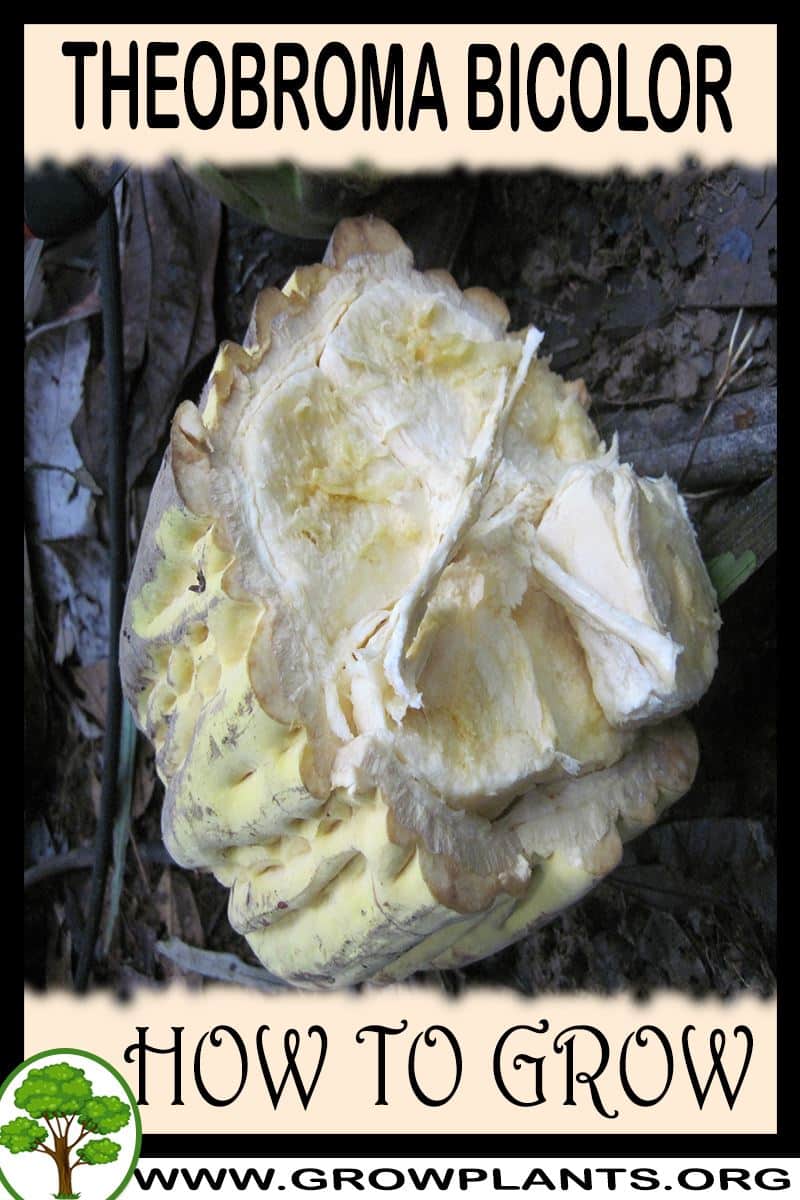
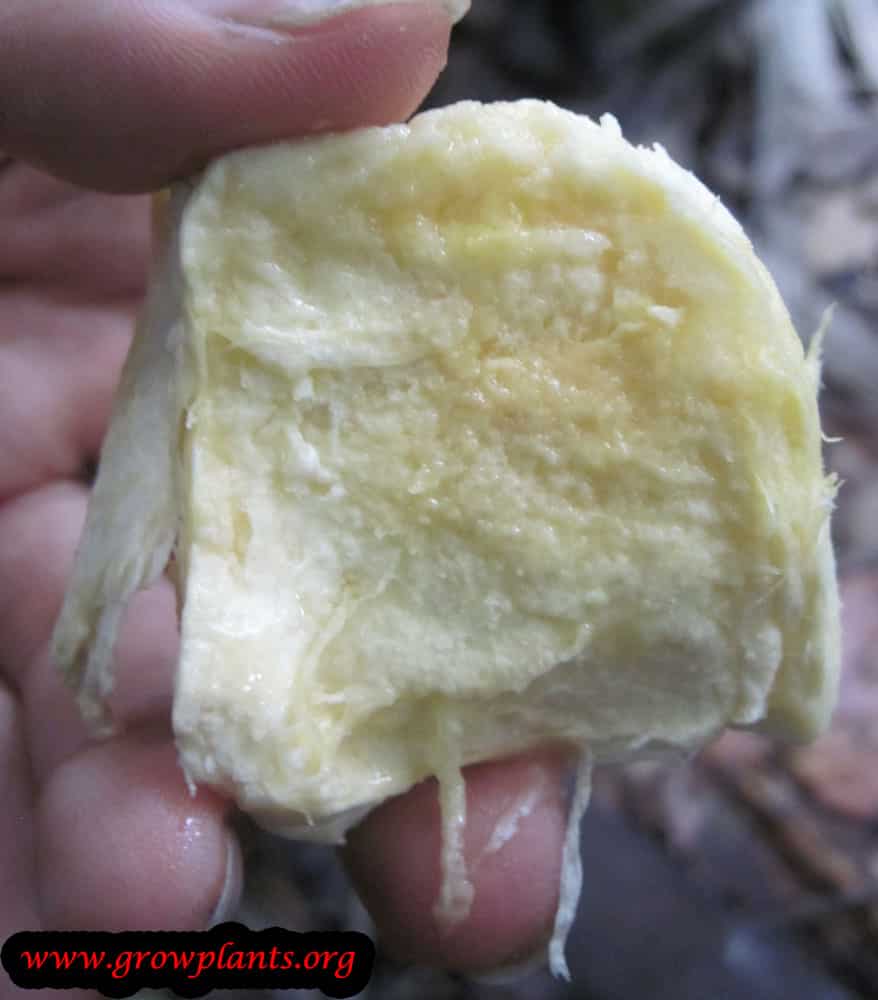
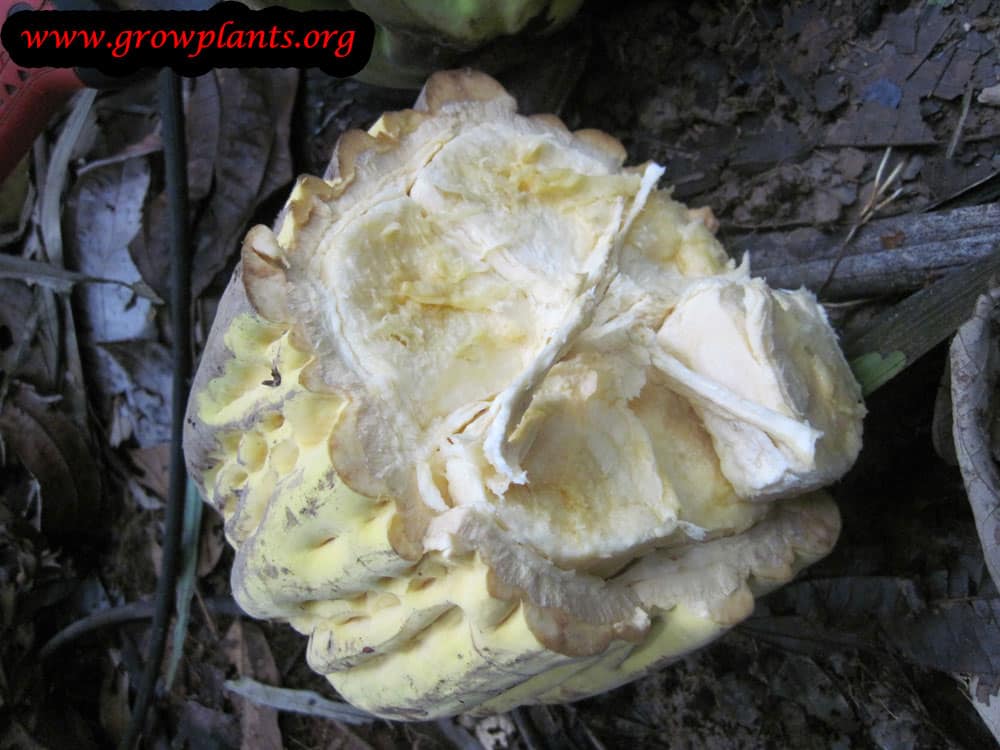
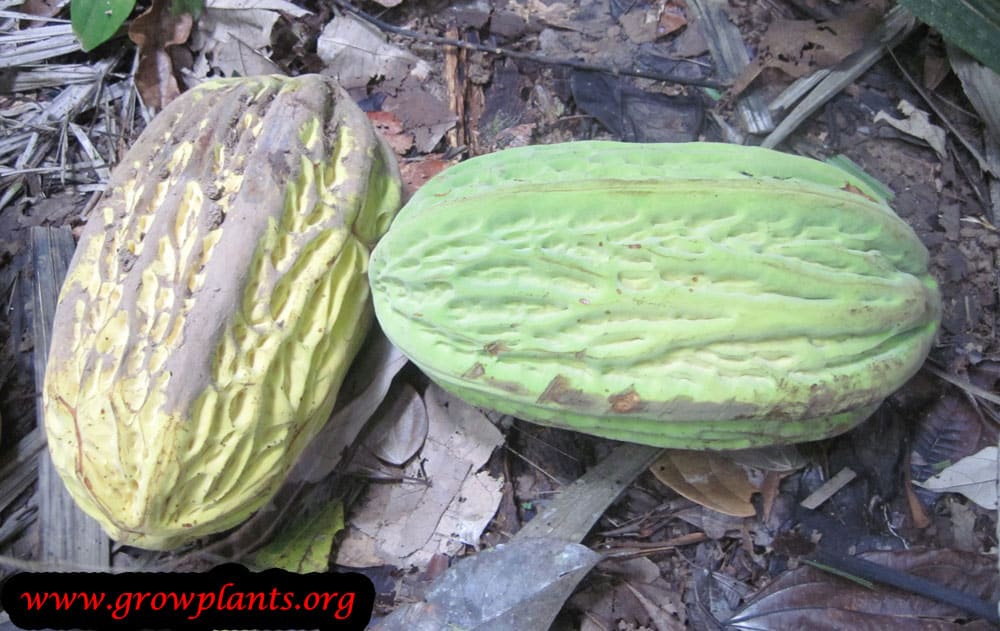
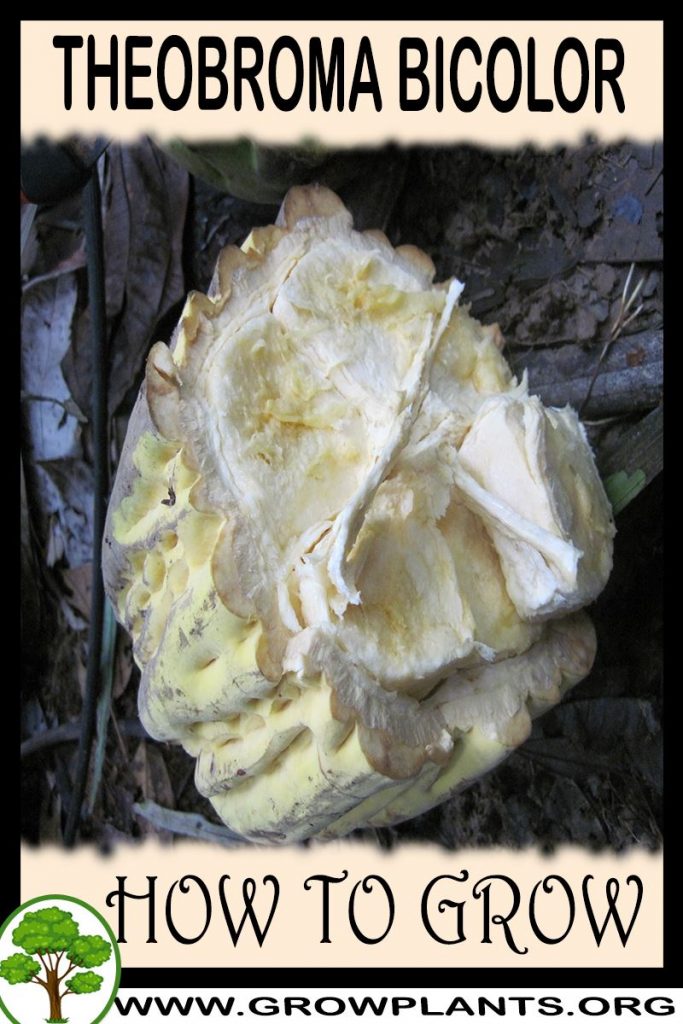
- Fruit Profile: Large green-yellow pods holding 30-plus seeds in sweet, white, faintly cocoa-flavoured pulp; the seeds are edible but not used like true cocoa.
Primary Uses & Landscape Value
- Edible Uses: Sweet pulp eaten raw, juiced or made into jams and cakes; the seeds are edible.
- Functional and Ornamental Roles: A tropical edible-crop tree also grown as an ornamental for its trunk-borne flowers and striking pods.
Care Guide: Planting, Soil & Watering
Overview: Theobroma bicolor (white cacao or mocambo) is a slow-growing tropical tree that needs warm, frost-free conditions (hardiness zone 10b and up) and moist, rich soil in full sun to part shade. It is thirsty and cold-sensitive, needing steady moisture through the warm season.
Quick Care Requirements
| Requirement | Ideal Condition |
|---|---|
| Planting Season | Year-round in the tropics; spring elsewhere |
| Growth Rate | Slow |
| Soil Type | Moist, rich soil |
| Water Need | High — keep consistently moist |
Planting & Establishment
- Best Planting Season: In the tropics it can be planted year-round; outside the tropics plant in spring so it establishes in warmth. Keep it above about 2°C at all times.
- How to Plant:
- Hole Preparation: Dig a hole about twice the width of the root ball and loosen the surrounding soil.
- Soil Amendments: Enrich the backfill with compost and organic matter, and mulch to retain moisture.
- Planting Depth: Set the root collar level with the soil surface, keeping the trunk base unburied.
- Growth Speed & Expectations: Grows slowly to a small-to-medium tree (3–7 m); patience is needed in the early years.
Soil, Watering & Drainage Care
- Soil Mix & Drainage Needs: Moist, rich, free-draining soil suits it best; keep it mulched. It is a full-size tree and is not suited to container growing.
- Watering Schedule & Technique:
- Young / Newly Planted: Keep the soil consistently moist while the young tree establishes.
- Established: Water generously and regularly so the soil never dries out.
- Seasonal Adjustments: Maintain steady moisture in warm weather and protect from cold; it is frost-sensitive and needs temperatures above roughly 2°C.
Climate, Light & Hardiness
Theobroma bicolor is more climate-flexible than its cacao relatives, growing in tropical, Mediterranean, and subtropical climates in full sun to half shade rather than requiring deep shade. It still needs essentially frost-free conditions, at zone 10b and warmer.
Quick Climate Specifications
| Climate Zones | Tropical, Mediterranean, Subtropical |
|---|---|
| USDA Hardiness Zones | 10b+ |
| Approx. Survival Minimum | approximately 1.7°C (35°F) at the zone 10b boundary, briefly, for an established plant |
| Frost Tolerance | Low |
| Light Conditions | Full Sun / Half Shade |
Sunlight & Light Exposure
Optimal Light Setup
Full sun to half shade – unlike its shade-obligate relatives Theobroma cacao and Herrania purpurea, this species tolerates more open light.
Direct Sun Requirement
Reasonably flexible; both full sun and half shade are workable.
Best Exposure / Orientation
A warm site with sun to light shade.
Temperature Extremes & Hardiness
USDA Hardiness & Regional Limits
Zone 10b+ makes it notably more cold-tolerant than true cacao (zone 13+), while remaining a warm-climate species overall.
Cold Damage & Winter Protection
Site in a warm, sheltered spot; protect young plants near the cold edge of the range.
Frost Sensitivity
Low frost tolerance; avoid frost-prone sites.
Extreme Heat Tolerance
Good in tropical and subtropical heat.
Wind, Humidity & Microclimate
Rainfall & Seasonal Moisture
Suited to tropical, Mediterranean, and subtropical rainfall patterns.
Microclimate Recommendations
A warm, sheltered site with sun to light shade works well.
Growing in Pots, Balconies & Indoors
Theobroma bicolor is a slow-growing tropical tree of 3-7 m (10-21 ft), a relative of cacao. The grower advises against both indoor and container growing – it really wants the open ground in a warm, humid climate.
Quick Details
- Container Size: Only a stopgap while very young – a large tub; not recommended long term
- Indoor Suitability: Not suitable
- Best Spot: Full sun to half shade, warm and humid
- Soil & Drainage: Rich, moisture-retentive but free-draining mix
- Watering in Pots: Generous – it likes plenty of water and never wants to dry out
Indoors & On the Windowsill
- Houseplant limits: Not a houseplant – it is a sizeable, moisture-hungry tropical tree, and the grower does not recommend pots for it.
- Overwintering: Where young trees are grown in cold climates, move a potted specimen to a bright, warm, frost-free spot for the cool season.
On a Balcony or Patio
- Young plants only: A young tree can be nursed in a large pot in a sheltered, humid, warm spot, but expect to plant it out. Pots dry fast in sun and wind, so watch moisture closely.
Choosing the Pot, Soil & Long-Term Care
- Pot & drainage: Use a pot with plenty of drainage holes; skip a standing water saucer to avoid root rot. Terracotta breathes and dries faster, while glazed or plastic pots hold moisture longer.
- Potting mix: A well-aerated, organic-rich mix – peat or coir blended with perlite or vermiculite for drainage.
- Feeding: Potted plants need feeding more often than those in the ground, as nutrients leach out with each watering – feed lightly through the active growing season. It is a hungry tree that appreciates added compost and organic matter.
- Repotting: Refresh the mix or pot up about every two years; for an established specimen, replace part of the soil and lightly prune the roots and top growth.
Fertilizing & Feeding
Theobroma bicolor (white cacao) is a naturally very slow-growing tree that tolerates more sun than its cacao relatives; light, restrained feeding suits its unhurried growth better than a heavy program.
Quick Fertilizing Specs
| Feeding Level | Light; this tree grows very slowly even under good conditions and does not respond to heavy feeding with faster growth. |
|---|---|
| young_feeding | Light, balanced feeding supports gradual canopy development without forcing growth this slow grower won’t sustain. |
| mature_feeding | Light, balanced feeding through flowering, with attention to potassium as the trunk-borne pods fill out. |
| Main Nutrient Priority | Balanced, restrained nutrition overall; this species performs on a naturally slow, steady schedule. |
| Best Feeding Period | Through the warm growing season, moist soil permitting. |
| Organic Options | Mulch and organic matter worked into consistently moist soil suit this tree well. |
| Reduce/Stop Feeding | Ease off feeding in cooler weather, since this species is frost-tender and better protected than pushed with feeding through a cool spell. |
Feeding by Growth Stage
Newly planted
Help a newly planted Theobroma bicolor root into moist soil without forcing growth beyond its naturally slow pace.
| Nutrient direction | Light, balanced nutrition focused on root establishment rather than pushing top growth. |
|---|---|
| Timing | In the weeks and months after planting, while the young tree is still becoming established. |
| Frequency | A single light feeding at planting is usually enough for this naturally slow-growing species. |
| Fertilizer types | A balanced complete fertilizer used sparingly, Mulch and organic matter worked into moist soil |
| Precautions | This species is frost-tender, so protect newly planted trees through any cool spell rather than pushing soft new growth with heavy feeding. |
Young, non-bearing tree
Support gradual canopy development on a young, slow-growing Theobroma bicolor before it begins flowering on its trunk.
| Nutrient direction | Light, balanced nutrition; this species is naturally slow and doesn’t need a nitrogen-heavy push. |
|---|---|
| Timing | Through the warm growing season as the young tree slowly puts on new growth. |
| Frequency | Light feeding is usually enough during the growing season for this unhurried grower. |
| Fertilizer types | A balanced complete fertilizer used lightly, Mulch and organic matter to maintain consistently moist soil |
| Routine trace nutrients | iron, manganese |
| Precautions | Keep soil consistently moist alongside light feeding; heavy feeding will not speed this species’ naturally slow growth. |
Established, pre-bearing
Support a maturing Theobroma bicolor as it approaches its first cauliflorous flowering directly on the trunk.
| Nutrient direction | Light, balanced nutrition that supports continued growth alongside the onset of flowering. |
|---|---|
| Timing | Through the warm growing season as the tree slowly matures toward its first crop. |
| Frequency | Light, infrequent feedings through the growing season suit a tree maturing at its own unhurried pace. |
| Fertilizer types | A balanced complete fruit-tree fertilizer used lightly, Mulch and organic matter maintained around the root zone |
| Routine trace nutrients | iron, manganese |
| Precautions | Avoid heavy late-season feeding, which can favor leafy growth over the flowering the tree needs to begin bearing. |
Mature, pod-bearing
Support a mature Theobroma bicolor through flowering and the development of its green-yellow, trunk-borne pods.
| Nutrient direction | Light, balanced nutrition through flowering, with attention to potassium as pods fill out. |
|---|---|
| Timing | Through pod development following flowering. |
| Frequency | Light, regular feedings support flowering and pod development better than infrequent heavy applications. |
| Fertilizer types | A balanced to potassium-conscious complete fertilizer used lightly, Mulch maintained around the root zone, as this tree is generally best left unpruned |
| Routine trace nutrients | iron, manganese |
| Precautions | Keep feeding light and consistent rather than heavy; this slow-growing species does not benefit from aggressive fertilizing even while bearing. |
Nutrient Deficiency Signs & Corrections
Leaves yellow between the veins while the veins themselves stay green.
| Possible causes | High soil pH limiting iron or manganese availability, Waterlogged or compacted soil restricting root uptake, A genuine iron or manganese shortage in the soil |
|---|---|
| Appears first on | New growth toward the branch tips. |
| What to check | Soil pH and drainage, Whether only the newest leaves are affected, Recent watering and root health |
| Possible correction | Correct soil pH and drainage first; if yellowing persists, apply a chelated iron or manganese product per its label. |
Growth is even slower than this species’ normally unhurried pace, or appears to have stalled entirely.
| Possible causes | Cold stress, since this species is frost-tender, Soil that has been allowed to dry out, A general nutrient shortage on very poor soil |
|---|---|
| Appears first on | New growth across the canopy. |
| What to check | Recent cold exposure, Soil moisture consistency, Overall soil fertility and feeding history |
| Possible correction | Rule out cold stress and dry soil first; if growth is still stalled, a light balanced feeding is usually enough to correct a true nutrient shortage. |
The tree flowers on its trunk but few flowers develop into pods.
| Possible causes | Insufficient pollinator activity, since flowers grow directly on the trunk, A young or still-establishing tree not yet reliably bearing, Growing conditions that are too dry for this moisture-loving species |
|---|---|
| Appears first on | The trunk flower clusters and any developing pods. |
| What to check | Pollinator activity around bloom, Tree age and bearing history, Soil moisture levels |
| Possible correction | Keep soil consistently moist, support pollinator activity where possible, and be patient with a young or newly established tree. |
Pruning, Training & Seasonal Maintenance
Theobroma bicolor (White cacao / Mocambo tree) is a slow-growing tropical tree that flowers and fruits directly on the trunk and older branches (cauliflory), so the woody framework itself is the plant’s fruiting surface. Pruning tolerance is low – the species’ own guidance is essentially not to prune – and the only safe window for any cut is winter, right after the pod harvest, so new flower cushions are not disturbed before they set the next crop.
Quick Pruning & Maintenance Specs
| Pruning Tolerance | Low |
| Primary Pruning Window | Winter, immediately after pod harvest |
| Typical Frequency | Infrequent – sanitary only, as needed |
| Main Objective | Protect trunk/branch flower cushions; remove only dead or diseased wood |
| Young Plant Priority | Let a single trunk establish; do not tip or head |
| Mature Plant Priority | Sanitary removal of dead or fungal-damaged wood only |
| Best Tool Type | Precision snips / bypass secateurs |
| Avoid Heavy Pruning During | Any time outside the post-harvest window – flowering and pod development occupy most of the year |
Pruning by Plant Age & Size
Newly Established
Remove only transplant-damaged growth. The species is slow-growing and needs every year of trunk/branch development to build future cauliflorous flowering surface, so do not top or head a young tree.
Young / Formative
No formal training system is used. Simply allow one dominant trunk to develop naturally and remove any obviously crossing or damaged branch before it becomes part of the permanent framework.
Mature / Established
Essentially hands-off. Limit work to removing dead, storm-broken, or fungal-infected wood – the trunk and branch bark are the permanent flowering zone and should not be routinely cut into.
Seasonal Pruning Schedule
Post-Harvest (Winter)
- Objective: sanitary cleanup once the pod harvest is finished
- Remove: dead twigs, fungal cankers or dieback
- Do not remove: healthy trunk/branch bark where flower cushions form
- Expected response: none intended – this is maintenance, not a growth trigger
- Flowering/fruiting impact: pruning at any other time risks cutting into flower cushions and reduces the next cauliflorous flush
Ongoing Sanitary
- Objective: remove fungal-infected tissue as soon as it appears (fungal disease is this species’ main pest pressure)
- Remove: visibly diseased or dead material
- Do not remove: living cushion wood
- Expected response: slows disease spread
- Flowering/fruiting impact: protects future flower cushions from infection
Flowering & Fruiting Wood
Theobroma bicolor is cauliflorous: flowers (0.5-1.5cm, white or pink) and the resulting large pods form directly on the trunk and older woody branches, not on new shoot tips. Because the permanent trunk and branch surface IS the fruiting wood, any cut that removes bark or wood in these zones permanently removes future flowering sites – this is the biological reason pruning is discouraged rather than routine.
Structural Pruning & Training
Minimal by design. No vase or leader-training system is practiced beyond keeping one dominant trunk while young; established trees are left alone structurally.
Special Growth to Remove
Only dead twigs and fungal-cankered wood. This species is not commonly grafted in cultivation and does not produce meaningful root suckers or watersprouts.
Tools
- Precision snips or bypass secateurs for small dead twigs
- A pruning saw only for an occasional storm-damaged limb – never shears or loppers for routine work, since every cut should be selective
Tool Hygiene & Disease Risk
Increased. Fungal disease is the species’ listed pest pressure, so tools should be cleaned between cuts when removing infected wood to avoid carrying the pathogen into healthy trunk/branch tissue.
Cut Placement & Technique
Use thinning-style cuts back to a healthy junction or collar; avoid flush cuts that create unnecessary wound area on the trunk near flower-cushion zones.
Heavy Pruning & Rejuvenation
Not tolerated. Hard or rejuvenation pruning would strip away years of accumulated cauliflorous flowering wood on this slow-growing species and is not recommended at any age.
Post-Pruning Care
After any sanitary cut, watch the wound for fungal entry and keep the root zone consistently moist – the species needs a large amount of water, and drought stress on an already slow-growing tree will slow wound closure further.
Common Pruning Mistakes
Cosmetically ‘cleaning up’ or scraping the trunk, which strips the cauliflorous flowering surface; pruning outside the post-harvest window, which cuts into forming or newly set pods.
When NOT to Prune
During flowering and pod development (most of the year for this species) and never as routine maintenance – only after harvest, and only for sanitary reasons.
Recommended Tools (by task)
- precision_snips – small dead twigs on a slow-growing tree need clean cuts that will not tear bark near flower cushions
- pruning_saw – for an occasional storm- or disease-damaged limb too large for secateurs
- blade_disinfectant – fungal disease is this species’ main pest pressure, so tools should be cleaned between cuts
Pruning Troubleshooting
| Problem | Possible Cause | What to Check | Corrective Action |
| No pods forming on trunk | Trunk/branch bark removed or scraped during pruning or handling | Old pruning wounds over flower-cushion zones | Stop pruning trunk surfaces; let cushions re-establish over future seasons |
| Dieback on branches | Fungal infection | Cankers or discoloration under the bark | Remove affected wood back to clean tissue; disinfect tools between cuts |
| Very slow recovery after any cut | Species is naturally slow-growing | Confirm no over-pruning occurred | Avoid further cuts and be patient rather than compensating with more pruning |
Propagation Guide
Theobroma bicolor is grown from seed, which is the recommended and, per available records, only propagation route for this species – vegetative or graft propagation is not indicated as necessary or commonly practiced here. Difficulty is moderate: the tree grows slowly and needs consistently warm, moist conditions to establish, but the seed itself is not described as fussy.
Quick Propagation Specs
| Best Propagation Method | Seed |
| Propagation Difficulty | Moderate |
| Seed True-to-Type | Usually true-to-type |
| Best Propagation Season | Tropical: all year; outside the tropics: spring |
| Germination Temperature | Warm, roughly 24–30°C (75–86°F) |
Growing from Seed
Seed Handling & Viability
Seed is taken from the pulpy fruit pod. As with related cacao-family seeds borne in moist pulp, it is best sown while fresh rather than dried or stored for long periods.
Sowing Season
In the tropics seed can be sown all year; outside the tropics, spring planting is preferred, matching this species’ listed planting season.
Germination Conditions
Provide consistently moist soil and warmth, in line with this species’ need for a minimum temperature above freezing and moist soil generally.
Germination Time
Germination time is not documented for this species; given its slow overall growth habit, allow a generous, cautious window and expect some variability.
Seedling Care
Keep young plants in moist soil in full sun to half shade, and protect them while small, since this is a slow-growing tree that the site notes can struggle if conditions are unsuitable.
Bloom & Flower Guide
Quick Details
- Bloom Season: In the tropics summer into autumn; outside the tropics spring into summer
- Flower Appearance: Small white or pink flowers, about 0.5-1.5 cm, borne directly on the trunk and main branches
- Edibility: Grown for its pods; the flowers themselves are not eaten
Detailed Blooming Overview
Theobroma bicolor, the white cacao or mocambo, flowers straight from its trunk and older branches – a habit called cauliflory that it shares with true cacao. The small pale flowers cluster on the bark, so the developing pods appear to sprout right out of the tree.
Flower Characteristics
- Small white to pink flowers, roughly 0.5-1.5 cm across.
- Borne on the trunk and main branches rather than the twigs (cauliflory).
Bloom Care & Thinning
- Pollination: Worked by small insects – the grower notes bees and butterflies visiting the flowers.
- Managing the bloom: Warmth, humidity, and shelter help the trunk flowers set pods.
Fruit & Uses
Theobroma bicolor (White cacao / Mocambo) is grown mainly for its fruit: a pod holding more than 30 seeds in a sweet, hairy white pulp with a mild cocoa-like flavor. The pulp is eaten fresh, and while the seeds are edible, they cannot be used the same way as true cocoa (Theobroma cacao) seeds.
Quick Edible Specs
| Edible Parts | Fruit pulp, seeds |
| Main Use(s) | Pulp: fresh eating, juice, jam, cakes; seeds: edible but a limited/different use than cocoa |
| Eaten Raw or Cooked | Pulp raw; seeds not treated as a raw-eaten food |
| Preparation Required | Pulp: none; seeds: unspecified processing (do not assume cocoa-style processing applies) |
| Harvest Season | Spring–summer–autumn in the tropics; summer–autumn outside the tropics |
| Time to First Harvest | Several years after planting |
| Storage | Fresh fruit does not keep; processed pulp products (juice/jam) store as usual for those forms |
| Safety/Toxicity Caveat | No specific toxicity noted, but seeds should not be substituted for or processed like cocoa seeds |
Fruit
The pod is green-yellow and holds more than 30 seeds surrounded by sweet, hairy white pulp with a light cocoa note. Ripe pods are harvested from the trunk and branches. The pulp is eaten raw, and can also be made into juice, jams and cakes.
Seeds, Pods & Nuts
The seeds are edible, but the site is explicit that they cannot be used like true cocoa seeds – treat them as a different, more limited product rather than a chocolate substitute. No specific preparation method is confirmed for this species here, so avoid assuming cocoa-style fermenting/roasting gives an equivalent result.
Preparation, Uses & Safety
Pulp is used fresh or processed into juice, jams and cakes with no special preparation needed. For the seeds, follow the site’s caution: they are edible but not a like-for-like substitute for cocoa beans.
Pests, Diseases & Troubleshooting
Overview: Mocambo (Theobroma bicolor) is a close cacao relative grown for its pulp and seeds, and shares its genus’s pests and diseases though it is generally regarded as somewhat hardier and less disease-prone than true cacao. Expect the same sap-suckers and pod borers, and the Phytophthora pod/black-pod rots as the main disease risk, managed by shade, harvest hygiene and pod sanitation.
Quick Troubleshooting Overview
| Issue / Pest | Main Symptom | Primary Solution |
|---|---|---|
| Cocoa mirids / capsids | Sunken lesions, shoot dieback | Shade canopy, targeted control |
| Pod borer | Tunnelled, damaged pods | Frequent harvest, bag pods |
| Black pod (Phytophthora) | Black spreading pod rot | Remove pods, copper, airflow |
| Ants / mealybugs | Trails, white fluff, honeydew | Manage sap-suckers, barriers |
| Termites | Mud tubes on stressed wood | Keep trees vigorous |
Common Pests & Management
- Cocoa Mirids / Capsids (Sahlbergella singularis / Distantiella theobroma):
- Symptoms: Sap-sucking bugs that feed on pods and young shoots, leaving sunken necrotic lesions; feeding kills shoot tips, causes staghead dieback and opens the way for fungal infection. A primary pest of cacao in Africa.
- Prevention & Control: Keep a shady, closed canopy, which suppresses mirids, and remove chupons (basal suckers) and dieback wood. Encourage natural enemies such as ants and weaver ants that deter them; targeted control of hotspots is preferred over blanket spraying to protect pollinating midges.
- Cocoa Pod Borer (Conopomorpha cramerella):
- Symptoms: A moth whose larvae bore into developing pods and feed around the beans, causing uneven ripening, clumped beans and heavy yield loss; the key pest of cacao across Southeast Asia.
- Prevention & Control: Practise frequent complete harvesting to break the life cycle, bag young pods, and bury or compost infested husks promptly. Prune for an open, manageable canopy and encourage ants; pheromone monitoring guides any targeted intervention.
- Ants (honeydew-farming) (Formicidae):
- Symptoms: Ants trailing over trunk, pods and shoots, tending mealybugs and scale for honeydew; some are beneficial predators of mirids, but honeydew-farming species boost sap-sucker numbers and spread swollen-shoot-virus vectors.
- Prevention & Control: Manage the sap-suckers they farm and use trunk barriers where a species is clearly harmful, while conserving beneficial weaver ants that actually protect cacao from mirids and pod borer. Identify which ants are present before acting.
- Mealybugs (Pseudococcidae):
- Symptoms: White cottony masses tucked in leaf axils, growing points and along veins; feeding weakens the plant and leaves sticky honeydew followed by sooty mould. Some species also attack roots.
- Prevention & Control: Dab visible colonies with a cotton bud dipped in dilute alcohol and isolate affected plants. Avoid over-feeding with nitrogen. Encourage predators such as the mealybug destroyer ladybird, and treat with insecticidal soap or horticultural/neem oil, repeating until clear.
- Termites (Isoptera):
- Symptoms: Mud tubes running up the trunk and hollowed or ring-barked wood, most often attacking stressed, injured or already-dying tissue rather than vigorous healthy growth.
- Prevention & Control: Keep trees vigorous and avoid trunk wounds, mulch piled against the bark, and waterlogging that invites attack. Remove nearby dead stumps and debris, expose and break mud galleries, and treat active nests directly; healthy bark is the best defence.
Diseases & Fungal Issues
- Black Pod Disease (Phytophthora palmivora / megakarya):
- Symptoms: The most damaging cacao disease worldwide: hard brown-to-black spreading lesions rot the pods (and can infect stems and cause canker), spreading fast in warm, wet, humid weather and destroying beans.
- Treatment & Management: Harvest frequently and remove and bury infected pods and any mummified ‘black’ pods that carry inoculum. Prune and space trees and shade for airflow and quicker drying, and improve drainage. Copper-based fungicides protect pods where pressure is high, integrated with sanitation.
- Fungal Leaf Spot (Cercospora / Colletotrichum spp.):
- Symptoms: Brown, tan or black spots, often with a yellow halo or concentric rings, that enlarge and merge in warm humid weather; severe spotting causes leaves to yellow and fall.
- Treatment & Management: Remove and destroy spotted leaves and fallen litter to reduce spores, and avoid overhead watering. Improve spacing and airflow. Copper-based fungicides can protect new growth if the problem recurs each season.
- Cacao Swollen Shoot Virus (CSSV (Badnavirus)):
- Symptoms: Red vein-banding on young leaves, swellings on shoots and roots, small mottled pods and progressive decline, spread by mealybugs; a serious virus of West African cacao.
- Treatment & Management: There is no cure: remove and destroy infected trees (and often a buffer of neighbours) and control the mealybug vectors, conserving the predatory ants that suppress them. Plant certified clean, tolerant material.
Growing Difficulties & Abiotic Problems
- Frost & Cold Damage:
- Cause & Symptoms: Blackened, water-soaked, limp new growth and leaf tips after a cold snap; this tender or tropical plant is damaged or killed by frost and by prolonged cold.
- Correction Strategy: Site in a warm, sheltered spot, delay planting until the cold has passed, and protect with fleece or bring container plants under cover when frost threatens. Avoid feeding late so growth hardens off before cold weather.
- Sunscald / Leaf Scorch:
- Cause & Symptoms: Bleached, tan or brown dead patches on the most exposed leaves or bark, appearing after a sudden move into strong sun, intense heat, or reflected heat, especially on soft or previously shaded growth.
- Correction Strategy: Acclimatise plants gradually to stronger light, provide light shade during fierce afternoon heat, and keep roots evenly moist so the plant can transpire. Site sensitive plants where they escape the harshest midday and reflected sun.
- Overwatering & Root Rot:
- Cause & Symptoms: Yellowing lower leaves, wilting despite wet soil, and a soft, foul-smelling root ball or stem base result from waterlogged, airless soil that suffocates and rots the roots.
- Correction Strategy: Let the soil dry appropriately between waterings, plant in free-draining media, and ensure pots have working drainage holes. Ease off water in cool or dormant periods and never leave the plant standing in a saucer of water.
What Helps – Products & Tools
Cacao is managed far more by canopy shade, frequent harvest and rigorous pod sanitation than by chemicals; where pressure is high, copper-based fungicides protect pods against black pod and other rots, and targeted rather than blanket insecticide protects the pollinating midges. Conserve weaver ants as natural allies against mirids and pod borer.
Frequently Asked Questions
How do you eat mocambo (Theobroma bicolor) fruit and beans?
The sweet white pulp inside the pod is eaten fresh, or used to make juice, jams and cakes. The seeds are also edible, but they aren’t a substitute for true cocoa beans and can’t be processed the same way as Theobroma cacao seeds.
Is Theobroma bicolor toxic to pets?
The pulp and seeds are fine for people to eat, but as with its cacao relatives the plant contains theobromine, which is toxic to dogs and cats, so keep pets away from fallen pods and seeds.
Can Theobroma bicolor be grown in a pot or indoors?
No, it isn’t suited to pots or indoor growing. It’s a sizeable, moisture-hungry tropical tree that does best in the open ground in a warm, humid climate; a young plant can only be nursed temporarily in a large pot before being planted out.
How much water does Theobroma bicolor need?
It’s a thirsty, cold-sensitive tree that needs steady moisture through the warm season. Once established, water generously and regularly so the soil never dries out.
When should you prune Theobroma bicolor?
Pruning tolerance is low, and the only safe time to cut is winter, right after the pod harvest, so the new flower cushions aren’t disturbed before they set the next crop. Avoid cutting into the trunk or branches at any other time, since flowers and pods form directly on that wood.
How long does Theobroma bicolor take to fruit?
It’s a notably slow grower, and it usually begins to bear fruit in about 3-5 years.