Plant Profile & Key Characteristics
Overview: A small evergreen tropical tree of 3-6 m (10-20 ft) whose pink flowers and fruit pods sprout directly from the trunk (cauliflory). Its seeds are the source of cocoa and chocolate, making it a highly prized edible-crop tree that can even be grown in a large pot.
Quick Specifications
| Specification | Attribute |
|---|---|
| Plant Type / Life Cycle | Woody perennial (small tree) |
| Foliage Type | Evergreen |
| Mature Size | 3-6 m (10-20 ft) tall |
| Growth Rate | Slow |
| Toxicity | Seeds are edible and the source of cocoa/chocolate; note that the theobromine they contain is toxic to dogs and cats |
| Hardiness | USDA zones 13 and warmer |
Growth Form & Structure
- Height and Spread: A modest 3-6 m (10-20 ft) in the ground, and one of the few fruiting trees that can be kept as a large container or indoor specimen in a bright, warm spot.
- Growth Habit and Form: Small, spreading tree with tiered branches and glossy foliage; flowers and pods form directly on the trunk and older branches (cauliflory).
- Lifespan and Maturity: A slow-growing but long-cropping tree; it usually begins bearing in about 3-5 years, with pods ripening roughly 5 months after flowering.
Anatomy & Physical Features
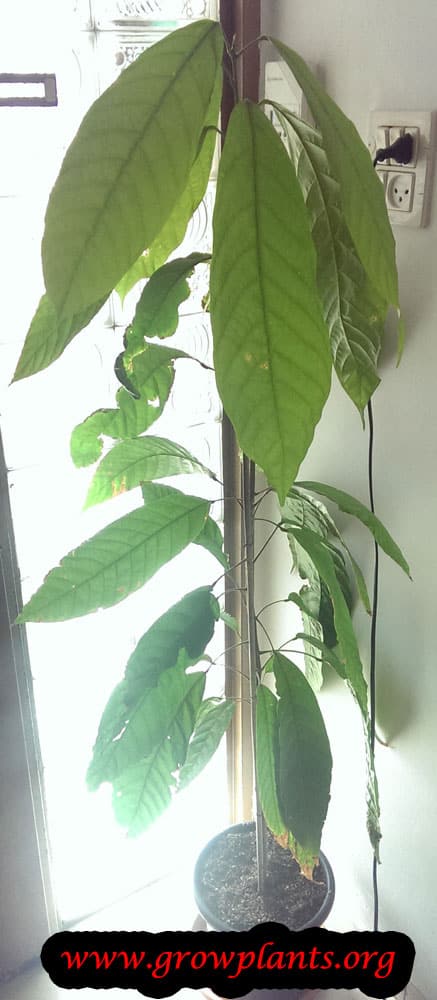
- Leaves and Foliage: Large, glossy leaves, reddish and limp when young, hardening to deep green.
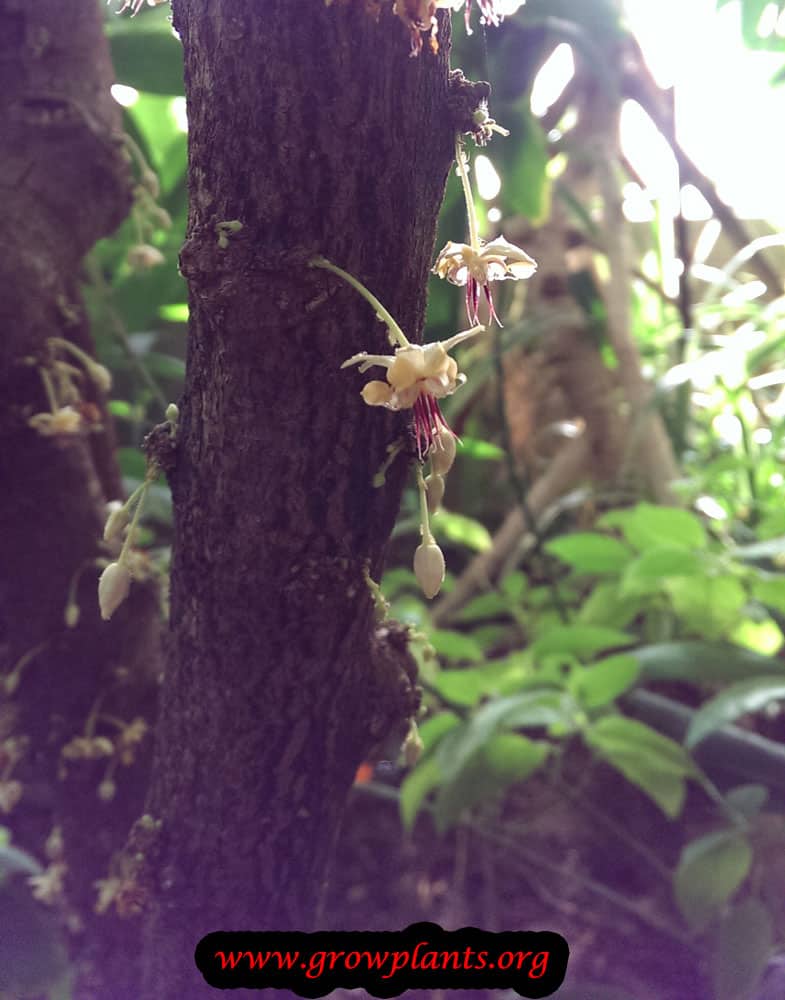
- Flower Characteristics: Small pink flowers (1-2 cm) borne straight on the trunk and main branches.
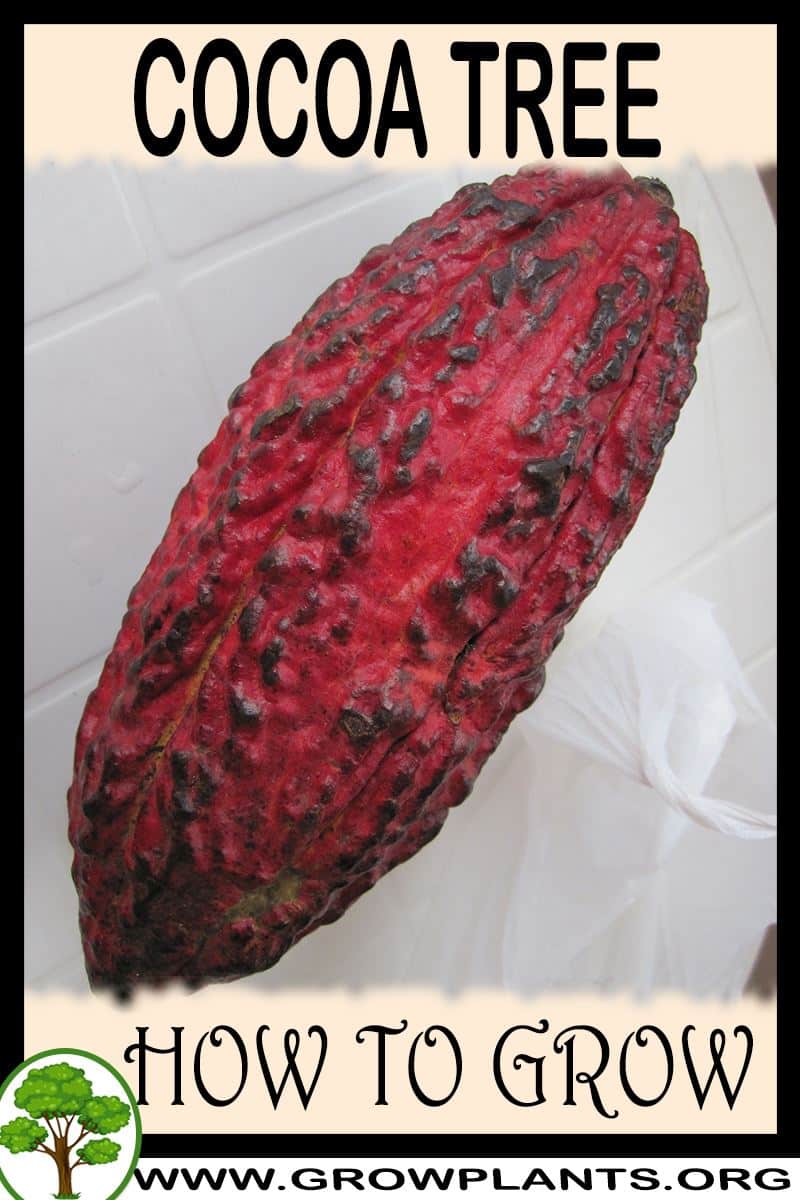
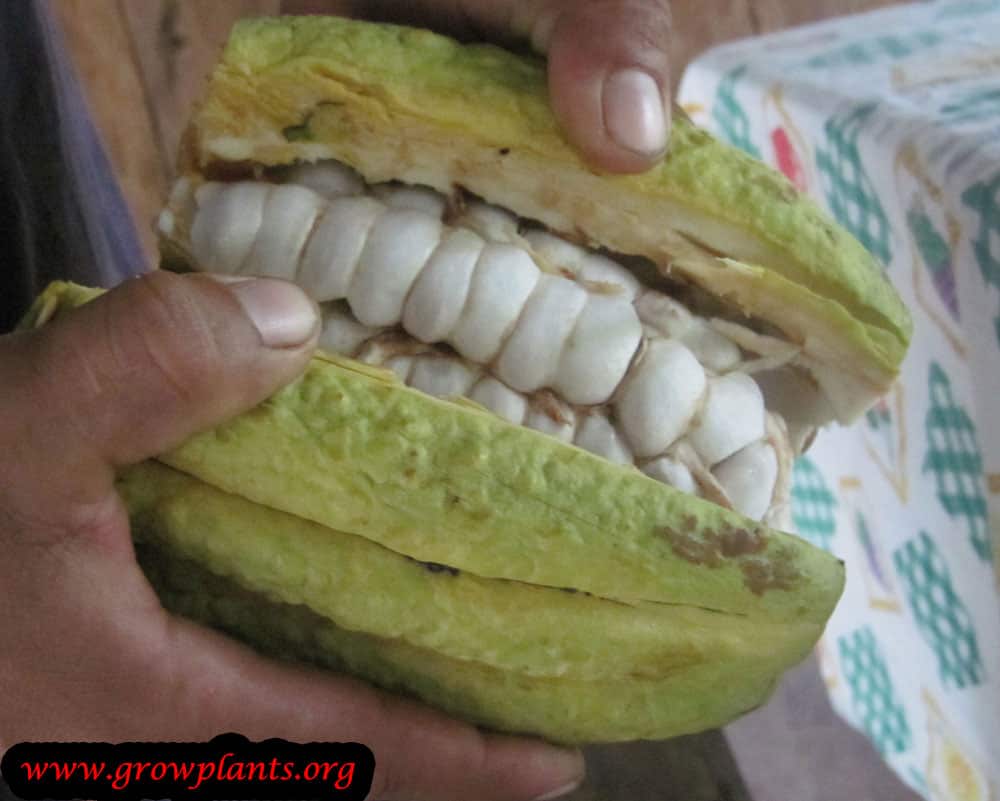
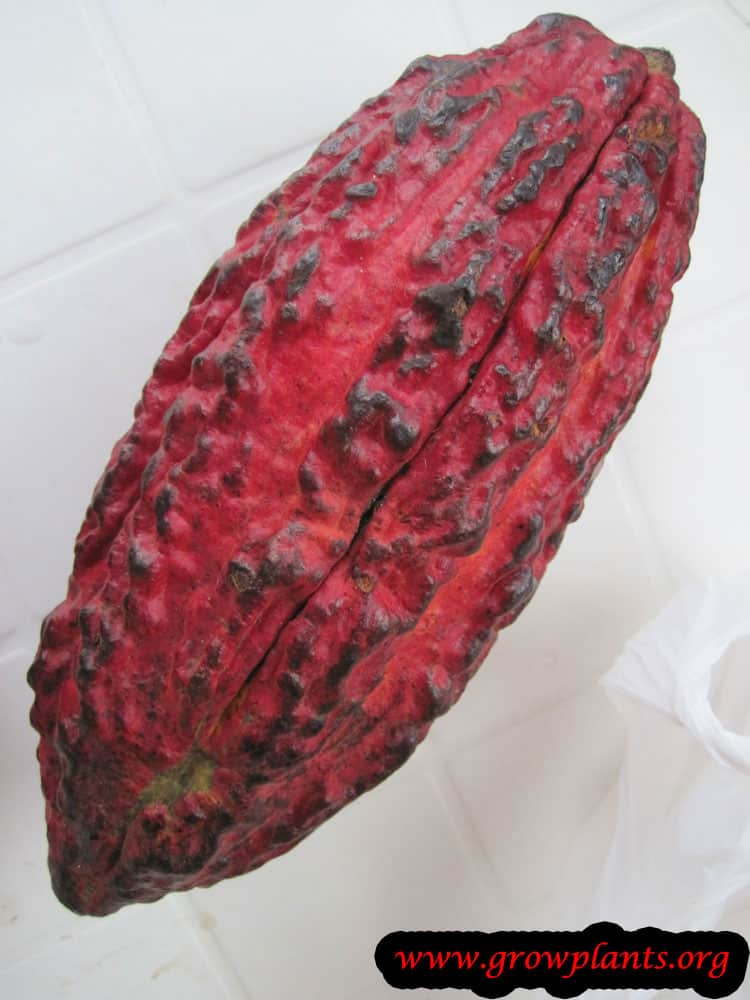
- Fruit Profile: Large ridged pods holding 20-plus seeds in sweet, white, faintly cocoa-flavoured pulp; the seeds are the raw material of cocoa and chocolate.
Primary Uses & Landscape Value
- Edible Uses: Seeds fermented and processed into cocoa and chocolate; the sweet white pulp is eaten fresh.
- Functional and Ornamental Roles: A collector’s edible-crop tree and an unusual tropical ornamental or conservatory specimen thanks to its trunk-borne flowers and pods.
Care Guide: Planting, Soil & Watering
Overview: The cocoa tree is a tropical understorey tree (hardiness zone 13 and up) that grows best in warm, humid shade with moist, rich, well-mulched soil. It is slow-growing, thirsty and frost-tender, needing steady moisture and protection from direct sun and cold.
Quick Care Requirements
| Requirement | Ideal Condition |
|---|---|
| Planting Season | Year-round in warm, humid tropics |
| Growth Rate | Slow |
| Soil Type | Moist, rich, well-mulched soil |
| Water Need | High — keep consistently moist |
Planting & Establishment
- Best Planting Season: In its frost-free tropical range it can be planted year-round; choose a sheltered, shaded spot with high humidity.
- How to Plant:
- Hole Preparation: Dig a hole about twice the width of the root ball, loosening the surrounding soil.
- Soil Amendments: Work in plenty of compost or organic matter and mulch heavily to keep the root zone cool, moist and rich.
- Planting Depth: Set the root collar level with the soil surface and keep the stem base unburied.
- Growth Speed & Expectations: Grows slowly to a small tree (3–6 m); as an understorey species it needs shade and shelter to thrive.
Soil, Watering & Drainage Care
- Soil Mix & Drainage Needs: Moist, rich, humus-heavy soil that still drains is ideal; keep it mulched. It can also be grown in a large container or indoors in bright, indirect light with high humidity.
- Watering Schedule & Technique:
- Young / Newly Planted: Keep the soil consistently moist while the young tree establishes; never let it dry out.
- Established: Water generously and regularly to maintain constant soil moisture and high humidity.
- Seasonal Adjustments: Maintain steady moisture year-round in warmth, and protect from any cold, as the tree is very frost-sensitive.
Climate, Light & Hardiness
Cocoa is a true tropical rainforest-understory tree needing full shade and consistent warmth, with no meaningful cold tolerance. Like its relative monkey cocoa, it is one of the most strictly tropical species in this group.
Quick Climate Specifications
| Climate Zones | Tropical (rainforest understory) |
|---|---|
| USDA Hardiness Zones | 13+ |
| Frost Tolerance | None |
| Light Conditions | Full Shade |
Sunlight & Light Exposure
Optimal Light Setup
Full shade, as this is naturally an understory tree grown beneath taller canopy species in commercial cultivation.
Direct Sun Requirement
Not applicable – avoid direct sun.
Shade & Heat Management
Needs overhead canopy or artificial shade; leaves can scorch in direct tropical sun.
Best Exposure / Orientation
A shaded, humid, sheltered understory-type position.
Temperature Extremes & Hardiness
USDA Hardiness & Regional Limits
Zone 13+ is a genuine lowland-tropical limit, with essentially no tolerance for cool or temperate conditions.
Cold Damage & Winter Protection
Needs consistent tropical warmth year-round; cool snaps outside a true tropical climate cause damage.
Frost Sensitivity
No frost tolerance.
Extreme Heat Tolerance
Adapted to warm, humid tropical heat under shade; does not tolerate hot, dry, or exposed conditions well.
Wind, Humidity & Microclimate
Humidity Preferences
Requires consistently high humidity.
Wind Tolerance
Low; grown in sheltered understory conditions and vulnerable to wind exposure and drying.
Microclimate Recommendations
A shaded, humid, wind-protected tropical site – under canopy trees or in a humid greenhouse – is essential.
Growing in Pots, Balconies & Indoors
The cocoa tree (Theobroma cacao) is a shade-loving tropical of 3-6 m (10-20 ft), and the grower confirms it can be grown indoors as a houseplant. Its natural preference for shade and humidity makes it a striking, if demanding, container plant for a warm, humid home.
Quick Details
- Container Size: A large tub (40 L+ / 10 gal+), potted up as it grows
- Indoor Suitability: A genuine houseplant – it naturally grows in shade
- Best Spot: Bright, indirect light or shade; avoid harsh direct sun
- Soil & Drainage: Rich, moisture-retentive but free-draining mix
- Watering in Pots: Generous – it is thirsty and wants high humidity; never let it dry out
Indoors & On the Windowsill
- A true houseplant: Cocoa naturally grows beneath forest canopy, so it takes to indoor light well – give it a bright spot out of direct sun.
- Humidity & warmth: It needs steady warmth and high humidity, so mist it, group plants together or use a humidity tray, and keep it away from cold draughts; it is sensitive outside its native region.
- Safety: Cocoa contains theobromine, which is toxic to dogs, cats and other pets – keep its pods, seeds and any nibs well out of their reach.
On a Balcony or Patio
- Shade & shelter: Outdoors it needs a warm, shaded, humid, sheltered spot – never full sun or wind. Pots dry fast, so check moisture often and protect it from cold.
Choosing the Pot, Soil & Long-Term Care
- Pot & drainage: Use a pot with plenty of drainage holes; skip a standing water saucer to avoid root rot. Terracotta breathes and dries faster, while glazed or plastic pots hold moisture longer.
- Potting mix: A well-aerated, organic-rich mix – peat or coir blended with perlite or vermiculite for drainage.
- Feeding: Potted plants need feeding more often than those in the ground, as nutrients leach out with each watering – feed lightly through the active growing season. It appreciates added compost and organic matter.
- Repotting: Refresh the mix or pot up about every two years; for an established specimen, replace part of the soil and lightly prune the roots and top growth.
Fertilizing & Feeding
Cocoa tree is a shade-loving tropical tree that wants consistently moist, mulched soil; steady, moderate feeding supports the pods that grow directly on its trunk and hold its prized cocoa seeds.
Quick Fertilizing Specs
| Feeding Level | Moderate; consistently moist, mulched soil in full shade is central to this tree’s care. |
|---|---|
| young_feeding | A nitrogen-forward approach supports canopy development on a young, non-bearing tree. |
| mature_feeding | Balanced feeding through flowering, shifting toward potassium-conscious feeding as the trunk-borne pods fill out. |
| Main Nutrient Priority | Balanced nutrition overall, with extra nitrogen while young and attention to potassium during pod fill. |
| Best Feeding Period | Through the warm, humid growing season; this species can flower across much of the year in favorable conditions. |
| Organic Options | Mulch and organic matter worked into consistently moist soil suit this tree well. |
| Reduce/Stop Feeding | Ease off feeding if the tree is grown outside its preferred shaded, humid conditions and growth slows. |
Feeding by Growth Stage
Newly planted
Help a newly planted cocoa tree root into moist, mulched soil in its preferred full-shade site.
| Nutrient direction | Light, balanced nutrition focused on root establishment rather than pushing top growth. |
|---|---|
| Timing | In the weeks and months after planting, while the young tree is still becoming established. |
| Frequency | A light feeding at planting, with further light feedings only once new growth confirms the tree has rooted in. |
| Fertilizer types | A balanced complete fertilizer used lightly, Mulch and organic matter worked into moist soil |
| Precautions | This species is noticeably sensitive when grown outside its natural humid, shaded range, so keep soil consistently moist and avoid heavy feeding right at planting. |
Young, non-bearing tree
Build a full canopy on a young cocoa tree in full shade before it begins flowering directly on its trunk.
| Nutrient direction | A nitrogen-forward feeding approach to encourage steady vegetative growth. |
|---|---|
| Timing | Through the warm growing season as the young tree puts on new growth. |
| Frequency | Several light feedings spread through the growing season suit a young, actively growing tree better than one heavy application. |
| Fertilizer types | A nitrogen-forward complete fertilizer for young trees, Mulch and organic matter to build soil fertility |
| Routine trace nutrients | iron, manganese, zinc |
| Precautions | Keep this understory species in full shade with consistently moist soil; it does not tolerate the stress of full sun or drying out well. |
Established, pre-bearing
Support a maturing cocoa tree as it approaches its first cauliflorous flowering directly on the trunk and larger branches.
| Nutrient direction | Shift toward balanced feeding that supports continued growth alongside the onset of flowering. |
|---|---|
| Timing | Through the warm growing season as the tree matures toward its first crop. |
| Frequency | Regular light-to-moderate feedings through the growing season support a tree maturing toward its first harvest. |
| Fertilizer types | A balanced complete fruit-tree fertilizer, Mulch and organic matter maintained around the root zone |
| Routine trace nutrients | iron, manganese, zinc |
| Precautions | Avoid pushing excessive late-season nitrogen, which can favor leafy growth over the flowering the tree needs to begin bearing. |
Mature, pod-bearing
Support a mature cocoa tree through flowering and the development of its large trunk-borne pods, which hold the cocoa seeds used for chocolate and beverages.
| Nutrient direction | Balanced nutrition through flowering, shifting toward potassium-conscious feeding as pods fill out. |
|---|---|
| Timing | Through pod development, which can occur across much of the year in favorable conditions. |
| Frequency | Regular, moderate feedings support flowering and pod development better than a single heavy application. |
| Fertilizer types | A balanced to potassium-conscious complete fruit-tree fertilizer, Mulch and organic matter maintained around the root zone |
| Routine trace nutrients | iron, manganese, zinc |
| Precautions | Keep feeding consistent rather than heavy and infrequent, and maintain the humid, shaded, moist conditions the pods need to fill out well. |
Nutrient Deficiency Signs & Corrections
Leaves yellow between the veins while the veins themselves stay dark green.
| Possible causes | High soil pH limiting iron or manganese availability, Waterlogged or compacted soil restricting root uptake, A genuine iron or manganese shortage in the soil |
|---|---|
| Appears first on | New growth toward the branch tips. |
| What to check | Soil pH and drainage, Whether only the newest leaves are affected, Recent watering and root health |
| Possible correction | Correct soil pH and drainage first; if yellowing persists, apply a chelated iron or manganese product per its label. |
The tree flowers on its trunk but few flowers develop into pods.
| Possible causes | Insufficient pollination, since flowers grow directly on the trunk in an unusual position and rely on tiny specialized pollinators, Growing conditions outside this species’ preferred shaded, humid range, A young tree flowering before it is fully mature |
|---|---|
| Appears first on | The trunk flower clusters and any developing pods. |
| What to check | Whether flowers are being pollinated, Shade, humidity and soil moisture levels, Tree age and bearing history |
| Possible correction | Confirm shaded, humid, consistently moist growing conditions, support pollinator habitat where possible, and be patient with young trees. |
Leaves wilt or scorch despite regular watering.
| Possible causes | Too much direct sun for a species adapted to full shade, Insufficient humidity, Root stress from soil that has dried out |
|---|---|
| Appears first on | Leaves most exposed to sun. |
| What to check | Light exposure relative to this tree’s shade requirement, Ambient humidity, Soil moisture consistency |
| Possible correction | Move or shade the tree to reduce direct sun exposure and keep soil consistently moist before assuming a feeding problem. |
Pruning, Training & Seasonal Maintenance
Cacao is cauliflorous — flowers and pods form directly on the trunk and older branches, never on new shoot tips — so the entire pruning approach is built around protecting that trunk surface. The plant’s own guidance matches standard cacao-growing practice worldwide: cut only the small, weak branches, and leave the big trunk and main limbs alone. Spring is the recommended window, and because cacao is prone to serious fungal pathogens (black pod, witches’ broom), tool hygiene is a genuinely elevated concern here, unlike most plants in this set.
Quick Pruning & Maintenance Specs
| Pruning Tolerance | Low on the trunk/main framework (must be preserved); Moderate for small-branch/sucker removal |
| Primary Pruning Window | Spring |
| Secondary Maintenance Window | Ongoing removal of vertical “chupon” suckers as they appear, year-round |
| Typical Frequency | Light, ongoing sucker/weak-branch removal, with a concentrated pass in spring |
| Main Objective | Remove small weak branches and chupon suckers without disturbing the trunk surface that bears the pods |
| Young Plant Priority | Allow the tree to form its natural branching whorl (jorquette) and fan branches undisturbed |
| Mature Plant Priority | Remove chupons and weak/crossing growth; open the canopy modestly without cutting into pod-bearing wood |
| Best Tool Type | Bypass secateurs/loppers for small-to-mid growth; never a saw on the main trunk/framework of a healthy tree |
| Avoid Heavy Pruning During | Any time flowers or developing pods are present on the trunk (bloom occurs most of the year) |
Pruning by Plant Age & Size
Newly Established
Minimal pruning; allow the young tree to develop its natural low branching whorl (the “jorquette”), where the main trunk splits into several fan branches — this is the lifelong fruiting framework and should not be disturbed by early heading cuts.
Young / Formative
Remove weak, crossing, or poorly-placed branches within the fan framework, and remove vertical chupon (watersprout-type) suckers arising from the base or trunk, which compete with the framework rather than adding useful structure.
Mature / Established
Ongoing chupon removal, light canopy opening for airflow and disease control, and removal of small weak branches — never removing the trunk or major fan branches themselves, since those carry the crop.
Seasonal Pruning Schedule
Pre-Growth/Early-Spring (per the plant’s own stated pruning season)
Objective: the main annual pass for weak-branch and sucker removal.
Ongoing Sanitary (year-round)
Objective: chupon suckers and any diseased material should be removed as soon as seen rather than left until the spring pass, since cacao’s fungal disease pressure makes prompt sanitary removal more important than waiting for a fixed season.
Flowering & Fruiting Wood
This is the defining fact for cacao pruning: flowers and pods form via cauliflory directly on the trunk and older branches from persistent flower cushions, not on current-season shoot tips. Pruning the trunk or major limbs removes those cushions permanently and directly cuts future yield. All productive pruning must stay confined to small branches, suckers, and canopy-thinning cuts that don’t touch the main framework or its flower cushions.
Structural Pruning & Training
The young tree’s natural branching whorl (jorquette, splitting into fan branches) is the permanent framework and should be left to form naturally rather than trained into an artificial shape. Ongoing structural work is limited to removing weak/crossing growth within that framework and controlling chupon suckers. Light canopy thinning is genuinely useful here to improve airflow and reduce the humid, still conditions that favor cacao’s fungal diseases — but must avoid cutting the fruiting wood itself.
Special Growth to Remove
- Chupons — vigorous vertical watersprout-type suckers arising from the trunk base or along the framework — are the main growth to manage in cacao, removed regularly since they draw energy from the fruiting framework without bearing productively themselves.
- Small, weak branches, per the plant’s own guidance.
Container & Small-Space Pruning
This species can be grown indoors and in a container, given its full-shade, high-moisture requirements. Container specimens follow the same rule — remove small weak growth and chupons, but never prune the trunk, which can carry flowers and pods even on a young container-grown plant.
Tools
- bypass_secateurs — chupon and small weak-branch removal, the routine task here.
- loppers — occasional mid-size branch removal within the fan framework.
- blade_disinfectant — see Tool Hygiene below.
Tool Hygiene & Disease Risk
High-risk — cacao is affected by serious, tool- and contact-transmissible fungal pathogens (black pod disease from Phytophthora species, and witches’ broom in susceptible regions), on top of the fungal pressure already noted in this species’ own facts. Disinfect blades between cuts and especially between trees, and remove and destroy any diseased material promptly rather than composting it near healthy trees.
Cut Placement & Technique
Remove chupons flush at their point of origin on the trunk/base. Use thinning cuts for weak or crossing branches within the fan framework, cutting just outside the branch collar. Never cut into or scrape the trunk or main fan-branch bark, where the flower cushions that bear the crop are located.
Heavy Pruning & Rejuvenation
Not appropriate for the productive trunk/framework of a healthy tree — the trunk must be preserved. If a tree is old and unproductive, rejuvenation in cacao is typically done by selecting and training a single vigorous chupon to grow into a replacement trunk while the old unproductive wood is phased out, rather than hard-cutting the existing crop-bearing framework.
Post-Pruning Care
Keep the full-shade, consistently moist conditions this species needs. Monitor for the fungal disease, termites, and ants already flagged as pest/disease pressure, and inspect cut surfaces regularly given the elevated disease risk noted above. No special feeding is tied to pruning.
Common Pruning Mistakes
- Cutting into the trunk or main fan branches, permanently destroying flower cushions and future yield.
- Letting chupon suckers accumulate instead of removing them regularly.
- Failing to disinfect tools between cuts or trees, given cacao’s real risk of spreading fungal pathogens this way.
- Imposing an artificial trained shape on the young tree instead of allowing the natural jorquette/fan framework to form.
When NOT to Prune
Never prune the trunk or main fan branches, at any time — a permanent rule given the cauliflorous fruiting habit, not a seasonal one. Also avoid pruning when active flowers or young pods are visible, and avoid pruning during prolonged wet weather, which favors the spread of the fungal pathogens this species is prone to.
Recommended Tools (by task)
- Removing chupon suckers and small weak branches: bypass_secateurs — the routine, recurring cut this species needs to keep the fruiting framework clear of competing growth.
- Occasional mid-size branch removal within the fan framework: loppers — for slightly larger wood than secateurs can handle.
- Between cuts and especially between trees: blade_disinfectant — genuinely warranted given cacao’s documented susceptibility to serious tool-transmissible fungal pathogens.
Pruning Troubleshooting
| Problem | Possible Cause | What to Check | Corrective Action |
| Declining yield over time | Trunk or main fan branches pruned or damaged, destroying flower cushions | Cuts, scrapes, or wounds on the trunk and main framework | Stop all trunk/framework pruning; confine cuts to chupons and small weak branches only |
| Excess vertical shoots crowding the base/trunk | Chupon suckers left unremoved | Vigorous upright growth arising from the trunk or base | Remove chupons regularly as part of the ongoing sanitary routine |
| Disease spreading between trees or cuts | Tools not disinfected between cuts | Blade hygiene practice, especially after cutting diseased material | Disinfect blades between cuts/trees; remove and destroy diseased material rather than leaving it near healthy trees |
| Dense, humid canopy with fungal pressure | No canopy-opening thinning done | Airflow and light penetration into the canopy | Light thinning of non-fruiting canopy growth to improve airflow, without cutting into trunk/framework wood |
Propagation Guide
Cocoa tree is usually grown from seed, but because seedlings vary and can be slow to bear reliably, vegetative propagation (rooted cuttings or grafting/budding) is not strictly necessary yet is generally the better route where consistent fruiting quality matters. Difficulty is moderate: seed germinates readily but must be sown fresh, while cutting or graft propagation needs warm, humid nursery conditions and more skill.
Quick Propagation Specs
| Best Propagation Method | Seed |
| Alternative Methods | Stem cuttings; grafting/budding for known cultivars |
| Propagation Difficulty | Moderate |
| Seed True-to-Type | Hybrid offspring vary |
| Vegetative True-to-Type | Yes |
| Best Propagation Season | All year in tropical conditions |
| Germination Time | Typically a couple of weeks under warm, humid conditions |
| Cutting Rooting Time | Several weeks under warm, humid, misted conditions |
| Germination Temperature | Warm, roughly 24–30°C (75–86°F) |
Growing from Seed
Seed Handling & Viability
Cocoa seed comes from the sweet white pulp inside the large pods and is best treated as short-lived: sow it fresh rather than drying or storing it, as viability drops quickly once seed dries out.
Sowing Season
Planting season is listed as all year for this species, so fresh seed can be sown whenever it is available in a warm, humid tropical setting.
Germination Conditions
Keep sowing medium constantly moist, warm, and shaded, matching the moist, mulched, full-shade conditions this tree needs generally.
Germination Time
Fresh seed generally germinates within a couple of weeks under warm, humid conditions; exact timing varies with freshness and temperature.
Seedling Care
Grow young seedlings in full shade with plentiful, consistent moisture and protection from cold or dry spells, since this tree is noted as sensitive when grown outside its natural climate.
Stem Cuttings
Semi-hardwood cuttings from healthy growth can be rooted under warm, humid, shaded conditions to produce plants identical to the parent. Rooting hormone can be beneficial for improving success but is not documented as strictly required.
Grafting & Budding
Why Grafting Is Used
Because seedling trees vary and are not guaranteed to fruit as well, grafting or budding a known, reliably fruiting selection onto seedling rootstock is the better option for assured, consistent production.
Rootstock
Vigorous seedling rootstock of the same species is typically used.
Best Grafting Season
Warm growing periods within an all-year tropical planting window are most favorable.
Graft Aftercare
Keep grafted plants warm, humid, and shaded while the union establishes, consistent with this tree’s general moist, mulched, shaded care needs.
Bloom & Flower Guide
Quick Details
- Bloom Season: Through much of the year
- Flower Appearance: Small pink flowers, 1-2 cm, borne directly on the trunk and older branches
- Edibility: The flower is not eaten; the tree is grown for the pods whose seeds become cocoa
Detailed Blooming Overview
Cocoa is cauliflorous – its small pink flowers emerge straight from the trunk and main branches rather than the shoot tips. The tree flowers over much of the year but sets only a small share of those blooms as pods.
Flower Characteristics
- Small pink flowers, 1-2 cm across.
- Borne directly on the trunk and older wood (cauliflory).
Bloom Care & Thinning
- Pollination: Chiefly by tiny midges (Forcipomyia); the flowers are poorly suited to bees, so growers often hand-pollinate to lift fruit set.
Fruit & Uses
Cocoa tree is grown for both its fruit pulp and its seeds: the sweet white pulp inside the pod is eaten fresh, while the seeds (cacao beans) are fermented, dried and roasted to make chocolate and cocoa beverages. The pulp is eaten raw straight from the pod, but the seeds are never eaten raw – they require processing before use.
Quick Edible Specs
| Edible Parts | Fruit pulp, seeds (cacao beans) |
| Main Use(s) | Pulp: fresh snack; seeds: chocolate, cocoa beverages, alcoholic beverages |
| Eaten Raw or Cooked | Pulp raw; seeds cooked/roasted (never raw) |
| Preparation Required | Pulp: none; seeds: ferment, dry, roast |
| Harvest Season | About 5 months after flowering |
| Time to First Harvest | Several years after planting (see Propagation for exact timing) |
| Storage | Dried, fermented seeds store well; fresh pulp/pods do not keep |
| Safety/Toxicity Caveat | Raw seeds are bitter and not eaten unprocessed |
Fruit
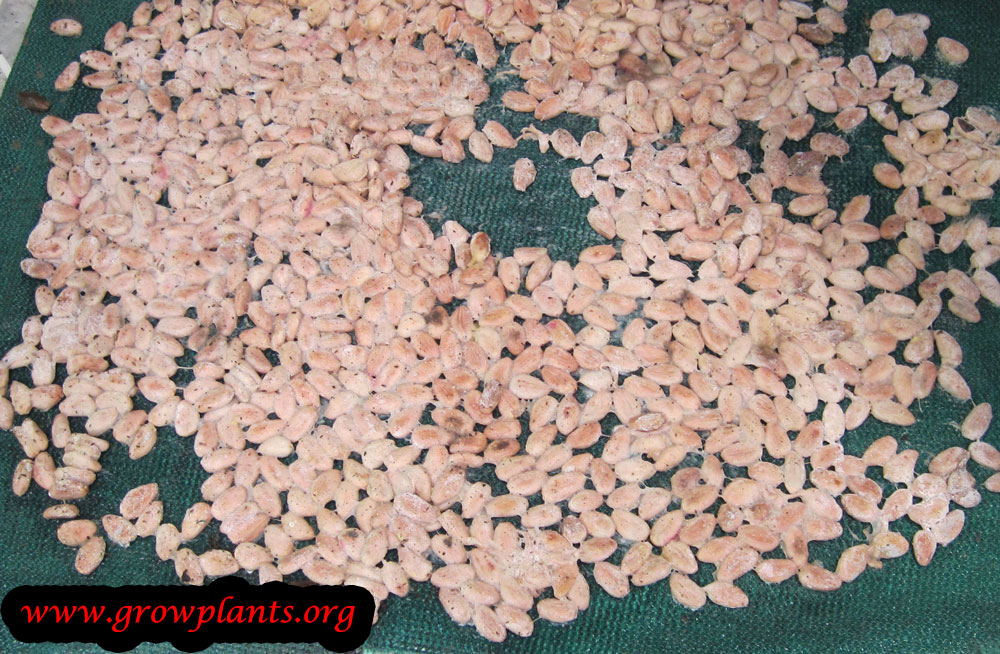
The pod holds more than 20 seeds wrapped in a white, hairy pulp that tastes sweet with a faint cocoa flavor. Pods are cut from the trunk and main branches once ripe; placing something soft under the tree makes collecting easier. The pulp is sucked or eaten fresh straight from the opened pod.
Seeds, Pods & Nuts
The seeds are the most valuable part of the fruit. After removal from the pod they are fermented and dried, then roasted to produce cocoa and chocolate, or brewed into beverages, including alcoholic ones. Raw, unfermented seeds are not eaten as food.
Preparation, Uses & Safety
Pulp needs no preparation and is eaten straight from the pod. Seeds must go through fermentation, drying and roasting before they are usable – this develops the characteristic chocolate flavor and makes them safe and palatable; raw beans are bitter and are not a food in their unprocessed state.
Pests, Diseases & Troubleshooting
Overview: Cacao is an understory tropical tree with an unusually rich pest and disease complex: sap-sucking mirids/capsids and the cocoa pod borer attack shoots and pods, while the fungal pod diseases – black pod, witches’ broom and frosty pod rot – and swollen-shoot virus are the truly serious threats. Management is dominated by canopy shade, frequent complete harvesting and strict removal of diseased pods.
Quick Troubleshooting Overview
| Issue / Pest | Main Symptom | Primary Solution |
|---|---|---|
| Cocoa mirids / capsids | Sunken lesions, shoot dieback | Shade canopy, targeted control |
| Cocoa pod borer | Tunnelled pods, clumped beans | Frequent harvest, bag pods |
| Black pod (Phytophthora) | Black spreading pod rot | Remove pods, copper, airflow |
| Witches’ broom | Broom shoots, distorted pods | Cut out brooms, sanitation |
| Frosty pod rot | White frosty crust on pods | Weekly pod removal |
| Swollen shoot virus | Vein-banding, shoot swellings | Remove trees, control mealybugs |
Common Pests & Management
- Cocoa Mirids / Capsids (Sahlbergella singularis / Distantiella theobroma):
- Symptoms: Sap-sucking bugs that feed on pods and young shoots, leaving sunken necrotic lesions; feeding kills shoot tips, causes staghead dieback and opens the way for fungal infection. A primary pest of cacao in Africa.
- Prevention & Control: Keep a shady, closed canopy, which suppresses mirids, and remove chupons (basal suckers) and dieback wood. Encourage natural enemies such as ants and weaver ants that deter them; targeted control of hotspots is preferred over blanket spraying to protect pollinating midges.
- Cocoa Pod Borer (Conopomorpha cramerella):
- Symptoms: A moth whose larvae bore into developing pods and feed around the beans, causing uneven ripening, clumped beans and heavy yield loss; the key pest of cacao across Southeast Asia.
- Prevention & Control: Practise frequent complete harvesting to break the life cycle, bag young pods, and bury or compost infested husks promptly. Prune for an open, manageable canopy and encourage ants; pheromone monitoring guides any targeted intervention.
- Ants (honeydew-farming) (Formicidae):
- Symptoms: Ants trailing over trunk, pods and shoots, tending mealybugs and scale for honeydew; some are beneficial predators of mirids, but honeydew-farming species boost sap-sucker numbers and spread swollen-shoot-virus vectors.
- Prevention & Control: Manage the sap-suckers they farm and use trunk barriers where a species is clearly harmful, while conserving beneficial weaver ants that actually protect cacao from mirids and pod borer. Identify which ants are present before acting.
- Mealybugs (Pseudococcidae):
- Symptoms: White cottony masses tucked in leaf axils, growing points and along veins; feeding weakens the plant and leaves sticky honeydew followed by sooty mould. Some species also attack roots.
- Prevention & Control: Dab visible colonies with a cotton bud dipped in dilute alcohol and isolate affected plants. Avoid over-feeding with nitrogen. Encourage predators such as the mealybug destroyer ladybird, and treat with insecticidal soap or horticultural/neem oil, repeating until clear.
- Scale Insects (Coccoidea):
- Symptoms: Small immobile brown, tan or waxy white bumps clamped to stems, twigs and leaf undersides. They exude honeydew that blackens with sooty mould; heavy infestations cause yellowing, dieback and reduced vigour.
- Prevention & Control: Scrub off light infestations with a soft brush or a cotton bud dipped in dilute alcohol, and prune out badly encrusted twigs. Conserve predatory ladybirds and parasitic wasps. Smother the vulnerable crawler stage with horticultural oil, timing repeat sprays for when young scales are active.
- Termites (Isoptera):
- Symptoms: Mud tubes running up the trunk and hollowed or ring-barked wood, most often attacking stressed, injured or already-dying tissue rather than vigorous healthy growth.
- Prevention & Control: Keep trees vigorous and avoid trunk wounds, mulch piled against the bark, and waterlogging that invites attack. Remove nearby dead stumps and debris, expose and break mud galleries, and treat active nests directly; healthy bark is the best defence.
Diseases & Fungal Issues
- Black Pod Disease (Phytophthora palmivora / megakarya):
- Symptoms: The most damaging cacao disease worldwide: hard brown-to-black spreading lesions rot the pods (and can infect stems and cause canker), spreading fast in warm, wet, humid weather and destroying beans.
- Treatment & Management: Harvest frequently and remove and bury infected pods and any mummified ‘black’ pods that carry inoculum. Prune and space trees and shade for airflow and quicker drying, and improve drainage. Copper-based fungicides protect pods where pressure is high, integrated with sanitation.
- Witches’ Broom (Moniliophthora perniciosa):
- Symptoms: Abnormal, thickened proliferating ‘broom’ shoots, swollen cushions and distorted, aborted pods; a devastating disease of cacao in the Americas.
- Treatment & Management: Cut out and destroy the brooms and infected pods during the dry season to remove spore sources, and maintain an open, well-pruned canopy. Plant tolerant/resistant selections where available; phytosanitary pruning is the backbone of control.
- Frosty Pod Rot (Moniliophthora roreri):
- Symptoms: Pods develop dark uneven maturation, internal watery rot and a characteristic white-to-cream frosty spore crust on the surface, ruining the beans; a major American cacao disease.
- Treatment & Management: Remove and bag or bury diseased pods weekly before they sporulate, harvest frequently, and open up the canopy to reduce humidity. Combine strict sanitation with tolerant material; fungicides give only partial help.
- Cacao Swollen Shoot Virus (CSSV (Badnavirus)):
- Symptoms: Red vein-banding on young leaves, swellings on shoots and roots, small mottled pods and progressive decline, spread by mealybugs; a serious virus of West African cacao.
- Treatment & Management: There is no cure: remove and destroy infected trees (and often a buffer of neighbours) and control the mealybug vectors, conserving the predatory ants that suppress them. Plant certified clean, tolerant material.
Growing Difficulties & Abiotic Problems
- Frost & Cold Damage:
- Cause & Symptoms: Blackened, water-soaked, limp new growth and leaf tips after a cold snap; this tender or tropical plant is damaged or killed by frost and by prolonged cold.
- Correction Strategy: Site in a warm, sheltered spot, delay planting until the cold has passed, and protect with fleece or bring container plants under cover when frost threatens. Avoid feeding late so growth hardens off before cold weather.
- Sunscald / Leaf Scorch:
- Cause & Symptoms: Bleached, tan or brown dead patches on the most exposed leaves or bark, appearing after a sudden move into strong sun, intense heat, or reflected heat, especially on soft or previously shaded growth.
- Correction Strategy: Acclimatise plants gradually to stronger light, provide light shade during fierce afternoon heat, and keep roots evenly moist so the plant can transpire. Site sensitive plants where they escape the harshest midday and reflected sun.
- Overwatering & Root Rot:
- Cause & Symptoms: Yellowing lower leaves, wilting despite wet soil, and a soft, foul-smelling root ball or stem base result from waterlogged, airless soil that suffocates and rots the roots.
- Correction Strategy: Let the soil dry appropriately between waterings, plant in free-draining media, and ensure pots have working drainage holes. Ease off water in cool or dormant periods and never leave the plant standing in a saucer of water.
What Helps – Products & Tools
Cacao is managed far more by canopy shade, frequent harvest and rigorous pod sanitation than by chemicals; where pressure is high, copper-based fungicides protect pods against black pod and other rots, and targeted rather than blanket insecticide protects the pollinating midges. Conserve weaver ants as natural allies against mirids and pod borer.
Frequently Asked Questions
What is a cocoa tree?
The cocoa tree (Theobroma cacao) is a small evergreen tropical tree, 3-6 m (10-20 ft) tall, whose pink flowers and pods form directly on the trunk and older branches (cauliflory) rather than at the shoot tips. It’s grown as the source of chocolate: its seeds are fermented and roasted into cocoa and cacao products.
Is cacao the same as chocolate?
Not exactly – cacao is the raw material chocolate is made from. The seeds (cacao beans) inside the pod are fermented, dried and roasted to make chocolate and cocoa beverages; raw, unfermented seeds are not eaten as food.
Can you grow a cocoa tree indoors as a houseplant?
Yes. Because cocoa naturally grows beneath forest canopy, it takes well to indoor light and can be grown as a houseplant in a large tub (40 L+ / 10 gal+). Give it a bright spot out of direct sun, and keep it warm and humid – mist it, group plants together or use a humidity tray, and keep it away from cold draughts.
Is the cocoa tree toxic to pets?
Yes. Cocoa contains theobromine, which is toxic to dogs, cats and other pets, so its pods, seeds and any nibs should be kept well out of their reach. The seeds are edible for humans as the source of cocoa and chocolate, but the theobromine they contain is toxic to dogs and cats.
How long does it take for a cocoa tree to produce pods?
A cocoa tree usually begins bearing in about 3-5 years, and once it flowers, pods take roughly 5 months to ripen.
Why do cocoa tree flowers and pods grow on the trunk instead of the branches?
Cocoa is cauliflorous: its small pink flowers, and the pods that follow, form directly on the trunk and older branches rather than at the shoot tips. Because the crop-bearing flower cushions sit on the trunk itself, that surface has to be protected – cutting or scraping it can permanently destroy future pods.