Plant Profile & Key Characteristics
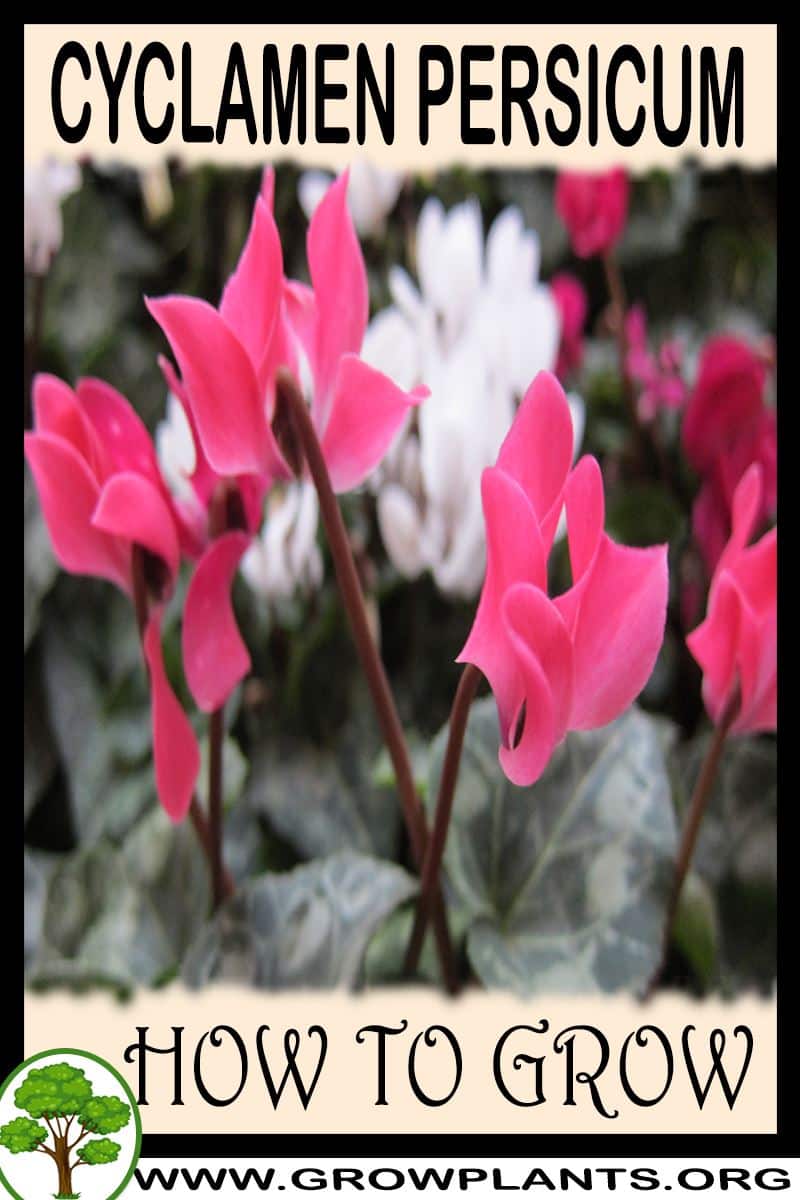
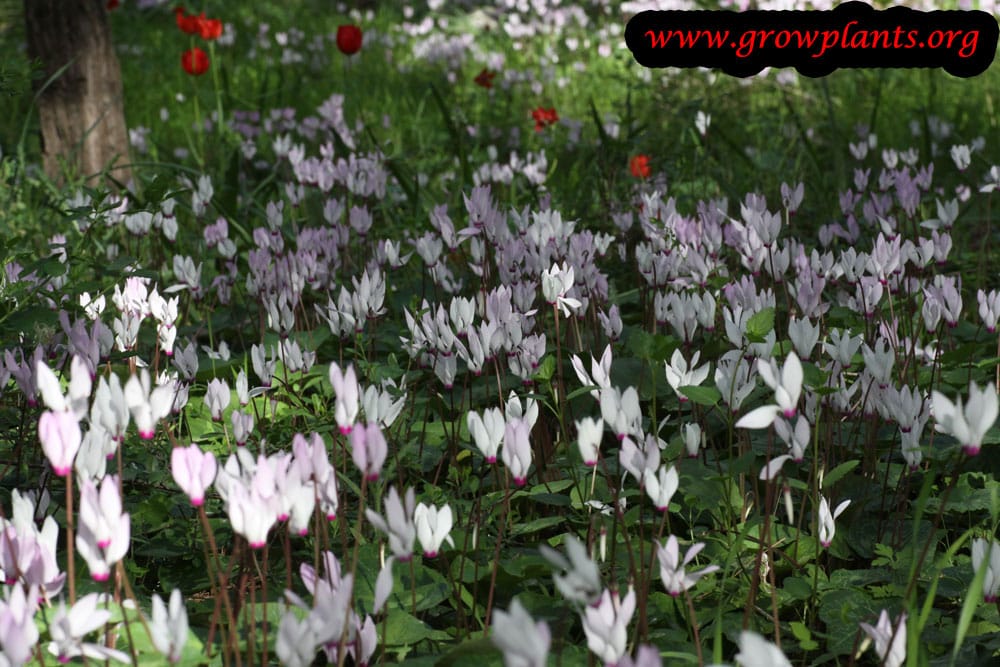
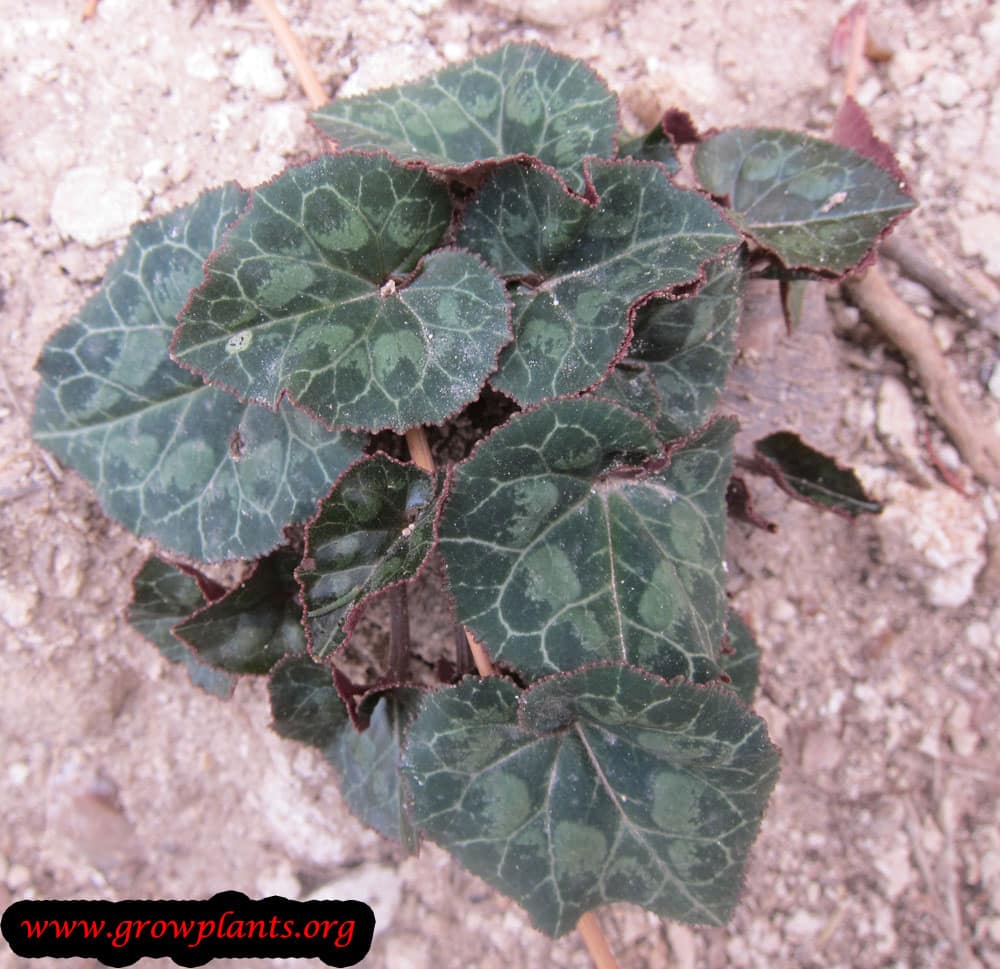
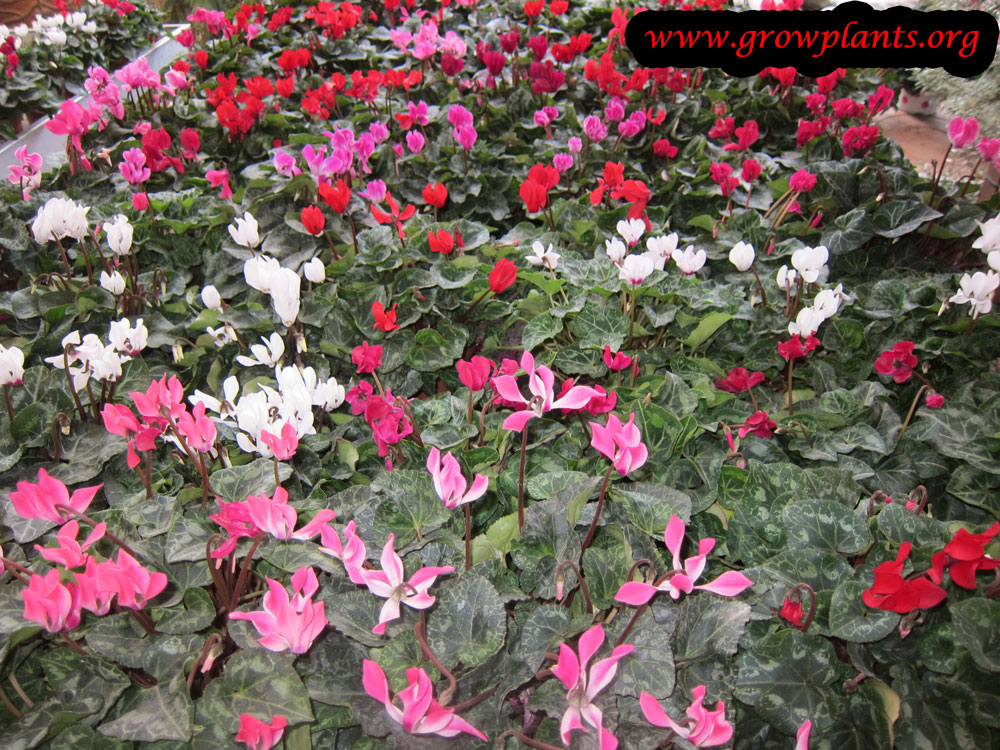
Overview: Cyclamen persicum (florist’s or Persian cyclamen) is a small deciduous tuberous perennial about 5–30 cm (2–12 in) high, forming a low rosette of silver-marbled, heart-shaped leaves. Grown as an ornamental groundcover and as a pot or house plant, it bears nodding red flowers with swept-up petals; the leaves are edible only when thoroughly cooked, but the tuber is toxic.
Quick Specifications
| Specification | Attribute |
|---|---|
| Plant Type / Life Cycle | Perennial (tuberous geophyte) |
| Foliage Type | Deciduous (dies back to the tuber in summer dormancy) |
| Mature Size | 5–30 cm (2–12 in) tall |
| Growth Rate | Slow to moderate |
| Root System | Tuberous – grows from a flattened underground tuber |
| Toxicity | Toxic – the tuber and roots contain saponins and are harmful to pets and people; the leaves are edible only when thoroughly cooked |
| Hardiness | USDA zones 9–10 (to 11 with winter protection) |
Growth Form & Structure
- Height & Spread: Low rosette about 5–30 cm (2–12 in) high and a little wider; in a container a single tuber grows well in a 0.5–2 L (about ½ gallon) well-drained pot.
- Growth Habit & Form: Low, spreading tuberous perennial used as a groundcover, forming a dense rosette of long-stalked leaves with flowers on slender stems held just above the foliage.
- Lifespan & Maturity: Long-lived from the tuber, which enlarges year on year; seed-grown plants take a few years to reach flowering size.
Anatomy & Physical Features
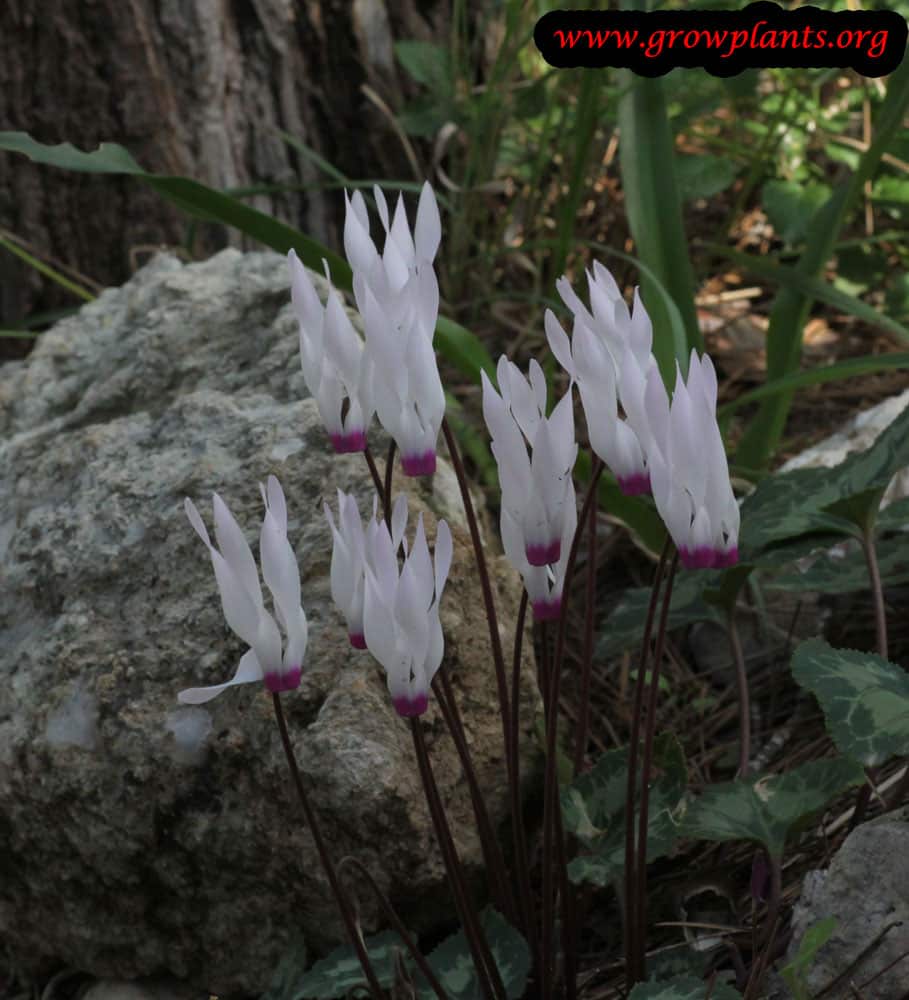
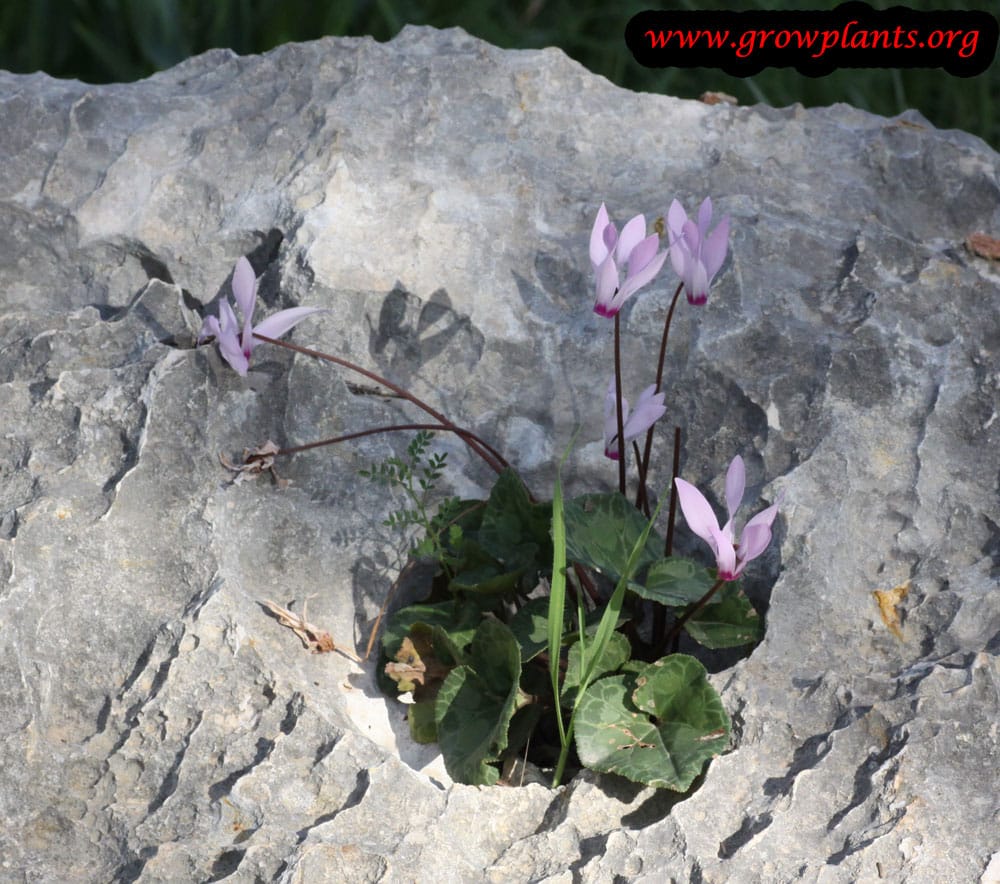
- Leaves & Foliage: Heart-shaped leaves on long stalks, dark to light green marbled with silver-white patterning that varies between plants.
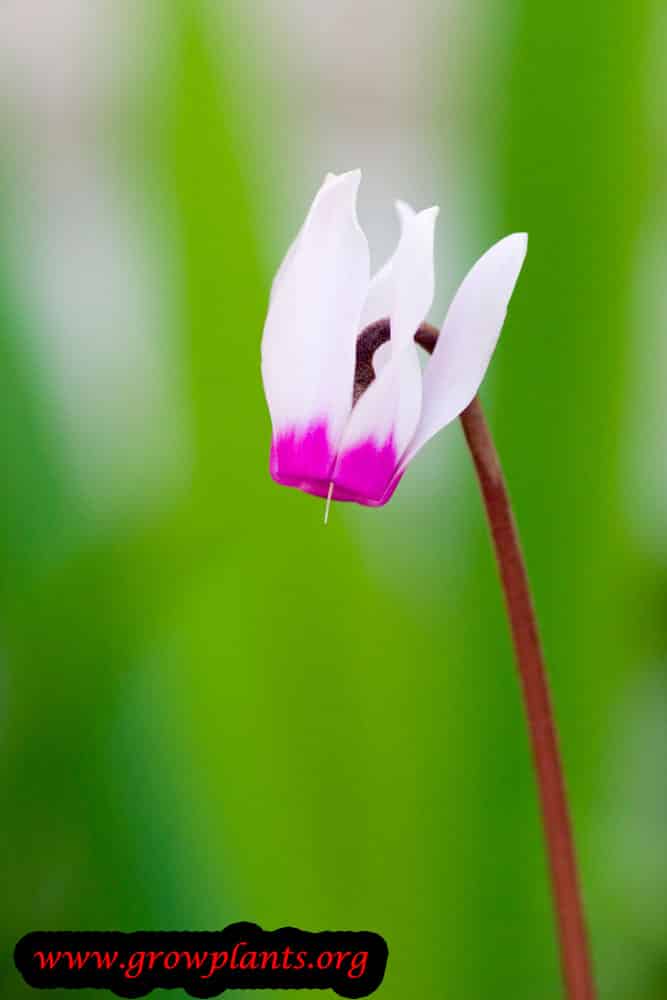
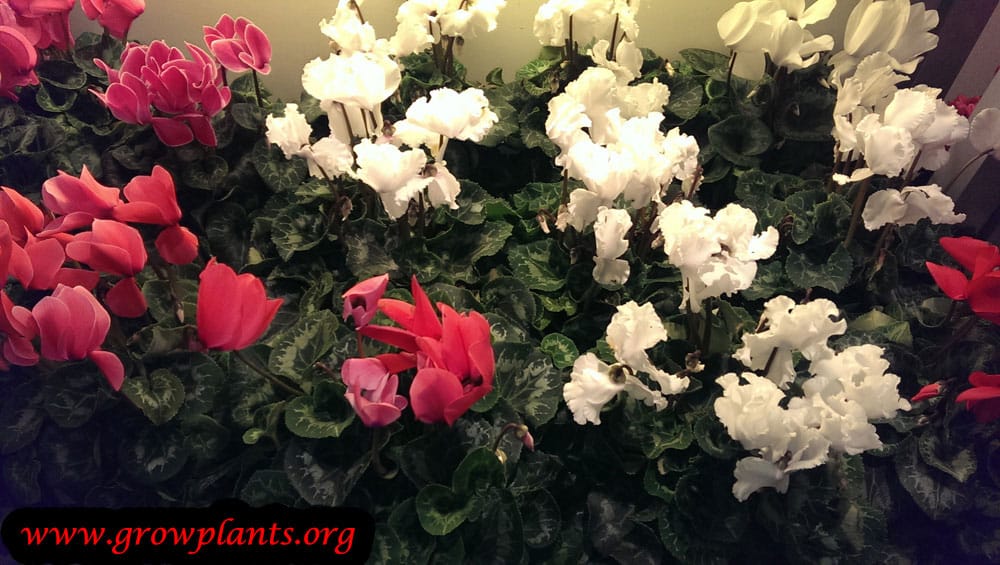
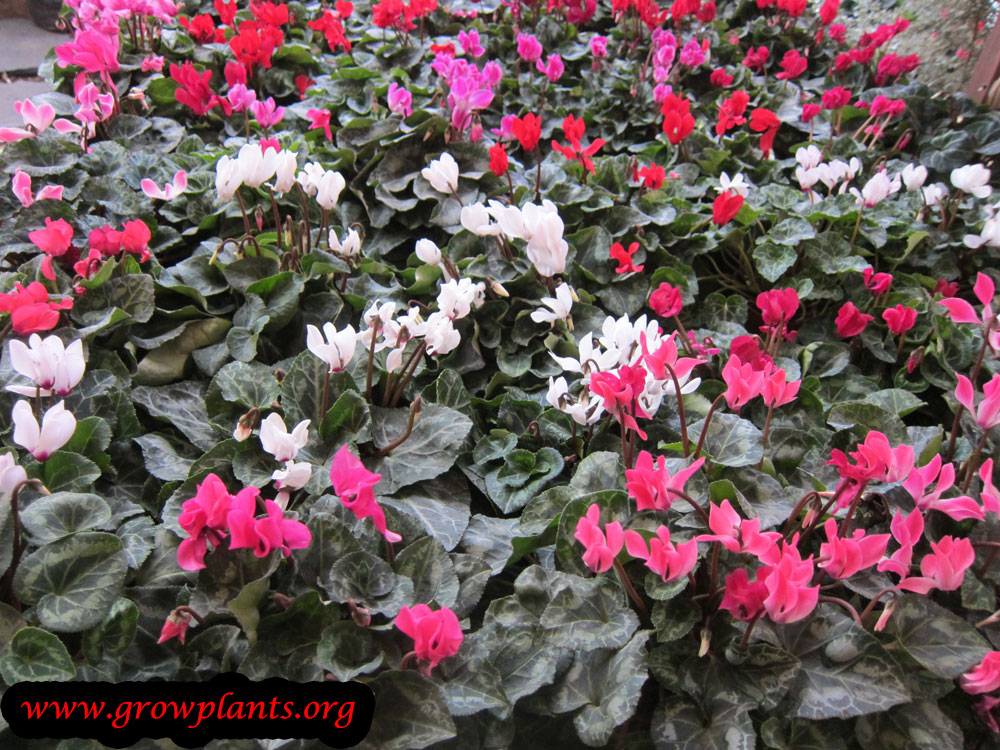
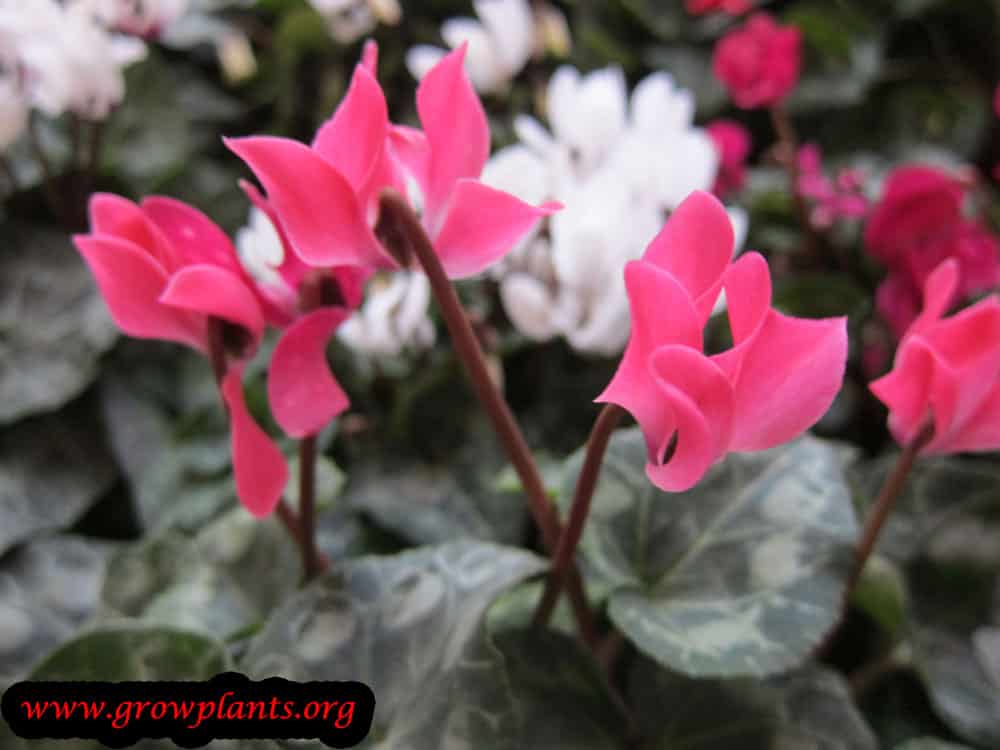
- Flower Characteristics: Nodding flowers with five reflexed (swept-up) petals, in red, pink, purple, white or bicolour; petals range from flat to twisted between cultivars.
Primary Uses & Landscape Value
- Edible Uses: The heart-shaped leaves are eaten cooked (for example rolled and stuffed) and must be well cooked, as they are toxic raw.
- Functional & Ornamental Roles: Ornamental for rock gardens, borders and woodland-edge plantings, and a popular pot or house plant (florist types); prized for cool-season colour; useful as a groundcover.
Care Guide: Planting, Soil & Watering
Overview: Cyclamen persicum is a tuberous perennial that thrives in cool conditions in sun to partial shade, growing from a tuber that demands sharp drainage above all else. Give it a rich, humus-laden yet free-draining soil and modest watering – evenly moist while in leaf, then much drier as the tuber rests over summer. It is hardy in roughly hardiness zone 9–10.
Quick Care Requirements
| Requirement | Ideal Condition |
|---|---|
| Planting Season | Autumn to winter (autumn–spring in zones 9–10) |
| Growth Rate | Slow to moderate |
| Soil Type | Rich, humus-laden, sharply draining |
| Water Need | Low to moderate – let the surface dry between waterings; keep drier in summer dormancy |
Planting & Establishment
- Best Planting Season: Plant in autumn as temperatures cool – autumn to winter in the warmer zones, and autumn through spring in zones 9–10. Cyclamen tubers are best set out while dormant or just breaking growth.
- How to Plant:
- Hole Preparation: Dig a planting hole well wider than the tuber – roughly 100–300% wider – and clear it of stones so roots can spread into loose, open soil.
- Soil Amendments: Work in plenty of organic matter and humus, adding grit if drainage is at all doubtful; once the plant is established, feed lightly about once a year.
- Planting Depth: Set the tuber so its top sits at or just above the soil surface rather than buried – burying it invites rot. Keep the soil lightly moist until growth appears.
- Growth Speed & Expectations: Expect slow to moderate growth, reaching about 5–30 cm (2–12 in) tall; tubers bulk up and flower more freely over several seasons, while seed-grown plants take a few years to reach blooming size.
Soil, Watering & Drainage Care
- Soil Mix & Drainage Needs: Sharp drainage is non-negotiable – a tuber left in cold, waterlogged soil, or hit by heavy summer rain, rots quickly. Plant on a free-draining, humus-rich site in the ground, or use a gritty, well-aerated potting mix in a small container of about 0.5–2 L with drainage holes.
- Watering Schedule & Technique:
- Young / Newly Planted: After planting, keep the soil evenly moist but never soggy until leaves emerge and the plant roots in.
- Established: Water moderately through the growing and flowering season, letting the top of the soil dry before watering again; water at soil level and keep the crown of the tuber dry to avoid rot.
- Seasonal Adjustments: Ease right off as the plant dies back into summer dormancy – most cyclamen want a dry, warm rest – then resume watering as fresh growth returns in autumn.
Climate, Light & Hardiness
Cyclamen persicum does best in mediterranean, subtropical, temperate climates with cool, moist growth periods and a drier summer rest, grown in adaptable light conditions from full sun through full shade. It is a frost-tender, Mediterranean-climate-adapted cyclamen species, rated outdoors to about USDA zone 9–10 (to 11 with careful winter protection).
Quick Climate Specifications
| Climate Zones | Mediterranean, subtropical, temperate |
| USDA Hardiness Zones | 9–10 (to 11 with careful winter protection) |
| Optimal Temp Range | Approximately 10–20°C (50–68°F) during active, cool-season growth - the same range site data gives for seed germination; no separate general growing-temperature figure is recorded. |
| Cold Damage Begins | Begins with the first hard frost; foliage and flowers are damaged well above the tuber's brief survival minimum, and repeated freezes threaten the tuber itself. |
| Approx. Survival Minimum | Approximately -7–-1°C (20–30°F) - the average annual minimum for USDA zone 9, the coldest zone in this plant's rated range. |
| Frost Tolerance | Low |
| Light Conditions | Full Sun / Half Shade / Full Shade |
| Wind Tolerance | Moderate |
Sunlight & Light Exposure
Optimal Light Setup
Adaptable to a wide light range. In climates with mild, cool-summer conditions it grows well in full sun; where summers are hot, increasing shade through half to full shade keeps it healthier and reduces stress on the tuber.
Direct Sun Requirement
Tolerates full sun where summers stay mild and soil remains evenly moist through the growing season; in hot-summer climates, part shade is the safer choice.
Shade & Heat Management
In hot-summer or dry climates, part to full shade reduces heat load on the tuber and helps retain the soil moisture needed for good flowering, without forcing the plant into dormancy prematurely.
Best Exposure / Orientation
Open beds work in cool-summer climates; a woodland-edge or east-facing position with midday relief suits hot-summer regions.
Temperature Extremes & Hardiness
USDA Hardiness & Regional Limits
Cyclamen persicum is rated to USDA hardiness zone 9–10 (to 11 with careful winter protection) on this site. The zone number reflects the average annual minimum winter temperature a location experiences, not summer heat or overall climate suitability. Young or recently planted tubers are generally more cold-sensitive than well-established plantings, so extra protection in the first winter or two is worthwhile toward the colder end of the range. Some Cyclamen persicum cultivars - the florist's cyclamen commonly sold as an autumn or winter gift plant - are often grown and discarded as an annual, especially where winters turn cold. That reflects how the plant is marketed and used, not a lack of genuine cold tolerance within its rated zone: where winters stay within USDA zone 9–10 (to 11 with careful winter protection), the same plant can persist and rebloom outdoors for years as a true perennial.
Cold Damage & Winter Protection
Site care guidance recommends that, where winters are too cold for the tuber to stay in the ground, growers lift it before hard frost, store it, and replant in spring. Outside the rated zone, or in any garden that sees occasional hard freezes, growing the tuber in a container that can be moved under cover for winter is the more reliable approach.
Frost Sensitivity
High. This species has little tolerance for freezing conditions at any growth stage; it is best treated as frost-tender across the board outside genuinely frost-free or well-protected sites.
Extreme Heat Tolerance
Cyclamen persicum's summer dormancy is normally triggered by rising heat following a period of winter cold. Where winters are too mild to deliver that chilling cue, combined with intense summer heat, site care guidance recommends lifting the tuber in summer, storing it refrigerated in a dry, dark place, and replanting it in autumn. Heat itself is well tolerated by the dormant tuber; the more common problem is a missing winter chill disrupting the normal growth-dormancy cycle and reducing flowering.
Wind, Humidity & Microclimate
Humidity Preferences
Moderate ambient humidity typical of a Mediterranean-climate winter-wet, summer-dry cycle suits it; it is not a high-humidity specialist.
Dry-Air Tolerance
Grown indoors, dry air from heating is explicitly flagged in site care data as a cause of poor flowering - keep the plant away from radiators and heating vents, and favor a cool room with moderate humidity.
Wind Tolerance
Moderate. Tolerates more open, sunnier sites than the shade-loving cyclamen species, though a sheltered position is still preferable to a consistently wind-exposed one.
Rainfall & Seasonal Moisture
Adapted to a Mediterranean-type rainfall pattern: moist, cool-season growth followed by a drier summer rest. Site care data specifically warns that excessive summer rain without sharp drainage can rot the tuber, so summer moisture needs to stay light regardless of how wet the growing season was.
Microclimate Recommendations
A slight slope or raised bed with sharp drainage suits the tuber's need for a dry summer rest; siting beneath deciduous shrubs or trees conveniently supplies winter light and summer shade together. In the colder part of its rated zone, a warm wall or south-facing microclimate plus a dry winter mulch adds useful margin.
Growing in Pots, Balconies & Indoors
Cyclamen persicum is a small, tuberous cyclamen that makes an excellent pot plant and can genuinely be grown indoors as a houseplant – the grower confirms this works, provided it gets enough light to flower and, crucially, stays cool. Keep it well away from radiators and other heat sources, because too much warmth stops it blooming.
Quick Details
- Container Size: About 0.5-2 L (up to ~1.3 gal) per tuber, depending on the size of the bulb
- Indoor Suitability: A real houseplant in a bright, cool spot; it will not flower if kept too warm
- Best Spot: Bright light out of hot, direct sun; cool temperatures
- Soil & Drainage: Well-drained potting mix; never waterlogged
- Watering in Pots: Small to average amounts – keep just moist and let the surface dry slightly between waterings, as pots dry faster than open ground
Indoors & On the Windowsill
- A genuine houseplant: Grown indoors it needs a bright position with enough light to set flowers, plus cool temperatures – do not place it next to heaters, which harm growth and can stop it blooming.
- Why it stops flowering: The main indoor problems are a spot that is too warm or too little feeding; correct both and flowering returns.
- Windowsill growing: A bright, cool windowsill out of scorching midday sun is close to ideal – it supplies the light needed for flowers without overheating the plant.
- Dormancy: After flowering the plant dies back and rests; ease off water while the tuber is dormant, then resume as new growth appears.
On a Balcony or Patio
- Light & shelter: Give it a bright but sheltered position, protected from hot direct sun and drying wind; cyclamen dislike heat, and walls and paving that reflect warmth push pots to dry out and wilt quickly, so check moisture often.
- Practicalities: These are small, light pots – easy to shift to the coolest, brightest corner as the seasons change, and to move under cover in harsh weather.
Choosing the Pot, Soil & Long-Term Care
- Pot & drainage: A small pot of about 0.5-2 L per tuber with strong drainage holes; skip a standing-water saucer to avoid rotting the tuber. Terracotta breathes and dries faster, while glazed or plastic holds moisture longer.
- Potting mix: A free-draining, aerated potting mix (for example coir or peat with added perlite) – the grower stresses that good drainage is essential.
- Feeding: Potted plants need feeding more regularly than those in the ground because nutrients leach out; a light feed during growth and flowering keeps blooms coming.
- Refreshing & dividing: Every few years check that the mix still drains well; if not, wash the old soil off the tuber and repot into fresh mix. In the dormant season the tuber can be lifted. Once the roots fill the planter and flowering falls off, divide and reduce the plants or move up to a larger pot.
Safety: Cyclamen are toxic if eaten – the tuber especially – so keep plants out of reach of children and pets.
Fertilizing & Feeding
The cyclamen most commonly sold as a flowering houseplant: a light, balanced feed through leaf growth and its autumn-into-winter bloom supports flowering, but no feeding at all while the tuber rests, and getting bloom right indoors depends as much on keeping the plant cool as on feeding it.
Quick Fertilizing Specs
| Feeding Level | Light feeder |
|---|---|
| Main Nutrient Priority | A balanced feed rather than a phosphorus-heavy bloom booster |
| Best Feeding Period | During active leaf growth through its autumn and winter bloom period |
| Organic Options | Compost or organic matter worked into the planting hole for garden plantings |
| Reduce/Stop Feeding | Stop entirely once foliage yellows and the tuber settles into its rest period |
| Soil pH | Tolerates a range of well-drained soils; avoid heavy, waterlogged ground |
Feeding by Growth Stage
Leaf growth after planting, repotting, or rest
Support new root and leaf growth as the tuber is planted or a houseplant resumes growth after its rest period.
| Nutrient direction | A balanced, complete fertilizer supports steady root and leaf development without pushing soft, rot-prone growth. |
|---|---|
| Timing | At autumn planting or repotting, or as new leaves emerge after the tuber’s rest period ends. |
| Frequency | Light, occasional feeding is enough at this stage for a naturally light-feeding species. |
| Fertilizer types | A balanced, complete fertilizer formulated for flowering bulbs or general garden use, A dilute balanced liquid fertilizer for potted, indoor plants |
| Precautions | Hold off on feeding a freshly planted, freshly divided, or freshly repotted tuber until roots have established; feeding too soon can stress a tuber that hasn’t resumed active growth. |
Active growth through autumn and winter bloom
Sustain the heart-shaped foliage and support the long autumn-into-winter flowering this species is grown for, whether in the garden or as a potted houseplant.
| Nutrient direction | Continue with a balanced feed; adequate nitrogen alongside phosphorus and potassium supports flowering better than a phosphorus-heavy product, and keeping an indoor plant cool matters as much as feeding for getting it to bloom well. |
|---|---|
| Timing | Through autumn and winter while leaves are fully expanded and during bloom. |
| Frequency | A few light feedings spread through the growing season are enough for this light feeder. |
| Fertilizer types | A balanced, complete fertilizer suited to flowering garden bulbs, A dilute balanced liquid fertilizer for potted, indoor plants |
| Precautions | Taper off feeding as winter flowering finishes and leaves begin to yellow; heavy feeding late in the cycle can build up salts around the tuber, particularly in a container. |
Dormant rest period
Let the tuber rest without fertilizer once foliage dies back after flowering.
| Nutrient direction | None – withhold fertilizer while the tuber is resting and leafless. |
|---|---|
| Timing | After flowering ends and foliage yellows and dies back. |
| Frequency | No feeding at this stage; resume only once new leaf growth restarts. |
| Fertilizer types | No feeding at this stage – do not fertilize a resting, leafless tuber until new growth resumes |
| Precautions | Do not fertilize the resting tuber; in climates too warm for a cold rest the tuber is commonly lifted and stored dry, and a stored tuber should never be fed. |
Nutrient Deficiency Signs & Corrections
The plant, whether in the garden or a pot, produces few or no flowers despite otherwise healthy-looking leaf growth.
| Possible causes | insufficient fertilizer during the active growth period, indoor growing temperatures too warm to trigger flower set – a very common cause for potted plants kept near heaters, insufficient light for the plant to fuel flowering |
|---|---|
| Appears first on | new flower bud production |
| What to check | recent feeding history through the growing season, whether a potted plant is being kept cool and away from heaters, the amount of light the plant is receiving |
| Possible correction | Resume light, balanced feeding through the growing season, move any indoor plant to a cooler spot away from heat sources, and ensure adequate light; feeding alone will not fix a temperature problem. |
Leaves are pale, smaller than usual, and overall growth is weak during the active season.
| Possible causes | low available nitrogen from insufficient or lapsed feeding, poor, depleted potting or garden soil, root or tuber stress limiting nutrient uptake |
|---|---|
| Appears first on | older leaves first |
| What to check | recent feeding history, soil richness and how long a potting mix has been in use, root and tuber condition |
| Possible correction | Resume light, balanced feeding once active growth is confirmed, and refresh an old, depleted potting mix. |
General decline, yellowing leaves, and stunted growth that does not respond to feeding.
| Possible causes | waterlogged or poorly-drained soil or an over-watered pot, fungal or bacterial rot organisms, excess watering, particularly around the tuber’s rest period |
|---|---|
| Appears first on | the tuber and the base of the leaf stalks |
| What to check | soil or potting-mix drainage, tuber firmness when checked, recent watering, especially during the rest period |
| Possible correction | Improve drainage and cut back watering rather than adding more fertilizer; fertilizer will not correct a rot problem and can add further stress to an already struggling tuber. |
New leaves emerge yellow between the veins while the veins themselves stay green.
| Possible causes | high soil or potting-mix pH limiting iron availability, waterlogged soil restricting root uptake, naturally low iron in an alkaline garden soil |
|---|---|
| Appears first on | young, newly emerging leaves |
| What to check | soil or potting-mix pH and whether it is alkaline, drainage and whether the soil stays wet, overall root health |
| Possible correction | Correct pH toward neutral and improve drainage first; a chelated iron product can correct a confirmed deficiency per its label. |
Pruning, Training & Seasonal Maintenance
Cyclamen persicum has no woody or structural growth to prune – all leaves and flowers arise directly from a single tuber, so maintenance is limited to grooming spent foliage and flower stems and, occasionally, dividing the tuber. Tolerance for cutting is low: this is about tidiness and disease prevention, not shaping. The safest window is anytime foliage is actively green, with the main flush of grooming right after each bloom fades (autumn–winter into spring); heavy handling should stop once leaves begin their natural yellowing into summer dormancy, since that die-back is the plant’s own renewal cycle, not something to force with a blade.
Quick Pruning & Maintenance Specs
| Pruning Tolerance | Low (grooming only, not structural) |
| Primary Pruning Window | Autumn–winter into spring, while in active leaf and after each flower fades |
| Secondary Maintenance Window | Early summer, as foliage begins natural yellowing before dormancy |
| Typical Frequency | Light grooming every 1–2 weeks during the growing/blooming season |
| Main Objective | Remove spent leaves/flower stems cleanly to prevent rot and redirect the tuber’s energy |
| Young Plant Priority | Minimal handling; let the young tuber build leaf mass undisturbed |
| Mature Plant Priority | Routine deadheading/leaf grooming; periodic tuber division once multiple growing points appear |
| Best Tool Type | Bare-hand grasp-and-pull technique; precision snips only as a fallback |
| Avoid Heavy Pruning During | Summer dormancy (nothing green to cut) and while leaves are still fully green and functional |
Pruning by Plant Age & Size
Newly Established
In the first season, avoid removing anything but visibly dead or rotting tissue – the young tuber needs every functional leaf to build up reserves before it can support a full bloom cycle.
Young / Formative
No structural training applies to a stemless tuberous geophyte; the only “formative” habit worth building is grooming discipline – removing spent flowers and yellowing leaves promptly so the crown stays clean and rot-free as the clump of leaves thickens.
Mature / Established
Once the tuber has more than one visible growing point (nub), it can be considered for division during dormancy (see facts: divide 2–4 weeks into dormancy, only if there is more than one growth point). Otherwise, mature-plant care is the same grooming cycle repeated each growing season.
Seasonal Pruning Schedule
Post-Flowering (as each bloom fades, autumn–spring depending on zone)
Objective: prevent spent flowers and stems from rotting into the crown. Remove faded flower stems as they finish, but only stems that have fully finished – not buds still developing. Do not remove surrounding green leaves. Expected response: the tuber continues cycling new flower stems through its bloom season without energy lost to rotting tissue.
Dormancy Transition (early summer, as foliage yellows)
Objective: let the plant shut down on its own terms. Remove only leaves that have fully yellowed and pull free easily; do not cut green leaves early just to “tidy up” – they are still feeding the tuber for next year’s bloom. In hot-summer/low-chill areas the whole top growth may be lifted and the tuber stored dry and dark per the plant’s normal dormancy handling; in mild zones (9-10) it can be left in the ground. Note: unlike most temperate perennials, this species’ dormant season is summer, not winter – so “dormant-season pruning” for Cyclamen persicum falls in early summer, not winter.
Ongoing Sanitary (through the active autumn–spring growing season)
Objective: keep the crown clean. Remove any leaf or bulb tissue that has actually died or rotted (soft, discolored tuber tissue is a summer over-watering/poor-drainage risk) as soon as it’s noticed, to stop rot spreading into healthy tuber tissue.
Special Growth to Remove
- Spent flower stems – once fully finished, not while still upright and firm.
- Fully yellowed/dead leaves – leave green leaves in place even if they look tired; they are still photosynthesizing for the tuber.
- Any soft, rotten patches of tuber tissue found at the crown – cut back cleanly to firm tissue to stop spread.
Container & Small-Space Pruning
Most Cyclamen persicum grown as houseplants or in pots need the same grooming, but pot culture raises the stakes on hygiene: a crowded pot with dead leaf litter sitting against the crown in low airflow is a fast route to rot, so spent material should be removed promptly rather than left to compost in place. When repotting after a few years, this is also the point to check whether the tuber has filled the container and needs dividing or moving up a size; if keeping it compact, thin the number of growth points rather than shearing foliage.
Tools
Hand-pulling (grasp the leaf or flower stem close to the base and pull with a firm, quick twist) is the traditional and most effective technique – it removes the stem cleanly at its natural break point without leaving a stub. Precision snips are a reasonable fallback for stems that won’t release cleanly, or for cutting back rotten tuber tissue.
Tool Hygiene & Disease Risk
Routine hygiene (clean, dry tools) is enough for everyday leaf/flower grooming, since hand-pulling avoids most cut-surface exposure. Risk rises specifically during tuber division: use a sterile knife for that cut, and let the cut surface heal outside the soil for about two weeks before replanting, per the plant’s own propagation guidance – tuber tissue is soft and vulnerable to rot organisms if divided with a dirty blade.
Cut Placement & Technique
Pull, don’t shear, whenever possible: grasp the stem near where it meets the tuber and twist/pull so it detaches at its natural abscission point, rather than cutting mid-stem and leaving a stub that can wick moisture into the crown and rot. If a blade is used instead, cut as close to the tuber as possible without nicking the tuber surface itself.
Heavy Pruning & Rejuvenation
There is no hard or rejuvenation pruning for this species – there is no woody framework to cut back into. The plant’s own annual die-back into summer dormancy is its renewal event; forcing an equivalent by stripping green leaves early only weakens the tuber for the next bloom cycle.
Post-Pruning Care
After routine grooming, keep the crown area on the drier side rather than wetting it heavily – excess summer rain or overwatering around the tuber is a known cause of tuber rot/death for this species. Do not fertilize right after cutting spent growth; feeding is timed to the growing/pre-bloom season, not to a grooming session. After tuber division specifically, keep the cut surface dry until it calluses before replanting.
Common Pruning Mistakes
- Cutting leaf/flower stems with scissors instead of pulling, leaving stubs that rot into the crown.
- Removing green, still-functional leaves too early “for tidiness,” which starves the tuber before next season’s bloom.
- Dividing the tuber with an unsterilized knife, or dividing a single-growing-point tuber that shouldn’t be split at all.
- Overwatering the crown after grooming, especially into summer, encouraging tuber rot.
When NOT to Prune
- While leaves are still green and turgid – they’re still feeding the tuber; wait for natural yellowing.
- During peak bud emergence, to avoid accidentally pulling or damaging unopened flower stems mistaken for spent ones.
- Outside the recommended division window (2–4 weeks into dormancy, and only if the tuber shows more than one growth point).
Recommended Tools (by task)
- precision_snips – fallback for spent leaf/flower stems that resist hand-pulling; clean, small cuts suited to soft tissue.
- grafting_knife – a fine sterile blade for tuber division, matching the plant’s own guidance to use a sterile knife when splitting the tuber.
- blade_disinfectant – to sterilize the blade before and between tuber divisions, since cut tuber tissue is rot-prone.
Propagation Guide
Cyclamen persicum is usually started from seed, since a tuber typically produces only a single growing point and does not divide freely; where a tuber has developed more than one growing point, careful division can multiply an existing plant true to type. Seed germinates reliably but seedlings take a few years to reach flowering size, so overall difficulty is moderate.
Quick Propagation Specs
| Best Propagation Method | Seed sowing |
| Alternative Methods | Tuber division (only when a tuber has more than one growing point) |
| Propagation Difficulty | Moderate |
| Seed True-to-Type | Usually true-to-type for the species; named seed strains/cultivars can vary |
| Vegetative True-to-Type | Yes |
| Best Propagation Season | Sow in spring or autumn depending on temperature; divide tubers a few weeks into dormancy |
| Seed Germination Time | 2–8 weeks |
| Germination Temperature | 10–20°C (50–68°F) |
| Seed Sowing Depth | 0.5–1cm (0.25–0.5in) |
Growing from Seed
Seed Handling & Viability
Store saved seed in a dry, dark place; the site recommends refrigerating it before sowing rather than sowing immediately after harvest.
Dormancy & Pre-Sowing Treatment
A period of cool, refrigerated storage before sowing is noted on this site; treat this as cautious cool storage rather than a fixed chilling schedule.
Sowing Season
Spring or autumn, chosen mainly by temperature rather than calendar season.
Sowing Depth & Orientation
Sow shallowly, about 0.5–1cm (0.25–0.5in) deep, into vermiculite kept consistently moist. Space seed roughly 10x10cm (4x4in), later thinning or transplanting seedlings to about 3x3cm (2.2×2.2in) spacing.
Germination Conditions
A sunny position with good drainage at 10–20°C (50–68°F); keep the medium moist with light humidity, watering moderately without letting it dry out or become waterlogged.
Germination Time
2–8 weeks; germination can be uneven.
Seedling Care
Grow seedlings in half shade with regular watering, keeping the soil moist; flowering from seed can take a few years.
Rhizomes, Tubers, Bulbs & Corms
Cyclamen persicum grows from a tuber (often loosely called a bulb in general use). Division is only appropriate when the tuber has developed more than one growing point (nub); a tuber with a single growing point should not be cut. Divide during the dormant season, ideally a few weeks after dormancy begins, using a sterile knife and sterile soil. Let the cut surface heal before replanting, about two weeks ahead of the normal planting season. When replanting, set the tuber with its top at or just above the soil surface and ensure sharp drainage, since waterlogging during heavy summer rain is a common cause of tuber loss.
Bloom & Flower Guide
Quick Details
- Bloom Season: Autumn into winter
- Time to First Bloom: Grown from a tuber; plants started from seed take a few years before they flower
- Flower Appearance: 5-petalled flowers in red, pink, purple, white or bicolours; petals bend up into a cup shape and range from flat to twisted by cultivar
- Edibility: Not edible – Cyclamen persicum is toxic to people and pets, especially the tuber
Detailed Blooming Overview
Florist’s cyclamen flowers through the cooler months, typically from autumn into winter, which is what makes it such a valued indoor plant when little else is in bloom. Each flower rises on its own stalk with the petals swept upward, and a well-grown plant carries many blooms in succession over a long season. Plants raised from seed are slow to reach this stage, often taking a couple of years.
Flower Characteristics
- 5 petals that bend up to form a cup-like structure, in red, pink, purple, white, or more than one colour.
- Petal shape varies by cultivar – some flat, others twisted or ruffled.
Bloom Care & Thinning
- Removing spent flowers: Pull each faded stalk away with a twist at the base rather than cutting, to reduce the risk of crown rot.
- Prolonging the display: Keep the plant cool and bright and water from below, keeping the crown dry.
- Pollination: Pollinated by bees where grown outdoors.
- Safety: Despite older claims that the leaves are edible, all parts of Cyclamen persicum are toxic – grow it as an ornamental only and keep it away from children and pets.
Bloom Health & Protection
- Cyclamen mite: Causes distorted, streaked buds and flowers; discard badly affected plants and treat milder cases with neem oil or a suitable miticide.
- Grey mould (Botrytis): Faded flowers left in damp, still air can turn mouldy; improve airflow and remove spent blooms promptly.
Fruit & Uses
The only part of Cyclamen persicum grown for eating is its leaves, and even they are eaten cooked rather than raw. In traditional Middle Eastern and Iranian cooking the young leaves are prepared like a dolma – cooked and rolled around a filling – never eaten fresh off the plant.
Quick Edible Specs
| Edible Parts | Leaves only |
|---|---|
| Main Use(s) | Culinary – cooked, rolled/stuffed leaf dish |
| Eaten Raw or Cooked | Cooked only – not eaten raw |
| Preparation Required | Cook well before eating; use young, fully-grown leaves rolled around a filling |
| Harvest Season | Autumn / Winter / Spring |
| Storage | Best used fresh, soon after picking, as with other leafy greens |
| Safety/Toxicity Caveat | Leaves are toxic if not cooked well; the tuber (rootstock) is not eaten and is the most toxic part of the plant |
Leaves & Greens
The heart-shaped leaves are picked once they are fully formed but still young, by trimming them from the plant; harvest can continue across autumn, winter and into spring while the plant is in active growth (see Pruning for general dead-leaf removal, which is a separate task from harvesting for food). Only take a moderate amount of leaves at a time – stripping too many will weaken the bulb’s ability to flower and store energy for the following season.
Preparation, Uses & Safety
Safety caution first: the leaves must be cooked well before eating – if undercooked they are toxic. Do not eat any part of the plant raw, and do not eat the tuber (rootstock) under any circumstances: like the rest of the Cyclamen genus, the tuber concentrates a toxic saponin (cyclamin) that can cause vomiting, diarrhea and stomach pain, and the whole plant is also considered toxic to pets. Within that limit, the traditional and well-established use of this species is the young leaves, thoroughly cooked and rolled/stuffed in the style of a dolma. Treat this as a minor, occasional-use edible leaf rather than a staple green, and when in doubt about how well a batch has been cooked, do not eat it.
Pests, Diseases & Troubleshooting
Overview: Cyclamen are cool-season tuberous perennials most troubled by microscopic tarsonemid mites and by rots that follow water sitting in the crown. Cyclamen persicum, the common florist’s cyclamen, is the type most affected because it is so widely grown indoors. The management philosophy is preventive and cultural: water from below to keep the crown dry, give bright but cool airy conditions, and inspect new growth regularly, reserving sprays and biocontrols for confirmed infestations.
Quick Troubleshooting Overview
| Issue / Pest | Main Symptom | Primary Solution |
|---|---|---|
| Cyclamen mite | Puckered, curled, stunted new leaves and distorted, streaked flowers | Discard heavily infested plants; release predatory mites or apply a labelled miticide; isolate stock |
| Vine weevil | Sudden wilting or collapse; notched leaf margins; grubs chewing the corm and roots | Drench with entomopathogenic nematodes; remove and destroy grubs; refresh clean compost |
| Aphids | Sticky honeydew, sooty mould and distorted young growth; virus spread | Rinse or wipe off; insecticidal soap; encourage ladybirds and lacewings |
| Grey mould (Botrytis) | Fuzzy grey rot on flowers, stalks and leaves in cool damp air | Improve airflow, remove faded tissue promptly, avoid wetting foliage |
| Fusarium / crown rot | Yellowing, one-sided wilt, soft brown rot at the crown and corm | Water from below, use free-draining mix, discard infected corms |
Common Pests & Management
- Cyclamen mite (Phytonemus pallidus):
- Symptoms: The signature pest. Too small to see, it hides in unopened buds and leaf folds; infested new leaves emerge cupped, puckered, hardened and darkened, while flowers become streaked, distorted or fail to open. Damage looks like a growth disorder and is easily mistaken for herbicide injury.
- Prevention & Control: Isolate and usually discard badly affected plants because the mite is hard to eradicate. On valued stock, release predatory mites (Amblyseius / Neoseiulus species), keep humidity moderate, and if needed use a labelled miticide, treating repeatedly to catch new generations; sanitise hands and tools between plants.
- Broad mite (Polyphagotarsonemus latus):
- Symptoms: Similar tiny mite causing downward-curled, bronzed or glazed young leaves and corky, distorted flower buds; often overlaps with cyclamen mite.
- Prevention & Control: Same approach as cyclamen mite: remove worst growth, introduce predatory mites, and apply a labelled miticide or horticultural oil, repeating on a short interval.
- Vine weevil (Otiorhynchus sulcatus):
- Symptoms: Adults notch leaf edges at night, but the real damage is from cream-coloured, C-shaped grubs that tunnel into the corm and eat roots, causing sudden wilting and collapse of an otherwise healthy plant.
- Prevention & Control: Drench the compost with entomopathogenic nematodes (Steinernema / Heterorhabditis) in warm soil; tip plants out to find and crush grubs; repot into fresh medium and keep pots off infested ground.
- Aphids (Myzus persicae):
- Symptoms: Soft green, grey or black insects cluster on tender new leaves and flower stalks, secreting honeydew that fuels sooty mould; they twist growth and, more importantly, transmit viruses.
- Prevention & Control: Knock off with a firm water rinse or wipe away by hand; treat with insecticidal soap or a light horticultural oil; support natural predators such as ladybirds, lacewings and hoverflies.
- Fungus gnats (Bradysia species):
- Symptoms: Small dark flies drift up from the compost; their larvae feed on roots and seedlings in constantly wet, peaty mix, weakening young plants.
- Prevention & Control: Let the surface dry between waterings, cover the top with grit, use yellow sticky traps for adults, and drench with Bacillus thuringiensis israelensis or beneficial nematodes for larvae.
- Thrips (Frankliniella occidentalis):
- Symptoms: Silvery flecking and black frass on leaves and petals, distorted buds; a key vector of INSV/TSWV tospoviruses.
- Prevention & Control: Use blue sticky traps to monitor, remove affected buds, encourage predatory mites, and apply insecticidal soap or spinosad if populations climb.
- Slugs and snails (various species):
- Symptoms: Ragged holes and slime trails on seedlings and low leaves, especially in damp shaded conditions; young plants can be grazed to the ground.
- Prevention & Control: Hand-pick after dark, remove hiding places, use copper barriers on benches, and scatter iron-phosphate bait sparingly around vulnerable seedlings.
Diseases & Fungal Issues
- Grey mould (Botrytis cinerea):
- Symptoms: Fuzzy grey-brown mould rotting flowers, stalks and leaves, thriving in cool, damp, crowded conditions and on faded tissue left on the plant.
- Treatment & Management: Increase spacing and airflow, water from below, promptly remove spent flowers and dead leaves, and if pressure is high apply a biofungicide or a labelled fungicide with good coverage.
- Fusarium wilt (Fusarium oxysporum f. sp. cyclaminis):
- Symptoms: Progressive yellowing and one-sided wilting; cutting the corm reveals brown-stained vascular tissue. Plants decline slowly and rarely recover.
- Treatment & Management: There is no cure; remove and destroy affected plants, discard the mix, disinfect containers, use clean stock and pathogen-free media, and avoid overwatering and high temperatures.
- Bacterial soft rot (Erwinia (Pectobacterium) species):
- Symptoms: Rapid, foul-smelling wet collapse of the crown and corm, often after water lodges in the crown or after tissue is bruised.
- Treatment & Management: No chemical cure; discard rotted plants, keep the crown dry by bottom-watering, avoid injury, and maintain cool airy conditions with clean tools.
- Cyclamen root and corm rot (Phytophthora / Pythium species):
- Symptoms: Roots turn brown and mushy, lower leaves yellow and wilt, and the corm softens in soggy, poorly drained media.
- Treatment & Management: Use a fast-draining mix, never let pots stand in water, water from below, and remove affected plants; a labelled soil-drench fungicide can protect remaining healthy stock.
- Tospoviruses (INSV / TSWV) (Impatiens / Tomato spotted wilt virus):
- Symptoms: Ring spots, necrotic flecks, stunting and distorted growth; spread by thrips and not curable.
- Treatment & Management: Rogue out infected plants immediately, control thrips, and buy virus-tested stock; there is no treatment once infected.
Growing Difficulties & Abiotic Problems
- Crown rot from overhead watering:
- Cause & Symptoms: Water sitting in the crown or splashing the corm invites rot and Botrytis; the centre softens and the plant collapses.
- Correction Strategy: Always water from below or at the pot edge, keep foliage and crown dry, and use a gritty free-draining mix.
- Heat-induced yellowing and dormancy:
- Cause & Symptoms: Cyclamen dislike warmth; above roughly 18–20°C leaves yellow and the plant tries to go dormant, which is often mistaken for disease.
- Correction Strategy: Keep in a bright, cool, airy spot; reduce watering as it declines and let the corm rest, then resume watering when new growth appears.
- Over- or under-watering stress:
- Cause & Symptoms: Wilting can come from either soggy roots or a bone-dry rootball; leaves flop and yellow.
- Correction Strategy: Check the mix and water only when the top has begun to dry, thoroughly and from below, then let excess drain fully.
What Helps – Products & Tools
Reach first for cultural fixes – bottom watering, cool airy conditions and prompt removal of faded tissue. Useful tools include insecticidal soap and light horticultural oil for aphids and mites, predatory mites (Amblyseius/Neoseiulus) and entomopathogenic nematodes for vine weevil and fungus-gnat larvae, yellow and blue sticky traps, iron-phosphate slug bait, and a biofungicide or labelled fungicide for Botrytis and root rots. Apply oils in the evening and follow all label directions to protect pollinators.