Plant Profile & Key Characteristics
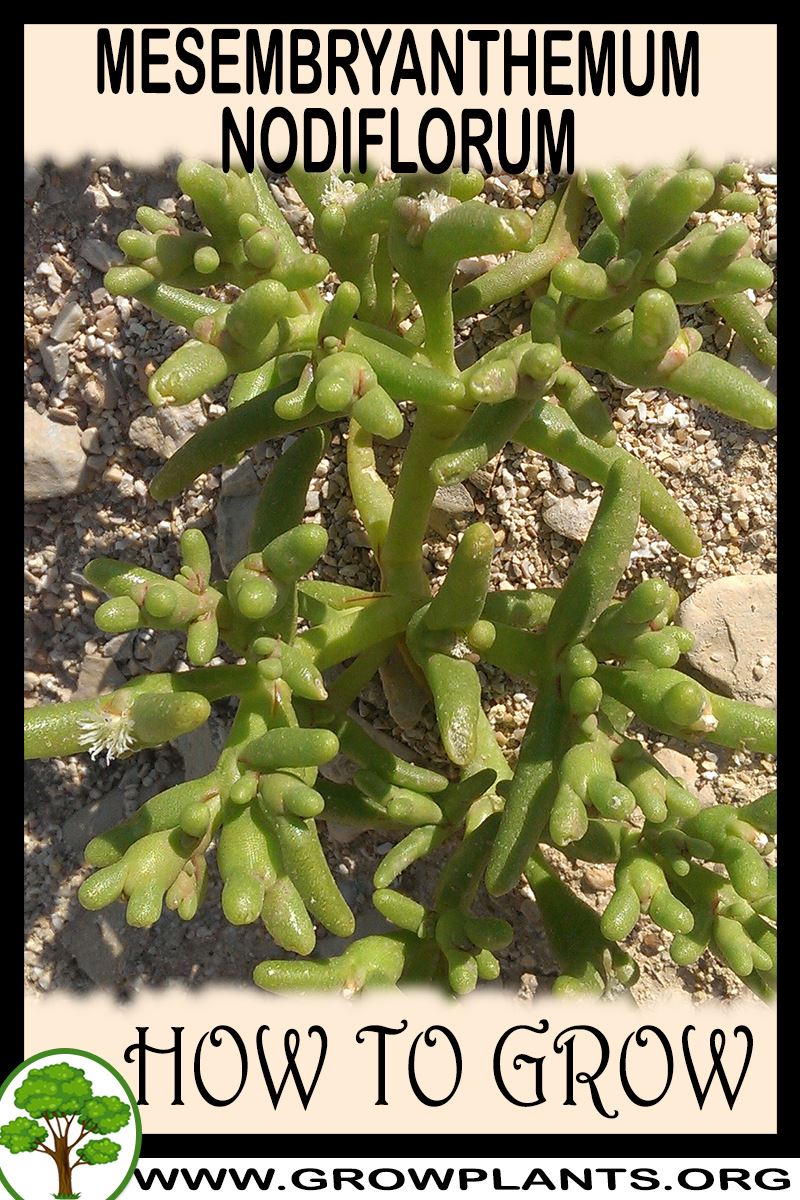
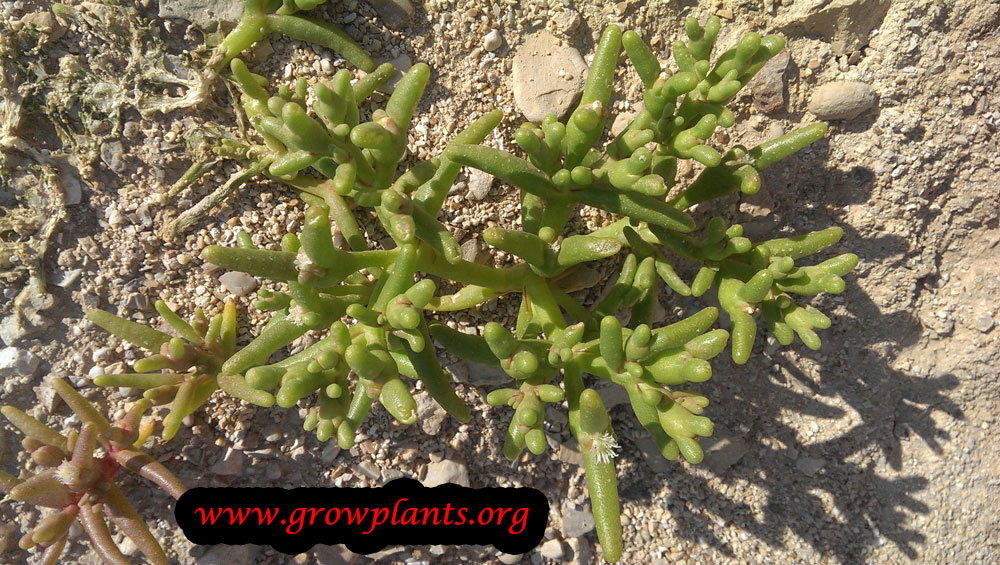
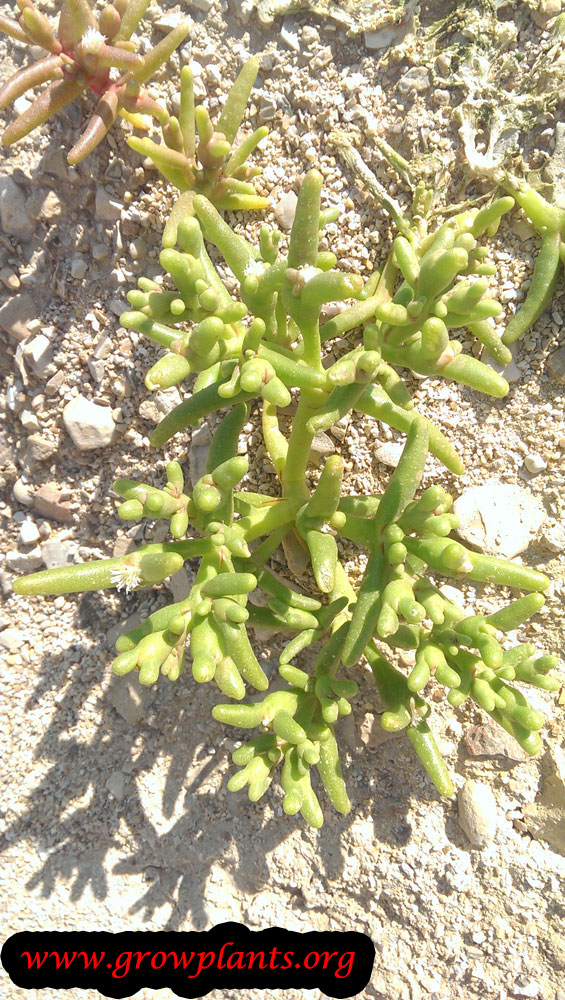
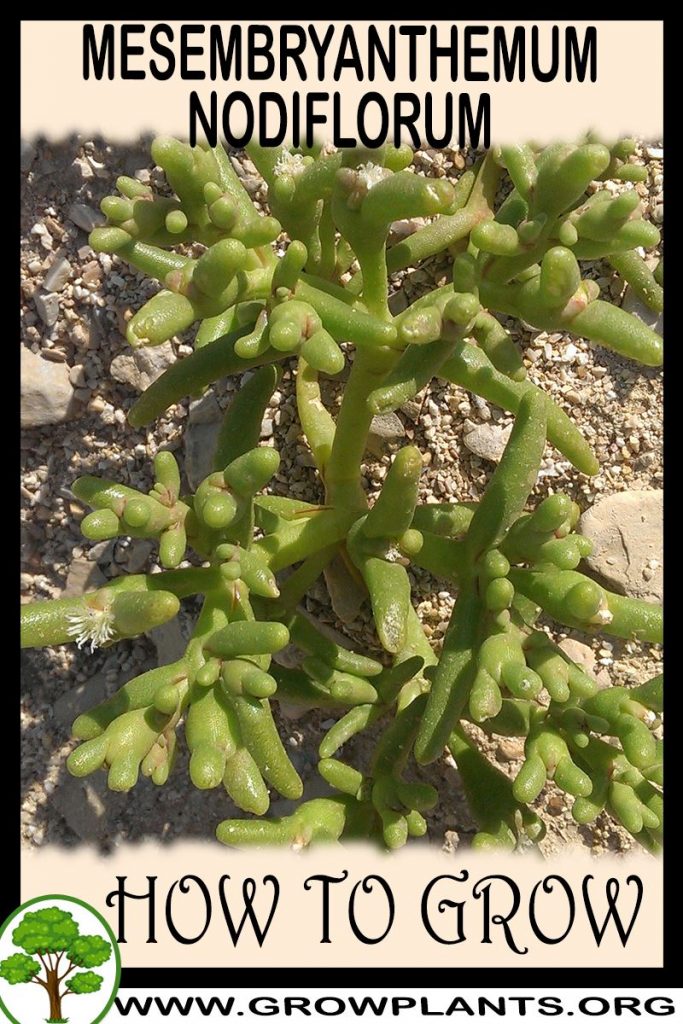
Overview: Mesembryanthemum nodiflorum (slenderleaf iceplant) is a fast-growing succulent subshrub only 10–20 cm (4–8 in) tall, grown as an ornamental groundcover. It is prized for its fleshy foliage and flat, many-petalled, daisy-like flowers.
Quick Specifications
| Specification | Attribute |
|---|---|
| Plant Type / Life Cycle | Annual |
| Foliage Type | Evergreen succulent |
| Mature Size | 10–20 cm (4–8 in) tall, spreading |
| Growth Rate | Fast |
| Root System | Fibrous and shallow (spreading groundcover) |
| Hardiness | USDA zones 2+ |
Growth Form & Structure
- Height & Spread: Low and mat-forming, 10–20 cm (4–8 in) tall and spreading outward; well suited to containers, rockeries, edging and hanging baskets.
- Growth Habit & Form: Creeping succulent subshrub / groundcover with fleshy stems.
- Lifespan & Maturity: Fast to establish and flower within its first season.
Anatomy & Physical Features
- Leaves & Foliage: Fleshy, cone-shaped leaves in green, red or both.
- Flower Characteristics: Small, flat, many-petalled white flowers with a yellow centre, blooming from winter through summer. (See the Bloom accordion for detail.)
Primary Uses & Landscape Value
- Functional & Ornamental Roles: Drought-tolerant ornamental groundcover for hot, dry, sunny sites, rockeries, edging, containers and coastal gardens.
Care Guide: Planting, Soil & Watering
Overview: Fig marigolds (ice plants) are heat-loving succulents that flourish in full sun and hot, dry conditions, forming a fast, sprawling groundcover. They demand light, sharply drained, sandy soil and very little water, storing moisture in their fleshy leaves.
Quick Care Requirements
| Requirement | Ideal Condition |
|---|---|
| Planting Season | Spring in cold climates; autumn, winter or spring in warm climates |
| Growth Rate | Fast |
| Soil Type | Light, sandy, sharply draining |
| Water Need | Low; let the soil dry out between waterings |
Planting & Establishment
- Best Planting Season: Plant in spring in cold climates; in warm climates it can go in during autumn, winter or spring while temperatures are mild.
- How to Plant:
- Hole Preparation: Loosen a hole slightly wider than the root ball in gritty, sandy soil.
- Soil Amendments: Work in coarse sand or grit to guarantee fast drainage; it does not need rich soil and dislikes heavy, water-retentive ground.
- Planting Depth: Set the root ball at soil level and avoid burying the fleshy stem, which can rot if kept wet.
- Growth Speed & Expectations: Fast, spreading groundcover reaching about 10-20 cm tall.
Soil, Watering & Drainage Care
- Soil Mix & Drainage Needs: Needs a free-draining sandy or cactus/succulent mix; poor drainage quickly leads to root rot.
- Watering Schedule & Technique:
- Young / Newly Planted: Water lightly and occasionally until the roots take hold.
- Established: Water sparingly, letting the soil dry fully between waterings; it is drought-tolerant once established.
- Seasonal Adjustments: A little more in peak summer heat, and almost none through winter.
Climate, Light & Hardiness
Mesembryanthemum nodiflorum is a fast-growing, low-mounding annual succulent that thrives in a hot, sunny climate with full sun to light half shade, preferring dry, well-drained, sandy soil. It is very frost-sensitive and is grown almost everywhere as a warm-season annual rather than relying on winter survival.
Quick Climate Specifications
| Climate Zones | Mediterranean, desert, subtropical, temperate, and tropical climates (sunny, dry-summer conditions preferred) |
|---|---|
| USDA Hardiness Zones | Self-sows and grows reliably as an annual from about zone 2 upward; the plant itself is not relied on to survive winter |
| Optimal Temp Range | Approximately 18–29°C (64–84°F) |
| Cold Damage Begins | Approximately 5°C (41°F) |
| Frost Tolerance | Very Low |
| Light Conditions | Full Sun to Half Shade |
| Wind Tolerance | High |
| Salt / Coastal Tolerance | High |
Sunlight & Light Exposure
Optimal Light Setup
Full sun produces the most compact growth, brightest foliage color, and heaviest flowering; light half shade is tolerated but growth becomes looser and flowering lighter.
Direct Sun Requirement
Several hours of direct sun daily are needed for a dense, colorful mat and good flower production; deep shade results in sparse, leggy growth with little bloom.
Shade & Heat Management
Tolerates intense heat and reflected sun from sandy or rocky ground without difficulty; a little afternoon shade in the hottest desert gardens can help prevent leaf scorch but is not essential.
Best Exposure / Orientation
South- or west-facing beds, sunny banks, and rockeries with sharp drainage suit it best.
Temperature Extremes & Hardiness
USDA Hardiness & Regional Limits
As an annual succulent, its outdoor season is set by the first autumn frost rather than by winter survival; it self-sows readily and completes its life cycle well outside any zone where the plant itself could overwinter.
Cold Damage & Winter Protection
Foliage blackens and collapses at the first hard frost; because winter protection outdoors is impractical for this low groundcover, gardeners in cold climates simply replant it as an annual each year.
Frost Sensitivity
Very frost-sensitive - even a light frost typically damages the foliage.
Extreme Heat Tolerance
Excellent; once established it thrives through prolonged summer heat and full desert sun, provided the soil drains sharply.
Wind, Humidity & Microclimate
Humidity Preferences
Prefers dry air and performs best under arid to mediterranean humidity levels.
Dry-Air Tolerance
Very high; a true succulent well adapted to arid atmospheres.
Wind Tolerance
High; its low, mat-forming habit resists wind damage and suits exposed slopes.
Coastal / Salt Tolerance
High; well suited to seaside gardens and salt-spray exposure.
Rainfall & Seasonal Moisture
Adapted to climates with a distinct dry season; prolonged wet, humid weather combined with poor drainage encourages rot rather than benefiting the plant.
Microclimate Recommendations
Best on slopes, banks, or raised beds with fast-draining, sandy soil in full sun; avoid low spots that stay damp after rain.
Growing in Pots, Balconies & Indoors
Mesembryanthemum nodiflorum (Mesembryanthemum nodiflorum) is a low, sun-loving succulent grown for its bright, daisy-like flowers. It is not a houseplant – the grower marks it as unsuitable indoors – but it shines in pots, troughs and window boxes on a sunny balcony or patio, and only a very bright, sunny windowsill will keep it going indoors.
Quick Details
- Container Size: A wide, shallow pot, trough or window box suits its low, spreading habit; good drainage matters more than depth
- Indoor Suitability: Not a houseplant; only a very sunny, direct-sun windowsill will do
- Best Spot: Full sun (it tolerates a little light shade)
- Soil & Drainage: Sandy, gritty, free-draining mix; drainage holes essential
- Watering in Pots: Sparingly – let it dry between waterings; it hates wet feet
Indoors & On the Windowsill
- Houseplant limits: The grower rates it as not suited to growing indoors – it needs strong, direct sun that most rooms cannot provide, and in low light it sprawls and stops flowering.
- Windowsill growing: The one indoor option is a very sunny, south-facing sill with hours of direct sun; even then it performs best outside.
- Cold protection: As a tender, warm-season sun-lover it will not survive frost, so it is grown fresh each season or moved somewhere frost-free and very bright over winter.
On a Balcony or Patio
- Light, heat & wind: Give it the sunniest, warmest spot – a hot, wall-backed balcony is perfect, as it thrives on reflected heat. Shallow pots and troughs dry fast, so check moisture in hot weather, but always let the surface dry before watering again.
- Practicalities: Wide, shallow containers with open drainage suit its carpeting habit; tip out any saucer water after rain.
Choosing the Pot, Soil & Long-Term Care
- Pot & drainage: A shallow, wide pot or trough with strong drainage holes and no standing-water saucer. Terracotta suits it well, breathing and drying quickly.
- Potting mix: A sandy, gritty, free-draining mix; add extra grit or perlite for sharp drainage.
- Feeding: Very little is needed – flowers come freely in lean soil, so an occasional weak feed in the growing season is plenty.
- Fresh each season: Grown as a fast, warm-season plant, it usually just needs fresh, free-draining mix at each planting rather than long-term repotting.
Growing this plant in a greenhouse
A greenhouse can give mesembryanthemum nodiflorum frost protection and cold protection.
Greenhouse at a glance
| Greenhouse suitability | Conditional - depends on your climate |
|---|---|
| Main benefits | frost protection, cold protection |
| Outdoor protection advisable below | about 5°C |
| Maintain greenhouse minimum | around 5°C for active growth |
| Suitable types | unheated greenhouse, polycarbonate greenhouse |
| Heating | Heating is optional - useful mainly for winter growing in cold areas. |
Related greenhouse guides
- Greenhouses: How to Choose the Right Greenhouse
- Polycarbonate Greenhouses: What to Look for Before Buying
- Greenhouse Climate Control: Temperature, Ventilation and Humidity
Fertilizing & Feeding
A very light feeder: a dilute, low-nitrogen feeding through the warm active growing season is plenty, and it is best to withhold fertilizer while the plant is resting.
Quick Fertilizing Specs
| Feeding Level | Light feeder |
|---|---|
| Main Nutrient Priority | A dilute, low-nitrogen feed; succulents need very little |
| Best Feeding Period | During the warm active growing season |
| Organic Options | A little compost or worm castings blended into a gritty, fast-draining mix |
| Reduce/Stop Feeding | Withhold fertilizer through the cool-season rest or overwintering |
| Micronutrients | Rarely needed; correct only a confirmed deficiency |
| Soil pH | Tolerates a wide range; sharp drainage in a gritty mix matters more |
Feeding by Growth Stage
Warm-season active growth
Support steady, firm growth through the warm months without forcing soft, weak stems.
| Nutrient direction | A dilute, low-nitrogen complete fertilizer; the plant stores its own reserves and needs only a gentle boost. |
|---|---|
| Timing | During the warm active growing season. |
| Frequency | A light, dilute feeding while the plant is actively growing is usually enough. |
| Fertilizer types | A dilute, low-nitrogen complete fertilizer, A little compost or worm castings blended into a gritty mix |
| Precautions | Feed sparingly; overfeeding produces soft, floppy, stretched growth and can leave fertilizer salts in the fast-draining mix. |
Cool-season dormancy or rest
Let the plant rest through cool weather or low light without pushing tender growth.
| Nutrient direction | None – withhold fertilizer while the plant is resting. |
|---|---|
| Timing | During cool weather, winter, or a low-light indoor rest. |
| Frequency | No feeding at this stage; resume only when active growth returns. |
| Fertilizer types | No feeding at this stage; do not fertilize until active growth resumes. |
| Precautions | Do not fertilize a resting succulent; feeding now wastes nutrients and risks salt injury to the roots. |
Nutrient Deficiency Signs & Corrections
Older, lower leaves fade to pale green or uniform yellow and new growth slows.
| Possible causes | low available nitrogen in an exhausted potting mix, nitrogen leaching from a fast-draining, gritty medium, long spell without any feeding |
|---|---|
| Appears first on | older, lower leaves |
| What to check | how long since the mix was refreshed or fed, overall vigor and color of new growth, drainage and how quickly the mix flushes through |
| Possible correction | Apply a dilute, low-nitrogen complete fertilizer during active growth and refresh tired mix with a little compost. |
Leaf tips and margins brown or scorch and roots look damaged despite careful watering.
| Possible causes | fertilizer salt buildup in the fast-draining mix, overfeeding or feeding too strong a solution, sparse watering that concentrates salts around the roots |
|---|---|
| Appears first on | leaf tips and margins |
| What to check | recent feeding strength and how often it was applied, any white salt crust on soil or pot, drainage and watering thoroughness |
| Possible correction | Ease off feeding, water the mix thoroughly to flush accumulated salts, then return to lighter, more dilute feeding. |
Newest leaves yellow between the veins while the veins themselves stay green.
| Possible causes | reduced iron uptake in alkaline soil or hard water, waterlogged or poorly drained roots limiting uptake, cold, wet mix slowing root activity |
|---|---|
| Appears first on | youngest leaves at the growing tips |
| What to check | drainage and whether the mix stays wet, irrigation water hardness or alkalinity, root health and soil temperature |
| Possible correction | Improve drainage and correct soil or water alkalinity; if it persists, apply a chelated iron product per its label. |
Pruning, Training & Seasonal Maintenance
Mesembryanthemum nodiflorum, the slenderleaf iceplant, is a fast-growing, low, spreading leaf succulent grown strictly as an annual — it has no perennial form documented, unlike several of its relatives. It completes its life cycle within a single season, so pruning is limited to within-season shearing and trimming for design and containment, plus deadheading, rather than any long-term framework maintenance or renewal. Facts document trimming across the whole growing season, and the plant is simply cleared, or left to self-seed, once it finishes.
Quick Pruning & Maintenance Specs
| Pruning Tolerance | Moderate — tolerates trimming, but is a one-season plant |
| Primary Pruning Window | Ongoing through its single growing season |
| Typical Frequency | Light trims/deadheading every few weeks while active |
| Main Objective | Contain spread, tidy the mat, limit self-seeding of an invasive species |
| Best Tool Type | Bypass secateurs or hand shears; precision snips for deadheading |
| Avoid Heavy Pruning During | Peak summer heat stress; near the end of its natural life cycle when cutting no longer helps |
Pruning by Plant Age & Size
Newly Established
Let seedlings root and spread; no cutting needed while establishing.
Young / Formative
No formal training system for this fast, low-spreading annual; it fills in and branches on its own.
Mature / Established
Shear or trim the mat’s surface and edges to shape and contain it for the remainder of the season, and deadhead spent flowers to keep the display going.
Special Growth to Remove
Deadhead spent white-and-yellow flowers before seed forms to limit self-seeding — the main practical control on a species documented as invasive — and remove any stem fragments that have crept past the intended area rather than composting them nearby.
Container & Small-Space Pruning
Grown outdoors in a planter, not as a houseplant; trim regularly through its one season to keep trailing growth within the pot.
Tools
Bypass secateurs or hand shears for routine mat trims, precision snips for individual spent flowers.
Tool Hygiene & Disease Risk
Risk level: Routine. No specific transmissible disease documented; clean tools are sufficient for this soft-tissued annual.
Cut Placement & Technique
Shear at a consistent height for an even mat, or spot-cut trailing stems to a node; gather and remove trimmings rather than leaving them on soil, where fragments can root.
Post-Pruning Care
Water lightly after trims; skip extra feeding, since this vigorous annual does not need it and excess fertility only encourages more spread. Watch for snails, its documented pest.
Common Pruning Mistakes
- Letting flowers set and drop seed, worsening its documented invasiveness.
- Trying to renewal-prune it like a perennial — it has no persistent framework to cut back to.
- Dropping trimmed fragments on damp soil, where they root and spread.
When NOT to Prune
Avoid heavy cutting during peak summer heat stress, and there is little value in cutting back hard once the plant is naturally finishing its annual life cycle.
Recommended Tools (by task)
- bypass_secateurs — routine shaping and containment trims through its single season.
- precision_snips — deadheading to curb self-seeding.
Propagation Guide
Slenderleaf iceplant (Mesembryanthemum nodiflorum) is a true annual that completes its life cycle in a single season, so seed is essentially the only practical propagation method; it germinates readily and self-sows so freely that the species is considered invasive in some regions. Seed comes reliably true to type for this straight species, and raising it is easy.
Quick Propagation Specs
| Best Propagation Method | Seed |
| Propagation Difficulty | Easy |
| Seed True-to-Type | Yes (true species) |
| Best Propagation Season | Spring in cold climates; autumn, winter or spring in warm climates |
| Seed Germination Time | Often within one to a few weeks |
| Germination Temperature | Warm, roughly 18–24°C (64–75°F) |
| Seed Sowing Depth | Surface-sow, barely covered |
Growing from Seed
Seed Handling & Viability
Seed stores reasonably well cool and dry. This species self-sows so readily that it is regarded as invasive in mild, dry climates, so remove spent seed heads if containment matters.
Sowing Season
Spring in cold climates, or autumn through spring where winters are mild.
Sowing Depth & Orientation
Surface-sow on a well-drained, sandy mix; do not bury the fine seed.
Germination Conditions
Warm, bright and well-drained; keep evenly moist without waterlogging until seedlings appear.
Germination Time
Usually prompt given this fast-growing annual, often within one to a few weeks.
Seedling Care
Grow on in full sun to half shade with sparing watering. Because this species is a true annual with no perennial stems to fall back on, sowing a fresh batch each season (rather than relying on cuttings, which offer little practical benefit here) is the standard approach.
Bloom & Flower Guide
Quick Details
- Bloom Season: Winter, spring and summer
- Time to First Bloom: In its first season – this species is grown as an annual
- Flower Appearance: Small, flat, many-petalled flowers, white with a yellow centre
- Edibility: Ornamental only
Detailed Blooming Overview
Mesembryanthemum nodiflorum, the slenderleaf iceplant, is a low, annual ground cover that scatters small, flat, daisy-like flowers across winter, spring and summer, depending on climate. Each little bloom is white with a yellow centre and opens in full sun, closing when overcast or at night. It grows and flowers quickly, completing its cycle in a single season.
Flower Characteristics
- Small, flat, many-petalled flowers.
- White with a yellow centre.
- Open in bright sun, close in dull weather and at night.
Bloom Care & Thinning
- Encouraging bloom: Full sun and sharp drainage give the best flowering; shade and wet soil hold blooming back.
- Managing the bloom: Leave some flowers to set seed if you want the plant to return the following season.
Bloom Health & Protection
- Aphids often gather on the soft buds and new growth; a strong jet of water or a little insecticidal soap keeps them in check.
- In cool, damp spells gray mould (Botrytis) can spot the open flowers – improving airflow and removing faded blooms helps prevent it.
Fruit & Uses
Despite being a close relative of the common ice plant (Mesembryanthemum crystallinum), this species has only a marginal food record – reference sources list just the seed as a reported edible part, and even that is described as a minor, low-yield use rather than a real food source. Do not assume the leaves are edible the way they are in M. crystallinum; that has not been verified for this species.
Quick Edible Specs
| Edible Parts | Seed only (reported, minor) |
|---|---|
| Main Use(s) | Other/minor traditional – seed use, not a leaf vegetable |
| Eaten Raw or Cooked | Not documented in detail |
| Preparation Required | Seed would need separating from the tiny capsules – impractical in any quantity |
| Harvest Season | After flowering, once seed capsules mature (see Blooming for bloom timing) |
| Time to First Harvest | Not documented with any precision |
| Storage | Not documented |
| Safety/Toxicity Caveat | Only the seed is reported as edible; leaf and other-part edibility for this specific species is unverified, so do not eat the leaves on the assumption that they behave like the related, well-documented M. crystallinum |
Seeds, Pods & Nuts
The seed is the only part of this species with any reported edible use, and reference sources describe it as low-value: the seeds are tiny and impractical to collect in any real quantity, making this a curiosity rather than a usable food source.
Preparation, Uses & Safety
Treat this species as essentially a non-food plant for garden purposes. Its one reported edible part – seed – is too small and low-yielding to be practical, and its leaves, unlike those of its relative M. crystallinum (a genuinely used leaf vegetable), do not have a verified edible record. If you want a leafy, edible ice plant, grow the confirmed species rather than relying on this one.
Pests, Diseases & Troubleshooting
Overview: Slender-leaved ice plant (Mesembryanthemum nodiflorum) is a fleshy-leaved ice plant (Aizoaceae) and, like most succulents, is essentially free of serious insect pests – its overwhelming vulnerability is rot from wet soil and overwatering. Aphids, mealybugs and slugs are the only regular nuisances. Manage it as a sun-loving succulent: sharp drainage, minimal water and plenty of light. A small annual halophyte ice plant; expect the standard succulent rot-and-slug profile with very few insects.
Quick Troubleshooting Overview
| Issue / Pest | Main Symptom | Primary Solution |
|---|---|---|
| Overwatering / rot | Soft, blackening, collapsing stems | Gritty soil, full sun, water sparingly |
| Slugs / snails | Chewed fleshy leaves, slime | Hand-pick, grit/copper, iron-phosphate |
| Aphids / mealybugs | Colonies & honeydew on new growth | Soap spray, evening oil, beneficials |
| Etiolation | Pale, stretched, few flowers | Give maximum direct sun |
| Frost | Mushy blackened growth | Grow as annual / protect from frost |
Common Pests & Management
- Aphids (Aphis / Myzus spp.):
- Symptoms: Small green or black colonies clustered on flower buds, stems and soft new growth, with sticky honeydew and some distortion.
- Prevention & Control: Rinse off with a gentle water spray; encourage lady beetles and hoverflies; insecticidal soap for persistent colonies – use oils sparingly and in the cool of evening on succulent foliage.
- Mealybugs (Pseudococcus / Rhizoecus spp.):
- Symptoms: White cottony tufts in leaf axils and among the crown, and root mealybugs as a white powder on the roots of pot plants; sticky honeydew and stunted, off-colour growth.
- Prevention & Control: Wash foliar colonies off with a soap spray or dab with alcohol on a cotton bud; for root mealybug, drench or repot into fresh gritty mix and clean the roots; release mealybug destroyer beetles under glass.
- Slugs & Snails (Deroceras / Helix spp.):
- Symptoms: Ragged holes, chewed fleshy leaves and slime trails, worst in damp weather and on young or ground-hugging growth (snails are the source’s main note).
- Prevention & Control: Hand-pick after dark; ring plants with grit or copper; keep the surface dry and mulch-free at the crown; use iron-phosphate baits, which are safe around pets and wildlife, in wet spells.
- Scale Insects (Coccus / Diaspididae):
- Symptoms: Brown or grey bumps on stems and fleshy leaves with honeydew and sooty mould.
- Prevention & Control: Scrape off light infestations; encourage parasitic wasps; a light horticultural oil spray applied in the evening for heavier loads.
- Spider Mites (Tetranychus spp.):
- Symptoms: Fine stippling, dulling and light webbing on plants kept hot, dry and airless, especially under glass.
- Prevention & Control: Increase airflow and hose down; avoid dusty, stagnant conditions; a soap or oil spray if they build up.
Diseases & Fungal Issues
- Root, Crown & Stem Rot (Pythium / Phytophthora / Fusarium spp.):
- Symptoms: Soft, blackening, collapsing stems at the base, mushy roots and sudden death – by far the main killer of these succulents, caused by wet, poorly drained soil or overwatering.
- Treatment & Management: Grow in sharply drained, gritty soil in full sun; water sparingly and let the soil dry between waterings; never let plants sit wet, especially in cool weather; remove and destroy rotted plants and take cuttings from healthy tips to restart.
- Grey Mould (Botrytis cinerea):
- Symptoms: Fuzzy grey mould on flowers and soft growth in cool, damp, still conditions.
- Treatment & Management: Improve airflow, remove faded flowers and dead leaves, and avoid overhead watering; keep foliage dry.
- Fungal Leaf Spot:
- Symptoms: Dark spots or blotches on the fleshy leaves in prolonged humidity.
- Treatment & Management: Increase airflow and light and reduce leaf wetness; remove affected leaves; rarely needs a fungicide if watering is corrected.
Growing Difficulties & Abiotic Problems
- Overwatering & Wet-Soil Rot:
- Cause & Symptoms: The commonest cause of failure – soft, translucent, collapsing growth from too much water or heavy, cold, wet soil.
- Correction Strategy: Treat as a true succulent: gritty free-draining soil, full sun, minimal water, and a dry rest in cool weather; err firmly on the dry side.
- Etiolation / Stretching in Low Light:
- Cause & Symptoms: Pale, stretched, floppy growth and few flowers in shade or indoors, with the fleshy leaves losing colour.
- Correction Strategy: Give the maximum possible sun – these plants flower and stay compact only in bright, direct light; move indoor plants to the sunniest spot.
- Frost Damage:
- Cause & Symptoms: Fleshy foliage turns mushy and blackens after frost; most species are tender annuals or half-hardy.
- Correction Strategy: Grow as summer annuals in cold climates or protect from frost; many self-sow to return the next season.
- Self-Seeding / Spread:
- Cause & Symptoms: Free self-seeding and spreading mats can colonise ground and crowd out neighbours (the source flags them as invasive).
- Correction Strategy: Remove spent flower heads before seed sheds where spread is unwanted, and pull stray seedlings while young.
What Helps – Products & Tools
These succulents need very little: insecticidal soap for aphids and mealybugs, a light horticultural oil (applied in the evening) for scale and mite, iron-phosphate slug bait, and – most importantly – cultural care: gritty free-draining soil, full sun and a sparing hand with water to prevent the rots that are the real danger.