
Plant Profile & Key Characteristics
Overview: A small stemless succulent forming a compact rosette just 5-10 cm (2-4 in) across, grown as an evergreen ornamental and easy houseplant. This slow-growing perennial thrives in bright indirect light indoors or in frost-free gardens.
Quick Specifications
| Specification | Attribute |
|---|---|
| Plant Type / Life Cycle | Perennial |
| Foliage Type | Evergreen |
| Mature Size | 5-10 cm tall (2-4 in), forming a rosette |
| Growth Rate | Slow |
| Root System | Fibrous, shallow |
| Toxicity | Non-toxic to people and pets |
| Hardiness | USDA zone 10b+ |
Growth Form & Structure
- Height & Spread: Compact ground-level rosette 5-10 cm (2-4 in) across; in a container use a pot about 30% larger than the root ball and step up every few years.
- Growth Habit & Form: Low, clump-forming succulent with leaves in a tight rosette, offsetting into clusters via pups (daughter plants).
- Lifespan & Maturity: Long-lived perennial; slow to establish while young, then persists for many years.
Anatomy & Physical Features
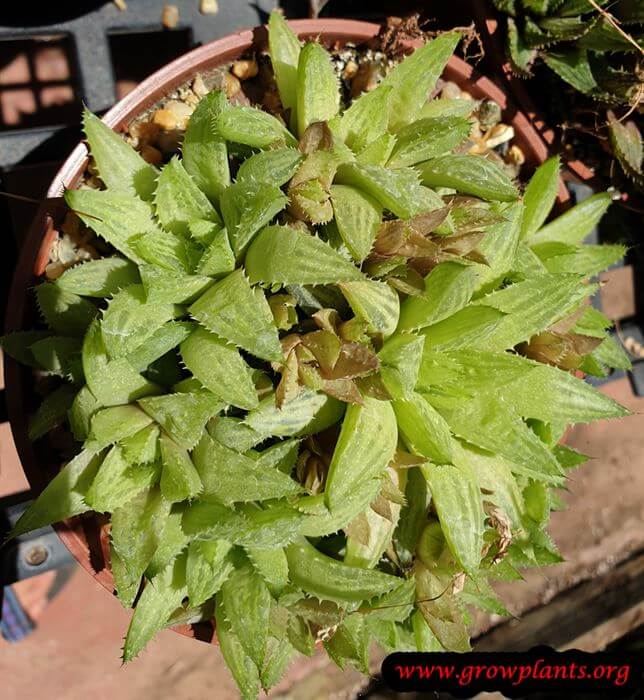
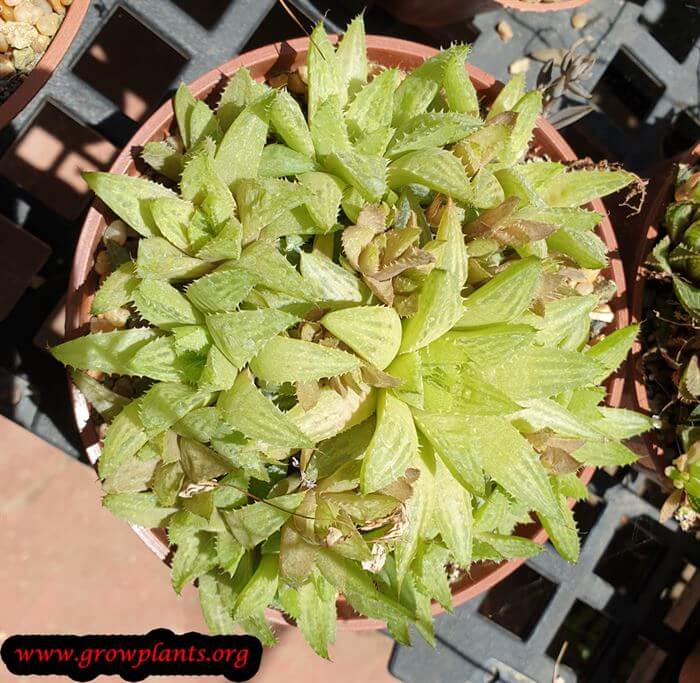
- Leaves & Foliage: Fleshy translucent leaves, green and flushing purple or red, arranged in a rounded rosette.
- Flower Characteristics: Small white flowers borne on a slender stem.
Primary Uses & Landscape Value
- Functional & Ornamental Roles: Ornamental succulent for windowsills, dish gardens and containers; well suited to indoor culture as a houseplant.
Note: Prone to sudden rot if overwatered or if water is allowed to sit in the leaf rosette — water at the soil line and let it dry between waterings.
Care Guide: Planting, Soil & Watering
Overview: Haworthia maculata is a slow-growing rosette succulent that thrives in bright but indirect light, sheltered from harsh direct sun. It needs sharply draining, sandy or gritty soil and only sparing moisture, resenting any water that lingers around its roots.
Quick Care Requirements
| Requirement | Ideal Condition |
|---|---|
| Planting Season | Year-round in frost-free zones (11+); spring to summer in zone 10a, spring to autumn in zone 10b |
| Growth Rate | Slow |
| Soil Type | Sandy, gritty, sharply draining |
| Water Need | Low – let the soil dry out fully between waterings |
Planting & Establishment
- Best Planting Season: Best planted in the warm season — year-round in frost-free zones (11+), spring to summer in zone 10a and spring to autumn in zone 10b. Avoid planting when frost threatens, as it is damaged below about 3°C (37°F).
- How to Plant:
- Hole Preparation: Set into a hole just larger than the root system, on ground that drains freely; in rainy areas plant on a raised bed or mound so the base never sits in a puddle.
- Soil Amendments: Work in plenty of coarse sand, grit or lava rock to open up the mix; only a little organic matter is needed, and heavy, water-retentive soil should be lightened.
- Planting Depth: Set the rosette so its base sits at soil level, keeping the neck and lower leaves above the surface to prevent rot; do not bury the crown.
- Growth Speed & Expectations: Slow-growing, especially while young, taking a while to establish before it settles into steady growth; a small plant, only about 5-10 cm (2-4 in).
Soil, Watering & Drainage Care
- Soil Mix & Drainage Needs: Grow in a gritty, free-draining mix — for pots, sandy soil with perlite, peat and a base layer of lava grit works well. Excellent drainage is essential, as standing moisture quickly causes fatal rot.
- Watering Schedule & Technique:
- Young / Newly Planted: After planting, water lightly and let the plant settle; keep the soil barely moist rather than wet while roots establish.
- Established: Water only when the leaves begin to soften, then let the soil dry out completely before watering again — overwatering is the main killer of this plant.
- Seasonal Adjustments: Cut watering back sharply in winter and in cool, damp spells; shelter it from heavy rain, and indoors give even less water and check the pot is not staying wet.
Climate, Light & Hardiness
Haworthia maculata is a shade-loving succulent for subtropical, Mediterranean, and tropical climates, or as a houseplant, preferring half shade to full shade with adequate light rather than harsh direct sun. It has essentially no frost tolerance and is happiest kept reliably above about 3°C (37°F).
Quick Climate Specifications
| Climate Zones | Subtropics, Mediterranean, and tropics, or indoors as a houseplant |
|---|---|
| USDA Hardiness Zones | 10b+ (zone 10a workable with adjusted, later spring planting) |
| Approx. Survival Minimum | Best kept frost-free; ideally maintained above roughly 3°C (37°F) |
| Frost Tolerance | Very Low |
| Light Conditions | Half shade to full shade (with adequate ambient light) |
Sunlight & Light Exposure
Optimal Light Setup
Provide bright, indirect light or half shade; the leaves are translucent-windowed and prone to scorching in harsh, intense direct sun.
Shade & Heat Management
Does well in half to full shade as long as some light reaches it; avoid unfiltered midday sun, especially in hot climates.
Best Exposure/Orientation
A bright but shaded outdoor spot, or a well-lit indoor window without intense direct exposure, both work well; keep away from heaters when grown indoors.
Temperature Extremes & Hardiness
USDA Hardiness & Regional Limits
Hardy to roughly USDA zone 10b+; in the cooler part of zone 10a it can still be grown, but planting is best timed for spring through summer rather than year-round.
Cold Damage & Winter Protection
Best kept frost-free, and growers note it does noticeably better maintained above about 3°C (37°F). Cold combined with wet soil is a common cause of sudden rot, which can be hard to catch before damage shows.
Frost Sensitivity
Very low frost tolerance - avoid any exposure to freezing conditions.
Extreme Heat Tolerance
Tolerates warm subtropical, Mediterranean, and tropical heat well when given adequate shade and sharp drainage.
Wind, Humidity & Microclimate
Rainfall & Seasonal Moisture
Dislikes sitting in wet soil; in rainy locations it should be grown above ground level (raised beds) or in a gritty, fast-draining mix such as lava grit and sandy soil. In tropical climates it needs a sheltered, drier microclimate away from heavy rains.
Microclimate Recommendations
Use raised beds or gritty container mixes in wet climates, and keep indoor plants away from heaters and in a consistently lit but not intensely sunny spot.
Growing in Pots, Balconies & Indoors
Haworthia maculata is a small, slow-growing succulent rosette (about 5-10 cm / 2-4 in) and an excellent, forgiving houseplant. It actually prefers half to full shade with light rather than fierce sun, so a bright indoor spot or a windowsill out of the harshest midday sun suits it perfectly.
Quick Details
- Container Size: At least ~30% larger than the root ball – not much more; step up to a bigger pot every few years rather than starting oversized
- Indoor Suitability: A first-rate houseplant – keep it in good light and away from heaters
- Best Spot: Half shade to full shade with light; avoid scorching direct midday sun
- Soil & Drainage: Free-draining – sandy soil with a little organic matter, lava grit at the base and sandy mix on top, or perlite with peat; make sure there are plenty of drainage holes
- Watering in Pots: Small amounts – let it dry between waterings; indoors water even less and check the pot is not staying wet
Indoors & On the Windowsill
- Houseplant use: The grower recommends it indoors: keep it in a spot with good light but not right next to a heater, water less than you would outdoors, and always check the pot is not staying too wet.
- Windowsill growing: Its tiny size suits any sill; an east or north window with bright, indirect light is ideal since it dislikes harsh midday sun.
- Overwintering: Tender to frost – it is naturally a good indoor plant, so simply keep it warm, bright and on the dry side through winter.
On a Balcony or Patio
- Light & wind: On a balcony or patio give it a bright but part-shaded position; it can rot suddenly if kept too wet, so shelter it from heavy rain – in wet or tropical spots keep it under cover or in gritty, inert media so water drains straight through.
- Practicalities: The pot is small and light and easy to move under cover when rain threatens.
Choosing the Pot, Soil & Long-Term Care
- Pot & drainage: Choose a pot about 30% bigger than the root ball with plenty of holes – oversized pots are not useful and stay wet. Terracotta breathes and dries fast, which suits it well; skip a standing-water saucer.
- Potting mix: As the grower advises – sandy soil with a little organic matter, coarse lava grit at the bottom and sandy mix on top, or perlite blended with peat. Wetter climates need sharper drainage.
- Feeding: Feed only lightly during growth; these slow succulents need little.
- Repotting: Rather than starting in a big pot, move up to the next size every few years as the mix loses viability; with sharp drainage or sandy soil you can go 5 years or more between changes.
Fertilizing & Feeding
A very light feeder: this small rosette succulent needs only minimal feeding during active growth and none while resting or when stressed by wet conditions.
Quick Fertilizing Specs
| Feeding Level | Light feeder |
|---|---|
| Main Nutrient Priority | Low-nitrogen, minimal feeding – this rosette succulent grows slowly and has little use for a rich feeding routine |
| Best Feeding Period | During clear active growth in the warmer part of the year |
| Organic Options | A gritty, sandy mix with good drainage matters more than added organic matter |
| Micronutrients | Rarely an issue; a single light feeding during active growth is usually enough to cover the plant’s needs |
| Soil pH | Well-drained, gritty soil matters more than a specific pH target; tolerates a wide range |
| Reduce/Stop Feeding | Stop feeding once growth slows, and never feed a plant that’s showing soft or rotting tissue |
Feeding by Growth Stage
Active rosette growth
Support slow, steady rosette development without pushing soft growth that invites rot.
| Nutrient direction | A single light, well-diluted balanced feed is usually all this slow grower needs through its active period. |
|---|---|
| Timing | During the clearest stretch of active growth in the warmer months. |
| Frequency | Minimal – a light feeding is enough; this plant rarely benefits from a regular feeding routine. |
| Fertilizer types | A cactus/succulent-formulated fertilizer diluted well below normal garden strength |
| Precautions | This plant is prone to sudden rot, so never feed on top of wet or waterlogged soil; let the mix dry appropriately first. |
Cool-season rest
Let the rosette rest undisturbed rather than pushing feeding it can’t use.
| Nutrient direction | None – withhold fertilizer while growth is at a standstill. |
|---|---|
| Timing | Through the cooler, slower part of the year. |
| Frequency | No feeding at this stage. |
| Fertilizer types | No feeding at this stage – let the plant coast on stored reserves |
| Precautions | Do not fertilize a resting plant, and especially not one showing any sign of soft or rotting tissue. |
Nutrient Deficiency Signs & Corrections
New growth on the rosette comes in pale, washed-out green rather than a healthy deep green, and overall growth stays noticeably slow.
| Possible causes | little to no nitrogen reaching the roots over a long stretch without feeding, a gritty, low-organic mix that holds almost no nutrient reserve, roots that are compromised by overwatering and can’t take up what nutrients are present |
|---|---|
| Appears first on | newest growth |
| What to check | how long it has been since any feeding, root health and soil moisture, overall vigor compared with the plant’s normal slow pace |
| Possible correction | Work a light, diluted balanced feed into the active growing season rather than skipping feeding indefinitely; correct any overwatering issue first. |
Stem or leaf tips turn brown or corky, and the base of the plant can look stressed or soft even though watering seems appropriate.
| Possible causes | mineral salts accumulating from repeated feeding without adequate flushing, feeding at a stronger dose than this slow-growing succulent can use, a container without enough drainage to let excess salts wash out |
|---|---|
| Appears first on | stem or leaf tips and the base near the soil line |
| What to check | recent feeding strength and frequency, drainage of the pot and soil mix, any crusty residue on the soil surface |
| Possible correction | Flush the soil with plain water to carry off excess salts, cut back feeding strength, and confirm the mix and container drain freely. |
Older, lower growth shows yellowing between the veins or in blotchy patches while the newest growth still looks normal.
| Possible causes | low magnesium in the soil or potting mix, an imbalanced feeding history that leans heavily on other nutrients, leaching from a very free-draining, mineral-heavy mix |
|---|---|
| Appears first on | older, lower stems or leaves |
| What to check | age and pattern of the affected growth, recent feeding history and mix composition, whether new growth is unaffected |
| Possible correction | Apply a labeled magnesium source such as Epsom salt sparingly and rebalance the general feeding routine. |
Pruning, Training & Seasonal Maintenance
Haworthia maculata is a small, slow-growing rosette succulent that needs no structural pruning at all – there is no stem or branch framework to shape. What passes for ‘pruning’ here is purely cosmetic: removing dead leaves and cutting the spent bloom stem after flowering finishes, done any time of year as needed. Neither task affects the plant’s health or its ability to flower again.
Quick Pruning & Maintenance Specs
| Pruning Tolerance | Low (cosmetic only) |
| Primary Pruning Window | As needed, year-round (reactive) |
| Typical Frequency | Occasional – dead leaves and, after bloom, the flower stalk |
| Main Objective | Tidiness: remove dead leaves and spent bloom stems |
| Young Plant Priority | Leave undisturbed while the rosette slowly establishes |
| Mature Plant Priority | Remove dead outer leaves and spent bloom stalks for appearance |
| Best Tool Type | Precision snips |
Pruning by Plant Age & Size
Newly Established
Avoid cutting; young plants are notably slow to establish, so leave them undisturbed beyond removing anything that arrived already dead.
Young / Formative
No structural training applies – a single rosette has nothing to train. Any offsets (pups) that form at the base are left to develop naturally.
Mature / Established
As the rosette ages, older outer leaves may die back and can be trimmed for tidiness; after each bloom, the spent flower stalk can be cut at its base.
Special Growth to Remove
Dead or shriveled outer leaves, and the spent flower stalk once blooming has finished. Offset pups clustering around the base are the plant’s normal means of spreading, not unwanted growth – leave them unless you intend to separate and pot them up as a propagation step, which is distinct from pruning.
Container & Small-Space Pruning
Almost always grown in a small pot. Repot only when the container is clearly outgrown – an oversized pot holds excess moisture around the roots and raises this species’ well-documented rot risk, so err toward a snug container rather than sizing up for future growth.
Tools
Precision snips only – cuts here are limited to single leaves and a slender bloom stalk, never anything thicker.
Tool Hygiene & Disease Risk
Increased – this species is noted to rot suddenly and with little warning, so use a clean, sharp blade for every cut to avoid introducing rot pathogens into the rosette.
Cut Placement & Technique
Snip a dead leaf cleanly at its point of attachment rather than pulling it, which can tear healthy tissue and open an entry point for rot; cut the spent bloom stalk close to its base without nicking neighboring leaves.
Heavy Pruning & Rejuvenation
Not applicable – there is no framework to rejuvenate; a single rosette is either healthy or it isn’t, and hard cutting has no role here.
Post-Pruning Care
Let any cut dry briefly before watering resumes near it, given the plant’s tendency to rot.
Common Pruning Mistakes
- Pulling dead leaves off instead of snipping them, tearing healthy tissue
- Cutting with a dirty blade on a species prone to sudden rot
- Watering heavily right after trimming
When NOT to Prune
Avoid unnecessary cutting during prolonged wet or humid conditions, when this rot-prone species is at greatest risk.
Recommended Tools (by task)
- Removing dead leaves and the spent bloom stalk – precision_snips: the only cuts this plant ever needs are small and precise.
- Protecting against sudden rot on every cut – blade_disinfectant: this species is specifically noted to rot suddenly, so a clean edge matters more than usual.
Propagation Guide
Haworthia maculata is easiest to increase by separating the offsets (pups) it forms around the base of mature rosettes, since these are already rooted or root quickly and are fully true-to-type; the site’s own detailed method of rooting leaf or stem cuttings is a reliable slower alternative, especially when few offsets are available. Propagation is easy, though this species is prone to sudden, hard-to-catch rot, so a cautious, well-drained approach matters more here than for many succulents.
Quick Propagation Specs
| Best Propagation Method | Offsets (pups) |
| Alternative Methods | Leaf cuttings; Stem cuttings; Seed |
| Propagation Difficulty | Easy |
| Seed True-to-Type | Variable (cultivated Haworthias cross-pollinate readily) |
| Vegetative True-to-Type | Yes |
| Best Propagation Season | All year in hardiness zone 10a spring to summer, in zone 10b spring to autumn |
Growing from Seed
Seed is listed by the site as one possible starting method, but Haworthia species cross-pollinate readily in cultivation, so seed collected from a garden-grown plant may not reproduce the parent’s exact leaf markings; offsets or cuttings are the more reliable way to keep this species’ appearance true. Where seed is used, sow it on a well-drained, gritty mix and keep it warm and only lightly moist, as for most Haworthia species.
Stem Cuttings
Cutting Type
A stem cutting, or a leaf cut at its base – the site notes a leaf cut right at the base roots better than a mid-leaf cut, and stems can also be used.
Cutting Preparation
After cutting, let the leaf or stem sit a few days in a shaded spot to dry slightly before inserting it into soil; this callusing step is specified directly in the site’s own instructions.
Rooting Setup
Insert into soil and water only enough to keep it lightly moist – the site is explicit that overwatering must be avoided, since this species can rot suddenly and the rot is hard to catch early.
Rooting Hormone
Optional; not required by the site’s method.
Leaf & Root Cuttings
Leaf cuttings root from a leaf cut at the base of the rosette (preferred by the site) or, less reliably, from a mid-leaf section. As with the stem method, let the cut leaf dry a few days in shade before potting, then keep the soil only lightly moist. This is a plain (non-variegated) species in the site’s own description, so there is no variegation-loss concern with leaf propagation here.
Division, Offsets, Pups & Suckers
The site lists pups (daughter plants) alongside cuttings as a way to start this species, though it does not detail the technique. In practice, offsets forming at the base of the rosette can be gently separated once they have their own roots (or are large enough to root quickly on their own) and potted individually in the same free-draining mix as the parent – this is generally the fastest, most reliable, and truest-to-type way to increase Haworthia maculata.
Bloom & Flower Guide
Quick Details
- Bloom Season: Can flower at any time of year
- Flower Appearance: Small white tubular flowers carried on a slender stem well above the rosette
- Edibility: Ornamental only; the flowers are not eaten. The plant is non-toxic and pet-safe.
Detailed Blooming Overview
Haworthia maculata sends up a thin flower stalk from the centre of its rosette, carrying a loose spray of modest white blooms. The flowers are subtle compared with the patterned, semi-transparent leaves, but a healthy plant can throw a stalk at almost any time of year.
Flower Characteristics
- Small, tubular white flowers.
- Held on a slim stem that rises above the foliage.
Bloom Care & Thinning
- Managing the bloom: The flowers take some energy for little display, so many growers cut the stalk once it appears to keep the plant’s strength in the leaves; leave it if you want to enjoy the blooms or collect seed.
- Pollination: Insect-pollinated outdoors; hand pollination is possible if you want seed.
Pests, Diseases & Troubleshooting
Overview: Haworthias are tough, slow-growing rosette succulents with remarkably few insect enemies; the overwhelming majority of losses come not from pests but from overwatering and poor drainage. Management is almost entirely cultural – a gritty, fast-draining mix, restrained watering, bright indirect light and good airflow keep these plants trouble-free. H. maculata has translucent windowed leaf faces.
Quick Troubleshooting Overview
| Issue / Pest | Main Symptom | Primary Solution |
|---|---|---|
| Root & foliar mealybug | White cottony fluff in leaf axils or on roots; stunting | Isolate, physically remove, 70% alcohol spot-treat, repot into fresh gritty mix |
| Scale | Small brown/tan limpet-like bumps on leaves | Scrape off, dab with alcohol, horticultural oil if widespread |
| Fungus gnats | Tiny black flies over soil; larvae in constantly wet mix | Let mix dry, yellow sticky traps, reduce watering |
| Basal / soft rot | Translucent, mushy, browning base; collapse | Remove rotted tissue, dry out, root healthy offsets; correct watering |
| Etiolation & scorch | Stretched pale growth OR bleached/scorched red-brown leaves | Increase light gradually / shade from harsh midday sun |
Common Pests & Management
- Root mealybug (Rhizoecus spp.):
- Symptoms: Colonies of white, waxy insects hidden on roots and at the soil line, discovered only when repotting; plants stall, lose vigour and refuse to grow despite correct care. A white, mould-like waxy deposit coats the root ball.
- Prevention & Control: Inspect roots at every repot. Bare-root affected plants, wash the roots, cut away infested feeder roots, and repot into fresh gritty mix in a clean pot. Drench the fresh mix or dip roots in horticultural oil / insecticidal soap solution; quarantine until re-established.
- Mealybug (Pseudococcus / Planococcus spp.):
- Symptoms: Cottony white tufts wedged deep in the tight leaf axils and rosette centre, often with sticky honeydew and sooty mould. Look-alike: the plant’s own natural farina or leaf waxing – mealybug fluff moves and clumps.
- Prevention & Control: Dab each insect with a cotton bud dipped in 70% isopropyl alcohol. For heavier infestations, spray insecticidal soap or horticultural oil into the axils, repeating weekly for 3 cycles to catch hatchlings. Keep new plants quarantined.
- Scale (Diaspididae & soft brown scale (Coccus hesperidum)):
- Symptoms: Immobile brown, tan or grey bumps stuck flat to leaf surfaces; soft scale exudes honeydew. Leaves may yellow beneath heavy colonies.
- Prevention & Control: Scrape off with a fingernail or soft brush and wipe with alcohol. Follow with horticultural oil to smother crawlers; inspect the undersides and leaf bases where they hide.
- Fungus gnats (Bradysia spp.):
- Symptoms: Small dark flies running or fluttering over the soil surface; translucent larvae in chronically wet mix can nibble fine roots of seedlings and offsets.
- Prevention & Control: The cure is cultural – let the mix dry thoroughly between waterings and top-dress with grit. Yellow sticky traps catch adults; a Bti (Bacillus thuringiensis israelensis) drench targets larvae if needed.
- Aphids (Aphididae (esp. on flower stalks)):
- Symptoms: Small green or grey soft-bodied insects clustered on the emerging flower spike, causing distortion and honeydew. Rarely a threat to the leaves themselves.
- Prevention & Control: Usually cosmetic – rinse off with water or pinch out the affected spike. Insecticidal soap resolves persistent clusters.
Diseases & Fungal Issues
- Basal & soft rot (Fusarium / Pythium / Erwinia spp.):
- Symptoms: The plant base turns soft, translucent and brown-black, often with a foul smell; leaves detach easily and the rosette collapses from the centre or bottom. This follows overwatering, water sitting in the crown, or a cold, wet pot.
- Treatment & Management: There is no cure for rotted tissue – cut well above the damage into clean, firm flesh, dust with sulfur or cinnamon, let it callus, and re-root the healthy top or offsets in dry gritty mix. Prevent by watering the soil (never the rosette), using terracotta/gritty mix, and never leaving the plant wet and cold.
- Leaf spot / anthracnose (fungal (minor)):
- Symptoms: Occasional sunken brown or black spots on leaves in stagnant, humid, crowded conditions.
- Treatment & Management: Improve airflow, avoid overhead watering, remove affected leaves. Rarely warrants fungicide; a copper product is sufficient if it spreads.
Growing Difficulties & Abiotic Problems
- Overwatering rot (the #1 killer):
- Cause & Symptoms: Roots suffocate and rot in soggy mix; lower leaves go soft, yellow-translucent and mushy. By far the most common cause of Haworthia death.
- Correction Strategy: Use a fast-draining, mostly-mineral mix (added pumice/perlite/grit), pots with drainage, and water only when the mix is fully dry. Water less in cool/low-light periods.
- Etiolation (stretching):
- Cause & Symptoms: Insufficient light causes pale, elongated, loosely-spaced growth and a flattened, reaching rosette.
- Correction Strategy: Move to bright indirect light (an east/south window or gentle grow light). Increase light gradually to avoid scorch; the stretched growth won’t reverse but new growth tightens up.
- Sun scorch:
- Cause & Symptoms: Sudden intense direct sun bleaches leaves white or turns them red-brown with dry patches.
- Correction Strategy: Acclimatise slowly to brighter light and shade from harsh midday sun. Light reddening/’stress colour’ is harmless; dry scorched patches are permanent.
- Mineral / salt build-up & corking:
- Cause & Symptoms: White crust on soil or pot, brown corky scars on older leaves from hard water, fertiliser salts or handling.
- Correction Strategy: Flush the mix occasionally with clean water, fertilise sparingly (dilute, in growth periods only), and use rain/filtered water where salts are high.
What Helps – Products & Tools
This is a plant to manage with your hands and your watering can more than sprays: 70% isopropyl alcohol on a cotton bud for mealybug and scale, insecticidal soap or light horticultural/neem oil for wider infestations, yellow sticky traps and a Bti drench for fungus gnats, and sulfur or cinnamon as a cut-surface dressing against rot. A gritty mineral mix and terracotta pots are your best ‘products’ of all.