

Plant Profile & Key Characteristics
Overview: A small stemless succulent forming a compact rosette just 5-10 cm (2-4 in) across, grown as an evergreen ornamental and easy houseplant. This slow-growing perennial thrives in bright indirect light indoors or in frost-free gardens.
Quick Specifications
| Specification | Attribute |
|---|---|
| Plant Type / Life Cycle | Perennial |
| Foliage Type | Evergreen |
| Mature Size | 5-10 cm tall (2-4 in), forming a rosette |
| Growth Rate | Slow |
| Root System | Fibrous, shallow |
| Toxicity | Non-toxic to people and pets |
| Hardiness | USDA zone 10b+ |
Growth Form & Structure
- Height & Spread: Compact ground-level rosette 5-10 cm (2-4 in) across; in a container use a pot about 30% larger than the root ball and step up every few years.
- Growth Habit & Form: Low, clump-forming succulent with leaves in a tight rosette, offsetting into clusters via pups (daughter plants).
- Lifespan & Maturity: Long-lived perennial; slow to establish while young, then persists for many years.
Anatomy & Physical Features
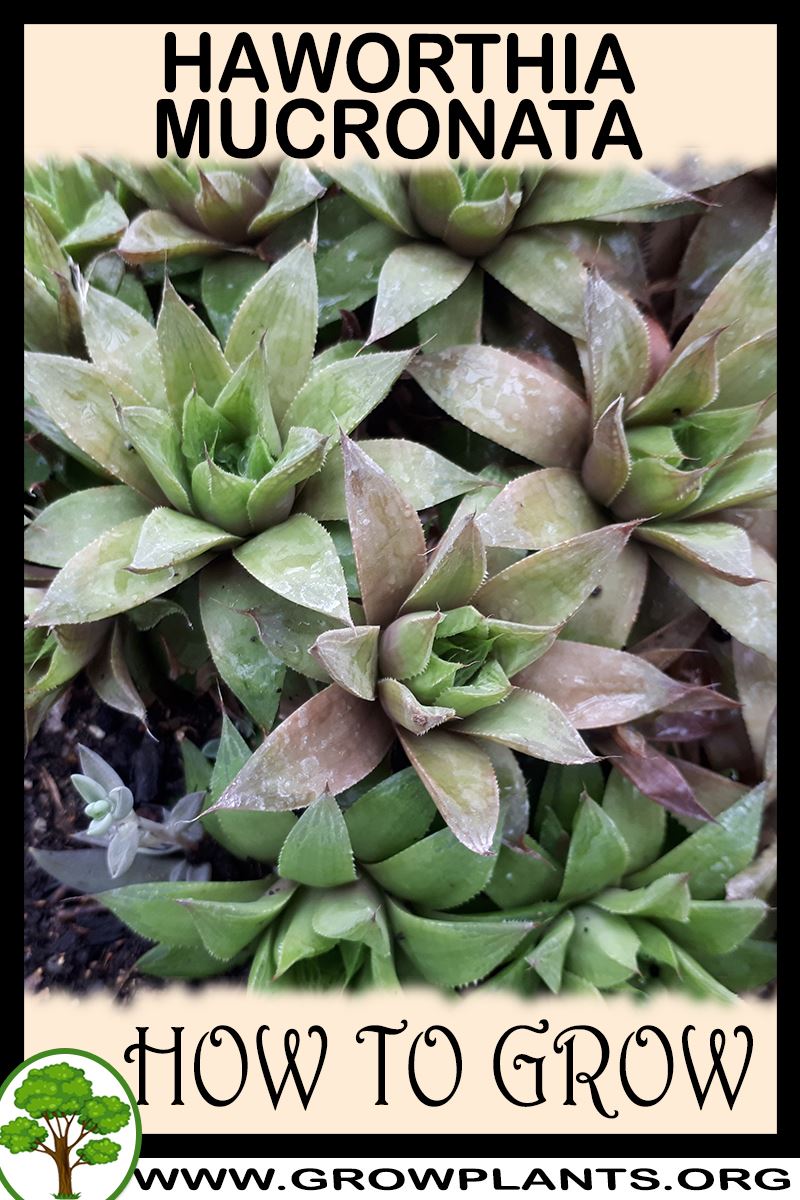
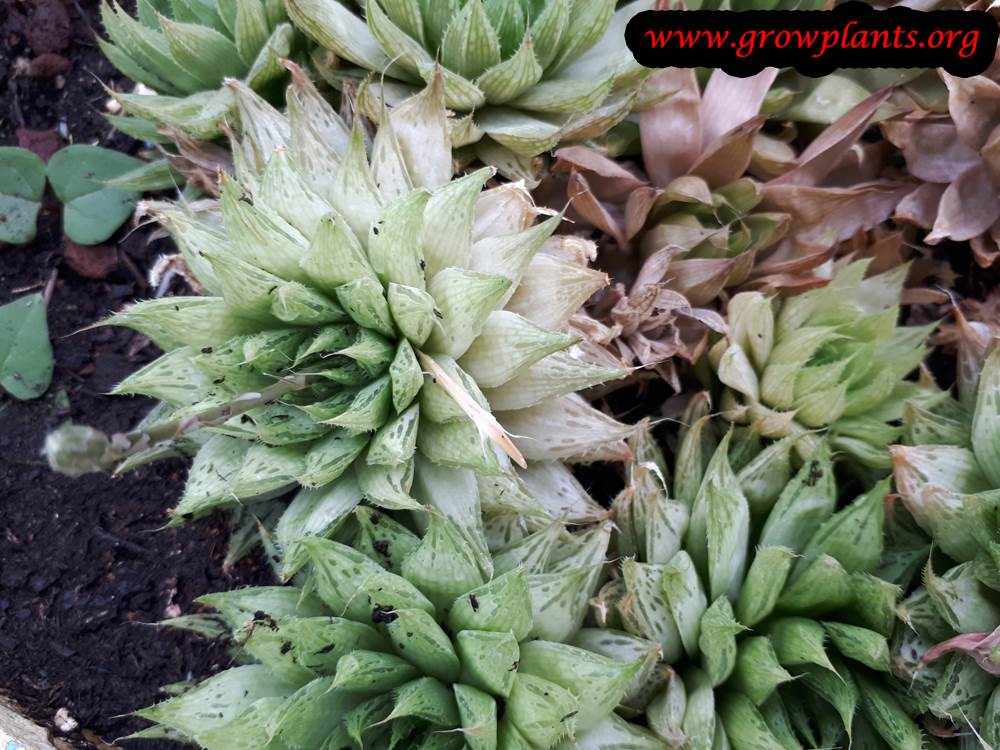
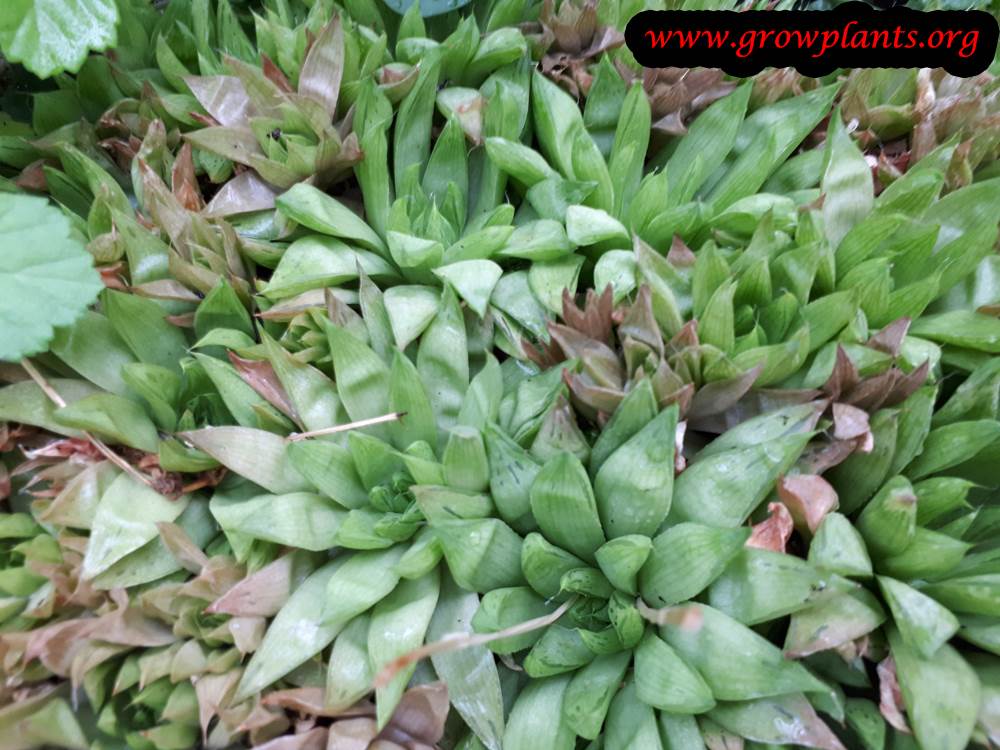
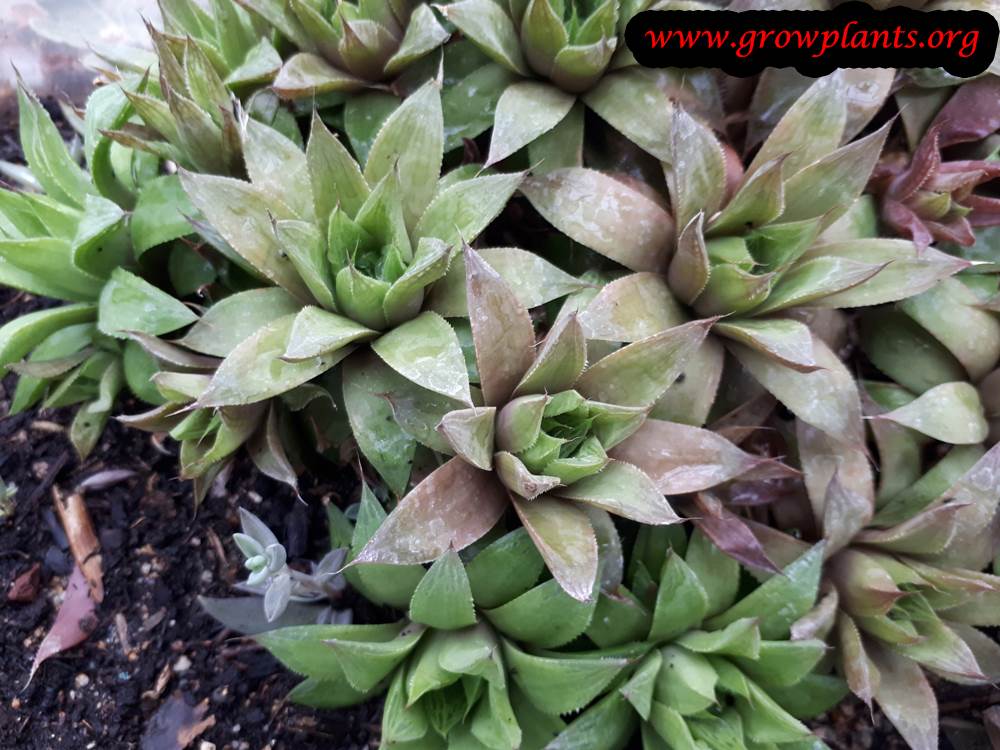
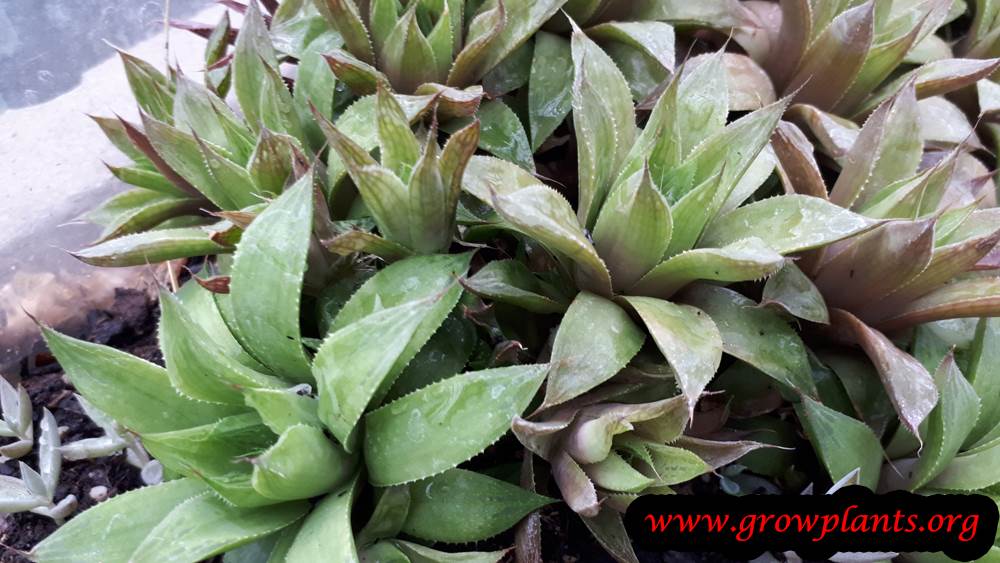
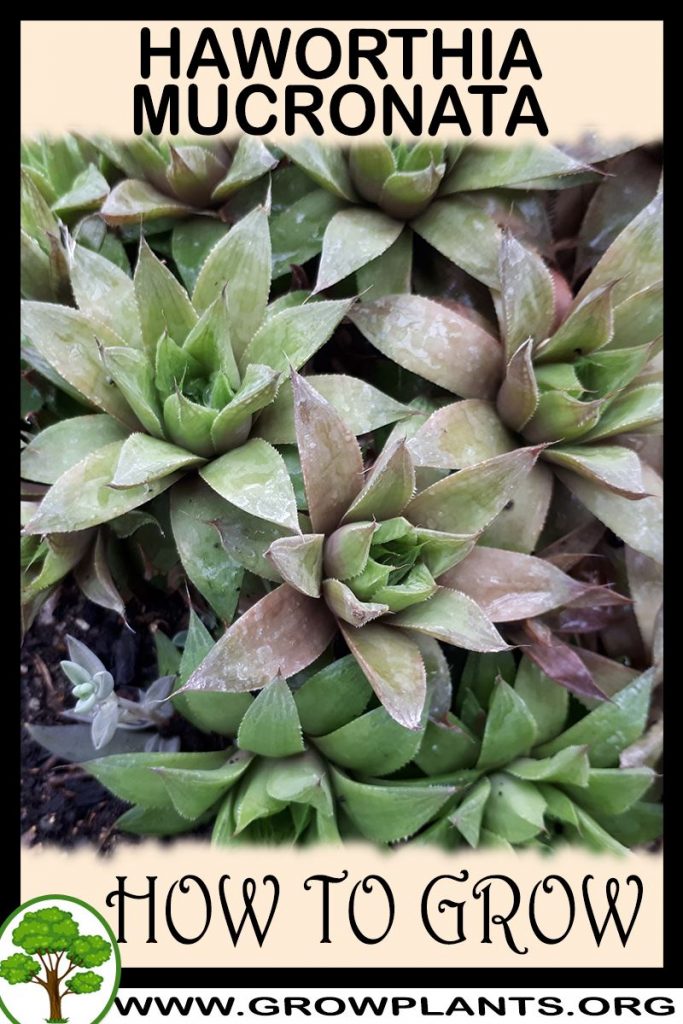
- Leaves & Foliage: Soft, translucent green leaves ending in a fine point (mucro), arranged in a rounded rosette.
- Flower Characteristics: Small white flowers borne on a slender stem.
Primary Uses & Landscape Value
- Functional & Ornamental Roles: Ornamental succulent for windowsills, dish gardens and containers; well suited to indoor culture as a houseplant.
Care Guide: Planting, Soil & Watering
Overview: Haworthia mucronata is a slow-growing rosette succulent that thrives in bright but indirect light, sheltered from harsh direct sun. It needs sharply draining, sandy or gritty soil and only sparing moisture, resenting any water that lingers around its roots.
Quick Care Requirements
| Requirement | Ideal Condition |
|---|---|
| Planting Season | Year-round in frost-free zones (11+); spring to summer in zone 10a, spring to autumn in zone 10b |
| Growth Rate | Slow |
| Soil Type | Sandy, gritty, sharply draining |
| Water Need | Low – let the soil dry out fully between waterings |
Planting & Establishment
- Best Planting Season: Best planted in the warm season — year-round in frost-free zones (11+), spring to summer in zone 10a and spring to autumn in zone 10b. Avoid planting when frost threatens, as it is damaged below about 3°C (37°F).
- How to Plant:
- Hole Preparation: Set into a hole just larger than the root system, on ground that drains freely; in rainy areas plant on a raised bed or mound so the base never sits in a puddle.
- Soil Amendments: Work in plenty of coarse sand, grit or lava rock to open up the mix; only a little organic matter is needed, and heavy, water-retentive soil should be lightened.
- Planting Depth: Set the rosette so its base sits at soil level, keeping the neck and lower leaves above the surface to prevent rot; do not bury the crown.
- Growth Speed & Expectations: Slow-growing, especially while young, taking a while to establish before it settles into steady growth; a small plant, only about 5-10 cm (2-4 in).
Soil, Watering & Drainage Care
- Soil Mix & Drainage Needs: Grow in a gritty, free-draining mix — for pots, sandy soil with perlite, peat and a base layer of lava grit works well. Excellent drainage is essential, as standing moisture quickly causes fatal rot.
- Watering Schedule & Technique:
- Young / Newly Planted: After planting, water lightly and let the plant settle; keep the soil barely moist rather than wet while roots establish.
- Established: Water only when the leaves begin to soften, then let the soil dry out completely before watering again — overwatering is the main killer of this plant.
- Seasonal Adjustments: Cut watering back sharply in winter and in cool, damp spells; shelter it from heavy rain, and indoors give even less water and check the pot is not staying wet.
Climate, Light & Hardiness
Haworthia mucronata is a shade-preferring succulent suited to subtropical, Mediterranean, and tropical climates, or grown indoors as a houseplant elsewhere. It is best kept essentially frost-free, ideally above about 3°C (37°F), and prefers filtered light over harsh direct sun.
Quick Climate Specifications
| Climate Zones | Subtropical, Mediterranean, and tropical climates, or indoors as a houseplant |
|---|---|
| USDA Hardiness Zones | Approximately zone 10b and warmer |
| Optimal Temp Range | Mild, generally above 3°C (37°F) |
| Cold Damage Begins | Leaves can be damaged as temperatures approach freezing |
| Approx. Survival Minimum | Site guidance recommends keeping the plant frost free, indicating little margin below 0°C (32°F) |
| Frost Tolerance | Low |
| Light Conditions | Half Shade to Full Shade with ample ambient light |
Sunlight & Light Exposure
Optimal Light Setup
Bright, filtered light or half shade suits this translucent-leaved succulent well; too much direct sun can scorch the leaves.
Shade & Heat Management
Full shade with good ambient light is tolerated, useful for indoor growing or shaded succulent beds.
Best Exposure / Orientation
An east-facing or otherwise softly lit position, away from harsh midday sun, works well.
Temperature Extremes & Hardiness
USDA Hardiness & Regional Limits
Site data places this plant at roughly zone 10b and warmer; outside consistently mild climates, container growing that allows moving the plant indoors before cold weather is the practical approach.
Cold Damage & Winter Protection
Keep frost-free, ideally above 3°C (37°F); move container plants indoors before frost and reduce watering in cooler indoor conditions.
Frost Sensitivity
Frost sensitivity is fairly high for this genus; the plant is prone to sudden rot triggered by cold, wet conditions, which can be hard to catch before damage is visible.
Extreme Heat Tolerance
Tolerates heat and dry conditions well once established, provided it is not also in direct, intense sun.
Wind, Humidity & Microclimate
Dry-Air Tolerance
Tolerates dry air well, consistent with its succulent nature and native dry habitats.
Rainfall & Seasonal Moisture
Prefers a dry climate pattern; in rainy locations, raised planting with sharp drainage (such as lava grit) helps prevent the rot this species is prone to.
Microclimate Recommendations
A dry, well-drained, lightly shaded spot-raised above ground level in high-rainfall areas-suits this plant’s combination of cold sensitivity and rot-proneness.
Growing in Pots, Balconies & Indoors
Haworthia mucronata is a small, shade-tolerant succulent (5-10 cm / 2-4 in) that the grower confirms makes a good houseplant. Because it prefers half to full (bright) shade over blazing sun, it is one of the easiest succulents for an indoor windowsill, staying neat in a small, free-draining pot for years.
Quick Details
- Container Size: Small – at least 30% larger than the root ball; too big a pot is not helpful
- Indoor Suitability: A genuinely good houseplant
- Best Spot: Bright/half shade to full shade with light; keep it out of a hot radiator’s draught
- Soil & Drainage: Sandy, very free-draining mix with plenty of holes
- Watering in Pots: Sparing – let it dry between waterings; overwatering is the main danger, so check the pot is not still wet
Indoors & On the Windowsill
- A true houseplant: It thrives in bright indoor light without needing direct sun, so a well-lit sill suits it perfectly.
- Care: Keep it away from heaters, give it a spot with good light, water sparingly, and always confirm the pot has dried out before watering again – it is far easier to underwater than to overwater safely.
On a Balcony or Patio
- Light & shelter: In warm climates it can sit outside in bright shade; protect it from strong sun and, especially, from rain – excess water is its main enemy.
Choosing the Pot, Soil & Long-Term Care
- Pot & drainage: A pot at least 30% larger than the root ball (no bigger) with plenty of drainage holes; never leave it in standing water. Terracotta breathes and dries fast, which suits it well.
- Potting mix: Sandy and free-draining with a little organic matter – lava grit in the base with sandy soil on top, or perlite with peat.
- Feeding: Feed only lightly in the growing season; it needs very little.
- Repotting: Mix loses its structure over time – refresh it every few years (in sandy, well-drained soil that is not overwatered, every five years or more is fine), and move up one pot size as the plant grows rather than starting in a large pot.
Fertilizing & Feeding
Haworthia mucronata is a slow-growing succulent adapted to lean, dry soils and needs only minimal feeding to stay healthy; overfeeding pushes soft, rot-prone growth.
Quick Fertilizing Specs
| Feeding Level | light |
|---|---|
| Main Nutrient Priority | a low-nitrogen fertilizer formulated for cacti and succulents |
| Best Feeding Period | during the active warm-season growth period |
| Soil pH | tolerates a wide range; well-drained mineral soil matters more than exact pH |
| Reduce/Stop Feeding | withhold feeding entirely while the plant rests |
Feeding by Growth Stage
Active Growing Season
Provide light nutrition that supports steady growth without encouraging soft, rot-prone tissue.
| Nutrient direction | Favor a low-nitrogen fertilizer formulated for succulents and cacti, used sparingly. |
|---|---|
| Timing | Warmer months when the plant is actively growing. |
| Frequency | Minimal feeding is usually enough; this species rarely needs more than light, occasional nutrition. |
| Fertilizer types | A low-nitrogen liquid fertilizer formulated for cacti and succulents, diluted well |
| Precautions | Only feed when the soil is already on the dry side, and skip feeding right after repotting or during rot recovery. |
Cool-Season Rest
Let the plant rest through the cooler, slow-growth part of the year.
| Nutrient direction | None – withhold fertilizer while growth has slowed or stopped. |
|---|---|
| Timing | Cooler months when growth slows. |
| Frequency | No feeding at this stage. |
| Fertilizer types | No feeding at this stage; resume only once active growth is clearly underway |
| Precautions | Do not fertilize a resting or dormant succulent; excess moisture and nutrients at this time raise the risk of rot. |
Nutrient Deficiency Signs & Corrections
Leaves turn soft, translucent, or mushy, sometimes with a sudden collapse.
| Possible causes | Overwatering or poor drainage causing root rot, which also blocks nutrient uptake, Fertilizing on top of already wet or poorly drained soil, Fungal pathogens taking hold in consistently damp mix |
|---|---|
| Appears first on | Lower or central leaves, then spreading |
| What to check | Check soil moisture and drainage, Inspect roots for firm, pale tissue versus mushy, dark tissue, Review recent watering and feeding history |
| Possible correction | Improve drainage, let the mix dry out, remove any rotten tissue, and resume feeding only once new healthy growth appears. |
Unusually soft, elongated, pale-green growth that looks stretched or lush.
| Possible causes | Fertilizer that is too rich in nitrogen for a slow-growing succulent, Feeding too often for this species’ naturally light needs, Insufficient light causing stretched growth that mimics over-feeding |
|---|---|
| Appears first on | New growth at the center or growing tip |
| What to check | Review fertilizer type and feeding frequency, Check light levels – low light alone can cause similar stretching, Compare recent growth rate to the plant’s normal slow pace |
| Possible correction | Switch to a low-nitrogen succulent fertilizer used sparingly and confirm the plant is getting enough light. |
Leaves develop dull, blotchy, or unevenly pale coloring not tied to sunburn.
| Possible causes | Very old, depleted potting mix lacking trace minerals, Consistently high soil pH or mineral-heavy irrigation water limiting nutrient availability, General nutrient depletion from years without repotting or feeding |
|---|---|
| Appears first on | Older leaves and overall plant color |
| What to check | Note how long it has been since the last repot or fresh mix, Test irrigation water mineral content if available, Rule out sunburn or pest damage as the cause |
| Possible correction | Repot into fresh, well-drained succulent mix and resume light seasonal feeding. |
Pruning, Training & Seasonal Maintenance
Haworthia mucronata is a small, slow-growing clustering rosette succulent. It tolerates essentially no structural pruning – there is no framework of stems or branches to shape – and the only real cutting task is sanitation: removing dead or rotted leaf tissue and the spent bloom stalk once flowering finishes. Because this species is noted to rot suddenly and be hard to save once it starts, cuts are as much about disease management as tidiness, and are best made when the plant and soil are dry.
Quick Pruning & Maintenance Specs
| Pruning Tolerance | Low – sanitation only, no structural cuts |
| Primary Pruning Window | Any time, as needed; best carried out when the plant is dry (not right after watering) |
| Typical Frequency | Occasional, as dead leaves or bloom stalks appear |
| Main Objective | Remove dead/rotted leaf tissue promptly and the spent bloom stalk after flowering |
| Best Tool Type | Precision snips or a fine sterile blade |
| Avoid Heavy Pruning During | Not applicable – heavy pruning is never used on this species |
Special Growth to Remove
- Spent flower stalk – cut at its base once blooming is completely finished; it will not rebloom.
- Dead or rotted leaf tissue – remove promptly and cut back into firm, healthy tissue rather than just trimming the visibly dead part, since rot can spread quickly through this species.
- Offsets (pups) – can be left to form a clustering mat, or gently detached once they have their own roots for propagation.
Container & Small-Space Pruning
Almost always grown in a small pot. There is no canopy or root-to-canopy balance to manage by pruning; the main container-specific task is checking the base of the rosette and roots when rot is suspected, since poor drainage in a pot is the most common trigger. Repotting for drainage, not cutting, is the real fix for that.
Tools
- Precision snips – for dead leaf tips and spent bloom stalks.
- A fine, sterile blade (grafting-knife type) – for cleanly excising rotted tissue back to healthy flesh.
Tool Hygiene & Disease Risk
Increased – this species is specifically noted to rot suddenly and be difficult to save. Use a clean, sharp edge for any cut into rotted tissue and wipe the blade between plants so rot-causing organisms are not carried from one Haworthia to the next.
Cut Placement & Technique
When removing rot, cut at an angle back into firm, healthy leaf tissue well beyond any soft or discoloured area, then let the cut surface dry and callus for a day or two before it contacts any moisture. Cut spent bloom stalks flush at their point of origin.
Heavy Pruning & Rejuvenation
Not tolerated. This is a small rosette succulent with no woody framework to cut back and regrow from. If a rosette is badly damaged or rotting throughout, propagate a replacement from a healthy leaf or offset rather than attempting to rejuvenate the original by cutting it.
Post-Pruning Care
Hold off watering for several days after any cut into rot or dead tissue so the wound can dry and callus – watering too soon is the most common cause of reinfection. Keep the plant in good airflow to help prevent rot recurring.
Common Pruning Mistakes
- Watering immediately after cutting out rot, which reintroduces the moisture that caused the problem.
- Removing healthy leaves purely for shape – this creates unnecessary wounds that are entry points for rot.
- Only trimming the visibly dead tip of a rotted leaf instead of cutting back into clean tissue, leaving infection behind.
When NOT to Prune
Avoid cutting while the plant or surrounding soil is wet, and avoid handling or cutting during cold, damp weather when rot risk is highest for this species.
Recommended Tools (by task)
- precision_snips – light dead-leaf and spent-bloom-stalk removal.
- grafting_knife – clean excision of rotted tissue back to healthy flesh; this species' sudden-rot tendency makes a sterile, sharp cut important.
- blade_disinfectant – wiping the blade between plants when working on or near rotted tissue, to avoid spreading rot organisms.
Propagation Guide
Leaf or stem cuttings, and separating rooted pups (daughter plants) from the base of the rosette, are both easy and reliable ways to start new Haworthia mucronata plants, and are generally quicker than raising it from seed. Seed is not necessary since the species grows readily from vegetative material and is usually true-to-type, making this overall an easy plant to propagate.
Quick Propagation Specs
| Best Propagation Method | Leaf or stem cuttings, or separating pups |
| Alternative Methods | Seed |
| Propagation Difficulty | Easy |
| Seed True-to-Type | Usually true-to-type |
| Vegetative True-to-Type | Yes |
| Best Propagation Season | Spring to summer |
| Seed Germination Time | 3–6 weeks |
| Cutting Rooting Time | Not stated precisely; allow the cut surface to callus a few days before potting, then expect roots to develop over the following weeks |
| Germination Temperature | 21–26°C (70–79°F) |
| Seed Sowing Depth | 0.5cm (0.25 inch) |
Growing from Seed
Seed Handling & Viability
Store seed in a dry, dark location at room temperature until sowing.
Sowing Season
Spring to summer, timed to when temperatures reach 21–26°C (70–79°F).
Sowing Depth & Orientation
About 0.5cm (0.25 inch) deep.
Germination Conditions
Light, sandy or well-ventilated soil with good drainage, kept slightly moist but never overwatered; sow in light to half shade at 21–26°C (70–79°F). Overwatering is the main cause of germination problems for this species.
Germination Time
3–6 weeks.
Seedling Care
Keep seedlings in light, moist, well-ventilated soil. For transplanting, space seedlings about 4x4cm (1.8×1.8 inches) apart.
Leaf & Root Cuttings
Cuttings can be taken from leaves or from stems. When taking a leaf cutting, cut right at the base of the leaf for the best results; cutting through a stem or through the middle of a leaf is also possible. Let the cutting sit for a few days in a shaded spot so the cut surface dries and calluses slightly before it goes into soil, then insert it and keep the soil moist – but not overwatered – until it roots.
Division, Offsets, Pups & Suckers
Pups (daughter plants) that form at the base of a mature rosette are another straightforward way to propagate this species. Once a pup has developed its own roots and is large enough to handle, separate it from the parent and pot it into a fast-draining succulent mix; alternatively, a cluster of pups can simply be left in place to grow into a multi-headed clump.
Bloom & Flower Guide
Quick Details
- Bloom Season: Can appear through much of the year
- Flower Appearance: Small white tubular flowers on a thin, wiry stalk
- Edibility: Not eaten – an ornamental succulent (non-toxic to pets)
Detailed Blooming Overview
Haworthia mucronata is grown for its neat rosette of translucent green leaves; the flowers are a quiet affair. It sends up a slender, wiry stalk (a raceme) topped with small white tubular flowers, each usually marked with a fine greenish-brown midstripe. They can appear at almost any time of year.
Flower Characteristics
- Small, white, tubular flowers
- Often with a greenish-brown stripe down each petal
- Spaced along a thin, wiry raceme held well above the rosette
Bloom Care & Thinning
- Managing the bloom: The flowers are modest; many growers snip the stalk off to steer the plant’s energy back into the rosette and offsets.
- After flowering: Remove the spent stalk at the base.
Pests, Diseases & Troubleshooting
Overview: Haworthias are tough, slow-growing rosette succulents with remarkably few insect enemies; the overwhelming majority of losses come not from pests but from overwatering and poor drainage. Management is almost entirely cultural – a gritty, fast-draining mix, restrained watering, bright indirect light and good airflow keep these plants trouble-free. H. mucronata has soft translucent-tipped leaves.
Quick Troubleshooting Overview
| Issue / Pest | Main Symptom | Primary Solution |
|---|---|---|
| Root & foliar mealybug | White cottony fluff in leaf axils or on roots; stunting | Isolate, physically remove, 70% alcohol spot-treat, repot into fresh gritty mix |
| Scale | Small brown/tan limpet-like bumps on leaves | Scrape off, dab with alcohol, horticultural oil if widespread |
| Fungus gnats | Tiny black flies over soil; larvae in constantly wet mix | Let mix dry, yellow sticky traps, reduce watering |
| Basal / soft rot | Translucent, mushy, browning base; collapse | Remove rotted tissue, dry out, root healthy offsets; correct watering |
| Etiolation & scorch | Stretched pale growth OR bleached/scorched red-brown leaves | Increase light gradually / shade from harsh midday sun |
Common Pests & Management
- Root mealybug (Rhizoecus spp.):
- Symptoms: Colonies of white, waxy insects hidden on roots and at the soil line, discovered only when repotting; plants stall, lose vigour and refuse to grow despite correct care. A white, mould-like waxy deposit coats the root ball.
- Prevention & Control: Inspect roots at every repot. Bare-root affected plants, wash the roots, cut away infested feeder roots, and repot into fresh gritty mix in a clean pot. Drench the fresh mix or dip roots in horticultural oil / insecticidal soap solution; quarantine until re-established.
- Mealybug (Pseudococcus / Planococcus spp.):
- Symptoms: Cottony white tufts wedged deep in the tight leaf axils and rosette centre, often with sticky honeydew and sooty mould. Look-alike: the plant’s own natural farina or leaf waxing – mealybug fluff moves and clumps.
- Prevention & Control: Dab each insect with a cotton bud dipped in 70% isopropyl alcohol. For heavier infestations, spray insecticidal soap or horticultural oil into the axils, repeating weekly for 3 cycles to catch hatchlings. Keep new plants quarantined.
- Scale (Diaspididae & soft brown scale (Coccus hesperidum)):
- Symptoms: Immobile brown, tan or grey bumps stuck flat to leaf surfaces; soft scale exudes honeydew. Leaves may yellow beneath heavy colonies.
- Prevention & Control: Scrape off with a fingernail or soft brush and wipe with alcohol. Follow with horticultural oil to smother crawlers; inspect the undersides and leaf bases where they hide.
- Fungus gnats (Bradysia spp.):
- Symptoms: Small dark flies running or fluttering over the soil surface; translucent larvae in chronically wet mix can nibble fine roots of seedlings and offsets.
- Prevention & Control: The cure is cultural – let the mix dry thoroughly between waterings and top-dress with grit. Yellow sticky traps catch adults; a Bti (Bacillus thuringiensis israelensis) drench targets larvae if needed.
- Aphids (Aphididae (esp. on flower stalks)):
- Symptoms: Small green or grey soft-bodied insects clustered on the emerging flower spike, causing distortion and honeydew. Rarely a threat to the leaves themselves.
- Prevention & Control: Usually cosmetic – rinse off with water or pinch out the affected spike. Insecticidal soap resolves persistent clusters.
Diseases & Fungal Issues
- Basal & soft rot (Fusarium / Pythium / Erwinia spp.):
- Symptoms: The plant base turns soft, translucent and brown-black, often with a foul smell; leaves detach easily and the rosette collapses from the centre or bottom. This follows overwatering, water sitting in the crown, or a cold, wet pot.
- Treatment & Management: There is no cure for rotted tissue – cut well above the damage into clean, firm flesh, dust with sulfur or cinnamon, let it callus, and re-root the healthy top or offsets in dry gritty mix. Prevent by watering the soil (never the rosette), using terracotta/gritty mix, and never leaving the plant wet and cold.
- Leaf spot / anthracnose (fungal (minor)):
- Symptoms: Occasional sunken brown or black spots on leaves in stagnant, humid, crowded conditions.
- Treatment & Management: Improve airflow, avoid overhead watering, remove affected leaves. Rarely warrants fungicide; a copper product is sufficient if it spreads.
Growing Difficulties & Abiotic Problems
- Overwatering rot (the #1 killer):
- Cause & Symptoms: Roots suffocate and rot in soggy mix; lower leaves go soft, yellow-translucent and mushy. By far the most common cause of Haworthia death.
- Correction Strategy: Use a fast-draining, mostly-mineral mix (added pumice/perlite/grit), pots with drainage, and water only when the mix is fully dry. Water less in cool/low-light periods.
- Etiolation (stretching):
- Cause & Symptoms: Insufficient light causes pale, elongated, loosely-spaced growth and a flattened, reaching rosette.
- Correction Strategy: Move to bright indirect light (an east/south window or gentle grow light). Increase light gradually to avoid scorch; the stretched growth won’t reverse but new growth tightens up.
- Sun scorch:
- Cause & Symptoms: Sudden intense direct sun bleaches leaves white or turns them red-brown with dry patches.
- Correction Strategy: Acclimatise slowly to brighter light and shade from harsh midday sun. Light reddening/’stress colour’ is harmless; dry scorched patches are permanent.
- Mineral / salt build-up & corking:
- Cause & Symptoms: White crust on soil or pot, brown corky scars on older leaves from hard water, fertiliser salts or handling.
- Correction Strategy: Flush the mix occasionally with clean water, fertilise sparingly (dilute, in growth periods only), and use rain/filtered water where salts are high.
What Helps – Products & Tools
This is a plant to manage with your hands and your watering can more than sprays: 70% isopropyl alcohol on a cotton bud for mealybug and scale, insecticidal soap or light horticultural/neem oil for wider infestations, yellow sticky traps and a Bti drench for fungus gnats, and sulfur or cinnamon as a cut-surface dressing against rot. A gritty mineral mix and terracotta pots are your best ‘products’ of all.