Plant Profile & Key Characteristics
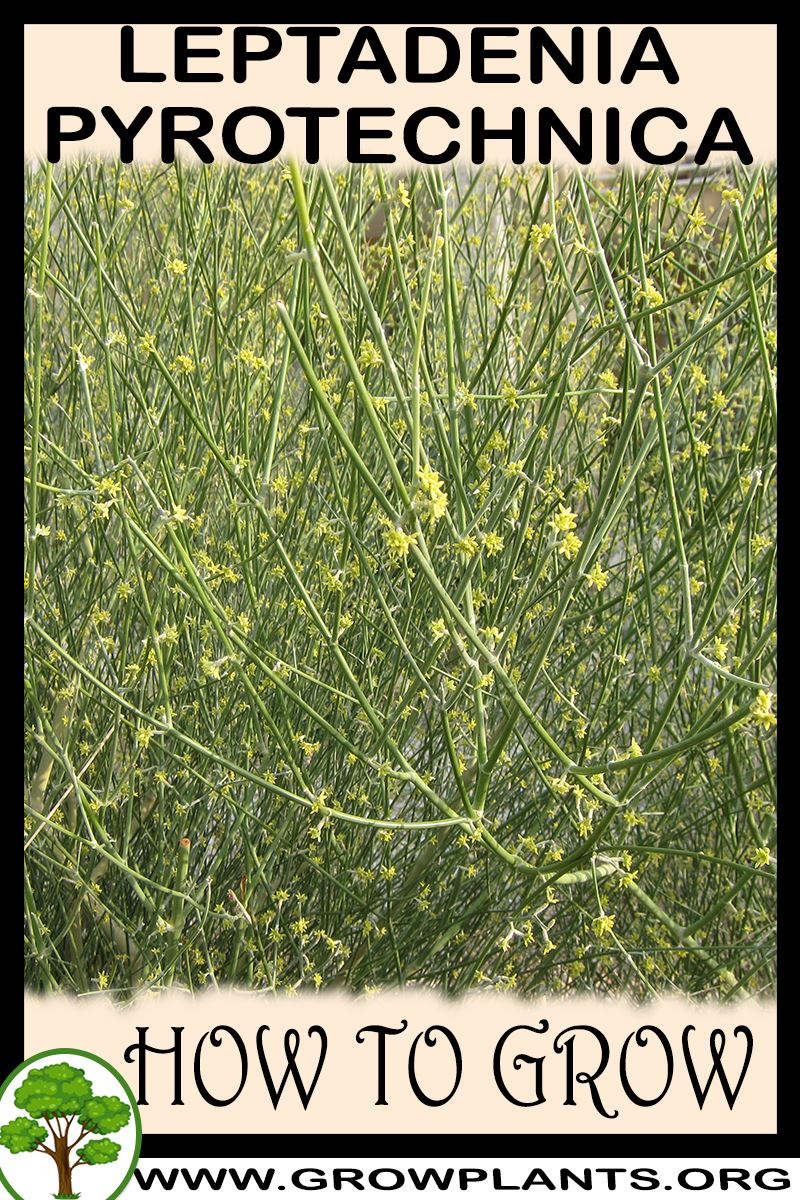
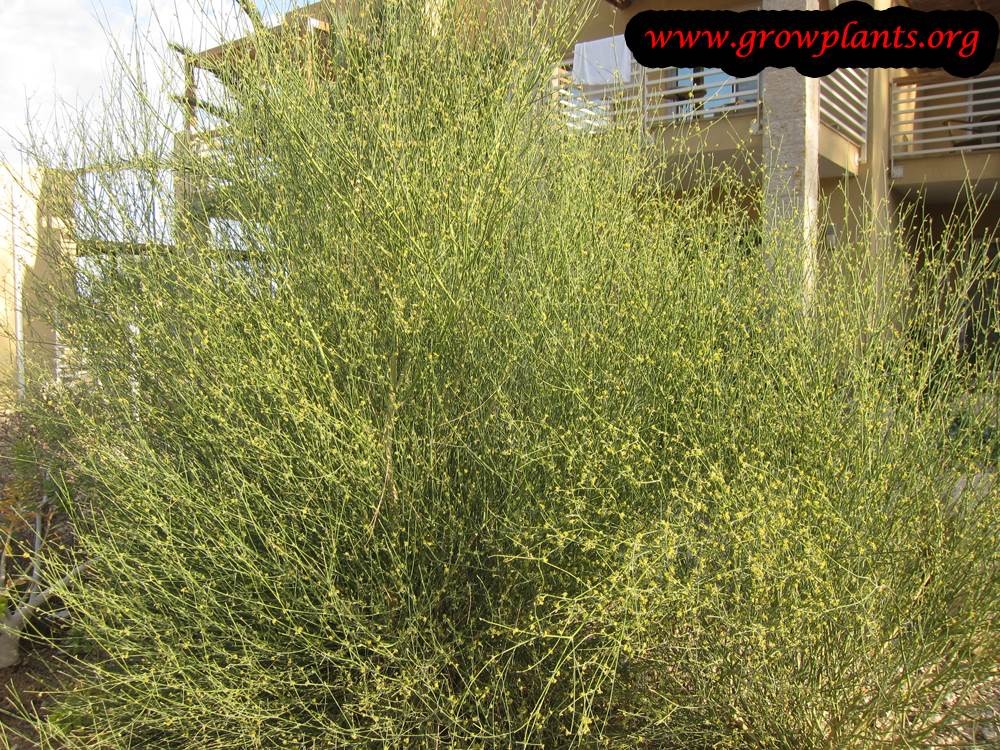
Overview: Leptadenia pyrotechnica (Khimp) is a broom-like desert shrub of 1-3 m with slender green, near-leafless stems, grown as a hardy ornamental and for its edible pods. It is a moderate- to slow-growing, drought-tolerant perennial hardy to USDA zone 11 and above.
Quick Specifications
| Specification | Attribute |
|---|---|
| Plant Type / Life Cycle | Perennial (desert shrub) |
| Foliage Type | Deciduous / near-leafless (green stems photosynthesise) |
| Mature Size | 1-3 m tall (3-10 ft) |
| Growth Rate | Moderate to slow |
| Root System | Deep-rooted desert shrub (used to stabilise sand dunes) |
| Toxicity | Non-toxic (young pods edible; also browsed as fodder) |
| Hardiness | USDA zone 11+ |
Growth Form & Structure
- Height & Spread: Reaches 1-3 m (3-10 ft) tall; can be grown in containers.
- Growth Habit & Form: Erect, broom-like shrub of slender green stems, sparsely leaved, adapted to hot, arid conditions.
- Lifespan & Maturity: Moderate to slow; long-lived and deep-rooting once established.
Anatomy & Physical Features
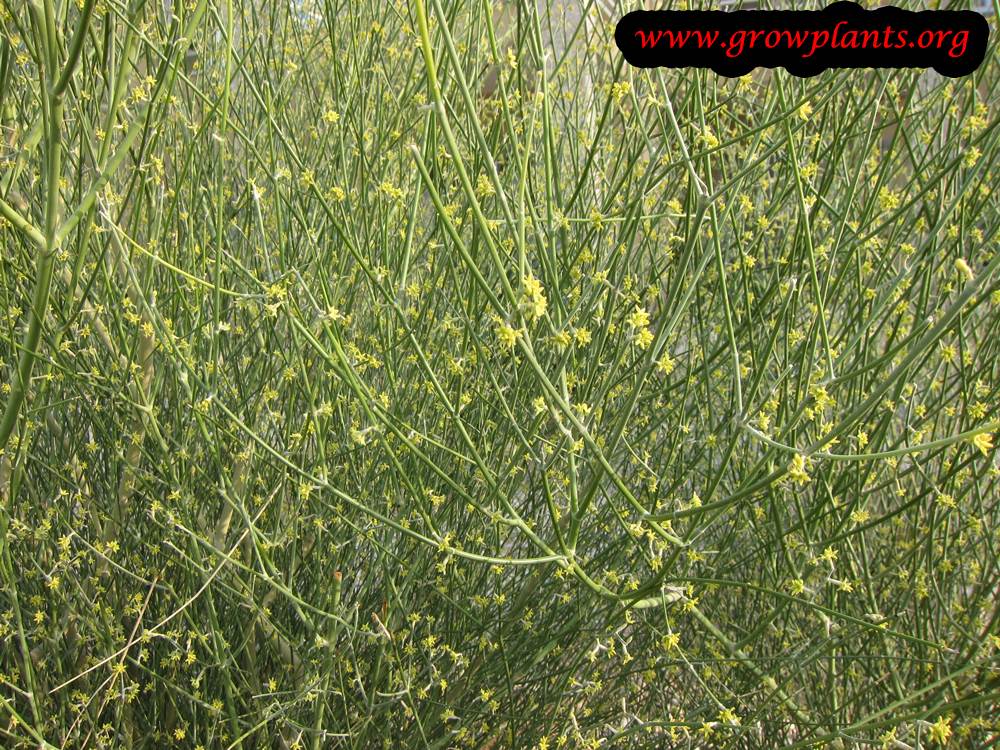
- Leaves & Foliage: Largely leafless; the thin green photosynthetic stems perform the work of leaves, an adaptation to drought.
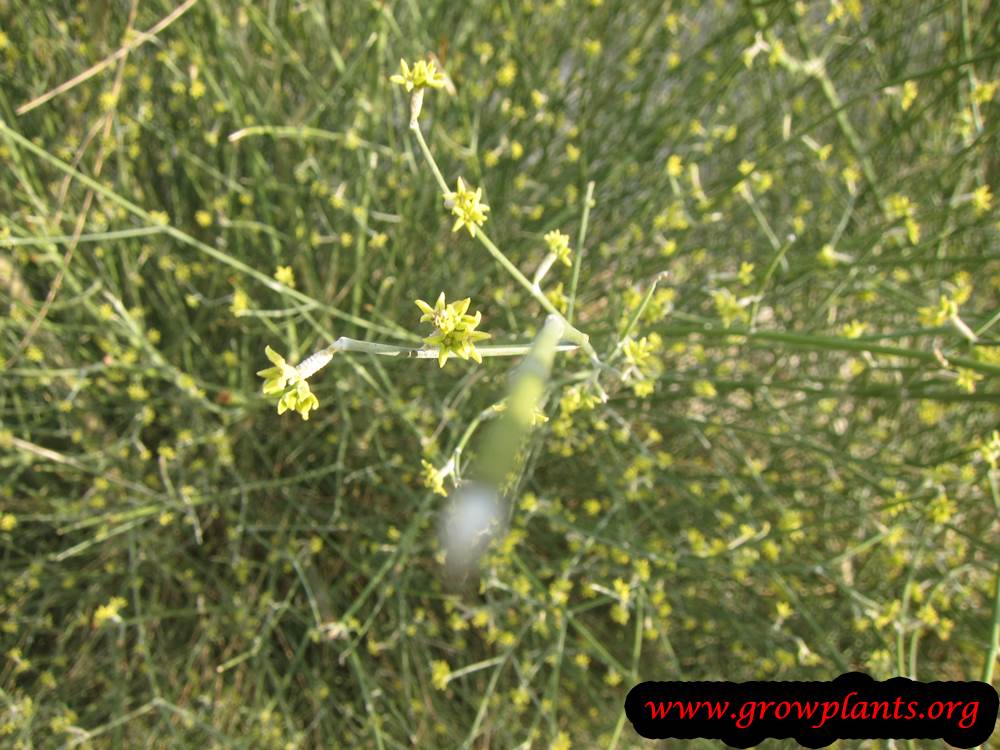
- Flower Characteristics: Small yellow star-shaped flowers borne in clusters at the stem ends.
Primary Uses & Landscape Value
- Edible Uses: Young pods are edible and the plant is browsed as fodder.
- Functional & Ornamental Roles: Ornamental desert shrub and an important sand-dune stabiliser; highly drought-tolerant.
Care Guide: Planting, Soil & Watering
Overview: Leptadenia pyrotechnica is a very drought-tolerant desert shrub that grows in full sun to part shade in hot desert, tropical, or subtropical climates (hardiness zone 11+). It needs a sharply drained, sandy soil and very little water.
Quick Care Requirements
| Requirement | Ideal Condition |
|---|---|
| Planting Season | Year-round in warm, frost-free desert conditions |
| Growth Rate | Slow to moderate |
| Soil Type | Well-draining, sandy |
| Water Need | Low; highly drought tolerant |
Planting & Establishment
- Best Planting Season: Plant year-round wherever it stays warm and frost-free.
- How to Plant:
- Hole Preparation: Dig a hole about the width of the root ball.
- Soil Amendments: Add sand or grit to guarantee sharp drainage.
- Planting Depth: Set the root collar level with the soil.
- Growth Speed & Expectations: A moderate to slow grower reaching about 1-3 m (3-10 ft).
Soil, Watering & Drainage Care
- Soil Mix & Drainage Needs: Use a sandy, free-draining soil and avoid any waterlogging.
- Watering Schedule & Technique:
- Young / Newly Planted: Water occasionally to help it establish.
- Established: Water minimally; it is highly drought tolerant.
- Seasonal Adjustments: Give little to no water during the cool or wet season.
Climate, Light & Hardiness
Khimp is a highly drought- and heat-tolerant desert shrub, also suited to tropical, subtropical, and Mediterranean climates, thriving in full sun with sharply drained soil. It has essentially no cold hardiness.
Quick Climate Specifications
| Climate Zones | Desert, Tropical, Subtropical, Mediterranean |
|---|---|
| USDA Hardiness Zones | 11 and above |
| Frost Tolerance | None |
| Light Conditions | Full Sun to Half Shade |
Sunlight & Light Exposure
Optimal Light Setup
Full sun suits this desert shrub best; half shade is tolerated.
Temperature Extremes & Hardiness
USDA Hardiness & Regional Limits
Suited to USDA zone 11 and warmer, essentially frost-free climates; it is not cold-hardy and freezing temperatures are expected to cause serious damage or death.
Extreme Heat Tolerance
Exceptionally heat- and drought-tolerant, well adapted to harsh desert summers.
Wind, Humidity & Microclimate
Dry-Air Tolerance
Well adapted to very dry air, as expected of a desert-native shrub.
Growing in Pots, Balconies & Indoors
Khimp is a tender, drought-tolerant desert shrub the grower confirms is not a houseplant but grows in containers. It demands intense light and warmth, so a pot suits a hot, sunny patio, and in cold climates it is potted mainly to move it somewhere very bright and frost-free for winter.
Quick Details
- Container Size: A roomy pot, 15-30 L, for a 1-3 m shrub kept trimmed
- Indoor Suitability: Not a room plant; only the brightest window and a frost-free winter
- Best Spot: Full sun (tolerates a little part shade)
- Soil & Drainage: Very free-draining, sandy/gritty mix; it is a desert plant
- Watering in Pots: Sparingly – low water; let the mix dry well between waterings
Indoors & On the Windowsill
- Houseplant limits: Far too light-hungry for a normal room; indoors it weakens quickly.
- Bright light only: The sunniest window or a bright glasshouse is the only realistic indoor spot.
- Overwintering: Tender to frost – the main reason to pot it in cold climates is to bring it into a bright, frost-free place for winter, kept nearly dry.
On a Balcony or Patio
- Light & heat: Reserve the hottest, sunniest, most sheltered corner; reflected wall heat suits it and the gritty mix copes with drying out.
- Rain: Shelter it from prolonged rain so the pot never stays wet.
Choosing the Pot, Soil & Long-Term Care
- Pot & drainage: A well-drained pot with strong drainage holes and no standing-water saucer to avoid root rot; terracotta breathes and dries faster, glazed or plastic holds moisture longer – sharp drainage is essential for a desert plant.
- Potting mix: A sandy, gritty, very free-draining blend – add coarse sand or pumice.
- Feeding: Potted plants are fed more often than those in the ground, as watering steadily leaches nutrients from the mix – feed sparingly in the warm growing season.
- Repotting: Pot up only when crowded; refresh part of the mix every few years.
Fertilizing & Feeding
A leafless, drought-adapted desert shrub grown mainly as an ornamental accent; it is naturally suited to nutrient-poor arid soils and needs very little supplemental feeding, with light organic matter at planting usually enough to support establishment.
Quick Fertilizing Specs
| Feeding Level | Light feeder – adapted to lean, arid desert soils |
|---|---|
| Main Nutrient Priority | Minimal, balanced feeding limited mainly to establishment |
| Best Feeding Period | Establishment period after planting |
| Soil pH | Tolerates a wide range of well-drained soils |
| Reduce/Stop Feeding | Reduce to little or no feeding once the shrub is established |
Feeding by Growth Stage
Establishment
Help a newly planted khimp build roots and adapt to its site before relying on its natural drought tolerance
| Nutrient direction | A light, balanced feeding with organic matter helps roots establish in lean desert soil |
|---|---|
| Timing | At planting and through the first growing season |
| Frequency | A light feeding is usually enough while the shrub establishes |
| Fertilizer types | A balanced general-purpose fertilizer applied at a light rate, Organic matter or compost worked into the planting hole |
| Precautions | Avoid rich or frequent feeding, which runs counter to this shrub’s natural adaptation to lean, arid soil |
Maintenance
Maintain the shrub’s health with minimal input once it is established and self-sufficient in arid conditions
| Nutrient direction | Established plants rarely need feeding beyond what the native soil already provides |
|---|---|
| Timing | Ongoing, once the shrub is well established |
| Frequency | Feeding is rarely needed once established – this desert shrub thrives on minimal input |
| Fertilizer types | A light balanced feeding only if growth appears weak; otherwise none is typically needed |
| Precautions | Overfeeding an established desert shrub can encourage soft growth poorly suited to its arid, drought-adapted habit |
Nutrient Deficiency Signs & Corrections
Slower-than-expected growth and thin, sparse stems
| Possible causes | General nutrient deficiency in extremely poor soil, Insufficient establishment period after transplanting, Root stress from poor drainage or compacted soil |
|---|---|
| Appears first on | Overall plant size and stem density |
| What to check | Soil fertility and texture, Time since planting, Drainage conditions |
| Possible correction | Apply a light balanced feeding during the growing season and confirm the site drains well |
Overall pale or faded green coloring on stems, which carry much of the plant’s photosynthesis
| Possible causes | Nitrogen deficiency in very poor soil, Excess water stressing roots in an otherwise dry-adapted plant, Insufficient light |
|---|---|
| Appears first on | Younger stem growth |
| What to check | Recent feeding history, Watering frequency relative to this drought-tolerant shrub’s needs, Light exposure |
| Possible correction | Apply a light balanced feeding and reduce watering frequency to match the shrub’s natural drought tolerance |
Pruning, Training & Seasonal Maintenance
Leptadenia pyrotechnica (khimp) is a sparse, rush-like desert shrub. Unlike most other shrubs, no leaf facts are recorded for it – consistent with a habit where most photosynthesis happens in slender green stems rather than true leaves. That means pruning tolerance is low to moderate: the goal is tidying dead or damaged stems and light shaping, not building a branch framework. Growers report it can be cut year-round, but as a genuine desert xerophyte the least stressful window is the cooler part of the year rather than peak summer heat, and cuts should never remove large amounts of living green stem.
Quick Pruning & Maintenance Specs
| Pruning Tolerance | Low-Moderate (dead-wood removal and light shaping only) |
| Primary Pruning Window | Year-round per grower reports, cooler months preferred |
| Typical Frequency | Occasional, as needed rather than on a routine schedule |
| Main Objective | Remove dead/damaged stems; keep an open, uncluttered form |
| Young Plant Priority | Minimal – let the multi-stem base establish |
| Mature Plant Priority | Remove deadwood; control height/spread within its 1–3 m size |
| Best Tool Type | Hand pruners for thin rush-like stems; loppers for thicker basal growth |
| Avoid Heavy Pruning During | Peak summer heat/drought stress, and whenever it would remove large amounts of live green stem tissue |
Pruning by Plant Age & Size
Newly Established
Remove only stems that arrived damaged from transplant; otherwise leave the young multi-stem base alone to establish in desert conditions.
Young / Formative
No structural training system applies – the plant is naturally multi-stemmed and rush-like. At most, light tip pinching can encourage a fuller base.
Mature / Established
Periodic removal of dead or wind/frost-damaged stems, plus light size control to keep the plant within its expected 1–3 m form; there is no framework to maintain.
Seasonal Pruning Schedule
Ongoing Sanitary: objective – remove dead, brittle, or wind/frost-damaged stems whenever spotted; what to remove – fully dead stems only; what NOT to remove – living green stem tissue, since that is this near-leafless plant’s main photosynthetic surface; expected response – a cleaner, more open form; flowering impact – minimal, since flowers form in clusters at the ends of the current season’s growth, light sanitary work doesn’t cost bloom.
Structural Pruning & Training
Limited to height and spread control within its 1–3 m mature size. The naturally sparse, rush-like canopy does not benefit from thinning cuts, and there is no crossing-branch framework to manage.
Special Growth to Remove
- Dead, brittle rush-like stems — the only routine removal target per grower guidance (“design and dead parts”)
- No rootstock suckers or watersprouts apply — propagation facts show this species is not typically grafted
Container & Small-Space Pruning
Container growing is possible for this species. In a pot, light tip pinching keeps a fuller, more compact habit; because it is a slow-to-medium grower adapted to small amounts of water, avoid frequent hard cutbacks that force flush regrowth demanding more water than its natural profile supports.
Tools
Hand pruners or precision snips for the thin stems; loppers only for thicker basal growth on older specimens.
Tool Hygiene & Disease Risk
Routine — no pest or disease pressure is noted in the facts for this species; clean, sharp tools are sufficient.
Cut Placement & Technique
Use thinning cuts back to a healthy stem junction or the base rather than heading cuts partway along a stem – this rush-like habit does not respond well to stubbing.
Heavy Pruning & Rejuvenation
Not well tolerated. As a sparse desert xerophyte that relies on its green stems for photosynthesis, removing a large fraction of the plant at once can significantly set back its energy reserves, and there is no documented vigorous rejuvenation response. Avoid hard cutbacks.
Post-Pruning Care
Water lightly to support recovery, staying within the plant’s small water requirement. Avoid pruning right before or during the hottest, driest stretch of the season, since fresh cuts on a stem-photosynthesizing plant add stress when it is already drought-stressed.
Common Pruning Mistakes
- Removing live green stem tissue, mistaking it for excess growth when it is actually the plant’s main photosynthetic organ
- Pruning on a fixed calendar rather than only when dead material appears
- Hard cutbacks during summer heat, adding stress on top of drought conditions
When NOT to Prune
- During extreme summer heat or active drought stress
- Right after transplanting, while the root system is still establishing
- Whenever a cut would remove a large amount of living green stem rather than dead material
Recommended Tools (by task)
- Removing dead, brittle rush-like stems: precision_snips – clean, small cuts on thin stem material.
- Cutting thicker basal stems on older specimens: loppers – for stems too thick for hand snips.
Propagation Guide
Khimp is grown from seed, which produces plants true to type and is the standard, practical way to start this desert shrub; there’s no indication grafting or vegetative propagation is needed. It isn’t difficult once established, but getting seedlings through their early stage takes some care, so overall difficulty is moderate.
Quick Propagation Specs
| Best Propagation Method | Seed |
| Propagation Difficulty | Moderate |
| Seed True-to-Type | Yes |
| Best Propagation Season | Warm season, matching this plant’s year-round planting window in frost-free desert and subtropical/tropical climates |
| Germination Temperature | Warm, roughly 25–30°C (77–86°F) |
| Seed Sowing Depth | Shallow, in a free-draining sandy medium |
Growing from Seed
Seed Handling & Viability
Collect seed from mature, dry pods and store it dry and cool until sowing, as with most arid-adapted shrubs.
Sowing Season
Best sown in the warm season.
Sowing Depth & Orientation
Sow shallowly in a sandy, free-draining medium that mimics its native desert soils.
Germination Conditions
Warm temperatures and sharp drainage suit this desert species best; avoid overwatering, since it is adapted to only small amounts of water even while establishing.
Seedling Care
Raise seedlings in containers until well-rooted, as is standard for arid-zone shrubs, before planting out and transitioning to its normal minimal-water regime.
Bloom & Flower Guide
Quick Details
- Bloom Season: Spring through summer and into autumn
- Flower Appearance: Small yellow, star-shaped flowers in clusters toward the tips of the near-leafless green stems
- Edibility: The flowers are not eaten – grown as a tough ornamental (the young pods are used, but that is a fruit-stage crop)
Detailed Blooming Overview
Khimp is a broom-like desert shrub of slender, almost leafless green stems that do much of the plant’s photosynthesis. Its small, star-shaped yellow flowers appear in clusters near the stem tips over a long, warm-season window. It is an extremely drought-hardy plant, and its modest flowers are well suited to hot, dry sites.
Flower Characteristics
- Small five-lobed, star-shaped flowers in soft yellow.
- Grouped in clusters toward the ends of the green rush-like stems.
- Produced over a long season in warm conditions.
Bloom Care & Thinning
- Pollination: Worked by insects visiting the small clustered flowers.
- Managing the bloom: No thinning is needed; simply tidy the plant as required.
Fruit & Uses
The young, tender seed pods of Leptadenia pyrotechnica (khimp) are the plant’s genuine edible part, traditionally cooked and eaten as a vegetable in desert regions; the plant is otherwise grown mostly as an ornamental, drought-tolerant shrub. Pods should be cooked, not eaten raw, and any milky latex sap from the plant should be avoided.
Quick Edible Specs
| Edible Parts | Young, tender pods |
|---|---|
| Main Use(s) | Culinary – cooked as a traditional desert vegetable |
| Eaten Raw or Cooked | Cooked only |
| Preparation Required | Cook; use only young/tender pods; avoid the plant’s latex sap |
| Harvest Season | Pods form after flowering (see Bloom season: spring/summer/autumn) |
| Time to First Harvest | Pods are picked young and tender, well before they mature and dry out |
| Storage | Best used fresh soon after picking, while still young and tender |
| Safety/Toxicity Caveat | this plant is in the Apocynaceae family, several members of which contain latex or toxic compounds in the sap and mature tissues; only young cooked pods are the established edible part – avoid raw pods, mature pods, and any milky sap. |
Seeds, Pods & Nuts
Young, still-tender green pods are picked before they mature and toughen. They are cooked (not eaten raw) and used as a vegetable, a traditional food source in the arid regions where the plant is native. As pods mature they become fibrous and are no longer suitable for eating.
Preparation, Uses & Safety
Only young, tender pods should be harvested for food, and they must be cooked before eating – do not eat raw pods or any part of the plant’s milky sap, which is consistent with the latex/toxic compounds found in many Apocynaceae relatives. Beyond this traditional food use, the plant is grown chiefly as an ornamental, drought-tolerant shrub.
Pests, Diseases & Troubleshooting
Overview: Leptadenia pyrotechnica is a leafless, broom-like desert shrub of the milkweed subfamily (Apocynaceae), adapted to hot sand and extreme drought; it is rarely cultivated ornamentally and little formal pest literature exists, but as a milkweed relative and desert species its likely issues are the sap-suckers typical of the family plus rot if ever over-watered. Treat pest names here as family-level guidance.
Quick Troubleshooting Overview
| Issue / Pest | Main Symptom | Primary Solution |
|---|---|---|
| Oleander / milkweed aphid | Yellow aphid colonies on green stems | Water jet; beneficials; soap |
| Mealybugs | White cottony tufts on stems | Wipe with alcohol; horticultural oil |
| Scale | Brown/waxy bumps on stems | Scrape off; oil spray |
| Caterpillars (milkweed feeders) | Grazed green stems, droppings | Hand-pick; Bt |
| Root rot | Soft base, collapse if over-watered | Sharp drainage; minimal water |
| Spider mites | Fine stippling in hot dry air | Hose; miticidal oil |
Common Pests & Management
- Oleander (milkweed) aphid (Aphis nerii):
- Symptoms: Bright yellow aphids with black legs clustering on the soft green stems and shoot tips of milkweed-family plants, sucking sap and leaving honeydew and sooty mould.
- Prevention & Control: Blast off with water and encourage ladybirds, lacewings and parasitic wasps; the aphid is often heavily parasitised naturally. Insecticidal soap or neem for heavy build-ups, sprayed in the evening to protect pollinators.
- Mealybugs (Pseudococcus spp.):
- Symptoms: White cottony tufts along the stems and joints, sucking sap and excreting honeydew; a common pest of drought-adapted stem succulents and shrubs.
- Prevention & Control: Wipe off with an alcohol-dipped swab and smother remaining crawlers with horticultural oil; check the roots for root mealybugs, and inspect new plants.
- Scale insects (Coccidae / Diaspididae):
- Symptoms: Small brown, tan or waxy limpet-like bumps on the stems, sucking sap and leaving honeydew.
- Prevention & Control: Scrape off and treat with horticultural oil to smother crawlers, repeating until clear.
- Milkweed-feeding caterpillars (Danainae / Noctuidae):
- Symptoms: Caterpillars grazing the green photosynthetic stems, leaving chewed tissue and droppings; some specialist species tolerate the plant’s latex.
- Prevention & Control: Hand-pick where practical and tolerate light feeding; Bacillus thuringiensis (Bt) for heavy infestations of young larvae.
Diseases & Fungal Issues
- Root & stem rot (Phytophthora / Pythium / Fusarium spp.):
- Symptoms: Softening and collapse at the base and roots if the plant is grown in heavy or wet soil or over-watered – this desert species has no tolerance for ‘wet feet’.
- Treatment & Management: Grow in very sharply drained sandy soil in full sun, water minimally, and never let it sit wet. Remove and destroy any rotted plants.
- Fungal stem spots (Various leaf/stem-spot fungi):
- Symptoms: Occasional dark spots or lesions on the stems in unusually humid or wet conditions.
- Treatment & Management: Keep the plant hot, dry and airy, remove affected stems, and avoid overhead watering – fungal issues are unlikely in its natural dry conditions.
Growing Difficulties & Abiotic Problems
- Over-watering / poor drainage:
- Cause & Symptoms: Yellowing, softening and collapse where soil holds moisture; the single biggest cultivation risk for this desert shrub.
- Correction Strategy: Replicate desert conditions: sharp sandy drainage, full sun, high heat and very little water; err on the side of drought.
- Cold damage:
- Cause & Symptoms: Dieback and blackening in frost, as it is a hot-desert species intolerant of cold.
- Correction Strategy: Grow only in frost-free heat or protect under cover in cold spells; prune out cold-killed growth once it warms.
- Etiolation in low light:
- Cause & Symptoms: Weak, sparse, stretched growth in shade or dull conditions.
- Correction Strategy: Give the strongest possible sunlight; this plant is built for open desert glare.
What Helps – Products & Tools
Given how little it needs, management is cultural – sand, sun and drought. Keep insecticidal soap or neem/horticultural oil for the milkweed aphids, mealybugs, scale and mites typical of the family, and Bt for caterpillars. No fungicide is normally warranted if the plant is kept dry. Spray oils in the evening to protect pollinators.