
Plant Profile & Key Characteristics
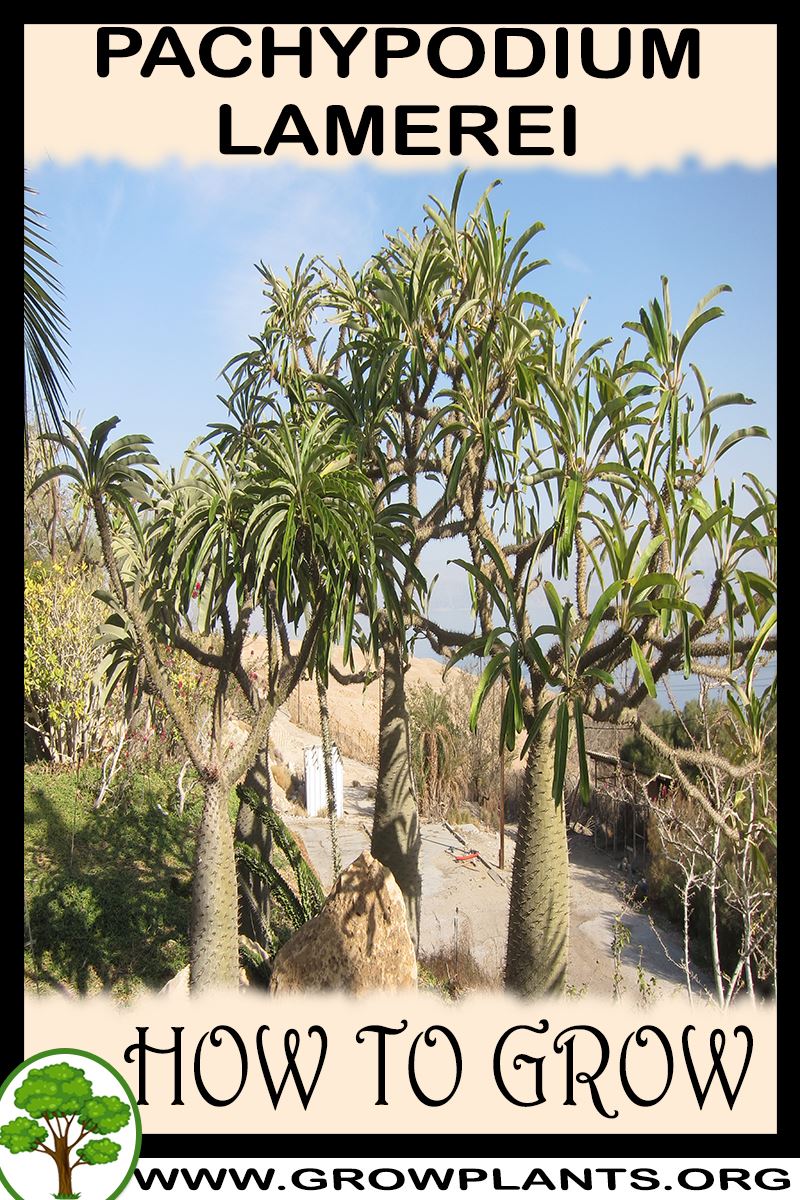
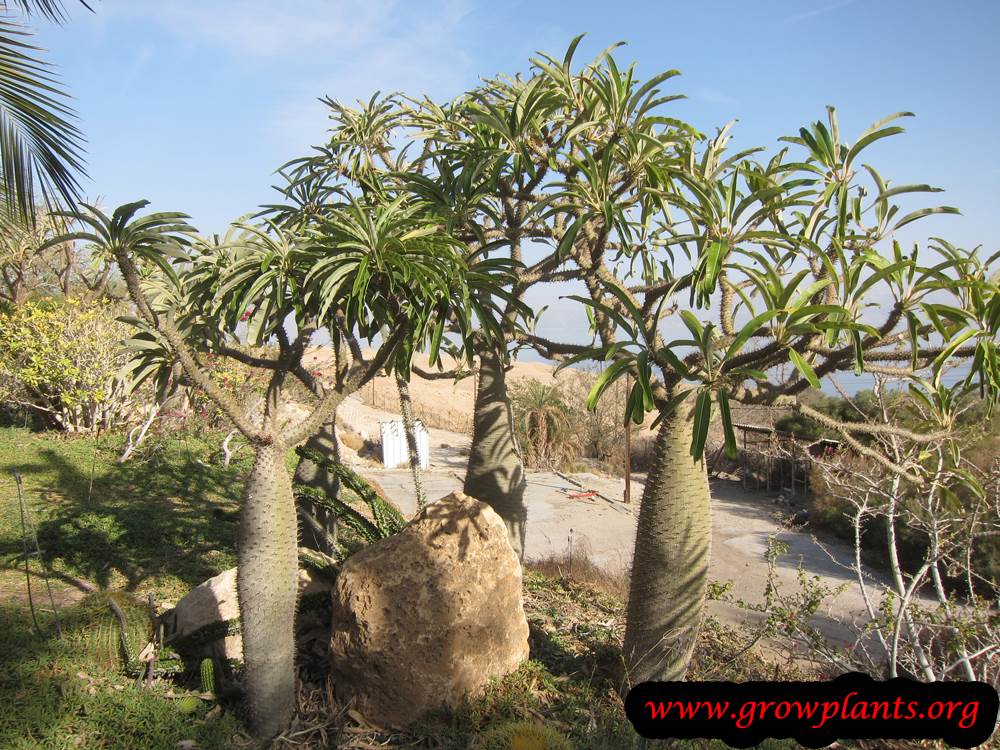
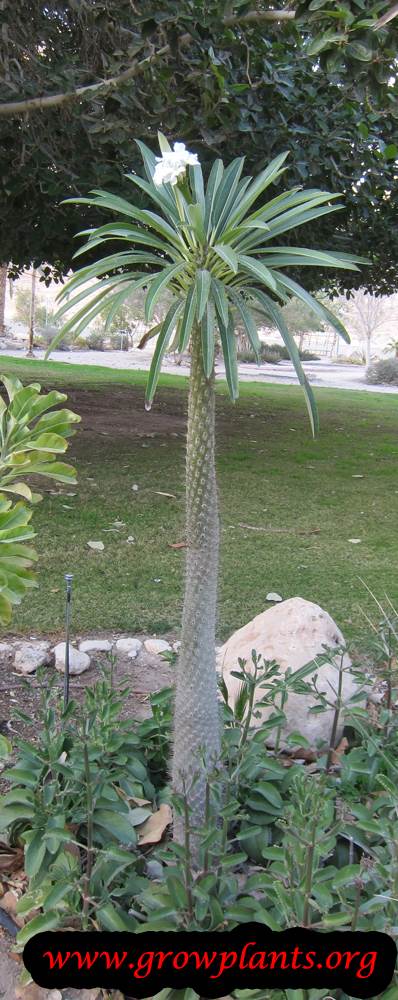
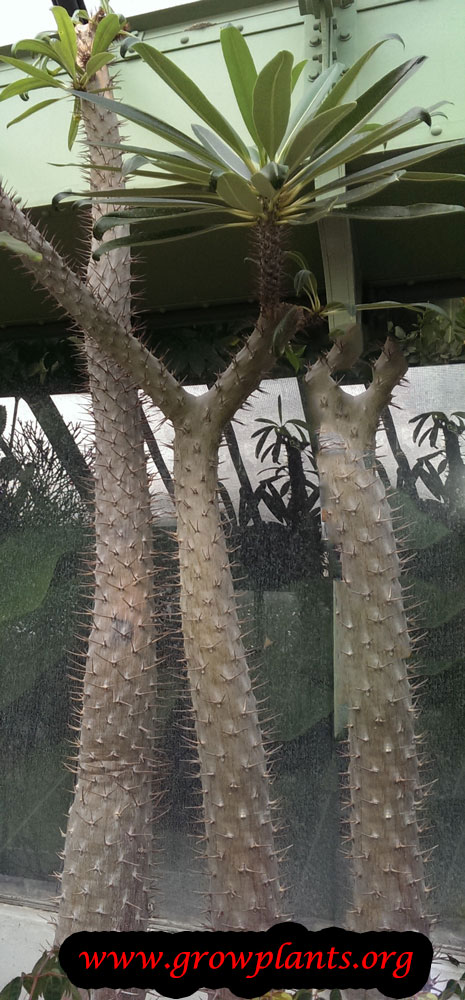
Overview: Pachypodium lamerei (Madagascar palm) is a succulent shrub or small tree reaching 1-6 m (3-24 ft), grown as a striking ornamental for its thick spiny bottle-shaped stem topped with a palm-like tuft of leaves. It is a caudex-forming succulent with a toxic latex, and is deciduous in the cool season.
Quick Specifications
| Specification | Attribute |
|---|---|
| Plant Type / Life Cycle | Perennial (succulent shrub / small tree) |
| Foliage Type | Deciduous |
| Mature Size | 1-6 m tall (3-24 ft) |
| Growth Rate | Slow to moderate |
| Toxicity | Toxic (milky latex); stem armed with sharp spines |
| Hardiness | USDA zones 10b-12 |
Growth Form & Structure
- Height & Spread: Reaches 1-6 m (3-24 ft) in the ground and is very well suited to containers, where it stays smaller.
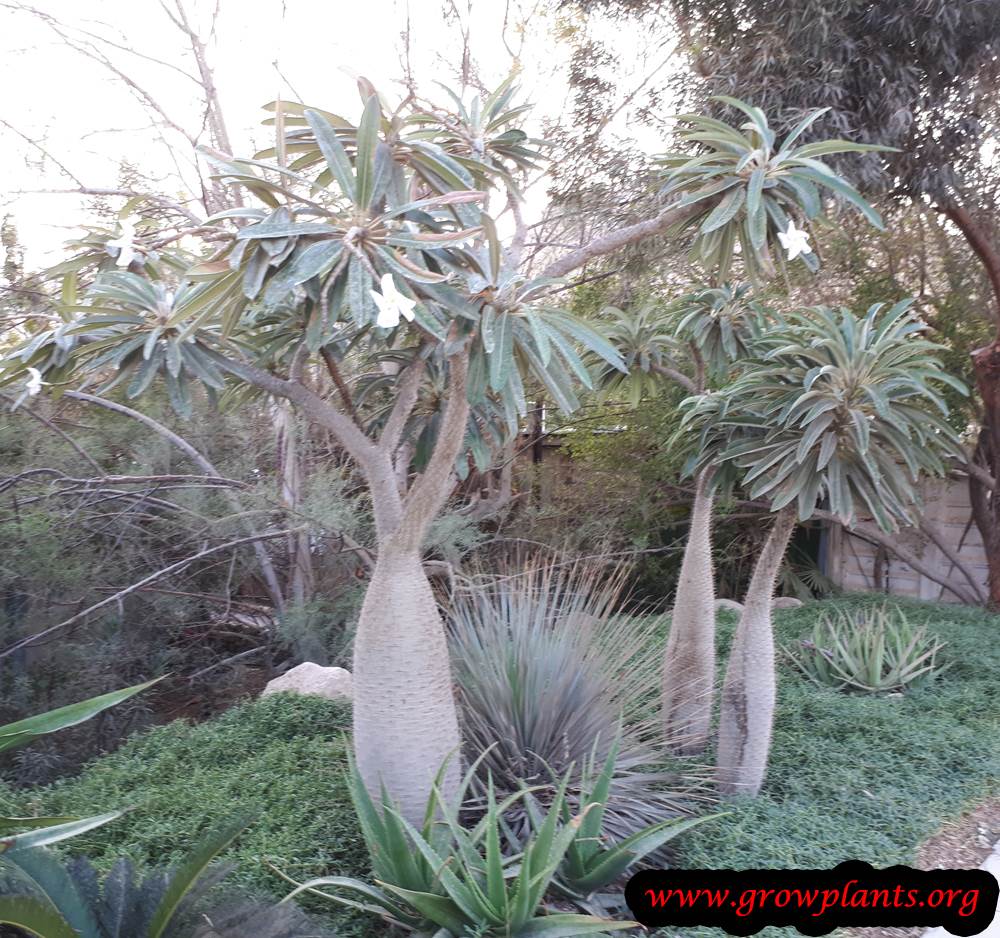
- Growth Habit & Form: Upright, usually single- or few-stemmed succulent with a swollen bottle-shaped base narrowing to a long neck; can be trained as a tree or shrub.
- Lifespan & Maturity: Long-lived and slow-growing, thickening its caudex over many years.
Anatomy & Physical Features
- Trunk & Bark: Thick brown succulent stem, wider at the base, densely covered in sharp spines.
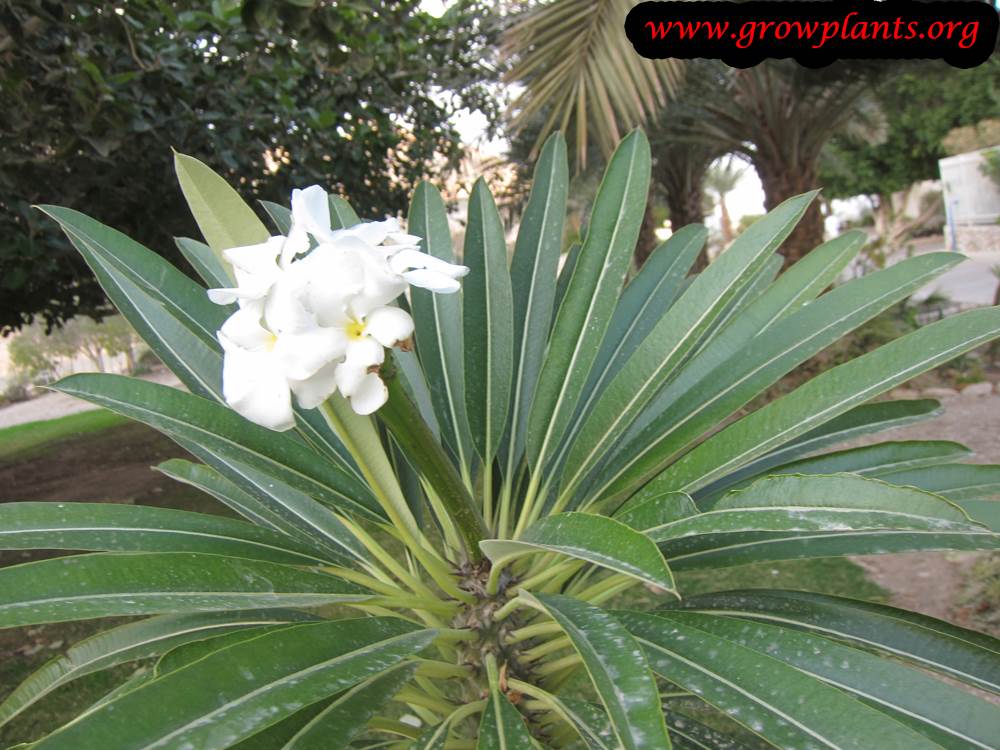
- Leaves & Foliage: Green, elliptic leaves with pointed tips clustered at the stem apex.
- Flower Characteristics: Fragrant white flowers with a yellow centre and five petals, borne on mature plants.
Primary Uses & Landscape Value
- Functional & Ornamental Roles: Sculptural ornamental and container/houseplant specimen for hot, dry-climate gardens.
Care Guide: Planting, Soil & Watering
Overview: The Madagascar palm is a succulent, drought-adapted plant that needs full sun to light shade and sharply drained soil. It stores water in its swollen stem, so it wants only light watering and cannot take more than a touch of frost.
Quick Care Requirements
| Requirement | Ideal Condition |
|---|---|
| Planting Season | In the warm season, from late winter into spring |
| Growth Rate | Slow to Moderate |
| Soil Type | Sharply drained, gritty or sandy succulent soil |
| Water Need | Low – let soil dry fully between waterings |
Planting & Establishment
- Best Planting Season: Plant in winter to spring as it comes into growth, once hard frost has passed (hardy only to zone 10b).
- How to Plant:
- Hole Preparation: Dig a hole to the depth of the root ball in very free-draining ground, and handle it carefully because of the sharp thorns.
- Soil Amendments: Add coarse sand, grit or pumice to guarantee fast drainage – never rich, moisture-holding soil.
- Planting Depth: Set the caudex (swollen base) at soil level; burying it invites rot.
- Growth Speed & Expectations: A slow-to-moderate grower that can eventually reach 1-6 m as a spiny, bottle-trunked specimen.
Soil, Watering & Drainage Care
- Soil Mix & Drainage Needs: Use a gritty cactus or succulent mix in a pot with drainage holes; standing moisture quickly rots the roots and stem.
- Watering Schedule & Technique:
- Young / Newly Planted: Water lightly and only when the soil has dried while the plant establishes.
- Established: Water sparingly, allowing the soil to dry out completely between waterings.
- Seasonal Adjustments: Water occasionally in warm growth and keep nearly dry through the cool, dormant winter.
Climate, Light & Hardiness
The Madagascar Palm is a caudex-forming succulent of hot, dry subtropical, Mediterranean and desert climates, thriving on strong light and warmth. It is only very lightly frost tolerant, so outdoor culture is limited to essentially frost-free warm-climate gardens.
Quick Climate Specifications
| Climate Zones | Subtropical, Mediterranean, desert (arid, warm) |
|---|---|
| USDA Hardiness Zones | 10b–12 (site data) |
| Optimal Temp Range | Approx. 21–32°C (70–90°F) |
| Cold Damage Begins | Around 2°C (36°F); soft growth and leaves are the first to suffer |
| Approx. Survival Minimum | Only very light, brief frost near 0°C (32°F) for an established plant |
| Frost Tolerance | Very Low |
| Light Conditions | Full sun to light (half) shade |
| Wind Tolerance | Moderate (sturdy trunk, but avoid knocking the spines) |
Sunlight & Light Exposure
Optimal Light Setup
Give it the brightest position available - full sun produces the sturdiest, most compact trunk and best leaf density.
Direct Sun Requirement
Direct sun is beneficial; only in the most intense desert summers does a little afternoon shade help young plants avoid stress.
Shade & Heat Management
Light half shade is tolerated but tends to produce softer, more etiolated growth. It handles high heat well when roots are dry.
Best Exposure / Orientation
A south- or west-facing wall or courtyard adds reflected warmth and helps push it through cool nights.
Temperature Extremes & Hardiness
USDA Hardiness & Regional Limits
Site data places it in zones 10b–12, i.e. essentially frost-free to warm. It is grown outdoors year-round only in these zones; elsewhere it is a container plant moved under cover for winter.
Cold Damage & Winter Protection
Growth slows and leaves drop as temperatures fall toward the low single digits Celsius; this deciduous behaviour in cool spells is normal. Keep the plant dry in cold weather, as cold combined with wet soil is far more damaging than cold alone.
Frost Sensitivity
Consistent with the site's “no more than light frost” guidance, only brief, light frost near 0°C (32°F) is survivable, and even then some tip and leaf damage should be expected.
Extreme Heat Tolerance
Excellent. As a desert succulent it thrives in high heat provided the root zone is not waterlogged.
Wind, Humidity & Microclimate
Humidity Preferences
Prefers dry to moderate air; low humidity is not a problem.
Dry-Air Tolerance
Very high - a defining trait of this arid-climate succulent.
Wind Tolerance
The thick trunk is wind-firm, though container specimens are top-heavy when leafy and may need staking or a sheltered spot.
Microclimate Recommendations
A warm, sunny, sharply drained pocket - raised bed, gravel garden or wall base - suits it best; cold, damp low spots should be avoided.
Growing in Pots, Balconies & Indoors
Pachypodium lamerei (Madagascar palm) is a spiny succulent that can reach 6 m in the wild but grows slowly in a pot. The grower does not list it as a houseplant, yet it is a well-known indoor succulent given the brightest light; while young it suits a sunny room, becoming a large specimen over time.
Quick Details
- Container Size: A pot sized to the trunk, potting up as it grows tall (general guide)
- Indoor Suitability: Grown indoors with intense direct light while young; gets large over years
- Best Spot: Full sun to half shade; the sunniest window indoors
- Soil & Drainage: Gritty, fast-draining cactus or succulent mix
- Watering in Pots: Sparingly – let the mix dry fully between waterings
Indoors & On the Windowsill
- Houseplant: The grower marks it No, but the Madagascar palm is commonly kept indoors as a succulent – it just needs all-day intense direct light. In weak light it stretches, drops leaves and rots.
- Windowsill growing: Give a young plant the brightest, sunniest window; rotate it and keep it warm and dry. Over years it grows too tall for a sill and needs a bright floor spot.
- Overwintering: Frost-tender – keep dry and above about 10 C in winter in a bright indoor spot.
On a Balcony or Patio
- Light & wind: It loves the hottest, sunniest, most sheltered spot and thrives on reflected wall heat. Keep rain off the pot in cool spells – it must never sit wet – and bring it in before frost.
- Practicalities: A heavy, well-draining pot suits the swollen trunk; handle carefully because of the spines.
Choosing the Pot, Soil & Long-Term Care
- Pot & drainage: A pot sized to the caudex with strong drainage – terracotta is ideal because it dries fast; Use a pot with strong drainage holes and skip a standing-water saucer to avoid root rot; terracotta breathes and dries out faster, while glazed or plastic pots hold moisture longer.
- Potting mix: Use a gritty, fast-draining cactus and succulent mix, adding extra perlite, pumice or coarse sand; wet, heavy soil rots the roots.
- Feeding: Feed lightly during active growth only; Potted plants use up their soil quickly because watering leaches nutrients away, so feed a little more often than plants in open ground through the growing season.
- Repotting: Pot up every few years as the trunk swells, handling the spines with care.
- Safety: The milky sap is toxic and irritant and the stems are fiercely spiny – keep it away from children and pets and wear gloves when handling.
Growing this plant in a greenhouse
A greenhouse can give pachypodium lamerei frost protection, cold protection, humidity control and extra warmth.
Greenhouse at a glance
| Greenhouse suitability | Conditional - depends on your climate |
|---|---|
| Main benefits | frost protection, cold protection, humidity control, extra warmth |
| Outdoor protection advisable below | about 2°C |
| Maintain greenhouse minimum | around 2°C for active growth |
| Suitable types | unheated greenhouse, polycarbonate greenhouse |
| Heating | Heating is optional - useful mainly for winter growing in cold areas. |
Related greenhouse guides
- Greenhouses: How to Choose the Right Greenhouse
- Polycarbonate Greenhouses: What to Look for Before Buying
- Greenhouse Climate Control: Temperature, Ventilation and Humidity
Fertilizing & Feeding
A very light feeder: a little dilute low-nitrogen fertilizer during the warm growing season is plenty, with none while the plant is dormant.
Quick Fertilizing Specs
| Feeding Level | Very light feeder |
|---|---|
| Main Nutrient Priority | Light, low-nitrogen feeding; avoid excess nitrogen |
| Best Feeding Period | The warm active growing season only |
| Organic Options | A gritty, fast-draining mix; go easy on rich organic matter |
| Reduce/Stop Feeding | Stop feeding through the cool-season dormant rest |
| Micronutrients | Rarely needed; a complete fertilizer covers trace needs |
| Soil pH | Slightly acidic to near neutral, in a fast-draining mix |
Feeding by Growth Stage
Warm-season active growth
Support modest warm-season growth while keeping the plant firm and compact.
| Nutrient direction | A dilute, low-nitrogen complete fertilizer; these plants need only light feeding. |
|---|---|
| Timing | During the warm active growing season. |
| Frequency | An occasional light feeding through the growing season. |
| Fertilizer types | A dilute low-nitrogen complete fertilizer, A specialized cactus and succulent fertilizer |
| Precautions | Avoid rich or heavy feeding, which produces weak, stretched growth and dulls the natural form. |
Cool-season dormant rest
Let the plant rest through its dormant period, when it may drop its leaves.
| Nutrient direction | None – withhold fertilizer while the plant is not in active growth. |
|---|---|
| Timing | During the cool-season dormant rest. |
| Frequency | No feeding at this stage. |
| Fertilizer types | No feeding at this stage; hold off fertilizing until active growth resumes. |
| Precautions | Do not fertilize while the plant is dormant and leafless; feed again only when new growth appears. |
Nutrient Deficiency Signs & Corrections
Growth turns soft, pale, and stretched, and the plant loses its compact form.
| Possible causes | excess nitrogen from over-generous feeding, feeding while light is too low to support the growth, a rich, moisture-holding mix instead of a gritty one |
|---|---|
| Appears first on | newest stems and leaves |
| What to check | how recently and heavily it was fed, light levels, whether the potting mix drains fast |
| Possible correction | Ease off feeding, move to brighter light, and let the plant firm up, then feed only lightly once strong growth resumes. |
Leaf margins brown or scorch and growth stalls despite adequate watering.
| Possible causes | fertilizer salt buildup in the root zone, under-watering that concentrates salts, excessive or too-frequent feeding |
|---|---|
| Appears first on | leaf margins and tips |
| What to check | recent fertilizer amounts, watering consistency, drainage, especially in containers |
| Possible correction | Ease off feeding, water thoroughly to flush accumulated salts, then return to lighter feeding. |
Overall growth pales and stalls, with older leaves losing color first.
| Possible causes | exhausted potting mix with little available nitrogen, nitrogen leaching from repeated watering, no feeding over a long period |
|---|---|
| Appears first on | older, lower leaves |
| What to check | how long since the mix was refreshed or fed, watering frequency, overall vigor and color |
| Possible correction | During the growing season, apply a dilute low-nitrogen complete fertilizer and refresh the mix if it is spent. |
Pruning, Training & Seasonal Maintenance
Pachypodium lamerei, the classic Madagascar Palm, is a tall, columnar deciduous succulent, single-stemmed and reaching up to about 6 m. This is a caudiciform succulent, not a shrub to be shaped: it does not tolerate structural or hard pruning. The thick, water-storing stem is prone to rot at any cut, so pruning is limited to removing damaged or rotten tissue with a clean, dry, warm-season cut. Cutting the growing tip will force branching but opens a large wound on a moisture-filled stem, so it is a deliberate, risky choice rather than routine maintenance.
Quick Pruning & Maintenance Specs
| Pruning Tolerance | Low — succulent stem, high rot risk |
| Primary Pruning Window | Warm active growth (so cuts callus fast) |
| Secondary Maintenance Window | None routine — damage removal only |
| Typical Frequency | Rarely; only when tissue is damaged or rotten |
| Main Objective | Remove damaged/rotten tissue, protect the stem |
| Young Plant Priority | None — let the natural form develop |
| Mature Plant Priority | Remove only damaged tissue; no shaping |
| Best Tool Type | Sterile sharp knife; snips for thin leaf/flower stems |
| Avoid Heavy Pruning During | Winter dormancy and any cold, wet spell |
Pruning by Plant Age & Size
Newly Established
Do not cut at all beyond removing clearly dead or rotten tissue. It is medium-to-slow growing from 1 up to 6 m on a single trunk.
Young / Formative
No structural training — it grows as a spined column crowned with a leaf rosette, mimicking a palm. The plant builds its own shape and does not need or benefit from formative cuts.
Mature / Established
Remove only damaged, sunscorched or rotting branch tips. Any shaping cut is optional and carries rot risk.
Grown as a tall, columnar single-stemmed “palm”, it has effectively one growing point. Topping it to induce branching permanently ends the clean single leader and risks rot at a wide cut — only do so knowingly, in warm active growth, and keep the wound bone dry afterwards.
Seasonal Pruning Schedule
Warm growing season: the only safe time for any cut, so the wound calluses quickly. Although the plant is deciduous and rests in winter, cuts made in that cold, dormant period heal slowly and readily rot — so despite the temptation to prune the bare plant in winter, hold any needed cut until warm active growth.
Ongoing sanitary: remove rotten or badly damaged tissue whenever it appears, then keep the wound dry.
Special Growth to Remove
- Rotten or damaged branch tips only — cut back to firm, healthy tissue.
- Fragrant flowers arise on the current season’s stems; there is no persistent flowering wood to manage, so simply snip spent flower stalks if desired.
Container & Small-Space Pruning
Very commonly grown in containers and indoors, where the same rule holds: do not hard-prune. Keep it dry after any cut, in a warm bright spot, so the wound calluses rather than rots. Root disturbance is a bigger risk than any top pruning.
Tools
A sterile, very sharp knife or grafting knife gives the clean flat cut a succulent needs; precision snips handle thin leaf or flower stems. Wear thick gloves — the stem is spined and the sap is toxic. Loppers and saws are never appropriate.
Tool Hygiene & Disease Risk
High-risk: an open succulent wound is an entry point for rot fungi and bacteria, so disinfect the blade before cutting, make one clean pass, and let the wound callus dry. This is the one situation where blade sterilising genuinely matters — because of rot, not a transmissible plant disease.
Cut Placement & Technique
Make a single clean, flat cut back to firm tissue; do not leave a crushed or ragged wound. Allow it to callus in dry, warm, airy conditions, and keep water off the cut surface.
Heavy Pruning & Rejuvenation
Not tolerated. There is no renewal or rejuvenation pruning for this plant: the succulent stem and few growing points mean hard cutting risks fatal rot and will not reliably regenerate a better form. Do not attempt to cut it back to reshape an old plant.
Post-Pruning Care
Withhold water after any cut and keep the plant warm, bright and dry until the wound has fully callused. Do not feed — feeding and watering a fresh succulent wound invites rot.
Common Pruning Mistakes
- Cutting the stem or caudex to “shape” it — the classic route to stem rot.
- Pruning during the cold, wet winter dormancy when wounds cannot callus.
- Watering or feeding straight after a cut.
When NOT to Prune
Do not prune during winter dormancy, in cold or wet conditions, or soon after repotting. If in doubt, leave it alone — this plant is healthiest uncut.
Recommended Tools (by task)
- grafting_knife — a sterile, sharp blade for the clean flat cut a succulent stem needs.
- precision_snips — for thin leaf or spent flower stems only.
- blade_disinfectant — sterilise before cutting to keep rot organisms out of the open wound.
Propagation Guide
Madagascar Palm is grown from seed, the standard method, and normally makes a single unbranched trunk, so cutting material is scarce unless the growing tip has been damaged and side branches form. Grafting is not needed; difficulty is moderate — germination is easy but the plant grows slowly.
Quick Propagation Specs
| Best Propagation Method | Seed |
| Alternative Methods | Branch cuttings (only if the plant has branched) |
| Propagation Difficulty | Moderate |
| Seed True-to-Type | Usually true-to-type (species) |
| Vegetative True-to-Type | Yes |
| Best Propagation Season | Spring into warm weather |
| Germination Temperature | 25–30°C (77–86°F) |
| Seed Sowing Depth | Barely covered in a gritty mix |
Growing from Seed
Seed Handling & Viability
Sow fresh seed; viability drops with age.
Dormancy & Pre-Sowing Treatment
None required; an optional short warm-water soak can help.
Sowing Season
Spring or warm weather, in line with the site’s winter–spring planting.
Sowing Depth & Orientation
Barely cover in a gritty, free-draining mix.
Germination Conditions
Warm at about 25–30°C (77–86°F), bright, lightly moist.
Germination Time
Usually within a few weeks under warmth, sometimes staggered.
Seedling Care
Keep drainage sharp, water sparingly, and protect from frost.
Stem Cuttings
Cutting Type
Only feasible when side branches have formed after the trunk tip was damaged; a solitary-stemmed plant offers no cutting material.
Cutting Preparation
Let the cut callus for several days, then set in a gritty, barely-moist mix.
Rooting Time
Slow and less certain than seed; keep the base only just moist to avoid rot.
Bloom & Flower Guide
Quick Details
- Bloom Season: Spring to summer
- Time to First Bloom: Once the plant matures (perennial succulent)
- Flower Appearance: Fragrant white flowers with a yellow centre and five petals
- Edibility: Not eaten – grown as an ornamental (the sap can irritate)
Detailed Blooming Overview
Pachypodium lamerei – the classic Madagascar palm – carries fragrant white, yellow-centred five-petalled flowers through spring and summer, atop its tall spiny trunk.
Flower Characteristics
- Fragrant five-petalled white flowers with a yellow eye; petals may partly merge.
Bloom Care & Pollination
- Pollination: Insects – the fragrance draws pollinators.
Pests, Diseases & Troubleshooting
Overview: The Madagascar palm (Pachypodium lamerei) is a spiny, caudex-forming succulent in the Apocynaceae. It is genuinely tough and nearly pest-free outdoors; its real killer is rot – soft, collapsing stems and roots when kept cold and wet. Under glass or indoors the usual succulent sap-suckers (mealybugs, mites, scale) appear. Sharp drainage and warmth are everything.
Quick Troubleshooting Overview
| Issue / Pest | Main Symptom | Primary Solution |
|---|---|---|
| Stem / root rot | Soft, blackening, foul base; collapse | Dry, warm, gritty mix; cut to clean tissue; withhold water |
| Mealybugs | White cottony tufts at spines and growth tip | Alcohol swab, horticultural oil, isolate |
| Spider mites | Fine stippling/bronzing on new growth | Raise humidity, wash foliage, oil/soap |
| Scale | Brown bumps on stem, honeydew | Scrape off, horticultural oil |
| Sunscald | Bleached/scorched patch after a move | Acclimatise gradually to full sun |
| Winter rot / edema | Blistering or rot in cold damp | Keep dry and above ~10C in winter |
Common Pests & Management
- Mealybugs (Planococcus, Pseudococcus spp.):
- Symptoms: White cottony tufts in leaf axils, shoot tips and among roots of potted plants; honeydew, sooty mould and stunted, distorted growth.
- Prevention & Control: Dab with an alcohol-tipped swab, drench roots if infested, and isolate affected plants. Horticultural oil or insecticidal soap repeated at intervals; quarantine new arrivals.
- Spider Mites (Tetranychus urticae):
- Symptoms: Fine pale stippling turning leaves dull bronze, with delicate webbing beneath in hot, dry air; heavy attack scorches and drops leaves.
- Prevention & Control: Raise humidity and hose down foliage, conserve predatory mites, and treat hot-spots with insecticidal soap or horticultural oil on the undersides.
- Scale Insects (Aspidiotus nerii, Saissetia spp.):
- Symptoms: Brown, grey or white limpet-like bumps encrusting stems and leaf undersides; yellow spotting, honeydew (soft scales) and sooty mould, and slow decline.
- Prevention & Control: Prune out heavily encrusted wood, encourage parasitic wasps and lady beetles, and wash off honeydew. Horticultural oil smothers crawlers – repeat to catch successive hatches; treat in cool conditions.
- Aphids (Aphis spp.):
- Symptoms: Small colonies on soft new shoot tips and flower buds with honeydew; occasional and minor on this succulent.
- Prevention & Control: Hose off or wipe away, encourage beneficials, and use insecticidal soap only if colonies build.
Diseases & Fungal Issues
- Stem & Root Rot (Fusarium, Pythium, Erwinia (bacterial)):
- Symptoms: The number-one problem: a soft, brown-to-black, sometimes foul-smelling rot at the base or into the trunk after cold, wet or overwatered conditions; the plant collapses or the top topples.
- Treatment & Management: Prevention is key – gritty free-draining mix, warmth, and very sparing water (almost none in cool weather). If caught early, cut back to firm clean tissue, dust with sulfur/fungicide, keep dry and warm to callus; heavily rotted plants are usually lost.
- Fungal Leaf Spot (Cercospora, Alternaria, Phyllosticta spp.):
- Symptoms: Brown or grey rounded spots, sometimes with yellow halos, on leaves in warm, humid, wet-leaf conditions; heavy spotting causes leaf drop.
- Treatment & Management: Improve airflow, avoid overhead watering, and remove spotted and fallen leaves. A copper fungicide protects new growth under persistent wet pressure.
Growing Difficulties & Abiotic Problems
- Sunscald:
- Cause & Symptoms: A sudden move from shade into fierce full sun bleaches and scorches soft trunk tissue and leaves.
- Correction Strategy: Acclimatise gradually to stronger light over a couple of weeks; provide light shade in the most intense midday sun in hot climates.
- Cold Damage & Winter Overwatering:
- Cause & Symptoms: Temperatures near or below ~10C, especially combined with wet soil, cause blackening, leaf drop and rot; the plant is naturally leafless and dormant in cool spells.
- Correction Strategy: Keep above about 10C, move under cover for winter, and withhold water during cold dormancy – dry cold is survivable, wet cold is not. Normal winter leaf drop is not a fault.
- Edema:
- Cause & Symptoms: Cool, overcast, over-wet conditions make cells burst, leaving corky blisters on leaves/stem.
- Correction Strategy: Reduce watering in dull, cool weather and improve airflow and light.
What Helps – Products & Tools
For this succulent, less is more: a gritty free-draining mix and restraint on water prevent most trouble, with sulfur or a fungicide dust for cut rot wounds, horticultural oil and alcohol swabs for mealybugs and scale, and insecticidal soap for mites. Note the milky sap is toxic – wear gloves.