

Plant Profile & Key Characteristics
Overview: Darmera peltata (Indian Rhubarb / Umbrella Plant) is a large-leaved rhizomatous perennial reaching 1-2 m, deciduous and grown as a bold ornamental groundcover. Its dramatic round leaves colour red in autumn and its stalks are edible when peeled.
Quick Specifications
| Specification | Attribute |
|---|---|
| Plant Type / Life Cycle | Perennial |
| Foliage Type | Deciduous |
| Mature Size | Height 1-2 m (40-80 in) |
| Growth Rate | Slow |
| Root System | Rhizomatous (spreading rhizomes) |
| Toxicity | Non-toxic (leaf stalks edible when peeled) |
| Hardiness | USDA zones 5-9 |
Growth Form & Structure
- Height & Spread: Forms a spreading clump 1-2 m (40-80 in) tall; can be grown in a large container but is happiest in moist ground beside water.
- Growth Habit & Form: Rhizomatous, clump-forming perennial with tall stalks holding large, umbrella-like parasol leaves.
- Lifespan & Maturity: Long-lived perennial spreading steadily by rhizomes; slow to bulk up.
Anatomy & Physical Features
- Leaves & Foliage: Large, round, lobed green leaves that turn red in autumn, carried on tall stalks; the peeled leaf stalk is edible.
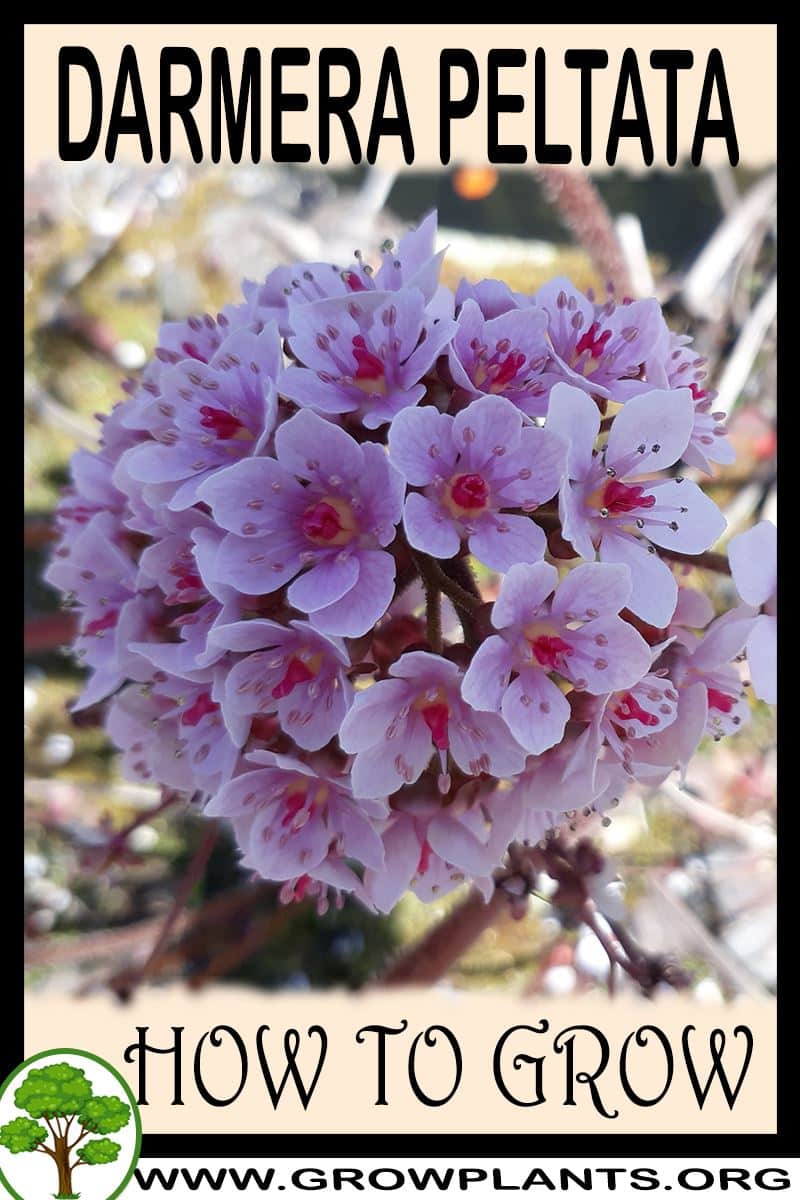
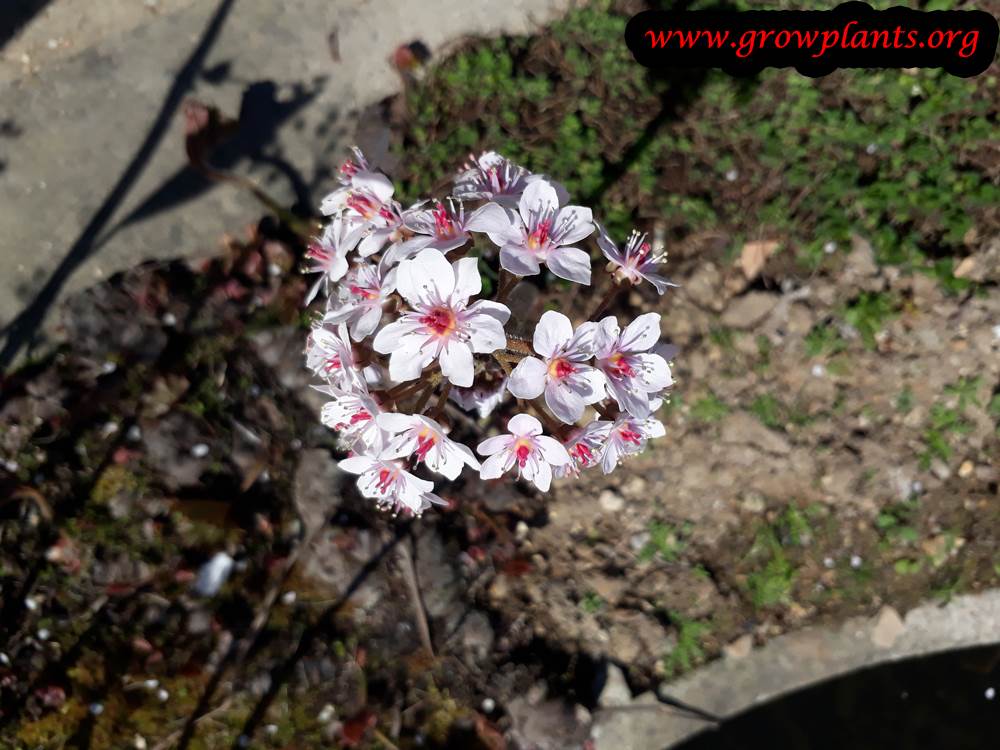
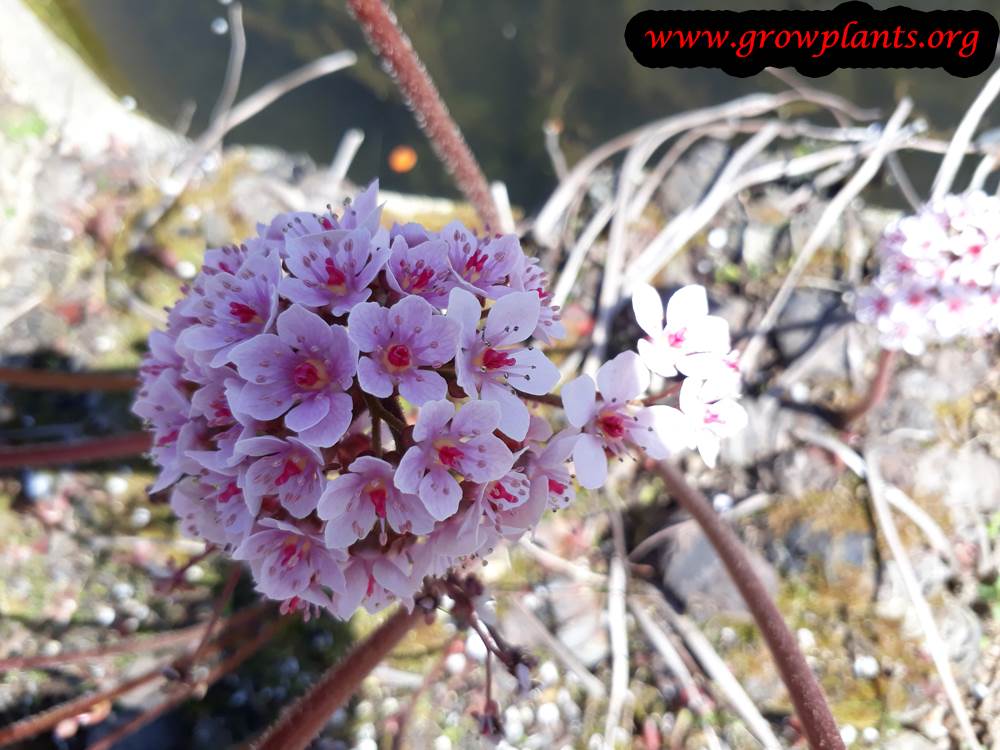
- Flower Characteristics: Domed clusters of pink, five-petalled flowers held on bare stems before the leaves expand (full detail in the Bloom guide).
Primary Uses & Landscape Value
- Edible Uses: The leaf stalks are edible once peeled.
- Functional & Ornamental Roles: Bold ornamental groundcover for pond margins, bog gardens and moist shade.
Care Guide: Planting, Soil & Watering
Overview: Darmera is a waterside perennial that loves consistently moist to wet soil and thrives beside ponds or in boggy ground. It grows slowly but spreads by rhizomes, and it tolerates full sun where the soil stays reliably damp.
Quick Care Requirements
| Requirement | Ideal Condition |
|---|---|
| Planting Season | Spring through autumn (the warm season) |
| Growth Rate | Slow |
| Soil Type | Moist to wet, humus-rich soil |
| Water Need | High – keep the soil consistently moist |
Planting & Establishment
- Best Planting Season: Plant during the growing season, from spring through autumn.
- How to Plant:
- Hole Preparation: Dig a hole a little wider than the root ball in ground that holds moisture – ideal beside water.
- Soil Amendments: Mix in plenty of compost or organic matter to help the soil retain moisture.
- Planting Depth: Set the rhizome so the root collar sits at soil level.
- Growth Speed & Expectations: Slow to establish, then spreads steadily by rhizomes to form a colony.
Soil, Watering & Drainage Care
- Soil Mix & Drainage Needs: Moisture-retentive, humus-rich soil; unlike most plants it accepts wet ground and boggy sites.
- Watering Schedule & Technique:
- Young / Newly Planted: Keep constantly moist while it establishes.
- Established: Never let it dry out; water generously, especially in sun.
- Seasonal Adjustments: Reduce in winter as it dies back (it is deciduous); increase in summer heat.
Climate, Light & Hardiness
Indian rhubarb is a moisture-loving woodland-edge and streamside perennial from temperate and subtropical climates, tolerating full sun to full shade with reliable moisture and having good general cold hardiness.
Quick Climate Specifications
| Climate Zones | Temperate, Subtropical |
|---|---|
| USDA Hardiness Zones | 5–9 |
| Frost Tolerance | High |
| Light Conditions | Full Sun to Full Shade |
Sunlight & Light Exposure
Optimal Light Setup
Tolerates a wide range from full sun to full shade, provided the soil stays consistently moist; more sun with reliable moisture brings out the best autumn leaf color.
Direct Sun Requirement
Full sun is fine as long as moisture is constant; without it, some shade is safer.
Shade & Heat Management
In hot climates or drier sites, more shade helps prevent leaf scorch.
Best Exposure / Orientation
Streamside, pond-margin, or boggy garden positions suit it best.
Temperature Extremes & Hardiness
USDA Hardiness & Regional Limits
Hardy in zones 5–9.
Cold Damage & Winter Protection
Deciduous and cold hardy within its range, dying back naturally each winter and resprouting from the rhizome in spring.
Frost Sensitivity
New spring growth can be nipped by a late frost, but the rhizome itself is hardy.
Extreme Heat Tolerance
Moderate; needs consistent moisture, or more shade, to handle hot summers well.
Wind, Humidity & Microclimate
Humidity Preferences
Prefers humid, streamside-type conditions.
Dry-Air Tolerance
Poor; this is fundamentally a bog/streamside plant.
Rainfall & Seasonal Moisture
Needs consistently moist to wet soil; it is not drought tolerant and struggles if allowed to dry out.
Microclimate Recommendations
A pond-edge, streamside, or boggy microclimate best replicates its native habitat.
Growing in Pots, Balconies & Indoors
The umbrella plant (Darmera peltata) is a bold, moisture-loving foliage plant that the grower confirms can be grown both indoors and in containers. It is large and thirsty, so give it a big pot, a cool bright spot, and never let it dry out.
Quick Details
- Container Size: 30-50 L (8-13 gal) – it is a big, 1-2 m plant with a spreading rhizome
- Indoor Suitability: A genuine houseplant per the grower; treat it as a large, moisture-hungry foliage specimen in bright, cool light
- Best Spot: Bright light to part shade; it even tolerates full shade, so an interior spot away from scorching sun suits it
- Soil & Drainage: Rich, moisture-retentive mix with plenty of organic matter
- Watering in Pots: Keep the mix constantly damp – stand the pot in a shallow saucer of water and never let it bake
Indoors & On the Windowsill
- As a houseplant: The grower confirms it grows indoors. Give it a large pot, bright indirect light and steady moisture; it handles shade better than most, so a cooler, low-sun room is fine.
- Windowsill: Only a young or divided plant fits a sill – full-grown leaves are big; keep the roots wet and the air humid.
- Cool rest: This is a hardy waterside perennial – it appreciates a cooler winter and can spend the warm months outdoors on a shady, damp patio.
On a Balcony or Patio
- Light & shelter: Ideal for a shady, sheltered corner; keep it out of hot midday sun and drying wind, which scorch and wilt the big leaves.
- Practicalities: A full, wet pot is heavy – stand it where the weight and drainage runoff are not a problem, ideally in a water-holding saucer.
Choosing the Pot, Soil & Long-Term Care
- Pot & drainage: A roomy pot with drainage holes; because this plant likes it damp, a plastic or glazed pot holds moisture better than terracotta, but still let excess water escape.
- Potting mix: A rich, moisture-retentive mix with added organic matter; it should stay damp yet still drain.
- Feeding: Potted plants need feeding more often than those in the ground, as watering leaches nutrients away; a balanced liquid feed through the growing season is enough.
- Repotting: Refresh the top of the mix each year and pot on or divide every couple of years, lightly trimming roots and old growth to keep it vigorous.
Fertilizing & Feeding
Darmera peltata is a slow-growing, moisture-loving perennial that thrives with only light, infrequent feeding rather than a rich feeding program.
Quick Fertilizing Specs
| Feeding Level | Light feeder – a slow-growing rhizomatous perennial that does not need rich feeding. |
|---|---|
| Best Feeding Period | Early spring through summer, while the plant is in active leaf growth. |
| Soil pH | Tolerates a wide range but performs best in soil that stays consistently moist and humus-rich. |
| Organic Options | Compost or well-rotted organic matter worked into the moist soil suits this bog-garden perennial well. |
| Reduce/Stop Feeding | Ease off and stop feeding as the foliage colors and dies back in autumn. |
Feeding by Growth Stage
Spring Emergence
Support the flush of new rhizome growth and flower stalks as Darmera peltata breaks dormancy in spring.
| Nutrient direction | A balanced, nitrogen-forward feeding encourages strong new foliage and stalk growth without overwhelming the plant. |
|---|---|
| Timing | As new growth emerges from the rhizome in early spring, before leaves fully unfurl. |
| Frequency | A single light feeding at the start of the growing season is usually sufficient; avoid repeated heavy applications. |
| Fertilizer types | A balanced, granular or slow-release fertilizer suited to moisture-loving perennials, Well-rotted compost or organic matter worked into the moist soil around the rhizome |
| Precautions | Avoid concentrated fertilizer placed directly against the rhizome; keep any granular product away from the crown to prevent burn. |
Active Growth (Late Spring-Summer)
Maintain steady leaf growth and plant vigor through the moist, warm growing season.
| Nutrient direction | Continue with a balanced feeding approach; nitrogen needs ease off once the foliage canopy is established. |
|---|---|
| Timing | Through late spring and summer while the plant is actively producing leaves. |
| Frequency | Light, occasional feeding through the growing season is enough for this slow-growing perennial; more is not better. |
| Fertilizer types | A balanced complete fertilizer at a light rate, Organic matter or compost top-dressing to sustain the moisture-rich soil this plant favors |
| Precautions | Because Darmera peltata is naturally slow growing, resist the urge to push growth with frequent or concentrated feeding – light, occasional feeding is usually plenty. |
Autumn Dieback and Winter Rest
Let the plant transition to natural winter dormancy as the deciduous foliage colors and dies back.
| Nutrient direction | None – withhold fertilizer as the rhizome moves into dormancy. |
|---|---|
| Timing | From autumn leaf coloring through winter, while the rhizome is dormant below ground. |
| Frequency | No feeding at this stage; resume only after new spring growth appears. |
| Fertilizer types | No feeding is appropriate once leaves begin to color and die back for winter. |
| Precautions | Do not fertilize during dormancy; wait until new growth resumes in spring. |
Nutrient Deficiency Signs & Corrections
Older, lower leaves turn pale green to yellow while new growth stays smaller than expected.
| Possible causes | Insufficient nitrogen availability in the soil, Soil that has become compacted or waterlogged, limiting root uptake, Naturally low-fertility garden soil that has never been amended with organic matter |
|---|---|
| Appears first on | Older, lower leaves first |
| What to check | Overall soil fertility and organic matter content, Whether the site drains poorly or stays waterlogged, Root health and any signs of rot at the rhizome |
| Possible correction | Work compost or a balanced fertilizer lightly into the soil around the root zone and confirm drainage is adequate before assuming a nutrient cause. |
New leaves emerge pale yellow with the veins remaining distinctly green.
| Possible causes | High soil pH limiting iron availability, Overly wet or compacted soil restricting root function, Root stress from recent transplanting or division |
|---|---|
| Appears first on | Newest leaves first |
| What to check | Soil pH and drainage conditions around the rhizome, Whether the plant was recently divided or transplanted, General root health |
| Possible correction | Correct pH toward the acidic-to-neutral range this plant prefers, or apply a chelated iron product per its label if a true iron deficiency is confirmed. |
General leaf yellowing, wilting despite moist soil, or stunted new growth from the rhizome.
| Possible causes | Soil staying saturated rather than evenly moist, leading to root oxygen deprivation, Nutrient lockout caused by poor drainage rather than true nutrient shortage, Rhizome rot from prolonged standing water |
|---|---|
| Appears first on | Whole-plant decline, often starting with newer shoots |
| What to check | Whether the planting site drains at all or simply stays waterlogged, Rhizome firmness and any signs of rot, Root color and smell for rot indicators |
| Possible correction | Improve site drainage while keeping soil consistently moist rather than stagnant, and hold off on fertilizer until root health recovers. |
Pruning, Training & Seasonal Maintenance
Darmera peltata is a deciduous, rhizomatous herbaceous perennial grown for its bold, umbrella-like foliage in moist or boggy ground. It has no woody structure, so care is limited to seasonal cutback rather than structural pruning. Notably, its pink flower clusters emerge on bare stalks in spring before the large round leaves unfurl, so there is no flowering wood to protect when cutting back – the safest and most useful time to tidy the clump is winter, once the foliage has died back and turned color for the season.
Quick Pruning & Maintenance Specs
| Pruning Tolerance | High (herbaceous, dies back naturally) |
| Primary Pruning Window | Winter, after foliage has died back |
| Typical Frequency | Once yearly cutback, plus light tidying through the season |
| Main Objective | Remove dead foliage and spent flower stalks; keep the rhizome clump tidy |
| Young Plant Priority | No pruning needed while establishing |
| Mature Plant Priority | Winter cutback of dead leaves; thin an overcrowded rhizome clump if needed |
| Best Tool Type | Bypass secateurs or precision snips |
Pruning by Plant Age & Size
Newly Established
No pruning needed – allow the clump and rhizome network to establish undisturbed.
Young / Formative
No structural training applies to this spreading, rhizomatous groundcover.
Mature / Established
Each winter, once the large lobed leaves have died back (often after turning red in autumn), cut the old foliage down to the base to tidy the clump ahead of the following spring’s bare-stalk flower display.
Seasonal Pruning Schedule
Dormant/Winter
Objective: seasonal cleanup after foliage dieback. Remove: dead leaves and old flower stalks. Do not remove: the rhizomes themselves, which carry the plant through to spring. Expected response: fresh flower stalks emerge from the rhizomes in spring, followed by new leaves. Flowering impact: none – flowers arise from the rhizome the following spring, independent of the previous season’s dead leaf growth.
Special Growth to Remove
Remove dead leaves at the base once they have browned off for the season. After the spring flower clusters fade (before the leaves have fully emerged), the spent flower stalks can also be cut out at their base.
Structural Pruning & Training
No branch/stem framework applies; the only “structural” consideration is thinning or dividing an overcrowded rhizome clump every few years to maintain vigor and control spread in its moist groundcover setting – this is a division task rather than a pruning cut.
Container & Small-Space Pruning
Can be grown in a large container or indoors given consistently moist soil; the same winter foliage cutback applies, and a container will naturally limit the rhizome spread that would otherwise need dividing in the ground.
Tools
- Bypass secateurs or precision snips – cutting back the large soft leaf stalks and spent flower stems.
Tool Hygiene & Disease Risk
Routine – clean tools are sufficient; no specific disease risk documented for this species.
Cut Placement & Technique
Cut dead leaf and flower stalks close to the base where they emerge from the rhizome, rather than leaving long stubs.
Post-Pruning Care
Keep the moist-to-boggy soil this species requires consistently damp through winter; no special aftercare beyond that.
Common Pruning Mistakes
- Cutting back foliage too early, before it has naturally died down and returned reserves to the rhizome.
- Disturbing or cutting into the rhizomes while tidying leaves.
When NOT to Prune
Avoid cutting back foliage while it is still green and functional in summer/autumn – wait until it has died down for winter.
Recommended Tools (by task)
- precision_snips – cutting spent flower stalks at the base in spring.
- bypass_secateurs – the larger winter cutback of dead leaf stalks.
Propagation Guide
Darmera peltata is most easily and reliably propagated by dividing its spreading rhizomes, which quickly re-establish moisture-loving colonies identical to the parent plant; seed propagation is also possible and generally comes reasonably true from this species, but it is slower and needs consistently damp conditions to germinate. Division makes this an easy plant to propagate, while raising it from seed is only moderately more demanding.
Quick Propagation Specs
| Best Propagation Method | Rhizome division |
| Alternative Methods | Seed |
| Propagation Difficulty | Easy (division); Moderate (seed) |
| Seed True-to-Type | Usually true-to-type |
| Vegetative True-to-Type | Yes |
| Best Propagation Season | Division in early spring before new leaves emerge, or in autumn; seed sown in spring |
| Seed Germination Time | Several weeks, often uneven |
| Germination Temperature | 15–20°C (59–68°F) |
| Seed Sowing Depth | Surface-sow or barely cover; fine seed benefits from light |
Growing from Seed
Seed Handling & Viability
Seed is fine and dust-like, typical of the Saxifragaceae; use reasonably fresh seed where possible, as viability in fine perennial seed like this tends to decline in storage.
Sowing Season
Spring, once hard frosts have passed, matching the plant’s own spring-summer-autumn planting window.
Sowing Depth & Orientation
Surface-sow or barely cover; press gently into a moist, humus-rich mix rather than burying.
Germination Conditions
Keep the mix constantly moist, echoing this species’ natural streamside and boggy habitat, in bright but indirect light and cool-to-moderate warmth around 15–20°C (59–68°F).
Germination Time
Germination can be slow and irregular, often taking several weeks; do not let trays dry out while waiting.
Seedling Care
Keep seedlings consistently damp at every stage and pot on once several true leaves have formed; this moisture-loving species will not tolerate drying out even briefly.
Rhizomes, Tubers, Bulbs & Corms
Darmera peltata spreads by thick, creeping rhizomes (as reflected in the plant’s own genus description), and rhizome division is the standard and most dependable way to increase it and to produce flowering-size plants quickly. Lift or expose a section of rhizome in early spring, before new leaves push up, or in autumn, and cut it into pieces roughly 10–15cm long, making sure each division carries at least one healthy growth bud and some fibrous roots. Replant divisions immediately, just below the soil surface, in the consistently moist, humus-rich ground this plant prefers, and keep them well watered until new leaves confirm establishment.
Bloom & Flower Guide
Quick Details
- Bloom Season: Spring – the flowers appear before the leaves
- Flower Appearance: Rounded, ball-shaped clusters of small pink five-petalled flowers on tall bare stalks
- Edibility: The flowers are ornamental only; the leaf stalks are edible when peeled, but that does not make the flowers a food
Detailed Blooming Overview
Umbrella plant has a striking way of flowering: in early spring the bare flower stalks push straight up from the ground and open their rounded pink heads before a single leaf has appeared. Only afterwards do the big, umbrella-like leaves unfurl. It is a waterside and bog plant, and the show is best where the soil stays reliably wet.
Flower Characteristics
- Small pink flowers, each with five petals.
- Gathered into rounded, ball-shaped clusters.
- Held on tall, leafless stalks that rise before the foliage.
Bloom Care & Thinning
- Encouraging bloom: Constantly moist, boggy soil at a pond or stream edge suits it best and gives the strongest spring display.
- Sequence: Expect the naked flower stalks first, with the large leaves following once flowering is under way.
Fruit & Uses
The edible part of Darmera peltata (Indian rhubarb, umbrella plant) is the young leaf stalk (petiole), which is peeled before eating. The peeled stalk can be eaten raw with a tart, rhubarb-like crunch or cooked in the same way rhubarb stalks are used.
Quick Edible Specs
| Edible Parts | Leaf stalks (petioles) |
|---|---|
| Main Use(s) | Culinary – eaten fresh or cooked, rhubarb-style |
| Eaten Raw or Cooked | Either; raw for a tart snack, cooked for a softer texture |
| Preparation Required | Peel the outer skin before eating |
| Harvest Season | Spring, while stalks are young and tender |
| Storage | Best used fresh soon after cutting; does not store long once peeled |
| Safety/Toxicity Caveat | Only the peeled stalk is eaten – do not eat the leaf blade itself; like other rhubarb relatives, mature or unpeeled stalks can be unpleasantly fibrous or tart |
Shoots & Stems
The leaf stalks are the part that is eaten. Harvest them while young, before the leaf blade has fully hardened and while the stalk is still tender – older stalks become tough and stringy. Cut the stalk near its base, then peel away the outer fibrous skin to reveal the tender core, exactly as with garden rhubarb. The peeled stalk can be sliced and eaten raw for its tart crunch, or cooked (stewed, added to compotes) to soften it and mellow the tartness.
Harvesting
Pick a few stalks at a time in spring rather than stripping the whole clump, since the large round leaves are also the plant’s main ornamental and groundcover feature (see Pruning for general dead-leaf removal). There is no single harvest date – simply select stalks while they still snap tender rather than waiting until they turn woody later in the season.
Preparation, Uses & Safety
Always peel the stalk before eating; the skin is fibrous and unpleasant rather than dangerous. The tart flavour pairs with sweeteners the same way rhubarb does, whether eaten raw as a garden nibble or cooked. Only the peeled leaf stalk is used as food – the broad leaf blade itself is not part of this edible use.
Pests, Diseases & Troubleshooting
Darmera peltata, the umbrella plant, is a robust waterside perennial that is remarkably trouble-free when given the constantly moist, humus-rich soil it needs. Its main enemies are slugs and snails on the emerging spring growth and rot or scorch when the soil is allowed to dry out or, in pots, stays airless and cold. Grow it in the right spot and it largely looks after itself.
Quick Troubleshooting Overview
| Issue / Pest | Main Symptom | Primary Solution |
|---|---|---|
| Slugs & snails | Holes and shredding on emerging spring leaves | Night patrol, iron-phosphate bait, barriers |
| Vine weevil (pots) | Notched leaf edges; larvae eat roots; sudden wilt | Check rootball, biological nematodes |
| Leaf scorch | Brown, crisping leaf margins in sun/wind/dry soil | Keep soil wet; give shelter/part shade |
| Powdery mildew | White film on leaves late in a dry season | Keep roots moist, improve airflow |
| Root/crown rot | Yellowing, collapse in stagnant cold wet pots | Ensure moving/fresh moisture, not stagnation |
Common Pests & Management
- Slugs & snails (Deroceras / Helix spp.):
- Symptoms: The unfurling spring leaves and leaf stalks are rasped and holed overnight, with slime trails; damage is worst on fresh, tender growth near the water’s edge.
- Prevention & Control: Patrol at dusk and hand-collect; ring clumps with grit or copper; scatter iron-phosphate pellets around emerging crowns; keep surrounding debris cleared where slugs shelter.
- Vine weevil (Otiorhynchus sulcatus):
- Symptoms: Adults notch the leaf margins at night; the more damaging C-shaped white larvae eat roots in containers, causing sudden wilting and collapse of potted plants.
- Prevention & Control: Inspect the rootball of container plants; drench with entomopathogenic nematodes (Heterorhabditis/Steinernema) in mild, moist conditions; tidy hiding places and hand-collect adults after dark.
- Aphids (Aphididae spp.):
- Symptoms: Occasional small colonies on soft new growth or flower stems, with sticky honeydew; rarely a serious problem on this vigorous plant.
- Prevention & Control: Hose off, encourage natural predators, and only spot-treat heavy clusters with insecticidal soap in the evening.
Diseases & Fungal Issues
- Powdery mildew (Erysiphales):
- Symptoms: A white, dusty film can appear on the large leaves, mainly late in a dry season when the roots are stressed.
- Treatment & Management: The best defence is keeping the soil constantly moist so the plant is unstressed; improve airflow and remove badly affected leaves; spraying is seldom needed if drought is corrected.
- Leaf spot (Various fungi):
- Symptoms: Brown or purplish spots may develop on leaves in persistently wet, still, crowded conditions.
- Treatment & Management: Remove spotted foliage, clear old leaves in autumn, and thin congested clumps to improve air movement; fungicide is rarely justified.
- Crown / root rot (Pythium / Phytophthora):
- Symptoms: In stagnant, cold, airless containers or compacted soil the crown and roots may rot, causing yellowing and collapse despite the plant’s love of moisture.
- Treatment & Management: Distinguish ‘moist and living’ from ‘stagnant and dead’: grow in humus-rich soil by moving or refreshed water, not in a sour, waterlogged pot; improve drainage/aeration and remove rotted material.
Growing Difficulties & Abiotic Problems
- Leaf scorch:
- Cause & Symptoms: Its big leaves scorch at the margins in strong sun, drying wind or when the soil dries out, browning and crisping.
- Correction Strategy: Grow in reliably moist to boggy soil in part shade with some shelter; never let a Darmera go dry, and mulch to hold moisture.
- Drought stress / wilting:
- Cause & Symptoms: Being a bog plant, it wilts and browns quickly if the soil dries, and repeated drying weakens the clump.
- Correction Strategy: Site it at a pond edge, stream side or in a low, moisture-retentive bed; water generously in dry spells and keep a thick organic mulch.
- Frost lift / winter wet on poor soil:
- Cause & Symptoms: Newly planted crowns can be heaved by frost, and in heavy static wet they may rot over winter.
- Correction Strategy: Firm and mulch new plantings; ensure the soil is moist but not a stagnant winter puddle; established clumps are fully hardy.
What Helps – Products & Tools
Darmera needs little beyond slug management: iron-phosphate pellets and barriers protect spring growth, and biological nematodes handle vine weevil in pots. Insecticidal soap covers the rare aphid outbreak. Its health is really about water – a permanently moist, humus-rich site and a good mulch prevent the scorch and stress that let mildew and rot in.