Plant Profile & Key Characteristics
Overview: Heuchera americana (American alumroot) is an evergreen perennial forming low mounds of 20-40 cm, grown mainly as an ornamental groundcover for its colourful lobed foliage. Airy flower stems reach 0.5-1 m, and the plant thrives in shade in zones 4-10a.
Quick Specifications
| Specification | Attribute |
|---|---|
| Plant Type / Life Cycle | Perennial (herbaceous) |
| Foliage Type | Evergreen |
| Mature Size | Foliage 20-40 cm (8-16 inches); bloom stems 0.5-1 m (20-40 inches) |
| Growth Rate | Moderate to slow |
| Root System | Clump-forming from a shallow woody crown with fibrous roots |
| Hardiness | USDA zones 4-10a |
Growth Form & Structure
- Height and Spread: Foliage mound of 20-40 cm (8-16 inches) with flower stems to 0.5-1 m (20-40 inches); grows in containers and can be kept indoors.
- Growth Habit and Form: Low, clump-forming perennial with a rounded mound of long-stalked leaves.
- Lifespan and Maturity: Perennial that matures at a moderate to slow rate into a tidy clump.
Anatomy & Physical Features
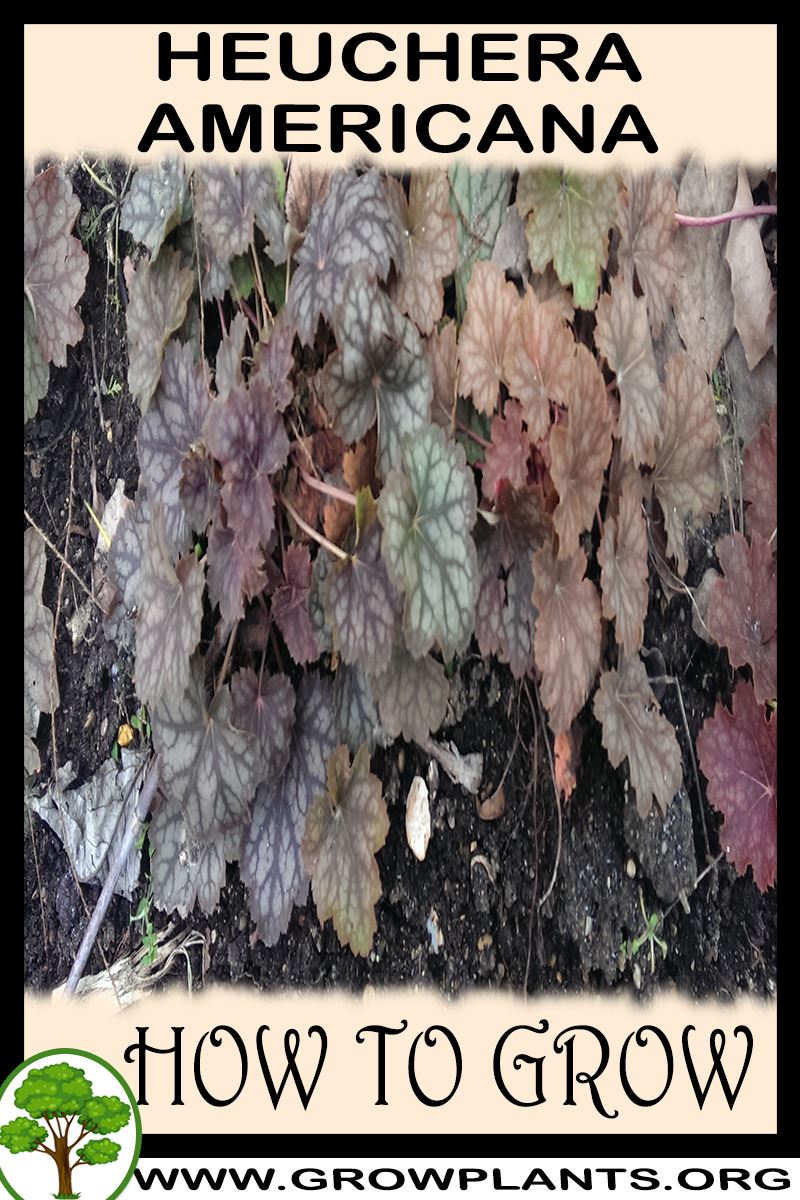
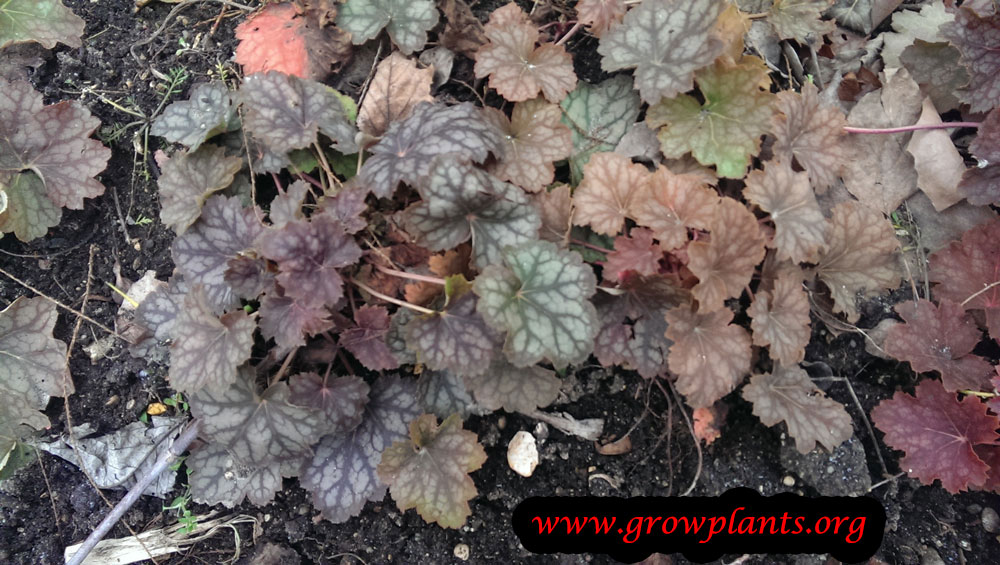
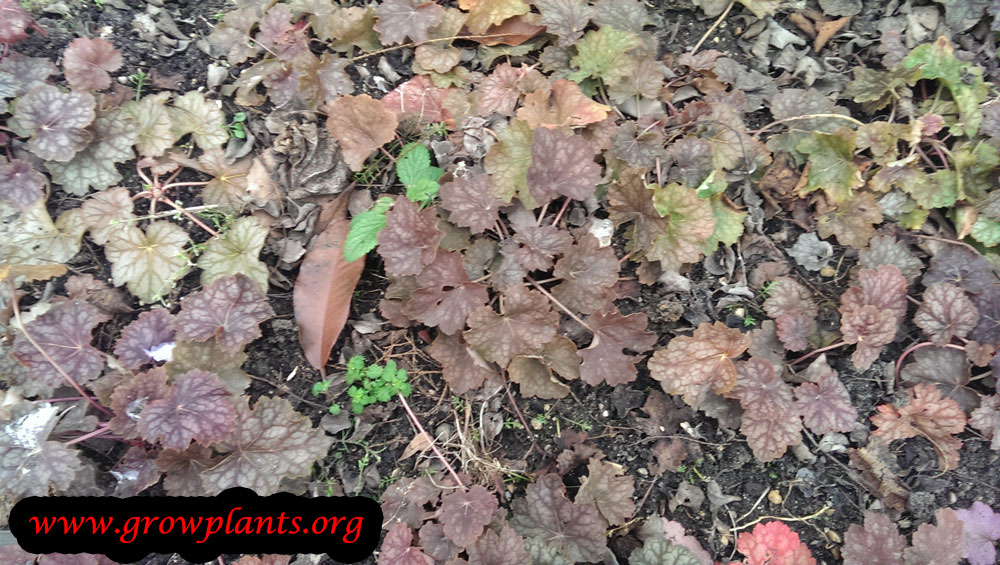
- Leaves and Foliage: Round, lobed leaves in green or green marked with purple, white or red.
- Flower Characteristics: Small white, purple or pink flowers on airy inflorescence stems in summer (full detail in the Bloom accordion).
Primary Uses & Landscape Value
- Functional and Ornamental Roles: Ornamental foliage groundcover for shade gardens, edging and containers.
Care Guide: Planting, Soil & Watering
Overview: Heuchera is a shade-loving evergreen grown as ground cover, preferring partial to full shade and rich, humus-rich, well-drained soil. It likes even, moderate moisture but dislikes waterlogged ground, which can cause crown rot.
Quick Care Requirements
| Requirement | Ideal Condition |
|---|---|
| Planting Season | Spring, or autumn in mild-winter areas |
| Growth Rate | Slow to moderate |
| Soil Type | Rich, humus-rich, well-drained soil |
| Water Need | Moderate – keep evenly moist but never waterlogged |
Planting & Establishment
- Best Planting Season: Plant in spring, or in autumn where winters are mild, so roots settle before summer heat.
- How to Plant:
- Hole Preparation: Dig a hole a little wider than the root ball to loosen the surrounding soil.
- Soil Amendments: Blend compost or leaf mould into the backfill for fertility and drainage.
- Planting Depth: Set the crown right at the soil surface; planting too deep invites rot, and shallow plants can heave in cold, so firm them in well.
- Growth Speed & Expectations: Slow to moderate – forms a neat mound that fills out over a season or two.
Soil, Watering & Drainage Care
- Soil Mix & Drainage Needs: Rich, free-draining, humus-rich soil is ideal; sharp drainage protects the crown from rot, and a container mix should drain freely.
- Watering Schedule & Technique:
- Young / Newly Planted: Keep the soil evenly moist while the plant establishes.
- Established: Water when the top of the soil begins to dry; avoid both drought stress and standing water.
- Seasonal Adjustments: A little more in summer heat, less in cool, wet or winter weather.
Climate, Light & Hardiness
American alumroot (Heuchera americana) is a hardy, clump-forming, semi-evergreen perennial grown for its coloured foliage and airy flower spikes, suited to cool temperate, cool-subtropical and cool-Mediterranean climates in part to full shade. It is very cold-hardy - roughly USDA zones 4–10a - and also grows well as a houseplant.
Quick Climate Specifications
| Climate Zones | Temperate, cool subtropical and cool Mediterranean; also grown indoors |
|---|---|
| USDA Hardiness Zones | Approximately 4–10a |
| Optimal Temp Range | Approximately 15–24 °C (59–75 °F) |
| Cold Damage Begins | Evergreen foliage bronzes and tatters in hard freezes; shallow crowns can be frost-heaved |
| Approx. Survival Minimum | Established plants generally hardy to about −34 °C (−30 °F) |
| Frost Tolerance | High (evergreen foliage: Moderate) |
| Light Conditions | Part shade to full shade (full/morning sun in cool climates) |
| Wind Tolerance | Low to Moderate |
| Salt / Coastal Tolerance | Low |
Sunlight & Light Exposure
Optimal Light Setup
Part shade to full shade gives the best foliage in most climates. In cool-summer regions it takes more sun - even full sun with adequate moisture - and darker-leaved forms generally colour best with a little more light.
Shade & Heat Management
In hot climates, shade from the harsh midday and afternoon sun prevents leaf scorch and fading; a cool, moist, mulched root-zone is as important as the light level.
Best Exposure / Orientation
A north- or east-facing bed, or dappled shade at the front of a border, gives the cool, bright conditions in which the mound of foliage stays dense and well-coloured.
Temperature Extremes & Hardiness
USDA Hardiness & Regional Limits
Across roughly USDA zones 4–10a the crown is thoroughly cold-hardy. At the warm end, deep shade and steady moisture become essential, since heat and strong sun - not cold - are the limiting factors there.
Cold Damage & Winter Protection
The semi-evergreen leaves may bronze or tatter over a hard winter and are tidied in spring. The main cold risk is frost-heave: repeated freezing and thawing lifts the shallow woody crown out of the soil, so a winter mulch and firming-back in spring protect it, and container plants need extra shelter.
Frost Sensitivity
Established plants are frost-hardy; only the exposed evergreen foliage is marked by severe freezes, while the crown and roots come through unharmed.
Extreme Heat Tolerance
It tolerates warmth reasonably in shade with moisture, but prolonged heat with sun and dry soil causes scorch and decline, which is why its comfortable range sits at the cooler end.
Wind, Humidity & Microclimate
Humidity Preferences
It grows well in average to moist air; in very humid, still conditions ensure good drainage and airflow to avoid crown rot on the woody base.
Dry-Air Tolerance
Dry-air tolerance is moderate at best - hot, dry conditions crisp the leaf margins - so a cool, lightly humid, shaded pocket suits it better than an open, exposed spot.
Wind Tolerance
The low foliage mound handles wind adequately, but the slender flower stems can be bent by strong gusts and appreciate a little shelter while in bloom.
Coastal / Salt Tolerance
It has low salt tolerance and is best grown away from direct coastal spray, in sheltered borders or containers.
Rainfall & Seasonal Moisture
Adapted to climates with reliable moisture and good drainage, it dislikes both waterlogged winter ground and long summer drought, favouring an evenly moist, humus-rich root-run.
Microclimate Recommendations
Give it a cool, shaded, sheltered pocket with free-draining, humus-rich soil; in cold zones mulch against frost-heave, and in hot zones lean toward deeper shade and steadier moisture.
Growing in Pots, Balconies & Indoors
Coral bells (Heuchera) are grown for mounds of colourful foliage. The grower says they can be grown indoors, and they are first-rate container and shade-patio plants. Indoors they want bright, cool conditions and a cool winter rest.
Quick Details
- Container Size: A roomy, well-drained pot; a fine foliage container plant
- Indoor Suitability: Foliage houseplant in bright, cool light (naturally an outdoor perennial)
- Best Spot: Bright shade to gentle morning sun; cool
- Soil & Drainage: Aerated, organic-rich, free-draining potting mix
- Watering in Pots: Keep evenly moist – avoid both drought and waterlogging
Indoors & On the Windowsill
- Can be grown indoors: The grower confirms it. Coral bells will grow as a foliage houseplant in a bright, cool spot, though it is naturally an outdoor perennial – give it good light and a cool winter rest to keep it healthy.
- Windowsill growing: A bright sill out of scorching sun suits the leaf colour; keep the mix evenly moist.
On a Balcony or Patio
- Light & wind: Choose a cooler, shadier corner out of harsh midday sun. Reflected heat from walls and railings dries pots quickly and can scorch shade-lovers, so check moisture often and shelter from drying wind.
- Weight & runoff: A full pot of moist soil is heavy – check the balcony can take it, and stand pots so drainage water runs off cleanly without staining or flooding a neighbour below.
Choosing the Pot, Soil & Long-Term Care
- Pot & drainage: A pot with strong drainage holes and no standing-water saucer, so the roots never sit wet and rot. Terracotta breathes and dries faster (good against overwatering), while glazed or plastic holds moisture longer – match it to how often you water.
- Potting mix: A light, aerated, organic-rich mix – potting soil or peat/coir with perlite or vermiculite, blended with compost or well-rotted organic matter.
- Feeding: Nutrients leach out of pots with every watering, so potted plants need feeding more often than those in the ground – a balanced liquid feed through the growing season keeps them going.
- Repotting: Refresh the mix and pot up about every two years; for perennials, lightly trim the root ball and top growth at the same time to keep them vigorous.
Fertilizing & Feeding
A moderate feeder: steady, light feeding through the growing season supports both foliage and flowers, with no feeding needed during dormancy.
Quick Fertilizing Specs
| Feeding Level | Moderate feeder |
|---|---|
| Main Nutrient Priority | Balanced nutrition with adequate nitrogen |
| Best Feeding Period | Through the active growing and blooming season |
| Organic Options | Compost and well-rotted organic matter |
| Soil pH | Adapts to a range; slightly acidic to near neutral is ideal |
| Reduce/Stop Feeding | Ease off as growth slows toward dormancy |
Feeding by Growth Stage
Spring growth flush
Support healthy leaf and stem growth as the plant resumes active growth.
| Nutrient direction | A complete fertilizer with adequate nitrogen fuels dense, well-coloured foliage as growth resumes. |
|---|---|
| Timing | As new growth emerges in spring. |
| Frequency | Begin light, regular feeding through the active growing season. |
| Fertilizer types | Balanced all-purpose granular or liquid fertilizer, Compost or well-rotted organic matter worked into the soil |
| Precautions | Feed steadily but modestly; excess nitrogen gives soft, weak growth rather than better colour. |
Blooming period
Sustain flowering with steady, balanced nutrition.
| Nutrient direction | A balanced fertilizer; adequate nitrogen and potassium support continued bloom. High-phosphorus ‘bloom boosters’ are not needed. |
|---|---|
| Timing | As flower buds form and through the bloom. |
| Frequency | Continue light, steady feeding while the plant is flowering. |
| Fertilizer types | Balanced all-purpose fertilizer |
| Precautions | Keep feeding moderate; excess nitrogen favours leaves over flowers. |
Dormancy / rest
Let the plant rest; there is little active growth to support.
| Nutrient direction | None – withhold fertilizer while the plant is dormant or resting. |
|---|---|
| Timing | After bloom, as the plant dies back or slows for winter. |
| Frequency | No feeding at this stage. |
| Fertilizer types | No feeding at this stage while the plant is dormant or resting. |
| Precautions | Do not fertilize until active growth resumes. |
Nutrient Deficiency Signs & Corrections
Older, lower leaves turn pale green to yellow and growth is weak.
| Possible causes | Low soil nitrogen, Leaching from frequent watering in containers, Cold or waterlogged soil limiting uptake |
|---|---|
| Appears first on | Older, lower leaves |
| What to check | Recent feeding history, Soil drainage and moisture, Container leaching |
| Possible correction | Apply a balanced complete fertilizer and add organic matter; recheck watering. |
New leaves yellow between green veins while the veins stay green.
| Possible causes | High soil pH reducing iron and manganese availability, Cold, wet or poorly drained soil, Genuinely low micronutrient supply |
|---|---|
| Appears first on | Youngest leaves |
| What to check | Soil pH, Drainage, Root health |
| Possible correction | Correct pH and drainage; if it persists apply a chelated iron or manganese product following its label. |
Leaf colour turns dull or reverts toward plain green.
| Possible causes | Insufficient nitrogen, Too little light for full colour development, Overly rich, unbalanced feeding |
|---|---|
| Appears first on | New foliage |
| What to check | Feeding history and nitrogen supply, Light exposure, Overall soil fertility |
| Possible correction | Provide steady balanced feeding with adequate nitrogen and give ample light. |
Pruning, Training & Seasonal Maintenance
Heuchera americana (American alumroot, a coral bells) is an evergreen, clump-forming foliage perennial grown chiefly for its marbled, lobed leaves, throwing up airy flower scapes of small, greenish-to-pink bells to about a metre in summer. It has no woody framework to prune; maintenance is light and comes down to three things. Through summer, deadhead or simply cut the whole spent flower scapes at the base — and because this species is grown more for its foliage than its modest flowers, many gardeners remove the scapes early to keep the plant’s energy in the leaves. In late winter or early spring, comb out the tired, winter-burned outer leaves to let fresh foliage come through. And over a few years the real issue emerges: the crown lifts and woodies up out of the soil, so the plant is renewed not by cutting but by lifting, dividing and replanting the crown deeper. Being evergreen, it is never cut to the ground.
Quick Pruning & Maintenance Specs
| Pruning Tolerance | Low/not structural — leaf tidying, scape removal and crown division only |
| Primary Maintenance Window | Late winter/early spring leaf clean-up; summer scape removal |
| Secondary Maintenance Window | Every 3–4 years — lift and divide the lifting, woody crown |
| Typical Frequency | An annual spring tidy and summer deadheading; periodic division |
| Main Objective | Keep fresh foliage; remove spent scapes; renew a heaving crown by division |
| Young Plant Priority | Remove only damaged leaves; let the clump build |
| Mature Plant Priority | Spring leaf clean-up, scape removal, and division of a lifted crown |
| Best Tool Type | Precision snips for leaves and scapes; a spade for division |
| Avoid Heavy Pruning During | Any time — never shear an evergreen clump to the ground |
Pruning by Plant Age & Size
Newly Established
A young plant needs only the removal of a damaged or dead leaf while it settles into rich, well-drained soil in part to full shade. Let the foliage mound build; there is no formative cutting.
Young / Formative
No structural training applies to a foliage rosette. ‘Formative’ care is simply keeping the crown clean and the mound full by removing any leaf that yellows or scorches, and deciding whether to let it flower or to remove scapes to favour the leaves it is mainly grown for.
Mature / Established
Keep an established plant fresh with an annual spring comb-through of old leaves and summer removal of spent scapes. The defining mature job is dealing with the crown, which naturally rises and becomes woody and bare-necked after a few years: lift the plant, split the crown into healthy rooted pieces, discard the tired woody core, and replant the divisions deeper. This division is the plant’s true renewal — it is not cut back to rejuvenate.
Seasonal Pruning Schedule
Late Winter / Early Spring (leaf clean-up)
Objective: refresh the evergreen mound. Remove: tatty, winter-burned or spotted outer leaves, cutting at the leaf base. Do NOT: shear the whole plant down — it is evergreen and the crown carries it through. Impact: clean new foliage takes over as growth resumes.
Summer (flowering)
Objective: tidiness and, if wanted, foliage focus. Remove: spent flower scapes at the base once bloom fades — or remove them early, as many do on this foliage-first species, to keep energy in the leaves. Impact: a neater plant and stronger foliage.
Ongoing Sanitary
Objective: health. Remove: dead or aphid-damaged leaves as they occur. Impact: a cleaner clump and less pest carry-over.
Structural Pruning & Training
There is no branch or stem structure to train; the ‘structural’ matter here is the crown itself. Over three to four years a Heuchera crown lengthens, turns woody and heaves up so the plant looks leggy and roots poorly — the remedy is not a cut but lifting and dividing the crown and replanting the sound pieces deeper into fresh, rich, well-drained soil. Regular division both renews vigour and keeps the mound sitting properly at soil level.
Special Growth to Remove
The removals are the spent (or, for foliage emphasis, the emerging) flower scapes and any dead, tired or scorched leaves. There are no runners, suckers or woody shoots to manage. When you lift and divide, cut away and discard the old, hardened, bare crown core, keeping only the healthy, well-rooted younger sections.
Container & Small-Space Pruning
Heuchera is a popular container and shade-pot plant, where the same light care applies: comb out old leaves in spring, remove spent scapes, and watch the crown, which lifts just as readily in a pot. Refresh the compost and divide the crown every couple of years when it fills the container or starts to rise, replanting divisions at the right depth. There is no top cut-back; container renewal is by division and repotting, not shearing.
Tools
Precision snips are all that is needed for cutting leaves and flower scapes on this soft-tissue plant; a spade or sharp knife is used to lift and divide the crown. Secateurs, shears, loppers and saws have no place — there is nothing woody enough to warrant them beyond splitting an old crown.
Tool Hygiene & Disease Risk
Hygiene is routine — clean, sharp snips suffice, since the plant’s main pest is aphids rather than a blade-borne disease. Use a clean, sharp blade or spade when dividing so the cut crown sections are not crushed or infected, and clean tools between plants if any show rot at the crown, which can set in when the woody neck sits wet.
Cut Placement & Technique
Cut spent scapes right at the base among the leaves, leaving no stub, and remove old leaves cleanly at the leaf base rather than tearing them and wounding the crown. When dividing, make clean cuts through the crown into sections that each keep healthy roots and leaves, discard the woody core, and set the divisions deep enough to bury the bare neck.
Post-Pruning Care
Leaf tidying and deadheading need no feeding. After dividing, replant into rich, well-drained soil, firm the divisions in with the neck buried, and keep them shaded and evenly moist until re-established. Mulching helps hold the crown at the right level and keeps the shallow roots cool, which matters more to this plant than any post-pruning feed.
Common Pruning Mistakes
- Shearing the whole evergreen clump to the ground as if it were a herbaceous perennial — it should only be combed through.
- Ignoring the crown as it lifts and woodies, so the plant grows leggy and roots poorly, when timely division would renew it.
- Tearing old leaves off and wounding the crown, or replanting divisions with the woody neck left exposed.
- Leaving spent scapes to sap a foliage-first plant, or letting aphid-damaged leaves stay on the clump.
When NOT to Prune
Do not cut an evergreen Heuchera hard back or strip its foliage — there is no hard renewal cut; renew by division instead. Avoid lifting and dividing in summer heat or drought, when the plant is stressed; divide in spring or in autumn in warmer areas. Leave the winter foliage in place until late winter/early spring, as it protects the crown through cold.
Recommended Tools (by task)
- precision_snips — for removing spent flower scapes and combing out old or scorched leaves on a soft-tissue foliage perennial.
- garden_spade — for lifting and dividing the lifting, woody crown every few years, the plant’s true means of renewal.
Propagation Guide
Alumroot is most dependably increased by dividing its crown, which also rejuvenates plants that lift themselves up on a woody base over time. Seed is easy for the plain species, but the many coloured-leaf selections do not come true from it and must be divided.
Quick Propagation Specs
| Best Propagation Method | Crown division |
| Alternative Methods | Seed; basal (leaf-with-heel) cuttings |
| Propagation Difficulty | Easy to Moderate |
| Seed True-to-Type | Species fairly uniform; coloured cultivars variable |
| Vegetative True-to-Type | Yes |
| Best Propagation Season | Spring, or autumn in mild climates |
| Germination Temperature | Cool to moderate, roughly 15–21°C (59–70°F) |
Growing from Seed
Seed Handling & Viability
Seed is very fine and best sown fresh; it is short-lived, so avoid long storage.
Sowing Depth & Orientation
Surface-sow and do not cover – the dust-fine seed needs light to germinate.
Germination Conditions
Keep evenly moist at cool to moderate temperatures, roughly 15–21°C (59–70°F); germination is often slow and uneven.
Division, Offsets, Pups & Suckers
Crown Division
In spring (or autumn in mild areas) lift the clump and cut the woody crown into sections, each with roots and a rosette of leaves. Replant so the crown sits at the soil surface in rich, well-drained soil. Old plants that have pushed their crowns above ground root and grow better after this splitting.
Basal Cuttings
Individual rosettes cut with a sliver of the woody crown (a heel) can be rooted in moist, gritty mix under humidity to bulk up a favoured plant.
Bloom & Flower Guide
Quick Details
- Bloom Season: Summer
- Time to First Bloom: Usually from the second year, once the clump establishes
- Flower Appearance: Tiny white, purple or pink flowers held in airy sprays on slender stems
- Edibility: Ornamental – grown mainly for its foliage; the flowers are not eaten
Detailed Blooming Overview
American alumroot is grown above all for its handsome mounded foliage, but in summer it sends up slender stems topped with clouds of tiny bell-shaped flowers. The airy sprays float above the leaves, add a soft haze to shady borders, and last well as cut stems.
Flower Characteristics
- Small flowers in white, purple or pink.
- Held in loose, airy panicles on wiry stems well above the foliage.
- Long-lasting and useful for cutting.
Bloom Care & Thinning
- Managing the bloom: Remove flower stems once they fade to keep plants neat and direct energy back into the foliage clump; leave some if you enjoy the seed heads.
- Pollination: Visited by bees and other insects, and by hummingbirds where they occur.
Pests, Diseases & Troubleshooting
Overview: Heuchera americana (American alumroot) is a woodland coral bells valued for its marbled, heat-tolerant foliage. Coral bells are grown for their foliage and are generally healthy, but they have one signature killer — the black vine weevil, whose grubs sever the roots and cause sudden collapse — plus foliar nematode, crown/root rot, and the physical problem of frost-heave that lifts plants out of the soil. Culture is the best defence: sharp drainage, airflow, and re-firming or replanting heaved crowns each spring.
Quick Troubleshooting Overview
| Issue / Pest | Main Symptom | Primary Solution |
|---|---|---|
| Black vine weevil | Notched leaf edges; sudden wilt/collapse (grubs eat roots) | Beneficial nematodes; check pots; hand-pick adults |
| Foliar nematode | Dark angular blotches between leaf veins | Remove & destroy leaves; avoid wetting foliage |
| Powdery mildew | White powdery film on leaves | Improve airflow; sulfur/potassium-bicarbonate spray |
| Rust | Orange-brown pustules on leaf undersides | Remove infected leaves; fungicide if severe |
| Crown / root rot | Blackened, mushy crown; wilting | Improve drainage; plant high; remove rot |
| Frost-heave | Woody crown pushed up out of the soil in winter | Re-firm/replant deeper; mulch |
Common Pests & Management
- Black vine weevil (Otiorhynchus sulcatus):
- Symptoms: The classic and most dangerous pest — adults chew distinctive notches in leaf margins at night, while the plump, C-shaped, legless white grubs devour roots and hollow out the crown, causing sudden wilting and collapse of an apparently healthy plant. Container plants are especially at risk.
- Prevention & Control: Inspect the root ball for grubs when planting or repotting, trap adults under boards or with sticky barriers, and encourage birds and ground beetles. The key control is a drench of beneficial nematodes (Steinernema kraussei / Heterorhabditis) applied to warm, moist soil to kill the grubs.
- Foliar nematode (Aphelenchoides fragariae):
- Symptoms: Dark brown to purplish angular blotches on the leaves, sharply bounded by the veins, spreading in wet conditions; leaves brown and die.
- Prevention & Control: Remove and destroy affected leaves, avoid overhead watering and splashing, space plants for quick drying, and discard severely infested plants — there is no chemical cure for gardeners.
- Aphids (Aphis / Myzus spp.):
- Symptoms: Small colonies on flower stems and new growth with sticky honeydew.
- Prevention & Control: Hose off, encourage beneficials, and use insecticidal soap for persistent colonies.
- Spider mites & mealybugs (Tetranychus, Pseudococcidae):
- Symptoms: Stippling and webbing in hot dry spells; white cottony tufts in leaf bases in containers.
- Prevention & Control: Keep plants watered and humid, hose foliage, and use horticultural oil or insecticidal soap.
Diseases & Fungal Issues
- Powdery mildew (Podosphaera / Golovinomyces spp.):
- Symptoms: White powdery coating on leaves and stems, worst in crowded, shady, humid but dry-rooted conditions.
- Treatment & Management: Improve spacing and airflow, avoid drought stress, remove affected leaves, and spray sulfur or potassium bicarbonate if needed.
- Rust (Puccinia heucherae):
- Symptoms: Orange-brown pustules on leaf undersides with yellow spots above; disfigures foliage.
- Treatment & Management: Remove and destroy infected leaves, improve airflow, avoid overhead watering, and use a labelled fungicide only under heavy pressure.
- Crown & root rot (Phytophthora / Pythium / Botrytis):
- Symptoms: Blackened, mushy crown, wilting and collapse, especially in heavy or wet soil or where the woody crown sits low and damp.
- Treatment & Management: Plant high in free-draining soil, keep the crown from sitting wet, remove rotted tissue, and lift and divide woody old plants to rejuvenate them.
Growing Difficulties & Abiotic Problems
- Frost-heave:
- Cause & Symptoms: Repeated freeze-thaw pushes the woody crown up out of the soil over winter, exposing roots to drying and cold — a classic coral-bells problem. Correction Strategy: Re-firm or replant heaved crowns a little deeper in spring, mulch to buffer temperature swings, and divide woody plants that have risen too high.
- Leaf scorch:
- Cause & Symptoms: Bleached, brown, crisp leaf edges in too much hot sun, especially on dark or brightly coloured cultivars. Correction Strategy: Give morning sun and afternoon shade and keep evenly moist.
- Woody, hollow crowns:
- Cause & Symptoms: Older plants build up bare, woody crowns that flop and root poorly. Correction Strategy: Lift, divide and replant the vigorous outer pieces deeper every few years.
H. americana tolerates more heat and humidity than many hybrids, but still watch for vine weevil and for powdery mildew in muggy, shaded, crowded sites.
What Helps — Products & Tools
The most important product for coral bells is a pack of beneficial nematodes to control vine-weevil grubs — the pest most likely to kill the plant. Add insecticidal soap or horticultural oil for aphids and mites, sulfur or potassium bicarbonate for powdery mildew, and a good organic mulch to reduce frost-heave. Sharp drainage and periodic division do more than any spray.