Plant Profile & Key Characteristics
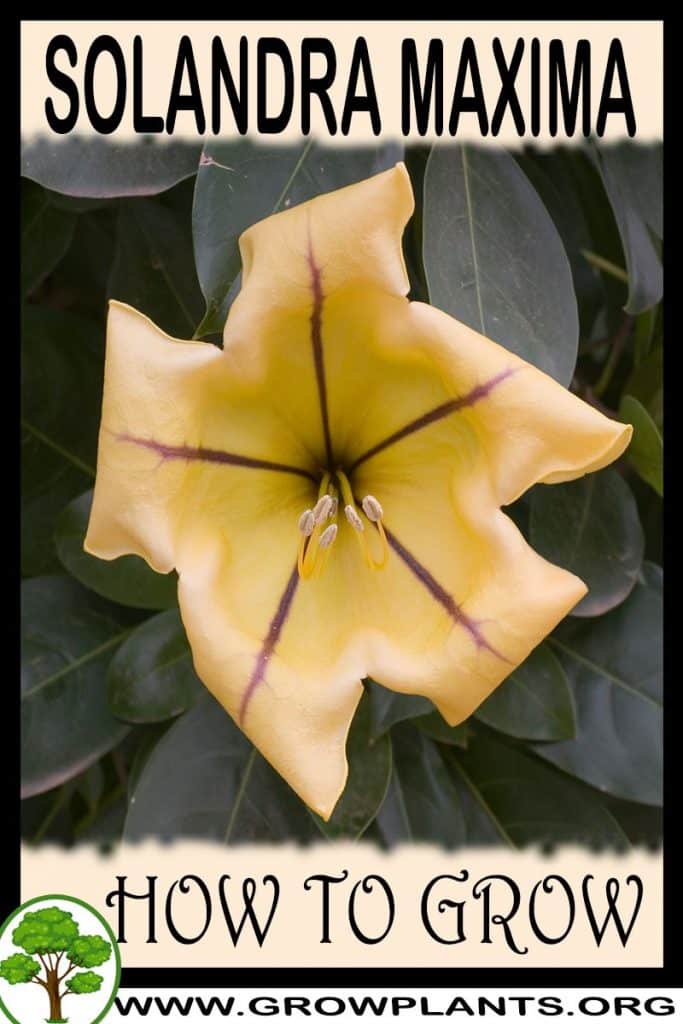
Overview: A vigorous, woody evergreen climber that can scramble 7–15 m (21–45 ft) up a support. It is grown as an ornamental for its huge, fragrant, golden chalice-shaped flowers, and every part of the plant is poisonous.
Quick Specifications
| Specification | Attribute |
|---|---|
| Plant Type / Life Cycle | Evergreen woody perennial (climbing vine) |
| Foliage Type | Evergreen |
| Mature Size | 7–15 m (21–45 ft) long |
| Growth Rate | Fast to moderate |
| Toxicity | Poisonous — all parts contain toxic alkaloids; not for planting where livestock, pets or children may browse it |
| Hardiness | USDA zones 10+ (tropical, Mediterranean and subtropical; frost-free) |
Growth Form & Structure
- Height & Spread: Climbs 7–15 m (21–45 ft) on a wall, pergola or trellis in the ground; it can also be grown in a large container, which restrains its size, but it is not suited to being an indoor houseplant.
- Growth Habit & Form: Fast-growing evergreen liana with long, semi-woody stems that need sturdy trellising; can be aggressive and invasive in favourable climates.
- Lifespan & Maturity: A long-lived perennial vine that reaches full size quickly once established and can flower through much of the year.
Anatomy & Physical Features
- Leaves & Foliage: Glossy green, elliptic leaves 10–15 cm long (some cultivars edged in purple or white).
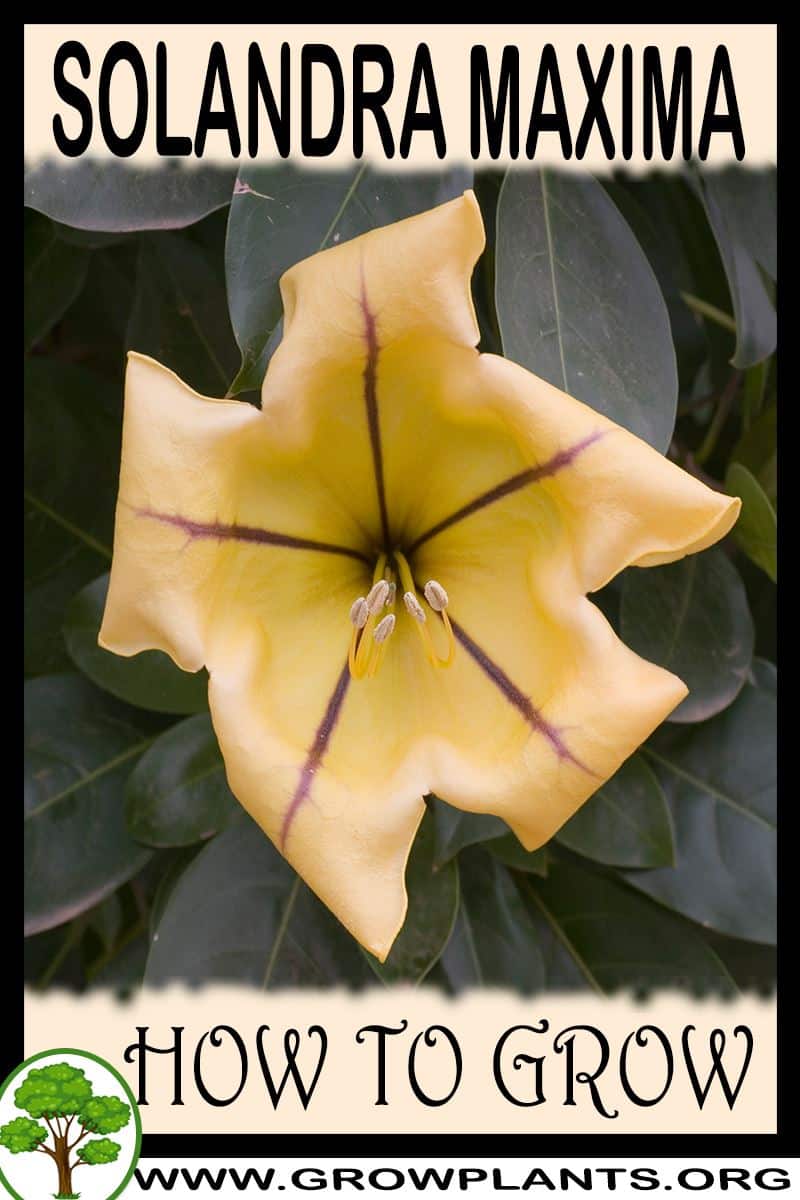
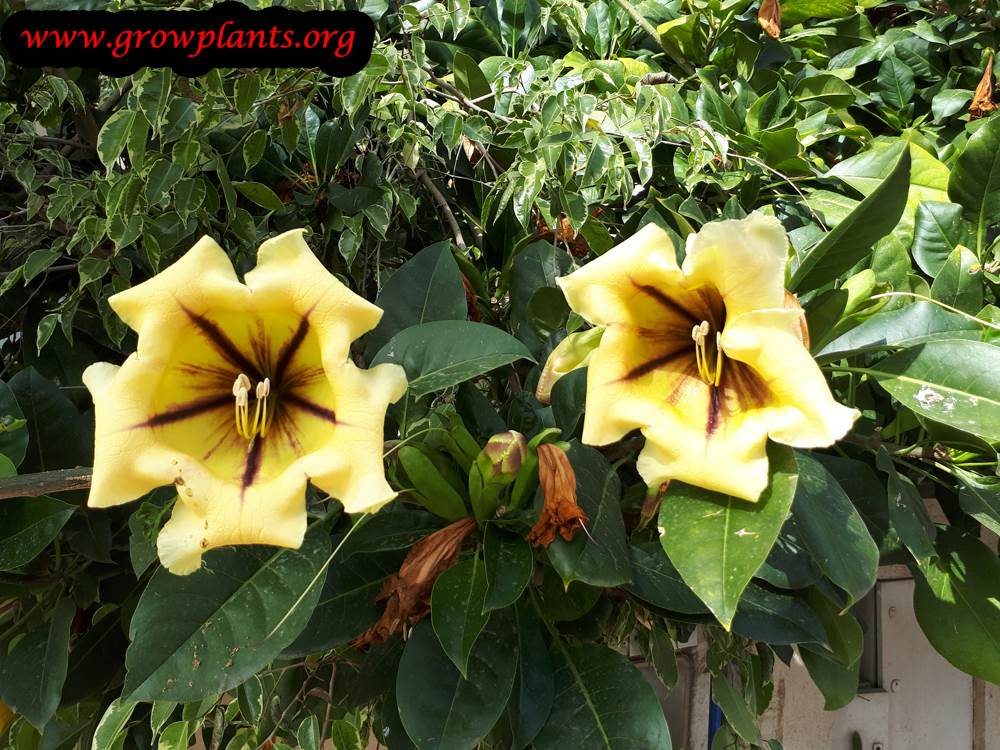
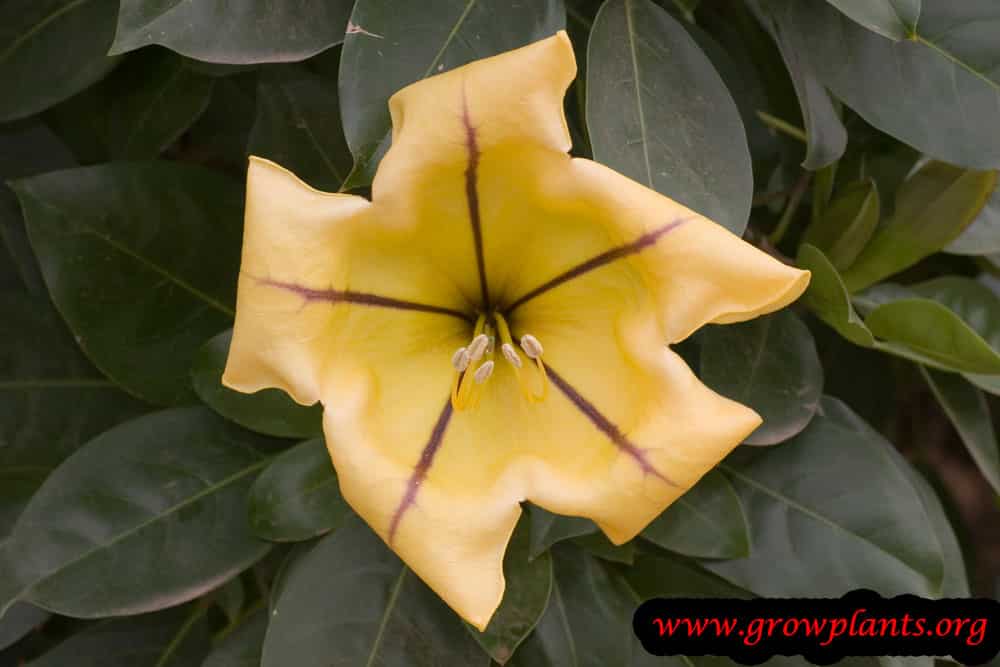
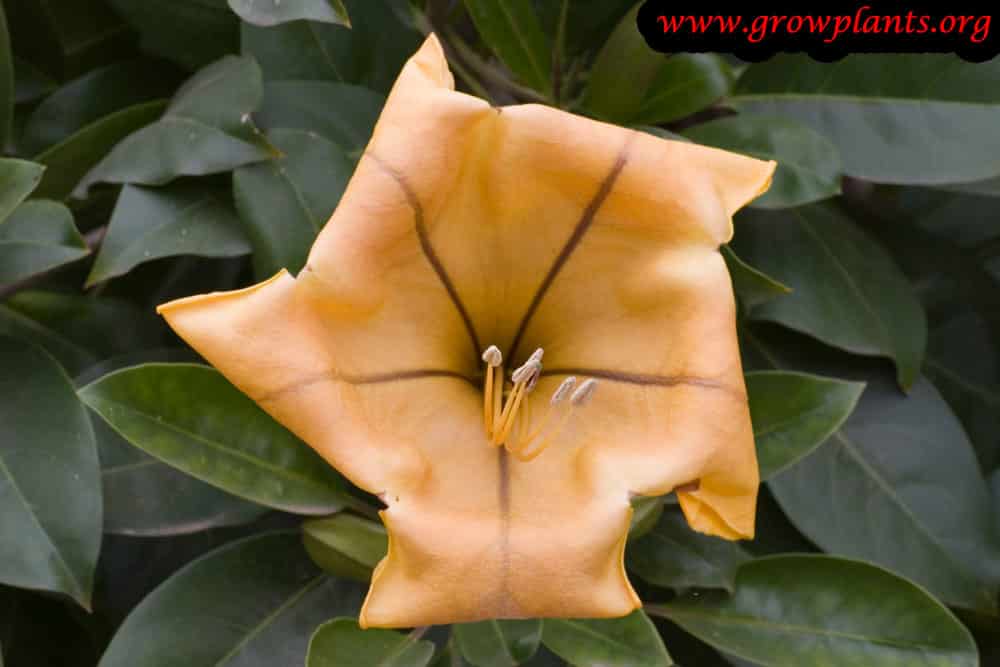
- Flower Characteristics: Very large fragrant chalice- or cup-shaped flowers, 10–20+ cm across, yellow to orange with a purple stripe down each of the five petals.
Primary Uses & Landscape Value
- Functional & Ornamental Roles: A dramatic ornamental climber for covering pergolas, arches, fences and large walls in frost-free gardens, and a specimen for large containers; grown for its show and scent rather than any edible use.
Care Guide: Planting, Soil & Watering
Overview: Solandra maxima (Cup of gold vine) is a vigorous, fast-growing tropical vine that grows best in full sun to light shade with rich, well-drained soil and a sturdy support to climb. It appreciates regular water in growth while needing good drainage to keep its roots healthy.
Quick Care Requirements
| Requirement | Ideal Condition |
|---|---|
| Planting Season | In spring or summer during warm weather |
| Growth Rate | Moderate to fast |
| Soil Type | Rich, well-drained soil |
| Water Need | Moderate to high — water regularly, letting the surface dry between waterings |
Planting & Establishment
- Best Planting Season: Plant in spring or summer during the warm season; it is frost-tender (zone 10 and warmer), so plant only where it is safe from frost, against a strong trellis or wall.
- How to Plant:
- Hole Preparation: Dig a hole about twice as wide as the root ball and no deeper, near a robust support the heavy vine can climb.
- Soil Amendments: Work compost or organic matter into the backfill to enrich the soil and improve both moisture retention and drainage.
- Planting Depth: Set the vine so the root collar is level with the surrounding soil — do not bury the stem base.
- Growth Speed & Expectations: Fast, vigorous growth into a large 7–15 m vine; it can be aggressive and invasive, so give it a strong structure and prune to keep it in bounds.
Soil, Watering & Drainage Care
- Soil Mix & Drainage Needs: Provide rich, freely draining soil; in containers use a quality mix that drains well so the roots never sit waterlogged.
- Watering Schedule & Technique:
- Young / Newly Planted: Water regularly after planting to establish the vigorous root system.
- Established: Water deeply and regularly in the growing season, letting the top few centimetres dry between waterings.
- Seasonal Adjustments: Water more in hot, dry weather; reduce in cooler months, when the vine flowers heavily but needs less at the roots.
Climate, Light & Hardiness
Cup of gold is a massive, evergreen tropical vine for tropical, subtropical and frost-free Mediterranean climates, growing in full sun to part shade. It is frost-tender - the site data lists it as growable in roughly USDA zone 10 and warmer and specifies frost-free conditions. Note the plant is poisonous.
Quick Climate Specifications
| Climate Zones | Tropical, subtropical and frost-free Mediterranean |
|---|---|
| USDA Hardiness Zones | Zone 10 and warmer (frost-free) |
| Optimal Temp Range | Warm, frost-free conditions year-round |
| Cold Damage Begins | In the low single digits °C (upper 30s–low 40s °F); soft growth and flowers suffer well before freezing |
| Approx. Survival Minimum | Around 0 °C (32 °F); an established vine may resprout after a brief light frost that burns the top, but hard frost is damaging to fatal |
| Frost Tolerance | Very Low (frost-tender) |
| Light Conditions | Full sun to part shade |
| Wind Tolerance | Low–Moderate (large, soft, leafy vine) |
Sunlight & Light Exposure
Optimal Light Setup
Full sun gives the heaviest flowering; the vine also grows in part shade, with fewer of its large golden cups.
Direct Sun Requirement
Ample direct sun drives the best bloom, though light shade is accepted.
Shade & Heat Management
In the fiercest, driest heat the big soft leaves can scorch, so light afternoon shade helps; the vine otherwise revels in warmth.
Best Exposure / Orientation
Give a warm, sheltered, sunny wall or strong support - this is a very large, heavy vine that needs sturdy trellising and room.
Temperature Extremes & Hardiness
USDA Hardiness & Regional Limits
The site data lists it in zone 10 and warmer and specifies frost-free conditions. It is a true tropical/subtropical vine grown outdoors only where frost is absent or very rare; elsewhere it is a conservatory or large-container plant.
Cold Damage & Winter Protection
Soft growth and flowers suffer in cool weather; an established vine may resprout after a brief light frost that burns the top, but hard or sustained frost is damaging to fatal. In marginal areas keep it against a warm wall or under frost-free cover. Cold tolerance varies with plant age and exposure duration.
Frost Sensitivity
Frost-tender - frost scorches the foliage and flowers; young plants are more vulnerable than established ones.
Extreme Heat Tolerance
Thrives in tropical heat; only fierce, dry, exposed heat scorches the leaves, buffered by light shade and steady soil moisture.
Wind, Humidity & Microclimate
Humidity Preferences
Prefers warm, humid conditions in keeping with its tropical origins.
Dry-Air Tolerance
Low to moderate - hot, dry winds stress the large soft leaves.
Wind Tolerance
Low to moderate; the big, leafy, soft-stemmed vine catches wind and needs firm support and a sheltered aspect. Some coastal tolerance is reported, but shelter from strong salt-laden wind is safer.
Microclimate Recommendations
A warm, wind-sheltered, sunny wall in a frost-free pocket suits it best; in cooler areas grow it in a large container under frost-free glass and bring the warmth of a sheltered courtyard in summer.
Growing in Pots, Balconies & Indoors
Cup of gold vine (Solandra maxima) is a massive tropical climber reaching 7-15 m (20-45 ft), so a container only suits it while young or where you can keep it hard-pruned as a patio specimen – long term it wants far more room than a pot gives. It is not a houseplant, but being frost-tender it is often potted so it can be sheltered in cold climates.
Quick Details
- Container Size: A large 40 L+ (10 gal+) pot with a stout trellis and strong drainage (general guidance – it will outgrow any pot in time)
- Indoor Suitability: Not a houseplant and far too large; a pot is only for young plants or for overwintering under glass
- Best Spot: Full sun to part shade, with sturdy support
- Soil & Drainage: Rich, well-aerated mix that drains freely
- Watering in Pots: Water generously in growth as pots dry fast; ease back in cool weather
Indoors & On the Windowsill
- Houseplant limits: Not an indoor plant – it is a vigorous, heavy climber that needs full sun and space.
- Overwintering: The reason to pot it is portability: in cold regions move the pot into a bright, frost-free conservatory or greenhouse over winter.
- Safety: All parts are highly poisonous (tropane alkaloids, as in its nightshade relatives) – keep it well away from children and pets and wash hands after pruning.
On a Balcony or Patio
- Light & wind: Give it full sun and a very strong support fixed to a wall or railing; the heavy vine catches wind badly, so anchor it well. Reflected wall heat suits it but dries the pot fast – water often.
- Practicalities: A big vine in a large pot is heavy and unwieldy – site it permanently and secure the trellis.
Choosing the Pot, Soil & Long-Term Care
- Pot & drainage: A large 40 L+ pot with strong drainage holes and a sturdy trellis. Skip a standing-water saucer, which keeps the roots wet and invites rot. Terracotta breathes and dries faster; glazed or plastic pots hold moisture longer.
- Potting mix: Well-aerated and organic-rich – a quality potting mix, or peat/coir with perlite or vermiculite for drainage.
- Feeding: Potted plants need feeding more often than those in the ground, since frequent watering leaches nutrients away – feed through the growing season with a balanced, organic-rich fertilizer.
- Repotting: Every couple of years refresh the mix and pot on a size; for perennials, lightly prune the root ball and top growth at the same time to keep them vigorous.
Fertilizing & Feeding
A moderate feeder: this vigorous tropical vine takes steady, balanced feeding through the warm season to fuel growth and its large flowers.
Quick Fertilizing Specs
| Feeding Level | moderate |
|---|---|
| Main Nutrient Priority | Balanced nutrition for vigorous growth and bloom |
| Best Feeding Period | During warm-season active growth and bloom |
| Reduce/Stop Feeding | Stop feeding during the cool-season slowdown |
| Soil pH | Tolerates a wide range of well-drained soils |
| Organic Options | Compost and mulch over the root zone |
Feeding by Growth Stage
Establishment on the support
Help the young vine build roots and a framework on its trellis.
| Nutrient direction | A balanced complete fertilizer to support early vining growth. |
|---|---|
| Timing | In the first seasons after planting, as growth resumes. |
| Frequency | A light feeding as growth begins. |
| Fertilizer types | Balanced complete fertilizer, Compost or mulch over the root zone |
| Precautions | All parts are poisonous – wear gloves. Guide new growth onto the support. |
Vigorous growth and bloom
Support strong vining growth and the large fragrant flowers.
| Nutrient direction | A balanced feed sustains vigorous growth and repeat bloom. |
|---|---|
| Timing | Through the warm-season growth and the long bloom period. |
| Frequency | Steady, moderate feeding during active growth and flowering. |
| Fertilizer types | Balanced complete fertilizer |
| Precautions | Wear gloves when handling; the sap and plant parts are poisonous. |
Cool-season slowdown
Growth slows in cooler weather; no nutrients are needed then.
| Nutrient direction | None – withhold fertilizer while the plant is not in active growth. |
|---|---|
| Timing | During cool weather when vining growth pauses. |
| Frequency | No feeding at this stage. |
| Fertilizer types | No feeding at this stage – hold off on fertilizer until active growth resumes |
| Precautions | Do not fertilize while growth is paused by cool weather; resume when it returns. |
Nutrient Deficiency Signs & Corrections
Older, lower leaves fade to pale green or yellow and overall growth is slow and weak.
| Possible causes | Low or leached soil nitrogen, Cold or waterlogged soil limiting root uptake |
|---|---|
| Appears first on | Older, lower leaves |
| What to check | Recent feeding history and soil organic matter, Soil drainage and root health |
| Possible correction | Apply a complete nitrogen-bearing fertilizer during active growth and build soil with compost. |
Youngest leaves yellow between still-green veins (interveinal chlorosis).
| Possible causes | High soil pH reducing iron availability, Waterlogged or cold roots, Often not a true shortage of soil iron |
|---|---|
| Appears first on | Youngest leaves |
| What to check | Soil pH, Soil drainage and watering |
| Possible correction | Correct soil pH and, where needed, apply a chelated iron product per its label. |
Interveinal yellowing on older leaves while the veins stay green.
| Possible causes | Low soil magnesium, High potassium competing with magnesium uptake, Sandy, leached soils |
|---|---|
| Appears first on | Older leaves |
| What to check | Soil test for magnesium, Balance of recent fertilizer use |
| Possible correction | Apply a magnesium source such as a labeled Epsom-salt drench if a soil test confirms the need. |
Pruning, Training & Seasonal Maintenance
Solandra maxima, the cup-of-gold vine, is a massive, extremely vigorous woody evergreen liana that can reach 7–15 m (21–45 ft) and carries huge fragrant golden chalice flowers, mainly through autumn and winter. It needs a very strong permanent support and firm training, and—because it flowers on mature, ripened wood—it should be pruned after a flowering flush, cutting back the spent growth to force the new wood that will bear the next flush. It tolerates hard cutting and re-covers fast. All parts are toxic (tropane alkaloids), so wear gloves, wash after handling, and never burn the prunings.
Quick Pruning & Maintenance Specs
| Pruning Tolerance | High (very vigorous; resprouts strongly) |
| Primary Pruning Window | After the main flowering flush |
| Typical Frequency | At least yearly; often after each major flush to control size |
| Main Objective | Contain the huge growth, renew flowering wood, keep it on its support |
| Young Plant Priority | Tie in a strong framework of main stems on a heavy-duty support |
| Mature Plant Priority | Shorten spent flowered growth; thin tangles; hold it to its space |
| Best Tool Type | Bypass secateurs and loppers; a pruning saw for old thick stems |
| Avoid Heavy Pruning During | The build-up to and peak of flowering (you cut off the bloom) |
Pruning by Plant Age & Size
Newly Established
Concentrate on support and framework, not cutting: install a heavy-duty pergola, wall wires or stout trellis (this vine becomes very heavy), and tie in a few strong main stems as they extend. Remove only damaged growth early on.
Young / Formative
Train the chosen main stems out over the support to build a permanent framework, tying them in firmly—the vine does not twine tightly and needs securing. Let side growth develop and mature, because it is the ripened wood that flowers.
Mature / Established
After each flowering flush, shorten the spent flowered shoots and thin congested tangles to force fresh flowering wood and keep the enormous plant within its space. Cut out dead, weak and wayward growth, and keep the framework tied to its support so the weight is carried safely.
Seasonal Pruning Schedule
Post-Flowering (main prune)
Objective: renew flowering wood and control size. Remove: spent flowered shoots (shortened back), congested and wayward growth, dead and weak stems. Do NOT remove: young ripening wood that will carry the next flush. Response: strong new growth that matures into the next season’s flowering wood. Flowering impact: pruning here sets up the next bloom; cutting before flowering removes it.
Ongoing Containment
Objective: keep the vigorous vine off gutters, trees and neighbouring plants. Cut back and tie in extending growth as needed through the season, keeping the heaviest cutting to the post-flowering window.
Flowering & Fruiting Wood
Solandra flowers on mature, ripened wood rather than on soft new tips, which is why timing matters: pruning straight after a flush removes the exhausted flowered wood and drives new shoots that then ripen and flower, whereas hard pruning at the wrong time—or repeatedly shearing back all growth—keeps the plant permanently juvenile and vegetative, so it grows lushly but barely blooms. Give shoots time to mature between cuts.
Structural Pruning & Training
Build and maintain a strong permanent framework of main stems tied to a heavy support, then renew the flowering wood off that framework. Thin dense tangles to let light in and to lighten the load, remove crossing and inward growth, and shorten over-extended runners back to the framework. The sheer weight and vigour make secure tying and regular containment essential.
Special Growth to Remove
Remove spent flowered shoots (shortened to renew the wood), dead and weak growth, and the long wayward runners that escape the support. Because it is grown from cuttings on its own roots there is no graft and no rootstock suckering, but strong basal shoots can be used to extend or replace framework stems rather than simply cut away.
Container & Small-Space Pruning
This is a huge vine, so a container needs a big pot and a strong frame, and much more frequent cutting-back to keep it in scale—essentially treating it as a hard-pruned, contained specimen. Expect to sacrifice some flowering to the extra size control, and root-prune and refresh the mix when repotting a pot-bound plant.
Tools
Young shoots and thin growth: bypass secateurs. Framework-thick stems and spent flowered wood: loppers. Old, heavy main stems on a mature vine: a pruning saw. Hedge shears are wrong—shearing keeps it vegetative and non-flowering; make placed, selective cuts. Wear gloves throughout for the toxic sap.
Tool Hygiene & Disease Risk
Classification: Routine for disease (it is generally trouble-free apart from spider mites), but treat it as hazardous to handle: it is poisonous, so wash hands and tools after cutting, keep sap off skin and eyes, and dispose of prunings safely rather than burning or shredding them near living areas.
Cut Placement & Technique
Shorten spent shoots to a strong bud or lateral on ripened wood; cut larger stems just outside the branch junction, and undercut and support heavy limbs before the final cut so the bark does not tear on this brittle-heavy growth. Angle cuts to shed water and leave no long stubs.
Heavy Pruning & Rejuvenation
The vine tolerates hard renewal—an overgrown plant can be cut back severely into the main framework and will resprout vigorously—but expect it to skip a flowering cycle while the new wood grows and ripens. Spread very hard reduction over the season or two after a flush, and re-tie the strong regrowth as it extends.
Post-Pruning Care
After a big cut, tie in the vigorous regrowth promptly so it is carried by the support, keep the plant watered while it re-covers, and protect any newly exposed bark from sunburn. Avoid a heavy nitrogen push, which only adds to the vegetative surge at the expense of the flowering you want the new wood to reach.
Common Pruning Mistakes
- Shearing or hard-pruning at the wrong time, keeping the vine leafy and flowerless.
- Under-building the support, so the heavy vine pulls it down.
- Pruning just before flowering and cutting off the coming flush.
- Handling and burning the toxic prunings without care.
When NOT to Prune
Do not prune in the build-up to or during flowering—wait until the flush is over. Avoid hard cutting on a plant that is drought-stressed, and keep the heaviest work to the post-flowering window rather than the cooler months when little regrowth follows.
Recommended Tools (by task)
- bypass_secateurs — shorten spent flowered shoots and thin young growth.
- loppers — framework-thick stems and heavier spent wood.
- pruning_saw — old heavy main stems on a mature vine.
- soft_ties_stakes — tie the heavy framework and regrowth to a strong support.
Pruning Troubleshooting
| Problem | Possible Cause | What to Check | Corrective Action |
| Vigorous leafy growth, few flowers | Pruned/sheared too hard or too often; wood kept juvenile | Timing and severity of cuts; heavy feeding | Prune only after a flush; let wood mature; ease off nitrogen |
| Support sagging or pulled over | Under-built support for a very heavy vine | Strength of frame; where the weight sits | Reinforce the support; thin and lighten the top growth |
| Bark tearing on big cuts | Heavy limbs cut without undercutting | How large limbs were removed | Undercut and support heavy limbs before the final cut |
| Missed a flowering cycle after hard cut | New wood not yet mature enough to bloom | Age of the regrowth | Let the new wood ripen; resume renewal after the next flush |
Propagation Guide
Cup-of-gold vine is propagated vegetatively – semi-hardwood stem cuttings and layering both root well on this vigorous woody climber, and layering is especially easy given its long trailing stems. Propagation is easy to moderate; note the plant is poisonous and can be invasive.
Quick Propagation Specs
| Best Propagation Method | Semi-hardwood stem cuttings |
| Alternative Methods | Air or ground layering |
| Propagation Difficulty | Easy to Moderate |
| Vegetative True-to-Type | Yes – cuttings and layers reproduce the parent, including variegated forms |
| Best Propagation Season | Spring to summer (warm season) |
| Cutting Rooting Time | Typically several weeks under warm, humid conditions |
Stem Cuttings
Cutting Type & Timing
Take firm semi-hardwood cuttings of the current or previous season’s growth in the warm season. Wear gloves and wash up afterwards, as the sap is poisonous.
Rooting Setup & Hormone
Insert cuttings into a moist, free-draining mix and keep them warm and humid; rooting hormone is beneficial on the woodier stems though not essential.
Rooting Time
Expect rooting over several weeks.
Air & Ground Layering
The long stems layer very easily: peg a stem into moist soil (or wrap a wounded section for air layering), let it root over the warm months, then sever the rooted length – a reliable way to get a large, established plant quickly.
Bloom & Flower Guide
Quick Details
- Bloom Season: Mostly year-round, with the heaviest flush in autumn and winter
- Flower Appearance: Very large, fragrant, chalice-shaped flowers, golden-yellow to orange with a purple-brown stripe down the center of each of the five petals, 10-20 cm or more across
- Edibility: Not edible – the whole plant is toxic. Grown purely as an ornamental
Detailed Blooming Overview
The cup of gold vine is grown entirely for its spectacular flowers: huge, goblet-shaped golden chalices, sweetly fragrant in the evening, that unfurl over a long season and peak through the cooler months. The blooms are magnificent but the plant is poisonous throughout, so it is one to admire rather than handle carelessly.
Flower Characteristics
- Enormous cup- or chalice-shaped flowers with five broad petals.
- Golden-yellow ageing to orange, each petal marked with a deep purple-brown stripe down the middle.
- Richly fragrant, especially at night, and 10-20 cm or more across.
Bloom Care & Thinning
- Encouraging bloom: Full sun, a sturdy support and restrained feeding bring the best flowering; over-rich soil pushes leafy growth at the expense of flowers.
- Pruning for bloom: Light pruning after a flush keeps the vine within bounds and encourages fresh flowering wood.
- Safety: Wear gloves when pruning and keep all parts away from children and pets – the whole plant is poisonous.
Pests, Diseases & Troubleshooting
Overview: Solandra maxima is a vigorous tropical Solanaceae vine grown for its huge chalice flowers; it is fairly robust but, like other nightshades, is troubled mainly by sap-sucking insects under warm, sheltered or indoor conditions, and by root rot in soggy soil. Keep it in bright airy conditions with free drainage and treat pests culturally first. All parts are toxic, so wear gloves when pruning.
Quick Troubleshooting Overview
| Issue / Pest | Main Symptom | Primary Solution |
|---|---|---|
| Spider mites | Stippling and fine webbing under leaves in dry heat | Raise humidity, rinse, oil/soap |
| Whiteflies | White clouds when disturbed; honeydew, sooty mould | Yellow traps, soap/neem, beneficials |
| Aphids | Curled shoot tips, honeydew on new growth | Rinse off, encourage predators, soap |
| Mealybugs & scale | Cottony fluff or brown bumps on stems/axils | Alcohol swab, horticultural oil |
| Sooty mould | Black film over honeydew-coated leaves | Control the sap-suckers; wash foliage |
| Root rot | Yellowing, wilting, mushy roots in wet soil | Improve drainage, ease off watering |
Common Pests & Management
- Spider mites (Tetranychus urticae):
- Symptoms: Fine pale stippling, a bronzed dull cast and delicate webbing on leaf undersides, worst in hot, dry, still air or indoors.
- Prevention & Control: Raise humidity and airflow, rinse foliage undersides, release predatory mites, and use insecticidal soap or horticultural oil.
- Whiteflies (Trialeurodes vaporariorum, Bemisia tabaci):
- Symptoms: Tiny white insects that rise in clouds when the vine is brushed; honeydew, sooty mould and yellowing follow.
- Prevention & Control: Hang yellow sticky traps, encourage parasitoids, and spray leaf undersides with insecticidal soap or neem.
- Aphids (Aphis spp., Myzus persicae):
- Symptoms: Soft green or black colonies on tender shoot tips and buds, causing curl and sticky honeydew.
- Prevention & Control: Blast off with water, encourage ladybirds and lacewings, and spot-treat with insecticidal soap.
- Mealybugs (Planococcus citri):
- Symptoms: White cottony clusters tucked into leaf axils and stem joints, with honeydew and weakened growth.
- Prevention & Control: Dab with an alcohol swab, rinse, and follow with horticultural oil or soap, repeating to catch crawlers.
- Soft & armoured scale (Coccus, Saissetia spp.):
- Symptoms: Brown or tan bumps along stems and leaf veins, sticky honeydew and sooty mould.
- Prevention & Control: Scrape off, prune heavily infested stems, and coat with horticultural oil; keep the plant vigorous.
Diseases & Fungal Issues
- Root & stem rot (Phytophthora / Pythium spp.):
- Symptoms: Wilting and yellowing despite moist soil, with blackened mushy roots and stem bases in poorly drained or overwatered conditions.
- Treatment & Management: Improve drainage, water only when the surface dries, avoid crown burial, and remove badly rotted growth.
- Fungal leaf spots (Cercospora, Alternaria spp.):
- Symptoms: Brown or black spots, sometimes with yellow halos, mostly on older leaves in humid weather.
- Treatment & Management: Remove affected leaves, improve airflow, avoid wetting foliage, and use copper fungicide if spread continues.
- Powdery mildew (Erysiphales):
- Symptoms: White powdery patches on leaves and shoots in warm, still, humid conditions.
- Treatment & Management: Improve airflow and light, avoid crowding, and treat with sulphur, potassium bicarbonate or a horticultural-oil spray.
Growing Difficulties & Abiotic Problems
- Root rot from overwatering:
- Cause & Symptoms: Constantly wet, heavy soil suffocates roots, causing yellow leaves and collapse.
- Correction Strategy: Plant in free-draining soil, let it dry between waterings, and never leave it waterlogged.
- Few flowers:
- Cause & Symptoms: Too much shade, excess nitrogen or over-pruning at the wrong time reduces the spectacular blooms.
- Correction Strategy: Give full sun, ease off high-nitrogen feed, and prune after flowering rather than removing flowering wood.
- Cold & wind damage:
- Cause & Symptoms: Frost blackens foliage and strong wind tears the large leaves of this tropical vine.
- Correction Strategy: Shelter from wind, protect or bring under cover below about 5°C, and site in a warm sunny spot.
What Helps – Products & Tools
For Solandra maxima the useful kit is insecticidal soap and neem/horticultural oil for mites, whiteflies, aphids, mealybugs and scale, yellow sticky traps for monitoring, isopropyl alcohol swabs for spot removal, and sulphur or potassium-bicarbonate and copper fungicides for mildew and leaf spots. Free-draining soil and measured watering prevent the root rot that is its main real threat.