Plant Profile & Key Characteristics
Overview: A fast-growing leafy chicory (radicchio) forming a low head 5-20 cm (2-8 in) across, grown for its striking red-and-white, pleasantly bitter salad leaves. Grown as an annual, it also has a traditional medicinal use.
Quick Specifications
| Specification | Attribute |
|---|---|
| Plant Type / Life Cycle | Annual to biennial (leaf vegetable) |
| Mature Size | Head 5-20 cm (2-8 in); edible root 5-12 cm (2-5 in) long |
| Growth Rate | Fast |
| Root System | Taproot (fleshy, edible) |
| Toxicity | Non-toxic / edible |
Growth Form & Structure
- Height & Spread: Low head/rosette 5-20 cm (2-8 in) across with an edible taproot 5-12 cm (2-5 in) long; grows in the ground or in containers
- Growth Habit & Form: Low, ground-hugging leafy rosette forming a dense head
- Lifespan & Maturity: Fast-growing; leaves ready to harvest about 50-70 days from sowing
Anatomy & Physical Features
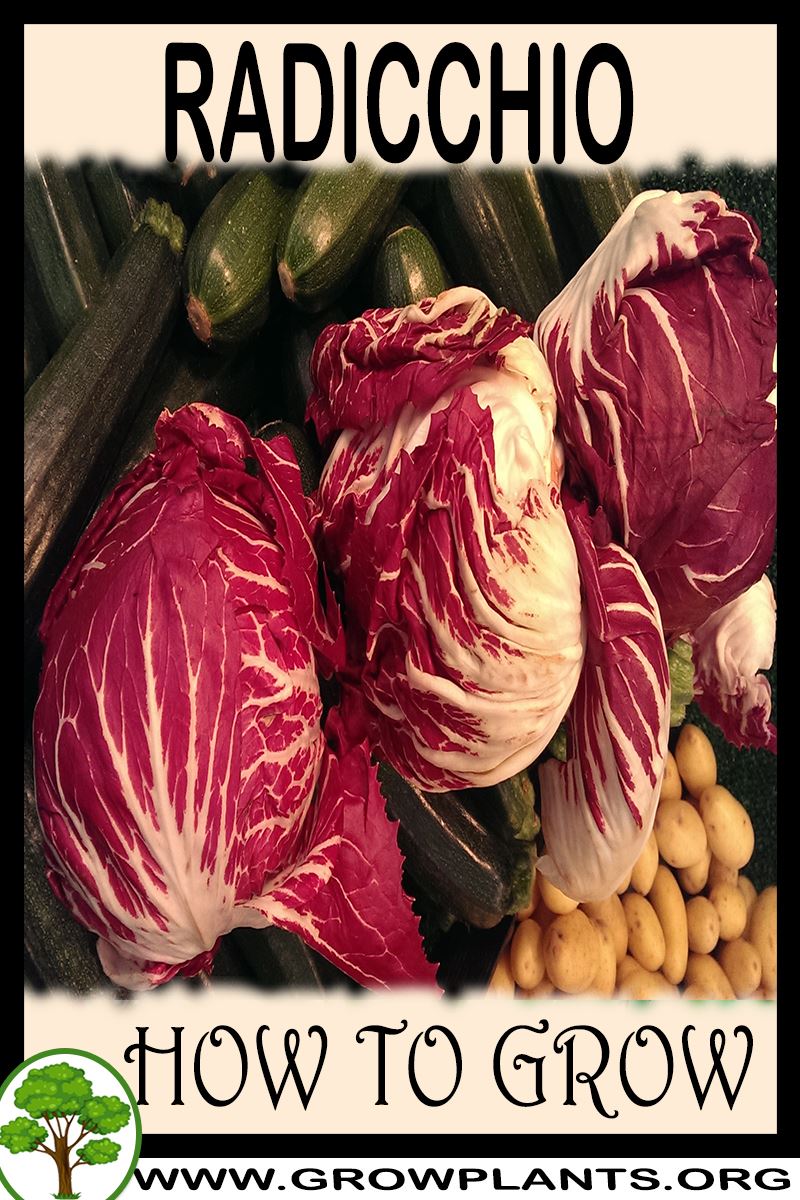
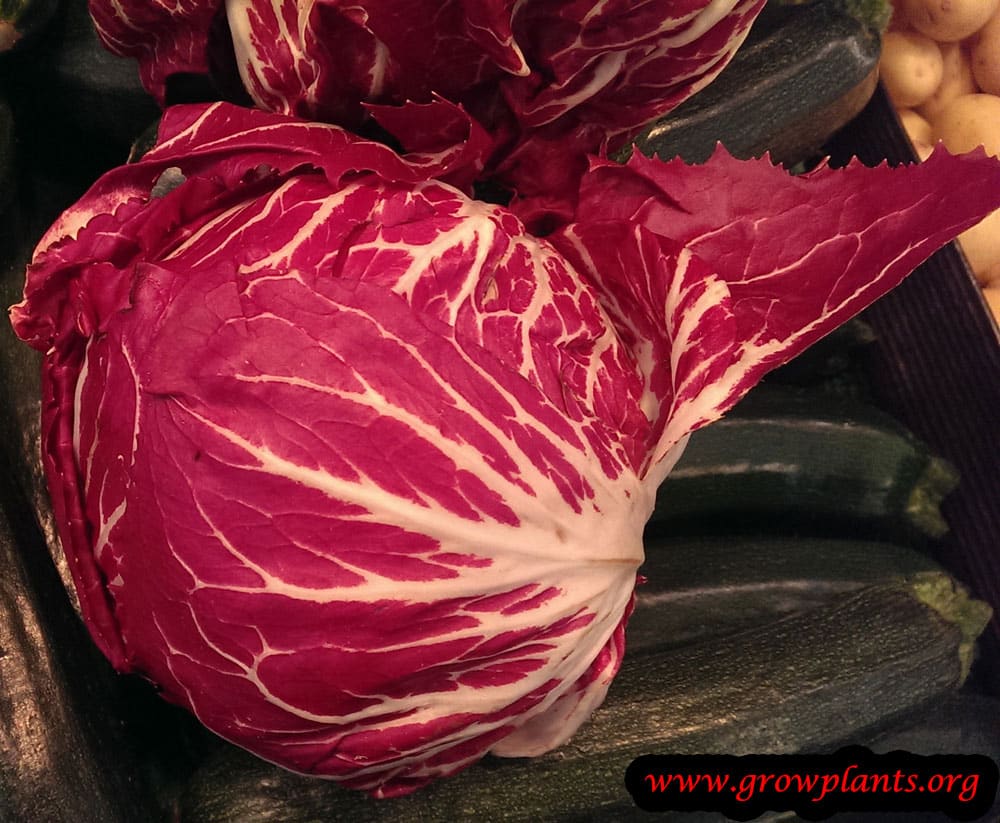
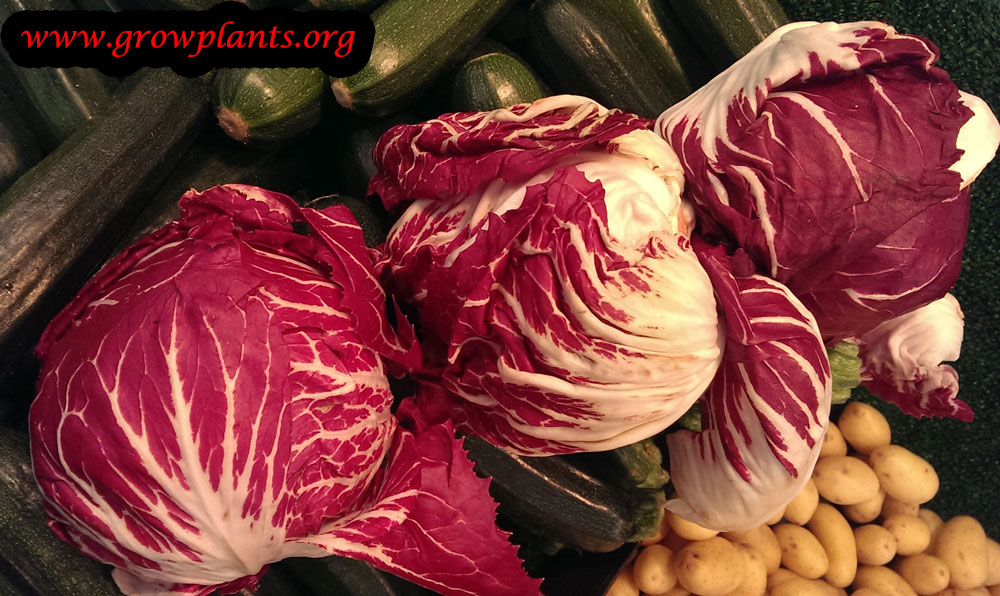
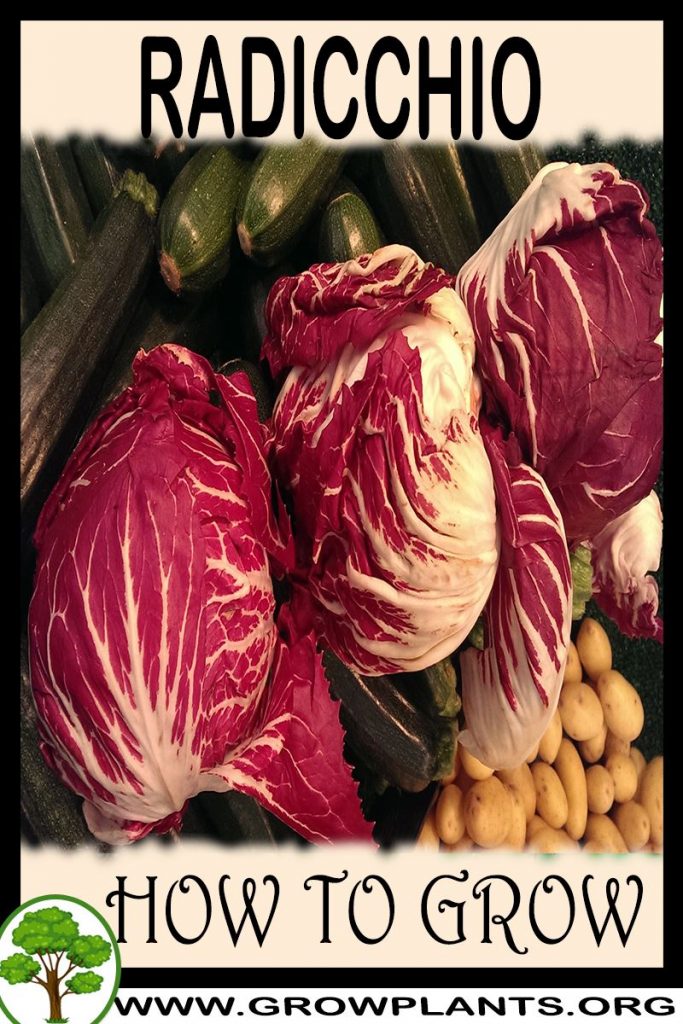
- Leaves & Foliage: Green outer leaves; inner leaves form a head, deep red with white veins
- Flower Characteristics: Small blue flowers (1-3 cm) borne on an inflorescence; buds also edible
Primary Uses & Landscape Value
- Edible Uses: Leaves eaten raw in salads or pickled; the sweet root is edible and used medicinally
- Functional & Ornamental Roles: Leaf-vegetable crop; traditional medicinal plant
Care Guide: Planting, Soil & Watering
Overview: Radicchio is a fast-growing, cool-season leafy crop that does best in fertile, moisture-retentive, weed-free soil in full sun to part shade. It needs steady, even moisture and mulch to stay tender – heat and drought make the leaves bitter and trigger bolting.
Quick Care Requirements
| Requirement | Ideal Condition |
|---|---|
| Planting Season | Cool season – spring or autumn (autumn where summers are hot) |
| Growth Rate | Fast |
| Soil Type | Fertile, moisture-retentive, well-worked, weed-free |
| Water Need | Moderate to High – keep the soil evenly moist |
Planting & Establishment
- Best Planting Season: Plant in the cool seasons – spring or autumn; in hot-summer climates grow it as an autumn crop to avoid heat stress (suited to zones 4–10).
- How to Plant:
- Hole Preparation: Work the bed to a loose, fine tilth and clear all weeds; for transplants, make a hole just big enough for the root plug.
- Soil Amendments: Enrich the bed with compost or other organic matter for fertility and moisture retention, and mulch to keep the soil cool, moist and weed-free.
- Planting Depth: Set seedlings at the same depth they grew in the tray, with the crown at soil level – do not bury the growing point.
- Growth Speed & Expectations: A fast grower; leaves are usually ready to harvest in about 50–70 days, cut leaf-by-leaf or as a whole head.
Soil, Watering & Drainage Care
- Soil Mix & Drainage Needs: Loose, fertile, moisture-retentive soil that still drains freely. In containers use a rich potting mix with good drainage holes.
- Watering Schedule & Technique:
- Young / Newly Planted: Keep the soil consistently moist while seedlings establish; water gently and often so it never dries out.
- Established: Water regularly for steady, tender growth – chicories turn bitter and bolt if stressed by drought, so keep the soil evenly moist rather than letting it dry out hard.
- Seasonal Adjustments: Water more in warm, dry weather and less in cool, damp conditions; grow through the cooler seasons to keep the leaves sweet.
Climate, Light & Hardiness
Radicchio is a cool-season leafy chicory that performs best in the mild temperatures of a temperate or Mediterranean climate, colouring and sweetening as nights turn cool. It enjoys full sun in cool weather (accepting light afternoon shade where summers are hot), and is one of the more cold-tolerant salad crops – heat, rather than cold, is what usually limits it.
Quick Climate Specifications
| Climate Zones | Temperate, Mediterranean, subtropical (grown as a cool-season crop) |
|---|---|
| USDA Hardiness Zones | Approximately 4–10 (site data) |
| Optimal Temp Range | Cool, roughly 10–20°C (50–68°F) |
| Cold Damage Begins | Light frost is tolerated and can improve flavour; hard freezes damage outer leaves and the heart |
| Frost Tolerance | Moderate (light frost) |
| Light Conditions | Full sun to partial shade |
Sunlight & Light Exposure
Optimal Light Setup
Grow in full sun during the cool part of the season for compact, well-coloured heads. In hot-summer regions, light afternoon shade slows bolting and eases heat stress.
Shade & Heat Management
Heat and long days push radicchio to bolt and turn bitter, so schedule the crop for the cool shoulder seasons and give some shade during warm spells.
Temperature Extremes & Hardiness
USDA Hardiness & Regional Limits
Site data places radicchio in hardiness zones of roughly 4–10. It is commonly sown in spring, or – in warm-summer climates – in autumn so the crop matures through cool weather rather than summer heat.
Cold Damage & Winter Protection
Established plants tolerate light frost, and a touch of cold often sweetens the leaves and deepens their red colour. Prolonged hard freezes damage the outer wrapper leaves and can rot the heart; a cloche or row cover extends harvest in cold snaps.
Extreme Heat Tolerance
Heat is the real constraint. High temperatures and lengthening days trigger bolting, looser heads and bitterness, so aim the crop at the cool end of the growing season.
Wind, Humidity & Microclimate
Microclimate Recommendations
An open, sunny but not baking bed suits it. In hot regions, a spot that stays cooler in late afternoon – or simply timing the crop for autumn and late winter – gives the best heads.
Growing in Pots, Balconies & Indoors
Radicchio (red chicory) is a leafy salad crop that grows well in deeper containers and balcony troughs – the grower does not class it as a decorative houseplant, but you can raise young leaves on a bright, sunny sill, and a cool spell late in the season is what turns the heads their rich red.
Quick Details
- Container Size: Roomy – a 5-10 L pot at least 20 cm deep for a heading plant (5-20 cm top, 5-12 cm root)
- Indoor Suitability: Not a decorative houseplant, but a bright, sunny sill grows the leaves
- Best Spot: Full sun to half shade, in cool conditions – cool weather deepens the red colour
- Soil & Drainage: Rich, weed-free, moisture-retentive mix that still drains; mulch to keep it cool
- Watering in Pots: Average to generous – keep steadily moist; drought makes it more bitter
Indoors & On the Windowsill
- Not a decorative houseplant: The grower marks it unsuitable as an ornamental indoor plant – it is a chicory crop that wants strong light.
- Sunny sill: A bright, cool, sunny sill grows young leaves for salads as a cut-and-come-again crop.
- Colour & heading: Cooler conditions late in growth turn the heart red and firm; a mild autumn chill improves both colour and flavour.
On a Balcony or Patio
- Cool-season crop: Grow it in the cooler parts of the year on a bright balcony; heat keeps it green, loose and bitter.
- Watering: Pots dry fast in sun and wind – keep the mix evenly moist for milder, tender leaves.
Choosing the Pot, Soil & Long-Term Care
- Pot & drainage: A deep pot or trough with strong drainage holes; skip a standing water saucer so roots never sit wet.
- Potting mix: A rich, well-aerated but moisture-retentive mix – potting compost with a little extra organic matter.
- Feeding: A steady, balanced feed supports leafy growth; potted nutrients leach with watering, so feed little and often.
- Growing on: Grown as an annual crop – sow fresh each season for firm autumn heads rather than repotting.
Fertilizing & Feeding
A moderate feeder grown for its leaves; keep nitrogen steady through growth and ease off near harvest so plants stay sweet and do not run to seed.
Quick Fertilizing Specs
| Feeding Level | Moderate |
|---|---|
| Main Nutrient Priority | Nitrogen for steady leaf growth, balanced overall |
| Best Feeding Period | Through active leafy growth |
| Organic Options | Compost worked in before planting |
| Micronutrients | Usually not needed in healthy soil |
| Soil pH | Fertile, moist soil; near neutral to slightly acidic |
| Reduce/Stop Feeding | Ease nitrogen near harvest to limit bolting |
Feeding by Growth Stage
Seedbed and establishment
Prepare a fertile, moisture-retentive bed so young plants root quickly.
| Nutrient direction | Work compost and a balanced starter fertilizer into the bed before planting. |
|---|---|
| Timing | At bed preparation and transplanting. |
| Frequency | Worked into the bed at planting, then feed as growth begins. |
| Fertilizer types | Compost or well-rotted organic matter, A balanced starter fertilizer |
| Precautions | Avoid fresh manure on leafy crops; keep the bed evenly moist. |
Leafy growth
Drive fast, tender leaf production, the harvested part of the crop.
| Nutrient direction | A nitrogen-forward feed to sustain lush leaf growth; keep nitrogen steady but not excessive. |
|---|---|
| Timing | Through active leafy growth after establishment. |
| Frequency | Light, regular feedings while the leaves are bulking. |
| Fertilizer types | A nitrogen-forward complete fertilizer, Side-dressed compost or a liquid feed |
| Precautions | Avoid excess nitrogen, which softens leaves and attracts aphids; keep growth steady. |
Harvest period
Maintain steady quality as leaves are picked, without forcing bolting.
| Nutrient direction | Ease toward a balanced feed; keep plants growing steadily up to harvest. |
|---|---|
| Timing | As leaves reach usable size and are harvested. |
| Frequency | Light feeding as needed to keep growth even. |
| Fertilizer types | A balanced complete fertilizer, A dilute liquid feed |
| Precautions | Excess nitrogen late can encourage bolting and bitterness in these chicory and lettuce crops; keep it moderate. |
Nutrient Deficiency Signs & Corrections
Overall pale, yellow-green leaves with slow, stunted growth.
| Possible causes | Low soil nitrogen, Leaching from heavy watering or rain, Cold soil slowing nitrogen release |
|---|---|
| Appears first on | Older, lower leaves |
| What to check | soil fertility and recent feeding, drainage and rainfall, soil temperature |
| Possible correction | Side-dress with a nitrogen-bearing fertilizer or compost and keep growth steady. |
Inner leaf margins turn brown and papery (tipburn), especially in fast, warm growth.
| Possible causes | Localised calcium shortage in fast-growing inner leaves, Uneven watering or moisture stress, Excess nitrogen pushing rapid soft growth |
|---|---|
| Appears first on | Margins of young inner leaves |
| What to check | watering consistency, nitrogen level, weather and growth rate |
| Possible correction | Keep watering even and nitrogen moderate; calcium moves poorly into fast inner leaves. |
Yellowing between the veins of younger leaves while the veins stay green.
| Possible causes | Iron availability limited by high soil pH, Cold or waterlogged soil, Root damage limiting uptake |
|---|---|
| Appears first on | Younger leaves |
| What to check | soil pH, drainage, root condition |
| Possible correction | Correct pH and drainage; if needed apply a chelated iron product following its label. |
Pruning, Training & Seasonal Maintenance
Radicchio is a heading chicory grown for its red-and-white leaves, so its care is harvest and blanching rather than woody pruning. It has a useful trick unique among these salads: after a loose, green, often bitter autumn rosette forms, cutting the plant back to about 2–3 cm above the crown, followed by cool weather, prompts it to resprout a tighter, sweeter, well-coloured head. Cold itself sweetens and deepens the colour, so timing the cut-back to the cool season matters.
Quick Pruning & Maintenance Specs
| Pruning Tolerance | Moderate – regrows a firm head after a cut-back |
| Primary Pruning Window | Autumn: cut the loose rosette back to force a tight head |
| Secondary Maintenance Window | Through growth: remove damaged outer leaves |
| Typical Frequency | One cut-back to re-head, then a whole-head harvest |
| Main Objective | A firm, sweet, well-coloured heart; less bitterness |
| Young Plant Priority | Let the rosette establish; remove only damage |
| Mature Plant Priority | Cut back to re-head, or cut the whole head at the base |
| Best Tool Type | Precision snips for leaves; a clean knife for cut-back and heads |
| Avoid Heavy Pruning During | Warm spells – heat keeps it loose, green and bitter |
Pruning by Plant Age & Size
Newly Established
Thin to spacing; do not cut. A well-fed rosette gives the reserves for a firm re-headed heart later.
Young / Formative
No structural training – a leafy rosette. Remove only diseased or slug/aphid-damaged outer leaves.
Mature / Established
If the first growth is loose and bitter, cut the whole plant back to about 2–3 cm above the crown and let cool weather drive a tight new head; otherwise cut the mature head cleanly at the base.
Seasonal Pruning Schedule
Ongoing Sanitary
Objective: keep the rosette clean. Remove: spoiled outer leaves. Do NOT remove: healthy leaves the plant needs to re-head.
Autumn Cut-Back to Re-Head
Objective: convert a loose green rosette into a firm red heart. Cut back hard to the crown as cool weather arrives; the regrowth hearts up tighter and sweeter, and the cold intensifies the red colour. Expected response: a compact, well-coloured head from the cut crown.
Blanching (optional)
Objective: further reduce bitterness. Covering the heart to exclude light for a week or so pales and sweetens it, as with other chicories.
Special Growth to Remove
- Loose bitter outer rosette – cut it back to the crown to force a tight second head.
- Bolting flower stalk – remove in warm weather; a bolting plant will not heart.
- Damaged outer leaves – remove before covering to blanch.
Container & Small-Space Pruning
Radicchio heads well in deep pots; the same cut-back-and-re-head method works, and an upturned pot can blanch the heart. Cool autumn conditions in a container give the best colour and sweetness.
Tools
Use precision snips for leaf tidying and a clean sharp knife for the cut-back and for cutting the finished head at the base. No saw, loppers or shears apply.
Tool Hygiene & Disease Risk
Routine, but the cut-back leaves an exposed crown, so use a clean, sharp blade to reduce rot before it re-heads.
Cut Placement & Technique
For re-heading, cut to about 2–3 cm above the crown so the growing point survives; too low and it will not resprout. Harvest the firm head with one clean cut at the base.
Post-Pruning / Post-Harvest Care
After the cut-back keep the crown just moist and let cool weather do the work; no feeding is needed to re-head. Use the cut head promptly.
Common Pruning Mistakes
- Cutting back in warm weather, so the regrowth stays loose, green and bitter.
- Cutting the crown too low, so nothing re-sprouts.
- Expecting sweetness without cold or blanching.
When NOT to Prune
Do not cut back during warm spells (wait for cool weather), and do not strip healthy leaves that fuel the re-heading crown.
Recommended Tools (by task)
- precision_snips – for outer-leaf tidying and removing a bolt stalk.
- blade_disinfectant – a clean blade for the cut-back, where the exposed crown can rot before it re-heads.
Bloom & Edible Flower Guide
Quick Details
- Bloom Season: Spring and summer
- Time to First Bloom: In its first flowering season, once heat and long days trigger bolting
- Flower Appearance: Small blue, daisy-like flowers about 1-3 cm across, carried along the flowering stems
- Edibility: Edible – the blue flowers are used in salads
Detailed Blooming Overview
Radicchio, the red Italian chicory, is grown for its tight, colourful leaf heads, but a plant left to run will bolt and throw up branching stems set with small sky-blue, daisy-like flowers through spring and summer. Each bloom is about 1-3 cm across, opens with the morning sun and is worked by bees, and the flowers are edible, adding blue to a salad.
Flower Characteristics
- Small blue, daisy-like flower heads about 1-3 cm across
- Carried on tall, branching flower stems (inflorescences)
- Open with the sun and close later in the day; attractive to bees
Bloom Care & Thinning
- Using the flowers: scatter freshly opened blooms over salads for colour
- If growing for leaves: bolting to flower ends the leaf crop, so remove flower stems early unless you want blooms or seed
- Pollination: worked by bees
Fruit & Uses
Radicchio (red chicory) is grown for its firm heads of red, white-veined leaves, eaten raw in salads or pickled and also grilled; its blue flowers and buds are edible too. Like other chicories it has an edible sweet taproot that can be roasted as a coffee-like beverage.
Quick Edible Specs
| Edible Parts | Leaves (red heads), root, flowers & buds |
|---|---|
| Main Use(s) | Salad and pickle (also grilled/roasted); root as a roasted coffee-substitute beverage; traditionally used medicinally (no health claims) |
| Eaten Raw or Cooked | Leaves both (raw or grilled); root roasted |
| Preparation Required | Wash leaves; cooking/dressing tames the bitterness; peel and roast root for the beverage |
| Harvest Season | Leaves about 50–70 days from sowing; root lifted all year |
| Storage | Refrigerate heads; roots stored |
| Safety/Toxicity Caveat | No notable toxicity; distinctly bitter |
Leaves & Greens
The outer leaves are green while the inner leaves form a firm head that is red with white veins. Harvest leaf by leaf or cut the whole head. Use the leaves raw in salads or pickled; grilling or roasting mellows their bitterness.
Roots & Tubers
The taproot is edible and sweet, white with a brown peel, about 5–12 cm, and can be pulled all year. Roasted and ground it makes a caffeine-free coffee-like beverage; it is also traditionally used medicinally (no health claims).
Flowers & Flower Buds
The small blue flowers and their buds are edible and used in salads.
Harvesting
Heads are ready roughly 50–70 days from sowing; cool weather and blanching the heart deepen the colour and reduce bitterness. Roots can be lifted through the year.
Preparation, Uses & Safety
Wash the leaves; balance the bitterness by dressing, grilling or roasting. For the beverage, peel, roast and grind the root. No notable toxicity — the strong bitterness is characteristic and eases with cooking or blanching. Traditional medicinal use is noted only as background.
Pests, Diseases & Troubleshooting
Overview: Leafy chicory and endive crops are mainly troubled by sap-sucking aphids, slugs and snails in the dense hearts, and leaf-mining flies, alongside foliar and soil rots that thrive in wet, crowded plantings – downy mildew, Sclerotinia drop and bacterial soft rot. Clean beds, good spacing and airflow, careful watering and prompt removal of rotting leaves prevent most losses.
Quick Troubleshooting Overview
| Issue / Pest | Main Symptom | Primary Solution |
|---|---|---|
| Aphids | Colonies in hearts, honeydew, virus | Beneficials, water jet, insecticidal soap |
| Slugs & snails | Ragged holes, slime, hollowed hearts | Handpick at night, traps, iron-phosphate bait |
| Leaf miner | Serpentine mines in leaves | Remove leaves, row cover, sticky traps |
| Caterpillars/cutworms | Chewed leaves, severed seedlings | Handpick, Bt, collars, row cover |
| Downy mildew | Pale patches above, downy growth beneath | Airflow, base watering, resistant vars, copper |
| Sclerotinia / soft rot | Watery collapse, white mould or slimy rot | Sanitation, drainage, rotation, careful handling |
Common Pests & Management
- Aphids (Nasonovia ribisnigri, Myzus persicae, Aphis spp.):
- Symptoms: Green or grey aphids colonise leaf undersides and burrow deep into the folded hearts, contaminating heads and leaving honeydew and sooty mould; several species transmit mosaic and yellows viruses.
- Prevention & Control: Encourage ladybirds, lacewings, hoverflies and parasitic wasps, and use fine mesh/row cover on young crops. Manage nearby weeds. Dislodge with water and treat hot-spots with insecticidal soap or neem; because aphids hide in the heart, thorough coverage and early action matter most.
- Slugs and snails (Deroceras reticulatum, Cornu aspersum):
- Symptoms: Irregular ragged holes, slime trails and hollowed-out hearts; they shelter in the dense rosette and feed at night and in wet weather, and their damage opens the door to soft rots.
- Prevention & Control: Keep beds tidy and remove daytime hiding places, water in the morning so foliage dries by night, and set beer or trap boards. Hand-pick after dark and use iron-phosphate baits, which are safe around pets and wildlife; copper barriers protect blanched plants.
- Leaf miner (Liriomyza spp., Chromatomyia spp.):
- Symptoms: Pale serpentine tunnels and blotches inside the leaves; disfigured outer leaves reduce quality and, in salad crops, marketability.
- Prevention & Control: Cover crops with fine mesh to exclude the adult flies, remove and destroy mined leaves, and monitor with yellow sticky traps. Conserve parasitic wasps and avoid broad-spectrum sprays that kill them.
- Caterpillars and cutworms (Autographa gamma, Agrotis spp., Mamestra brassicae):
- Symptoms: Loopers and other caterpillars chew leaves and foul hearts with frass; cutworms sever young transplants at soil level overnight.
- Prevention & Control: Inspect and hand-pick at dusk, use collars around transplants, and float row cover over young plants. Bacillus thuringiensis (Bt) selectively controls caterpillars; keep beds weed-free to reduce egg-laying.
- Thrips (Thrips tabaci, Frankliniella occidentalis):
- Symptoms: Silvery speckling and scarring on leaves, worst in hot dry spells; can spread viruses and downgrade appearance.
- Prevention & Control: Use blue sticky traps and remove weedy hosts, keep plants watered and un-stressed, and encourage predatory mites and pirate bugs. Spot-treat with spinosad or insecticidal soap in the evening if needed.
Diseases & Fungal Issues
- Downy mildew (Bremia lactucae, Plasmopara spp.):
- Symptoms: Pale yellow angular patches on the upper leaf surface with a downy grey-white mould beneath in cool, damp, humid conditions; affected tissue browns and rots.
- Treatment & Management: Space plants and orient rows for airflow, water at the base early in the day, and rotate. Grow resistant varieties where offered and clear infected leaves. A copper or protectant fungicide helps under sustained damp pressure.
- Sclerotinia drop (white mould) (Sclerotinia sclerotiorum, S. minor):
- Symptoms: Plants wilt and collapse from the base with a watery, soft rot and fluffy white mould bearing hard black sclerotia; whole heads flatten and rot.
- Treatment & Management: Rotate away from susceptible crops for several years, improve drainage and airflow, and avoid dense, over-watered stands. Remove and destroy affected plants with surrounding soil; deep burial and avoiding splash reduce spread.
- Bacterial soft rot & bacterial leaf spot (Pectobacterium carotovorum, Pseudomonas spp., Xanthomonas spp.):
- Symptoms: Slimy, foul-smelling wet rot of the heart and midribs (soft rot), or dark, greasy, angular leaf spots (bacterial spot), spreading fast in warm, wet, damaged crops.
- Treatment & Management: Avoid overhead watering and working plants when wet, minimise leaf injury and pest damage that create entry points, and space for quick drying. Harvest dry, cull affected plants, and rotate; copper gives partial suppression of bacterial spots.
- Bottom rot & damping-off (Rhizoctonia solani, Pythium spp.):
- Symptoms: Rusty-brown rot of lower leaves and crown touching the soil (bottom rot) and seedling collapse (damping-off) in wet, crowded beds.
- Treatment & Management: Sow into warm, well-drained soil, avoid deep planting and waterlogging, and improve spacing. Remove affected plants; a Trichoderma or protectant drench helps on problem ground.
- Powdery mildew & Botrytis (Golovinomyces cichoracearum; Botrytis cinerea):
- Symptoms: White powdery film in warm dry spells (powdery mildew) or grey fuzzy mould on damaged, senescing leaves in cool damp weather (Botrytis).
- Treatment & Management: Improve airflow and light, avoid dense over-feeding, and remove old and injured leaves. Sulfur or potassium bicarbonate checks powdery mildew; sanitation and drier conditions curb Botrytis.
Growing Difficulties & Abiotic Problems
- Tipburn:
- Cause & Symptoms: Brown, dead margins on inner leaves from calcium not reaching fast-growing tissue during rapid growth, heat or uneven watering.
- Correction Strategy: Keep soil moisture even, avoid heavy nitrogen and forcing, ensure adequate calcium, and choose tolerant varieties; ventilate under cover to reduce humidity swings.
- Bolting (premature flowering):
- Cause & Symptoms: Plants shoot to seed and turn bitter after cold spells or long days and heat, especially from stressed or late sowings.
- Correction Strategy: Sow at the recommended time, choose bolt-resistant varieties, keep growth steady without checks, and avoid transplant and drought stress.
- Excessive bitterness / poor blanching:
- Cause & Symptoms: Endive and radicchio can be very bitter if not blanched or if heat-stressed; hearts stay green and sharp.
- Correction Strategy: Blanch endive by tying up or covering heads before harvest, grow through cooler conditions, and harvest at the right maturity for milder flavour.
- Nutrient chlorosis and drought stress:
- Cause & Symptoms: Pale leaves and stunting from nitrogen shortage; wilting, toughness and bitterness from dry soil.
- Correction Strategy: Feed a balanced fertiliser for steady leaf growth, mulch, and water evenly and regularly, since checks harm quality.
What Helps – Products & Tools
Rely first on spacing, base watering, bed hygiene and row cover. Useful products include insecticidal soap and neem (aphids, thrips), iron-phosphate slug bait and copper barriers (slugs and snails), yellow/blue sticky traps and fine mesh (leaf miner, thrips), Bacillus thuringiensis (Bt) for caterpillars, and copper or protectant fungicides plus sulfur/potassium bicarbonate for downy and powdery mildews. Handle plants dry and spray in the evening to protect pollinators.