Plant Profile & Key Characteristics
Overview: Belgian endive is a leafy chicory (genus Cichorium) grown for its edible, blanched leaf heads and its edible taproot; it is also used medicinally. Leaves are pale and tender when forced in the dark.
Quick Specifications
| Specification | Attribute |
|---|---|
| Plant Type / Life Cycle | Perennial / biennial |
| Foliage Type | Deciduous |
| Mature Size | Leafy top 5-20 cm (2-8 in); taproot 5-12 cm (2-5 in) |
| Growth Rate | Fast |
| Root System | Taproot (edible) |
| Toxicity | Non-toxic / edible |
| Hardiness | USDA zones 4-9 |
Growth Form & Structure
- Height & Spread: Leafy top 5-20 cm over a 5-12 cm taproot; also grown in containers.
- Growth Habit & Form: Leaf rosette over a fleshy taproot; blanched (forced) in the dark for pale, tender heads.
- Lifespan & Maturity: Perennial/biennial; leaves harvestable in about 50-70 days.
Anatomy & Physical Features
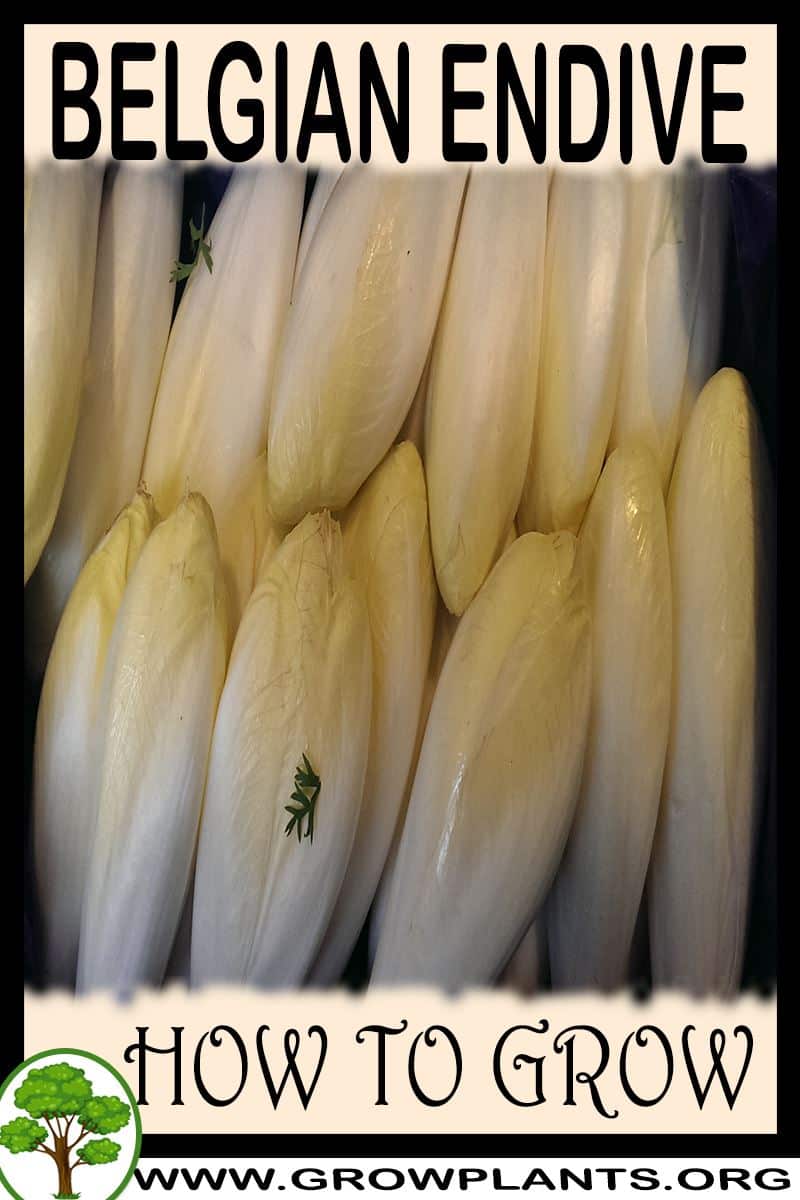
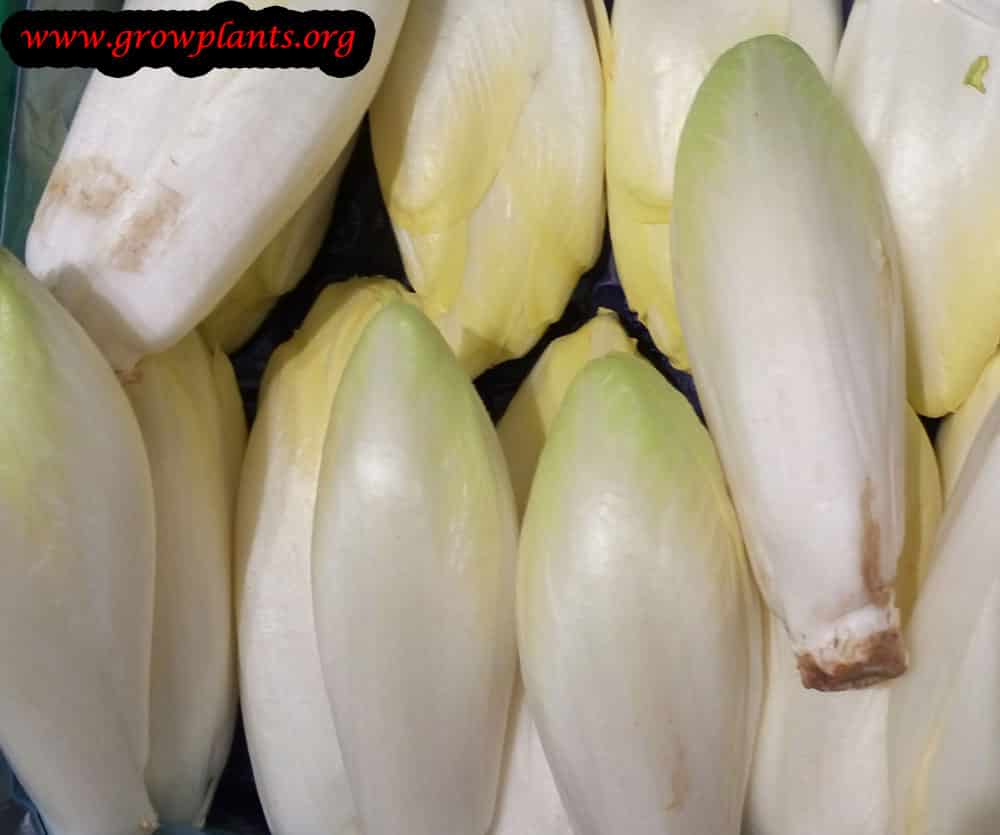
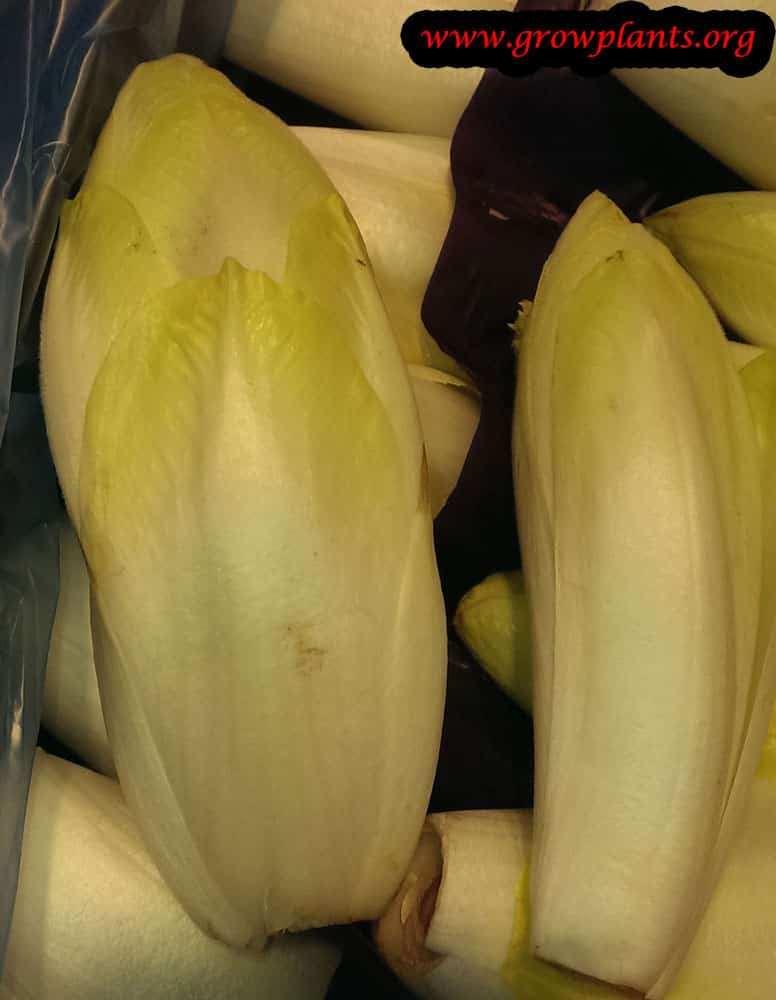
- Leaves & Foliage: Green or yellow leaves, mostly white when grown in the dark (blanched).
- Flower Characteristics: Small blue flowers 1-3 cm in inflorescences, the buds also edible; bee-pollinated.
- Fruit Profile: The edible, sweet white taproot (with brown peel, 5-12 cm) is a key harvested part, roasted as a coffee-like beverage.
Primary Uses & Landscape Value
- Edible Uses: Blanched leaves in salad or pickled; flower buds in salad; roasted root as a coffee-like beverage.
- Functional & Ornamental Roles: Medicinal plant; suited to containers.
Care Guide: Planting, Soil & Watering
Overview: Belgian endive is a cool-season leaf crop grown in full sun to half shade that prefers cool weather, weed-free ground and steady moisture. Rich, mulched, moist soil produces the tender leaves, which are often blanched in the dark for mildness.
Quick Care Requirements
| Requirement | Ideal Condition |
|---|---|
| Planting Season | Spring or autumn; autumn in warm-summer climates |
| Growth Rate | Fast |
| Soil Type | Moist, rich, weed-free and mulched |
| Soil pH | Neutral (about 6.0-6.8) |
| Water Need | Moderate to high; keep the soil evenly moist |
Planting & Establishment
- Best Planting Season: Sow or plant in spring or autumn; in areas with hot summers grow it into autumn so the leaves mature in cool weather (hardiness zone 4-9).
- How to Plant:
- Hole Preparation: For transplants, a hole a little wider than the root ball in deep, loose, stone-free soil that lets the taproot grow straight.
- Soil Amendments: Enrich with compost and mulch to hold moisture and keep the bed weed-free.
- Planting Depth: Plant at the level the seedling grew; the fleshy root sits just below the surface.
- Growth Speed & Expectations: A fast grower; roots are often lifted and forced in the dark to produce the pale, tender chicons for which it is prized.
Soil, Watering & Drainage Care
- Soil Mix & Drainage Needs: Wants moisture-retentive, fertile soil that still drains; deep containers suit its long root.
- Watering Schedule & Technique:
- Young / Newly Planted: Keep young plants consistently moist to fuel quick, tender leaf growth.
- Established: Water regularly and evenly – dryness makes the leaves tough and bitter.
- Seasonal Adjustments: More water in warm spells; steady moisture in cool growing weather.
Climate, Light & Hardiness
Belgian endive is a cool-season, cold-tolerant leafy chicory grown in temperate, Mediterranean and subtropical climates in full sun to half shade. It grows best in cool weather and, although usually grown as a seasonal crop, the site retains a hardiness range of about zones 4–9; summer heat, which triggers bolting and bitterness, is the main limiting factor rather than winter cold.
Quick Climate Specifications
| Climate Zones | Temperate, Mediterranean, subtropical (cool-season crop) |
| USDA Hardiness Zones | Approximately 4–9 (per site data) |
| Optimal Temp Range | Approximately 10–20 °C (50–68 °F) |
| Cold Damage Begins | Foliage takes light frost; hard freezing damages the tender leaves |
| Frost Tolerance | Moderate (a cool-season, frost-tolerant leafy crop) |
| Light Conditions | Full sun to half shade |
Sunlight & Light Exposure
Optimal Light Setup
Full sun to half shade for the leafy growth stage. In warm regions, light afternoon shade helps keep the crop cool and delays bolting. Note that the blanched, forced chicons are produced in darkness - a cultivation step rather than a climate requirement.
Shade & Heat Management
Partial shade and cooler conditions reduce heat stress, bolting and bitterness in the leaves.
Temperature Extremes & Hardiness
USDA Hardiness & Regional Limits
The site retains a hardiness range of about zones 4–9. In practice the crop is grown in the cool parts of the year - spring or autumn, and in autumn where summers are hot - because heat, not cold, is the chief limit on quality.
Cold Damage & Winter Protection
As a cool-weather crop it tolerates cool conditions and light frost, which can even improve flavour; hard or prolonged freezing damages the tender leaves.
Frost Sensitivity
Moderately frost-tolerant for the leaves; roots for forcing are lifted before hard freezes.
Extreme Heat Tolerance
Low - the key limiting factor. High temperatures cause premature bolting, toughening and bitterness, so hot summers are avoided by timing the crop for cool seasons.
Wind, Humidity & Microclimate
Rainfall & Seasonal Moisture
Suited to the cooler, moister parts of the growing year; steady, cool conditions give the best leaf quality.
Wind Tolerance
Low to moderate; the soft leafy heads are best given a somewhat sheltered position.
Microclimate Recommendations
Use a cool, sheltered spot and time sowings for spring or autumn to keep the crop out of peak summer heat.
Growing in Pots, Balconies & Indoors
Belgian endive is a leafy salad vegetable grown well in deep containers and window boxes on a balcony or patio – the grower does not class it as a decorative houseplant, though its lifted roots are famously forced indoors in the dark to produce the pale, tender chicons. A sunny sill or balcony grows the leafy crop; a dark cupboard forces the roots.
Quick Details
- Container Size: Roomy and deep – a 5-10 L pot at least 20 cm deep to allow the 5-12 cm root to develop
- Indoor Suitability: Not a decorative houseplant, but a bright, sunny sill grows the leaves; roots are forced indoors in darkness
- Best Spot: Full sun to half shade, in cool conditions – it dislikes hot weather
- Soil & Drainage: Rich, weed-free, moisture-retentive mix that still drains; mulch to keep it cool and moist
- Watering in Pots: Average to generous – keep steadily moist so growth stays sweet; drought turns leaves bitter
Indoors & On the Windowsill
- Not a decorative houseplant: The grower marks it unsuitable as an ornamental indoor plant – it is a vegetable that needs strong light for leafy growth.
- Sunny sill: On a bright, cool, sunny sill you can grow young leaves for salads, treating it as a cut-and-come-again crop.
- Forcing indoors: Its classic trick – lift the roots, pot them up, and keep them warm in complete darkness indoors to blanch the tight, mild chicons.
On a Balcony or Patio
- Cool-season crop: Grow it in the cooler parts of the year on a bright balcony; heat makes it run to seed and turn bitter.
- Watering: Containers dry fast in sun and wind – keep the mix evenly moist for tender, sweet leaves.
Choosing the Pot, Soil & Long-Term Care
- Pot & drainage: A deep pot or trough with strong drainage holes; skip a standing water saucer so roots never sit wet.
- Potting mix: A rich, well-aerated but moisture-retentive mix – potting compost with a little added organic matter.
- Feeding: A steady, balanced feed supports leafy growth; potted nutrients leach with watering, so feed little and often.
- Growing on: Grown as an annual crop – sow fresh each season, or lift roots at the end for indoor forcing rather than repotting.
Fertilizing & Feeding
A moderate feeder grown for its leaves; keep nitrogen steady through growth and ease off near harvest so plants stay sweet and do not run to seed. A fertilizer formulated for tomatoes and vegetables supports that feeding pattern through harvest.
Quick Fertilizing Specs
| Feeding Level | Moderate |
|---|---|
| Main Nutrient Priority | Nitrogen for steady leaf growth, balanced overall |
| Best Feeding Period | Through active leafy growth |
| Organic Options | Compost worked in before planting |
| Micronutrients | Usually not needed in healthy soil |
| Soil pH | Fertile, moist soil; near neutral to slightly acidic |
| Reduce/Stop Feeding | Ease nitrogen near harvest to limit bolting |
Feeding by Growth Stage
Seedbed and establishment
Prepare a fertile, moisture-retentive bed so young plants root quickly.
| Nutrient direction | Work compost and a balanced starter fertilizer into the bed before planting. |
|---|---|
| Timing | At bed preparation and transplanting. |
| Frequency | Worked into the bed at planting, then feed as growth begins. |
| Fertilizer types | Compost or well-rotted organic matter, A balanced starter fertilizer |
| Precautions | Avoid fresh manure on leafy crops; keep the bed evenly moist. |
Leafy growth
Drive fast, tender leaf production, the harvested part of the crop.
| Nutrient direction | A nitrogen-forward feed to sustain lush leaf growth; keep nitrogen steady but not excessive. |
|---|---|
| Timing | Through active leafy growth after establishment. |
| Frequency | Light, regular feedings while the leaves are bulking. |
| Fertilizer types | A nitrogen-forward complete fertilizer, Side-dressed compost or a liquid feed |
| Precautions | Avoid excess nitrogen, which softens leaves and attracts aphids; keep growth steady. |
Harvest period
Maintain steady quality as leaves are picked, without forcing bolting.
| Nutrient direction | Ease toward a balanced feed; keep plants growing steadily up to harvest. |
|---|---|
| Timing | As leaves reach usable size and are harvested. |
| Frequency | Light feeding as needed to keep growth even. |
| Fertilizer types | A balanced complete fertilizer, A dilute liquid feed |
| Precautions | Excess nitrogen late can encourage bolting and bitterness in these chicory and lettuce crops; keep it moderate. |
Forcing (blanching) the chicon
Let the lifted root push a pale, tender chicon using its own stored reserves in the dark.
| Nutrient direction | None – withhold fertilizer; forcing relies on reserves stored in the root. |
|---|---|
| Timing | After lifting roots, during dark forcing. |
| Frequency | No feeding during forcing. |
| Fertilizer types | No feeding at this stage; the chicon grows from stored root reserves. |
| Precautions | Do not fertilize during forcing; provide only darkness, moisture and cool conditions. |
Nutrient Deficiency Signs & Corrections
Overall pale, yellow-green leaves with slow, stunted growth.
| Possible causes | Low soil nitrogen, Leaching from heavy watering or rain, Cold soil slowing nitrogen release |
|---|---|
| Appears first on | Older, lower leaves |
| What to check | soil fertility and recent feeding, drainage and rainfall, soil temperature |
| Possible correction | Side-dress with a nitrogen-bearing fertilizer or compost and keep growth steady. |
Inner leaf margins turn brown and papery (tipburn), especially in fast, warm growth.
| Possible causes | Localised calcium shortage in fast-growing inner leaves, Uneven watering or moisture stress, Excess nitrogen pushing rapid soft growth |
|---|---|
| Appears first on | Margins of young inner leaves |
| What to check | watering consistency, nitrogen level, weather and growth rate |
| Possible correction | Keep watering even and nitrogen moderate; calcium moves poorly into fast inner leaves. |
Yellowing between the veins of younger leaves while the veins stay green.
| Possible causes | Iron availability limited by high soil pH, Cold or waterlogged soil, Root damage limiting uptake |
|---|---|
| Appears first on | Younger leaves |
| What to check | soil pH, drainage, root condition |
| Possible correction | Correct pH and drainage; if needed apply a chelated iron product following its label. |
Pruning, Training & Seasonal Maintenance
Belgian endive (witloof) is a leafy chicory grown in two stages, so “pruning” here means harvest and forcing management rather than shaping woody growth. In the field the leaf tops are cut back before the roots are lifted; the roots are then forced in the dark to produce the pale, tight bud (chicon) that is eaten. Through the season the work is simply removing damaged outer leaves and any bolting flower stalk to keep energy in the root and delay bitterness.
Quick Pruning & Maintenance Specs
| Pruning Tolerance | Moderate – the crown regrows a chicon after the tops are cut |
| Primary Pruning Window | End of season: cut leaf tops just before lifting roots for forcing |
| Secondary Maintenance Window | Through growth: remove damaged outer leaves and any bolt stalk |
| Typical Frequency | Occasional leaf tidy, then one cut-back at lifting time |
| Main Objective | Build a strong root, then force a sweet blanched chicon; prevent bolting |
| Young Plant Priority | Do not cut – the leaves are feeding the taproot you will force |
| Mature Plant Priority | Cut tops to about 2–3 cm above the crown before forcing |
| Best Tool Type | Precision snips for leaves; a clean sharp knife for tops and chicon |
| Avoid Heavy Pruning During | Warm-weather bolting risk – stress makes it run to seed |
Pruning by Plant Age & Size
Newly Established
Thin seedlings to spacing but do not cut the leaves – the whole point of year one is to grow a fat, straight taproot, and every leaf feeds it.
Young / Formative
No structural training – this is a leafy rosette. Remove only diseased or slug-damaged outer leaves; leave the canopy to bulk up the root.
Mature / Established
When the root is ready, cut the leaf top off to about 2–3 cm above the crown, lift the roots, and force them in the dark. The chicon that grows is then harvested with a single clean cut at its base.
Seasonal Pruning Schedule
Ongoing Sanitary
Objective: remove dead and pest-damaged leaves (lettuce aphid, leaf-miner and slug damage are noted). Remove: only clearly spoiled outer leaves. Do NOT remove: healthy green leaves that are still filling the root. Expected response: continued steady root growth.
Bolt Management
Objective: keep energy in the root. In heat or after stress the plant may throw up a blue-flowered stalk; remove it unless you are saving seed, because bolting drains the root and turns the leaves bitter.
Forcing Cut-Back
Objective: trigger a tight blanched chicon. Cut the tops to a short crown, lift, and grow the root on in complete darkness – light greens and toughens the chicon and raises its bitterness.
Special Growth to Remove
- Bolting flower stalk – cut it out (unless saving seed); it robs the root and bitters the leaves.
- Damaged outer leaves – remove spoiled or pest-eaten leaves; keep the rest.
- The leaf crown, at forcing time – cut to a short stub so the growing point survives to push the chicon.
Container & Small-Space Pruning
Roots lift readily into a deep pot or box of moist medium and can be forced in the dark on a balcony or in a cellar. Cut the tops the same way before forcing; the only “pruning” in a container is that top-cut and routine dead-leaf removal.
Tools
Soft leaves and the bolt stalk part with precision snips; use a clean sharp knife to cut the leaf top before forcing and to harvest the chicon at its base. No saw, loppers or shears are ever needed.
Tool Hygiene & Disease Risk
Routine, with one caveat: the forcing cut matters most, because a ragged, wet crown rots in the warm dark. Use a clean, sharp blade for that cut and for harvesting the chicon.
Cut Placement & Technique
When cutting tops for forcing, leave about 2–3 cm of crown above the root so the growing point survives; cutting too low means no chicon forms. Harvest the finished chicon with one clean cut across its base.
Post-Pruning / Post-Harvest Care
After the top-cut, keep the forcing roots cool, moist and fully dark until the chicon is ready. There is nothing to feed – the chicon lives on the root’s stored reserves.
Common Pruning Mistakes
- Cutting or harvesting leaves in year one and starving the root you meant to force.
- Leaving the bolt stalk, so the root weakens and the leaves turn bitter.
- Cutting the crown too low at forcing, so no chicon develops.
- Forcing in any light, giving a green, bitter, loose head instead of a pale tight one.
When NOT to Prune
Do not strip green rosette leaves during the growing season – they are building the root. Avoid cutting a heat-stressed, bolting-prone plant harder than needed.
Recommended Tools (by task)
- precision_snips – for soft outer leaves and cutting out the bolt stalk.
- blade_disinfectant – a clean blade for the forcing top-cut and chicon harvest, where rot in the warm dark is the main risk.
Propagation Guide
Belgian endive is raised from seed.
Quick Propagation Specs
| Preferred Method | Seed |
Propagation
Use mature seed when seed propagation is chosen. Where division is appropriate, separate only established rooted sections with viable shoots and replant them promptly.
Aftercare
Keep newly propagated plants evenly moist but not waterlogged until established.
Bloom & Edible Flower Guide
Quick Details
- Bloom Season: Spring and summer
- Time to First Bloom: In its first flowering season, once heat and long days trigger bolting
- Flower Appearance: Small blue, daisy-like flowers about 1-3 cm across, carried along the flowering stems
- Edibility: Edible – the blue flowers are used in salads
Detailed Blooming Overview
Belgian endive is a chicory grown for its tight leaf chicons, but if a plant is left to run it sends up airy flowering stems studded with small sky-blue, daisy-like flowers through spring and summer. The blooms, about 1-3 cm across, open with the morning sun and are worked by bees; they are also edible, adding colour to a salad.
Flower Characteristics
- Small blue, daisy-like flower heads about 1-3 cm across
- Carried on tall, branching flower stems (inflorescences)
- Open with the sun and close later in the day; attractive to bees
Bloom Care & Thinning
- Using the flowers: scatter freshly opened blooms over salads for colour
- If growing for leaves: bolting to flower ends the leaf crop, so remove flower stems early unless you want blooms or seed
- Pollination: worked by bees
Fruit & Uses
Belgian endive is grown for its crisp, pale leafy heads (chicons), eaten raw in salads or cooked; the plant also gives edible blue flowers and buds and a thick, sweet taproot. The root is roasted and ground as a caffeine-free, coffee-like beverage.
Quick Edible Specs
| Edible Parts | Leaves (blanched heads/chicons), root, flowers & buds |
|---|---|
| Main Use(s) | Salad and cooked vegetable; root as a roasted coffee-substitute beverage; traditionally used medicinally (no health claims) |
| Eaten Raw or Cooked | Leaves both (raw or braised); root roasted |
| Preparation Required | Blanch (force in darkness) for pale, mild leaves; peel and roast root for the beverage |
| Harvest Season | Leaves about 50–70 days from sowing; root lifted all year |
| Storage | Keep chicons cool and dark to stay pale; roots stored or forced through winter |
| Safety/Toxicity Caveat | No notable toxicity; naturally slightly bitter |
Leaves & Greens
The leaves are green in the light but turn white or mostly white when the head is grown in the dark (blanched/forced), which also makes them milder and less bitter. Harvest either leaf by leaf or by cutting the whole head. Use the crisp leaves raw in salads, pickled, or braised and baked as a cooked vegetable.
Roots & Tubers
The taproot is edible, sweet-tasting, white with a brown peel and about 5–12 cm long. It can be pulled all year. Peeled, roasted and ground it makes a caffeine-free coffee-like beverage; the root is also traditionally used medicinally (no health claims).
Flowers & Flower Buds
The small blue flowers (1–3 cm) and the buds are edible and are used in salads.
Harvesting
Leaf heads are ready roughly 50–70 days from sowing; excluding light (forcing) yields the pale, tender chicon. Roots can be lifted through the year and the best roots are commonly re-grown (forced) in darkness to produce a second flush of chicons.
Preparation, Uses & Safety
Blanching/forcing in the dark is the key step for sweet, mild leaves. For the beverage, wash, peel, roast and grind the root. There is no notable toxicity; the plant is simply bitter, which mellows with blanching and cooking. Traditional medicinal use is noted only as background.
Pests, Diseases & Troubleshooting
Belgian endive is grown in two stages – a field root, then forced in the dark for the blanched chicon – and its problems reflect both. In the field the source’s pests are accurate: lettuce aphid, leaf miners and slugs, plus cutworms and root-feeding wireworms. During forcing, grey mould, Sclerotinia and bacterial soft rot of the chicons are the main risks. Clean roots, cool airy forcing and good hygiene are the keys.
Quick Troubleshooting Overview
| Issue / Pest | Main Symptom | Primary Solution |
|---|---|---|
| Lettuce aphid | Colonies on leaves and into the heart | Water-jet, beneficials, insecticidal soap |
| Leaf miners | Pale winding or blotchy tunnels in leaves | Pick off mined leaves, row cover |
| Slugs & snails | Grazed leaves and chicons, slime trails | Hand-pick, iron-phosphate pellets |
| Forcing rots | Fuzzy mould or slimy breakdown of chicons | Cool airy forcing, sound roots, hygiene |
| Bolting / bitterness | Premature flowering; harsh bitter leaves | Correct timing; blanch/force in full dark |
Common Pests & Management
- Lettuce aphid (Nasonovia ribisnigri / Pemphigus spp.):
- Symptoms: Green or pinkish aphids colonising the leaves and pushing into the developing heart, stunting growth, fouling it with honeydew and contaminating the crop; some also attack the roots.
- Prevention & Control: Encourage ladybirds, lacewings and hoverflies, hose off colonies, and remove old outer leaves; use resistant varieties where available and treat persistent colonies with insecticidal soap or neem oil, observing harvest intervals.
- Leaf miners (Liriomyza spp.):
- Symptoms: Pale, winding or blotchy tunnels etched between the leaf surfaces where larvae feed; heavy mining reduces vigour but rarely kills an established plant.
- Prevention & Control: Pick off and destroy mined leaves as they appear and clear crop debris; row-cover barriers keep the egg-laying flies off. Encourage parasitic wasps, which usually keep numbers in check; reserve spinosad or neem for severe cases and rotate crops.
- Slugs & snails (Deroceras / Helix spp.):
- Symptoms: Irregular holes in leaves and stems with tell-tale silvery slime trails, worst on soft young growth in damp, shady conditions and after rain or watering; seedlings can be grazed to the ground overnight.
- Prevention & Control: Clear hiding places, water in the morning so surfaces dry by nightfall, and hand-pick after dark. Set beer traps or ring vulnerable plants with grit, copper tape or crushed shell. Where pressure is high, scatter iron-phosphate pellets, which are safe around pets and wildlife.
- Cutworms (Agrotis spp.):
- Symptoms: Soil caterpillars that sever young plants at ground level and chew the crown and root tops.
- Prevention & Control: Keep beds weed-free, cultivate to expose them to birds, hand-pick at night, and protect seedlings with collars.
- Wireworms (Agriotes spp.):
- Symptoms: Slender orange click-beetle larvae that bore into the storage roots, leaving holes that invite rot and spoil the forcing root.
- Prevention & Control: Rotate away from grassland and cereals, cultivate to expose larvae, and improve drainage; trap crops and patient cultivation reduce numbers over time.
Diseases & Fungal Issues
- Grey mould (Botrytis) & Sclerotinia rot (Botrytis cinerea / Sclerotinia sclerotiorum):
- Symptoms: Fuzzy grey mould or a soft, watery, white-cottony rot of the chicons and leaves, especially during humid forcing and in crowded, cool-wet fields.
- Treatment & Management: Force in cool, airy, clean conditions with sound, undamaged roots, avoid overcrowding and excess moisture, remove affected chicons promptly, and rotate in the field; clean and sanitise the forcing area between batches.
- Bacterial soft rot (Pectobacterium (Erwinia) spp.):
- Symptoms: A wet, slimy, foul-smelling breakdown of the chicon or root, entering through wounds during wet, warm forcing or storage.
- Treatment & Management: Handle roots gently to avoid bruising, force and store cool with good ventilation, keep hygiene high, and discard any rotting material at once.
- Downy mildew (Bremia lactucae):
- Symptoms: Yellow blotches on the upper leaf with grey-white mould beneath, in cool, damp, crowded field conditions.
- Treatment & Management: Space for airflow, avoid overhead watering, remove affected leaves, and rotate; resistant varieties help.
- Aster yellows (phytoplasma (leafhopper-spread)):
- Symptoms: Yellowed, distorted, twisted growth spread by leafhoppers in the field crop.
- Treatment & Management: Control leafhoppers and weed hosts and remove infected plants; there is no cure.
Growing Difficulties & Abiotic Problems
- Bolting & bitterness:
- Cause & Symptoms: Sown too early or stressed, the field crop can bolt to flower, and chicons forced in any light turn green, tough and very bitter instead of pale, crisp and mild.
- Correction Strategy: Sow at the correct season for a good root, and force the lifted roots in complete darkness at cool temperatures so the chicons blanch sweet and tender.
- Tip burn & forcing rot:
- Cause & Symptoms: Brown, dead leaf tips and rotting chicons follow overly warm, wet or stagnant forcing conditions and calcium imbalance.
- Correction Strategy: Force cool, airy and evenly moist (not wet), space roots, and maintain clean, well-ventilated conditions.
- Forked roots:
- Cause & Symptoms: Stony, cloddy or freshly manured soil forks the storage root, giving poor chicons.
- Correction Strategy: Grow the roots in deep, loose, stone-free soil without fresh manure, and thin to spacing for straight, single roots.
What Helps – Products & Tools
In the field, insecticidal soap or neem handles lettuce aphid, mesh excludes leaf-miner flies, and iron-phosphate pellets deal with slugs – all observing harvest intervals. The most important ‘tools’ for the forced chicon, though, are cultural: sound roots, complete darkness, and cool, airy, scrupulously clean forcing to prevent the mould and soft rots that spoil the crop.