

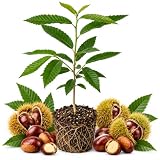
Plant Profile & Key Characteristics
A large deciduous tree reaching about 10-25 m (30-80 ft) with a broad crown. A long-lived temperate perennial grown for its edible cooked nuts and as a timber and shade tree; it needs a second tree for cross-pollination.
Quick Specifications
| Specification | Attribute |
|---|---|
| Plant Type / Life Cycle | Perennial (long-lived) |
| Foliage Type | Deciduous |
| Mature Size | 10-25 m tall (30-80 ft) |
| Growth Rate | Fast to moderate |
| Root System | Deep-rooted (taproot when young) |
| Toxicity | Nuts edible when cooked / non-toxic |
| Hardiness | USDA zone 4-10a |
Growth Form & Structure
- Height & Spread: 10-25 m (30-80 ft) with a broad crown; not suited to containers
- Growth Habit & Form: Large single-trunked tree with a spreading canopy
- Lifespan & Maturity: Long-lived; bears nuts about 5-7 years from grafting
Anatomy & Physical Features
- Trunk & Bark: Stout trunk; old trees develop ridged, spirally furrowed bark
- Leaves & Foliage: Green, elliptic, toothed leaves in a pinnate arrangement
- Flower Characteristics: Creamy white-yellow catkins, separate male and female; insect- and wind-pollinated
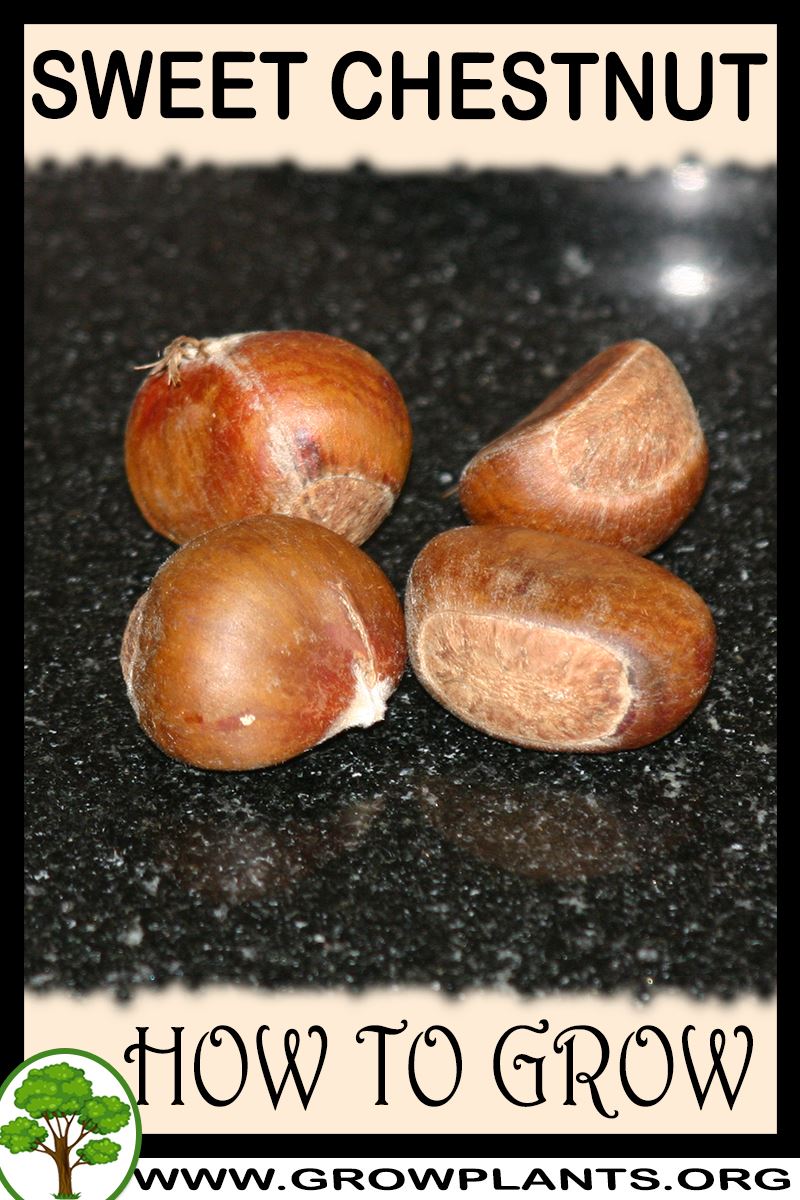
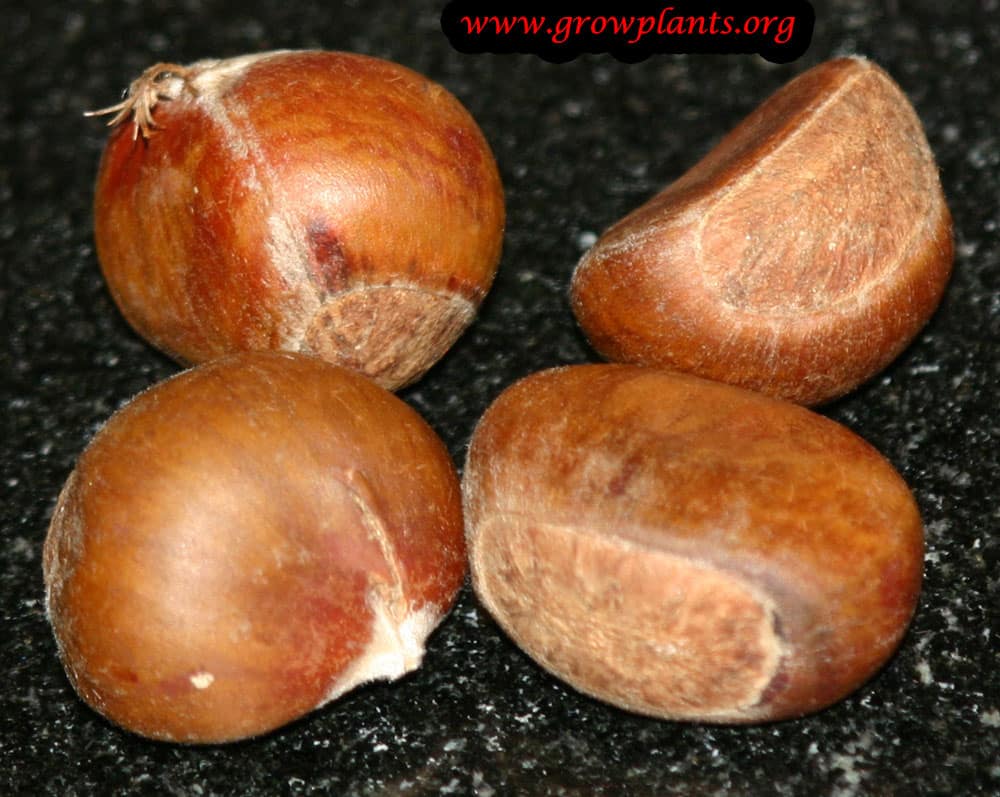
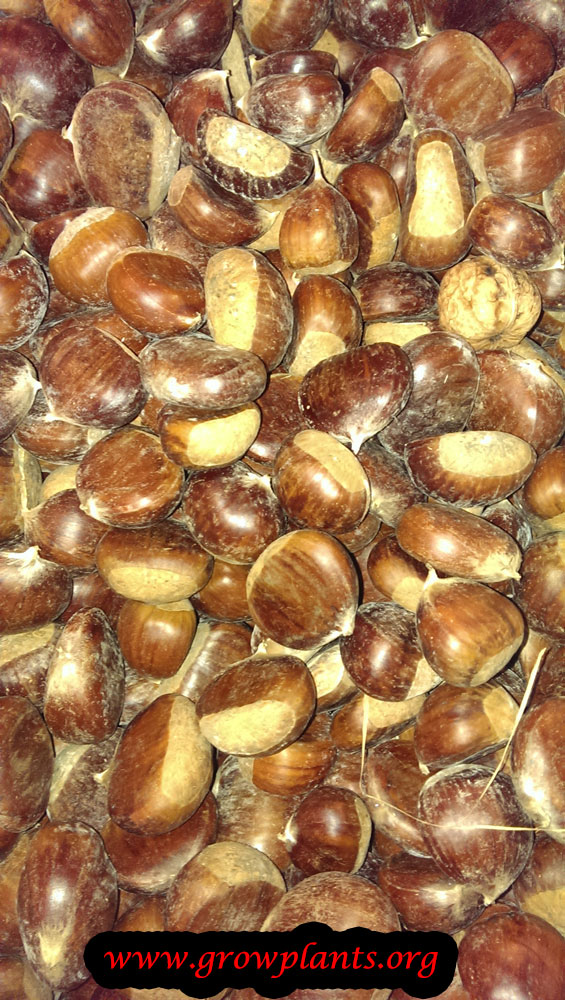
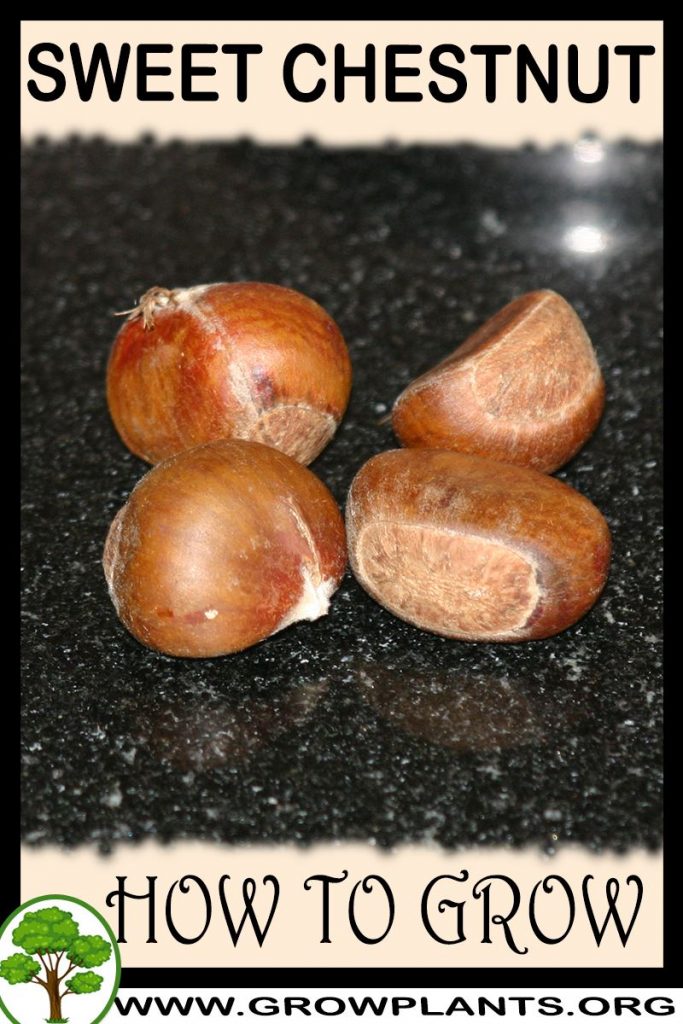
- Fruit Profile: Brown nuts enclosed in a spiny green-brown burr; eaten cooked
Primary Uses & Landscape Value
- Edible Uses: Nuts cooked, roasted, baked and used in cakes, soups and ice-cream
- Functional & Ornamental Roles: Orchard nut tree, timber tree and large shade/ornamental tree
Care Guide: Planting, Soil & Watering
Overview: A large, fast-growing deciduous nut tree for full sun and deep, acidic, well-drained soil. It needs winter chilling and a second tree for pollination, plus plenty of water in the growing season.
Quick Care Requirements
| Requirement | Ideal Condition |
|---|---|
| Planting Season | In winter to early spring, while dormant |
| Growth Rate | Fast to moderate |
| Soil Type | Deep, well-draining and acidic – dislikes chalky, limey soil |
| Soil pH | Acidic to neutral (about 4.5–6.5); intolerant of alkaline, chalky soils |
| Water Need | High – needs generous, regular water |
Planting & Establishment
- Best Planting Season: Plant while dormant, from winter to early spring, and plant at least two trees for cross-pollination.
- How to Plant:
- Hole Preparation: Dig a wide hole to accommodate the roots.
- Soil Amendments: Loosen deeply and add organic matter; do not add lime – chestnuts need acidic soil.
- Planting Depth: Set the root collar at soil level.
- Growth Speed & Expectations: Fast to moderate, ultimately a very large tree of 10–25 m – give it plenty of space.
Soil, Watering & Drainage Care
- Soil Mix & Drainage Needs: Deep, free-draining, acidic soil; avoid chalk, limestone and waterlogging. Not suited to containers.
- Watering Schedule & Technique:
- Young / Newly Planted: Water regularly and deeply to establish.
- Established: Water generously through the growing season; it is not drought-tolerant.
- Seasonal Adjustments: More in summer heat, less in the dormant winter.
Climate, Light & Hardiness
The sweet chestnut (Castanea sativa) is a large temperate-climate deciduous tree that likes a cool winter and a warm, not-too-dry summer. It grows in full sun and, dormant, is notably cold-hardy across the site's rated zones 4–10a.
Quick Climate Specifications
| Climate Zones | Temperate |
|---|---|
| USDA Hardiness Zones | 4–10a (per site data) |
| Optimal Temp Range | Mild-temperate growing season, roughly 16–27 °C (61–81 °F) |
| Frost Tolerance | High when dormant; new spring growth frost-sensitive |
| Light Conditions | Full sun |
| Wind Tolerance | Moderate |
Sunlight & Light Exposure
Optimal Light Setup
A full-sun tree; good light supports growth, flowering and nut fill.
Direct Sun Requirement
Direct sun is required for reliable cropping; heavy shade reduces yield.
Best Exposure / Orientation
An open, sunny site with deep, moisture-retentive soil suits it; because it needs at least two trees for cross-pollination, allow room for a pair.
Temperature Extremes & Hardiness
USDA Hardiness & Regional Limits
Rated for zones 4–10a, it is hardy through cold winters at the cooler end; at the warm, dry end summer moisture becomes the limiting factor rather than cold.
Cold Damage & Winter Protection
Dormant wood tolerates hard winter freezes within its wide zone range; young trees are more sensitive and appreciate protection at the coldest margin.
Frost Sensitivity
The dormant tree is very hardy, but late-spring frosts can damage emerging leaves and flowers.
Extreme Heat Tolerance
Moderate; it prefers cooler-summer temperate conditions and struggles in prolonged hot, dry heat.
Chilling Requirement
The site lists chilling hours. Sweet chestnut needs winter chill to break dormancy and flower evenly; in mild-winter climates inadequate chilling gives poor, uneven bud break. A precise chill-hour figure is not established here.
Frost-Free Growing Season
A warm, frost-free season long enough to ripen the nuts by autumn, following frost-free flowering, is needed for a good harvest.
Wind, Humidity & Microclimate
Rainfall & Seasonal Moisture
Adapted to temperate climates with reliable moisture; the site's high water need reflects a species that dislikes prolonged summer drought, so regions with summer rainfall or retentive soil suit it best. (This describes climatic moisture, not a watering schedule.)
Wind Tolerance
Moderate; a large tree that is best given a reasonably sheltered, open site.
Microclimate Recommendations
A cool-winter, mild-summer site with deep, moist (never waterlogged) soil and freedom from late spring frost gives the most dependable results.
Growing in Pots, Balconies & Indoors
The sweet chestnut (Castanea sativa) is a large tree (10-25 m / 30-80 ft), so the grower marks it as neither a houseplant nor a long-term container plant – and rightly so. You can keep a young seedling in a pot for its first few years, but it soon needs open ground to develop a deep root system and full canopy.
Quick Details
- Container Size: A large tub only while young (say 30-50 L / 8-12 gal for the first years); ultimately it needs open ground
- Indoor Suitability: Not a houseplant – it becomes a full-size tree and needs full sun
- Best Spot: full sun, planted in the ground outdoors
- Soil & Drainage: Deep, free-draining soil; a potted young tree needs an aerated mix that drains freely
- Watering in Pots: A potted young tree dries out far faster than one in the ground – check it often
Indoors & On the Windowsill
- Houseplant limits: The sweet chestnut (Castanea sativa) will not grow indoors – it demands full sun and quickly outgrows any room. Even a bright window only suits it at the seedling stage.
- Young plants: A seedling can spend its first year or two in a pot in a bright spot before being planted out.
On a Balcony or Patio
- Young specimen only: A young tree can stand on a large patio or balcony in full sun, but pots dry quickly and give no room for a taproot, so it will need moving into the ground within a few years.
Choosing the Pot, Soil & Long-Term Care
- Pot & drainage: If growing a young tree, use the largest tub you can with strong drainage holes; skip a standing water saucer to avoid root rot. Terracotta breathes and dries faster, while glazed or plastic holds moisture longer.
- Potting mix: An aerated, organic-rich mix – for example peat or coir with perlite or vermiculite.
- Watering: It likes plenty of water, so keep a young potted tree consistently moist.
- Feeding: A potted tree exhausts its soil quickly and nutrients leach with every watering, so feed more often than a tree in open ground.
- Potting on: Move it into a larger container each year while young; once it is too big for pots, plant it out.
Fertilizing & Feeding
Sweet chestnut is a moderate feeder: build the soil with organic matter and give balanced, restrained feedings through the growing season, easing off toward dormancy.
Quick Fertilizing Specs
| Feeding Level | Moderate |
|---|---|
| young_feeding | Nitrogen-forward complete fertilizer to build the framework. |
| mature_feeding | Balanced complete fertilizer with adequate potassium at bearing. |
| Main Nutrient Priority | Nitrogen while young, shifting to balanced with potassium once bearing. |
| Best Feeding Period | Through the active growing season. |
| Organic Options | Compost, well-rotted manure and organic mulch. |
| Micronutrients | Watch for iron, zinc and manganese on alkaline soils. |
| Soil pH | Slightly acidic to near neutral. |
| Reduce/Stop Feeding | Ease off as growth slows heading into winter dormancy. |
Feeding by Growth Stage
Newly planted
Help the young Sweet chestnut settle in and push out roots after planting.
| Nutrient direction | Focus on root establishment; keep any feeding gentle and let roots reach into the surrounding soil. |
|---|---|
| Timing | From planting through the first season of establishment. |
| Frequency | Feed sparingly at this stage; well-prepared soil often carries the tree through the first months. |
| Fertilizer types | Well-rotted compost or organic matter worked into the planting area, A gentle complete fertilizer only if soil is poor |
| Precautions | Avoid strong or concentrated fertilizer against fresh roots. Sweet chestnut prefers slightly acidic, well-drained soil and needs winter chill. |
Young tree (building the frame)
Drive steady shoot and canopy growth so the Sweet chestnut builds a strong framework before it starts bearing.
| Nutrient direction | Lean toward nitrogen to support vegetative growth, within a complete fertilizer. |
|---|---|
| Timing | Through the active growing season in the pre-bearing years. |
| Frequency | Several light feedings across the growing season rather than one heavy dose. |
| Fertilizer types | A nitrogen-forward complete fertilizer, Compost or other organic matter to build soil |
| Routine trace nutrients | iron, manganese, zinc |
| Precautions | Taper feeding as growth slows toward autumn so new shoots harden before cold weather. |
Established, approaching bearing
Keep the Sweet chestnut growing vigorously while it matures toward its first nuts crop.
| Nutrient direction | Shift toward a balanced complete fertilizer as the tree fills out. |
|---|---|
| Timing | During the active growing season as the tree nears bearing age. |
| Frequency | Light, spread-out feedings through the growing season. |
| Fertilizer types | A balanced complete fruit-tree fertilizer, Compost or mulch to maintain soil health |
| Routine trace nutrients | iron, manganese, zinc |
| Precautions | Watch for pale or yellowing new leaves on alkaline soils, a sign micronutrient availability is low. |
Mature, bearing nuts
Support consistent nuts yield and quality while keeping the mature Sweet chestnut healthy.
| Nutrient direction | A balanced complete fertilizer with adequate potassium to support the developing crop. |
|---|---|
| Timing | From the start of the growing season through crop development. |
| Frequency | Split light feedings across the growing season; adjust to the tree’s vigor and crop load. |
| Fertilizer types | A balanced complete fruit-tree fertilizer with potassium, Compost or organic mulch |
| Routine trace nutrients | iron, manganese, zinc |
| Precautions | Reduce feeding as the season ends so the tree can harden off before dormancy. |
Nutrient Deficiency Signs & Corrections
Interveinal yellowing on the youngest leaves, with veins staying green.
| Possible causes | High or alkaline soil pH locking up iron, Waterlogged or poorly drained soil stressing roots, Genuinely low available iron in the soil |
|---|---|
| Appears first on | Newest leaves at the shoot tips. |
| What to check | Soil pH and drainage, Whether symptoms track wet spells, Recent watering pattern |
| Possible correction | Correct pH and drainage first; where needed apply a chelated iron product per its label. |
Uniform pale-green to yellow older leaves with weak, slow growth.
| Possible causes | Low soil nitrogen, Leaching of nitrogen from sandy soil, Competition from grass or weeds at the root zone |
|---|---|
| Appears first on | Older, lower leaves first. |
| What to check | Overall shoot vigor and colour, Ground cover competition, Recent feeding history |
| Possible correction | Apply a nitrogen-containing complete fertilizer during active growth and keep the root zone weed-free. |
Small, narrow leaves, shortened internodes and rosetting of new shoots.
| Possible causes | High or alkaline soil pH reducing zinc uptake, Sandy, low-organic-matter soil, Cold, wet soil slowing root activity |
|---|---|
| Appears first on | New spring growth at the shoot tips. |
| What to check | Soil pH, Leaf size versus normal, Shoot spacing and rosetting |
| Possible correction | Correct soil pH and, where confirmed, apply a zinc product per its label. |
Scorching and browning along the margins of older leaves, with poor crop fill.
| Possible causes | Low soil potassium, Leaching from sandy soil, Heavy crop load drawing down reserves |
|---|---|
| Appears first on | Margins of older, lower leaves. |
| What to check | Crop load versus leaf health, Soil type and leaching, Feeding history |
| Possible correction | Use a complete fertilizer that supplies potassium through the growing season. |
Pruning, Training & Seasonal Maintenance
Sweet chestnut is a large, long-lived deciduous nut tree that needs very little pruning — its own facts simply say “no needs” — beyond forming a sound central-leader framework in youth and removing deadwood thereafter. Any structural work is best done in the dormant season (its facts specify the beginning of winter), and because named cultivars are grafted and the tree needs a second tree for cross-pollination, cultivar and rootstock identity matter. The one operation that demands real discipline is tool hygiene, because of chestnut blight.
Quick Pruning & Maintenance Specs
| Pruning Tolerance | Low – minimal once framed |
| Primary Pruning Window | Dormant, early winter |
| Typical Frequency | Formative in early years, then rarely |
| Main Objective | Central-leader framework; deadwood; blight-canker removal |
| Young Plant Priority | One dominant leader & wide-angled scaffolds |
| Mature Plant Priority | Deadwood, crossing limbs, remove cankered wood |
| Best Tool Type | Loppers & pruning saw; pole pruner for height |
| Avoid Heavy Pruning During | Wet weather (blight infection) and active growth |
Pruning by Plant Age & Size
Newly Established
Remove only damaged wood at planting; let a young grafted chestnut establish. Start light leader training in the first dormant seasons rather than hard-cutting.
Young / Formative
Train a dominant central leader with wide-angled, well-spaced scaffolds. Remove competing leaders early — this early framing is essentially all the structural pruning the tree will need.
Mature / Established
Leave the tree alone apart from removing deadwood, broken or crossing limbs, and — importantly — cutting out any blight cankers well back into healthy wood. Avoid large cuts on old trunks.
Seasonal Pruning Schedule
Dormant / early winter: the time for any structural cut — the leafless frame is easy to read and dry cold weather lowers blight infection of wounds.
Ongoing sanitary: remove dead or cankered wood whenever seen, but do it in dry conditions and disinfect between cuts (see hygiene).
Flowering & Fruiting Wood
Sweet chestnut is insect-pollinated and carries its catkins and burr-borne nuts on the current season’s new shoots, and it needs a second compatible tree for cross-pollination and a good crop. Because bearing is on new growth from the outer canopy, heavy heading reduces the following crop — another reason to keep pruning light.
Structural Pruning & Training
The objective is a single strong leader and well-spaced scaffolds; remove co-dominant stems and included-bark unions while small. Thinning cuts are preferred; a mature chestnut should not be height-reduced or topped.
Special Growth to Remove
Remove any suckers below the graft union on grafted trees, and clear basal shoots and root sprouts that compete with the trunk. Chestnut coppices readily, so basal regrowth is vigorous if the tree is cut low — remove it unless you are deliberately coppicing.
Tools
Small shoots take bypass secateurs; scaffold cuts take loppers; larger limbs and canker removal need a pruning saw. A pole pruner reaches the upper canopy of a tall tree from the ground.
Tool Hygiene & Disease Risk
High-risk where chestnut blight is present. Chestnut blight (Cryphonectria parasitica) is a serious canker disease of Castanea that enters through wounds; when removing cankered or suspect wood, disinfect the blade between cuts and prune in dry weather, cutting well back into clean wood and disposing of infected prunings. On healthy trees with no blight in the area, routine clean sharp tools are adequate.
Cut Placement & Technique
Cut just outside the branch collar, no flush cuts or stubs, and take large limbs with a three-cut sequence. When cutting out a canker, cut back into visibly healthy wood and sterilise the blade before the next cut.
Heavy Pruning & Rejuvenation
Chestnut tolerates hard cutting and coppices vigorously from the base, but standard orchard/ornamental trees should not be renovated by topping — large wounds invite decay and blight. If regenerating from the base (coppice), that is a deliberate whole-tree operation, not routine crown pruning.
Post-Pruning Care
Prune in dry weather and leave wounds open. Keep the tree watered, monitor cuts (especially canker-removal wounds) for clean closure, and remove any prunings that showed disease. No feeding is required as a pruning follow-up.
Common Pruning Mistakes
- Cutting cankered wood without disinfecting between cuts, spreading blight.
- Pruning in wet weather and opening wounds to infection.
- Heavy heading that removes current-season fruiting shoots.
- Leaving below-graft suckers or basal coppice shoots to compete with the trunk.
When NOT to Prune
Avoid pruning in wet weather (blight) and during active growth. Do not make large cuts on a stressed or newly transplanted tree, and delay non-essential work if blight pressure is high locally.
Recommended Tools (by task)
- loppers – scaffold selection and branch wood on the young framework.
- pruning_saw – larger limbs, deadwood and canker removal.
- blade_disinfectant – sterilise between cuts when removing chestnut-blight cankers.
- pole_pruner – upper-canopy deadwood on a tall tree from the ground.
Pruning Troubleshooting
| Problem | Possible Cause | What to Check | Corrective Action |
| Spreading sunken cankers / dieback | Chestnut blight entering wounds; tools not disinfected | Canker margins and tool hygiene | Cut back into clean wood, disinfect between cuts, remove infected prunings |
| Vigorous basal / root sprouts | Tree cut low; natural coppicing habit | Whether trunk was headed hard | Remove basal shoots unless coppicing deliberately |
| Poor nut set after pruning | Current-season bearing shoots headed off | How much outer canopy was removed | Prune lightly; retain new growth; ensure a pollinator tree |
| Slow-healing large wounds | Big cuts on old wood | Cut size on mature trunk/limbs | Keep cuts small; train young; avoid topping |
Propagation Guide
Sweet chestnut can be raised from its fresh nuts, but seedlings are variable and slow to fruit, so named cultivars are grafted — the site correctly flags grafting as necessary to reproduce a selected variety. Plant at least two trees for the cross-pollination this species needs.
Quick Propagation Specs
| Best Propagation Method | Grafting onto seedling rootstock (for cultivars) |
| Alternative Methods | Seed (for rootstock / variable seedlings) |
| Propagation Difficulty | Difficult / Specialist (chestnut grafts can be temperamental) |
| Seed True-to-Type | Variable – needs cross-pollination, seedlings differ |
| Vegetative True-to-Type | Yes (grafts keep the cultivar) |
| Best Propagation Season | Seed sown fresh in autumn/winter; grafting in spring |
| Seed Germination Time | Emerges in spring after cold-moist chilling |
Growing from Seed
Seed Handling & Viability
Chestnuts are recalcitrant — they must not be allowed to dry out. Keep the fresh nuts cool and slightly moist and sow as soon as possible; dried nuts lose viability.
Dormancy & Pre-Sowing Treatment
The nuts need cold-moist stratification (sow fresh in autumn to chill naturally over winter, or store damp and cool), matching the tree’s chilling-hours requirement.
Sowing & Germination
Sow into deep containers or a protected bed; chilled nuts germinate in spring. Guard sown nuts from rodents.
Grafting
Why Grafting Is Used
Grafting reproduces a chosen cultivar’s larger, better nuts and earlier cropping, which seedlings will not reliably give.
Methods, Rootstock & Scion
Whip-and-tongue or cleft grafting in spring, and budding, are used; success can be uneven, hence the specialist rating. Rootstock is chestnut seedling; scion is dormant one-year wood of the cultivar. Even grafted, plant a second compatible tree for pollination.
Graft Aftercare
Bind and seal unions, keep them from drying, and remove rootstock suckers until the graft is established.
Bloom & Flower Guide
Quick Details
- Bloom Season: Late spring to early summer
- Flower Appearance: Long, creamy white-to-yellowish catkins, with male and female flowers separate on the same tree
- Edibility: Ornamental – grown for its nuts; the flowers and catkins are not eaten
Detailed Blooming Overview
Sweet chestnut flowers later than most nut trees, wreathing the canopy in long creamy catkins from late spring into early summer. It is monoecious, with the abundant male flowers along the catkins and the female flowers set separately at the base of some catkins. Unusually for its family, the strongly scented flowers attract insects as well as relying on wind, so the tree hums with visitors when in full bloom.
Flower Characteristics
- Long creamy white-yellow catkins, strongly (and distinctively) scented.
- Male and female flowers separate but on the same tree.
Bloom Care & Thinning
- Pollination: Pollinated by bees and other insects drawn to the scent, with wind assisting.
- For a good set: Sweet chestnuts are largely self-incompatible, so plant more than one tree for reliable nut set.
Fruit & Uses
The edible part is the nut (chestnut), held inside a brown husk covered with soft spines. Sweet chestnuts are eaten only after cooking — they are roasted, boiled or baked and used in cakes, soup and ice-cream.
Quick Edible Specs
| Edible Parts | Nut (chestnut kernel) |
|---|---|
| Main Use(s) | Culinary: roasted, baked or boiled; used in cakes, soup and ice-cream |
| Eaten Raw or Cooked | Cooked — not eaten raw |
| Preparation Required | Remove from the spiny husk and shell, then cook (roast, boil or bake) |
| Harvest Season | Autumn |
| Time to First Harvest | Several years from planting (see growing notes) |
| Storage | Best used fresh; can also be dried or processed |
| Safety/Toxicity Caveat | Eat cooked, not raw (raw kernels are astringent and tannic); do not confuse with the inedible, toxic horse chestnut (Aesculus) |
Seeds, Pods & Nuts
Each brown nut sits inside a brown husk covered in soft spines. Nuts ripen and fall in autumn and are gathered from the ground. Cropping is improved when at least two trees are grown together for cross-pollination (see growing notes).
Harvesting
Collect the fallen nuts in autumn as the spiny husks split open and release them. Gather promptly to limit losses to worms and birds.
Preparation, Uses & Safety
Sweet chestnuts are prepared by removing the kernel from its husk and shell and cooking it — roast, boil or bake — before eating; the cooked nut is used on its own or in cakes, soup and ice-cream. Do not eat the kernels raw. Note that the edible sweet chestnut is unrelated to the toxic look-alike horse chestnut (Aesculus), which is not a food.
Pests, Diseases & Troubleshooting
Sweet chestnut is a long-lived nut tree whose most serious threats are two introduced pathogens-chestnut blight and ink disease (root rot)-plus a gall wasp and nut-boring insects that reduce the crop. Management is overwhelmingly preventive and cultural: plant clean, resistant or grafted stock on well-drained acidic soil, protect bark from wounds, and maintain vigour so trees can resist and compartmentalise infection.
Quick Troubleshooting Overview
| Issue / Pest | Main Symptom | Primary Solution |
|---|---|---|
| Chestnut blight | Sunken orange-brown bark cankers girdling stems, with wilting shoots above | Prune out early cankers; plant resistant/hypovirulence-treated stock; strict tool hygiene |
| Ink disease (root rot) | Blackish sap staining at the collar, root death, thinning yellow crown | Ensure sharp drainage; avoid waterlogging; remove infected trees; use tolerant rootstock |
| Chestnut gall wasp | Green-red galls on buds, leaf midribs and shoots; reduced growth and nut set | Prune and destroy galls in winter; encourage the parasitoid Torymus; plant tolerant cultivars |
| Chestnut weevil / nut moths | Grubs tunnelling inside harvested nuts; frass and exit holes | Sanitation (clear fallen nuts); hot-water or cold treat harvest; time picking |
| Nut rot | Brown, chalky, bitter kernels; internal browning at cutting | Harvest promptly, dry and store cool; remove mummified nuts |
Common Pests & Management
- Chestnut gall wasp (Dryocosmus kuriphilus):
- Symptoms: Small green-to-reddish galls swell on buds, leaf petioles, midribs and new shoots in spring; galled buds fail to develop, shoots are stunted, and nut yield falls. Old dry galls persist on twigs.
- Prevention & Control: Prune out and burn galled twigs during winter dormancy; buy certified gall-free nursery stock; support the introduced parasitoid wasp Torymus sinensis and other natural enemies by avoiding broad-spectrum sprays; choose tolerant cultivars where available.
- Chestnut weevils (Curculio elephas):
- Symptoms: Adults lay in developing burrs; creamy legless grubs feed inside the kernel, leaving tunnels, frass and round exit holes after nuts drop. Damage is often unseen until nuts are cracked.
- Prevention & Control: Collect and destroy fallen nuts and burrs promptly to break the cycle; keep the orchard floor clean; immerse harvested nuts in hot water (about 50°C) or refrigerate to kill larvae; encourage ground-foraging birds and predators.
- Chestnut nut moths (Cydia splendana):
- Symptoms: Caterpillars bore into ripening nuts, hollowing kernels and leaving reddish frass and silk; infested nuts often have a small entry hole and rot in storage.
- Prevention & Control: Rigorous sanitation of fallen nuts; time harvest to gather nuts quickly; pheromone monitoring traps to track flight; encourage parasitoids and bats/birds; only treat serious commercial infestations following local guidance.
- Defoliating caterpillars (Lymantria dispar):
- Symptoms: Episodic outbreaks strip foliage in late spring; frass beneath the canopy, ragged leaves and, in heavy years, near-total defoliation that weakens the tree.
- Prevention & Control: Tolerate light feeding on healthy trees; scrape and destroy egg masses on bark; sticky/barrier bands on trunks; targeted Bacillus thuringiensis (Btk) on young larvae only where outbreaks are severe.
- Aphids and scale insects (Lachnus / Eulecanium spp.):
- Symptoms: Colonies on shoots and leaf undersides suck sap, causing sticky honeydew, sooty mould and minor leaf distortion; usually cosmetic on established trees.
- Prevention & Control: Encourage ladybirds, lacewings and parasitic wasps; wash off small colonies; a horticultural-oil or insecticidal-soap spray only if honeydew becomes a nuisance on young trees, applied in the cool of evening to protect pollinators.
Diseases & Fungal Issues
- Chestnut blight (Cryphonectria parasitica):
- Symptoms: The single most devastating disease: sunken orange-brown cankers with cracked bark and orange fungal pustules girdle branches and trunks; foliage above wilts and dies, and vigorous epicormic sprouts appear below cankers. Left unchecked it kills the tree.
- Treatment & Management: There is no simple cure; act early. Prune out and burn cankered wood well below the lesion, sterilising tools between cuts; keep trees vigorous and wound-free; plant resistant hybrids or blight-tolerant selections; where available, use hypovirulence (virus-weakened strains) biocontrol under expert guidance. Report suspected outbreaks to plant-health authorities in regulated areas.
- Ink disease (root and collar rot) (Phytophthora cambivora):
- Symptoms: Roots and the root collar rot and turn dark; a characteristic blue-black inky sap may stain the bark at the base. The crown thins, leaves yellow and shoots die back, often killing the tree over a few seasons, worst on heavy or wet soils.
- Treatment & Management: Prevention is everything: plant on freely draining, slightly acidic soil and never waterlog; avoid moving contaminated soil or water between sites; remove and destroy dying trees with their roots; use tolerant rootstocks and clean nursery stock; improve drainage around valued specimens.
- Powdery mildew (Phyllactinia guttata):
- Symptoms: White powdery patches on leaves in late summer, sometimes with premature leaf yellowing; rarely serious on established trees.
- Treatment & Management: Favour good airflow and sun; avoid excess soft nitrogen growth; only established trees rarely need treatment-sulphur or a bicarbonate spray suffices on nursery stock.
- Chestnut brown rot of nuts (Gnomoniopsis smithogilvyi):
- Symptoms: Kernels turn brown, chalky and bitter with internal browning; damage is often hidden until nuts are cut, and it worsens in storage.
- Treatment & Management: Harvest promptly and dry nuts well; store cool and dry; remove mummified and fallen nuts; reduce insect wounding, which opens entry points; curing (hot-water or curing treatments) reduces losses.
Growing Difficulties & Abiotic Problems
- Lime-induced chlorosis:
- Cause & Symptoms: Sweet chestnut is a calcifuge that needs acidic soil; on alkaline or chalky ground iron and manganese lock up, yellowing leaves between green veins while growth slows.
- Correction Strategy: Plant only on neutral-to-acidic, well-drained soil; acidify and mulch with leaf mould or pine bark; apply chelated iron as a stop-gap; do not attempt long term on chalk.
- Waterlogging and drought stress:
- Cause & Symptoms: Heavy wet soils suffocate roots and predispose to ink disease, while prolonged summer drought causes leaf scorch, early leaf drop and small nuts.
- Correction Strategy: Match site to the tree: sharp drainage plus deep, infrequent watering in dry spells for young trees; mulch to buffer moisture; avoid compacted or seasonally flooded ground.
- Frost and sunscald damage:
- Cause & Symptoms: Late spring frosts blacken young shoots and catkins, reducing nut set; thin bark on exposed trunks can crack from winter sun (sunscald).
- Correction Strategy: Choose a site without frost pockets; shade or wrap young trunks in hot, exposed positions; delay pruning of frost-tender growth until danger passes.
What Helps — Products & Tools
The toolkit here is mostly cultural and sanitary rather than chemical: clean, sterilised pruning tools, burning of cankered and galled wood, prompt clearing of fallen nuts, and hot-water treatment of harvested nuts. For minor sap-suckers, insecticidal soap or horticultural oil; for nursery mildew, sulphur or bicarbonate; chelated iron corrects chlorosis on borderline soils. Sharp drainage is the best defence against ink disease.