Plant Profile & Key Characteristics
Overview: Cape honeysuckle is a fast-growing evergreen shrub (semi-deciduous in cold) reaching 2-3 m, grown as an ornamental flowering hedge that attracts pollinators. It is drought-tolerant once established.
Quick Specifications
| Specification | Attribute |
|---|---|
| Plant Type / Life Cycle | Perennial |
| Foliage Type | Evergreen (deciduous in cold climates) |
| Mature Size | 2-3 m (6-10 ft) |
| Growth Rate | Fast to moderate |
| Hardiness | USDA zones 9+ |
Growth Form & Structure
- Height & Spread: 2-3 m; can be trained as a hedge or espalier and suits large containers.
- Growth Habit & Form: Scrambling, arching shrub that spreads by suckers and can be invasive.
- Lifespan & Maturity: Long-lived perennial; fast to medium growing.
Anatomy & Physical Features
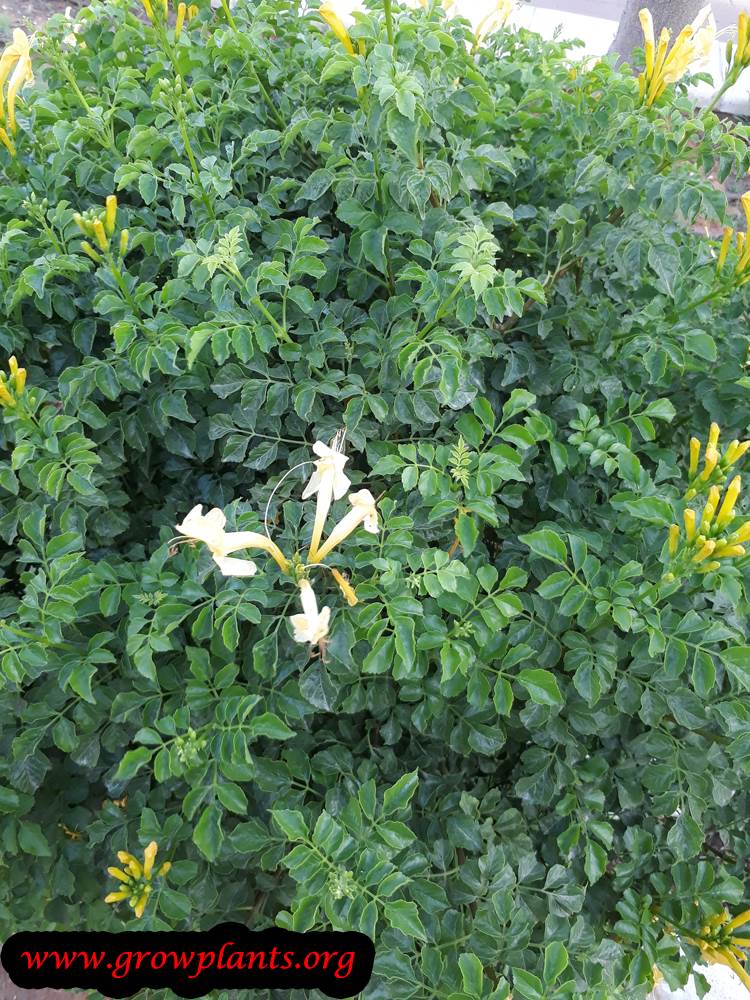
- Leaves & Foliage: Green pinnate leaves with elliptic, serrated leaflets.
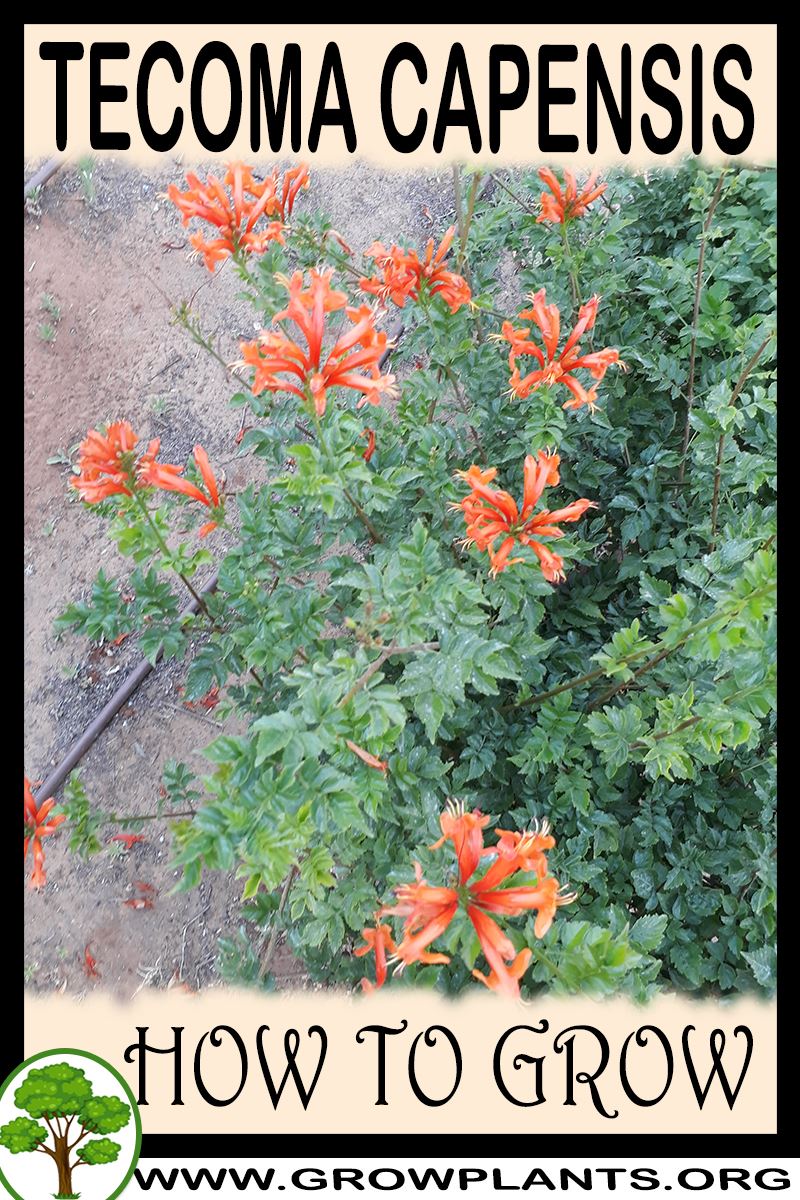
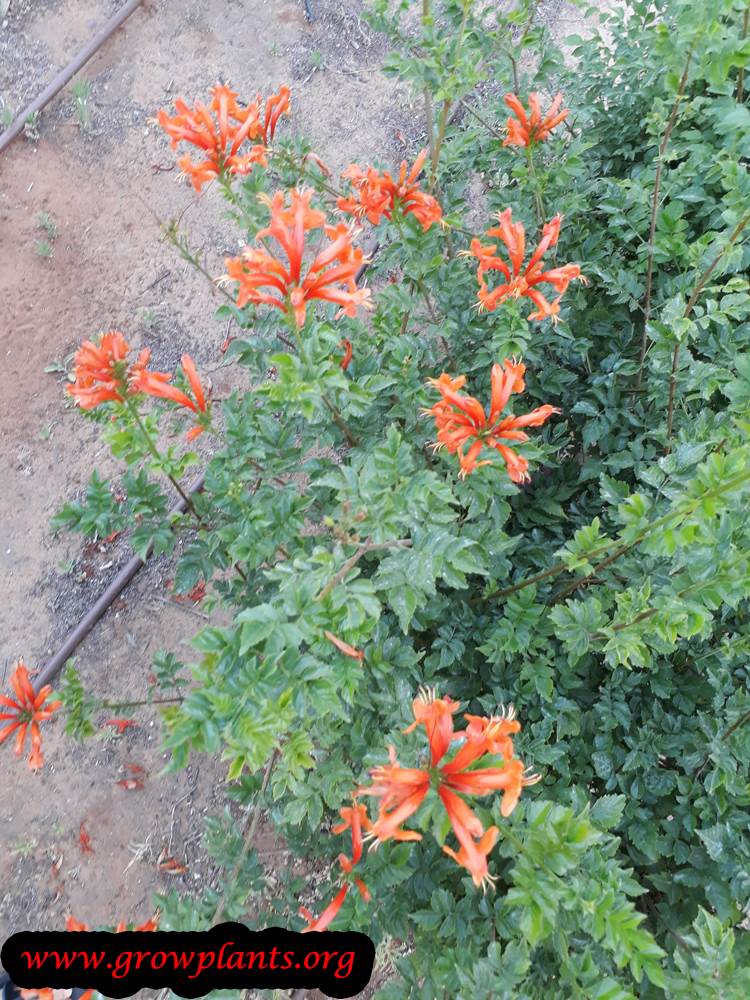
- Flower Characteristics: Trumpet-shaped flowers in red, orange, yellow or white; attract nectar-feeding birds and insects.
Primary Uses & Landscape Value
- Functional & Ornamental Roles: Flowering hedge, screen or bank cover; pollinator and hummingbird plant; suited to containers.
Care Guide: Planting, Soil & Watering
Overview: Cape honeysuckle is a fast, evergreen shrub for warm, frost-free climates (hardiness zone 9+) that flowers freely in full sun to half shade. It is fairly drought-tolerant once established and only asks for well-drained soil.
Quick Care Requirements
| Requirement | Ideal Condition |
|---|---|
| Planting Season | Spring, summer or autumn |
| Growth Rate | Moderate to fast |
| Soil Type | Well-draining |
| Water Need | Low to moderate; let the soil dry between waterings once established |
Planting & Establishment
- Best Planting Season: Plant in spring, summer or autumn in a warm spot; it establishes quickly in the warm season.
- How to Plant:
- Hole Preparation: Dig a hole a little wider than the root ball in free-draining soil.
- Soil Amendments: Mix some compost into the backfill to get it going; it is not fussy about soil once drainage is good.
- Planting Depth: Set the root ball level with the surrounding soil and firm gently.
- Growth Speed & Expectations: A vigorous grower reaching 2-3 m that can be trained as a hedge or scrambler; it may become invasive, so trim to keep it in bounds.
Soil, Watering & Drainage Care
- Soil Mix & Drainage Needs: The main requirement is good drainage; it tolerates poorer soils and grows well in large containers.
- Watering Schedule & Technique:
- Young / Newly Planted: Water regularly for the first season to establish a strong root system.
- Established: Once established it is drought-tolerant – water occasionally and let the soil dry between waterings.
- Seasonal Adjustments: A little extra water in prolonged summer heat; very little in winter.
Climate, Light & Hardiness
Tecoma capensis (Cape honeysuckle) is a warm-climate evergreen flowering shrub for subtropical, Mediterranean, desert, tropical and mild-temperate regions, grown in full sun to half shade. It is heat-loving and frost-tender but notably tough in coastal, salt-exposed sites, so winter cold sets its outdoor limit while it handles wind and salt spray well.
Quick Climate Specifications
| Climate Zones | Subtropical, Mediterranean, desert, tropical, mild-temperate |
|---|---|
| USDA Hardiness Zones | Approximately 9 and above |
| Optimal Temp Range | Warm, roughly 20–32 °C (68–90 °F) |
| Cold Damage Begins | Foliage and soft growth are damaged around freezing, 0 °C (32 °F) |
| Approx. Survival Minimum | May be cut back by frost but established plants resprout from the base near about −4 to −7 °C (25–20 °F); young plants are more tender |
| Frost Tolerance | Low |
| Light Conditions | Full sun to half shade |
| Wind Tolerance | Moderate to High |
| Salt / Coastal Tolerance | Moderate to High |
Sunlight & Light Exposure
Optimal Light Setup
Flowers most freely in full sun; half shade is tolerated but reduces bloom and can loosen the habit.
Direct Sun Requirement
A sun-lover that rewards strong direct light with dense growth and heavy flowering.
Best Exposure / Orientation
An open, warm, sunny aspect - including exposed coastal positions - with a little shelter from cold winter wind at the cool edge of its range.
Temperature Extremes & Hardiness
USDA Hardiness & Regional Limits
Suited to roughly USDA zone 9 and warmer. In marginal areas it is cut back by frost and resprouts. Cold tolerance varies with plant age, exposure and conditions.
Cold Damage & Winter Protection
Light frost scorches foliage; harder frost kills top growth but established plants usually regrow from the base. Mulch protects the crown in marginal zones.
Frost Sensitivity
Frost-sensitive, especially when young; soft new growth is hit first.
Extreme Heat Tolerance
Excellent - thrives in hot subtropical and desert conditions and flowers over a long warm season.
Wind, Humidity & Microclimate
Humidity Preferences
Adaptable to both humid coastal and drier inland climates.
Wind Tolerance
Good wind tolerance once established, making it a useful informal hedge or screen in breezy sites.
Coastal / Salt Tolerance
Handles coastal salt spray well and is widely used in seaside plantings - note this refers to airborne salt exposure rather than saline irrigation water or salty soil.
Microclimate Recommendations
A warm, sunny, coastal-or-inland position suits it; at the cool edge of its range a sheltered, sun-facing spot helps it through cold snaps.
Growing in Pots, Balconies & Indoors
The grower confirms Cape honeysuckle is not a houseplant – it is an evergreen shrub (2-3 m). It does grow well in a large container while young, giving a fine sun-loving patio or courtyard plant, but a big woody specimen ultimately wants the open ground.
Quick Details
- Container Size: a large 40 L+ (10 gal+) tub; it only stays pot-happy while young
- Indoor Suitability: Not a houseplant – too large and sun-hungry
- Best Spot: Full sun to part shade; a warm, sheltered patio
- Soil & Drainage: Free-draining mix; it dislikes wet feet
- Watering in Pots: Water when the top of the mix dries; drought-tolerant once established
Indoors & On the Windowsill
- Not for indoors: Cape honeysuckle is an outdoor an evergreen shrub (2-3 m) – it needs full sun and space no room can give.
- Overwintering: Where winters are colder than it likes, a young plant in a pot can be sheltered in a bright, frost-free spot for the cold months and moved back out in the warm season.
On a Balcony or Patio
- Light & wind: Give it the sunniest spot; walls and paving throw back heat so pots dry fast – check moisture in summer, and stake or shelter the top growth from wind.
- Keep it in bounds: Prune each year to hold it to size and keep it flowering or dense in the pot.
- Practicalities: A full pot of moist soil is heavy – check the balcony can take the weight, and stand pots so drainage water runs off cleanly instead of pooling.
Choosing the Pot, Soil & Long-Term Care
- Pot & drainage: a large 40 L+ (10 gal+) tub with strong drainage holes; skip a standing water saucer to avoid root rot; terracotta breathes and dries faster, while glazed or plastic holds moisture longer.
- Potting mix: A light, aerated mix – peat or coir blended with perlite or vermiculite so roots get both moisture and air.
- Feeding: Potted plants use up their soil faster as nutrients wash out with each watering, so feed a little and often through the growing season.
- Repotting: Pot up or root-prune every year or two; a large woody plant will eventually outgrow any pot and is best planted out.
Growing this plant in a greenhouse
A greenhouse can give tecoma capensis frost protection, cold protection, humidity control and extra warmth. In the right climate it may also be kept growing through winter, depending on how much warmth and light are provided.
Greenhouse at a glance
| Greenhouse suitability | Conditional - depends on your climate |
|---|---|
| Main benefits | frost protection, cold protection, humidity control, extra warmth |
| Season extension | earlier spring & later autumn |
| Outdoor protection advisable below | about 0°C |
| Suitable types | unheated greenhouse, polycarbonate greenhouse, lean-to |
| Heating | Heating is optional - useful mainly for winter growing in cold areas. |
Related greenhouse guides
- Greenhouses: How to Choose the Right Greenhouse
- Best Lean-To Greenhouses
- Polycarbonate Greenhouses: What to Look for Before Buying
Fertilizing & Feeding
A moderate feeder: a balanced complete fertilizer through the growing season supports strong growth and flowering, while overfeeding pushes leafy growth at the expense of blooms.
Quick Fertilizing Specs
| Feeding Level | Moderate |
|---|---|
| Main Nutrient Priority | Balanced complete feeding with adequate nitrogen and potassium |
| Best Feeding Period | Spring through the flowering season |
| Organic Options | Compost and other organic matter around the root zone |
| Soil pH | Prefers a slightly acidic to near-neutral soil |
| Reduce/Stop Feeding | Reduce feeding as growth slows and stop during dormancy |
| Micronutrients | Usually supplied by a complete fertilizer; iron may need correction in alkaline soils |
Feeding by Growth Stage
Spring growth
Support new shoots and leafy growth as the plant breaks from winter rest.
| Nutrient direction | A balanced complete fertilizer with steady nitrogen to build healthy foliage. |
|---|---|
| Timing | As growth resumes in spring. |
| Frequency | A few light feedings through the early growing season. |
| Fertilizer types | A balanced complete garden fertilizer, Compost or other organic matter worked in around the root zone |
| Precautions | Avoid heavy nitrogen late in the season, which pushes soft growth at the expense of flowers. |
Flowering
Sustain flowering without forcing excess leafy growth.
| Nutrient direction | Continue a balanced feed; adequate nitrogen and potassium support bloom better than high-phosphorus products. |
|---|---|
| Timing | Through the main flowering period. |
| Frequency | Keep feeding light and steady. |
| Fertilizer types | A balanced complete fertilizer |
| Precautions | Skip high-phosphorus bloom-booster products; balanced feeding drives flowering. |
Repeat bloom
Keep repeat-flowering plants blooming through the warm season.
| Nutrient direction | Light balanced feeding to replace nutrients used during continuous bloom. |
|---|---|
| Timing | Between flushes through summer into autumn. |
| Frequency | Light, steady feeding. |
| Fertilizer types | A balanced complete fertilizer |
| Precautions | Avoid overfeeding; excess nitrogen favors foliage over flowers. |
Dormancy / rest
Let the plant rest as growth slows in the cool season.
| Nutrient direction | None – withhold fertilizer while the plant is dormant. |
|---|---|
| Timing | Late autumn through winter dormancy. |
| Frequency | No feeding at this stage. |
| Fertilizer types | No feeding during dormancy – withhold fertilizer until growth resumes in spring. |
| Precautions | Do not fertilize dormant plants; resume only when new growth appears. |
Nutrient Deficiency Signs & Corrections
Pale, yellowing older leaves with weak, slow growth.
| Possible causes | Low soil nitrogen, Nitrogen leaching from frequent watering or sandy soil, Compacted or poor soil limiting root uptake |
|---|---|
| Appears first on | Older, lower leaves. |
| What to check | Recent feeding history, Soil condition and drainage, Watering frequency |
| Possible correction | Apply a balanced complete fertilizer and improve organic matter in the root zone. |
Interveinal yellowing on new leaves while veins stay green.
| Possible causes | High soil pH reducing iron availability, Waterlogged or cold roots limiting uptake, Not necessarily a lack of iron in the soil |
|---|---|
| Appears first on | New, young leaves at the shoot tips. |
| What to check | Soil pH, Drainage and root health |
| Possible correction | Correct soil pH and drainage, and apply a chelated iron product per its label. |
Scorched leaf edges and tips with dull foliage.
| Possible causes | Excess fertilizer salts in the root zone, Underwatering that concentrates salts, Poor drainage |
|---|---|
| Appears first on | Leaf margins and tips. |
| What to check | Feeding rate, Drainage, Salt buildup in soil |
| Possible correction | Reduce feeding and leach the root zone with thorough watering. |
Pruning, Training & Seasonal Maintenance
Cape honeysuckle is a vigorous, scrambling evergreen shrub grown for its dense clusters of orange-to-red trumpet flowers, and because it flowers on the current season’s new growth and takes hard pruning and shearing without complaint, it is one of the most pruning-tolerant of the trumpet-flowers — and one of the few genuinely suited to being grown as a clipped or informal hedge, or trained flat against a wall. That same tolerance means there is a trade-off to understand: shearing it tightly removes the shoot tips that would flower, so a formally clipped hedge blooms less than a plant pruned selectively. Its scrambling, suckering habit also spreads, so containment is part of the job. The heaviest structural cut is best made in late winter before the flush, with lighter shaping after each bloom.
Quick Pruning & Maintenance Specs
| Pruning Tolerance | High — among the most shear- and hard-prune tolerant Tecomas |
| Primary Pruning Window | Late winter / early spring, before the new flush (structural cut) |
| Secondary Maintenance Window | After bloom flushes, and light hedge trims through the season |
| Typical Frequency | One hard cut a year plus trims; hedges sheared several times a season |
| Main Objective | Contain the scrambling habit; balance hedging against flowering |
| Young Plant Priority | Choose form — free shrub, clipped hedge, or wall-trained |
| Mature Plant Priority | Renew flowering wood, control spread and suckers, maintain the form |
| Best Tool Type | Bypass secateurs and loppers; hedge shears only for a hedge |
| Avoid Heavy Pruning During | Peak bloom; and before hard frost in marginal areas |
Pruning by Plant Age & Size
Newly Established
Remove only damaged shoots as the plant roots in, and decide its role. For a hedge, plant closely and tip the young growth to thicken the base; for a wall, begin fanning and tying the leaders; for a free shrub, simply let it build several main stems.
Young / Formative
For a hedge, shear the young plants lightly and often to build a dense, well-clothed base before letting them reach full height. For a wall-trained plant, spread and tie leaders into a fan and tip them to force side-shoots. For a free shrub, select spaced main stems and tip for bushiness — in every case the tipping multiplies the new shoots that flower.
Mature / Established
An established plant needs its oldest wood renewed and its spread contained: in late winter cut back last year’s growth and remove the oldest stems, and through the season shear or trim to shape, deadhead, and cut back suckers and escaping runners. On a hedge, accept fewer flowers as the price of a tight surface, or trim more loosely for more bloom.
Seasonal Pruning Schedule
Late Winter / Early Spring (main cut)
Objective: renew and reshape before growth. Cut back last season’s stems, remove the oldest and any tangled wood, and reduce size. The strong new shoots that follow carry the flowers, so a hard cut now is repaid in bloom.
Growing Season (shaping and hedging)
Objective: hold the form and keep it flowering. Trim hedges to shape, shear or selectively cut after each flush, and cut back suckers and stray runners. What NOT to remove wholesale: if flowering matters, avoid shearing off all the new shoot tips at once — stagger trims so some wood is always coming into flower.
Flowering & Fruiting Wood
Cape honeysuckle flowers on current-season shoots, so encouraging vigorous new growth encourages bloom — but this is exactly why tight, frequent shearing suppresses flowering, since each shear removes the tips that were about to flower. A selectively pruned or loosely trimmed plant therefore flowers far more freely than a hard-clipped hedge. Choose your priority: a crisp hedge with modest bloom, or a looser plant with abundant flower. Removing spent trusses and any pods keeps the display going and limits self-seeding.
Structural Pruning & Training
The plant can be shaped as a free shrub, a clipped or informal hedge, or fanned and tied flat against a wall — its scrambling stems are flexible and adapt to all three. Remove crossing, tangled and inward growth to keep an open framework, and control its height and spread firmly, because it scrambles widely if left. Its high tolerance of hard cutting makes renewal and reshaping straightforward.
Special Growth to Remove
On its own roots there is no graft to sucker from, but Cape honeysuckle spreads by suckering and by long scrambling runners that root where they touch — remove these to contain the plant, keeping only shoots that fit the framework or hedge. Remove spent flower trusses and seed pods to prolong bloom and curb spread.
Container & Small-Space Pruning
In a container it stays smaller but grows fast and scrambles, so cut it back firmly in late winter, tip and trim through the season to keep it compact, and remove suckers and stray runners. It reshoots readily from old wood, tolerating the repeated cutting a pot demands, and can even be kept as a compact clipped mound.
Tools
Bypass secateurs and loppers do most of the work — secateurs for young shoots, deadheading and suckers, loppers for older stems. Hedge shears are genuinely appropriate here if the plant is grown as a hedge, this being one of the few trumpet-flowers that hedges well; but for a free-flowering shrub, selective cuts beat shearing. A saw is only needed for the oldest basal stems in renewal.
Tool Hygiene & Disease Risk
Hygiene is Routine: clean, sharp tools are sufficient, with aphids the main pest and no notable blade-borne disease. Keep shears and blades sharp so the dense growth is cut cleanly rather than torn.
Cut Placement & Technique
For a shrub or wall plant use thinning cuts back to junctions and cut to well-placed buds to keep an open, flowering framework. For a hedge, shear to a slightly batter-sided profile (wider at the base) so the lower growth keeps its light and does not go bare. Remove old thick stems at the base, avoid long stubs, and cut suckers and runners back to their origin.
Heavy Pruning & Rejuvenation
Cape honeysuckle rejuvenates as well as any trumpet-flower: an old, bare-based or overgrown plant — or a tired hedge — can be cut back hard, close to a low framework or near ground level, in late winter and will regrow densely, flowering on the new shoots the same season. This makes it easy to restore a neglected hedge or shrub in a single hard cut.
Post-Pruning Care
After a hard cut, water to drive regrowth but avoid heavy feeding — the plant is vigorous and hard pruning already forces plenty of new shoots; extra nitrogen only favours leaf over flower. Thin overcrowded regrowth, and watch the soft new growth for aphids.
Common Pruning Mistakes
- Shearing a plant tightly and often, then wondering why it barely flowers — the shears remove the flowering tips.
- Letting the scrambling runners and suckers spread unchecked into an untidy thicket.
- Pruning hard in mid-bloom and losing the display.
- Shearing a hedge with vertical or top-heavy sides, so the base shades out and goes bare.
When NOT to Prune
Avoid a hard cut just before frost in marginal (zone 9) areas — wait for late winter and remove frost damage in spring. Do not shear away all the flowering wood at once if bloom matters, and do not prune a drought-stressed plant until it is watered.
Pruning Troubleshooting
| Problem | Possible Cause | What to Check | Corrective Action |
| Dense green hedge but very few flowers | Frequent tight shearing removing flowering tips | How often and how hard it is sheared | Trim more loosely or selectively; stagger cuts so some new wood always flowers |
| Spreading and running out of bounds | Untrained scrambling runners and suckers | Runners rooting at the tips, suckers at the base | Cut runners and suckers back to origin; retrain wanted stems into the framework |
| Bare base on a shrub or hedge | Only outer shearing, or a hedge with top-heavy sides | Interior wood and hedge profile | Renew from low down; reshape to a wider base so the bottom keeps its light |
| Frost dieback after a late cut | Tender regrowth caught by frost | Timing of the cut versus frost | Delay hard pruning to late winter; cut dead wood to live growth in spring |
Recommended Tools (by task)
- bypass_secateurs — for selective cuts, deadheading, and removing suckers and runners.
- loppers — for older stems and renewal cuts on a mature shrub or hedge.
- hedge_shears — only where it is grown as a clipped or informal hedge, for shaping the dense surface.
Propagation Guide
Cape honeysuckle is very easily increased from cuttings, and its scrambling stems root wherever they touch moist soil, so layering and rooted suckers are simple options too; seed is workable but less used. Vegetative methods keep a plant’s exact flower colour and are the quickest route. Overall a very easy plant to propagate.
Quick Propagation Specs
| Best Propagation Method | Semi-hardwood stem cuttings |
| Alternative Methods | Layering, rooted suckers, seed |
| Propagation Difficulty | Easy |
| Seed True-to-Type | Species mostly uniform; colour forms may vary |
| Vegetative True-to-Type | Yes |
| Best Propagation Season | Warm growing season (spring to autumn) |
| Cutting Rooting Time | Usually a few weeks in warmth |
Stem Cuttings
Cutting Type & Timing
Take softwood or semi-hardwood cuttings from healthy shoots during the warm season.
Rooting Setup
Remove the lower leaves, insert into a moist, free-draining mix and keep warm, humid and lightly shaded. Rooting hormone is optional on this willing material, and roots form within a few weeks.
Air & Ground Layering
A low, sprawling stem pinned onto moist soil roots readily at the contact points; sever the rooted section from the parent once it has established. Suckers and self-rooted stems can likewise be lifted with roots attached and grown on.
Growing from Seed
Seed from the pods can be sown shallowly in a warm, moist, free-draining mix and germinates in warmth, but cuttings are quicker and keep colour forms true, so seed is a secondary option.
Bloom & Flower Guide
Quick Details
- Bloom Season: Spring through autumn, and nearly continuous in frost-free areas
- Time to First Bloom: Fast; plants flower young and cuttings bloom in their first season
- Flower Appearance: Clustered curved trumpet flowers in red, orange, yellow or white
- Edibility: Ornamental only, grown for the display and to attract pollinators
Detailed Blooming Overview
Cape honeysuckle is a vigorous, scrambling shrub grown for its dense clusters of curved, tubular flowers. From spring through autumn, and almost year-round where winters are mild, it produces a steady supply of nectar-rich trumpets in red and orange, with softer yellow and white forms available. Sunbirds, hummingbirds and bees work the blooms constantly.
Flower Characteristics
- Curved, trumpet-shaped flowers in red, orange, yellow or white.
- Massed in showy terminal clusters over a long season.
- Nectar-rich and very attractive to birds and bees.
Bloom Care & Thinning
- Deadheading & shaping: Trimming spent clusters keeps the plant flowering and stops it becoming straggly.
- Pruning for bloom: Flowers form on new growth, so cutting back after a flush drives fresh flowering shoots.
- Pollination: Bird- and insect-pollinated; no intervention needed for the show.
Pests, Diseases & Troubleshooting
Cape honeysuckle is a robust, fast, near-trouble-free shrub whose only regular pests are sap-suckers on the soft new growth – aphids, whitefly, scale, mealybugs and, in hot dry spells, spider mites. It has few real diseases; its main faults are abiotic, chiefly chlorosis on alkaline soil and its own vigorous, suckering, somewhat invasive habit. Grown in sun with decent drainage it largely looks after itself.
Quick Troubleshooting Overview
| Issue / Pest | Main Symptom | Primary Solution |
|---|---|---|
| Aphids | Sticky, curled new shoots with colonies | Water-jet, beneficials, insecticidal soap |
| Whitefly | White clouds and sooty mould under leaves | Sticky traps, oil/soap on undersides |
| Scale / mealybug | Brown bumps or white fluff, honeydew | Wipe off, horticultural oil |
| Spider mite | Stippled, bronzed leaves in dry heat | Hose foliage, insecticidal soap |
| Chlorosis | Yellow leaves with green veins | Correct pH, feed, add iron chelate |
Common Pests & Management
- Aphids (Aphis / Myzus / Macrosiphum spp.):
- Symptoms: Small soft-bodied insects (green, black or grey) clustering on the soft new shoots and flower buds; they suck sap, causing curled, distorted and yellowing growth plus a sticky honeydew that blackens with sooty mould and draws ants. Winged forms spread them plant to plant and can carry viruses.
- Prevention & Control: Blast colonies off with a firm jet of water and pinch out badly infested tips; encourage and protect ladybirds, lacewings and hoverflies, and grow flowering companions to feed them. For persistent outbreaks use insecticidal soap or a light horticultural/neem oil, wetting leaf undersides in the cool of the evening to spare pollinators.
- Glasshouse whitefly (Trialeurodes vaporariorum):
- Symptoms: Tiny white moth-like insects that rise in a cloud when foliage is disturbed; scale-like nymphs on leaf undersides suck sap and excrete honeydew, leading to sooty mould and weak, yellowing growth.
- Prevention & Control: Hang yellow sticky traps to monitor and thin the adults; encourage the parasitic wasp Encarsia formosa under cover and keep plants unstressed. Spray insecticidal soap or horticultural oil onto leaf undersides, repeating every few days to break the life cycle.
- Scale insects (Coccus / Saissetia spp.):
- Symptoms: Brown or waxy bumps clinging to stems and leaf undersides, sucking sap and producing honeydew and sooty mould; heavy infestations weaken and yellow the plant.
- Prevention & Control: Rub off scale, prune out badly infested wood, and smother the rest with horticultural oil, repeating to catch crawlers; encourage ladybirds and parasitic wasps.
- Two-spotted spider mite (Tetranychus urticae):
- Symptoms: Fine pale stippling that bronzes whole leaves, with delicate webbing on the undersides and growing tips in hot, dry, dusty spells; heavily fed leaves dry and drop. Look for the moving specks with a hand lens.
- Prevention & Control: Raise humidity and hose foliage down regularly, and never let plants suffer dust or drought stress. Introduce predatory mites (Phytoseiulus persimilis) under cover. Treat hot-spots with insecticidal soap or horticultural oil, repeating at 5-7 day intervals to catch newly hatched mites.
- Mealybugs (Planococcus / Pseudococcus spp.):
- Symptoms: White cottony clusters in leaf axils and shoot tips with honeydew and sooty mould.
- Prevention & Control: Dislodge with a water jet or dab with alcohol, then treat with insecticidal soap or horticultural oil; keep the plant open and airy.
Diseases & Fungal Issues
- Root rot (Phytophthora / Pythium spp.):
- Symptoms: Yellowing, dieback and wilting in wet, poorly drained soil as the roots rot; uncommon in the well-drained conditions the plant prefers.
- Treatment & Management: Plant in free-draining soil, avoid overwatering, and never let it stand wet; improve drainage and cut back to healthy tissue on affected plants.
- Sooty mould (Capnodium spp.):
- Symptoms: A black superficial coating on leaves and stems growing on the honeydew of aphids, whitefly or scale, dulling the foliage rather than infecting it.
- Treatment & Management: Control the sap-suckers producing the honeydew and the mould dries up and flakes away; wipe or hose valued foliage clean.
Growing Difficulties & Abiotic Problems
- Lime-induced chlorosis:
- Cause & Symptoms: Yellow leaves with green veins on alkaline or waterlogged soil, where iron and manganese become unavailable.
- Correction Strategy: Improve drainage, mulch with organic matter to acidify gently, and apply chelated iron/manganese for a quick green-up; avoid overwatering.
- Vigorous, invasive habit:
- Cause & Symptoms: It grows and suckers rapidly and can scramble over and crowd out neighbours (the ‘invasive’ trait noted).
- Correction Strategy: Prune hard after flowering to keep it in shape and size, remove unwanted suckers, and site it with room or use it as a clipped hedge or bank cover.
What Helps – Products & Tools
Insecticidal soap and horticultural or neem oil cover all the sap-suckers this shrub gets – aphids, whitefly, scale, mealybug and mites – while yellow sticky traps monitor whitefly. For yellowing, an iron/manganese chelate greens it up; fungicides are rarely needed if drainage is good.