Plant Profile & Key Characteristics
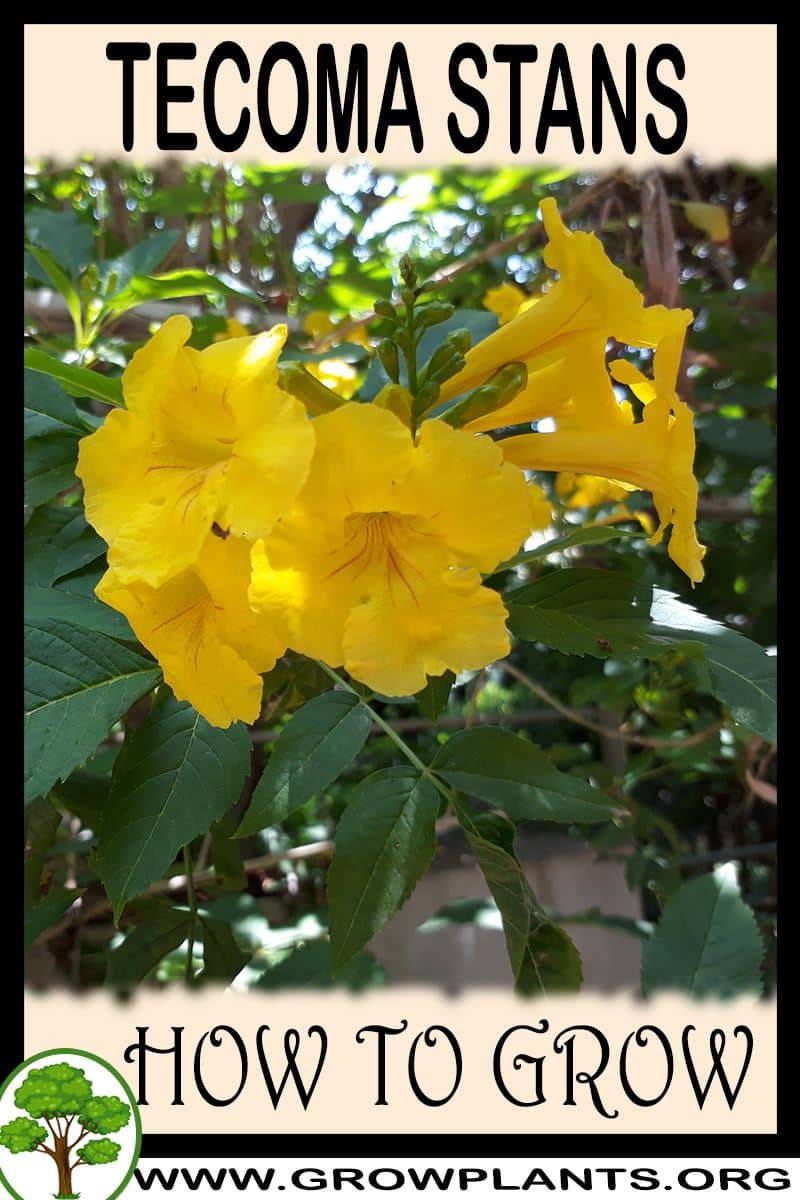
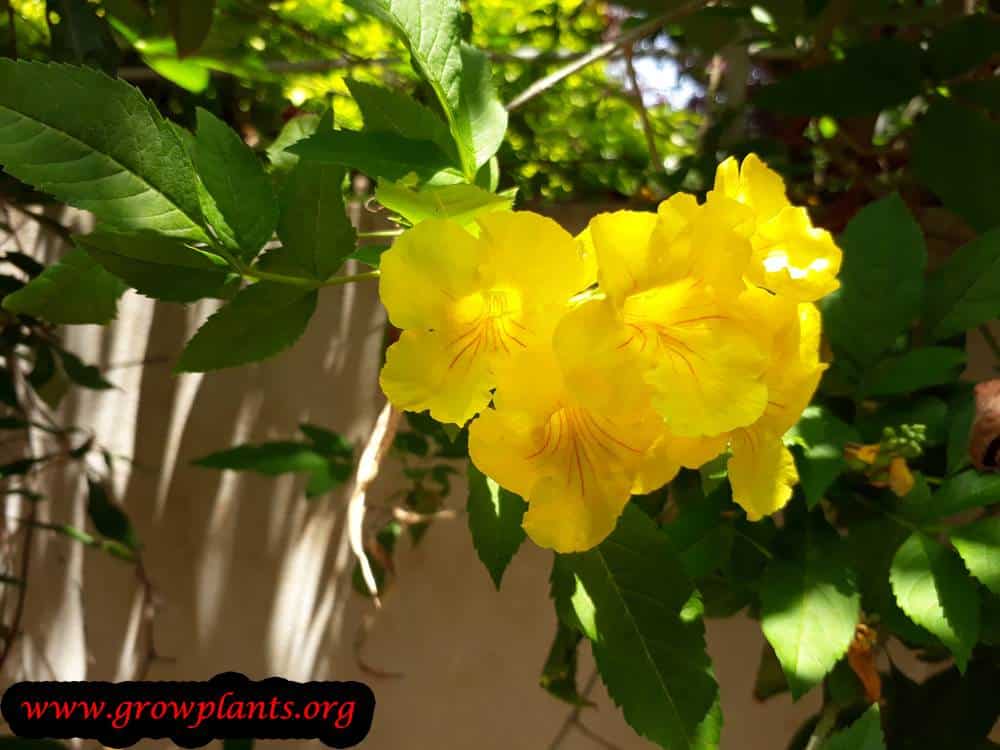
Overview: A fast-growing evergreen-to-deciduous shrub or small tree of about 3-5 m (10-16 ft), flowering in bright-yellow trumpets over a long season. It is planted as an ornamental and pollinator-friendly flowering hedge.
Quick Specifications
| Specification | Attribute |
|---|---|
| Plant Type / Life Cycle | Woody perennial (shrub or small tree) |
| Foliage Type | Evergreen to deciduous, depending on climate |
| Mature Size | 3-5 m (10-16 ft) tall |
| Growth Rate | Fast to moderate |
| Hardiness | USDA zones 9 and warmer |
Growth Form & Structure
- Height and Spread: In the ground a shrub or small tree of 3-5 m (10-16 ft); also grown in large containers, which keeps it more compact.
- Growth Habit and Form: Upright, multi-stemmed shrub trainable to a small tree or maintained as a flowering hedge.
- Lifespan and Maturity: A fast-establishing perennial that flowers freely once settled; can naturalise aggressively in favourable climates.
Anatomy & Physical Features
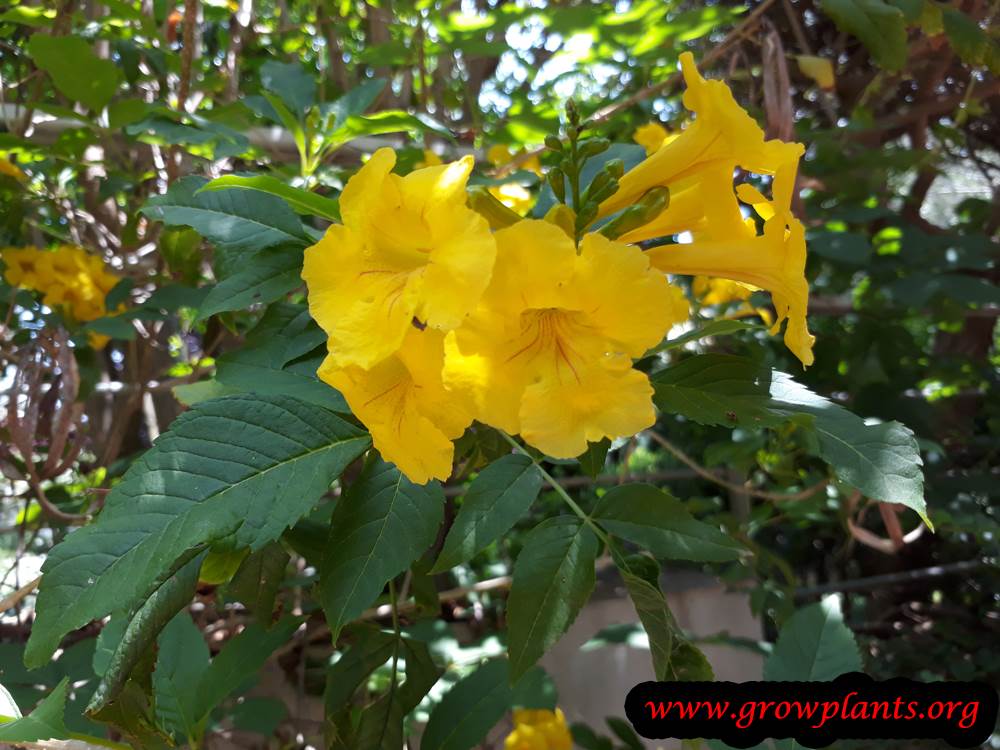
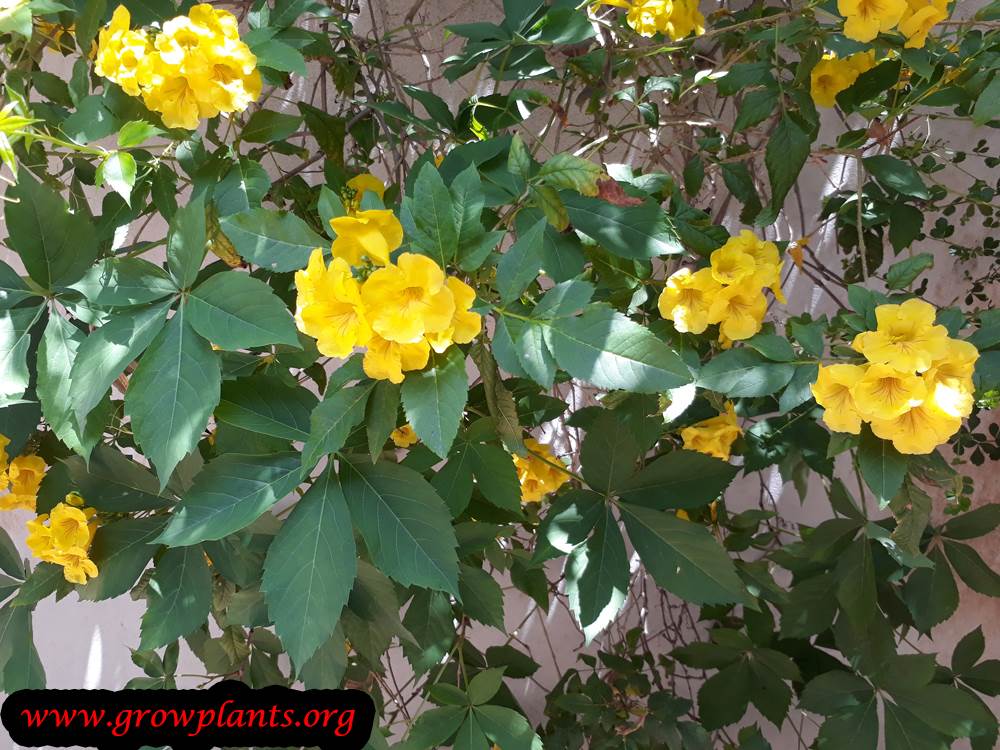
- Leaves and Foliage: Green, elliptic leaflets with serrated margins in a pinnate (feather-like) pattern.
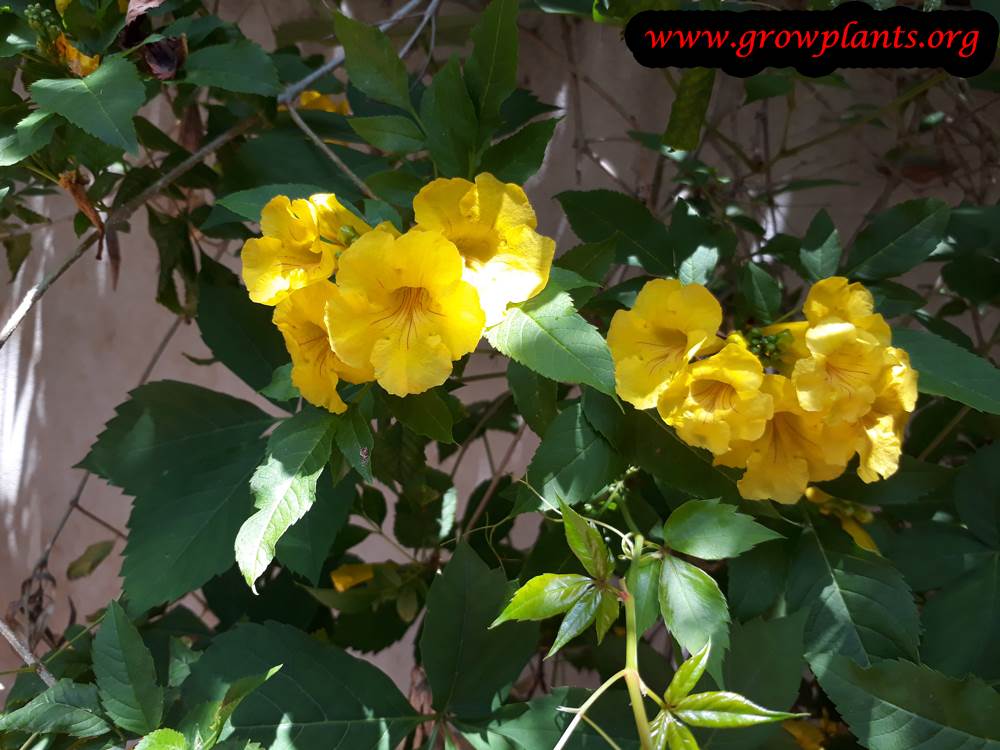
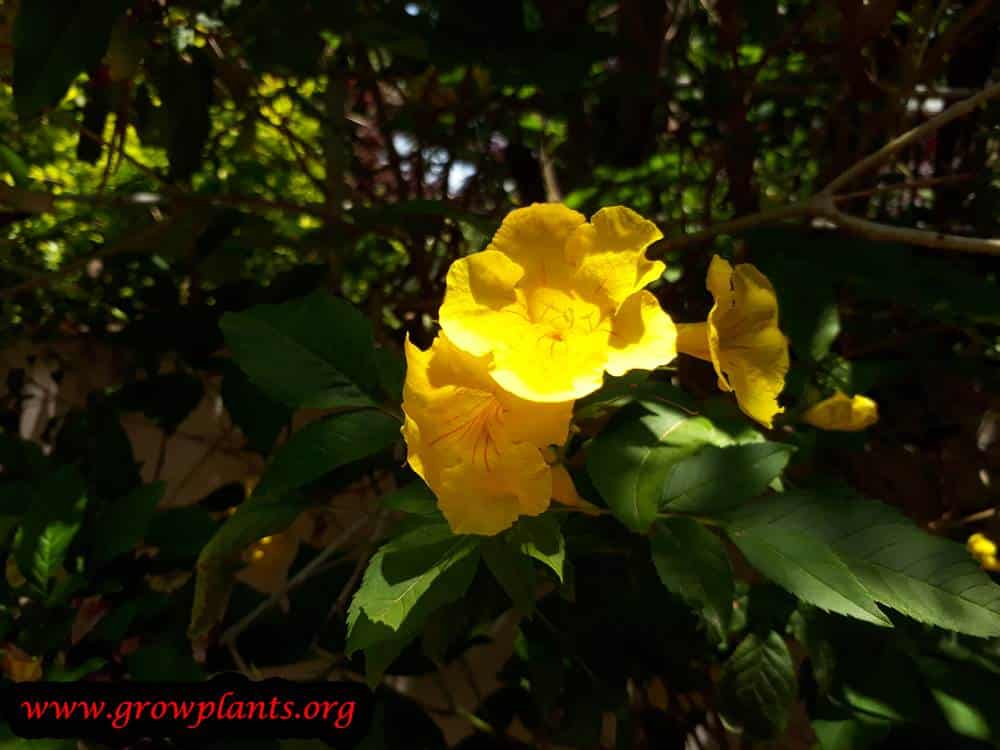
- Flower Characteristics: Bright-yellow trumpet-shaped flowers carried in clusters over a long season.
Primary Uses & Landscape Value
- Functional and Ornamental Roles: Flowering ornamental, informal hedge and pollinator magnet for warm-climate gardens. May become invasive where conditions suit it.
Care Guide: Planting, Soil & Watering
Overview: Tecoma stans (yellow trumpetbush) is a fast-growing evergreen to deciduous shrub or small tree for full sun to part shade and well-drained soil in subtropical, Mediterranean, desert, temperate and tropical climates (hardiness zone 9 and up). It needs only light to moderate watering once established and rewards good drainage with masses of yellow trumpet flowers.
Quick Care Requirements
| Requirement | Ideal Condition |
|---|---|
| Planting Season | Spring, summer or autumn |
| Growth Rate | Fast to moderate |
| Soil Type | Well-drained soil |
| Water Need | Low to moderate — let the surface dry between waterings |
Planting & Establishment
- Best Planting Season: Plant through the warm season, from spring to autumn, once frost has passed; hardy outdoors in zone 9 and warmer.
- How to Plant:
- Hole Preparation: Dig a hole about twice as wide as the root ball and as deep, loosening the sides.
- Soil Amendments: Blend some compost or organic matter into free-draining backfill; sharp drainage matters more than richness.
- Planting Depth: Set the root ball level with the surrounding soil and keep the stem base unburied.
- Growth Speed & Expectations: Grows fast to moderately fast, quickly forming a large shrub or small tree.
Soil, Watering & Drainage Care
- Soil Mix & Drainage Needs: Provide well-drained soil or a free-draining potting mix in containers; standing water risks root rot.
- Watering Schedule & Technique:
- Young / Newly Planted: Water regularly after planting to settle the roots, keeping soil moist but not soggy.
- Established: Water deeply and let the top few centimetres dry before watering again; established plants are quite drought tolerant.
- Seasonal Adjustments: More water in hot, dry spells and less in cool or wet weather.
Climate, Light & Hardiness
Tecoma stans (yellow trumpetbush) is a warm-climate flowering shrub or small tree for subtropical, Mediterranean, desert, tropical and mild-temperate regions, grown in full sun to half shade. It is heat-loving and frost-tender, so winter cold sets its outdoor limit while it flowers freely through the warm season.
Quick Climate Specifications
| Climate Zones | Subtropical, Mediterranean, desert, tropical, mild-temperate |
|---|---|
| USDA Hardiness Zones | Approximately 9 and above |
| Optimal Temp Range | Warm, roughly 20–32 °C (68–90 °F) |
| Cold Damage Begins | Foliage and soft growth are damaged around freezing, 0 °C (32 °F) |
| Approx. Survival Minimum | May be cut back by frost but established plants resprout from the base near about −5 to −7 °C (23–20 °F); young plants are more tender |
| Frost Tolerance | Low |
| Light Conditions | Full sun to half shade |
| Wind Tolerance | Moderate |
Sunlight & Light Exposure
Optimal Light Setup
Flowers most heavily in full sun; half shade is tolerated but reduces bloom.
Direct Sun Requirement
A genuine sun-lover - strong direct light gives the best flowering and sturdiest growth.
Best Exposure / Orientation
An open, warm, sunny aspect, with some shelter from cold winter winds at the cool edge of its range.
Temperature Extremes & Hardiness
USDA Hardiness & Regional Limits
Suited to roughly USDA zone 9 and warmer. In marginal areas it behaves as a cut-back-and-resprout shrub after frost. Cold tolerance varies with plant age, exposure and conditions.
Cold Damage & Winter Protection
Light frost scorches foliage; harder frost kills top growth but established plants commonly regrow from the base in spring. Mulching the root zone protects the crown in marginal zones.
Frost Sensitivity
Frost-sensitive, especially when young; soft new growth is the first to suffer.
Extreme Heat Tolerance
Excellent - it thrives in hot subtropical and desert heat, blooming through the warm season.
Wind, Humidity & Microclimate
Humidity Preferences
Adaptable across humid and dry-air climates alike.
Wind Tolerance
Reasonably wind-tolerant once established, though very exposed sites can thin the canopy.
Microclimate Recommendations
A warm, sunny, sheltered spot - such as against a sun-facing wall - extends its performance at the cool edge of its range.
Growing in Pots, Balconies & Indoors
The grower confirms yellow trumpetbush is not a houseplant – it is a shrub or small tree (3-5 m). It does grow well in a large container while young, giving a fine sun-loving patio or courtyard plant, but a big woody specimen ultimately wants the open ground.
Quick Details
- Container Size: a large 40 L+ (10 gal+) tub; it only stays pot-happy while young
- Indoor Suitability: Not a houseplant – too large and sun-hungry
- Best Spot: Full sun; a warm, sheltered patio
- Soil & Drainage: Free-draining mix; it dislikes wet feet
- Watering in Pots: Water when the top of the mix dries; drought-tolerant once established
Indoors & On the Windowsill
- Not for indoors: yellow trumpetbush is an outdoor a shrub or small tree (3-5 m) – it needs full sun and space no room can give.
- Overwintering: Where winters are colder than it likes, a young plant in a pot can be sheltered in a bright, frost-free spot for the cold months and moved back out in the warm season.
On a Balcony or Patio
- Light & wind: Give it the sunniest spot; walls and paving throw back heat so pots dry fast – check moisture in summer, and stake or shelter the top growth from wind.
- Keep it in bounds: Prune each year to hold it to size and keep it flowering or dense in the pot.
- Practicalities: A full pot of moist soil is heavy – check the balcony can take the weight, and stand pots so drainage water runs off cleanly instead of pooling.
Choosing the Pot, Soil & Long-Term Care
- Pot & drainage: a large 40 L+ (10 gal+) tub with strong drainage holes; skip a standing water saucer to avoid root rot; terracotta breathes and dries faster, while glazed or plastic holds moisture longer.
- Potting mix: A light, aerated mix – peat or coir blended with perlite or vermiculite so roots get both moisture and air.
- Feeding: Potted plants use up their soil faster as nutrients wash out with each watering, so feed a little and often through the growing season.
- Repotting: Pot up or root-prune every year or two; a large woody plant will eventually outgrow any pot and is best planted out.
Growing this plant in a greenhouse
A greenhouse can give tecoma stans frost protection, cold protection, humidity control and extra warmth. In the right climate it may also be kept growing through winter, depending on how much warmth and light are provided.
Greenhouse at a glance
| Greenhouse suitability | Conditional - depends on your climate |
|---|---|
| Main benefits | frost protection, cold protection, humidity control, extra warmth |
| Season extension | earlier spring & later autumn |
| Outdoor protection advisable below | about 0°C |
| Suitable types | unheated greenhouse, polycarbonate greenhouse, lean-to |
| Heating | Heating is optional - useful mainly for winter growing in cold areas. |
Related greenhouse guides
- Greenhouses: How to Choose the Right Greenhouse
- Best Lean-To Greenhouses
- Polycarbonate Greenhouses: What to Look for Before Buying
Fertilizing & Feeding
A moderate feeder: a balanced complete fertilizer through the growing season supports strong growth and flowering, while overfeeding pushes leafy growth at the expense of blooms.
Quick Fertilizing Specs
| Feeding Level | Moderate |
|---|---|
| Main Nutrient Priority | Balanced complete feeding with adequate nitrogen and potassium |
| Best Feeding Period | Spring through the flowering season |
| Organic Options | Compost and other organic matter around the root zone |
| Soil pH | Prefers a slightly acidic to near-neutral soil |
| Reduce/Stop Feeding | Reduce feeding as growth slows and stop during dormancy |
| Micronutrients | Usually supplied by a complete fertilizer; iron may need correction in alkaline soils |
Feeding by Growth Stage
Spring growth
Support new shoots and leafy growth as the plant breaks from winter rest.
| Nutrient direction | A balanced complete fertilizer with steady nitrogen to build healthy foliage. |
|---|---|
| Timing | As growth resumes in spring. |
| Frequency | A few light feedings through the early growing season. |
| Fertilizer types | A balanced complete garden fertilizer, Compost or other organic matter worked in around the root zone |
| Precautions | Avoid heavy nitrogen late in the season, which pushes soft growth at the expense of flowers. |
Flowering
Sustain flowering without forcing excess leafy growth.
| Nutrient direction | Continue a balanced feed; adequate nitrogen and potassium support bloom better than high-phosphorus products. |
|---|---|
| Timing | Through the main flowering period. |
| Frequency | Keep feeding light and steady. |
| Fertilizer types | A balanced complete fertilizer |
| Precautions | Skip high-phosphorus bloom-booster products; balanced feeding drives flowering. |
Repeat bloom
Keep repeat-flowering plants blooming through the warm season.
| Nutrient direction | Light balanced feeding to replace nutrients used during continuous bloom. |
|---|---|
| Timing | Between flushes through summer into autumn. |
| Frequency | Light, steady feeding. |
| Fertilizer types | A balanced complete fertilizer |
| Precautions | Avoid overfeeding; excess nitrogen favors foliage over flowers. |
Dormancy / rest
Let the plant rest as growth slows in the cool season.
| Nutrient direction | None – withhold fertilizer while the plant is dormant. |
|---|---|
| Timing | Late autumn through winter dormancy. |
| Frequency | No feeding at this stage. |
| Fertilizer types | No feeding during dormancy – withhold fertilizer until growth resumes in spring. |
| Precautions | Do not fertilize dormant plants; resume only when new growth appears. |
Nutrient Deficiency Signs & Corrections
Pale, yellowing older leaves with weak, slow growth.
| Possible causes | Low soil nitrogen, Nitrogen leaching from frequent watering or sandy soil, Compacted or poor soil limiting root uptake |
|---|---|
| Appears first on | Older, lower leaves. |
| What to check | Recent feeding history, Soil condition and drainage, Watering frequency |
| Possible correction | Apply a balanced complete fertilizer and improve organic matter in the root zone. |
Interveinal yellowing on new leaves while veins stay green.
| Possible causes | High soil pH reducing iron availability, Waterlogged or cold roots limiting uptake, Not necessarily a lack of iron in the soil |
|---|---|
| Appears first on | New, young leaves at the shoot tips. |
| What to check | Soil pH, Drainage and root health |
| Possible correction | Correct soil pH and drainage, and apply a chelated iron product per its label. |
Scorched leaf edges and tips with dull foliage.
| Possible causes | Excess fertilizer salts in the root zone, Underwatering that concentrates salts, Poor drainage |
|---|---|
| Appears first on | Leaf margins and tips. |
| What to check | Feeding rate, Drainage, Salt buildup in soil |
| Possible correction | Reduce feeding and leach the root zone with thorough watering. |
Pruning, Training & Seasonal Maintenance
Yellow trumpetbush is the largest of the common trumpet-flowers, growing from a big shrub to a small tree of several metres, and it flowers on the current season’s new growth over summer and autumn, so pruning both controls its size and drives the fresh wood that carries the yellow trumpets. Two features shape the work at this size: it can be trained to a single trunk as a small flowering tree (which brings its canopy out of secateur reach and makes a pole pruner or saw useful), and it sets prolific seed pods and is a recognised invasive in warm regions, so removing spent flowers and pods matters for restraint as well as bloom. In marginal (zone 9) climates the top may be cut back by frost and regrow from the base, so hard shaping is best left to late winter with frost damage cleaned up in spring.
Quick Pruning & Maintenance Specs
| Pruning Tolerance | High — vigorous, tolerates hard cutting and regrows from the base |
| Primary Pruning Window | Late winter / early spring, before the new flush |
| Secondary Maintenance Window | After bloom flushes — deadhead and remove pods to rebloom |
| Typical Frequency | One structural cut a year, plus season-long deadheading and pod removal |
| Main Objective | Control size, drive flowering wood, limit prolific self-seeding |
| Young Plant Priority | Choose form — multi-stem shrub or single-trunk small tree |
| Mature Plant Priority | Renew flowering wood, raise or thin the canopy, remove pods |
| Best Tool Type | Secateurs and loppers; a saw (and pole pruner) for tree-form limbs |
| Avoid Heavy Pruning During | Peak bloom; and before hard frost in marginal areas |
Pruning by Plant Age & Size
Newly Established
Remove only damaged or crossing shoots while the young plant establishes, and decide its form early. For a small tree, select one strong leader and begin clearing the lowest side-shoots; for a shrub, leave several low stems to build a multi-stem framework.
Young / Formative
For a single-trunk tree, keep one clear leader, remove competing stems and rising suckers, and lift the canopy gradually by removing the lowest branches each year until the head clears head height. For a shrub, build several spaced main stems and tip them to force branching flowering shoots. In both forms the tipping multiplies the new wood that flowers.
Mature / Established
On a mature plant, renew and control: in late winter shorten last year’s growth, remove the oldest stems or thin the tree’s canopy, and reduce size. Through the season, deadhead and strip developing pods to prolong bloom and curb seeding, and remove any basal suckers on a tree-form plant.
Seasonal Pruning Schedule
Late Winter / Early Spring (main cut)
Objective: shape and renew before growth, and clean up any frost-killed wood. Cut back last season’s stems, thin or renew old wood, remove frost-damaged tips to live growth, and reduce size. The new shoots that follow carry the flowers.
Summer–Autumn (repeat bloom and pod control)
Objective: sustain flowering and stop it seeding. Deadhead spent trusses and remove the long seed pods as they form — this both pushes new flowering shoots and sharply reduces the seedlings this prolific plant otherwise scatters. What NOT to remove: healthy new shoots yet to flower.
Flowering & Fruiting Wood
Yellow trumpetbush flowers on current-season shoots, so vigorous new growth means more bloom, and hard late-winter pruning increases flowering rather than reducing it. The catch is timing and seeding: cutting heavily during bloom removes the shoots about to flower, and the plant’s abundant seed pods both drain it and drive its invasiveness — so removing pods is doubly worthwhile, keeping the display going and limiting unwanted seedlings.
Structural Pruning & Training
At this size the structural choice matters: a single-trunk standard makes an attractive small flowering tree but needs its canopy thinned and lifted and its trunk kept clear of suckers, while a multi-stem shrub is renewed by removing old stems from the base. Either way, remove crossing, rubbing and inward branches to keep the canopy open, and control height and spread firmly — a fast plant that reaches small-tree size will overwhelm a modest space if left, and it regrows readily from hard cuts.
Special Growth to Remove
Grown on its own roots, it has no graft to sucker from, but a tree-form plant throws basal suckers and watersprouts that must be removed to keep a clean trunk and open head; on a shrub, keep a few basal shoots for renewal and remove the rest. The essential removal is the seed pods — this is a prolific self-seeder and invasive, so strip pods before they ripen to protect surrounding ground and prolong flowering.
Container & Small-Space Pruning
In a large container it can be kept as a compact shrub or a small standard, but it grows fast and needs firm, regular cutting-back: shorten hard in late winter, tip and deadhead through the season, and remove pods and suckers. Its readiness to reshoot from old wood makes it tolerant of the heavy pruning a pot requires.
Tools
Bypass secateurs handle young shoots and deadheading; loppers take older stems; a pruning saw is needed for the thicker trunk and scaffold limbs of a tree-form plant during renewal or canopy-raising; and a pole pruner earns its place once the canopy of a small tree rises out of hand reach. Hedge shears are only for a deliberately clipped hedge, not for this large, tree-capable plant grown for flowers.
Tool Hygiene & Disease Risk
Hygiene is Routine: clean, sharp tools are enough, with aphids the main pest and no notable blade-borne disease. Keep saw and blades sharp for clean cuts on the larger limbs; disinfecting between cuts is unnecessary on a healthy plant.
Cut Placement & Technique
Use thinning cuts back to junctions or the base rather than shearing, to keep an open canopy. Cut shoots to outward-facing buds, avoid long stubs, and cut just outside the branch collar when removing limbs so the wound seals. On larger limbs, undercut first then top-cut to prevent the bark tearing, and remove big branches in stages on a small tree. Take suckers and watersprouts off cleanly at their base.
Heavy Pruning & Rejuvenation
Yellow trumpetbush tolerates hard rejuvenation and even regrows from the base after frost or a severe cut: an overgrown or frost-damaged plant can be cut back hard in late winter — to a low framework or near ground level — and will regrow vigorously, flowering on the new shoots the same season. On a valued tree form, prefer staged canopy renewal over cutting to the ground, so you keep the trunk and framework.
Post-Pruning Care
After a hard cut, water to support the strong regrowth but avoid heavy feeding — the plant is vigorous and hard pruning already forces plenty of new growth; extra nitrogen only favours leaf over flower. On a tree form, select the best-placed regrowth and rub or thin out the rest, and watch the soft new shoots for aphids.
Common Pruning Mistakes
- Leaving seed pods on, so this invasive plant scatters seedlings and flowers less.
- Pruning hard in mid-bloom and cutting off the flowering shoots.
- Letting a tree-form plant keep its suckers and watersprouts, congesting the trunk and canopy.
- Removing large limbs with a single flush cut that tears the bark, instead of an undercut-then-topcut in stages.
When NOT to Prune
Avoid a hard cut just before frost in marginal (zone 9) areas — the plant may be frosted anyway, so wait for late winter and clean up the damage then. Do not prune heavily during peak bloom if you want the display, and do not prune a drought-stressed plant until it has water.
Pruning Troubleshooting
| Problem | Possible Cause | What to Check | Corrective Action |
| Vigorous growth but few flowers | Over-feeding or badly timed cutting of new wood | Feeding and pruning timing | Reduce nitrogen; make the hard cut in late winter, deadhead through the season |
| Seedlings springing up around the plant | Ripe seed pods left to shed | Whether pods are removed after flowering | Strip pods before they ripen; deadhead spent trusses promptly |
| Congested, top-heavy tree with bare interior | Canopy never thinned; suckers and watersprouts left | Interior branching, trunk suckers, crossing limbs | Thin and raise the canopy, remove suckers and watersprouts, open the centre |
| Whole top killed back in winter | Frost in a marginal zone | Extent of live wood in spring | Cut dead wood to live growth in late winter/spring; it regrows and flowers on new shoots |
Recommended Tools (by task)
- bypass_secateurs — for young shoots, deadheading and pod removal.
- loppers — for older stems and thinning a shrub or young tree.
- pruning_saw — for the trunk and scaffold limbs of a tree-form plant during renewal or canopy-raising.
- pole_pruner — for the higher canopy once a single-trunk small tree grows beyond hand reach.
Propagation Guide
Yellow trumpetbush is very easily grown from the flat winged seed carried in its long pods, which germinates freely – so freely that the plant self-sows readily; cuttings are used to reproduce a particular selected plant. It is an easy, fast subject.
Quick Propagation Specs
| Best Propagation Method | Seed |
| Alternative Methods | Softwood / semi-hardwood stem cuttings |
| Propagation Difficulty | Easy |
| Seed True-to-Type | Species mostly uniform; garden selections vary |
| Vegetative True-to-Type | Yes |
| Best Propagation Season | Spring to autumn, in warmth |
| Germination Temperature | Warm, about 20–25°C (68–77°F) |
Growing from Seed
Seed Handling & Sowing
Collect the flat, winged seed from mature pods and sow it fresh and shallowly in a warm, free-draining mix; no pre-treatment is needed.
Germination
Kept moist and warm at about 20–25°C (68–77°F), seed germinates quickly and reliably.
Stem Cuttings
Cutting Type & Rooting
Take softwood or semi-hardwood cuttings in the warm season, set them in a moist, free-draining mix and keep warm, humid and lightly shaded. Rooting hormone is beneficial but not essential; cuttings root within a few weeks and reproduce a selected plant exactly.
Bloom & Flower Guide
Quick Details
- Bloom Season: Spring through autumn, and nearly year-round in warm, frost-free areas
- Time to First Bloom: Fast; plants often flower in their first year
- Flower Appearance: Bright yellow trumpet-shaped flowers in showy clusters
- Edibility: Ornamental only, grown for the display and to attract pollinators
Detailed Blooming Overview
Yellow trumpetbush is one of the most reliable warm-climate bloomers, carrying clusters of bright, golden-yellow trumpets from spring through autumn. The lightly fragrant, nectar-rich flowers draw bees, butterflies and hummingbirds, and in mild regions the plant flowers almost without pause.
Flower Characteristics
- Trumpet-shaped flowers in clear yellow.
- Borne in abundant terminal clusters over a long season.
- Nectar-rich and very attractive to pollinators.
Bloom Care & Thinning
- Deadheading: Removing spent clusters and the long seed pods keeps flowering going and the plant tidy.
- Pruning for bloom: Flowers form on new growth, so cutting back after a flush encourages fresh flowering wood.
- Pollination: Insect- and bird-pollinated; no help needed for the display.
Pests, Diseases & Troubleshooting
Overview: Yellow bells (Tecoma stans) is a heat- and drought-tough flowering shrub or small tree, largely untroubled by pests; aphids, whitefly, spider mites, scale and mealybugs are its usual minor visitors, and root rot in wet soil its main real risk. Grow it in full sun and sharp drainage.
Quick Troubleshooting Overview
| Issue / Pest | Main Symptom | Primary Solution |
|---|---|---|
| Aphids | Sticky, curled shoot tips | Water jet, insecticidal soap |
| Whiteflies | White cloud on disturbance | Sticky traps, soap/oil |
| Spider mites | Stippled leaves in heat | Hose, insecticidal soap |
| Scale / mealybug | Bumps or white fluff | Horticultural oil |
| Root rot | Wilting in wet soil | Improve drainage |
Common Pests & Management
- Aphids (Aphidoidea):
- Symptoms: Clusters of tiny soft-bodied green, black or grey insects on new shoots, flower buds and leaf undersides. Feeding causes puckered, curled or yellowing young growth, and a sticky honeydew that fosters sooty mould and attracts ants.
- Prevention & Control: Knock colonies off with a firm jet of water and pinch out badly infested tips. Encourage ladybirds, lacewings and hoverflies, and avoid excess nitrogen that pushes soft sappy growth. For persistent outbreaks apply insecticidal soap or a light horticultural/neem oil, coating leaf undersides and spraying in the cool of evening to protect pollinators.
- Whiteflies (Trialeurodes vaporariorum / Bemisia spp.):
- Symptoms: Tiny white moth-like insects that fly up in a cloud when foliage is disturbed; nymphs and adults suck sap from leaf undersides, causing yellowing, weakness and honeydew with sooty mould.
- Prevention & Control: Hang yellow sticky traps to monitor and reduce adults, and clear weeds that host them. Encourage parasitic wasps (Encarsia) and lacewings. Spray insecticidal soap or horticultural/neem oil to the leaf undersides, repeating to break the life cycle.
- Spider Mites (Tetranychus urticae):
- Symptoms: Fine pale stippling or bronzing of leaves, with delicate silken webbing on undersides and between stems; worst in hot, dry, dusty conditions. Heavily fed leaves dry, curl and drop.
- Prevention & Control: Raise humidity and hose foliage regularly to break the dry microclimate mites favour. Remove and destroy the worst leaves, and conserve predatory mites and other natural enemies. Treat with insecticidal soap or horticultural/neem oil, thoroughly wetting leaf undersides and repeating every 5-7 days to catch new hatchlings.
- Scale Insects (Coccoidea):
- Symptoms: Small immobile brown, tan or waxy white bumps clamped to stems, twigs and leaf undersides. They exude honeydew that blackens with sooty mould; heavy infestations cause yellowing, dieback and reduced vigour.
- Prevention & Control: Scrub off light infestations with a soft brush or a cotton bud dipped in dilute alcohol, and prune out badly encrusted twigs. Conserve predatory ladybirds and parasitic wasps. Smother the vulnerable crawler stage with horticultural oil, timing repeat sprays for when young scales are active.
- Mealybugs (Pseudococcidae):
- Symptoms: White cottony masses tucked in leaf axils, growing points and along veins; feeding weakens the plant and leaves sticky honeydew followed by sooty mould. Some species also attack roots.
- Prevention & Control: Dab visible colonies with a cotton bud dipped in dilute alcohol and isolate affected plants. Avoid over-feeding with nitrogen. Encourage predators such as the mealybug destroyer ladybird, and treat with insecticidal soap or horticultural/neem oil, repeating until clear.
Diseases & Fungal Issues
- Fungal Leaf Spot (Cercospora / Colletotrichum spp.):
- Symptoms: Brown, tan or black spots, often with a yellow halo or concentric rings, that enlarge and merge in warm humid weather; severe spotting causes leaves to yellow and fall.
- Treatment & Management: Remove and destroy spotted leaves and fallen litter to reduce spores, and avoid overhead watering. Improve spacing and airflow. Copper-based fungicides can protect new growth if the problem recurs each season.
- Powdery Mildew (Erysiphales):
- Symptoms: A white to greyish powdery coating on leaves and shoots, usually starting on the upper surface; affected leaves may yellow, distort and drop. Worst in crowded plantings with warm days, cool nights and poor airflow.
- Treatment & Management: Space and prune for good air movement and sun, and avoid wetting foliage late in the day. Remove affected leaves and clear fallen debris. Where needed, apply a sulphur or potassium-bicarbonate fungicide, or a horticultural oil, at first signs and repeat per label.
- Root & Crown Rot (Phytophthora / Pythium spp.):
- Symptoms: Wilting despite moist soil, yellowing lower leaves, and dark, soft, decayed roots or a rotted stem base; a slow decline or sudden collapse in heavy, wet ground follows.
- Treatment & Management: Prevention is decisive: plant in free-draining soil (or raised beds), never let the crown sit wet, and water only when the topsoil dries. Remove and destroy badly affected plants and improve drainage before replanting; biological drenches (Trichoderma) can help protect healthy roots.
Growing Difficulties & Abiotic Problems
- Overwatering & Root Rot:
- Cause & Symptoms: Yellowing lower leaves, wilting despite wet soil, and a soft, foul-smelling root ball or stem base result from waterlogged, airless soil that suffocates and rots the roots.
- Correction Strategy: Let the soil dry appropriately between waterings, plant in free-draining media, and ensure pots have working drainage holes. Ease off water in cool or dormant periods and never leave the plant standing in a saucer of water.
- Nutrient Chlorosis:
- Cause & Symptoms: Yellowing leaves with green veins (interveinal chlorosis), often on new growth, signalling iron or manganese lock-out, commonly in alkaline, cold or waterlogged soils rather than a true shortage.
- Correction Strategy: Correct the underlying soil condition first: improve drainage, avoid overwatering, and acidify high-pH soil with organic matter or elemental sulphur. A foliar or soil application of chelated iron gives a quicker green-up while the soil is corrected.
- Frost & Cold Damage:
- Cause & Symptoms: Blackened, water-soaked, limp new growth and leaf tips after a cold snap; this tender or tropical plant is damaged or killed by frost and by prolonged cold.
- Correction Strategy: Site in a warm, sheltered spot, delay planting until the cold has passed, and protect with fleece or bring container plants under cover when frost threatens. Avoid feeding late so growth hardens off before cold weather.
What Helps – Products & Tools
These fast, sun-loving shrubs shrug off most pests; insecticidal soap and horticultural or neem oil handle aphids, whitefly, mites and scale, sprayed to leaf undersides in the evening to spare bees. Yellow sticky traps help monitor whitefly, and a copper fungicide is only needed if leaf spot recurs.